RESEARCH
Perceptions about mental illness
among general practitioners
Mª Carmen Castillejos Anguiano
1*, Antonio Bordallo Aragón
2, David Aguilera Fernández
2and Berta Moreno Küstner
1,3Abstract
Background: General practitioners (GPs) play an important role in the physical care of patients with severe mental ill-ness, so our aim was to analyse the relationships between GPs’ sociodemographic status and worked-related variables and their perceptions about mental illness.
Methods: A descriptive, cross-sectional study was conducted in the Clinical Management Unit of Mental Health (CMU-MH) of the Regional Hospital of Malaga (Spain). The eligible population comprised all GPs working in the 13 primary care centres (PCCs) in the hospital’s catchment area during the study period. GPs were interviewed to collect data on their attitudes to and knowledge of mental illness, psychiatry and the local mental health team, as well as their sociodemographic status, professional qualifications and experience. Bivariate analysis was carried out. Results: 145 GPs answered the questionnaire (77%). ANOVA revealed that most of the PCCs with the best relation-ship with their mental health team and best attitude to mental illness were in the Central Community Mental Health Unit, which operated a collaborative model of care.
Conclusions: These results indicated that GPs who worked more closely with their specialist mental health team had a better perception of their relationship with the mental health centre and less stigmatisation in regard to mental illness.
Keywords: Primary care, Schizophrenia, Stigma, Collaborative model
© The Author(s) 2019. This article is distributed under the terms of the Creative Commons Attribution 4.0 International License (http://creat iveco mmons .org/licen ses/by/4.0/), which permits unrestricted use, distribution, and reproduction in any medium, provided you give appropriate credit to the original author(s) and the source, provide a link to the Creative Commons license, and indicate if changes were made. The Creative Commons Public Domain Dedication waiver (http://creat iveco mmons .org/ publi cdoma in/zero/1.0/) applies to the data made available in this article, unless otherwise stated.
Background
It is widely known that patients with mental illness expe-rience discrimination and stigmatisation [1–3]. There has been a lot of research into self-stigmatisation by individ-uals with mental illness [4, 5], which is often due to soci-etal stigmatisation of mental illness [6, 7].
One would expect health professionals to have a more positive attitude to mental illness and the mentally ill because of their professional knowledge, but several stud-ies have shown that this is not the case [8, 9]. A recent systematic review concluded that older general prac-titioners (GPs) had a more negative attitude to patients with schizophrenia [10]. It has been shown that GPs’
stigmatisation of patients with mental illness depends on their level of experience of such patients, so that the more experience they have, the less stigmatisation they exhibit [11]. Comparisons of the attitudes of different categories of health professional have shown that GPs stigmatise mental illness more than psychiatrists do [12–14].
Health professionals’ perception of mental illness and their attitude to the mentally ill could influence their decisions in daily practice [15]. Moreover, health profes-sionals’ negative attitude is detected by patients [16] and may be a factor in the low rate of engagement of patients with serious mental illness with healthcare services [14].
A recent study carried out in the United States showed that GPs faced significant barriers to providing good care to patients with mental illness: lack of time and resources and lack of confidence [11, 17].
GPs play an important role in the care of patients with severe mental illness (SMI) because these patients have
Open Access
*Correspondence: [email protected]
1 Andalusian Group of Psychosocial Research (GAP), Department of Personality, Assessment and Psychological Treatment, University of Malaga, Campus Teatinos, Malaga, Spain
higher rates of mortality and morbidity from physical health problems than the general population [18–20] and because GPs are the main point of entry into the Span-ish health system. We therefore aimed to analyse the relationships between GPs’ sociodemographic status, work-related variables and their perceptions regarding mental illness. These perceptions will be defined as the level of satisfaction of GPs with their relationship with the community mental health centre, their erroneous beliefs, stigmatisation and attitudes regarding mental ill-ness and their perception of their level of training in men-tal health, schizophrenia and other psychotic disorders.”.
Material and methods
This was a descriptive, cross-sectional study.
Study area and temporal scope
The study was carried out in the CMU-MH of the Regional Hospital of Malaga, with two Community Mental Health Units (CMHUs), Central and Northern, which together covered a population of 315,159. The Central CMHU included 6 PCCs: Alameda-Perchel, Victoria, Limonar, El Palo, Colmenar and el Rincón de la Victoria; and the Northern CMHU included 7 PCCs: Trinidad, Nueva Malaga, Miraflores, Palma-Pamilla, Ciu-dad-Jardín, Capuchinos and Carlinda.
The study information was collected from January 1, 2008 to July 1, 2011.
Eligible population and sample
The eligible population comprised 188 GPs working in the 13 PCCs in the catchment area of CMU-MH of the Malaga Regional Hospital during the study period.
Questionnaire and study variables
We used the Primary Care Physicians and Mental Health Questionnaire (MAPSAM-14), which had been validated by the research team [21], to assess perceptions of GPs towards mental health.
So our dependent variables were scores on the three MAPSAM-14 scales, (1) Relationship: level of satisfac-tion of GPs with their relasatisfac-tionship with the community mental health centre (range 7–15; higher scores indicated greater satisfaction with the relationship); (2) Beliefs: this touched upon erroneous beliefs, stigmas and attitudes regarding mental illness (range 5–12; higher scores indi-cate more erroneous beliefs and greater stigmatisation); (3) Training: the GPs’ perception of their level of train-ing in mental health, schizophrenia and other psychotic disorders (range 5–15; higher scores indicate greater per-ceived adequacy of training).
The independent variables were age; gender; years in the current place of work ( ≤ 3 years; > 3 years);
specialisation training as a GP (yes/no); accredited train-ing as a tutors (yes/no); to have any residential traintrain-ing students (yes/no); size of patient list ( ≤ 1500; > 1500), PCC affiliation (Alameda-Perchel, Victoria, Limonar, El Palo, Colmenar, el Rincón de la Victoria, Trinidad, Nueva Malaga, Miraflores, Palma-Pamilla, Ciudad-Jardín, Cap-uchinos and Carlinda.). These variables were obtained using a self-report questionnaire.
Data analysis
Bivariate analysis of the relationships between the soci-odemographic and work-related variables and the MAP-SAM-14 variables (Relationship, Beliefs and Training) was carried out. For the independent dichotomous quali-tative variables a Student’s t-test was used. And for the independent qualitative polytomous variables, analysis of variance (ANOVA) was used. Differences were consid-ered significant at p < 0.05.
The statistical program SPSS statistics 22 was used for the construction of the database, the descriptive analyses and for the bivariate analysis.
Results
There were 188 GPs serving the catchment area of Mal-aga regional hospital, of whom 145 answered the ques-tionnaire, a response rate of 77%.
The mean age of the sample was 50.5 (95% CI 49.5– 51.5; range 35–63) and the median age was 51.5 years (range 35–6 and 64.7% was male. Mean professional experience was 7.2 years (95% CI 5.3–9.1; range 0–30). Forty-four percent of participating GPs had hospital resi-dent training, 64.7% were not accredited training tutors and 60.8% had not led a hospital doctor team in the last 3 years. The mean patient list size was 1608 (95% CI 1538.2–1678.8; median = 1500; range 900–2500).
Turning to the MAPSAM-14 variables, the mean scores were as follows: the level of satisfaction of GPs with their relationship with the community mental health centre [Relationship] was M = 12.51 (95% CI 12.16‒12.87), with the highest level of satisfaction being M = 15; the dimen-sion [Beliefs] that touched upon erroneous beliefs, stig-mas and attitudes regarding mental illness was M = 8.04 (95% CI 7.79–8.28), with the highest level of stigmatisa-tion being M = 12; and the dimension [Training] that measured the perception of GPs of their level of training in mental health, schizophrenia and other psychotic dis-orders was M = 8.61 (95% CI 6.43–10.80), with the high-est rate being M = 15, which indicates greater perceived adequacy of training.
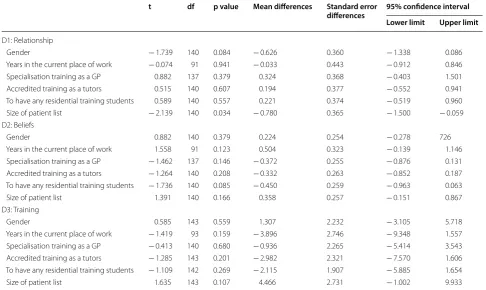
1500 patients was associated with a better level of satis-faction with their relationship with the community men-tal health centre (p= 0.034) (Table 1).
The ANOVA revealed differences between PCCs GPs affiliations with respect to the level of satisfaction with their relationship with the community mental health centre and beliefs about mental illness (both ps < 0.001).
The PCCs where GPs’ perception of the relationship with the local mental health team was best were El Rincón de la Victoria and El Palo. The PCCs where GPs had less stigmatisation regarding mental illness were Victoria, El Palo, El Rincón de la Victoria, Limonar, Alameda-Perchel and Nueva Malaga (Table 2); all these PCCs were linked with the Central CMHU except for Nueva Malaga.
Table 1 Student’s t-tests for GPs’ sociodemographic status, professional experience and qualifications
t df p value Mean differences Standard error
differences 95% confidence interval Lower limit Upper limit
D1: Relationship
Gender − 1.739 140 0.084 − 0.626 0.360 − 1.338 0.086 Years in the current place of work − 0.074 91 0.941 − 0.033 0.443 − 0.912 0.846 Specialisation training as a GP 0.882 137 0.379 0.324 0.368 − 0.403 1.501 Accredited training as a tutors 0.515 140 0.607 0.194 0.377 − 0.552 0.941 To have any residential training students 0.589 140 0.557 0.221 0.374 − 0.519 0.960 Size of patient list − 2.139 140 0.034 − 0.780 0.365 − 1.500 − 0.059 D2: Beliefs
Gender 0.882 140 0.379 0.224 0.254 − 0.278 726 Years in the current place of work 1.558 91 0.123 0.504 0.323 − 0.139 1.146 Specialisation training as a GP − 1.462 137 0.146 − 0.372 0.255 − 0.876 0.131 Accredited training as a tutors − 1.264 140 0.208 − 0.332 0.263 − 0.852 0.187 To have any residential training students − 1.736 140 0.085 − 0.450 0.259 − 0.963 0.063 Size of patient list 1.391 140 0.166 0.358 0.257 − 0.151 0.867 D3: Training
Gender 0.585 143 0.559 1.307 2.232 − 3.105 5.718 Years in the current place of work − 1.419 93 0.159 − 3.896 2.746 − 9.348 1.557 Specialisation training as a GP − 0.413 140 0.680 − 0.936 2.265 − 5.414 3.543 Accredited training as a tutors − 1.285 143 0.201 − 2.982 2.321 − 7.570 1.606 To have any residential training students − 1.109 142 0.269 − 2.115 1.907 − 5.885 1.654 Size of patient list 1.635 143 0.107 4.466 2.731 − 1.002 9.933
Table 2 ANOVA of primary care centre differences in relationship with the local mental health team, beliefs about mental illness and perceptions of the adequacy of training in mental health
Sum of squares df Root mean square F p value
D1: Relationship
Between groups 186.835 12 15.570 4.360 < 0.001 Within groups 460.637 129 3.571
Total 647.472 141
D2: Beliefs
Between groups 90.570 12 7.548 4.303 < 0.001 Within groups 226.254 129 1.754
Total 316.824 141
D3: Training
Between groups 1957.781 12 163.148 0.914 0.535 Within groups 23,568.591 132 178.550
Discussion
This study analysed the relationships between the three MAPSAM-14 dimensions (level of satisfaction of GPs with their relationship with the community mental health centre, their erroneous beliefs, stigmatisation and atti-tudes regarding mental illness and their perception of their level of training in mental health, schizophrenia and other psychotic disorder) and GPs’ age, gender and pro-fessional experience and qualifications.
The only variable associated with GPs’ relationship with their local mental health teams was the size of their patient list; those GPs with a longer list ( > 1500) per-ceived that they had a better relationship with the mental health team, perhaps because they had more contact with it and, therefore, this fact could be valued by the GPs as a more effective communication and relationship.
None of the sociodemographic or work-related varia-bles was associated with GPs’ beliefs about mental illness, which conflicts with the results of Rojas-Vistorte et al. and Lam et al. [10, 22]. They found that GPs who stig-matised mental illness tended to be more experienced, female, work at hospital level and not to have relatives or friends affected by mental disorders.
Finally, GPs perception of the adequacy of their train-ing in mental health problems was not associated with any of the sociodemographic or work-related variables.
Our most important finding, however, was that GPs’ perception of their relationship with the local mental health team and their beliefs about mental illness var-ied according to their PCC affiliation. The GPs which reported the best relationship with the community men-tal health centre were all working in PCCs located in the catchment area of the Central CMHU. Similarly, GPs affiliated to the six teams with the lowest Belief scores (i.e. less erroneous beliefs, stigmas and attitudes regard-ing mental illness) all but one (Nueva Malaga) belonged to the Central CMHU catchment area. At the time of the study the Central CMHU had been working collabora-tively with GPs for over 15 years, whereas the Northern CMHU had more traditional working relationships with GPs. This suggests that collaborative working improves communication and relationships between specialist mental health teams and GPs. It may also help to mini-mise misunderstanding of mental illness amongst GPs, because greater contact between GPs and mental health teams may increase GPs’ knowledge and understand-ing of mental illness; this relationship between contact with mental health services and knowledge of mental illness has in fact been observed in the general popula-tion [23]. Probably these aspects favour better care for patients with mental illness from Primary Care. At pre-sent, new, more collaborative relationship between pri-mary and secondary care are being introduced in order
to provide patients with mental illness with better, more holistic care [24]. Collaborative ways of working have been shown to improve the care of patients with severe mental illness [25–27]. A study carried out in a rural area showed that patients preferred services where there was an emphasis on collaboration between primary care and specialist mental health services [28].
Strengths and limitations
• This study analysed multiple associations between GPs’ characteristics and their attitude to and knowl-edge of mental illness and their relationship with their local mental health team.
• The study was carried out in a clinical mental health management unit with considerable experience of working collaboratively with primary care practition-ers; the unit concerned is one of the pioneers in this area in Andalucia.
• The study was carried out in a wide catchment area, including participants from 13 primary care centres. However, we could not consider differences between rural and urban PCCs as we had only one small PCC in a rural area.
• For unknown reasons not all GPs in the study area participated, and in some cases, the number of GPs per centre was very low. However, in general, the par-ticipation rate was high.
• We should be aware that there could be a bias con-cerning GPs who answer the questionnaire as they could have a better perception of their level of train-ing in mental health or a more positive attitude towards mental illness.
• We did not analyse nursing staff, although they are very involved in the treatment of patients with men-tal illness.
Conclusion
In this study we analysed relationships between multiple GP characteristics and GPs’ attitudes to mental illness, but our main finding was that GPs working at PCCs in the catchment area of Central CMHU, which had much greater experience of working collaboratively with GPs than the other CMHU in the study, perceived them-selves to have a better relationship with their local men-tal health centre and less stigmatisation regarding menmen-tal illness.
Relevance for clinical practice
more collaborative relationships between primary care teams and specialist mental health teams are widely implemented, in order to improve overall healthcare for people with mental illness.
Authors’ contributions
MCCA analysed the data and wrote the final manuscript. ABA collected the data, analysed the data and wrote the preliminary draft. DAF contributed to carried out the study and analysed the data. BMK designed the study, ana-lysed the data and revised the manuscript. All authors are in agreement with the manuscript. All authors read and approved the final manuscript.
Author details
1 Andalusian Group of Psychosocial Research (GAP), Department of Personal-ity, Assessment and Psychological Treatment, University of Malaga, Campus Teatinos, Malaga, Spain. 2 Clinical Management Unit of Mental Health of the Regional Hospital of Malaga, Andalusian Health Service, Avda del Hos-pital Civil S/N, Paseo Limonar, Malaga, Spain. 3 Biomedical Research Institute of Malaga (IBIMA), Malaga, Spain.
Competing interests
The authors declare that they have no competing interests.
Availability of data and materials
The data that support the findings of this study are available from Berta Moreno Küstner but restrictions apply to the availability of these data, which were used under license for the current study, and so are not publicly avail-able. Data are however available from the authors upon reasonable request and with permission of Berta Moreno Küstner.
Consent to participate
Not applicable.
Ethics approval and consent to participate
The study was approved by the Health Research Ethics Committee of the Health District of Malaga.
Funding
This work was supported by Consejería de Economía, Innovación, Ciencia y Empleo, Junta de Andalucía (Award Number: P10-CTS-5862, CTS-945) and Fundación Progreso y Salud (Award Number: PI-0193/2014).
Publisher’s Note
Springer Nature remains neutral with regard to jurisdictional claims in pub-lished maps and institutional affiliations.
Received: 29 January 2019 Accepted: 10 April 2019
References
1. Ando S, Yamaguchi S, Aoki Y, Thornicroft G. Review of mental-health-related stigma in Japan. Psychiatry Clin Neurosci. 2013;67:471–82. 2. Stier A, Hinshaw S. Explicit and implicit stigma against individuals with
mental illness. Aust Psychol. 2007;42:106–17.
3. Thornicroft G, Brohan E, Rose D, Sartorius N, Leese M. Global pattern of experienced and anticipated discrimination against people with schizo-phrenia: a cross-sectional survey. Lancet. 2009;373:408–15.
4. Girma E, Tesfaye M, Froeschl G, Möller-Leimkühler AM, Dehning S, Müller N. Facility based cross-sectional study of self stigma among people with mental illness: towards patient empowerment approach. Int J Ment Health Syst. 2013;7:21.
5. Tang I-C, Wu H-C. Quality of Life and Self-Stigma in Individuals with Schizophrenia. Psychiatr Q. 2012;83:497–507.
6. Evans-Lacko S, Brohan E, Mojtabai R, Thornicroft G. Association between public views of mental illness and self-stigma among individuals with mental illness in 14 European countries. Psychol Med. 2012;42:1741–52.
7. Hanafiah AN, Bortel TV. A qualitative exploration of the perspectives of mental health professionals on stigma and discrimination of mental ill-ness in Malaysia. Int J Ment Health Syst. 2015;9:10.
8. Li J, Li J, Thornicroft G, Huang Y. Levels of stigma among community men-tal health staff in Guangzhou China. BMC Psychiatry. 2014;14:231. 9. Mosaku KS, Wallymahmed AH. Attitudes of primary care health workers
towards mental health patients: a cross-sectional study in Osun State Nigeria. Community Ment Health J. 2017;53:176–82.
10. Rojas-Vistorte AO, Silva-Ribeiro W, Jaen D, Jorge MR, Evans-Lacko S, de Jesus Mari J. Stigmatizing attitudes of primary care professionals towards people with mental disorders: a systematic review. Int J Psychiatry Med. 2018;53(4):317–38.
11. Caplan S, Little TV, Garces-King J. Stigma about mental illness among multidisciplinary health care providers in the Dominican Republic. Per-spect Psychol Sci. 2016;5(3):192–206.
12. Hori H, Richards M, Kawamoto Y, Kunugi H. Attitudes toward schizophre-nia in the general population, psychiatric staff, physicians, and psychia-trists: a web-based survey in Japan. Psychiatr Res. 2011;186(2–3):183–9. 13. Mittal D, Corrigan P, Sherman M, Chekuri L, Han X, Reaves C, et al.
Health-care providers’ attitudes toward persons with schizophrenia. Psychiatr Rehabil J. 2014;37(4):297–303.
14. Smith JD, Mittal D, Chekuri L, Han X, Sullivan G. A Comparison of provider attitudes toward serious mental illness across different health care Disci-plines. Stigma and Health. 2017;2(4):327–37.
15. Corrigan PW, Mittal D, Reaves CM, Haynes TF, Han X, Morris S, et al. Mental health stigma and primary health care decisions. Psychiatr Res. 2014;218(1–2):35–8.
16. Cabassa LJ, Gomes AP, Meyreles Q, Capitelli L, Younge R, Dragatsi D, et al. Primary health care experiences of hispanics with serious mental illness: a mixed-methods study. Adm Policy Men Health. 2014;41:724–36. 17. Bagayogo IP, Turcios-Wiswe K, Kanako T, Peccoralo L, Katz CL. Providing
mental health services in the primary care setting: the experiences and perceptions of general practitioners at a New York City clinic. Psychiatr Q. 2018;89:1-12.
18. Temmingh HS, Oosthuizen pp. Pathways to care and treatment delays in first and multi episode psychosis. Soc Psychiatry Psychiatr Epidemiol. 2008;2008(43):727–35.
19. Tosh G, Clifton A, Bachner M. General physical health advice for people with serious mental illness. Schizophr Bull. 2011;37(4):671–3. 20. Smith DJ, Langan J, McLean G, Guthrie B, Mercer SW. Schizophrenia is
associated with excess multiple physical-health comorbidities but low levels of recorded cardiovascular disease in primary care: cross-sectional study. BMJ Open. 2013;3(4):e002808.
21. Küstner BM, Aragón AB, Sepúlveda MJ. Psychometrics properties of a questionnaire on the attitudes of general practitioners to-wards mental health (MAPSAM-14). Anales de Psicología. 2018;34(2):258–63. 22. Lam TP, Lam KF, Lam EWW, Ku YS. Attitudes of primary care physicians
towards patients with mental illness in Hong Kong. Asia Pac Psychiatry. 2012;5:E19–E28.
23. Martínez-Zambrano F, García-Morales E, García-Franco M, Miguel J, Vil-lellas R, Pascual G, et al. Intervention for reducing stigma: assessing the influence of gender and knowledge. World J Psychiatry. 2013;3(2):18–24. 24. Saeidi S, Wall R. The case for mental health support at a primary care level.
Int J Integr Care. 2018;26(2):130–9.
25. Morera-Llorcaa M, Romeu-Climentb JE, Lera-Calatayudb G, Folch-Marína B, Vicente Palop-Larreac V, Vidal-Rubiob S. Experiencia de colaboración entre atención primaria y salud mental en el Departamento de Salud La Ribera, 7 años después. Gac Sanit. 2014;28(5):405–7.
26. Reilly S, Planner C, Hann M, Reeves D, Nazareth I, Lester H. The role of primary care in service provision for people with severe mental illness in the United Kingdom. PLoS ONE. 2012;7(5):e36468.
27. Vickers KS, Ridgeway JL, Hathaway JC, Egginton JS, Kaderlik AB, Katzelnick DJ. Integration of mental health resources in a primary care setting leads to increased provider satisfaction and patient access. Gen Hosp Psychia-try. 2013;35(5):461–7.