R E S E A R C H
Open Access
Australia
’
s overseas development aid
commitment to health through the
sustainable development goals: a
multi-stakeholder perspective
Claire E. Brolan
1, Christopher A. McEwan
1and Peter S. Hill
2*Abstract
Background:In 2018, the Australian Government, through a Senate-led Parliamentary Inquiry, sought the views of diverse stakeholders on Sustainable Development Goal (SDG) implementation both domestically and as part of Australia’s Overseas Development Assistance (ODA) program. One hundred and sixty-four written submissions were received. The submissions offered perspective and guidance from a rich cross-section of those involved, and with keen interest in, Australia’s ODA-SDG commitment. This article identifies and explores the submissions to that Inquiry which placed impetus on Australia’s ODA-SDG and health and development nexus. It then compares how the synthesized views, concerns and priorities of selected Inquiry stakeholders align with and reflect the Australian Government’s treatment of SDG 3 in its SDG Voluntary National Review (VNR), as well as with the final Inquiry report summarizing submission content.
Results:Four key themes were synthesized and drawn from the thirty-one stakeholder submissions included in our analysis. Disconnect was then found to exist between the selected stakeholder views and the Australian
Government’s SDG-VNR’s treatment of SDG 3, as well as with the content of the Parliamentary Inquiry’s final report with respect to the ODA-SDG and health and development nexus.
Conclusions:We situate the findings of our analysis within the wider strategic context of the Australian Government’s policy commitment to“step up”in the Pacific region. This research provides an insight into both multi-stakeholder and Federal Government views on ODA in the Indo-Pacific region, especially at a time when Australia’s Pacific engagement has come to the forefront of both foreign and security policy. We conclude that the SDG agenda, including the SDG health and development agenda, could offer a unique vehicle for enabling a paradigm shift in the Australian Government’s development approach toward the Pacific region and its diverse peoples. This potential is strongly reflected in stakeholder perspectives included in our analysis. However, study findings remind that the political determinants of health, and overlapping political determinants of SDG
achievement, will be instrumental in the coming decade, and that stakeholders from different sectors need to be genuinely engaged in SDG-ODA policy-related decision-making and planning by governments in both developed and developing countries alike.
Keywords:Sustainable development goals, SDGs, SDG 3, Health and development, Australia, Overseas development aid, ODA, Indo-Pacific, Health policy, Governance
© The Author(s). 2019Open AccessThis article is distributed under the terms of the Creative Commons Attribution 4.0 International License (http://creativecommons.org/licenses/by/4.0/), which permits unrestricted use, distribution, and reproduction in any medium, provided you give appropriate credit to the original author(s) and the source, provide a link to the Creative Commons license, and indicate if changes were made. The Creative Commons Public Domain Dedication waiver (http://creativecommons.org/publicdomain/zero/1.0/) applies to the data made available in this article, unless otherwise stated.
* Correspondence:[email protected]
2School of Public Health, The University of Queensland, Brisbane, Australia
Introduction
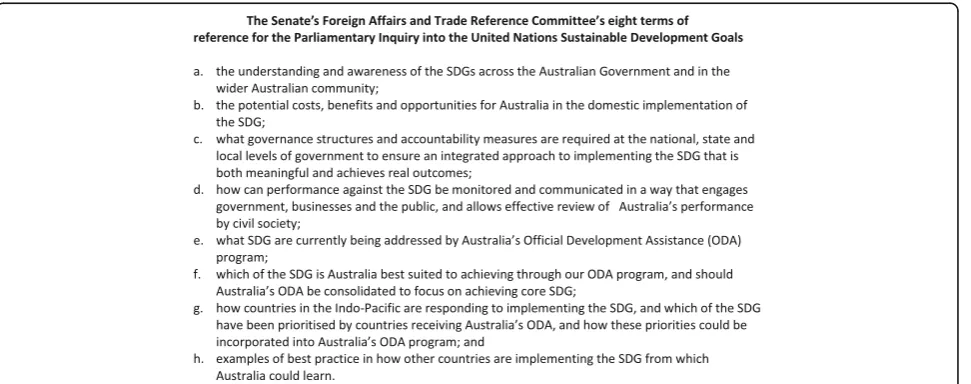
In 2018, the Australian Government conducted a Parlia-mentary Inquiry into the implementation of the United Nations (UN) Sustainable Development Goals (SDGs) in Australia and as part of Australia’s Overseas Develop-ment Aid (ODA) program [1]. The Inquiry sought the views of government and non-government actors and institutes, and the general public, with 164 submissions received from a range of actors and sectors. The Parlia-mentary Inquiry sought responses to eight terms of ref-erence, including scoping questions on how the SDGs
might shape Australia’s ODA commitments (Fig.1) [2].
This article focuses on support for the SDGs within
Australia’s development role, exploring the rich
experience, knowledge and voice on Australia’s health, development and ODA-SDG nexus within those sub-missions. It then examines whether those multi-sectoral insights and recommendations are consistent with the Australian Government’s treatment of SDG 3 (Ensure healthy lives and promote wellbeing for all at all ages) in the ODA context in its first Voluntary National Re-view (VNR) on SDG Implementation of June 2018, as well as with the Foreign Affairs and Trade References Committee’s (FATRC) summary of the Inquiry submis-sions released in 2019 [3,4].
The research –and findings – identify and integrate
a number of key policy topics of contemporary im-port and relevance to the Australian Government at a time of post-election transition. The findings and ana-lysis connect Australia’s SDG health and development commitments in the Indo-Pacific region with Austra-lian ODA policy, and situate this nexus in the wider
context of Australia’s new strategy of “stepping-up” in
the Pacific [5].
Background
Australia was one of 193 countries at the high-level UN Sustainable Development Summit in New York in September 2015 that unanimously committed to achieve the 2030 Agenda for Sustainable Development and its 17 SDGs, including the health goal SDG 3 (Ensure healthy lives and promote wellbeing for all at all ages) [6]. Thus, SDG implementation is the shared responsibility of all countries at all stages of development, including OECD nations like Australia, and SDG 17 (Strengthen the means of implementation and revitalize the global part-nership for sustainable development) is explicit in the multifaceted role developed countries must play in sup-porting developing countries, and regions, fully realize their SDG potential [7]. While the SDG agenda aims to leverage global commitment on a set of targets to reach by 2030, it lacks a shared strategy of implementation; the choice of planning and action is left to UN Member States [8]. Well-resourced countries are grappling with the machinations of integrating the SDGs into national economic, social and environmental policy, and, of particular interest to this paper, into their international development programs [9–11]. Indeed, political commit-ment (that includes financing) and integrated, systems approaches to SDG policy, planning and
implementa-tion will be key [12, 13]. The Australian context is no
different [14].
The Australian Government initially signaled its support for the SDGs in the context of its ODA program, when it
released its 2017 Foreign Policy White Paper:“In working
with partners to achieve the SDGs, Australia will use its [ODA], including through aid for trade, to catalyze sustained and inclusive economic growth to help reduce poverty” ([15] (p88)). In June 2018, Australia’s first VNR
Fig. 1The Senate’s Foreign Affairs and Trade Reference Committee eight terms of reference for the Parliamentary Inquiry into the United Nations
on SDG implementation was released, affirming the Aus-tralian Government’s September 2015 pledge to achieve the SDGs domestically, as well as support Indo-Pacific
coun-tries’ SDG achievement through Australia’s international
development and humanitarian assistance program [3]. Fol-lowing the government’s release of Australia’s SDG-VNR, in late 2018 Prime Minister Scott Morrison announced Australia would“step up its Pacific engagement”to forge a “new chapter in relations with our Pacific family”, including establishing five new diplomatic missions in the Pacific and the creation of the Office of the Pacific within the Depart-ment of Foreign Affairs and Trade (DFAT) [5].
Australian Government onus on “stepping-up in the
Pacific”continues with the re-election of Prime Minister
Morrison at the May 2019 Federal election, and remains focused on enhancing strong Australian-Pacific eco-nomic and security partnerships, and stronger social,
educational and cultural “people-to-people” links [16].
However, the Australian Government’s interest and im-petus in the Pacific, and in the broader Indo-Pacific re-gion, is a point of ongoing scrutiny. In particular, what constitutes the Indo-Pacific region (and whether it is a
helpful geographical framing), and the enduring
securitization paradigm that appears to be driving and informing Australia’s aid efforts in the Indo-Pacific, and specifically within the Pacific region [17–20].
China’s increased development engagement with Pacific Island governments, although it does not surpass Australia’s current development investment, has undoubtedly contrib-uted to growing unease within the Australian Government as to Chinese influence (and the proactivity of this influ-ence) in a traditionally Australian-dominated geopolitical sphere [20,21]. Hameiri argues,“This is mainly because of the perception that China’s engagement with the region is part of a broader intensification of geopolitical competition with the USA”[22]. Hence, foregrounding Australia’s devel-opment role in and with its“Pacific family”is making news headlines [23], and the government’s concurrent invest-ment in health security in the Pacific is interconnected [24, 25]. The latter development policy commits the Federal Government to strengthen public health systems in South-east Asia and the Pacific, with a view to“promote economic growth and development, protect Australia and Australians against the impact of these health threats, and decrease the risk of economic shocks arising from the suspension of
trade and movement of people”[26].
Yet, the public admonishment of the Australian Gov-ernment’s development motives and self-interest in the Pacific region, by Pacific leaders, at the Pacific Islands Forum meeting in Tuvalu in August 2019, highlights Pa-cific self-determination and growing regional solidarity
[23, 27–29]. It also highlights the real frustration with
the Australian Government’s stance, both at home and
abroad, on climate change issues –while for Australia’s
Pacific Island“family”, the consequences of climate change and rising sea-levels are a more literature threat [30, 31]. Recent exchanges in the Pacific Forum meetings have raised criticism of the Australian Government’s sensitivity to mutually respectful, bilateral Pacific relationships [23,27, 32]. The recalibration of Australian priorities will benefit Pacific Island countries and territories, and likewise more effectively serve Australia’s regional soft power ambitions.
This article examines the content of the written submis-sions to the 2018 Australian Parliamentary Inquiry into the UN SDGs seeking to explicate and explore the responses pertinent to health within Australia’s ODA-SDG context. The article synthesizes the key ODA-SDG and health prior-ities raised by the Inquiry’s respondents and juxtaposes these stakeholder perspectives with the content of the Aus-tralian Government’s first SDG-VNR, as well as the FATRC report of its findings on the Parliamentary Inquiry.
Methods
The objective of this research is twofold. We first sought to explore the views of diverse stakeholders on Austra-lia’s ODA-SDG implementation nexus, with a particular interest in Australia’s approach to health and develop-ment in the Indo-Pacific region. This investigation uses the publicly available written submissions to the Austra-lian Parliamentary Inquiry into the UN SDGs of 2018 as the data set for documentary analysis [33]. That Inquiry, led by the FATRC in the Senate Department (following a Senate referral on 4 December 2017), comprised an online public submission process, and public meetings in Sydney, Melbourne and Canberra. Our second re-search objective is to compare the findings that emerge from our thematic analysis of the selected written sub-missions with the Australian Government’s treatment of SDG 3 in the ODA context in its first SDG-VNR of June 2018, as well as with the FATRC summary of the Inquiry
submission content released in 2019 [3,4]. We note that
this study’s analysis was undertaken prior to the FATRC releasing its report into the Senate Inquiry into the UN SDGs in February 2019, and thus our analysis is not in-fluenced by the content or findings of that report.
To identify which written submissions to the Australian Parliamentary Inquiry into the UN SDGs of 2018 provided the most detail on the crosscutting topics of ODA, health and development to include in this analysis, and guided by the methodology in a previous documentary review of parliamentary inquiry responses [34], we reviewed all 164 written submissions to the UN SDG Inquiry. These were accessed from a publicly available Australian Parliamen-tary website, where written submissions were posted after formal acceptance by the FATRC delegated to lead the
UN SDG Inquiry [33, 35]. The 164 submissions totaled
1983 pages, with over two-thirds (69%) prepared by
submission is 12 pages: the shortest is one page in length (made by two individual Inquiry respondents and one non-government actor), while the longest is by the inter-national tobacco company Philip Morris Interinter-national Australia, New Zealand and Pacific (PMI) at 169 pages. A 90-page submission from the Sustainable Development Solutions Network (SDSN) Australia-New Zealand-Pacific was the next largest.
Each of the 164 submissions were read by CEB, to assess whether the submission content focused on both the
Aus-tralian Government’s ODA program andhealth and
well-being. The content of 31 submissions were identified as relevant to this study and included for thematic analysis, as described by Attride-Stirling (Table2) [36]. Several further readings of these 31 papers led to identification of emergent themes building on eight themes corresponding to the Inquiry’s Terms of Reference. Emergent thematic find-ings were iteratively discussed between CEB and PSH, and final thematic findings were confirmed by both team members to ensure inter-rata reliability and study rigor. CAM assisted in revising several manuscript drafts.
Following Weitzman’s [37] guidance on the use of computer software in qualitative research, a number of possible analytical strategies were initially identified among research team members for interrogation of the qualitative data set, and their use and benefits discussed. Analysis software (such as NVivo) were not used be-cause it was agreed that quantitative content analysis and data visualization would not necessarily add analyt-ical value, and had the potential to detract or distort the contextual richness and meaning of the stakeholder views and voices in the individual submissions. There was also concern that coding through a software package might distance the researchers from this data set [38].
Manual coding and analysis of the submissions was thus undertaken by CEB and a selection of 5% of submissions checked by PSH, with text-based management of the data (and thematic subsets of data) organized in tabular form using Microsoft Excel and Microsoft Word.
In terms of the second research objective, once the the-matic findings from the documentary analysis were final-ized, the research team turned their attention to comparing those findings on the priorities and issue areas identified by the selected Inquiry stakeholders on the Australian ODA-SDGs-health and development nexus with the Australian Government’s treatment of this same nexus within Austra-lia’s SDG-VNR of June 2018. Research team members sep-arately reviewed the 130-page VNR document, especially focusing on that document’s treatment of health in the ODA context in the chapter on SDG 3 (Good health and wellbeing), and compared and contrasted the Australian Government’s position and priorities in the VNR with this study’s preliminary findings. The provisional findings of this comparison were presented to a workshop of policy ana-lysts and academics, which allowed the research team members to discuss and finalize key comparative findings. A similar process was engaged to compare the content of
our analysis of respondents’ ODA-SDG-health and
devel-opment priorities with the summary offered by FATRC’s final report on the UN SDG Inquiry.
Results
Part 1 - findings of the documentary analysis
Thirty-one of the 164 written submissions to the Parlia-mentary Inquiry into the UN SDGs of 2018 were identi-fied to have a strong narrative and contextual focus on
both the Australian Government’s ODA program and
health and wellbeing, and were thus subject to thematic analysis. These 31 written submissions totaled 583 pages. When the content of these submissions was subject to thematic analysis, four broad themes on ODA, the SDGs and health and wellbeing emerged:
(1) Different characterizations of health in the SDG context by Inquiry stakeholders;
(2) Importance of governance and multi-sectoral plan-ning for integrating SDG implementation into Aus-tralia’s ODA program;
(3) Identification of health priorities for Australia’s ODA program, especially in the Indo-Pacific region; and (4) Financing for regional and global health (and the
SDGs broadly).
Theme 1: different characterizations of health
We found the respondents characterized health in three distinct ways. First, Australia’s pursuit of good health and wellbeing in the Indo-Pacific context is seen as crit-ical for broader regional development beyond health. Table 1A snapshot of the parties that made submissions to
the Australian Parliamentary Inquiry into the UN SDGs
Inquiry respondents Study %
Non-government actors 69% (n= 114)
i.e. submissions made by civil society organizations, community networks, peak bodies, educational entities (schools or universities), business and industry, or the private sector more broadly
Government organisations or agencies 12% (n= 19)
i.e. submissions made by Federal, state/territory and local government or government delegations
Individuals 18% (n= 30)
i.e. submissions made by members of the public
Joint > 1% (n= 1)
Second, there is a sense among some respondents that greater onus on sexual and reproductive health (SRH) will enable the achievement of the broader SDG frame-work, again beyond narrower health (SDG 3) attainment. Agencies with a SRH mandate were particularly strong in their advocacy for this position. Finally, two respon-dents suggest the SDGs present an opportunity for the integration of Australia’s current health and develop-ment approach into the more crosscutting, multi-sectoral Planetary Health approach, which these respon-dents contend has stronger SDG resonance.
Advancement of SDG 3 is critical to enable broader Indo-Pacific regional development under the SDG agenda Although SDG 3 achievement should be prioritized for “efficient and effective”SDG implementation [Fred Hol-lows Foundation], health and wellbeing are the product and outcome of all 17 SDGs. Thus, the pursuit of health and wellbeing in the Indo-Pacific context will require more than siloed focus on SDG 3 achievement:
“A lesson learned from the MDG era is that each glo-bal challenge and therefore each of the thematic [SDGs] are necessarily interlinked, and success for one goal can-not be complete without investment in others. Health,
gender and education… are important cross-cutting
is-sues…”[Global Partnership for Education].
The Department of Health (Australian Government) also emphasizes health’s intersection across the SDG
framework:“Good health is both a pre-condition and an
outcome of the 2030 Agenda, as the SDGs are closely aligned to the social, economic and environmental deter-minants of health”.
Sexual and reproductive health (SRH) underpins the success of all 17 SDGs
In terms of particular intersections, several respondents
specify that“Gender equality is an enabler and
acceler-ator for all the SDGs”[International Women’s
Develop-ment Association] and “The right to family planning
enables fulfilment of other human rights, such as gen-der equality, by allowing women to access education and employment, increase their negotiating power and
raise their socioeconomic status” [Marie Stopes
Inter-national Australia]. Alternatively, the InterInter-national Sex-ual and Reproductive Health and Rights Consortium distinguishes that gender equality and the achievement
of sexual and reproductive health and rights is crucial
to broader SDG achievement:
“A key driver of gender equality is the realization of sexual and reproductive health rights by women and girls. For women to be equal, healthy, educated, finan-cially secure, and live free from violence, they need to be able to make informed decisions about their own bodies.”
Coalescence with Planetary Health
Following the integrated nature of health (including SRH) as a pre-condition and outcome of the entire SDG agenda,
Planetary Health - “the health of human civilization and
the nature systems on which they depend”- is proposed
by Doctors for the Environment Australia as the necessary lens for Australia’s SDG implementation moving forward. The University of Sydney contends that adopting a Planet-ary Health approach toward Australia’s aid program could usher in the required transformational approach to SDG implementation in both Australia and the region, as a
Planetary Health approach will, crucially, focus on “key
systemic drivers that cut across the goals”.
Theme 2: planning and governance for integrating SDG implementation into Australia’s ODA program
Inquiry respondents included in this study discussed at length the need for strong Australian Government leadership and good governance, policy, and planning processes and practices for integrating the SDGs into Australia’s ODA program moving ahead. Diverse stake-holders called for the Australian Government to develop a SDG implementation plan with coherent ODA strat-egies and policies, SDG awareness raising, the shift from a siloed to integrated approach to SDG planning by gov-ernment, and the need for investment in robust data in the Indo-Pacific for a strong evidence base for health and development planning, and SDG roll-out broadly.
Australia should be an SDG leader in the Indo-Pacific and needs a SDG implementation plan
“Australia has a role to play as a leader and norm setter
in the region” argues the Fred Hollows Foundation,
es-pecially as“[w]e would expect an affluent country to set
an example and adopt a leadership position to progress
on the SDGs” [Doctors for the Environment Australia].
The Australian Government is encouraged to
strategic-ally leverage the “significant” SDG opportunity“to be a
leader on sustainable development in the Indo-Pacific” [World Vision Australia]. For Global Citizen Australia,
Australia’s SDG leadership in the region is, surely: “Not
only the right thing to do, but it is in Australia’s national
interest. Investing in our region will… ensure Australia
continues to prosper and be a good neighbour”.
To become a regional SDG leader, a number of stake-holders recommend the Australian Government should explicitly align the country’s ODA policy and planning
program with the SDGs for policy coherence: “A siloed,
two-track approach to the SDGs should be avoided by ensuring coherence between domestic and international
action…The SDGs must be affirmed in the purpose of
Citizen Australia recommends the government
de-velop a SDG implementation plan “outlining how
Australia will achieve the goals, both nationally and through our international development and humani-tarian assistance efforts”. For Vision 2020 Australia, the lack of a concrete sustainable development
strat-egy that encapsulates the SDGs “would be disastrous
for the Australian Government’s ambition to grow into a regional leader”. Oxfam Australia furthers that
a SDG implementation plan is also “important for
so-lidifying a long-term, bipartisan and strategic ap-proach to the aid program and for meeting the SDGs, whether individual or multiple goals, targets or indi-cators, according to the project and need”.
Raising public awareness on the SDGs and their significance for Australia and the region
A number of stakeholders consider it problematic that Australia’s international development sector appears to have the greatest SDG awareness. Thus, there is strong advocacy among stakeholders for greater SDG awareness raising, particularly led by the Australian Government
who, according to Vision 2020 Australia, “must elevate
knowledge of the goals beyond the international devel-opment and NGO sector by mainstreaming the SDGs to priorities across government, civil and private sectors in simple and understandable terms”.
For Marie Stopes International Australia, raising do-mestic awareness of the SDGs should include celebrating and promoting ODA achievements with the Australian public, including ODA health achievements:
“Raising awareness of the SDGs allows the government to highlight the successes already achieved domestically and through the Australian Government’s [ODA] pro-gram. For example, in Timor-Leste, where the Australian Government has been the largest partner since 2002, it is estimated that the maternal mortality rate reduced by 75% since 1990. The total fertility rate for women in Timor-Leste has also dropped form 7.8 children per woman in 2003 to 4.2 in 2016, demonstrating that Aus-tralia’s contribution to women’s health, empowerment and equality has made a significant difference”.
Shifting from siloed health and development planning to an integrated approach
As put by the Commonwealth Scientific and Industrial
Research Organization (CSIRO), “Implementing the
most transformative actions on the SDGs is complex and will require inter-disciplinary and cross-sectoral
effort, but yet there is no ‘best practice’ guide on how
to achieve this”. Therefore, “Governance mechanisms
for the SDGs should be carefully designed to enable greater policy coherence across different departments
and levels of government” [Australian Council for
International Development]. Accordingly, we found most stakeholders push the Australian Government to adopt an integrated, multi-sectoral, multi-stakeholder and interdisciplinary approach to SDG planning, in-cluding an interdisciplinary approach to health and de-velopment challenges:
“Given the nature of the 17 goals and their specific focus areas, there is a risk of adopting a siloed approach to im-plementation, delegating responsibility for each SDG within discrete policy portfolios. Focusing on specific goals in isolation may have the unintended consequence off
re-versing or undermining progress in other areas” [Vision
2020 Australia].
The CSIRO affirms that as the SDGS are interlinked and interdependent, the Australian Government should
take a systems view of SDG delivery because“a failure to
appreciate the cross linkages will likely lead to conflicts, inefficiencies, waste and cost blow-outs”. The CSIRO
goes onto state “a major gap, both technically and also
from a governance perspective” exists regarding “[h]ow
to assess and manage these cumulative impacts, within and between industry sectors”:
“Australia currently does well in managing single
in-dustry sectors and is world leading in many…However,
more work needs to be done on integrating between sec-tors and domains, and there are few examples of effect-ive multi-sector integration and management. There will likely be benefits in developing governance structures that allow meaningful consideration but in a cost-effective manner that does not present additional layers of bureaucracy. Understanding the cumulative impacts between and across industry sectors remains a key
Aus-tralian and global challenge”[CSIRO].
For the University of Sydney, “[t]here is a need for a
[new] framework to better understand and address the complex interlinkages between the social, environmental and governance challenges facing us”. The University of Sydney continues that the SDGs thus offer the Australian
Government“a unique opportunity to take an
interdiscip-linary, cross-sector approach to solving big complex
chal-lenges” because the SDGs “are inclusive and diverse
enough to be able to speak the language of the majority, providing a common language and platform for building collaboration internally and with external partners”.
Both the University of Sydney and Doctors for the Environment Australia point to the Planetary Health paradigm as best offering a framework for government to bring interdisciplinary approaches and partnerships to
realization. Alternatively, the International Women’s
Development Association commends“A focus on gender
equality and women’s empowerment” would provide
government with the framework “for moving away from
Data strengthening for robust data and strong evidence base for health
DFAT notes “Australia is working to continuously
im-prove data collection” including “supporting developing
country partners to strengthen their statistical capacity, and engaging in initiatives to improve data collection”. Certainly, many of the stakeholders emphasize that SDG success in Australia and the Indo-Pacific region will greatly depend on robust data generated by strong and reliable information systems, and the use of such data as evidence in SDG decision-making policy and planning.
Consequently, many stakeholders advocate,“The
collec-tion of high-quality, timely and disaggregated data should be prioritized to enable the Australian Govern-ment to track the experiences of vulnerable groups such as children”[World Vision Australia].
UNICEF Australia points out that although
govern-ments who receive Australian aid are“ultimately
account-able to generate the data that will guide and measure achievement of the SDGs”, the Australian Government “and the international community more broadly, has an obligation to partner with these countries to make sure the SDG targets are met”. The Australian Council for
International Development recommends Australia“Invest
in new measurement capacity to strengthen the collection of disaggregated data, and continue to support capacity building in this area in the Pacific”, including supporting and building“the capacity of National Statistics Offices in our region to collect disaggregated and intersectional data and to facilitate sharing of common learnings regionally to enable regional reporting on SDGs, reduce the burden on National Statistics Offices, and identify issues and trends relevant across countries”.
It follows that for a number of Inquiry stakeholders, strong health and wellbeing data is particularly critical in light of health inputs and outcomes cross-cutting all 17
SDGs, and specifically gender-related and SRH data: “it
is crucial that Australia’s ODA program improves the poor SRH data collection across the Pacific so a fuller
understanding of need can be gained” [Family Planning
NSW]. Indeed, several respondents identified the lack of gender-disaggregated data is a major challenge in the Pa-cific region, which will impede countries ability to meas-ure SDG progress, including health progress.
Theme 3: Australia’s regional and global health priorities Inquiry respondents emphasize the Australian Govern-ment should advance the health of priority populations in its ODA-SDG efforts in the Indo-Pacific region, and elsewhere. The health and wellbeing of five priority pop-ulations are identified: children; adolescents; persons with disabilities (explicitly including persons with vision
impairment);‘Left Behind’marginalized populations; and
women and girls (Table3).
Further, six key health issues for SDG health and ODA prioritization by the Australian Government are identified in the submissions included in our analysis
(Table 4). The first pertained to the Australian
Govern-ment continuing to invest in health system strengthen-ing efforts, especially in terms of supportstrengthen-ing inter-related Universal Health Coverage (UHC) strengthening, such as research. The second health priority identified is SRH, followed by combatting communicable and infec-tious disease, addressing the social determinants of health, poor eye health, and health security.
Theme 4: financing to deliver regional and global health SDG imperatives (and the SDGs generally)
Stakeholders had much to say about ODA-SDG financing, governance and policy. Repeated calls are made for the Australian Government to: increase its investment in ODA (including health-related ODA); alter Australia’s ODA pol-icy to overtly align with the SDGs; improve government transparency around ODA expenditure; support stronger tax collection processes for unlocking finance for SDG achievement in countries recipient of Australian aid; and le-verage the Australian private sector to partner and invest in ODA-SDG opportunities, such as impact investment.
Strong calls for Australia’s investment in ODA, including
ODA for health programs, to be increased
Although stakeholders acknowledge that ODA is one part of the solution to raising development finance for
the SDGs, it will nonetheless “play a vital role” [World
Vision Australia]. Most stakeholders are critical of the current level of Australian ODA and call on the Federal Government to rebuild the country’s ODA budget for the Indo-Pacific region. There were differing suggestions on aid targets. According to the Burnet Institute, for
ex-ample, “The Australian Government should reinstate –
and seek bipartisan support for–the goal of the
Austra-lian aid budget reaching 0.5% of GNI by a set date, at least before 2025”. World Vision Australia recommends
rebuilding the aid budget “back to 0.33% of Gross
Na-tional Income (GNI) over six years (2023-2024), and continue to incrementally increase funding to deliver on Australia’s international commitment as embodied in the SDGs, noting the 2030 Agenda encourage[s] devel-oped countries like Australia to invest 0.7% of GNI in aid”. Results International Australia suggests ODA be
in-creased “to 0.3% [GNI] over the next four years, and to
0.48% of GNI (returning to the historic peak of Austra-lian aid) within 10 years”.
A number of Inquiry respondents express concern that if Australia’s ODA expenditure is not increased, Austra-lia’s impact and influence in regional SDG achievement
–and leadership in the Indo-Pacific more broadly - will
“[T]he diminished funds available for aid have severely constrained DFAT’s ability to effectively respond to the challenges of achieving the SDGs. Newer initiatives are
fewer in number, with little opportunity to build upon notable successes in health and education from the pre-vious decade. Since FY2013-14, the aid budget has been Table 3Population segments of focus in Australia’s ODA-SDG health and well-being investment efforts
Five priority populations Rationale
1. Child health and wellbeing • “The 2030 Agenda presents an opportunity to support the rights and best interests of all children. It is a chance to provide children with the best start in life, and to ensure that they survive and thrive. The 2030 Agenda is a comprehensive and holistic framework that creates a vision for the world where children can live free from violence and abuse and in an environment that supports their healthy development” –UNICEF Australia
• “One practical way that the Australian Government can show leadership on leaving no one behind in the Indo-pacific region is by being an advocate for child protection and the elimination of violence against children” –World Vision Australia
2. Adolescent health • “Current population specific funding mechanisms targeting key affected, vulnerable and marginalised populations still exclude adolescent populations as a demographic priority. Australian ODA should be consolidated to enable an inter-sectoral and multi-component engagement of key SDGs that will harness the opportunities of the triple dividend that benefits during adolescence, across the life course, and into the next generation” – Burnet Institute
• “Adolescence is a pivotal period during which the gains of childhood can either be consolidated or lost. The second decade of life presents an opportunity to build on gains made in childhood and to invest in programmes that contribute to healthy, safe, informed and empowered transitions to adulthood. It can also be a forgotten stage” –UNICEF Australia
3. Persons with disabilities • “Australia has a strong commitment and track record on disability inclusion in the aid program. This is demonstrated by DFAT’s international advocacy for disability inclusive development, the commitments set out in Australia’sDevelopment for Allstrategy for strengthening disability inclusive development, and reported progress…Recommendation []: Inform all future program investments according to the Office of Development Effectiveness’strategic evaluation of DFAT’s work promoting disability-inclusive development”-Oxfam Australia
• “Importantly, [the SDG] document references disability 11 times…Given the Millennium Development Goals (MDGs) made no reference to persons with disabilities, this is an achievement in itself, presenting a tangible opportunity for the inclusion of people who are blind or vision impaired to be counted” –Vision 2020 Australia
4. Marginalized & poor populations • “The two most frequently-used words in the description of the SDG targets are“for all”. To improve the lives of everyone, care must be taken to ensure those who are most disadvantaged benefit from SDG progress…Australia’s domestic and international policies therefore need to prioritise marginalised and vulnerable groups, including but not limited to women, children, people with a disability, Indigenous people and ethnic and sexual minorities…The principle of leaving no one behind equally applies to Australia’s work overseas” –World Vision Australia • “Ensure Australia’s approach to implementing the SDGs domestically and through our aid program
centres on the commitment to leave no one behind, with concrete strategies to support inclusion of disadvantaged groups in the design, delivery and monitoring/evaluation and reporting on services and programs. This should result in…explicitly targeting the poorest communities and most marginalised groups within the countries where Australian aid is directed to... Although the drivers of inequality are complex and multi-dimensional, evidence shows that it is necessary to focus on the needs of the most disadvantaged populations to reduce inequality…Accordingly, it is important for Australia to make strategic choices about the type of aid it provides in support of poverty reduction and addressing inequality. Priority must be given to investing in human capital as a foundation for inclusive, equitable and sustainable development” –Save the Children
5. Women and girls’health and wellbeing,
and gender empowerment • “
It is critical for Australia to support integrated, multi sectoral approaches that empower women and girls and break the intergenerational cycle of poverty. We welcome the Australian Government’s strong commitment towards greater gender equality, as reflected in the goal that 80% of Australia’s development program will address gender issues in implementation” –Save the Children
• “Recommendation []: Australia should retain the 80% gender target, and ensure this target is made more meaningful by:
o Increasing transparency of DFAT’s self-assessment process so that stakeholders understand how programs are being assessed;
o Ensuring all partners, including private sector partners, integrate gender analysis from design through to program evaluation;
o Ensuring DFAT has sufficient technical expertise in gender mainstreaming to accurately assess all programs;
Table 4Six priority issue areas for ODA-SDG Investment in Health
Six priority issue areas Rationale
1. Health system strengthening • “Progress in generating research evidence to support UHC has been uneven,
and investment in low-income countries’research production neglected. Currently, only 10% of health policy and systems research globally is conducted on low- and middle-income countries. Building the capacity of poorer communities to research and learn is key to their sustainable development” –Burnet Institute
• “To implement sustainable change in the Pacific health sector, long term investment is required to build the capacity of Pacific communities to implement change themselves. Investment in infrastructure to provide appropriate health facilities is essential. Critical to achieving improved health outcomes is training of clinicians, community workers and teachers, trialling and implementing customised programs, and ensuring that they continue by embedding teaching in schools and universities” –Family Planning NSW
• “[Recommendation] Scale up ODA investments in strengthening health systems to support the provision and expansion of Universal health Coverage (UHC) schemes, including the provision of high quality, comprehensive and integrated eye care services” –Fred Hollows Foundation
• “Using an inclusive approach to intervene at multiple levels of the health system with locally tailored responses to eye health workforce development increases the efficiency, suitability and sustainability of the investment by the Australian Government, provides the best chance to leave no one behind”-Vision 2020 Australia
2. Sexual and reproductive health (SRH) • “The unmet need for family planning remains unacceptably high, especially in disadvantaged populations and in under-developed and developing countries, including in the Pacific region. In the Solomon Islands, for example, population increases are expected to outstrip food and water supply within ten years. Neighbouring Papua New Guinea is experiencing similar critical sustainability issues in relation to its current population projections. These parts of the Indo-Pacific are faced with limited and unreliable contraceptive supply, with some of the most under-resourced reproductive services in the world”-Family Planning NSW
• “We further recommend that our aid program continue to support the provision of SRH services in humanitarian emergencies and prioritise SRH support for regions where maternal mortality and the need for contraception is highest. Access to quality reproductive services has a transformative impact on women’s health, education and empowerment and is therefore essential to gender equality” -Australian Parliamentary Group on Population and Development • “[Recommendation] The Australian Government [] increase its current
funding of $23.7 million to investing $50 million per annum for reproductive health initiatives” –Global Citizen Australia
• “Sexual and reproductive health is an area of considerable success and great potential. DFAT’sGender Equality and Empowering Women and Girlsstrategy recognises reproductive health as a key factor in gender equality and economic empowerment, and theFamily Planning and Aid Program–Guiding Principlesare supportive of comprehensive care. Family planning is a mechanisms for achieving the SDGS as it contributes to decreasing maternal and child mortality and poverty, achieving gender equality, sustainable cities, responsible consumption, decent work, and access to higher education. Family planning can also help mitigate climate change and promote sustainable communities” –Marie Stopes International Australia
3. Combatting communicable and infectious disease • “As part of an increase in development assistance for health, Australia should focus on…Increased assistance to combat the infectious diseases claiming the most lives–HIV, TB and malaria–both through bilateral assistance in our region and through the Global Fund to Fight AIDS, TB and Malaria; Increased action to ensure all children have access to vaccines, including through ensuring the re-use of resources from the polio eradication campaign to improve vaccination systems” –Results International Australia
4. Social determinants of health, such as nutrition and food security, education, climate change & environmental health
Table 4Six priority issue areas for ODA-SDG Investment in Health(Continued)
Six priority issue areas Rationale
• “The impact of under nutrition on the health, productivity and survival of individuals should be of concern for Australia given that its neighbours in the Pacific have some of the highest child undernutrition rates in the world. In particular, in Papua New Guinea (PNG) almost one in two children are stunted from undernutrition–the fourth highest child stunting rate in the world. In a ground-breaking report released in 2017, Save the Children and Frontier Economics estimated that child undernutrition cost the PNG economy a staggering $1.5 billion (8.45% of GDP) in a single year. Yet only 0.1% of Australia’s [ODA] to PNG was allocated to nutrition in the years 2010 and 2012 (latest data publicly available). It is not possible to promote inclusive and sustainable economic development in the long term in PNG if around half of the population of working age continues to suffer reduced productivity from childhood undernutrition. Indeed, child undernutrition will likely impede the potential impact of other aid investments hat bilateral and multilateral donors make for the purpose of promoting economic growth” –Save the Children • “[Recommendation] The Australian Government should increase its support
for education from 18 to 20% of the Australian aid program and increase its share of total funding for the Global Partnership for Education…In relation to Goal 3, Ensure healthy lives and promote well-being for all at all ages, achieving universal education could: Prevent seven million cases of HIV and AIDS in the next decade; enable women with at least 7 years of formal education to have two or three fewer children; and reduce child mortality rates” –Results International Australia
•[Recommendation] The Australian Government to increase its support for education and increase its share of total funding for the Global Partnership for Education from current investment of $900 million to $200 million AUD” -Global Citizen Australia
• “[Recommendations] Australia should increase its contribution to international climate finance as part of a growing aid program and in line with Australia’ international obligations; Australia should develop a comprehensive Climate Change Strategy for the aid program” –Oxfam Australia
• “As our closest neighbours in the Pacific are among those most vulnerable to climate change and associated health impacts, Australia should be positioning itself to work on all SDGs in ODA but with a focus in the region on climate change, clean energy, land and ocean use, and chronic diseases and gender equality” –Doctors for the Environment Australia
5. Eye health • “[Recommends]“Eye health and vision care is regarded as a public health
priority in Asia and the Pacific” –Vision 2020 Australia
• “Good vision transforms lives and has positive development impacts far beyond good health; it can enable individuals and families to pull themselves out of poverty, helps people to go back to work or school, and to overcome inequality, marginalisation and exclusion that blindness and vision loss often perpetuate” –Fred Hollows Foundation
6. Health security • “DFAT engagement that aligns with SDGs 3, 5, 16 and 17[:] Australia’sForeign
Policy White Paperhighlights our commitment to guarding against global health risks, in particular preventing and responding to the introduction and spread of infectious diseases. The Minister for Foreign Affairs recently launched the Indo-Pacific Health Security Initiative ($300 million, 2017–22), which will support efforts to prevent and contain disease outbreaks in the Indo-Pacific that have the potential to cause social and economic impacts on a national, regional or global scale. Complementary to this initiative, Australia’s ODA program supports countries to build strong, functioning health systems, which are critical to promoting sustainability and achieving sustainable economic growth” –Department of Foreign Affairs and Trade (DFAT)
cut by nearly 25% in total and the forward estimates that once outlined the growth trajectory to reaching 0.55% GNI in 2020 have been repeatedly reversed”[Burnet Institute].
For Doctors for the Environment Australia, ODA cuts are“detrimental to regional solidarity and sustainable
de-velopment”, and as the nation “drops out of the OECD
club of top ten donors in rankings of global donor
gener-osity – it will lose influence on issues and values that
Australia traditionally leads or holds expertise in”. Save the Children also emphasize geo-political reasons for the Australian Government to increase its ODA investment: with the rise of emerging economies in the Asian region that are increasing their aid spending, Australia faced in-creased competition for access and influence in the global economy as well as global decision-making forums. There-fore, increased investment in ODA could extend Austra-lia’s geo-political influence.
“We appreciate that tough fiscal trade-offs need to be made to strengthen the Australian economy and return the budget to surplus. However, the drastic cuts made to Australia’s overseas aid budget are short-sighted saving
measures… These [ODA] cuts have come at a cost to
our international reputation, geo-political influence and capacity to credibly shape development outcomes in our region and beyond. Most crucially, these cuts have im-pacted the world’s poorest people, leaving the most
vul-nerable further behind”[Save the Children].
In addition to the many broad calls for the Australian Government to increase its ODA-SDG expenditure, spe-cific request is made for there to be an increase in Austra-lia’s ODA health budget. The Burnet Institute considers
that Australia’s’ ODA health budget should at least
in-crease to pre-2014/2015 ODA levels:
“The aid budget increased slightly in FY2017-18 and FY2018-19 to $3.9 billion and $4.0 billion, respectively; however, the steep decline in the previous four years has disproportionately affected health and education. For example, between the 2014/15 and 2015/16 budgets, the health budget fell by by $221 million or 28%. Between them, education and health made up 37% of the aid pro-gram before 2015/16, but contributed 52% of the cuts from that year. Both sectors are crucial for long-term
de-velopment, economic growth and regional security.”
Vision 2020 Australia points out that“public health in-terventions require long-term commitment which goes beyond short term policy and political cycles”and
there-fore recommends the Australian Government “Commit
to long term funding for [the] SDGs”. Meanwhile, the Fred Hollows Foundation advocates the Federal Govern-ment “Embed the principles and commitments of the Addis Ababa Agenda for Action in Australia’s ODA
pro-gram and accelerate efforts to realize Australia’s
com-mitment to increase the aid budget to 0.7% of [GNI] by 2030 through a sustained and predictable trajectory”.
Improvement in Australia’s ODA investment and re-sourcing in SRH is additionally called for in light of Australia halving its investment in family planning within the aid program from $46.4 million in 2013/14 to $23.7 million in 2015/16 [Family Planning NSW; Marie Stopes International Australia]. Increased investment in nutrition
programs in the Pacific is further advocated, “Australia
should commit at least 3% of ODA on nutrition-specific interventions (as defined by OECD-DAC criteria) and
nutrition-sensitive interventions… including targeted
support for the Pacific” [Results International Australia], as well as investment in the environmental determinants of health, including climate change [Oxfam Australia].
Changing the rhetoric and focus of Australia’s ODA
program to align with the SDGs
Not only do Inquiry respondents promote increased in-vestment in various ODA health programs, but several stakeholders contend the entire focus of the Australian Government’s ODA program should change from a “trade-for aid approach to development” to one that
re-flects the “broader aims articulated under the SDG
framework for achieving development”[Victoria
Univer-sity]. For Save the Children, this would involve improv-ing the targetimprov-ing of aid to population segments within the Indo-Pacific region in line with the SDG’s Leave No
One Behind principle, including “Improving the
target-ing of development assistance sub-nationally to reach geographic areas and disadvantaged population groups”. The International Sexual and Reproductive Health and Rights Consortium also calls for the targeting of Austra-lian aid investment in SRH services to the countries and
populations where needs are greatest. These include“the
12 countries in our region that are home to 90 per cent
of maternal deaths”, and“rural communities, ethnic
mi-norities, people living with disability, sex workers, and people who may face persecution or stigmatization due to their gender identity or sexual orientation”.
Australian Government investment in improving its ODA reporting and the enabling of countries, which are recipients of Australian aid, to improve tax collection for SDG financing
The need for greater transparency and accountability in the Australian Government’s acquittal of ODA expend-iture is emphasized by several stakeholders. For this to occur, Oxfam Australia and World Vision Australia sug-gest the government increase its annual investment in
resourcing the Office of Development Effectiveness, “to
follow the UK’s Department for Foreign International Development’s lead in reporting on aid allocations using the International Aid Transparency Initiative open standard, and for the Australian Government to reinstate the aid‘blue book’to be published alongside other budget documents.
Allocating additional ODA to address both multi-national tax avoidance and build the tax collection cap-acity of countries that received Australian aid to improve good governance and unlock further financing for the SDGs is advanced by Oxfam Australia. The latter
recom-mends the government: “Focus more foreign aid efforts
on building the tax collection capacity of recipient coun-tries’tax administrators–in line with Australia’s
commit-ment under the Addis tax initiative – to doubling our
support in the area of taxation and domestic resource mobilization in developing countries from $16 million in 2014-15 to $32 million by 2020”.
Leverage Australian private sector investment in ODA-SDG strategy and activities
Many of the stakeholders in their submissions to the
Inquiry acknowledge that government funding“would not
be sufficient to meet the ambitious aim of leaving no man,
woman or child behind” [Save the Children]. For Cardno
Development International, the private sector must there-fore be more effectively engaged in ODA. Accordingly, “the Australian Government [needs] to incentivize and ac-celerate the establishment of new models to leverage pri-vate capital flows together with ODA to enable both
commercial and development dividends” [Save the
Chil-dren]. The Australian Council for International
Develop-ment agrees, recommending the governDevelop-ment“Adopt new
and innovative blended finance approaches that allow Australia to leverage investment from multiple sources to achieve the SDGs”.
Regarding such new models, World Vision Australia welcomes the Australian Government’s 2017 announce-ment to establish a $40 million Emerging Markets Im-pact Investment Fund (EMIIF) to support investment in small and medium-sized enterprises in the Asia Pacific
region. In turn, World Vision Australia fears “it is not
yet clear which SDGs the EMIIF will contribute to other than those directly related to economic growth through a gender lens”. It thus proposes that the EMIIF is com-plemented by a $100 million Sustainable Development
Impact Fund “to augment its aid and social services
funding by providing finance to the private sector for investments that promote sustainable development in Australia and in aid recipient countries”. World Vision Australia also recommends that a Sustainable
Develop-ment Impact Fund use “an impact investing model
aimed at incentivizing private sector investment to ad-vance the SDGs in Australia and overseas”.
World Vision Australia further praises the business-led Global Compact Network Australia (GCNA) to ad-vance the private sector’s contribution to the SDGs, in-cluding its launch of the CEO Statement of Support for the SDGs in 2016, and its recent launch of an online Australian SDGs Hub for Business. Doctors for the En-vironment Australia further recommend that the GCNA and its business alliances“be directly informed by health
and environment communities” to “allow tracking of
progress as well as harms to health”:
“The [GCNA] is increasingly recognizing the historical harms to public health by certain actions of the corpor-ate community (i.e. tobacco and anti-retroviral pricing). National businesses declaring commitment to the SDGs can better align with the health and environment com-munity on health and environment themes to forge and expedite different healthy futures”.
In terms of advancing public private partnerships for SDG achievement in health, the Burnet Institute suggests the Australian Government take part in the Bill and Melinda Gates Foundation’s expanded Grand Challenges in Global Health initiative, as had Canada, South Africa, Brazil, India, China and Korea. For the Burnet Institute, Australia could especially progress a Grand Challenges program similar to Grand Challenges Canada, a
multi-stakeholder fund led by the Government of Canada:“Since
2015, Grant Challenges Canada has explicitly aligned its ob-jectives with the SDGs, which focuses the use of research and innovation on those global targets”.
Part 2 - comparison of whether, or to what degree, the above four themes are reflected in the FATRC summary of the submissions of early 2019 and Australia’s SDG VNR (June 2018)
FATRC report comparison
We found limited congruency exists between the find-ings from the first part of our study and the content of the FATRC summary of the content of the Inquiry sub-missions released in February 2019. The content of only one of our four thematic findings, Theme 2, is substan-tively reflected in the report’s 18 Recommendations. Our Theme 2 (importance of governance, policy coherence and planning for integrating SDG implementation into Australia’s ODA program) does resonate with four of the FATRC’s 18 Recommendations:
Recommendation 1 - The Australian Government develop a national SDG implementation plan; Recommendation 4 - The SDGs are integrated in all
Australian Government agencies’policies and strategies; Recommendation 9 - Government should improve
Recommendation 18 - Continue SDG integration into Australia’s ODA program and prioritize the commitment to leave no one behind.
Although the FATRC report recommends the
Austra-lian Government “assesses opportunities to encourage
sustainable public procurement, impact investment and
business practices that support the [SDGs]”
(Recommen-dation 17), this recommen(Recommen-dation nonetheless falls short of the recommendations given by Inquiry stakeholders in our Theme 4 on financing for the goals. Inquiry stakeholders do not suggest the Australian Government
should “assess[] opportunities” with the private sector
for ODA-SDG implementation. Rather, stakeholders in our analysis strongly recommend the Australian Govern-ment actively pursue and leverage the private sector for ODA-SDG financing opportunities in addition to the Australian Government increasing its expenditure on ODA, including health-related ODA.
Nor did the FATRC final report of February 2019 deal with SDG 3 priorities, or other inter-related SDG health and wellbeing priorities, in any depth - including in re-port recommendations. This is despite the Inquiry’s Terms of Reference specifically asking respondents to comment on what SDGs are currently being addressed by Australia’s ODA program (Terms of Reference ques-tion e); which of the SDGs is Australia best suited to achieving through our ODA program, and should Aus-tralia’s ODA be consolidated to focus on achieving core SDGs (Terms of Reference question f).
SDG-VNR comparison
The Australian Government’s treatment of ODA and health and development in its SDG-VNR of June 2018 comprises one-and-a-half pages of its four-page narrative on SDG 3. Consistent with the 2017 Foreign Policy White Paper, the government reports it is utilizing the SDG agenda to advance Australia’s ongoing national needs, not-ably progression of the government’s health security agenda. Australia’s SDG VNR specifies this will include Australia guarding against regional and global health risks (notably mosquito-borne viruses such as malaria, zika, den-gue and chikungunya, and infectious disease), investing in research partnerships through the Indo-Pacific Centre for Health Security, as well as preventing, detecting and responding to health emergencies and tackling antimicro-bial resistance. Australia’s commitment to regional health systems strengthening is also acknowledged in the VNR, as is brief acknowledgement of the impact of climate change on health and wellbeing in the Pacific:“Our neighbours in Pacific small island states face specific health care chal-lenges, including high rates of non-communicable diseases (NCDs), geographic barriers, constrained health spending
and health sector workforce shortages and health risks posed by climate change”[10].
We further found the VNR addresses some of the issues stakeholders identify that are outlined in Part 1 of the re-search findings. The VNR’s Global and Regional Action priority areas for health overlap with two of the six health priority issues identified in Theme 3 of our analysis - (1) combatting communicable and infectious disease and (2) health security. Although the VNR mentions strengthen-ing primary health care in its section on Health Challenges in the Pacific, there is not an emphatic embrace of the pursuit of health system strengthening in the region as
pressed by this study’s stakeholders (see Table 4). The
VNR also highlights the high rates of NCDs in the Pacific context, which aligns with our study’s stakeholders prioritization of the social determinants of health to com-bat chronic disease (Table4).
Strong written advocacy by vision impairment agencies in the Parliamentary Inquiry ensure the inclusion of eye health in our analysis as a key ODA-SDG priority area for health action in the Indo-Pacific. However, eye health is overlooked in Australia’s VNR. Stakeholder SRH advo-cates also identify action on SDG 5 (Achieve gender equality and empower all women and girls) as a priority area for the Australian Government’s ODA-SDG activities in our analysis. However, in the VNR, the Australian Gov-ernment’s role in advancing SRH in the Indo-Pacific re-gion is not overtly but implicitly mentioned by reference
to the funding of SRH agencies:“We are a long-standing,
major donor to global funds and organizations, including the Global Fund to fight AIDS, Tuberculosis and Malaria,
Gavi the Vaccine Alliance, UNAIDS and theUnited
Na-tions Population Fund (UNFPA), as well as multilateral
banks that work in the health sector”.
Discussion
This study does not offer an analysis of the Australian Gov-ernment’s ODA policy as it engages the SDGs in the Indo-Pacific region. What it does do is explore the dialogue around those issues, at the invitation of the Parliamentary Inquiry into the UN SDGs, examining and synthesizing the responses of selected Inquiry stakeholders. The study then compares the stakeholder priorities and concerns on ODA-SDGs, health and development with the content of the gov-ernment’s SDG-VNR, as well as with the FATRC report on UN SDG Inquiry findings. This study finds there is limited resonance in both the VNR document, and the Senate’s reporting of the Inquiry findings, with the views offered by multi-sectoral stakeholders whose written submissions to the Inquiry engage with the ODA-SDG and health and development intersection.
Inquiry into the UN SDGs, even if the content of the FATRC’s final report into that Inquiry is less than com-prehensive in its discussion of all eight of the Inquiry’s Terms of Reference as per this study’s findings. While we acknowledge that the Australian Government notes in its SDG-VNR that it did indeed conduct VNR consul-tations throughout 2017–2018, and a lengthy list of con-sulted organizations and contributors are thus listed in the SDG-VNR, we nonetheless contend that by releasing its VNR before critically sifting through the 164 written submissions to the Inquiry offered by engaged multi-stakeholders, the government put the proverbial cart be-fore the horse. In this regard, the Australian Govern-ment certainly missed an opportunity to systematically and transparently engage with an important and useful
evidence base for SDG policy making and planning –
the voices of Australian government and
non-government agencies, industry and business, civil society,
and the Australian people–which would have made
en-gaging in the Inquiry process more cost-effective and
impactful. It would seem this is an example of ‘policy
based evidence making’instead of‘evidence based policy
making’that Pankhurst suggests arises in cases involving
governmental policy resolution of wicked problems [39]. It follows that the four thematic findings derived from the submission data present two key messages to the Australian Government. The first message draws atten-tion to the critical role of health in moving Agenda 2030 forward in the Indo-Pacific region, as Australia’s ODA-SDG program engages regional and global health prior-ities, including the health and wellbeing of five priority populations identified by the selected Inquiry stake-holders (Themes 1 and 3). The second message is broader and structural in nature, and pertains to the im-portance of good governance, policy coherence and planning mechanisms for Australia’s ODA-SDG roll-out, which includes improving financing and aid accountabil-ity and transparency practices for implementing the SDGs (including SDG 3) (Themes 2 and 4). A compari-son with Australia’s VNR released in June 2018, and the FATRC’s summary of the Parliamentary Inquiry submis-sions completed in 2019, suggests that these messages remain pertinent.
The Australian Government’s recent renewed interest in both ODA and the SDGs has not gone unnoticed ei-ther domestically or internationally, or in the Pacific re-gion especially. The reason for this renewal is manifestly clear: Australia’s security agenda vis-à-vis China [20–22]. Increasingly, Australia’s regional policy towards its Pa-cific neighbours is being driven by concerns of growing Chinese presence in the Pacific region, and the desire for influence in the islands to the North and Northeast of Australia; an imperative which has always been central
to Australian geopolitical thought [17, 18]. Thus, on the
one hand, renewed Federal Government interest and stakeholder engagement is a positive step and the evi-dence from this paper shows that Australian SDG stake-holders are deeply committed to improving Australian ODA, especially in the context of the fulfilment of Aus-tralia’s ODA-SDG commitments. However, the govern-ment’s own policies and behaviour may be working against this goal [32]. As the results of this study found, there is a lack of correspondence between stakeholder engagement and government thought as demonstrated by the VNR and FATRC reports. If Australia wishes to improve the effectiveness of its ODA then it follows that listening to those Pacific nations, their leaders and their diverse peoples, as well as those heavily involved in the health and development space, is beneficial.
Conclusion
The voices, knowledge and guidance provided by the multi-stakeholders included in this research reaffirm that the SDG agenda presents an enormous opportunity to be both the catalyst and the vehicle for enabling a para-digm shift in the Australian Government’s development approach toward the Pacific and its diverse peoples. A reframed health and development policy commitment that is embedded in an inclusively devised Australian ODA-SDG program could be a key part of that catalytic shift. However, the SDGs cannot be achieved in Australia and Indo-Pacific region by government action alone - despite the primacy of the Australian Govern-ment’s UN SDG commitment. The stakeholder submis-sions suggest that there is an interest across the sectors
to be engaged both in discourse and action — for the
SDGs to be achieved, that interest needs to be leveraged and extended, and ongoing, open debate and overt plan-ning, is crucial.
Of concern, guidance around critical health and devel-opment ODA-SDG issues from the rich and diverse Inquiry stakeholder voices that came to life through this research are neither adequately captured in Australia’s SDG-VNR or Senate report that distilled submission in-put. This emphasizes that documentary analysis of pub-lic records remains a useful tool for health popub-licy researchers examining policymaking processes and their surrounding complexities [40], and that such researchers have a role to play in accountable and transparent evidence-based policy translation by government.