International Doctorate School in Information and Communication Technologies
DISI - University of Trento
Study and Development of Novel
Techniques for PHY-Layer Optimization
of Smart Terminals in the Context of
Next-Generation Mobile Communications
Leandro D'Orazio
Advisor:
Prof. Claudio Sacchi
Università degli Studi di Trento
Abstract
Future mobile broadband communications working over wireless channels are required to provide high performance services in terms of speed, capacity, and quality. A key issue to be considered is the design of multi-standard and multi-modal ad-hoc network architec-tures, capable of self-conguring in an adaptive and optimal way with respect to channel conditions and trac load. In the context of 4G-wireless communications, the implemen-tation of ecient baseband receivers characterized by aordable compuimplemen-tational load is a crucial point in the development of transmission systems exploiting diversity in dierent domains. This thesis proposes some novel multi-user detection techniques based on dier-ent criterions (i.e., MMSE, ML, and MBER) particularly suited for multi-carrier CDMA systems, both in the single- and multi-antenna cases. Moreover, it considers the use of evolutionary strategies (such as GA and PSO) to channel estimation purposes in MIMO multi-carrier scenarios. Simulation results evidenced that the proposed PHY-layer opti-mization techniques always outperform state of the art schemes by spending an aordable computational burden.
Particular attention has been used on the software implementation of the formulated algo-rithms, in order to obtain a modular software architecture that can be used in an adaptive and optimized recongurable scenario.
Keywords
Acknowledgements
Foremost, I would like to thank my advisor Prof. Claudio Sacchi for his guidance and support over the past three years. The work described in this thesis would not be possible without his assistance.
I would also like to thank my other co-authors on various papers, Dr. Riccardo Fedrizzi, Prof. Fabrizio Granelli, Prof. Massimo Donelli and Prof. Francesco G. B. De Natale for interesting and rewarding co-operation.
I am very grateful to Prof. Luc Vandendorpe for the opportunity to visit his research group at Université Catholique de Louvain (UCL), Belgium. I am also very grateful to him and to Prof. Jérôme Louveaux for all their help during the period I spent in Louvain-la-Neuve. My thanks also to all the other members in the Laboratoire de Télé-communications et Télédétection.
I gratefully acknowledge all my former and present colleagues at the Information Engi-neering and Computer Science Department (DISI) of the University of Trento. Especially the members of the ELEctromagnetic DIAgnostic (ELEDIA°c) and Multimedia Signal
Processing and Understanding (mmLAB) laboratories.
A special thanks to my current TRITon colleagues, all the people I played with and for, and all my real friends, wherever they are...
Last, but not least, I would like to thank my parents, Alfonso and Teresa, my brother Daniele and my whole family for their help and support.
Leandro D'Orazio
Contents
1 Introduction 1
1.1 The Motivations . . . 5
1.2 The Problems and the Innovative Solutions . . . 8
1.3 Research Contributions . . . 10
1.4 Structure of the Thesis . . . 11
2 State of the Art 13 2.1 Multi-Access Interference Mitigation Techniques for CDMA systems . . . . 13
2.1.1 Single-User Detection . . . 14
2.1.2 Multi-User Detection . . . 15
2.2 Channel Estimation Methods . . . 22
2.2.1 Pilot-Assisted . . . 23
2.2.2 Decision-Directed . . . 25
2.2.3 Blind . . . 26
3 Novel Multi-User Detection Techniques for Multi-Carrier CDMA Sys-tems 29 3.1 A Genetic Algorithm-Based Semi-Adaptive MMSE Receiver for MC-CDMA Mobile Transmission Systems . . . 29
3.1.1 MC-CDMA Signal Model . . . 30
3.1.2 The Proposed GA-Assisted MMSE MUD Receiver Structure . . . . 32
3.2 Genetic Algorithm-Assisted Maximum-Likelihood Multi-User Detection for Multi-Rate MC-CDMA Systems . . . 36 3.2.1 Multi-Rate VSL MC-CDMA Transmission . . . 36 3.2.2 The Proposed GA-Based Multi-User Detection for Multi-Rate VSL
MC-CDMA . . . 39 3.3 An Adaptive MBER Receiver for Space-Time Block-Coded MIMO
MC-CDMA Mobile Communication Systems . . . 41 3.3.1 System Description . . . 42 3.3.2 The Adaptive MBER Multi-User Detection Algorithm for STBC
MIMO MC-CDMA Mobile Transmission Systems . . . 45 3.4 A Linear Multi-User Detector for STBC MIMO MC-CDMA Systems Based
on the Adaptive Implementation of the Minimum-Conditional BER Criterion 49 3.4.1 System Model . . . 49 3.4.2 Minimum Conditional BER Decision Criterion . . . 52
4 Application of Evolutionary Strategies to Channel Est. in MIMO
Multi-Carrier Scenarios 57
4.1 Genetic Algorithm-Assisted Channel Estimation for STBC MIMO MC-CDMA Systems . . . 57 4.1.1 Basics of GAs . . . 57 4.1.2 The Proposed GA-Assisted Channel Estimation . . . 58 4.2 Particle Swarm Optimization-Assisted Channel Est. for STBC MIMO
OFDM Systems . . . 61 4.2.1 Overview of PSO . . . 61 4.2.2 The Proposed PSO-Assisted Channel Estimation . . . 64
5 Adaptive and Optimized PHY-Layer Recongurability 67
6.1 GA-Assisted MMSE MUD Receiver for MC-CDMA Systems . . . 77 6.2 GA-Assisted ML MUD Receiver for Multi-Rate VSL MC-CDMA Systems . 83 6.3 Adaptive MBER MUD Detector for STBC MIMO MC-CDMA Systems . . 89 6.4 Adaptive MCBER MUD Detector for STBC MIMO MC-CDMA Systems
with GA-Assisted MMSE Channel Estimation . . . 94 6.5 MMSE PSO-Assisted Channel Estimator for STBC MIMO OFDM Systems 102
7 Conclusions and Future Works 107
List of Tables
6.1 Channel model (urban) . . . 77 6.2 Parameters of the considered channel . . . 78 6.3 Analysis of computational complexity of the dierent MUD algorithms
as-sessed . . . 88 6.4 Channel model (RAx) . . . 89
List of Figures
1.1 The user-centric system presented in [14] . . . 4
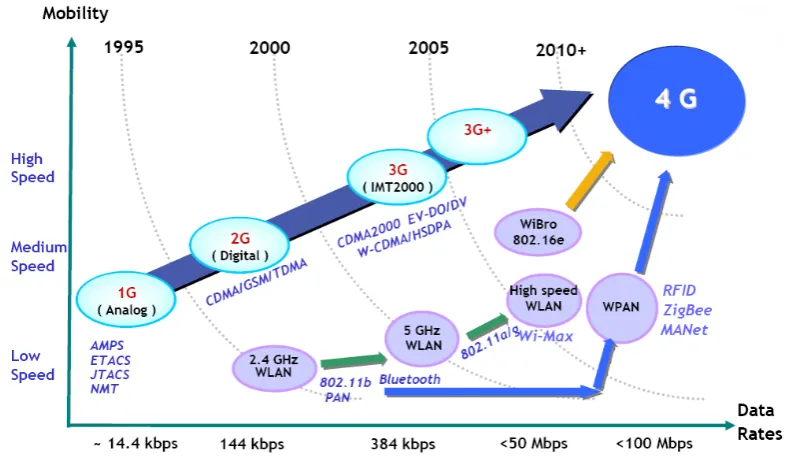
1.2 Evolution of wireless communication systems . . . 5
1.3 Wireless communications techniques overview . . . 7
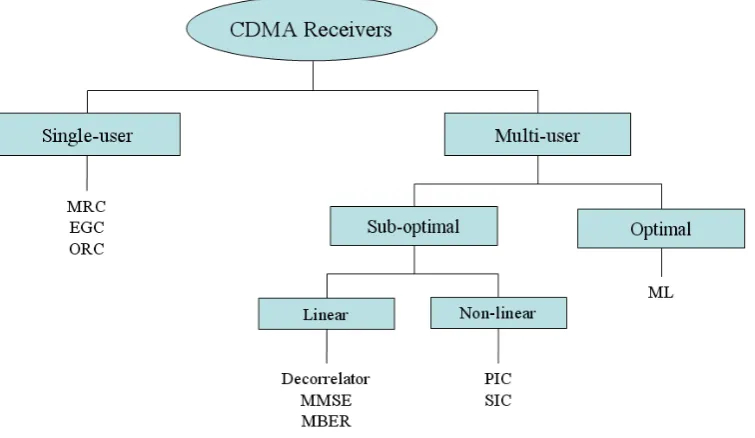
2.1 Classication of various CDMA receiver techniques . . . 14
2.2 Conventional (a) and optimum (b) K-user detector . . . 16
2.3 Arrangement of pilot symbols . . . 24
3.1 Block diagram of the MC-CDMA system . . . 30
3.2 Block diagram of the GA-assisted MMSE MUD receiver . . . 33
3.3 Illustration of VSL accessed multi-rate MC-CDMA . . . 37
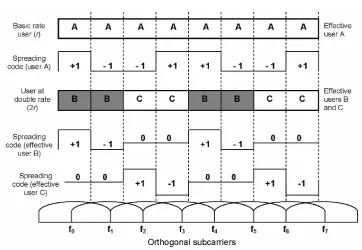
3.4 Pictorial illustration of the concept of eective users in VSL MC-CDMA multi-rate access . . . 38
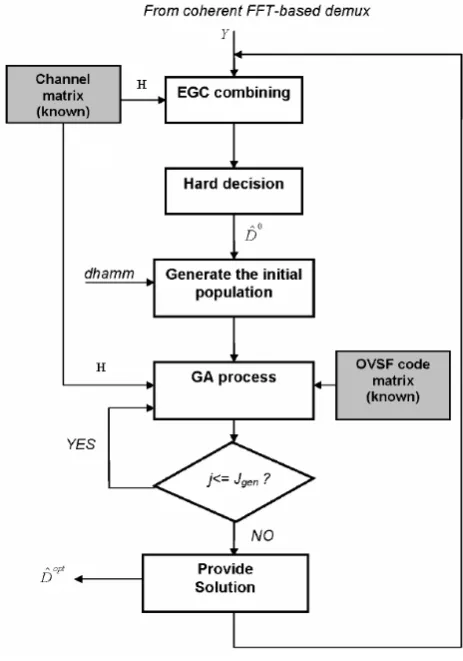
3.5 Flowchart of the proposed GA-assisted ML MUD algorithm . . . 40
3.6 The considered STBC MC-CDMA system (2x2) . . . 43
3.7 The considered STBC MC-CDMA system (2x1) . . . 50
5.1 PHY-layer recongurability . . . 68
5.2 General overview of the recongurable architecture . . . 70
5.3 Examples of basic blocks' organization . . . 71
5.4 Basic blocks of the Simulink library . . . 72
5.5 Innovative algorithms implemented in the Simulink library . . . 73
5.6 MCBER algorithm implemented in the Simulink library . . . 74 5.7 Digital Spectrum DSP module . . . 75 6.1 BER vs SNR for the simulated MC-CDMA receivers (with K = 9 users) . 80
6.2 BER vsK for the simulated MC-CDMA receivers (SNR = 20 dB) . . . 81
6.3 Receiver weight estimated by the considered algorithms for subcarrier #8 (N = 32, K = 15, SNR = 20 dB) . . . 82
6.4 GA updating standard deviation . . . 83 6.5 BER results vsEb/N0 provided by the dierent MUD algorithms assessed
(GA-assisted ML MUD, MMSE-SIC, MMSE-pcPIC, MMSE) and by the single-user bound: user class #1 (N1 = 4, rb1 = 1024 Kbps), urban 3GPP
vehicular channel, Jgen = 10,dhamm = 2 . . . 85
6.6 BER results vsEb/N0 provided by the dierent MUD algorithms assessed
(GA-assisted ML MUD, MMSE-SIC, MMSE-pcPIC, MMSE) and by the single-user bound: user class #2 (N2 = 8, rb2 = 512 Kbps), urban 3GPP
vehicular channel, Jgen = 10,dhamm = 2 . . . 86
6.7 BER results vsEb/N0 provided by the dierent MUD algorithms assessed
(GA-assisted ML MUD, MMSE-SIC, MMSE-pcPIC, MMSE) and by the single-user bound: user class #3 (N3 = 16, rb3 = 256 Kbps), urban 3GPP
vehicular channel, Jgen = 10,dhamm = 2 . . . 87
6.8 BER results vs SNR provided by the dierent signal detection algorithms assessed (with K = 2 users, N = 8 subcarriers, NT x = NRx = 2 antenna
elements) . . . 91 6.9 BER results vs SNR provided by the dierent signal detection algorithms
assessed (with K = 4 users, N = 8 subcarriers, NT x = NRx = 2 antenna
elements) . . . 92 6.10 BER results vs SNR provided by the dierent signal detection algorithms
assessed (with K = 7 users, N = 8 subcarriers, NT x = NRx = 2 antenna
6.11 Block diagram of the STBC MIMO MC-CDMA system with GA-assisted channel estimation . . . 95 6.12 BER performance yielded by LMS-based MCBER and ideal MMSE (with
ideal CSI knowledge and GA-assisted channel estimation), LMS-based MMSE multi-user detectors and EGC receiver (with ideal CSI knowledge) for N = 8 subcarriers and K = 2 users . . . 97
6.13 BER performance yielded by LMS-based MCBER and ideal MMSE (with ideal CSI knowledge and GA-assisted channel estimation), LMS-based MMSE multi-user detectors and EGC receiver (with ideal CSI knowledge) for N = 8 subcarriers and K = 4 users . . . 98
6.14 BER performance yielded by LMS-based MCBER and ideal MMSE (with ideal CSI knowledge and GA-assisted channel estimation), LMS-based MMSE multi-user detectors and EGC receiver (with ideal CSI knowledge) for N = 8 subcarriers and K = 6 users . . . 99
6.15 Variance of the channel estimation error measured for K = 6 users, N = 8
subcarriers, NT x = 2 and NRx = 1 antenna elements . . . 100
6.16 BER performance yielded by MRC detector of Eq. 6.6 (with ideal CSI knowledge, LMS-assisted, RLS-assisted, GA-assisted, and PSO-assisted channel estimation) for N = 32 subcarriers . . . 104
6.17 BER performance yielded by MRC detector of Eq. 6.6 (with ideal CSI knowledge, LMS-assisted, RLS-assisted, GA-assisted, and PSO-assisted channel estimation) for N = 64 subcarriers . . . 105
6.18 Variance of the channel estimation error measured forN = 32 subcarriers,
NT x = 2 and NRx = 1 antenna elements, both for the GA-assisted and the
List of Abbreviations and Acronyms
1G First Generation Wireless Communication System 2G Second Generation Wireless Communication System 3G Third Generation Wireless Communication System
3GPP 3G-Partnership Project
4G Fourth Generation Wireless Communication System
ACO Ant Colony Optimization
AFSA Articial Fish Swarm Algorithm
AMPS Advanced Mobile Phone System
ASF Antenna Subarray Formation
AWGN Additive White Gaussian Noise
BA Bees Algorithm
BER Bit Error Rate
BPSK Binary Phase Shift Keying
CFO Carrier Frequency Oset
CG Conjugate Gradient
CI Carrier Interferometry
CIR Channel Impulse Response
CSI Channel State Information
DD Decision-Directed
DS-CDMA Direct-Sequence Code-Division Multiple Access DS-SS Direct-Sequence Spread Spectrum
DSP Digital Signal Processor
DVB Digital Video Broadcasting
EDGE Enhanced Data Rates for Global Evolution
EGC Equal Gain Combining
EM Expectation Maximization
ETACS Extended Total Access Communications System
FFT Fast Fourier Transform
FOMA Freedom of Mobile Multimedia Access
GA Genetic Algorithm
GPRS General Packet Radio Service
GSM Global System for Mobile communications
HDTV High-Denition TeleVision
I-FFT Inverse Fast Fourier Transform
IMT-2000 International Mobile Telecommunications programme
IS Interim Standard
ITU International Telecommunication Union
JDC Japan Digital Cellular
LMS Least Mean Square
LS Least Squares
MAI Multi-Access Interference
MBER Minimum Bit Error Rate
MC-CDMA Multi-Carrier Code-Division Multiple Access MC-SS Multi-Carrier Spread Spectrum
MCBER Minimum Conditional Bit Error Rate MIMO Multiple Input Multiple Output MJBER Minimum Joint Bit Error Rate
ML Maximum-Likelihood
MM Majorize (Minorize) - Minimization (Maximization)
MMS Multimedia Messaging Service
MMSE Minimum Mean Square Error
MRC Maximal Ratio Combining
MSE Mean Square Error
MUD Multi-User Detection
NLMS Normalized Least Mean Square
NMT450 Nordic Mobile Telephone
NRZ Non-Return-to-Zero
NTT Nippon Telephone and Telegraph
OFDM Orthogonal Frequency Division Multiplexing ORC Orthogonality Restoring Combining
OVSF Orthogonal Variable Spreading Factor
PAPR Peak-to-Average Power Ratio
pcPIC Per-Carrier Parallel Interference Cancellation
PDF Probability Density Function
PIC Parallel Interference Cancellation
PSO Particle Swarm Optimization
QAM Quadrature Amplitude Modulation
QE Quantum Evolution
QoS Quality of Service
R&D Research and Development
RAx 3GPP Rural Area channel model
RF Radio Frequency
RLS Recursive Least Square
RT Recongurable Terminal
SDMA Space Division Multiple Access
SDR Software Dened Radio
SIMO Single Input Multiple Output
SINR Signal-to-Interference-plus-Noise-Ratio
SISO Single Input Single Output
SNR Signal-to-Noise Ratio
ST Space-Time
STBC Space Time Block Code
STTC Space Time Trellis Code
SVD Singular Value Decomposition
TACS Total Access Communications System
UMTS Universal Mobile Telecommunications System
VSL Variable-Spreading-Length
WCDMA Wideband Code Division Multiple Access WLAN Wireless Local Area Networks
WWRF Wireless World Research Forum
Chapter 1
Introduction
Wireless communication is one of the most active areas of research over the past and the current decades. A variety of services have been oered in such a context, starting from Voice, continuing to Data and now to Multimedia. Signicant reductions in cost and time can also be achieved using wireless solutions, providing even several benets to the users in terms of mobility and exibility in the placement of terminals. In fact, wireless mobile systems have begun to permeate all areas of our daily life and are therefore required to provide high-speed, high-capacity and high-quality services with performances closer to those aorded by wireline systems. This evolution has been made possible by academic and industrial Research and Development (R&D) labs with the implementation of three generations of cellular systems ([1]).
The rst-generation (1G) was analog-based. It used analog modulations and sent in-formation as a continuously varying waveform. The widespread commercial deployment of 1G systems started in the 1979s in Tokyo, Japan by Nippon Telephone and Telegraph (NTT). This was followed in Europe in 1981 by the Nordic Mobile Telephone (NMT450) system developed by Ericsson for Scandinavia, in 1982 by the Total Access Communi-cations System (TACS) for the United Kingdom and in 1985 by the Extended Total Access Communications System (ETACS) for the other european countries. Those sys-tems were not interoperable, given that the operating frequency was dierent in almost
each country. The situation was dierent in the United States, where only a single analog cellular standard called Advanced Mobile Phone System (AMPS) has been developed by Ameritech in 1983. These systems suered from low user capacity and had voice quality issues ([2, 3, 4]).
The second generation (2G) cellular systems use digital modulation schemes, source coding, and error correction coding techniques. These advances helped improve user capacity, voice quality, and spectrum eciency. The spreading of 2G systems started with the european Global System for Mobile communications (GSM) in 1990 ([5]) and continued with North American TDMA Systems (IS-54, IS-136) in 1992 and 1996, North American Spread Spectrum System (IS-95) in 1993 ([6]) and Japan Digital Cellular (JDC) in 1992 ([7]). GSM became the more widely used system throughout the world, providing an upgraded transmission technology with a single, unied standard in Europe. These systems were able to perfectly provide basic services (e.g., voice and low bit-rate data), but when demands for a variety of wideband services increased (e.g., high speed Internet access and video/high quality images transmission), the evolution toward third generation (3G) started. The rst step in this direction has been commonly accepted as the second and one-half generation (2.5G), with the development of new technologies always based on the classical GSM (e.g., General Packet Radio Service (GPRS) and Enhanced Data Rates for Global Evolution (EDGE)).
programme, IMT-2000. It is able to oer wideband services, such as wireless Internet services (with peak rate of 384 Kbps) and video transmissions (with data rate up to 2Mbps).
At the present time, it is predicted that the current 3G technology and its rst evolu-tions (commonly recognized as the third and one-half generation (3.5G)) will tend to be congested in few years. The research community and the telecommunications industry are therefore working to identify possible solutions for the fourth generation (4G) of wireless communications. It should be able to meet needs of future high-performance applications like wireless broadband access, Multimedia Messaging Service (MMS), video chat, mobile TV, High-Denition TeleVision (HDTV) content, and Digital Video Broadcasting (DVB). It requires an extension of the 3G capacity by an order of magnitude. The 4G tendency is to integrate mobile communications standards (specied by IMT) and Wireless Local Area Networks (WLAN). The resulting technology will be therefore based on a fully IP-based integrated system. The goal is to have data rates in the range 50-100 Mbps in cellular networks and around 1 Gbps in the WLAN environment, with premium quality and high security.
The 4G working group (the Wireless World Research Forum (WWRF), launched on Au-gust 2001 by the founding members Alcatel, Ericsson, Motorola, Nokia, and Siemens) has dened the following as objectives of the 4G wireless communication standard ([9, 10, 11, 12, 13]):
• a spectral ecient system
• high network capacity: more simultaneous users per cell
• a nominal data rate of 100 Mbps while the client physically moves at high speeds
relative to the station, and 1 Gbps while client and station are in relatively xed positions as dened by the ITU-R
Figure 1.1: The user-centric system presented in [14]
• seamless connectivity and global roaming across multiple networks • high quality of service for next generation multimedia support • interoperability with existing wireless standards
• an all IP, packet switched network.
An innovative vision of 4G systems has been provided by Frattasi et al. in [14]. As depicted in Fig. 1.1, the user is located in the center of the system and the dierent key features dening 4G rotate around him on orbits with a distance dependent on a user-sensitivity scale. Therefore, the further the planet is from the center of the system the less the user is sensitive to it. The user-centric system demonstrates that it is mandatory in the design of 4G to focus on the upper layers (max user-sensitivity) before improving or developing the lower ones. Without user friendliness, for example, the user cannot exploit his device and access to other features, such as user personalization.
The research community has already generated several enabling technologies for 4G, e.g., adaptive coding and modulation, iterative (turbo) decoding algorithms, space-time coding, multiple antennas and Multiple Input Multiple Output (MIMO) channels, multi-carrier modulation, multi-user detection, and ultra wideband radio.
Figure 1.2: Evolution of wireless communication systems
The subject of this thesis is inserted in such a framework, considering the study and development of novel techniques for physical layer optimization of diversity based smart terminals in the context of next-generation wireless communications.
1.1 The Motivations
In order to implement reliable wireless communication networks, it is necessary to con-sider the hostile physical properties of the wireless channel in the form of rapid time variation, fading, multipath propagation, and co-channel interference. Countermeasures should be employed in order to combat these impairments and to achieve high-speed communications, high-quality communications and/or high-capacity communications.
A widely considered solution consists of the use of diversity in the frequency, time, and space domains.
frequency spacing equal or larger than the coherence bandwidth of the channel.
The most common techniques actually used to exploit the frequency diversity are based on multi-carrier modulation: Orthogonal Frequency Division Multiplexing (OFDM) and Multi-Carrier Code-Division Multiple Access (MC-CDMA) ([15]).
In MC-CDMA, a user sends simultaneously his data stream over N subcarriers. Multiple users are supported by allowing each user to transmit over the same N subcarriers at the same time by using a unique spreading sequence (typically +1/-1 values) to separate the various users at the receiver.
Time diversity can be obtained by transmitting the information-bearing signal in dierent time slots, with the interval between successive time slots being equal to or grater than the coherence time of the channel.
The transmission technique that exploits this natural diversity in the time domain is Direct-Sequence Code-Division Multiple Access (DS-CDMA) with a Rake receiver ([15]). In DS-CDMA, each symbol of the data stream of each user is modulated by a known and unique spreading sequence. By using a Rake receiver, it is possible to demodulate each path of the composite multipath signal. In this way, all of the energy provided by the channel will be extracted.
Space diversity can be obtained by using multiple transmit or receive antennas, or both, with the spacing between adjacent antennas being chosen so as to ensure the independence of possible fading events occurring in the channel. The advantage of having NT x andNRx
multiple antennas at the transmitter and the receiver respectively is to transform the original wireless fading channels into MIMO wireless fading channels ([16]). It has been shown ([17]) that the link capacity can be increased bym = min (NT x, NRx)times relative
Figure 1.3: Wireless communications techniques overview
spatial diversity so as to enhance the reliability of the transmission.
The three types of diversity obtainable in multipath fading channels (frequency, time, and space diversity) can be exploited separately or jointly. In the rst case, the aforemen-tioned techniques are used, i.e., MC-CDMA or OFDM (frequency), DS-CDMA (time), and MIMO systems (space). In the second case, these basic techniques are partially or en-tirely combined to obtain new, more ecient, and more reliable transmission techniques. In Fig. 1.3, it is possible to nd a summary of the obtainable techniques.
1.2 The Problems and the Innovative Solutions
In the context of 4G wireless communications systems, the optimization of the radio link is a key issue to be faced. This thesis work jointly considers the diversity in space, time, and frequency domain, in order to provide performances very close to the single-user bound in multipath fading channels. In particular, new strategies for the joint optimization of antenna arrays and baseband receiver sections have been developed. From an algorithmic point of view, the novelty of the considered approach relies on the joint solution of the beamforming problem and the ecient reception for wireless systems equipped with an-tenna arrays. Usually, the problem of the anan-tenna arrays optimization and the problem of the baseband reception are separately considered in the current literature using dier-ent algorithms. On the contrary, the proposed methodology aims to found an integrated approach able not only to maximize the Signal-to-Interference-plus-Noise-Ratio (SINR) at the antenna arrays output but even to minimize simultaneously the Bit Error Rate (BER) at the output of the baseband receiver (both for single carrier and multi-carrier modulations).
This approach is completely dierent from the traditional Minimum Mean Square Er-ror (MMSE) criterion: the receiver aims to minimize directly the BER rather than the Mean Square Error (MSE) ([18]). Using this kind of approach, it is possible to inte-grate the space, time, and frequency diversities obtained, e.g., by using smart antennas, Direct-Sequence Spread Spectrum (DS-SS) modulation, and multi-carrier modulations (both OFDM and MC-CDMA). In this way, it is possible to mitigate the eects of the multipath propagation and to reject interference: both RF co-channel interference coming from other transmitters and baseband interferences (i.e., intersymbol interference, clipping noise, interchannel interference of OFDM systems, and multi-user interference in CDMA systems). In this work, considering that MBER approach has not been yet considered in MIMO MC-CDMA systems, it will be introduced into the multi-user detection of Space Time Block Coded (STBC) MIMO MC-CDMA signals.
conventional MMSE criterion. Despite its intrinsic sub-optimality, it is often preferred in practical applications of MC-CDMA due to its reduced computational load and because it can easily support adaptive implementations based on Least Mean Square (LMS) or Recursive Least Square (RLS) optimization algorithms ([19]). These approaches are very ecient from a computational point of view. However, their performances and conver-gence rates are strongly inuenced by the choice of the updating parameters. This draw-back makes them more suitable for static channels rather than for time varying fading channels ([20]). In this work, the application of evolutionary methodologies for optimiza-tion like Genetic Algorithms (GAs) has been considered to implement a semi-adaptive MMSE MUD reception in MC-CDMA systems transmitting information over multipath fading channels. Their use has been also investigated in order to implement a computa-tionally tractable Maximum Likelihood (ML) MUD detector for synchronous multi-rate MC-CDMA systems. GAs, an evolutionary computing method, are commonly recognized in the literature as valuable optimization tools. They are characterized by robustness, adaptation capability and reduced sensitivity to parameter setting ([21]). This technique was pioneered by Holland in the 60's and 70's and his work is comprehensively presented in [22], while useful practical details of genetic algorithms are available in [23, 24].
The GAs have been even used for the Channel Impulse Response (CIR) estimation, in conjunction with another evolutionary strategy, the Particle Swarm Optimization (PSO) algorithm. The PSO is a stochastic evolutionary computation technique developed by Kennedy and Eberhart in 1995 ([25]), inspired by social behavior of bird ocking or sh schooling.
In real systems, the fading channel coecients are not known to the receiver. They are explicitly estimated by the receiver and the estimate is used as if it were the exact Channel State Information (CSI), even if it is only a mathematical estimation of what is truly happening in nature. In such a context, GA- and PSO-assisted MMSE estimate of the channel matrix has been considered, in particular for diversity based 4G-systems.
implemented by taking into account their possible application in fully recongurable ter-minals capable of adapting their transmission layer to a change of status of the network. Therefore, they have been developed by considering adaptive design issues such as modu-larity and re-usability of software modules, in order to obtain an adaptive and optimized PHY-layer recongurability.
1.3 Research Contributions
Some parts of this thesis have been already published in international publications. In particular, the GA-assisted MUD approach described in section 3.1 has been presented in one conference paper and one journal paper:
• C. Sacchi, L. D'Orazio, M. Donelli, R. Fedrizzi, and F. G. B. De Natale, A genetic algorithm-assisted semi-adaptive MMSE multi-user detection for MC-CDMA mobile communication systems, in Proc. of PIMRC 2006 Conf., Sept. 2006.
• C. Sacchi, M. Donelli, L. D'Orazio, R. Fedrizzi, and F. G. B. De Natale, Genetic
algorithm-based MMSE receiver for MC-CDMA systems transmitting over time-varying mobile channels, Electronics Letters, vol. 43, no. 3, pp. 172173, Feb. 2007.
The adaptive MBER receiver for STBC MIMO MC-CDMA mobile communication sys-tems proposed in section 3.3 has been presented in one conference paper:
• L. D'Orazio, C. Sacchi, R. Fedrizzi, and F. G. B. De Natale, An adaptive
minimum-BER approach for multi-user detection in STBC-MIMO MC-CDMA systems, in Proc. of GLOBECOM 2007 Conf., Nov. 2007, pp. 34273431.
The results obtained by using the channel estimation technique presented in section 4.1 have been published in one conference paper:
detection with GA-assisted channel estimation for STBC-MIMO MC-CDMA mobile communication systems, in Proc. of ISSSTA 2008 Conf., Aug. 2008, pp. 182187. Other research contributions not presented in this dissertation are two conference papers:
• L. D'Orazio, C. Sacchi, F. Granelli, and F. G. B. De Natale, Situation-aware radio
resource management for multi-rate MC-CDMA wireless networks targeted at mul-timedia data exchanges in local areas, in Proc. of ACM MOBIMEDIA 2006 Conf., Sept. 2006.
• L. D'Orazio, C. Sacchi, and F. G. B. De Natale, Multicarrier CDMA for data trans-mission over HF channels: application to digital divide reduction, in Proc. of Aerospace 2007 Conf., March 2007.
1.4 Structure of the Thesis
This thesis consists of seven chapters. The outline of each chapter is as follows.
Chapter 1, the present chapter, gives an overview of the motivations, the dealed prob-lems and the proposed solutions. Moreover, it contains outline and research contributions of this dissertation.
Chapter 2 reviews the state of the art of multiple access interference avoidance/cancellation techniques for CDMA systems and overviews channel estimation techniques particularly used in multi-carrier and multiple antenna scenarios.
Chapter 3 and Chapter 4 introduce the proposed MUD techniques and consider the use of evolutionary strategies to channel estimation purposes, respectively.
Chapter 5 takes into account the possibility to use the presented algorithms in an adaptive and optimized recongurable system, given their modular implementation.
Chapter 2
State of the Art
At rst, a review of multiple access interference avoidance/cancellation techniques for CDMA systems is provided, considering both Single- and Multiple-User approaches. The second part of the chapter is dedicated to summarize the mostly used channel estimation techniques, in particular for multi-carrier and multiple antenna scenarios.
2.1 Multi-Access Interference Mitigation Techniques for CDMA
systems
The trend to deal with more and more simultaneous users tends to allow users to transmit simultaneously on the same frequency band, either using Single Input Single Output (SISO) or MIMO systems. It is well known that the capacity of a communication system is strongly limited by Multi-Access Interference (MAI). In wireless communication channels, the intentional non-orthogonal signaling (e.g., caused in CDMA systems by the cross-correlation between spreading codes of active users) or the non-ideal channel eects (e.g., due to multipath propagation) can lead to lose the orthogonality between multiple users' signals.
In this sub-section, an overview of various MAI reduction techniques will be provided (following the classication reported in Fig. 2.1, [26]).
Figure 2.1: Classication of various CDMA receiver techniques
2.1.1 Single-User Detection
The rst approach to deal with the MAI problem has been the simple use of the tra-ditional Single-User Detection receivers, where MAI is treated as noise and no use of information regarding the interference created by other users is done ([27]). The Maximal Ratio Combining (MRC) detector consists of a lter matched to the channel's transfer function. It is able to maximize the Signal-to-Noise Ratio (SNR) at the receiver output by reducing the attenuation and eliminating the phase rotation induced by the multipath reections ([20, 28]). This operation could further compromise the users' orthogonality. In order to mitigate this behaviour, the Equal Gain Combining (EGC) detector corrects only the phase rotation without handle the magnitude, and the Orthogonality Restoring Combining (ORC) or Zero Forcing (ZF) detector attempts to eliminate the channel eect by inverting its eects ([28, 29]).
multiple users' signals are characterized by widely varying power level disparities, users equipped with single-user detectors may lose communication. This phenomenon is known as the near-far eect and it can be alleviated by using power control schemes ([30]).
2.1.2 Multi-User Detection
The natural evolution of the research has been to take into account all the available infor-mation at the receiver in order to improve the CDMA receivers' performance by reducing or cancelling the MAI. The resulting multi-user detectors are generally characterized by a very high complexity but they oer a huge capacity improvement over the conventional single-user detectors ([31]). These methods are actually practical only at the base-station, where all the information is readily available and there are no power consumption con-straints.
The optimum multi-user receiver has been presented by Verdu in [32]. The sequence of symbols is selected by jointly considering the matched lter outputs of all users. Therefore, the resulting K-user Maximum-Likelihood (ML) sequence detector consists of a bank of single-user matched lters followed by a Viterbi algorithm whose complexity per binary decision isO(2K). It oers excellent performance gains over conventional systems but it
is too complicated for practical application, given that its complexity grows exponentially with the number of active users (see Fig. 2.2, [32]).
Thus, numerous sub-optimal approaches with acceptable complexity have been pro-posed in the literature. Excellent reviews of them can be found in [33, 34, 35, 36, 37, 38]. In general, they can be classied into two categories: linear and non-linear detectors.
In the linear multi-user detectors, the soft outputs of the conventional lters are linearly transformed to reduce the access interference and provide better performance. The most used are the decorrelating ([39]), the Minimum Mean Square Error (MMSE) ([40, 41]) and the Minimum Bit Error Rate (MBER) ([18]) detector.
(a) (b)
Figure 2.2: Conventional (a) and optimum (b)K-user detector
It has some interesting advantages over the conventional detector, e.g., the received sig-nal power does not have to be estimated or controlled and the near-far eect is strongly reduced ([37]). The disadvantages are the noise enhancement and the impossibility to eliminate any Inter-Symbol Interference (ISI) caused by channel dynamics. The compu-tational complexity is O(K3), due to the correlation matrix inversion.
The MMSE detector applies a linear transformation to the output of the conventional detector of a matched lter bank to minimize the square dierence between the transmit-ted symbol sequence and the estimatransmit-ted symbol sequence. The MBER detector aims to directly minimize the BER in output at the decoder.
A deeper dive into the last two approaches will be taken in the follow of the dissertation. In non-linear multi-user detectors (also called subtractive or interference cancellation detectors), the interfering signals are estimated and then removed from the received sig-nal before detection. The interference cancellation can be carried out either successively (Serial Interference Cancellation, SIC) ([42, 43]) or in parallel (Parallel Interference Can-cellation, PIC) ([44, 45]).
CDMA systems. In particular, the application to MC-CDMA systems of detectors based on the MMSE and MBER principles has been considered, both in the SISO and in the MIMO scenario.
The choice of these particular systems has been done in order to remain in the context of the diversity-based 4G-wireless communication devices presented in the former Chapter 1. MC-CDMA transmission techniques can jointly exploit the advantages of multi-carrier OFDM and single-carrier Spread Spectrum DS-CDMA techniques ([15]). As previously enounced, the basic MUD techniques for MC-CDMA are ML, MMSE and MBER detec-tion. For each of them, several modications have been proposed in the literature in order to increase the performance and reduce the computational complexity.
Unconventional mathematical tools have been recently used to implement near-optimum ML MUD algorithms characterized by a reduced computational load with respect to the Verdu's work [32] (polynomially growing with the number of active users instead of ex-ponentially). In [49] and in [50], a Genetic Algorithm (GA) and a Neural Network (NN) MUD receiver have been presented, respectively. Brunel used in [51] a low-complexity optimum lattice decoder (the sphere decoder) to jointly detect all users. Its complexity is a polynomial function of the number of users and is independent of the modulation size. Thus, it allows optimum performance even for full-loaded systems using large modula-tions, but only for low noise received signals.
Neither of the above techniques take into account the presence of Carrier Frequency O-sets (CFOs). It tends to destroy the orthogonality among users, greatly degrading the performance of MC-CDMA systems. Such a situation has been considered in [52], where a low computational load ML MUD receiver based on the use of Carrier Interferometry (CI) codes ([53]) has been presented. It exploits the sparsity of the cross-correlation matrix of CI codes to obtain a complexity that grows exponentially with the channel multipath length instead of the number of active users.
RLS algorithm have been presented in [19] and another one based on the Normalized Least Mean Square (NLMS) in [55]. They are very ecient from a computational point of view but their performances and convergence rates are strongly inuenced by the choice of the LMS/RLS updating parameters. A possible solution to this behaviour has been proposed in [19], consisting in the calculation of the receiver weights deriving from the explicit solution of the MMSE equation ([15]) by using an estimation of the channel matrix obtained through LMS/RLS methodologies. Such an approach can achieve better performance than fully adaptive MMSE solutions as well as increased robustness to the selection of the adaptation parameters. On the other hand, it may always suer from the same drawbacks of deterministic gradient based algorithms.
A more reliable solution in the presence of uncertainties about channel estimation and equalization has been described in [56], where a supplementary GA-based MUD stage has been inserted after a classical MMSE MUD stage, driven by a blind channel identication algorithm. Another blind linear MMSE detector and channel estimator is shown in [57]. It is based on the RLS updating of the correlation matrix, and the channel can be estimated blindly by solving the minimum eigenvector of a data sub-matrix. A new pilot-based channel estimation scheme has been used in [58] to drive a PIC stage with MMSE ltering. The MBER criterion has been applied in several works to DS-CDMA systems. Chen et al. proposed in [59] a LMS-style stochastic gradient adaptive algorithm based on the approach of kernel density estimation for approximating the BER from training data. A modied version of the same adaptive algorithm is shown in [60]. It is based on the Gradient-Newton algorithm and can speed up the convergence of the multi-user receiver, requiring shorter training data.
receiver that minimizes the conditional probability of error for reducing the complexity of the detector.
The ow of multimedia trac through wireless networks is constantly increasing, both in local and in metropolitan areas. Multimedia trac is characterized by heterogeneous data rates typical of the dierent streamed media. In this framework, ecient tech-niques for multi-user and multi-rate data transmission should be investigated. In the case of frequency-selective wireless channels and time-frequency diversity-based transmission techniques, the usual tradeo between data rate and robustness against channel eects becomes more evident. In a multi-rate context, the diversity gain of higher-data rate transmitters may be reduced with respect to lower-data rate ones. This typically happens in the 3G WCDMA PHY-layer standard of Universal Mobile Telecommunications System (UMTS) (based on DS-CDMA), where variable spreading factors [66] are attributed to various user classes in order to arrange multi-rate services ranging from 15 Kbps to 960 Kbps.
Multi-rate transmission can be fairly managed also by 4G MC-CDMA schemes by at-tributing to dierent user classes a dierent number of subcarriers and variable-length orthogonal spreading codes [67]. The usual tradeo between diversity gain and data rate turns on a lower number of subcarriers attributed to the fastest users that will be penal-ized with respect to slowest users in terms of channel degradation and MAI. In such a perspective, multi-rate MC-CDMA performances could be substantially improved by the adoption of multi-user detection.
All the above techniques are referred to SISO scenario, just considering the diversity in the frequency domain. Recent trends in R&D about mobile communication systems are going towards the joint exploitation of diversity concept in dierent domains (space, time, and frequency). In particular, there is an increasing interest concerning the integra-tion of MIMO techniques aimed at exploiting diversity in the space domain with digital transmission techniques aimed at exploiting diversity in time and frequency.
capacity without an expansion of the Radio Frequency (RF) bandwidth ([68]). Adaptive antenna arrays have been already used in wireless communication systems since late 1960s. Applebaum's paper [69] presented a method for adaptively optimizing the SINR in the presence of any type of noise environment (background noise and jamming signals). This work was the starting point for intelligent or self-congured and highly ecient systems: adaptive or smart antennas ([70]). They are aimed at separating a desired signal from interfering ones by controlling the radiation pattern of the array by adjusting the array weights so that a certain optimization criterion is met.
The conventional beamformers are based on the MMSE approach. Several beamforming algorithms based on it have been proposed in the literature (e.g., LMS and RLS algorithms [71], genetic algorithms based solutions [72]). Another usable approach is the MBER one ([73]). A solution based on this approach and on the use of genetic algorithms has been proposed in [74]. A comparison between dierent MBER-based beamforming algorithms is reported in [75].
The core idea in MIMO system is Space-Time (ST) signal processing in which the time dimension is complemented with the spatial dimension inherent to the use of multiple spatially-distributed antennas ([68, 76, 77]). Commonly used ST coding schemes are ST Trellis Codes (STTC) and STBC.
Closed form expressions for the average BER have been derived in [80] for STBC systems with generic number of transmit and receive antennas, transmitting data over MIMO correlated Nakagami-m fading channels.
The promising results yielded by MIMO and STBC techniques and the increasing importance of spread-spectrum and multi-carrier modulations in next-generation cellular systems design have recently suggested to researchers to protably combine diversity in dierent domains. Examples of space-time-frequency coding schemes have been shown by Petre et al. in [81] for MIMO DS-CDMA, by Bizzarri et al. in [82] for MIMO OFDM, and, nally, a thorough overview of MIMO MC-CDMA implementations has been proposed by Juntti et al. in [16].
In this last work, STBC MIMO MC-CDMA systems have been regarded among the most promising technologies for future cellular standards. They can jointly exploit diversity in dierent domains in order to counteract multipath fading eects and, therefore, to provide performances very close to the single-user bound.
The MUD problem in STBC MC-CDMA systems has been already dealt. The advan-tages taken by MMSE MUD in MAI cancellation are well evidenced in [83], both over Rayleigh and MIMO METRA ([84]) channels. In [85, 86, 87], eective schemes employing blind or semi-blind channel estimation techniques have been discussed. More advanced techniques have been recently presented in [88] and [89], where a GA-based MUD de-tector and a turbo iterative receiver for the downlink of STBC MC-CDMA systems are described, respectively.
Recent trends of R&D in diversity combining and MUD are moving from MMSE ap-proaches to MBER apap-proaches. In such a framework, recent literature has shown that BER cost function might be more suitable for MUD tasks than MSE one.
A combination of MMSE and MBER criterion has been presented in [76] to obtain a multi-stage linear receiver for MIMO multiplexing systems.
[91] with the presentation of another receiver which aims to minimize the joint probability of error for all users (MJBER).
The Space Division Multiple Access (SDMA) MIMO OFDM scenario has been considered in [92] and [93, 94]. The former presents a traditional adaptive Conjugate Gradient (CG) algorithm for arriving at the minimum solution of the BER cost function. It oers good performance but its convergence is sensitive to the choice of the algorithm's parameters (e.g., the initialization value and the step-size parameter). The latter uses a GA to over-come these problems. The MBER MUD's weight vectors are directly determined by the GA with a lower complexity than the CG algorithm.
An adaptive space-time equalisation ([68]) assisted MBER MUD scheme for Single Input Multiple Output (SIMO) systems is described in [95] and its evolution using decision feedback in [96, 97]. An iterative version of the same approach is shown in [98]. It is particularly suitable in the over-loaded scenarios.
Recently, a joint generalized scheme of antenna combination (using a modied version of the Antenna Subarray Formation (ASF) scheme presented by Karamalis et al. in [99]) and symbol detection based on the MBER criterion has been proposed in [100]. The two issues are jointly considered by solving the highly non-linear decision statistic through a PSO algorithm.
2.2 Channel Estimation Methods
All the previously presented detection techniques require the knowledge of the channel impulse response, which can be provided by a separate channel estimator. For wireless systems, channel estimation can be dicult and computationally intensive, in particular for those using multiple sub-bands and multiple antennas. In fact, its function is to estimate the amplitude and phase shift caused by the multipath propagation for every sub-band and for every transmit/receive antenna pair.
An extensive overview of channel estimation techniques employed in OFDM systems has been presented in [101], both for SISO and MIMO scenario. In the following sub-sections, given that estimation of the wireless channel is a very broad topic (e.g., more than 200 references are reported in [101]), a particular emphasis will be placed on the methods developed for multi-carrier and multiple antenna systems. Furthermore, considering that two MMSE channel estimation techniques based on GA and PSO will be presented in this thesis, the application of evolutionary strategies to channel estimation issues will be also considered.
2.2.1 Pilot-Assisted
Pilot-assisted methods use a subset of the available subcarriers to transmit training se-quences known to the receiver. The desired frequency domain channel transfer function is directly estimated over the pilots and an interpolation method is then used to obtain the remaining values. The most important issues are the optimum choice of training sequences, their placement, their dimension and the used interpolation method.
The importance of the pilot pattern choice has been evidenced in [102], by comparing in terms of BER several positioning of the pilot symbols, both in time and frequency. The number and placement of pilots in the time-frequency grid has been extensively studied in [103, 104, 105, 106, 107, 108, 109, 110], and their references. It represents an important topic, aecting not only the quality of CIR evaluation but the transmission rate as well.
The most considered interpolation methods are the polynomial interpolation (linear, quadratic, and cubic) ([111, 112, 113, 114]) and the Fast Fourier Transform (FFT) inter-polation ([115, 116]). In [111] and [117], the eectiveness of the linear interinter-polation in terms of system complexity, processing delay and estimation accuracy has been shown. A novel linear interpolator for OFDM systems has been presented in [118] by Doukas and Kalivas. Its performance in terms of MSE and BER have been expressed as a function of the number and distance of the pilots, and of the channel parameters.
a standard UMTS channel model are compared. One considers transmitting pilot and data symbols in the same OFDM symbol and performing interpolation in frequency be-tween pilot symbols. The other involves transmitting pilot and data symbols in separate OFDM symbols and interpolating in time (see Fig. 2.3 (a) and (b), respectively, [119]).
(a) (b)
Figure 2.3: Arrangement of pilot symbols
Bastug et al. proposed in [120] a three-step dedicated channel estimation procedure which exploits all the existing pilot sequences as well as the structured dynamics of the channel in WCDMA receivers. The method starts with block-wise dedicated and common chan-nel Least Squares (LS) estimates of the chanchan-nels associated with dedicated and common pilots. Afterward, the initial LS estimates are optimally combined to obtain an improved unbiased MMSE estimate of the dedicated channel, and, nally, it is further rened via Kalman ltering by exploiting the channel temporal correlation.
A robust pilot-based OFDM channel estimator based on the combination of low-pass l-tering and delay-subspace projection has been presented in [121].
MMSE-based frequency domain channel estimation is proposed in [122, 123, 124] for multiple-transmit antenna-assisted OFDM scenario.
approaches have been shown in [125] and [126] for MIMO OFDM systems. Their gener-alization in the context of the Majorize (Minorize) - Minimization (Maximization) (MM) algorithm has been presented in [127].
In [128], a PSO-assisted frequency osets and channel gains estimation algorithm for MIMO systems is described. The evolutionary strategy is used to obtain a rst estimate of the frequency osets (assuming that a training sequence is available). Then channel gains are estimated by ML estimator.
GAs are used in [129] to estimate low Peak-to-Average Power Ratio (PAPR) near-optimum training sequences for channel estimation in an OFDM system. It is shown that such training sequences are able to improve channel estimation and BER performance in a coherent system with a large number of sub-channels. A similar work has been presented in [130] in the context of multiple antenna aided systems.
2.2.2 Decision-Directed
The Decision-Directed (DD) approaches consider all the subcarriers as pilots. The channel estimation of a previous OFDM symbol is used for the data detection of the current estimation, and therafter the newly detected data is used for the estimation of the current channel. The resulting channel transfer function can be accurate in the absence of symbol errors and in particular for slowly varying fading channels, without signaling overhead.
Regarding the space-time coded OFDM scenario, a least-squares error channel estima-tor has been presented by Li et al. in [131]. It exploits the independence of the transmitted subcarrier symbol sequences to recover the dierent transmit antennas' channel transfer functions.
Jeon et al. considered in [132] a subtraction-based channel estimator for the case with two transmit and two receive antennas. For each specic receive antenna, the interfering signal contributions associated with the remaining transmit antennas are subtracted, re-sulting in a sort of frequency domain PIC-assisted DD channel estimation.
a further deepening in [134]. It can be considered as a simplication of [131]. Another reduced-complexity version of the method proposed in [131] has been described in [135]. It returns to consider the channel's correlation in the frequency direction instead of that in the time direction followed in the works of Li.
Gong and Letaief described in [136] a MMSE-assisted DD channel estimator as an exten-sion of the least-squares based approach presented in [131]. It is shown to be practical in the context of transmitting consecutive training blocks.
A robust and ecient EM-based estimation algorithm is considered in [137]. It partitions the problem of estimating a multi-input channel into independent channel estimations for each transmit-receive antenna pair. Another EM-based method has been described in [138] for MIMO STBC OFDM systems. It separates the superimposed received signals into their signal components and estimates the channel parameters of each signal compo-nent separately.
Wiener and Kalman channel estimation and tracking algorithms have been described in [139, 140] and [141, 142], respectively. A comparison of LMS and RLS channel estima-tion techniques has been provided in [143], showing the superiority of the latter over the former.
A novel channel estimation method which optimally combines the decision-directed and the previously described pilot-assisted framework has been shown in [144].
2.2.3 Blind
Blind methods do not require any training sequence to be transmitted but exploit the spatial or temporal structure of the channel or, alternatively, properties of the transmitted signal such as constant magnitude.
In [147], a method based on Singular Value Decomposition (SVD) accompanied by a simple block precoding scheme is described. Its advantage is that it does not require a decoder at the receiver side, but the coding rate decreases with the number of transmit-ting antennas. An improved version of the same method has been presented in [148]. It holds the advantages of the previously described scheme without sacricing the coding rate for any number of transmitting antennas (provided that the numbers of transmitting and receiving antennas are equal).
The traditional subspace based methods have been developed in [149] in the general context of digital communications. They can not be directly applied in MIMO-OFDM scenario if the number of antennas at the receiver is smaller than or equal to the number of antennas at the transmitter. Some solutions to this so-called multi-dimensional ambi-guity ([150]) have been proposed in [151, 152, 153, 154].
Coherent processing across the subcarriers has been used in [155] to estimate the channel in the time domain. It estimates the channel parameters in the time domain jointly for all subcarriers instead of doing this in the frequency domain independently for each sub-carrier.
A blind strategy addressed to the 2×1 Alamouti system is described in [156]. It estimates the channel parameters by computing the eigenvectors of a matrix containing 4th-order cumulant matrices of the observations. A similar work was presented in [157].
Several other techniques have been recently published in the context of STBC systems, both OFDM (e.g., [158, 159, 160, 161, 162]) and MC-CDMA (e.g., [163, 164, 165, 166, 167]).
A blind PSO-based MIMO channel identication technique has been presented in [168]. It uses particle swarm algorithm to estimate the outputs of channel equalizer, and put the estimation to the inverse lter algorithm. Therefore, it exploits the signal space diversity information and the signal time diversity information.
blind way and outperforms the original PSO.
Joint blind channel estimation and symbol detection schemes using GAs are described in [170] and [171]. The former is a single-user receiver divided into a two-layer optimization loop: the unknown channel model is obtained through a micro genetic algorithm (µGA, [172]) and then a set of Viterbi algorithms (one for each member of the channel population) is used to provide the maximum likelihood sequence estimation of the transmitted data sequence.
The latter is always based on the ML decision rule and proposes a multi-user detector that jointly performs the channel estimation and the symbol detection using the same GAs simultaneously.
Chapter 3
Novel Multi-User Detection Techniques
for Multi-Carrier CDMA Systems
This Chapter is aimed at describing some novel Multi-User Detection techniques partic-ularly suited for multi-carrier CDMA scenarios from an algorithmic point of view. Some common guidelines followed for their implementation will be provided in Chapter 5.
At rst, a GA-assisted MUD approach based on the MMSE criterion is described. Then, a GA-assisted Maximum-Likelihood MUD receiver for multi-rate MC-CDMA sys-tems will be proposed. Both are developed for single-antenna MC-CDMA syssys-tems. Fi-nally, the description of two MUD techniques based on the MBER approach will be provided for the multi-antenna STBC MC-CDMA context.
3.1 A Genetic Algorithm-Based Semi-Adaptive MMSE Receiver
for MC-CDMA Mobile Transmission Systems
In this section, a GA-assisted MUD approach is described for semi-adaptive per-carrier MC-CDMA systems transmitting over time-varying multipath fading channels. At rst, the description of the MC-CDMA received signal model is provided. Then, the GA-assisted MMSE MUD algorithm is detailed.
3.1.1 MC-CDMA Signal Model
The MC-CDMA transmitter applies the spreading sequences in the frequency domain. Each chip of the spreading code is mapped to an individual subcarrier, which maintains a data rate identical to the original input data rate ([15]). A block diagram of the MC-CDMA system is reported in Fig. 3.1 ([26]).
(a) Transmitter side
(b) Receiver side
Figure 3.1: Block diagram of the MC-CDMA system
The complex baseband equivalent multi-user signal of a synchronous downlink MC-CDMA system can be represented as:
x(t) = A
+∞
∑
i=−∞
N∑−1
n=0
K
∑
k=1
cknakiej(2πntT )p(t−iT) (3.1)
where:
• N is the number of subcarriers
• K is the number of active users
• ckn represents the n-th chip of the spreading sequence of the k-th user (Hadamard-Walsh sequences of length N have been employed)
• ak
i is the message symbol transmitted by the k-th user during the i-th signalling
period of duration T
• p(t)is a Non-Return-to-Zero (NRZ) rectangular signalling pulse shifted in time given
by:
p(t),
1 for 0 ≤t≤T
0 otherwise.
(3.2)
Let's suppose to employ a Binary Phase Shift Keying (BPSK) modulation (i.e., ak i ∈
{−1,+1}), so that each transmitted symbol corresponds to a single bit.
The signal expressed in Eq. 3.1 is transmitted over a Rayleigh multipath-fading chan-nel, characterized by a delay spreadTm and a Doppler spreadBd. The transmission data
rate is chosen in order to assure at fading over each single subcarrier (i.e.,T ÀTm) and
the signal amplitudeA is equal to 1.
Under such hypothesis, the received MC-CDMA signal can be expressed as follows:
y(t) =
+∞
∑
i=−∞
N∑−1
n=0
K
∑
k=1
hn(t)ckna k ie
j(2πntT )
p(t−iT) +η(t) (3.3)
where hn(t) is the complex time-varying channel coecient related to subcarrier n, and
η(t)is the Additive White Gaussian Noise (AWGN).hn(t)is a complex Gaussian process
with Rayleigh-distributed envelope and uniformly-distributed phase. The samples ofη(t)
are independent and identically-distributed in Gaussian way, with zero mean and variance σ2
η.
1/T. The sample obtained from the subcarriernduring thei-th signalling interval is given
by:
yn(i) = hn(i) K
∑
k=1
cknaki +ηn(i) (3.4)
The received signal energy scattered in the frequency domain is then combined by mul-tiplying each sample yn(i) by a specic gain. The resulting decision variable is given
by:
λk(i) =
N∑−1
n=0
wn(i)yn(i) (3.5)
3.1.2 The Proposed GA-Assisted MMSE MUD Receiver Structure
The choice of the diversity-combining weights can be done according to the various tech-niques proposed in the previous Chapter 2 (i.e., EGC, MRC, ORC,...). In particular, a per-carrier MMSE multi-user detector has been considered in this part of the work ([19]).
The corresponding optimization criterion is to nd anN-element weight vectorwOpt.(i) =
[
wOpt.0 (i), . . . , wOpt.N−1(i)
]
that minimizes the mean square error between the equalized re-ceived signal and the noise-less pattern we would have on each subcarrier at the receiver. Such a problem can be formalized as follows:
wOpt.n (i) = arg min
wn(i)
E ¯¯ ¯¯ ¯ ( K ∑ k=1
cknaki
)
−wn(i)yn(i)
¯¯ ¯¯ ¯
2
(3.6)
where E{·} represents the mathematical expectation operator. The explicit solution to Eq. 3.6 is the following ([15, 19]):
wOpt.n (i) = h
∗
n(i)
|h∗n(i)|2+2σ2
η/KEc
(3.7) where Ec is the energy per chip and the superscript operator ∗ is the complex conjugate
operator.
The use of the ideal weights expressed in Eq. 3.7 requires the exact knowledge of the N-element channel vector h(i) = [h0(i), . . . , hN−1(i)]. If it is not available, the realh(i)
techniques described in section 2.2 of the previous Chapter 2. Nevertheless, such an operation would increase the computational complexity of the receiver.
To avoid this additional task, a semi-adaptive GA-assisted MMSE MUD strategy has been analyzed. It is articulated into two dierent steps:
(a) Training-aided step
(b) Decision-Directed step
Figure 3.2: Block diagram of the GA-assisted MMSE MUD receiver
of B bits is transmitted for each user k. The task of GA is to compute for each subcarrier the weight wˆT rn (i) that minimizes the following metric:
Λ ( ˆwn(i)) =
1 B B ∑ i=1 ¯¯ ¯¯ ¯ ( K ∑ k=1
ckn˜aki
)
−wˆn(i)yn(i)
¯¯ ¯¯ ¯
2
(3.8) The GA-based computation of the optimal weights is performed after having buered B samples of the received signal yn(i) (see Fig. 3.2 (a)). The ensamble average of
Eq. 3.6 has been replaced in Eq. 3.8 by the sample average made on the entire duration of the training sequence. The GA convergence would be seriously aected by noise eects (particularly at low SNR) if such an average operation would not be performed. This approximation is correct if the channel can be modeled as an ergodic stochastic process. It can be shown that the GA-based estimation of the MMSE weights is unbiased if the following relation is valid for each subcarrier:
1 B B ∑ i=1 ( K ∑ k=1
ckn˜aki
)2
=K (3.9)
It happens when the training sequences of the users are orthogonal. If they are ob-tained from Hadamard-Walsh matrices, some limitations are imposed to the system. In particular, the training sequences' length has to be equal to a power of two and greater than the number of users (i.e.,B > K).
The GA works with a selected parameterisation in terms of generation numberGT r,
population sizePT r, crossover and mutation probabilitiesαT r and γT r, respectively.
This training step is repeated with a period approximately equal to the coherence time of the channel.
the solution computed during the training-aided step (i.e., wˆT r(i)). During each
symbol period, a single generation of individuals is produced. The new population is stochastically generated in Gaussian way starting from the solution computed at the previous signalling period wˆDD(i−1) and imposing to the Gaussian generator an
updating standard deviationσup. Such a system parameter is linked to the Doppler
spread and to the SNR. An explicit mathematical link is very dicult to be ob-tained. It should be increased as Doppler spread and SNR increase. Experimental trials pointed out that a good choice for this parameter is:
σup'max i,n
{¯¯wOpt.n (i)−wOpt.n (i−1)¯¯} (3.10)
Among the new population, it is chosen the individual that minimizes the following metric:
Ω ( ˆwn(i)) =
¯¯ ¯¯ ¯ ( K ∑ k=1
cknˆaki
)
−wˆn(i)yn(i)
¯¯ ¯¯ ¯
2
(3.11) Given that only one generation runs, crossover and mutation operators do not work in such a step (i.e., the values of crossover and mutation probabilities are αDD = 0
and γDD = 0, respectively). The generation number GDD is equal to one and the
population size PDD has to be chosen. The estimated data symbol ˆaki is used to
calculate the tness function Ω ( ˆwn(i)).
This updating procedure is light, but it is reasonable because only small variations of the channel amplitude and phase are to be tracked during the coherence period. Moreover, in such a way, the eect of possible symbol errors on weight estimation are conveniently reduced.
These two steps are opportunely combined to obtain the whole GA-based MMSE MUD procedure. It can be summarized as follows:
i) At time t = 0 the GA-based procedure is initialised by a constant-value
popu-lation wˆ (0) = [1, . . . ,1].
is computed by minimizing the per-carrier cost function of Eq. 3.8. The GA parameters (GT r, PT r,αT r, γT r) are opportunely chosen.
iii) The Training-aided step ends with the computation of the receiver weights at the time t = BT +εT (ε is the execution time of the GA-based optimisation procedure expressed in number of bit periods). Now, the GA switches to the Decision-directed modality and its parameters are reassigned as follows: GDD =
1, αDD = 0, and γDD = 0. The population size PDD has to be chosen.
iv) The Decision-directed updating step ends at the time t = BT +εT +WcohT,
whereWcohis the coherence time-window of the channel. The GA is re-initialised
with the weights computed at the end of the coherence time-window and re-parameterised in order to start again with the Training-aided step of ii).
3.2 Genetic Algorithm-Assisted Maximum-Likelihood Multi-User
Detection for Multi-Rate MC-CDMA Systems
In this section, the application of GAs to multi-rate MC-CDMA multi-user detection is proposed and discussed in order to obtain a near-optimum solution to the ML MUD problem, reached by spending a reasonable computational eort. The claimed objective is, in particular, to maintain the computational burden of a polynomial order with respect to system parameters. At rst, the description of the multi-rate Variable-Spreading-Length (VSL) MC-CDMA received signal model is provided. Then, the GA-assisted ML MUD algorithm is detailed.
3.2.1 Multi-Rate VSL MC-CDMA Transmission
user population is subdivided into user classes, each one transmitting a digital data stream over a subset of Nm subcarriers, whose cardinality is an integer fractional value
of N and depends on the channel bitrate rm. More in details, M bitrate classes can be
dened by the rule: rm = 2(M−m)·r (with m = 1, . . . , M), where r = 1/T is the bitrate
of the slowest user class (i.e., classM), also named basic data-rate of the system. The data stream of a user of class m is converted into m parallel outputs. Symbols at each output are copied over Nm =N/2(M−m) branches and then respectively being multiplied
by the corresponding bit of spreading codes whose length isNm. A block diagram of the
corresponding transmitter scheme is depicted in Fig. 3.3 ([67]).
Figure 3.3: Illustration of VSL accessed multi-rate MC-CDMA
The baseband transmitted signal of theu-th user with rate rm