Sorbus gongshanensis
(Rosaceae), a new species from
the Hengduan Mountains, China
Meng Li1, Xin-Fen Gao2, Jing Tian3,4, Wen-Bin Ju2
1 Co-Innovation Center for Sustainable Forestry in Southern China, College of Biology and the Environment, Nanjing Forestry University, Nanjing, China 2 Chengdu Institute of Biology, Chinese Academy of Sciences, Chengdu, China 3 Wuhan Botanical Garden, Chinese Academy of Sciences, Wuhan, China 4 Sino-Africa Joint Research Center, Chinese Academy of Sciences, Wuhan, China
Corresponding author:Meng Li ([email protected])
Academic editor:H. Schaefer | Received 15 November 2019 | Accepted 13 February 2020 | Published 17 March 2020
Citation: Li M, Gao X-F, Tian J, Ju W-B (2020) Sorbus gongshanensis (Rosaceae), a new species from the Hengduan Mountains, China. PhytoKeys 144: 1–9. https://doi.org/10.3897/phytokeys.144.48516
Abstract
Sorbus gongshanensis sp. nov., a new species from the Hengduan Mountains China, is described and illus-trated. It is similar to S. kurzii from China (Yunnan & Xizang), Nepal, and Sikkim in the size of the leaflets, glabrous veins, persistent (sometimes) herbaceous stipules and reddish brown villous inflorescences and red fruits, but differs in its serrate leaflet margins toothed in the distal half or often almost to their base, reddish brown villous to glabrous hypanthium and reddish brown villous infructescences, among other characteristics.
Keywords
Flora of China, taxonomy, Yunnan, Xizang
Introduction
Sorbus L. sensu lato (s.l.; Rosaceae) comprises about 260 species distributed in the
tem-perate zone of the Northern Hemisphere (Aldasoro et al. 1998; Lu and Spongberg 2003; Zika and Bailleul 2015; Sennikov and Kurtto 2017). Both molecular (Campbell et al. 2007; Lo and Donoghue 2012) and morphological evidence (Zheng and Zhang 2007) suggests that Sorbus s.l. is polyphyletic. Sorbus sensu stricto (s.s.) includes ca. 80 species and is characterized by pinnately compound leaves. Recent molecular study of
Sorbus s.s. suggests that the most recent common ancestor originated in eastern Asia (Li
et al. 2017). The greatest diversity of species of Sorbus s.s. (ca. 60 species) is found in the http://phytokeys.pensoft.net
Copyright Meng Li et al. This is an open access article distributed under the terms of the Creative Commons Attribution License (CC BY 4.0), which permits unrestricted use, distribution, and reproduction in any medium, provided the original author and source are credited.
Meng Li et al. / PhytoKeys 144: 1–9 (2020)
2
mountains of southwestern China (principally the Hengduan mountains) and adjacent areas of Myanmar, Nepal, and the eastern Himalaya (Long 1987; Lu and Spongberg 2003; McAllister 2005; Watson and Manandhar 2012). This region is one of the world’s biodiversity hotspots, as it also is for the genus Sorbus (Myers et al. 2000; Li et al. 2017).
While studying Sorbus for the Flora of Pan-Himalaya Project, we found several accessions from Yunnan and Xizang, China, at the Harvard University Herbarium (GH) that were markedly different from other species of Sorbus. After detailed mor-phological examination, field investigation and literature study, it was concluded that these specimens represent an undescribed species, which we name S. gongshanensis. The description of S. gongshanensis is based on dried herbarium specimens stored at GH (all herbarium acronyms in this paper follow Thiers 2019).
Material and methods
Morphological study was based on specimens deposited in the following herbaria: A, BM, CAS, CDBI, G, GH, K, KUN and NF. Macroscopic descriptions were based on the specimen sheets and notes made in the field. Detailed observations were conducted us-ing an optical microscope. For scannus-ing electron microscopy (SEM), dried pollen grains and stomata were mounted on metal stubs and sputtered with technical gold, and then were observed under Phenom proX SEM at 10 kV accelerating voltage at the Chengdu Institute of Biology, CAS. Pollen grains come from the field collection from Motuo [China, Xizang, Meng Li 00281(NF)]. Terminology of descriptive terms followed Flora of China vol. 9 (Lu and Spongberg 2003). Conservation assessment was based on the known distribution data and followed the IUCN red list category criteria (IUCN 2017).
Results
Taxonomic description
Sorbus gongshanensis Xin-Fen Gao & Meng Li, sp. nov. urn:lsid:ipni.org:names:77208266-1
Figs 1, 2
Type. China. Yunnan: Gongshan County, Bingzhongluo Xiang. Vicinity of Fucai, on the north side of Nianwaluo River, ca. 10.8 direct km of Bingzhongluo, east side of Gaoligong Mountains, 28°0.47'N, 98°31.11'E, alt. 2780 m, 1 Sept. 2006. Gaoligong
Shan Biodiversity Survey (2006) 31749 (holotype: GH; isotypes: CAS, KUN).
Diagnosis. Similar to S. kurzii, but differs in its serrate leaflet margins toothed in the distal half or often almost to their base, reddish brown villous to glabrous hypan-thium and reddish brown villous infructescences.
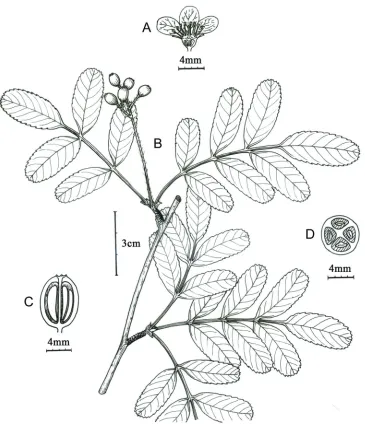
Figure 1. Main morphological characters of Sorbus gongshanensisA flower, longitudinal section B fruit-ing branch C fruit, longitudinal section D fruit, cross section.
Meng Li et al. / PhytoKeys 144: 1–9 (2020)
4
Figure 2. Sorbus gongshanensisA habit B stipules and reddish-brown hairs on infructescences C leaves D sto-mata of abaxial blade surface E inflorescence F perprolate shape pollen, length of polar axis (33.03 ± 2.67 μm) and equatorial (16.61 ± 2.44 μm) diameter G striate-perforate ornamentation of pollen grains.
sparsely reddish brown villous; pomes red, globose to subglobose, 6–8 mm in diam.; sepals inconspicuous, incurved when fruiting. Seeds brown, ovoid-lanceoloid, 3–4 × 1.2–1.5 mm, slightly asymmetric.
Etymology. The specific epithet refers to the type locality, Gongshan County.
Phenology. Flowering May–July, fruiting September–October.
Distribution and ecology. Sorbus gongshanensis is known from the Yunnan & Xizang Province, China (Fig. 3). It grows in broad-leaved forests or on rocky slopes; 2500–3000 m.
Specimens examined. China. Yunnan: Gongshan County, Cikai Xiang, east side of Gaoligong Mountains, along the Danzhu River, on the roadside from Nu Jiang to Danzhu, 27°37.82'N, 98°37.30'E, alt. 2650 m., 2 July 2000. Li Heng 11905 (GH, CAS, KUN). Xizang: Motuo County, 80k to Galung La, 29°42.30'N, 95°34.24'E, alt. 2782 m., 2 June 2015. Meng Li 00281 (CDBI, NF).
Conservation status. The distribution of S. gongshanensis is based on three collec-tions. The collection notes mention that S. gongshanensis is occasional in forests among boulders. There is no direct or indirect information about its current conservation sta-tus or possible threats. We therefore assign the conservation stasta-tus of S. gongshanensis as ‘Data Deficient (DD)’ according to the IUCN red list criteria (IUCN 2017).
Discussion
Sorbus species show a high level of similarity in flower structure and color. The
Meng Li et al. / PhytoKeys 144: 1–9 (2020)
6
Figure 4. Type materials of four similar species distinguishing Sorbus gongshanensis A Sorbus kurzii
useful floral morphological characteristics are limited, pairs of leaflets, leaflet size, serra position, stipule shape and fruit color can provide valuable information for the identi-fication of Sorbus at the species level.
A few species in the Hengduan Mountains have few pairs of leaflets. This group includes S. helenae Koehne (3–4 pairs), S. insignis (Hook. f.) Hedl. (3–6 pairs), S. kurzii
(Watt ex Prain) C. K. Schneid (3–6 pairs) and S. macallisteri Rushforth (1–2 pairs) (Hed-lund 1901; Hooker 1878; Koehne 1913; Prain 1904; Rushforth 1991; Schneider 1906) (Fig. 4 and Table 1). Sorbus gongshanensis is easily distinguished from all others by several distinctive characteristics (Long 1987; Lu and Spongberg 2003; Watson and Manand-har 2012) (Table 1). The red fruits distinguish S. gongshanensis from all species except S.
kurzii. However, S. gongshanensis differs in its serrate leaflet margins toothed in the distal
half or often almost to their base, the hypanthium reddish brown villous or glabrous and infructescences reddish brown villous. In all other species (exclude S. gongshanensis and
S. kurzii), the fruits are typically white. Sorbus gongshanensis is also distinguished from
S. macallisteri, S. helenae, and S. insignis by its persistent herbaceous stipules when
fruit-ing (Table 1). Furthermore, S. gongshanensis have 2–4 pairs of leaflets which have serrate margins. Sorbus macallisteri only has 1–2 pairs of leaflets with few teeth. Sorbus helenae
and S. insignis both have more pairs of leaflets (3–6 pairs) with the leaflets also longer and
broader (10–20 cm long, 1.7–4 cm wide) than S. gongshanensis (Table 1).
There are also several species sometimes with few pairs of leaflets found in other geographic regions. They are S. gracilis (Siebold et Zucc.) K. Koch [3–6 pairs of leaf-lets, distributed in Japan (Honshu, Shikoku, and Kyushu)], S. sargentiana Koehne (3–5 pairs of leaflets, distributed in southwest Sichuan Province, and northeast Yun-nan Province), S. sambucifolia (Chamisso & Schlechtendal) M. Roemer (3–5 pairs of leaflets, distributed in Alaska, Japan, and the Russian Far East), and S. sitchensis
M. Roem. (3–5 pairs of leaflets, distributed in the Pacific Northwest) (Chamisso and
Table 1. Comparison of characters distinguishing Sorbus gongshanensis and similar species.
Sorbus gongshanensis S. kurzii S. macallisteri S. helenae S. insignis
Leaf & petiole
length (cm) 8–10 & 1.5–2.5 7–11 & 1.2–2.8 3.5–6 & 1–1.8 13–20 & 2.5–4 10–15 & 1.7–3
Pairs of leaflets 2–4 3–6 1–2 3–4 3–6
Leaflet size (cm) 2.8–3.5 × 1–1.5 1.8–3.2 × 0.8–1.8 1.7–3 × 0.7–1.4 5–9 × 2–3 3–5 × 1–2 Margins Deep toothed 1/2
way and often almost to base
Finely toothed in
upper 1/2 Few teeth Serrate or doubly serrate Finely toothed in upper 1/2 or 1/4
Veins Glabrous Glabrous Glabrous Reddish brown
villous along veins Glabrous Stipules Herbaceous, semiorbicular, persistent Herbaceous, lanceolate, persistent Membranous, lanceolate, caducous Membranous, lanceolate, caducous Membranous, lanceolate, caducous Inflorescences Reddish brown villous Reddish brown
villous Glabrous Reddish brown villous Slightly pubescent Hypanthium Reddish brown villous
to glabrous Glabrous to pubescent Glabrous Glabrous Glabrous to pubescent Infructescences Reddish brown villous Glabrous Glabrous Glabrous to
pubescent Glabrous
Meng Li et al. / PhytoKeys 144: 1–9 (2020)
8
Schlechtendal 1827; Koch 1853; Koehne 1913; Roemer 1847; Siebold and Zuccarini 1846). Sorbus sargentiana, S. sambucifolia, and S. sitchensis have larger infructescences when fruiting (more than 30 fruits), while S. gracilis has large stipules (1.5 × 1.5 cm) at the nodes of the inflorescences. Sorbus gongshanensis can be easily distinguished from these four species by its few fruits and small stipule size.
Acknowledgments
The authors thank curators and staff at A, BM, CAS, CDBI, G, GH, K, KUN and NF for providing access to the herbarium material in their care. Our special thanks go to Anthony R. Brach and Kanchi N. Gandhi for help and suggestions, and to David E. Boufford, Danny Schissler and Steven Sylvester for linguistic help. This study was partially supported by grants from National Natural Science Foundation of China (Grant No. 31670192) to Xin-Fen Gao, and by the 2016 Shiu-Ying Hu Student/Post-Doctoral Exchange Award from Arnold Arboretum of Harvard University and NJFU Scientific Research Starting Foundation (Grant No. GXL2018039) to Meng Li.
References
Aldasoro JJ, Aedo C, Navarro C, Garmendia FM (1998) The genus Sorbus (Maloideae, Rosace-ae) in Europe and in North Africa: Morphological analysis and systematics. Systematic Botany 23(2): 189–212. https://doi.org/10.2307/2419588
Campbell CS, Evans RC, Morgan DR, Dickinson TA, Arsenault MP (2007) Phylogeny of sub-tribe Pyrinae (formerly the Maloideae, Rosaceae): limited resolution of a complex evolu-tionary history. Plant Systematics and Evolution 266: 119–145. https://doi.org/10.1007/ s00606-007-0545-y
Chamisso LKAv, Schlechtendal DFLv (1827) De plantis in expeditione speculatoria Romanzo-ffiana observatis. Linnaea: Ein Journal für die Botanik in ihrem ganzen Umfange 2: 1–37. Hedlund T (1901) Monographie der Gattung Sorbus. Kungliga Svenska
Vetenskaps-Akade-miens Handlingar nov ser 35: 1–147.
Hooker JD (1878) Rosaceae. In: Hooker JD (Ed.) The Flora of British India (Vol. 2). L. Reeve, London, 307–388.
IUCN (2017) Guidelines for using the IUCN Red List categories and criteria. Version 13. Prepared by the Standards and Petitions Subcommittee. http://www.iucnredlist.org/docu-ments/RedListGuidelines.pdf
Koch K (1853) Hortus Dendrologicus: Verzeichnis der Bäume, Sträucher und Halbsträucher, die in Europa, Nord- u. Mittelasien, im Himalaya und in Nordamerika wild Wachsen und Möglicher Weise in Mitteleuropa im Freien Ausdauern; Nach dem Natürlichen Systeme und mit Angabe aller Synonyme, so wie des Vaterlandes, Aufgezählt und mit Einem Alpha-betischen Register Versehen, 1–346.
Univer-sity during the years 1907, 1908, and 1910 by E H Wilson. Cambridge UniverUniver-sity Press, Cambridge, 457–483. [Index Herbariorum: A global directory of public herbaria and as-sociated staff. http://sweetgum.nybg.org/ih/ [accessed 4 May 2019]]
Li M, Ohi-Toma T, Gao Y-D, Xu B, Zhu Z-M, Ju W-B, Gao X-F (2017) Molecular phyloge-netics and historical biogeography of Sorbus sensu stricto (Rosaceae). Molecular Phylogenet-ics and Evolution 111: 76–86. https://doi.org/10.1016/j.ympev.2017.03.018
Lo EYY, Donoghue MJ (2012) Expanded phylogenetic and dating analyses of the apples and their relatives (Pyreae, Rosaceae). Molecular Phylogenetics and Evolution 63(2): 230–243. https://doi.org/10.1016/j.ympev.2011.10.005
Long DG (1987) Sorbus. In: Grierson AJC, Long DG (Eds) Flora of Bhutan: Including a Record of Plants from Sikkim (Vol. 1, Part 3). Royal Botanic Garden Edinburgh, Edinburg, 592–599. Lu LT, Spongberg SA (2003) Sorbus L. In: Wu ZY, Raven PH, Hong DY (Eds) Flora of China
9. Science Press, Beijing & Missouri Botanical Garden Press, Saint Louis, 144–170. McAllister H (2005) The Genus Sorbus – Mountain Ash and Other Rowans. Royal Botanic
Gardens, Kew, 252 pp.
Myers N, Mittermeier RA, Mittermeier CG, da Fonseca GAB, Kent J (2000) Biodiver-sity hotspots for conservation priorities. Nature 403(6772): 853–858. https://doi. org/10.1038/35002501
Prain D (1904) Some new Indian plants. Journal of the Asiatic Society of Bengal Part 2 Natural History 73: 192–206.
Roemer MJ (1847) Familiarum Naturalium Regni Vegetabilis Synopses Monographicae. III. Landes-Industrie-Comptoir, Weimar, 226 pp.
Rushforth K (1991) Bhutanese Sorbi, the rowans and whitebeams of Bhutan. Plantsman (Lon-don, England) 13: 111–124.
Schneider CK (1906) Pomaceae sinico-japonicae novae et adnotationes generales de Pomaceis. Bulletin de l’Herbier Boissier 2: 314–319.
Sennikov AN, Kurtto A (2017) A phylogenetic checklist of Sorbus s.l. (Rosaceae) in Europe. Memoranda Societatis Pro Fauna Et Flora Fennica 93: 1–78.
Siebold PFv, Zuccarini JG (1846) Florae Japonicae familiae naturales, adjectis generum et spe-cierum exemplis selectis. Sectio prima. Plantae dicotyledoneae Polypetatae. Abhandlungen der Mathematisch-Physikalischen Classe der Königlich Bayerischen Akademie der Wis-senschaften 4: 109–203. https://doi.org/10.5962/bhl.title.10718
Thiers B (2019) Index Herbariorum: A global Directory of Public Herbaria and Associated Staff. New York Botanical Garden’s Virtual Herbarium. The New York Botanical Garden. http://sweetgum.nybg.org/ih/ [accessed 05.2019]
Watson MF, Manandhar VK (2012) Sorbus L. In: Watson MF, Akiyama S, Ikeda H, Pendry CA, Rajbhandari KR, Shrestha KK (Eds) Flora of Nepal. Royal Botanic Garden Edin-burgh, EdinEdin-burgh, 25–32.
Zheng DM, Zhang ML (2007) A Cladistic and Phenetic Analysis of the Infrageneric Relation-ships of Sorbus s.l. (Maloideae, Rosaceae) Based on the Morphological Characters. Acta Horticulturae Sinica 34: 723–728. (In Chinese). http://dx.doi.org/10.3321/j.issn:0513-353x.2007.03.033