Native and introduced Argentine ant populations are
characterised by distinct transcriptomic signatures
associated with behaviour and immunity
Antoine Felden1, Carolina Paris2, David G. Chapple3, Andrew V. Suarez4, Neil D. Tsutsui5, Philip J. Lester1, Monica A. M. Gruber1
1 Centre for Biodiversity and Restoration Ecology, School of Biological Sciences, Victoria University of Wel-lington, WelWel-lington, New Zealand 2 Departamento Ecología, Genética y Evolución, Universidad de Buenos Aires, Buenos Aires, Argentina 3 School of Biological Sciences, Monash University, Clayton, Victoria, Australia 4 Department of Animal Biology and Department of Entomology, University of Illinois, Urbana, Illinois, USA 5 Department of Environmental Science, Policy and Management, University of California, Berkeley, California, USA
Corresponding author:Antoine Felden ([email protected])
Academic editor:Marcela Uliano-Silva | Received 10 May 2019 | Accepted 24 July 2019 | Published 19 August 2019
Citation: Felden A, Paris C, Chapple DG, Suarez AV, Tsutsui ND, Lester PJ, Gruber MAM (2019) Native and introduced Argentine ant populations are characterised by distinct transcriptomic signatures associated with behaviour and immunity. NeoBiota 49: 105–126. https://doi.org/10.3897/neobiota.49.36086
Abstract
Biological invasions can be influenced by trait variation in the invader, such as behavioural traits and ecological factors, such as variation in pathogen pressure. High-throughput nucleotide sequencing has increased our capacity to investigate the genomic basis of the functional changes associated with biologi-cal invasions. Here, we used RNA-sequencing in Argentina and California, Australia and New Zealand to investigate if native and introduced Argentine ant populations were characterised by distinct transcrip-tomic signatures. We focused our analysis on viral pressure and immunity, as well as genes associated with biogenic amines known to modulate key behaviour in social insects. Using a combination of differential expression analysis, gene co-expression network analysis and candidate gene approach, we show that na-tive and introduced populations have distinct transcriptomic signatures. Genes associated with biogenic amines were overall up-regulated in the native range compared to introduced populations. Although we found no significant variation in overall viral loads amongst regions for viruses known to infect Argentine ants, viral diversity was lower in most of the introduced range which was interestingly associated with down-regulation of the RNAi immune pathway, primarily directed against viruses. Altogether, our data show that Argentine ant populations exhibit range-specific transcriptomic signatures, perhaps reflecting regional adaptations that may contribute to the ecological success of introduced populations.
Copyright Antoine Felden et al. This is an open access article distributed under the terms of the Creative Commons Attribution License (CC BY 4.0), which permits unrestricted use, distribution, and reproduction in any medium, provided the original author and source are credited.
Keywords
Argentine ant, Biogenic amines, Biological invasions, Immunity, RNA-seq, Viruses
Introduction
Exotic species are commonly transported around the world as inadvertent stowaways in cargo and can sometime become invasive and pose great threats to biodiversity, agri-culture and other human activities (Hulme 2009). Through population bottlenecks or novel evolutionary forces, both during the introduction process and in the introduced range, introduced species can experience rapid changes and sometimes enhanced eco-logical success (Sakai et al. 2001; Suarez and Tsutsui 2008). Some traits and ecoeco-logical factors, such as behavioural variation and pathogen pressure, are key determinants of invasion success and, therefore, quantifying variation in these may be particularly relevant for understanding biological invasions. High-throughput sequencing has in-creased our capacity to investigate the genomic basis of the functional changes associ-ated with biological invasions (Rius et al. 2015). Here, we used RNA-sequencing data to investigate possible functional variations between native and introduced popula-tions of the Argentine ant (Linepithema humile), a globally successful pest. We focused our analysis on genes associated with biogenic amines, which modulate key behaviour in social insects (Kamhi et al. 2017), as well as immunity and associated virus diversity.
Korsten et al. 2010) and can exhibit range-specific polymorphism (Mueller et al. 2013; Holtmann et al. 2016). Behavioural differences between the native and introduced Ar-gentine ant populations might be restricted to specific behaviour in a specific context (Felden et al. 2018). To gain further insight into variation in the molecular basis of the Argentine ant’s behaviour across its native and introduced ranges, we measured expres-sion of genes related to the main biogenic amine pathways. We hypothesised that the molecular basis of behaviour, central to the fitness of ant societies, may exhibit range-specific expression profiles.
Pathogens often play an important role in biological invasions (Tomp-kins et al. 2011; Dunn et al. 2012; White and Perkins 2012). Social insects possess several characteristics that likely make them vulnerable to pathogens, including high densities of individuals within nests and social groups comprised of related individu-als (Schmid-Hempel 1998). Introduced species, including invasive ants, can exhibit boom-and-bust population dynamics and pathogens may play a part in such dynamics (Simberloff and Gibbons 2004; Lester and Gruber 2016). The Argentine ant is known to harbour a number of microbes and invasion pathways have been shown to be associ-ated with changes in microbial communities of invasive ants, including both losses and gains of pathogens and endosymbionts (Yang et al. 2010; Sébastien et al. 2015; Gruber et al. 2017; Lester et al. 2017; Viljakainen et al. 2018). Either loss or acquisition of pathogens along an introduction pathway could directly affect an invader’s fitness and influence population dynamics and invasion success. Furthermore, under the Evolu-tion of Increased Competitive Ability hypotheses (EICA), diverting resources from immunity or allocating resources to less costly immune pathways in response to relaxed pathogen pressure is thought to promote invasion success (Keane and Crawley 2002; Torchin et al. 2003; Lee and Klasing 2004). Homology-based analysis has revealed many immune genes that appear conserved across model organisms and Argentine ants (Smith et al. 2011). We measured variation in the expression of genes associated with the JaK/STAT, RNAi, Toll and Imd immune signalling pathways across the native and introduced ranges. To clarify the landscape of viral pressure in the native and invaded ranges, we also measured viral diversity and overall viral loads in our samples. We hy-pothesised that, if Argentine ant invasion were facilitated by variation in viral pressure, introduced populations may exhibit differential regulation of immune genes, thereby promoting invasiveness both directly and through beneficial resource re-allocation.
Methods
Sampling and RNA library preparation
We used worker ants collected in Argentina, California, Australia and New Zealand from colonies maintained in standardised conditions for 20 days prior to sampling as described in Felden et al. (2018). Ants were collected at four different sites in each region, except in Europe that only included two distinct sites (Suppl. material 1: Table S1). Briefly, colonies were maintained in experimental colonies comprising 1,200 workers and four queens, fed daily with one mealworm (Tenebrio molitor, ≈ 150 mg) and 1 ml of 20% sucrose solution (or 1% sucrose for Low sugar colonies, i.e. samples AROTA-2, CARCH-2, AUSTA-1, NZHAS-3 and NZHAS-4). For the purpose of virus presence and load analysis only (i.e. not gene
expression), we also included samples from colonies that were fed with one mealworm and octopamine in 1% sucrose solution (i.e. samples AROTA-3, CARCH-3, AUSTA-2, AUSTA-3; see Felden et al. 2018). Foraging workers were sampled and stored in ice-cold RNALater (Invitrogen, USA). Tubes of ants in RNALater were kept at 6 °C for 24 h, and at -20 °C in the country of origin until shipped to New Zealand where they were stored at -80 °C for up to six months until RNA was extracted.
Ant heads with antennae were separated from bodies in RNALater under a stereomi-croscope and total RNA was extracted from 20 pooled heads and antennae of workers from the same colony. Samples were then briefly washed with ice-cold phosphate-buffered saline (PBS) to remove RNALater that can affect extraction quality. RNA was extracted using an in-column Trizol-based purification kit, using the manufacturer’s recommended methods (Direct-Zol Microprep, Zymo Research, USA). RNA integrity was confirmed and quanti-fied with an RNA 6000 Nano chip on the Agilent 2100 Bioanalyzer (Agilent Technologies Co. Ltd., Diegem, Belgium), according to the manufacturer’s instructions. Extracted RNA was stored in RNAStable (Biomatrica Inc., San Diego, USA) and sent to BGI (Shenzen, China) for Illumina Hi-Seq sequencing. Overall, 30 head/antenna libraries were sequenced in the native and introduced ranges, including six replicates from Argentina (four sites), seven from California (four sites), three in Europe (two sites), seven from Australia (four sites) and seven from New Zealand (three sites) (see details in Suppl. material 1: Table S1). Four libraries that were experimentally treated with octopamine (OA) for another study were discarded from the gene expression analysis and only used in the virus analysis, as ex-perimental treatment likely affected gene expression. Samples were sequenced as 150 base paired-end barcoded mRNA TruSeq libraries, aiming to generate 4 GB of data per sample. Pre-processing at BGI included the removal of reads with more than 10% values missing, reads with more than 10% of bases with quality scores Q < 20 and removal of adapters.
Read alignment and Argentine ant transcript quantification
reads were aligned to the Argentine ant reference genome (Smith et al. 2011) with
HISAT 2.1.0 using default parameters (Kim et al. 2015) to produce sample-specific BAM files. Overall, the average read alignment rate to the Argentine ant genome was 89.66%. StringTie 1.3.4 (Pertea et al. 2015) was used to generate GTF files from the BAM files, using the -e argument to restrict the assembly to transcripts matching the reference (Lhum_UMD_V04, accession number GCF_000217595.1). We generated a raw transcript counts matrix at the gene level using StringTie’s authors’ prepDE.py script.
Differential gene expression analysis
To detect the most differentially expressed genes between the native and the introduced ranges, we followed part of the guidelines outlined in Law et al. (2016). Briefly, we imported the raw counts matrix into R as a DGEList object using the edgeR 3.22.3 pack-age (Robinson et al. 2010), together with one of the GTF files created by StringTie as a source of information for each gene. To filter the raw counts matrix for low expressed transcripts, we first computed counts per million (CPM), discarded transcripts expressed in less than three samples at more than 1 CPM and then applied a TMM normalisation on the filtered raw count data. We then used the limma 3.36.5 (Ritchie et al. 2015) in R to perform a series of four pairwise differential gene expression analyses between Argentina and each region of the introduced range included in the dataset (i.e. Califor-nia, Europe, Australia, New Zealand). We transformed TMM-normalised raw counts filtered for low expressed transcripts into log2-counts per million (log2CPM) with the
limma/voom function and fitted a linear model for each gene on this post-filtering TMM-normalised log2CPM matrix. We selected the most differentially expressed genes within each pairwise comparison using a FDR cut-off of 0.05 and an absolute fold change > 1.1. To identify genes consistently differentially expressed between the native and the intro-duced range, we selected the overlap of the differentially expressed gene in all four pair-wise comparisons, which yielded a set of 130 genes. In order to gain a broader functional assessment of the lists of differentially expressed genes between the native and introduced ranges, we undertook gene ontology (GO) enrichment analysis. First, we used BLASTx to determine the closest matches of all Argentine ant reference genes (assembly Lhum_ UMD_V04, accession number GCF_000217595.1) against the Swissprot database (The Uniprot Consortium 2017; downloaded 28/02/2019). Then, we imported the BLASTx output as a XML file into BLAST2GO and proceeded to the mapping and annotation step in order to run Gene Set Enrichment Analyses (GSEA) restricted to Biological Func-tions. The list of differentially expressed genes was ranked based on fold-change.
Weighted Gene Co-expression Network Analysis (WGCNA)
pheno-typic traits and is an alternative approach to detect genes of interest to that of a classical differential gene expression analysis as described above. To examine tran-scriptome-wide expression patterns associated with range (native or introduced), we analysed the post-filtering TMM-normalised log2CPM matrix produced prior to the differential gene expression analysis using WGCNA. We followed WGCNA authors’ guidelines to further detect low expressed transcripts and outlying sam-ples. We then used the scale-free topology criterion to select a soft thresholding power to build the gene co-expression network (Langfelder and Horvath 2008; Suppl. material 1: Figure S2). We used range as a numerical variable (0 for native populations and 1 for introduced populations) to investigate the correlation be-tween the eigengene of each module and range. We investigated GO enrichment of the module that was the most correlated with range as outlined above in the DGE analysis section, except that genes were ranked based on module membership. Module membership indicates how the focal gene expression is correlated with the module eigengene expression profile (Langfelder and Horvath 2008). Highly connected genes that exhibit high module membership are likely to have particular biological relevance.
Candidate gene approach
Virome analysis
Reads that did not align to the Argentine ant genome were assembled de novo using
Trinity 2.3.2 (Haas et al. 2013) using default parameters. We quantified transcript expression within Trinity 2.3.2 using eXpress (Roberts and Pachter 2012), yielding a TMM-normalised TPM matrix at the gene level. We then aligned the assembled tran-scripts to various reference databases to screen for and quantify viral trantran-scripts. We used BLAST 2.2.3 (Camacho et al. 2009) to run BLASTx searches of the NCBI viral protein database (downloaded on 19/11/2018 from ftp://ftp.ncbi.nlm.nih.gov/refseq/ release/viral/), as well as of a more recently published Argentine ant novel viruses data-base (Viljakainen et al. 2018), using a e-value cut-off of 10-5. We discarded transcripts
that were less than 100 bases long and queries that returned < 90% identity with the target sequence. From the filtered BLAST outputs, we selected a single best hit per assembled transcript based on the highest bitscore. To compute viral loads, we first summed TPMs for all genes belonging to each identified virus (Suppl. material 1: File S1). Then, we used the Argentine ant library size, computed in the differential expression analysis section, to normalise viral loads to host tissue amongst samples.
Virus presence was verified via RT-PCR. Briefly, RNA was extracted from 10 whole ants per site (i.e. four extractions per region) following a similar Direct-Zol protocol as described above. Ants from Europe were sampled at only two different locations; hence these samples included two replicated extractions per site. A total of 250 ng of RNA from each extraction was pooled with respect to region so that each regional sample contained 1 µg of RNA. We prepared cDNA libraries using qScript cDNA SuperMix (Quanta Biosciences), using the manufacturer’s instructions. Target-specific PCR con-ditions are given in Suppl. material 1: Table S6.
Results
Overall transcriptomic profile variation and most differentially expressed genes between the native and introduced ranges
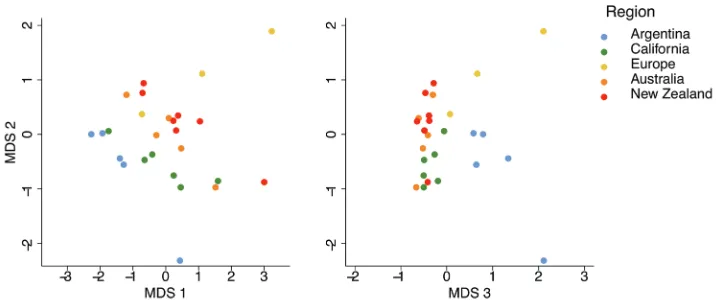
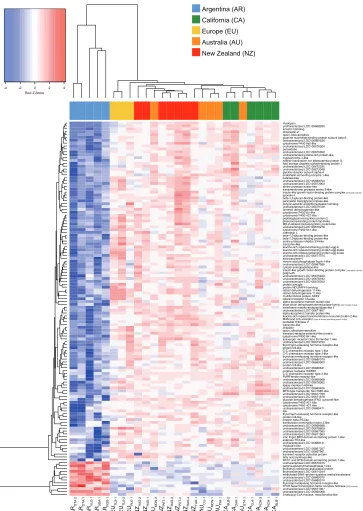
Overall gene expression profiles clustered with region and range (Figure 1). We found highly variable numbers of differentially expressed genes between Argentina and intro-duced regions (Suppl. material 1: Figure S1, Table S2). For further analysis of range-specific transcriptomic signatures, we considered the 130 genes that were consistently differentially expressed between Argentina and all of the introduced populations (genes coloured in red in Suppl. material 1: Figure S1, File S1).
lipid transport (11 genes, FDR = 0.187, Suppl. material 1: File S2). We found significantly differentially expressed genes associated with immune pathways up-regulated in the introduced range, i.e. three proteins Toll-like (LOC105674719, LOC105668121 and LOC105674712), uncharacterised proteinLOC105672003, recognition protein transcripts (three beta-1,3-glucan-binding protein-like (LOC105674418, LOC105674426 and LOC105674427), peptidoglycan-recogni-tion protein-like LOC105676298 and MD-2-related lipid-recognipeptidoglycan-recogni-tion protein-like LOC105669917). We also found a number of genes associated with phototransduc-tion that were differentially expressed between the native and introduced ranges, i.e. two transient receptor-like proteins (LOC105675038 and LOC105669468), gua-nine nucleotide-binding protein subunit beta-2 (LOC105678521), arrestin homo-logue (LOC105668394), rhodopsin and rhodopsin-likeproteins (LOC105679645 and LOC105677743, respectively), phosrestin-2 (LOC105672477), blue- and UV-sensitive opsin transcripts (LOC105674733 and LOC105673714, respectively), protein aveugle (LOC105680182), retinol dehydrogenase 11-like (LOC105673325 and LOC105673325) and chaoptin (LOC105674278) (The Uniprot Consortium 2017).
Weighted Co-Expression Network Analysis
al 1: Figure S3). One of these modules was significantly (p < 0.001) and strongly correlated (r = 0.96) with range (Suppl. material 1: Figure S4). A total of 103 genes within the module were also present in the set of differentially expressed genes be-tween the native and introduced ranges (Suppl. material 1: File S1). Gene set en-richment analysis of the module, associated with range, showed significant enrich-ment for redundant biological process terms related to immune signalling pathways (e.g. positive regulation of response to biotic stimulus, immune response-activating signal transduction, regulation of immune effector process with up to 36 genes per enriched term, FDR < 0.25, Suppl. material 1: File S3) and phototransduction (e.g. sensory perception of light stimulus, visual perception with up to 41 genes per en-riched term, FDR < 0.25, Suppl. material 1: File S3). Thirteen genes overlapped be-tween our list of candidate immune genes (Suppl. material 1: Table S4) and the co-expressed genes in the module, including five Toll-like transcripts (LOC105668121, LOC105668599, LOC105674013, LOC105674712 and LOC105678784), four beta-1,3-glucan-binding protein-like transcripts (LOC105673881, LOC105674418, LOC105674426 and LOC105674427), a PGRP-LC transcript (LOC105678063),
defensin-2 (LOC105975717), serine protease nudel-like (LOC105670067) and a Toll/ Imd-associated uncharacterised protein transcript (LOC105672003) (The Uniprot Consortium 2017). Five of these transcripts (i.e. Toll-like protein LOC105668121, beta-1,3-glucan-binding protein-like transcripts LOC105674418, LOC105674426, LOC10567442, and uncharacterised LOC105672003) were amongst the 20% of most connected transcripts within the module (Suppl. material 1: Figure S5).
Candidate gene approach: genes associated with biogenic amines
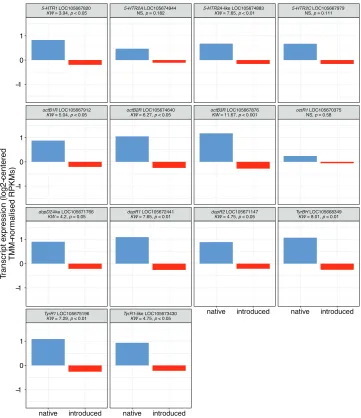
Amongst the 14 genes selected for their association with biogenic amine pathways in Argentine ants, 10 serotoninergic, dopaminergic, octopaminergic and tyramin-ergic receptors exhibited expression levels that were significantly higher in the na-tive range compared to the introduced range (Figure 3). A transcript coding for tyramine beta-hydroxylase (TyrBH) was also significantly up-regulated in Argen-tina and only the octopaminergic receptor OctR1 and two serotoninergic recep-tors (5-HTR-2A and 5-HTR-2C) expression levels were not significantly different between the two ranges.
Candidate gene approach: immune pathways
Figure 3.Log-centred TMM-normalised FPKM expression levels for genes associated with biogenic amine pathways. Results of Kruskal-Wallis tests are given above each plot facet. Full names and accession numbers of the genes included can be found in Suppl. material 1: Table S3.
Figure 4. Variation in candidate immune gene expression in the Argentine ant native (Argentina, AR) and introduced (California, CA; Europe, EU; Australia, AU; New Zealand, NZ) ranges. Log-centred TMM-normalised FPKMs for genes associated with the immune pathways (a) RNAi, (b) JaK/STAT, (c) Imd, (d) JNK and (e) Toll. P-values for GLMs or Kruskal-Wallis tests, testing for differences between introduced regions and Argentina are given above each introduced range boxplot, compared to Argentina. Details of the genes, included in the datasets, are found in Suppl. material 1: Table S4 and full results of statistical tests in Suppl. material 1: Table S5.
Virome analysis
al-though a plateau was not reached in Europe or the native range (Figure 5a). Fewer virus species were detected in California, Australia and New Zealand samples compared to Argentina and Europe and all study populations harboured a core virome of 9 known viruses (Figure 5b, Table 1). These ubiquitous viruses included Linepithema humile pi-corna-like virus 1 (LhuPiLV1), bunyan-like virus 1 (LhuBLV1), partiti-like virus 1 (Lhu-PLV1), toti-like virus 1 (LhuTLV1), C virus 1 (LhuCV1), rhabdo-like virus 1 (LhuRLV1),
polycipivirus 2 (LhuPcV2), Linepithema humile virus 1 (LHUV-1) and Kashmir bee virus
(KBV). Virus presence was confirmed with RT-PCR for a subset of viruses (Table 1). Figure 5. a Virus accumulation curves in Argentina (AR), California (CA), Europe (EU), Australia (AU) and New Zealand (NZ) as detected from RNA-seq data. Error bars indicate standard deviations
b Venn diagram showing viral diversity and overlap amongst regions. Detail of the data is given in Table 1
Viral loads, expressed as the sum of viral transcripts detected, were extremely vari-able at the individual virus species level, as were overall viral loads computed by sum-ming counts for all virus sequences (Figure 5c). We found no significant differences in overall viral loads amongst regions (KW = 3.432, df = 4, p = 0.488).
Discussion
We examined possible functional adaptations underlying the success of a globally invasive pest by investigating transcriptome-wide expression profiles associated with range in the Argentine ant. First, we identified the most differentially expressed genes amongst regions across the introduction pathway, as well as modules of co-expressed genes. We then further investigated gene expression profiles associated with immune pathways, as well as biogenic amine signalling. We also identified viral transcripts present in the libraries to measure viral diversity along the introduction pathway, as well as overall viral loads. Unsupervised multi-dimensional scaling analysis, based on normalised expression of all expressed transcripts, showed range and region-driven clustering. Similarly, hierarchical sample clustering, based on the most differentially expressed genes, showed perfect range-wise and close to perfect region-wise clustering. Functional analysis of differentially expressed genes in both analyses indicated a num-ber of genes associated with a wide range of biological processes, including immunity. Further scrutiny at specific gene groups pointed to consistent range differences in genes associated with biogenic amines and key immune pathways. We also found lower viral Table 1. Viral diversity detected via RNA-seq, presence is indicated with 1, absence with a dash. Ubiqui-tous viruses are shown in bold. Virus presence confirmed by RT-PCR is shown with an asterisk.
AR CA EU AU NZ
Lhu picorna-like virus 1 1 1 1 1 1
Lhu narnia-like virus 1 1 - 1 -
-Lhu bunyan-like virus 1 1* 1* 1* 1* 1*
Lhu partiti-like virus 1 1* 1* 1* 1* 1*
Lhu qinvirus-like virus 1 1 1 - -
-Lhu toti-like virus 1 1* 1* 1* 1* 1*
Lhu C virus 1 1* 1* 1* 1* 1*
Lhu rhabdo-like virus 1 1* 1* 1* 1* 1*
Lhu polycipivirus 1 1* - -* -
-Lhupolycipivirus 2 1 1 1 1 1
LHUV-1 1* 1 1 1* 1*
Acute Bee Paralysis Virus - - 1 -
-Black Queen Cell Virus - - 1 1 1
Aphid Lethal Paralysis Virus 1 1 1 -
-Kashmir Bee Virus 1* 1 1* 1* 1*
Deformed Wing Virus - - 1 -
-Israeli Acute Paralysis Virus - - - - 1
diversity in the introduced range, highly variable viral loads between samples within and amongst regions, but no difference in overall viral loads amongst regions.
Behavioural traits key to the ecological success of ants, such as foraging and ag-gression, are modulated by biogenic amines (Kamhi and Traniello 2013; Kamhi et al. 2017). We investigated if expression of genes related to the dopaminergic, octopamin-ergic and serotoninoctopamin-ergic neural pathways could be associated with the Argentine ant range, potentially contributing to its invasion success through, for instance, increased foraging activity, increased interspecific aggression and/or lower intraspecific aggres-sion. Interestingly, we did not find behavioural differences in foraging activity between native and invaded ranges, and we found no variation in sensitivity to OA supplemen-tation in the diet provided to the experimental colonies (Felden et al. 2018). Here, genes associated with biogenic amines, including OA, displayed clear range-specific expression pattern, suggesting an association with the introduction process. Biogenic amines are associated with a wide range of behaviour in insects, including key social be-haviour in ants (Kamhi et al. 2017) and it is interesting that the vast majority of genes associated with biogenic amines exhibited the same trend. Although the insect brain is comparatively smaller than that of a vertebrate brain, it is a complex organ with largely heterogeneous regions that fulfil different functions and likely exhibit widely variable gene expression patterns. Further analysis of neuropil-specific expression patterns will be useful to elucidate variation in the molecular basis of behaviour.
In our study, all Argentine ant populations harboured a core virome of nine viruses, but we found lower viral diversity in most of the introduced range (i.e. California, Australia and New Zealand) compared to Argentina and Europe, where virus species richness was the highest. Variation in viral diversity has similarly been shown in another widespread invasive ant, the red imported fire ant, Solenopsis invicta (Yang et al. 2010). We found that the RNAi and Imd pathways, as well as the JaK/STAT and JNK path-ways, are down-regulated in the introduced range. In honey bees, the JaK/STAT and RNAi immune pathways are primarily directed against viruses, whereas the Toll, Imd
viruses within individual hosts and host communities appear to be complex (Viljakain-en et al. 2018) and it is therefore hard to dis(Viljakain-entangle the respective weight of viral loads and diversity. Viral diversity may, however, be an informative metric in the context of biological invasions as it is less susceptible to variation at the population level.
Lower viral pressure in the introduced range may promote invasion success in two ways. First, ants are known to harbour a range of viruses (Valles et al. 2007, 2018; Sébastien et al. 2015; Cooling et al. 2017; Gruber et al. 2017; Viljakainen et al. 2018; Valles and Rivers 2019) and lower viral pressure may directly increase their fitness. For instance, viral infections in the red imported fire ant have been shown to influence col-ony foraging performance (Hsu et al. 2018). Second, in line with the EICA framework and supported by our results of lower expression of certain immune pathways primarily targeted against viruses, relaxed viral pressure may allow reallocation of resources away from immunity to other functions that increase the invader’s fitness. Furthermore, dif-ferent types of viruses are known to trigger difdif-ferent physiological responses (Lester et al. 2019). Therefore, plastic allocation of resources to specific immune responses with respect to variable viral exposure amongst regions may also increase the ant’s competi-tive abilities and persistence of populations (Lester and Gruber 2016).
A significant proportion of genes up-regulated in the introduced range, compared to that of the native range, were surprisingly associated with vision. Some ant species heavily rely on vision to orientate themselves while foraging (Cheng et al. 2014), but Argentine ants have comparatively smaller eyes and are likely to have under-developed vision. Chemoreception appears to be the primary modality of Argentine ant’s sensory biology, as indicated by the large number of chemoreceptor genes in their genome (Smith et al. 2011). Nevertheless, our results may indicate that vision has been overlooked in past studies. Alternatively and partly because gene annotation in non-model organisms is rarely definite, these genes may have been co-opted for other functions in Argentine ants. Throughout our analyses, we also found many genes associated with functions that are difficult to tie to specific biological processes and current resources do not allow for more than speculation on their association with the Argentine ant invasion. Our study does, however, point to several genes and gene families that are worthy of further investigation towards understanding patterns of invasiveness in Argentine ants and other species.
Conclusions
We found that native and introduced Argentine ant populations exhibit distinct tran-scriptomic signatures. Genes associated with biogenic amines were consistently up-regulated in the native range, suggesting variation in the molecular basis of behaviour between the native and introduced range. We also observed lower viral diversity in most of the introduced range, which was associated with differential regulation of im-mune pathways, most notably in the RNAi pathway involved in defence against virus-es. We provide the first evidence that native and introduced Argentine ant populations are characterised by transcriptomic variation that may reflect region-specific functional adaptations and contribute to the invasion success of the Argentine ant.
Data accessibility
Supplementary information, scripts and data can be downloaded from GitHub at
https://doi.org/10.5281/zenodo.3351674; RNA-seq reads can be accessed on the NCBI SRA repository (BioProject ID PRJNA553098, http://www.ncbi.nlm.nih.gov/ bioproject/553098)
Acknowledgements
We thank Priscilla Hanisch, Romain Felden and Brad de Abreu for their precious help in the field in Argentina, Australia and New Zealand, respectively. We thank James Baty for primer development used in virus presence PCR confirmation. We thank Andrew Veale for his comments on an earlier version of the manuscript.
References
Brutscher LM, Daughenbaugh KF, Flenniken ML (2015) Antiviral defense mechanisms in honey bees. Current Opinion in Insect Science 10: 71–82. https://doi.org/10.1016/j. cois.2015.04.016
Brutscher LM, Daughenbaugh KF, Flenniken ML (2017) Virus and dsRNA-triggered tran-scriptional responses reveal key components of honey bee antiviral defense. Scientific Re-ports 7. https://doi.org/10.1038/s41598-017-06623-z
Camacho C, Coulouris G, Avagyan V, Ma N, Papadopoulos J, Bealer K, Madden TL (2009) BLAST+: architecture and applications. BMC bioinformatics 10: 421. https://doi. org/10.1186/1471-2105-10-421
Cooling M, Gruber M a. M, Hoffmann BD, Sébastien A, Lester PJ (2017) A metatranscrip-tomic survey of the invasive yellow crazy ant, Anoplolepis gracilipes, identifies several poten-tial viral and bacterial pathogens and mutualists. Insectes Sociaux 64: 197–207. https:// doi.org/10.1007/s00040-016-0531-x
Corin SE, Lester PJ, Abbott KL, Ritchie PA (2007) Inferring historical introduction pathways with mitochondrial DNA: the case of introduced Argentine ants (Linepithema humile) into New Zealand: Inferring introduction pathways. Diversity and Distributions 13: 510–518.
https://doi.org/10.1111/j.1472-4642.2007.00355.x
Dunn AM, Torchin ME, Hatcher MJ, Kotanen PM, Blumenthal DM, Byers JE, Coon CAC, Frankel VM, Holt RD, Hufbauer RA, Kanarek AR, Schierenbeck KA, Wolfe LM, Perkins SE (2012) Indirect effects of parasites in invasions. Functional Ecology 26: 1262–1274.
https://doi.org/10.1111/j.1365-2435.2012.02041.x
Evans JD, Aronstein K, Chen YP, Hetru C, Imler J-L, Jiang H, Kanost M, Thompson GJ, Zou Z, Hultmark D (2006) Immune pathways and defence mechanisms in honey bees
Apis mellifera. Insect Molecular Biology 15: 645–656.
https://doi.org/10.1111/j.1365-2583.2006.00682.x
Felden A, Paris CI, Chapple DG, Haywood J, Suarez AV, Tsutsui ND, Lester PJ, Gruber MAM (2018) Behavioural variation and plasticity along an invasive ant introduction pathway. Journal of Animal Ecology 87: 1653–1666. https://doi.org/10.1111/1365-2656.12886
Fidler AE, van Oers K, Drent PJ, Kuhn S, Mueller JC, Kempenaers B (2007) DRD4 gene polymorphisms are associated with personality variation in a passerine bird. Proceedings of the Royal Society B: Biological Sciences 274: 1685–1691. https://doi.org/10.1098/ rspb.2007.0337
Friedman DA, Pilko A, Skowronska-Krawczyk D, Krasinska K, Parker JW, Hirsh J, Gordon DM (2018) The role of dopamine in the collective regulation of foraging in harvester ants. iScience. https://doi.org/10.1016/j.isci.2018.09.001
Giraudoux P, Antonietti J-P, Beale C, Pleydell D, Treglia M (2018) pgirmess: Spatial analy-sis and data mining for field ecologists. Available from: https://CRAN.R-project.org/ package=pgirmess [May 31, 2018].
Gruber MAM, Cooling M, Baty JW, Buckley K, Friedlander A, Quinn O, Russell JFEJ, Sébastien A, Lester PJ (2017) Single-stranded RNA viruses infecting the invasive Argentine ant,
Line-pithema humile. Scientific Reports 7: 3304. https://doi.org/10.1038/s41598-017-03508-z
Haas BJ, Papanicolaou A, Yassour M, Grabherr M, Blood PD, Bowden J, Couger MB, Eccles D, Li B, Lieber M, MacManes MD, Ott M, Orvis J, Pochet N, Strozzi F, Weeks N, Wester-man R, William T, Dewey CN, Henschel R, LeDuc RD, FriedWester-man N, Regev A (2013) De novo transcript sequence reconstruction from RNA-Seq: reference generation and analysis with Trinity. Nature protocols 8. https://doi.org/10.1038/nprot.2013.084
Holtmann B, Grosser S, Lagisz M, Johnson SL, Santos ESA, Lara CE, Robertson BC, Naka-gawa S (2016) Population differentiation and behavioural association of the two “person-ality” genes DRD4 and SERT in dunnocks (Prunella modularis). Molecular Ecology 25: 706–722. https://doi.org/10.1111/mec.13514
Holway DA, Suarez AV (1999) Animal behavior: an essential component of invasion biol-ogy. Trends in Ecology & Evolution 14: 328–330. https://doi.org/10.1016/S0169-5347(99)01636-5
Hothorn T, Bretz F, Westfall P, Heiberger RM, Schuetzenmeister A, Scheibe S (2016) mult-comp: Simultaneous inference in general parametric models. Available from: https:// cran.r-project.org/web/packages/multcomp/index.html.
Hoyle G (1985) Generation of behaviour: the Orchestration hypothesis. In: Feedback and Motor Control in Invertebrates and Vertebrates. Springer, 57–75. https://doi.org/10.1007/978-94-011-7084-0_4
Hsu H-W, Chiu M-C, Shoemaker D, Yang C-CS (2018) Viral infections in fire ants lead to reduced foraging activity and dietary changes. Scientific Reports 8: 13498. https://doi. org/10.1038/s41598-018-31969-3
Hulme PE (2009) Trade, transport and trouble: managing invasive species pathways in an era of globalization. Journal of Applied Ecology 46: 10–18. https://doi.org/10.1111/j.1365-2664.2008.01600.x
Jandt JM, Bengston S, Pinter-Wollman N, Pruitt JN, Raine NE, Dornhaus A, Sih A (2014) Behavioural syndromes and social insects: personality at multiple levels. Biological Reviews 89: 48–67. https://doi.org/10.1111/brv.12042
Kamhi JF, Arganda S, Moreau CS, Traniello JFA (2017) Origins of aminergic regulation of behavior in complex insect Social systems. Frontiers in Systems Neuroscience 11. https:// doi.org/10.3389/fnsys.2017.00074
Kamhi JF, Traniello JFA (2013) Biogenic amines and collective organization in a superorgan-ism: neuromodulation of social behavior in ants. Brain, Behavior and Evolution 82: 220– 236. https://doi.org/10.1159/000356091
Keane RM, Crawley MJ (2002) Exotic plant invasions and the enemy release hypoth-esis. Trends in Ecology & Evolution 17: 164–170. https://doi.org/10.1016/S0169-5347(02)02499-0
Kim D, Langmead B, Salzberg SL (2015) HISAT: a fast spliced aligner with low memory re-quirements. Nature Methods 12: 357–360. https://doi.org/10.1038/nmeth.3317
Korsten P, Mueller JC, Hermannstädter C, Bouwman KM, Dingemanse NJ, Drent PJ, Lied-vogel M, Matthysen E, Oers KV, Overveld TV, Patrick SC, Quinn JL, Sheldon BC, Tin-bergen JM, Kempenaers B (2010) Association between DRD4 gene polymorphism and personality variation in great tits: a test across four wild populations. Molecular Ecology 19: 832–843. https://doi.org/10.1111/j.1365-294X.2009.04518.x
Langfelder P, Horvath S (2008) WGCNA: an R package for weighted correlation network analysis. BMC Bioinformatics 9: 559. https://doi.org/10.1186/1471-2105-9-559
Law CW, Alhamdoosh M, Su S, Smyth GK, Ritchie ME (2016) RNA-seq analysis is easy as 1-2-3 with limma, Glimma and edgeR. F1000Research 5: 1408. https://doi.org/10.12688/ f1000research.9005.2
Lee KA, Klasing KC (2004) A role for immunology in invasion biology. Trends in Ecology & Evolution 19: 523–529. https://doi.org/10.1016/j.tree.2004.07.012
Lester PJ, Gruber MAM (2016) Booms, busts and population collapses in invasive ants. Bio-logical Invasions 18: 3091–3101. https://doi.org/10.1007/s10530-016-1214-2
Lester PJ, Sébastien A, Suarez AV, Barbieri RF, Gruber MAM (2017) Symbiotic bacterial com-munities in ants are modified by invasion pathway bottlenecks and alter host behavior. Ecology 98: 861–874. https://doi.org/10.1002/ecy.1714
Liang ZS, Mattila HR, Rodriguez-Zas SL, Southey BR, Seeley TD, Robinson GE (2014) Com-parative brain transcriptomic analyses of scouting across distinct behavioural and ecologi-cal contexts in honeybees. Proceedings of the Royal Society B: Biologiecologi-cal Sciences 281: 20141868. https://doi.org/10.1098/rspb.2014.1868
Liang ZS, Nguyen T, Mattila HR, Rodriguez-Zas SL, Seeley TD, Robinson GE (2012) Mo-lecular determinants of scouting behavior in honey bees. Science 335: 1225–1228. https:// doi.org/10.1126/science.1213962
Libersat F, Pflueger H-J (2004) Monoamines and the orchestration of behavior. BioScience 54: 17–25. https://doi.org/10.1641/0006-3568(2004)054[0017:MATOOB]2.0.CO;2
McMenamin A, Daughenbaugh K, Parekh F, Pizzorno M, Flenniken M (2018) Honey bee and bumble bee antiviral defense. Viruses 10: 395. https://doi.org/10.3390/v10080395
Mueller JC, Partecke J, Hatchwell BJ, Gaston KJ, Evans KL (2013) Candidate gene polymor-phisms for behavioural adaptations during urbanization in blackbirds. Molecular Ecology 22: 3629–3637. https://doi.org/10.1111/mec.12288
Pertea M, Pertea GM, Antonescu CM, Chang T-C, Mendell JT, Salzberg SL (2015) StringTie enables improved reconstruction of a transcriptome from RNA-seq reads. Nature Biotech-nology 33: 290–295. https://doi.org/10.1038/nbt.3122
Phillips BL, Suarez AV (2012) The role of behavioural variation in the invasion of new ar-eas. In: Behavioural responses to a changing world. Oxford University Press. https://doi. org/10.1093/acprof:osobl/9780199602568.003.0014
Ritchie ME, Phipson B, Wu D, Hu Y, Law CW, Shi W, Smyth GK (2015) limma powers dif-ferential expression analyses for RNA-sequencing and microarray studies. Nucleic Acids Research 43: e47–e47. https://doi.org/10.1093/nar/gkv007
Rius M, Bourne S, Hornsby HG, Chapman MA (2015) Applications of next-generation se-quencing to the study of biological invasions. Current Zoology 61: 488–504. https://doi. org/10.1093/czoolo/61.3.488
Roberts A, Pachter L (2012) Streaming fragment assignment for real-time analysis of sequenc-ing experiments. Nature Methods 10: 71. https://doi.org/10.1038/nmeth.2251
Robinson MD, McCarthy DJ, Smyth GK (2010) edgeR: a Bioconductor package for differ-ential expression analysis of digital gene expression data. Bioinformatics 26: 139–140.
https://doi.org/10.1093/bioinformatics/btp616
Sakai AK, Allendorf FW, Holt JS, Lodge DM, Molofsky J, With KA, Baughman S, Cabin RJ, Cohen JE, Ellstrand NC, others (2001) The population biology of invasive species. An-nual Review of Ecology and Systematics 32: 305–332. https://doi.org/10.1146/annurev. ecolsys.32.081501.114037
Schmid-Hempel P (1998) Parasites in Social Insects. Princeton University Press, 428 pp. Sébastien A, Lester PJ, Hall RJ, Wang J, Moore NE, Gruber MAM (2015) Invasive ants carry
Silverman J, Buczkowski G (2016) Behaviours mediating ant invasions. In: Biological Invasions and Animal Behaviour. Cambridge University Press.
Simberloff D, Gibbons L (2004) Now you see them, now you don’t! – Population crashes of established introduced species. Biological Invasions 6: 161–172. https://doi.org/10.1023/ B:BINV.0000022133.49752.46
Smith CD, Zimin A, Holt C, Abouheif E, Benton R, Cash E, Croset V, Currie CR, Elhaik E, Elsik CG, Fave M-J, Fernandes V, Gadau J, Gibson JD, Graur D, Grubbs KJ, Hagen DE, Helmkampf M, Holley J-A, Hu H, Viniegra ASI, Johnson BR, Johnson RM, Khila A, Kim JW, Laird J, Mathis KA, Moeller JA, Munoz-Torres MC, Murphy MC, Nakamu-ra R, Nigam S, Overson RP, Placek JE, Rajakumar R, Reese JT, Robertson HM, Smith CR, Suarez AV, Suen G, Suhr EL, Tao S, Torres CW, van Wilgenburg E, Viljakainen L, Walden KKO, Wild AL, Yandell M, Yorke JA, Tsutsui ND (2011) Draft genome of the globally widespread and invasive Argentine ant (Linepithema humile). Proceed-ings of the National Academy of Sciences 108: 5673–5678. https://doi.org/10.1073/ pnas.1008617108
Suarez AV, Tsutsui ND (2008) The evolutionary consequences of biological invasions. Molecu-lar Ecology 17: 351–360. https://doi.org/10.1111/j.1365-294X.2007.03456.x
Suhr EL, O’Dowd DJ, McKechnie SW, Mackay DA (2011) Genetic structure, behaviour and invasion history of the Argentine ant supercolony in Australia. Evolutionary Applications 4: 471–484. https://doi.org/10.1111/j.1752-4571.2010.00161.x
The Uniprot Consortium (2017) UniProt: the universal protein knowledgebase. Nucleic Acids Research 45: D158–D169. https://doi.org/10.1093/nar/gkw1099
Tompkins DM, Dunn AM, Smith MJ, Telfer S (2011) Wildlife diseases: from individuals to ecosystems. Journal of Animal Ecology 80: 19–38. https://doi.org/10.1111/j.1365-2656.2010.01742.x
Torchin ME, Lafferty KD, Dobson AP, McKenzie VJ, Kuris AM (2003) Introduced species and their missing parasites. Nature 421: 628–630. https://doi.org/10.1038/nature01346
Valles SM, Porter SD, Calcaterra LA (2018) Prospecting for viral natural enemies of the fire
ant Solenopsis invicta in Argentina. PLOS ONE 13: e0192377. https://doi.org/10.1371/
journal.pone.0192377
Valles SM, Rivers AR (2019) Nine new RNA viruses associated with the fire ant Solenopsis invicta from its native range. Virus Genes. https://doi.org/10.1007/s11262-019-01652-4
Valles SM, Strong CA, Oi DH, Porter SD, Pereira RM, Vander Meer RK, Hashimoto Y, Hooper-Bùi LM, Sánchez-Arroyo H, Davis T, Karpakakunjaram V, Vail KM, “Fudd” Graham LC, Briano JA, Calcaterra LA, Gilbert LE, Ward R, Ward K, Oliver JB, Tanigu-chi G, Thompson DC (2007) Phenology, distribution, and host specificity of Solenopsis
invicta virus-1. Journal of Invertebrate Pathology 96: 18–27. https://doi.org/10.1016/j.
jip.2007.02.006
Van Wilgenburg E, Torres CW, Tsutsui ND (2010) The global expansion of a single ant su-percolony: A transcontinental Argentine ant supercolony. Evolutionary Applications 3: 136–143. https://doi.org/10.1111/j.1752-4571.2009.00114.x
Vogel V, Pedersen JS, Giraud T, Krieger MJB, Keller L (2010) The worldwide expansion of the Argentine ant. Diversity and Distributions 16: 170–186. https://doi.org/10.1111/j.1472-4642.2009.00630.x
White TA, Perkins SE (2012) The ecoimmunology of invasive species. Functional Ecology 26: 1313–1323. https://doi.org/10.1111/1365-2435.12012
Yang C-C, Yu Y-C, Valles SM, Oi DH, Chen Y-C, Shoemaker D, Wu W-J, Shih C-J (2010) Loss of microbial (pathogen) infections associated with recent invasions of the red import-ed fire ant Solenopsis invicta. Biological Invasions 12: 3307–3318. https://doi.org/10.1007/ s10530-010-9724-9
Supplementary material 1
Supplementary information
Authors: Antoine Felden, Carolina Paris, David G. Chapple, Andrew V. Suarez, Neil D. Tsutsui, Philip J. Lester, Monica A. M. Gruber
Data type: molecular data
Explanation note: File S1: List of DEGs in the differential expression analysis and genes in module highly correlated with range in WGCNA (showing overlap be-tween the outputs). File S2: Gene Set Enrichment Analysis for list of DEGs. File S3: Gene Set Enrichment Analysis for genes in module highly correlated with range. File S4: BLASTx output indicating best matches of de novo-assembled transcripts and published viral references. Table S1: Sampling sites for libraries included in the study. Figure S1: Volcano plots showing pairwise comparisons of genes differentially expressed between Argentina and each of the introduced re-gions. Table S2: Number of most differentially expressed genes between Argentina and introduced regions. Figure S2: Diagnostic plot for WGCNA parameter tun-ing. Figure S3: Module clustering and gene dendrogram. Figure S4: Heatmap showing eigengene-range correlation for all modules. Figure S5: Gene significance vs connectivity in module highly correlated with range. Table S3: List of candidate genes associated with biogenic amines. Table S4: List of candidate genes for im-mune pathways. Table S5: Output of the statistical tests for differences in immune genes expression between each introduced region and Argentina. Table S6: PCR conditions for confirmation of virus presence.
Copyright notice: This dataset is made available under the Open Database License (http://opendatacommons.org/licenses/odbl/1.0/). The Open Database License (ODbL) is a license agreement intended to allow users to freely share, modify, and use this Dataset while maintaining this same freedom for others, provided that the original source and author(s) are credited.