Open Access
Methodology
A study of spatial resolution in pollution exposure modelling
Emilie Stroh*
†1, Lars Harrie
†1and Susanna Gustafsson
2Address: 1GIS Centre, Lund University, Sölvegatan 12, SE-223 62 Lund, Sweden and 2Malmö Evironmental Protection Agency, Malmö Municipality, Bergsgatan 17, SE-205 80 Malmö, Sweden
Email: Emilie Stroh* - [email protected]; Lars Harrie - [email protected]; Susanna Gustafsson - [email protected]
* Corresponding author †Equal contributors
Abstract
Background: This study is part of several ongoing projects concerning epidemiological research into the effects on health of exposure to air pollutants in the region of Scania, southern Sweden. The aim is to investigate the optimal spatial resolution, with respect to temporal resolution, for a pollutant database of NOx-values which will be used mainly for epidemiological studies with durations of days, weeks or longer periods. The fact that a pollutant database has a fixed spatial resolution makes the choice critical for the future use of the database.
Results: The results from the study showed that the accuracy between the modelled concentrations of the reference grid with high spatial resolution (100 m), denoted the fine grid, and the coarser grids (200, 400, 800 and 1600 meters) improved with increasing spatial resolution. When the pollutant values were aggregated in time (from hours to days and weeks) the disagreement between the fine grid and the coarser grids were significantly reduced. The results also illustrate a considerable difference in optimal spatial resolution depending on the characteristic of the study area (rural or urban areas). To estimate the accuracy of the modelled values comparison were made with measured NOx values. The mean difference between the modelled and the measured value were 0.6 µg/m3 and the standard deviation 5.9 µg/m3 for the daily difference.
Conclusion: The choice of spatial resolution should not considerably deteriorate the accuracy of the modelled NOx values. Considering the comparison between modelled and measured values we estimate that an error due to coarse resolution greater than 1 µg/m3 is inadvisable if a time resolution of one day is used. Based on the study of different spatial resolutions we conclude that for urban areas a spatial resolution of 200–400 m is suitable; and for rural areas the spatial resolution could be coarser (about 1600 m). This implies that we should develop a pollutant database that allows different spatial resolution for urban and rural areas.
Background
The air we breathe contains a vast number of chemical pollutants. Some originate from natural sources such as soil or salt particles generated from nearby fields or the
sea, but most of them originate from man-made sources such as vehicles, industrial plants, combustion and heat-ing. These chemicals not only interact with each other but also with the cells and compounds within our respiratory Published: 4 June 2007
International Journal of Health Geographics 2007, 6:19 doi:10.1186/1476-072X-6-19
Received: 27 March 2007 Accepted: 4 June 2007
This article is available from: http://www.ij-healthgeographics.com/content/6/1/19
© 2007 Stroh et al; licensee BioMed Central Ltd.
and cardiovascular systems. Studies have shown that exposure to air pollutants such as fine particles and nitro-gen dioxide contributes to excess diseases and mortality among people suffering from cancer, respiratory and car-diovascular diseases [1]. It has also been shown that air pollution leads to poorer health among vulnerable groups such as asthmatics, old people and children. The health effects on children are of special concern since these health problems might have repercussions later in life [2].
Geographic analyses have previously been used in epide-miology to study the correlation between exposure to air pollutants and health [3,4]. Some of these analyses were conducted in three steps: (1) modelling of the pollutant field using a dispersion model and an emission source database, (2) using the pollutant field to estimate the exposure to pollutants of the study group, and (3) corre-lation of the exposure with health status of the study group.
This study is part of several ongoing projects involving epidemiological research in the region of Scania in south-ern Sweden. These projects employ population databases obtained from the Regional Office of Scania and are based on the Swedish National Population Register. These pop-ulation databases are comparatively detailed regarding both the high degree of detail in the socio-economic and health data they contain, but also in their spatial resolu-tion. All the databases contain information on individu-als, including the exact location of their residence. This location is either represented as a point at the centre of the real estate where they live, or as a centroid in a 500 m-1 km grid. This detailed information regarding the popula-tion in Scania enables us to perform exposure studies with high resolution.
An emission source database including traffic, industry, and combustion was established and dispersion model-ling software implemented [5]. However, it was found to be impractical to conduct dispersion modelling for each epidemiological study. Therefore, we plan to establish a
pollutant database of NOx values; this database will contain pollutant values in a fixed grid covering Scania for the time period 2000–2004. The advantage of a pollutant data-base, rather than an emission source database, is that it will make epidemiological studies much easier to perform for users who are not accustomed to using emission source databases and dispersion modelling. The disadvantage is that a pollutant database is not as flexible as an emission source database, mainly in that the pollutant database has a fixed resolution in time and space.
It is important to take the time factor into consideration when conducting geographical analysis in exposure stud-ies with the aim of analysing diseases and health hazards
with long latency periods, such as cancers. Samples and measurements made when a disease manifests itself do not usually represent historical exposure levels [6]. It is therefore important to collect data in order to be able to model accumulated exposure levels from previous years. This need to store data raises the issues of storing capacity and modelling resources. Since digital data for these stud-ies are often required as high-resolution data with a low level of spatial aggregation, the storage capacity needed and the modelling time required increase rapidly. This problem is apparent in exposure studies that take the movement of a dynamic population into account; not only do these studies demand digital data with high spa-tial resolution, but there is also a need for high temporal resolution.
The aim of this study was to examine the optimal spatial resolution, with respect to the temporal resolution, for our pollutant database. This was done through comparing the absolute differences and standard deviations of the differences among pollution estimates of different spatial and temporal resolutions. The choice of optimal spatial resolution was also related to the accuracy of the esti-mated pollutant field generated by the dispersion model and the emission database.
Related studies
The impact of scale and aggregation factors in epidemio-logical analysis can not be ignored. As Krieger states: "in epidemiological studies completeness in geocoding does not equal success. Accuracy – and choice of geographic level – matter as much, if not more" [7]. Cromley also concludes that, in many health studies, the aggregated level of available health data is a major limitation since data are often aggregated inappropriately for the purpose of the study [6]. A study by João shows that scale, in terms of both detail and extent, is an important issue, which to date has been largely neglected in environmental impact assessments [8]. This is further emphasized by Setton et al. who stated that many exposure assessments and epidemi-ological analyses of the impacts of air pollution on health have been undertaken on regional scales, and that only recently have researchers begun to investigate neighbour-hood-level variations in pollutant levels [9].
ecological associations with diseases, since these patterns might otherwise be concealed or misjudged. As Gregorio et al. concludes: "spatial analysis results may be rightfully considered conditional upon the particular geography selected for the study" [12].
Apart from the risk of altering the results of a study by choosing the "wrong" scale or aggregation level Ali et al. also concluded that the optimal neighbourhood size is data dependent [10]. Their study suggests that, depending on the factors and correlations included, different neigh-bourhood sizes may be optimal for different variables. This is supported by findings from our previous study [13]. Therefore, it can not always be assumed that the choice of study area for one set of parameters is optimal for another, even though they may be similar. According to Gregorio et al. nationwide efforts to promote regional health information networks/organisations that cross tra-ditional geo-political boundaries demand a greater under-standing of how aggregating health and population data may affect the analysis and interpretation of disease pat-terns [12].
Due to the four-dimensional nature of the distribution of atmospheric pollutants, the importance of scale and aggregation level applies not only to spatial but also tem-poral variations. According to Pénard-Morand et al., who conducted a study on schoolchildren's exposure to traffic-related air pollution in France, there is extreme variability in the level of exposure that exists from one place to another [14]. Briggs also concludes that pollution surfaces in urban areas are often extremely complex, with steep gradients away from ground-level sources, and often highly localised hot-spots and peaks [4]. Also, Cyrys et al. state that several studies have documented important var-iations in pollutant concentrations within cities, espe-cially related to motorised traffic and location within the city – for example city centre versus suburbs [15]. These variations are not only variations in space, but also in time mostly due to human behaviour such as rush-hour traffic and industrial activities. Results from a study by Wentz et al. suggest that there is a distinct relationship between lev-els of CO2 and spatial patterns of human activities in urban areas [16]. The results of their study also show that the temporal and spatial patterns of CO2 levels corre-spond closely to the density of traffic, population and workplaces. Consequently, the optimal choice of resolu-tion for a pollutant database may be mainly dependent on the spatial distribution of the concentration of air pollu-tion in the area, but also on the temporal distribupollu-tion.
João shows in her study that the chosen scale should be considered as part of the observation bias since the choice of scale, both in the meaning of the details analysed and the spatial extent of study area, can have important
reper-cussions on the results, such as the determination of impact significance and the measurement of environmen-tal parameters [8]. It is therefore of fundamenenvironmen-tal impor-tance to define the scale of observation. In other words, scale choice should be explained, justified and explicitly stated in all environmental impact assessment studies [8].
Objectives
The overall objective of this study was to determine the optimal spatial resolution for a pollutant database for the county of Scania, southern Sweden. The database will contain concentration values of nitrogen oxides (NOx), and possible also other pollutants, over a period of five years (2000–2004).
The optimal spatial resolution is dependent on which time resolution is considered in the epidemiological study. Since the pollutant database will be used mainly for epidemiological studies with durations of days, weeks or even longer periods, we have evaluated the results using different time resolutions.
The difference between modelled and measured values, i.e. the error estimate, of air pollutant concentrations has also been evaluated since this in combination with the error estimate generated from the choice of resolution will give the total error estimate for the pollutant database.
Study area
The area studied was Scania, the southernmost county of Sweden. The county covers around 11,350 km2, which is approximately 2% of the total Swedish land area. The region is relatively densely populated, with more than 1.1 million people living in the area, which constitutes approximately 11% of the total Swedish population. In Scania, approximately 67% of the population lives close to the west coast. Most road traffic (passenger cars as well as trucks) from the European continent to Sweden and Norway passes through this area, and five motorways run through the region. There are also several harbours in the region and a considerable amount of cargo shipping and ferry transport along the coast. These factors, and the closeness to Copenhagen in Denmark, and the European continent, contribute to high concentrations of air pollut-ants in the region, compared with most other regions in Sweden.
Lund is the third largest city in Scania with approximately 76,000 inhabitants, and the city covers approximately 23 km2. Although the city centre consists mainly of narrow streets and pedestrian precincts, the traffic can be quite intense in some areas, and there are one motorway and two major roads along the north, south and east bounda-ries of the city. This creates rather steep gradients in the concentrations of traffic-generated pollutants between the city, enclosed by the motorways, and the surroundings, which consist mainly of agricultural land.
The area around Genarp consists mainly of rural and agri-cultural land with small clusters of buildings. A major road with a large traffic volume passes through the north-ern part of this study area.
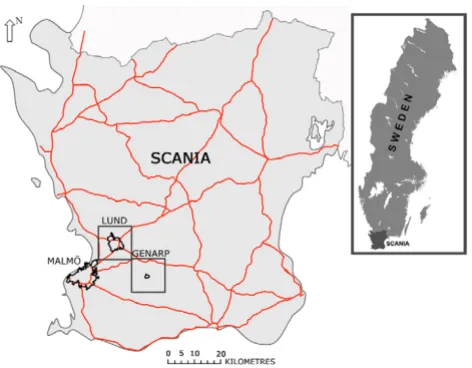
The validation analysis between modelled concentrations and measured concentrations was performed using pollu-tion data obtained from the meteorological stapollu-tion in Malmö (Figure 1). Malmö is the largest city in Scania with a population of about 260,000. The city is located on the west coast facing Denmark and covers an area of 66 km2. Malmö is surrounded by a ring road at which three of the five main motorways in the area converge.
Study design
To investigate suitable spatial resolution for our pollutant database we modelled pollutant fields (NOX values) for several spatial and time resolutions. This enabled us to compare the loss of information when using coarser reso-lutions. This loss of information should be seen in rela-tion to the accuracy of the modelled values. To estimate this quality we compared modelled values with values
measured at the meteorological station. Our approach consisted of the following steps (Figure 2).
1) Comparison of modelled values and observed values
Measured hourly NOX values from the meteorological sta-tion in Malmö city were collected. These measured values were then compared with hourly NOX values modelled for the same period and area using a dispersion model and an emission database. Temporal variation, mean and stand-ard deviation was evaluated.
2) Generation of pollutant fields with a time resolution of one hour A dispersion model was used to estimate pollutant fields. The pollutant field with the highest spatial resolution (100 metre) is below denoted the fine grid. The other four grids are denoted coarse grids (200, 400, 800 and 1600 metres). Hourly NOX values for four weeks were estimated for all grids.
3) Generation of pollutant fields with a time resolution of one day and one week
Mean values of the original hourly data were used to cre-ate new pollutant fields with time resolutions of one day
and one week for the time period modelled in step 2.
Main flow sheet of the study
Figure 2
Main flow sheet of the study. The numbers refer to the dif-ferent steps in the study design.
Map showing the two study sites: Lund (urban area) and Genarp (rural area), the location of Malmö, the major roads in the county and Scanias location in Sweden
Figure 1
4) Interpolation of the coarse pollutant fields
The hourly, daily and weekly time series of the coarse grids were interpolated to obtain the same spatial resolu-tion as the fine grid.
5) Comparison of the fine grid and the coarse grids
The values of the fine grid and the interpolated coarse grids were plotted in time series and evaluated concerning the loss of information due to using a coarser spatial res-olution in relation to the time resres-olution (hour, day and week). The spatial distribution of the difference between the grid values was also studied.
6) Evaluation
The results obtained from Step 1 and 5 were evaluated and the spatial resolution of the pollutant database was deter-mined.
Results and discussion
Comparison with measured valuesTo estimate the quality of the modelled concentrations of NOx, measured values from the meteorological station in Malmö were compared with the concentration values modelled with the same emission database and disper-sion model used to generate values for the study sites. The results were plotted as a time series of daily mean values (Figure 3). As can be seen in the figure, the divergence between the daily time series is large during the first week, and thereafter follows the pattern of the measured values, with some exceptions, reasonably well.
The mean difference between the modelled and the meas-ured value of NOx is 0.6 µg/m3 and the standard deviation of the differences is 12.3 µg/m3 for the hourly difference, 5.9 µg/m3 for the daily difference and 4.4 µg/m3 for the weekly difference.
Despite the temporal variations seen in Figure 3 the mean difference is low, with a value of approximately 0.6 µg/m3 NOx. However, the standard deviation of the differences reveals that the divergence for the hourly values is high. This number decreases considerably when comparing the concentrations as daily or weekly means. This indicates that the general trend predicted by the dispersion model follows the actual pattern of concentrations of air pollut-ants in Malmö, but that the dispersion model is too coarse to reflect finer temporal variations than daily means. If the highest and lowest quartiles are removed from the dataset the standard deviation of the means is lowered considera-bly, and in the case of daily means the standard deviation of the difference is reduced from 5.9 µg/m3 to 2.4 µg/m3 NOx.
The main contribution to both the modelled and meas-ured values is traffic generated. The dispersion model uses predefined patterns of traffic flow in the area to estimate the concentration and levels of emitted air pollutants. This may be the reason for the large divergence between modelled and measured values at the beginning of the month (days 1–6). During the first week in January many people are still on holiday due to the Christmas and New Year holidays, causing the traffic flow to diverge from its normal pattern. This will probably lead to lower levels of measured traffic-generated emissions than the modelled results. However, this does not explain the large diver-gence between modelled and measured values during days 9–11 and 23–26, which probably originates, from errors related to emission sources or the calculation of the dispersion model.
Due to limited possibilities to measure actual levels of NOX at the two study sites (Lund and Genarp) the com-parison between modelled and measured NOX levels for the two study areas should be considered with care. The difference in spatial characteristics, such as emission sources, between Malmö and the two study sites might cause the evaluation of the accuracy and performance of the dispersion model to be invalid for Lund and Genarp. Nevertheless this meteorological station was the closest one to our study areas and the accuracy of the dispersion model and emission database used have been evaluated for the whole county of Scania elsewhere [5] with good agreement. Subsequently we consider this comparison to be a good indication of the general agreement between the validity of the emission database and the performance of the dispersion modelled compared to actual levels of NOX.
Comparison of interpolation methods
Coarse grids (with spatial resolutions of 200, 400,800 and 1600 m) of hourly data were interpolated by bilinear interpolation (Eq. 1) and polynomial interpolation (Eq.
Modelled and measured NOX values for the metrological
sta-tion in Malmö
Figure 3
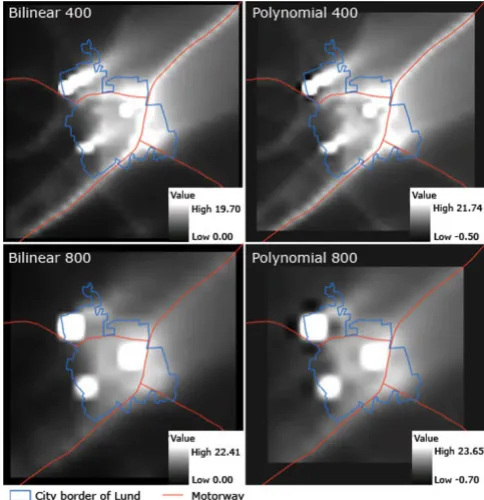
2) for the urban study site. The mean and standard devia-tion of the difference between interpolated grids and the fine grid (100 m resolution) were computed. In Table 1 the mean values for all cells given by Eq. 5 are listed. Fig-ure 4 illustrates the interpolated daily mean of NOx, dur-ing January, calculated for the urban study site (originating from the 400 and 800 resolutions).
The interpolated surface should preferably be as close as possible to the modelled surface of the fine grid. As can be seen in Table 1 the differences and standard deviations between the two interpolation methods are quite similar. Both the mean and the standard deviation are slightly bet-ter for the polynomial inbet-terpolation method than the bilinear.
Studying the different methods visually reveals, however, that the interpolation methods differ spatially. As can be seen from the polynomial interpolation shown in Figure 4, this method gives low values less than zero. This is caused by the fact that polynomial interpolation of degree three can model local maxima/minima between the input values where the contrast for the modelled values is high (this implies that the parameter a3 in Eq. 2 is large if the input values vary much). In Figure 4, the local minima for the polynomial interpolation are seen as black dots close to areas with high concentrations (i.e. bright areas).
Although the polynomial surface seems to follow the fine surface slightly better on average than the bilinear interpo-lation, we chose to use the bilinear interpolation method for this study (and recommend bilinear interpolation be used in future studies). The main reason is that polyno-mial interpolation can produce poor-quality output if there is high contrast in the input data.
Comparison of interpolated values and modelled values
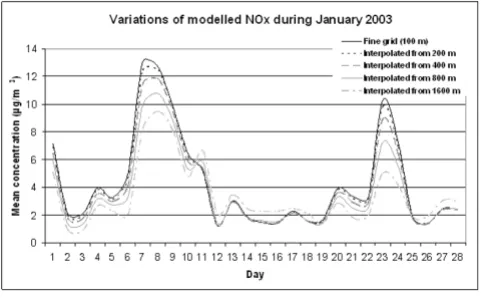
To estimate the loss of information using a coarse grid instead of a fine grid we compared the fine grid and the interpolated coarse grids by plotting their daily mean NOx concentrations against each other. In Figure 5 the mod-elled values for the 100-metre grid (fine grid) and for the interpolated coarse grids (200, 400, 800 and 1600 metres) for the urban study site are plotted in a time series of daily
values. As can be seen in Table 2 and Figure 5 almost all of the coarser grids, except for the 1600-m interpolated grid, gave lower or equal concentrations when they were interpolated to the same resolution as the fine grid. The grid with the coarsest resolution, 1600 metres, overesti-mates the concentrations during periods with low concen-tration. The accuracy and fit to the fine grid seem to be dependent on the resolution, the higher resolution, the better the accuracy compared to the fine grid.
NOX values [µg/m3] obtained by bilinear and polynomial
interpolation for the urban study site with spatial resolution 400 and 800 metres and a time resolution of one hour during the whole of January 2003
Figure 4
NOX values [µg/m3] obtained by bilinear and polynomial interpolation for the urban study site with spatial resolution 400 and 800 metres and a time resolution of one hour during the whole of January 2003. The polynomial interpolation method requires 16 (4 × 4) input values, unlike the bilinear interpolation method, which requires only 4 input values, and therefore a large proportion of the grid cells close to the boundary of the modelled area are not computed.
Table 1: Mean ( ) and standard deviation ( ) of the difference between interpolated and modelled hourly NOX values for the whole urban study site, January 2003.
Resolution (m)
Bilinear [ug/m3] Bilinear [ug/m3] Polynomial [ug/m3] Polynomial [ug/m3]
200 0.141 0.143 0.140 0.142
400 0.309 0.346 0.307 0.345
800 0.473 0.682 0.465 0.678
1600 0.394 1.119 0.342 1.125
∆ shour
Studying the standard deviations in Table 2 and Figure 6 reveals that when concentration values are aggregated in time (i.e. hours, days and weeks) the deviation and disa-greement between the different resolutions is considera-bly reduced. It is also quite obvious that the standard deviation is much lower for the rural study site than for the urban one.
Urban study site – Lund
The spatial distribution of standard deviations of
differ-ences in daily concentrations ( ) between different
res-olutions of modelled daily concentrations for the urban study area can be seen in Figure 7. The dissimilarity at lower resolutions is quite apparent, and varies between 0 and 30 µg/m3. The largest divergence is seen in areas of high contrast, such as along roads, near combustion sources and in the city centre. For the resolution of
200-metres the divergence is largest near the motorways, with values up to approximately 5 µg/m3, and near combus-tion sources, 2.60–30 µg/m3. For the 400-metre grid the
values begin to diverge near major roads (
approxi-mately 5–10 µg/m3). For the lower resolutions of 800-and 1600-metres calculations fail to reflect the correct concentrations in the city centre, and for the coarsest res-olution (1600 metres) the divergence for the entire city of Lund is 5.84 µg/m3.
Rural study site – Genarp
The spatial distribution of the standard deviation of differ-ences between different resolutions of modelled daily concentrations for the rural study area can be seen in Fig-ure 8. The dissimilarity at lower resolutions is not as apparent as for the urban study area. The divergence varies sdayi j,
sdayi j,
Areal standard deviation of NOx concentrations (µg/m3) for
different resolutions interpolated to 100 metres by bilinear interpolation
Figure 6
Areal standard deviation of NOx concentrations (µg/m3) for different resolutions interpolated to 100 metres by bilinear interpolation. The graphs show the values for the urban and rural study sites.
Table 2: Mean ( ) and standard deviation ( , , ) of differences in concentrations of NOX (µg/m3) between the
interpolated coarse resolutions and the fine grid for the whole month of January.
Resolution
Urban study site: Lund
200 m 0.14 0.87 0.45 0.22
400 m 0.38 1.63 0.80 0.40
800 m 0.70 3.00 1.36 0.69
1600 m 0.96 5.52 2.52 1.33
Rural study site: Genarp
200 m 0.03 0.16 0.08 0.04
400 m 0.09 0.27 0.14 0.07
800 m 0.17 0.46 0.23 0.10
1600 m 0.27 0.71 0.36 0.15
∆ shour sday sweek
∆ shour sday sweek
Time series of NOx concentrations (µg/m3) for different
res-olutions interpolated to 100 metres by bilinear interpolation
Figure 5
between 0 and 5 µg/m3, but for all the resolutions most of the area has a standard deviation of less than 1 µg/m3. As in the case of the urban study area, the highest contrasts occur along roads and near the village centre. For the 200-m resolution the standard deviation of the difference is largest near the motorway 0 – 3 µg/m3 and the standard deviation near the village of Genarp is well above 1 µg/m3. For the 400- and 800-metre grids the changes in estima-tion along the motorway are somewhat more apparent and the standard deviation rises to a maximum of approx-imately 5 µg/m3. Using a resolution of 1600 metres the daily standard deviation for the village centre of Genarp increases to levels between 1.1 and 2 µg/m3.
As can be seen from Table 2 and Figure 5 there is a system-atic difference between the values from the fine grid and the interpolated values from the coarse grids. The larger the cell size, the lower the NOxvalue. It should be noted that this is not due to the interpolation but the dispersion modelling. This can be illustrated by studying the original modelled values. The mean values for all modelled points (for all cells and time intervals); were computed and denoted Mean100, etc. The difference between the grids
was then calculated to obtain: Mean100-Mean200 = 0.14
µg/m3, Mean100-Mean400 = 0.32 µg/m3, Mean100
-Mean800 = 0.52 µg/m3, and Mean100-Mean1600 = 0.52
µg/m3. These values show a clear resemblance to the val-ues in Table 2.
Preference of resolution
It is important to take into consideration the properties of the modelled area into consideration. Concentrations modelled in urban areas with coarser resolution than 400 metres seem to generate larger error estimates in areas with high contrasts. However, for rural areas, where the variations in air pollutants are much lower, even a grid size of 1600 metres seems to generate reasonable results. However, most individuals in Scania live in urban areas where both levels and gradients of air pollutants are high. When conducting exposure studies in these areas too low a resolution might fail to reflect these variations, thus giv-ing incorrect exposure estimates for the inhabitants. Therefore, the results from the urban study site should have a greater impact on the choice of resolution. If data are to be stored as hourly values a resolution of, at least, 400 metres is preferable as lower resolutions will yield too high deviations in the cities and in areas with high
gradi-Spatial distribution of the standard deviation of the discrep-ancy between the coarse grids and the fine grid (100 metres) (equal to in Eq. 4) of NOx [µg/m3] for the rural study
site
Figure 8
Spatial distribution of the standard deviation of the discrep-ancy between the coarse grids and the fine grid (100 metres) (equal to in Eq. 4) of NOx [µg/m3] for the rural study site.
sdayi j,
sdayi j,
Spatial distribution of the standard deviation of the discrep-ancy between the coarse grids and the fine grid (100 metres) ( in Eq.n 4) of NOx [µg/m3] for the urban study site Figure 7
Spatial distribution of the standard deviation of the discrep-ancy between the coarse grids and the fine grid (100 metres) ( in Eq.n 4) of NOx [µg/m3] for the urban study site.
sdayi j,
ents. However, this may lead to a huge increase in the need for generation and storage of data. One option could therefore be to generate a grid for the entire region of Scania with a resolution of 800–1600 metres, and in addi-tion to this generate concentraaddi-tion grids with higher reso-lution, at least 400 metres, for the larger urban areas. This could lead to calculated concentrations in areas along major roads in the rural areas having a larger error than the rest of the region. The advantages, on the other hand, would be that the data storage and computer capacity needed would decrease considerably, while exposure esti-mates for the vast majority of the population in the region would be accurate.
Conclusion
When establishing a pollutant database certain criteria must be taken into consideration. The fact that a pollutant database has a fixed resolution in time and space makes the choice of resolution for these two parameters critical for the future use of the database. The aim of this study was to investigate the optimal spatial resolution with respect to temporal resolution for future epidemiological studies in Scania, Sweden. The pollutant database of NOx values will be used mainly for epidemiological studies with durations of days, weeks or even longer periods. Some studies might model exposure for a dynamic popu-lation (e.g. modelling being at work and at home), and therefore we need an hourly time resolution in the pollut-ant database. However, since the duration of the studies is at least one day the spatial resolution should be set in rela-tion to this time resolurela-tion.
The standard deviation for the accuracy of the modelled daily mean values of air pollutants is approximately 6 µg/ m3; a value that could be decreased by about 50% if the extreme values are removed. Previous studies [5] have given similar accuracy estimations. The choice of spatial resolution should not considerably deteriorate the accu-racy of the modelled values; therefore, we believe that an error due to coarse resolution greater than 1 µg/m3 is inad-visable. Based on Table 2 we conclude that for urban areas a spatial resolution of 200–400 m is suitable; and for rural areas the spatial resolution could be coarser (about 1600 m). This implies that we should develop a pollutant data-base that allows different spatial resolution for urban and rural areas.
Methods
The procedure used in this study is described below and follows the study design illustrated in Figure 2.
Comparison of modelled values and observed values
NOx values were modelled using a dispersion software and an emission source database for air pollutants. This database was constructed by the GIS Centre, Lund
Univer-sity, supported by the Swedish National Air Pollution and Health Effects Programme (SNAP)[5]. The database includes emission data for all major sources for the years 2000–2004; the main pollutants included are nitrogen oxides (NOx) and particular matter. The emission source database covers the whole Öresund region, where Scania, Zealand (Denmark) and the sea around Scania. The pur-pose of extending the area is to obtain more precise description of air quality in Scania, since emissions from Zealand and shipping affect the air quality in the western part of Scania. The most important sources in the database are road traffic, shipping, aviation, rail transport, industry, power plants, small-scale heating and machinery. Infor-mation, statistics and emissions were collected from offi-cial sources. The database includes data on about 23,000 road sources, 500 point sources and nearly 100 area sources.
For modelling we used the dispersion software Enviman [17]. Enviman estimates the pollutant values over a grid in which all emission sources are located in the centre of the cell. A box model is used to compute the contribution to the cell in which the emission sources are located. The contribution to other cells is calculated using a Gaussian dispersion method [18]. Enviman has a default time reso-lution of one hour. To perform dispersion calculations a meteorological dataset is needed. In this study we used observed meteorological data, such as wind speed, wind direction, temperature and solar radiation. The meteoro-logical observations were made on a 24 m high mast, in an open field a few kilometres from central Malmö. In the calculations, we allowed the plume from each source inside the calculation area travel 6 hours. After six hours, we assumed that the concentration was so low that it had no significant effect on the air pollution levels.
Enviman dispersion software and the emission source database were used to estimate the hourly NOx values at the location of the meteorological station in Malmö dur-ing four weeks in January 2003. Hourly NOx values for the same time period were also collected from the meteoro-logical station. The measurements were performed by the local environment protection agency in Malmö and the measuring technique was chemiluminescence. Temporal variations, means and standard deviation between the modelled and measured concentrations were then evalu-ated.
Generation of pollutant fields with a time resolution of one hour
was four weeks in January 2003. In the modelling we used meteorological data from Malmö. It should be noted that the modelling of these pollutant fields does not include background emissions; the reason being that the aim was only to estimate the effect of using different spatial resolu-tions and for this estimation the background emissions has no effect.
Figure 9 illustrates the 100 m pollutant fields computed for the two study sites. For the urban study site the mean level of NOx (from local sources during the study period January 2003) varies between 0.74 and 30.07 µg/m3. It can be seen that the highest values are along the motor-ways and other major roads, and in the city centre. For the rural study site the level, as well as the gradient, of air pol-lution is low in comparison with the urban study site; the mean concentrations of NOx in the study area during Jan-uary 2003 were between 0.16 and 4.85 µg/m3.
Generation of pollutant fields with time resolutions of one day and one week
From the one-hour data we computed pollutant fields of NOX values with temporal resolutions of one day and one
week. This step was simply performed by taking the mean values of the one-hour data.
Interpolation of the coarse pollutant fields
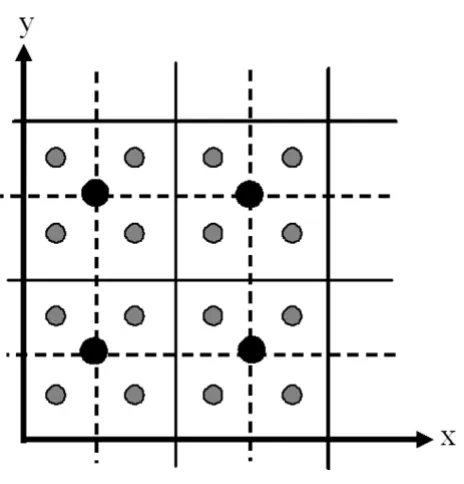
To estimate the loss of information when using a coarser grid it is necessary to know the NOX values for the same locations for all pollutant fields. The basic approach used was to estimate the NOX values in the coarse grid for all the points in the fine grid; this was performed by interpo-lation. The dispersion software (Enviman) estimates the NOX value at the centre of each cell in the grid. From Fig-ure 10, we can see that there are no common points mod-elled in both the fine grid and in the coarse grids (if the cell sizes differ by a factor of 2 and the grids have the same extent).
The ideal interpolation method for our application should generate a continuous surface that passes through all the modelled values (i.e., the input values for the inter-polation), this and the interpolated surface should be as close as possible to the modelled surface. In this study, we tested two interpolation methods: bilinear interpolation
and polynomial interpolation [19-21].
Bilinear interpolation requires that the input points be given in a regular grid, and is defined in Eq. 1 (using the notation in Figure 11):
z (xp, yp) = z1 + (z2 - z1)·w + (z3 - z1)·u + (z1 - z2 -z3 + z4)·uw
where
z(xp, yp) = interpolated value at the point xp, yp (i.e. the point at which the value is to be interpolated),
z1, z2, z3, z4 = values of the four closest points (to xp, yp) in the coarse grid,
w = (xp - x1)/∆x,
u = (yp - y1)/∆y and
∆x, ∆y = the spatial resolution of the coarse grid.
Bilinear interpolation has the advantage that it is simple and creates a continuous surface that passes through all the input points (points 1–4 in Eq.1). But it is not capable of modelling extreme values between the input points.
Polynomial interpolation can be implemented by com-puting a two-dimensional polynomial surface. However, this is too computationally intensive for our application (we have to interpolate around 100 million points) and therefore we decided to use a succession of one-dimen-sional interpolations. We used polynomials of degree three and 4 × 4 input points in a regular grid (equal to the 16 closest points in the coarse grid) for the interpolation. The approach adopted was to start computing a one-dimensional polynomial for a fixed y-value (y1) using Eq. 2 (with the notation in Figure 12):
z(xp|y = y1) = a0 + a1·xp + a2·xp2 + a 3·xp3
Since only four values (along the line y = y1) are used to estimate the polynomial parameters (ai) there is a unique solution (in reality the polynomial is written somewhat differently, (see [21]), but here we prefer this simple form
Illustration of the modelled NOx values (µg/m3) at the urban
study site (Lund) and the rural study site (Genarp)
Figure 9
for clarity). Equation 2 is then applied for the other three
y-values; this implies that we have four estimations of z for
x = xp. Finally, these values are used to interpolate the point (xp, yp) using a polynomial in the y-direction (Figure 12).
Polynomial interpolation provides a continuous surface as long as the same input points are used. However along the boundary lines where the input points are changed the surface is discontinuous. Polynomial interpolation (of degree three) is capable of modelling extreme values between the input values. This can be both an advantage and a disadvantage. For some types of surface characteris-tics the extreme values will decrease the difference between a modelled surface and an interpolated surface; for other types the difference will increase.
Comparison of the fine grid and the coarse grids
Interpolation provides pollutant fields with values for the same points. For the fine grid the values are modelled and for the coarse grid the values are interpolated. Further-more, we have pollutant fields with time resolutions of
one hour, one day and one week.
A number of methods are available to compare the values from the grids. Of special interest for our objective is the discrepancy between the values from the modelled fine grid and the interpolated values from the coarse grids. The discrepancy is estimated for each cell by its mean value and the standard deviation. The mean value of the
dis-crepancy for each cell ( ) is estimated by:
where:
i, j denotes that the cell in row i and column j in the grid,
Thour is the number of time intervals for a spatial resolution of one hour,
t denotes the time interval,
are the NOX values for time interval t and cell i, j in the fine grid, and
are the NOX values for time interval t
and cell i,j in the interpolated coarse grid.
The mean value will be the same regardless of whether we study hourly, daily or weekly NOX values (since the daily
∆i j,
∆i j
hour hour t
i j
hour t i j
t T
T FineNOX CoarseNOX
hour
,
, ,
, ,
= ⋅ −
=
∑
1
1
FineNOXhour ti j, ,
CoarseNOXhour ti j, ,
Bilinear interpolation
Figure 11
Bilinear interpolation. The value at point P (with coordinates xp, yp) is interpolated from the values at points 1–4.
The black dots indicate the centre points in the coarse grid (the solid line); the grey smaller dots show the centre points of the fine (or interpolated) grid (dashed line)
Figure 10
and weekly data were computed as mean values from the hourly data). Behind this lies an approximation that the mean values of the discrepancies are constant throughout the day and between different days. This approximation is fairly good.
The standard deviation will vary depending on whether we study hourly, daily or weekly data. For each cell and
time resolution, the standard deviation ( ) is given by:
where:
x denotes the time resolution (hour, day or week), and
Finally, we also use the mean value for all cells, i.e.:
where N, M are the number of rows/columns.
Software environment
A program in C++ was developed to compute the daily/ weekly values, perform the interpolation and compute the statistics. Input data for the program were binary files con-taining modelled NOX values from the dispersion soft-ware Enviman. For the implementation of the polynomial interpolation the program utilizes functions from Numer-ical Recipes in C [21]. The time series were generated by a standard spreadsheet program (MS Excel) and the maps by a standard GIS program (ArcGIS from ESRI).
Authors' contributions
ES: performed the analyses and parts of the programming, participated in the design of the study, and drafted the manuscript. LH: performed the main part of the program-ming, wrote the interpolation section and participated in the design of the study.
SG: performed the dispersion modelling.
All authors have read and approved the final manuscript.
Acknowledgements
We would like to acknowledge EMFO (Emission research programme con-ducted by the Swedish Road Administration) for financial support of this project, Anna Axmon for statistical advice, Kristina Jakobsson and Petter Pilesjö for general support and Håkan Törnevik for consultation regarding the dispersion model Enviman. We would also like to acknowledge our anonymous reviewers for their helpful comments.
References
1. WHO: Health aspects of air pollution with particulate matter, ozone and nitrogen dioxide. Report on a World Health Organisa-tion(WHO) working group. Bonn 2003 2003.
2. Chaix B, Gustafsson S, Jerrett M, Kristensson H, Lithman T, Boalt Å, Merlo J: Children's exposure to nitrogen dioxide in Sweden: investigating environmental injustice in an egalitarian coun-try. Journal of Epidemiology and Community Health 2005, 60:234-241. 3. Jerret M, Arain A, Kanaroglou P, Beckerman B, Potoglou D,
Sahsuvaro-glu T, Morrison J, Giovis C: A review and evaluation of intraur-ban air pollution exposure models. Journal of Exposure and Environmental Epidemiology 2005, 15:185-204.
4. Briggs D: The role of GIS: Coping with space (and time) in air pollution exposure assessment. Journal of Toxicology and Environ-mental Health, Part A 2005, 68:1243-1261.
5. Gustafsson S: A geographical and temporal high resolution emission database for dispersion modeling of environmental NOX in southern Sweden. In Lic ThesisVolume 1. Lund University, Department of Physical Geographya and Ecosystemanalysis; 2007:1-14. 6. Cromely EK: GIS and Disease. Annual Review of Public Health 2003,
24:7-24.
7. Krieger N: Place, Space, and Health: GIS and Epidemiology.
Epidemiology 2003, 14(4):384-385.
8. João E: How scale affects environmental impact assessment.
Environmental Impact Assessment Review 2002, 22:289-310.
9. Setton EM, Hystad PW, Keller CK: Opportunities for using spatial property assessment data in air pollution assessments. Inter-national Journal of Health Geographics 2005, 4:26.
sxi j,
s T x i j
x
x t i j i j
t Tx
,
, , ,
( )
=
− ⋅
∑
= −1 1
2
1
∆ ∆
∆i jx t,, =FineNOXi jx t,, −CoarseNOXx ti j,,.
∆= 1 ⋅
∑
∑
∆NM
i j
j M
i N
,
s
NM s
x xi j
j M
i N
= 1
∑
∑
,Interpolation of the value at point P (xp, yp) (greydot) by a succession of polynomial interpolations
Figure 12
Publish with BioMed Central and every scientist can read your work free of charge "BioMed Central will be the most significant development for disseminating the results of biomedical researc h in our lifetime."
Sir Paul Nurse, Cancer Research UK
Your research papers will be:
available free of charge to the entire biomedical community
peer reviewed and published immediately upon acceptance
cited in PubMed and archived on PubMed Central
yours — you keep the copyright
Submit your manuscript here:
http://www.biomedcentral.com/info/publishing_adv.asp
BioMedcentral 10. Ali M, Park J-K, Thiem VD, Canh DG, Emch M, Clemens JD:
Neigh-borhood size and local geographic variation of health and social determinants. International Journal of Health Geographics 2005,
4:12.
11. CEAA: A reference guide for the Canadian Environmental Assessment Act: assessing environmental effects on physical and cultural heritage resources Hull, Quebec: Canadian Environmental Assessment Agency; 1996. 12. Gregorio DI, Samociuk H, DeChello L, Swede H: Effects of study
area size on geographical characterization of health events: Prostate cancer incidence in Southern New England, USA, 1994–1998. International Journal of Health Geographics 2006, 5:8. 13. Stroh E, Oudin A, Gustafsson S, Pilesjö P, Harrie L, Strömberg U,
Jakobsson K: Are associations between socio-economic charac-teristics and exposure to air pollution a question of study area size? An example from Scania, Sweden. International Journal of Health Geographics 2005, 4:30.
14. Pénard-Morand C, Schillinger C, Armengaud A, Debotte G, Chrétien E, Pellier S, Annesi-Maesano I, ISSAC-France: Assessment of school-children's exposure to traffic related air pollution in the French Sic Cities Study using a dispersion model. Atmospheric Environment 2006, 40:2274-2287.
15. Cyrys J, Hochadel M, Gehring U, Hoek G, Diegmann V, Brunekreef B, Heinrich J: GIS-based Estimation of Exposure to Particulate Matter and NO2 in Urban Area: Stochastic versus Dispersion
modelling. Environmental Health Perspectives 2005, 113(8):987-992. 16. Wentz EA, Gober P, Balling RC Jr, Day TA: Spatial Patterns and
Determinants of Winter Atmospheric Carbon Dioxide Con-centrations in an Urban Environment. Annals of the Association of American Geographers 2002, 92(1):15-28.
17. Opsis: 2006 [http://www.opsis.se/]. 2006-05-26
18. USEPA: User's guide for the AMS/EPA regulatory model – Aermod. 1998 [http://www.epa.gov/scram001/7thconf/aermod/aer modug.pdf]. (2006-05-15)
19. Zhizhou W: Principles of Photogrammetry Beijing, Press of Wuhan Tech-nical University of Surveying and Mapping; 1990.
20. Burrough P, McDonnel R: Principles of Geographical Information Systems Oxford, Oxford University Press; 1998.