R E S E A R C H
Open Access
Toward measuring language teachers
’
assessment knowledge: development and
validation of Language Assessment
Knowledge Scale (LAKS)
Elçin Ölmezer-Öztürk
*and Belgin Aydin
* Correspondence:
[email protected] Department of Foreign Language Education, Anadolu University, 26470 Eskişehir, Turkey
Abstract
This study reports on the development and validation of Language Assessment Knowledge Scale, LAKS, which aims to measure teachers’ language assessment knowledge. The initial development of the scale included a thorough literature review, creating an item pool, and an initial expert opinion stage. The later process, which led to the development of the final form, consisted of several detailed stages including organizing meetings with practitioners in the field, gathering opinions of experts in language testing and assessment, and piloting the scale. At the end of this long-lasting validation process, LAKS with 60 items and 4 constructs (assessing reading, assessing listening, assessing writing, and assessing speaking) was completed by 542 EFL teachers working in higher education context. The statistical procedures during the analysis process included second-order confirmatory factor analysis, and Cronbach alpha for the reliability. The findings revealed that LAKS had a good model-data fit with the obtained factor loads, and Cronbach alpha coefficients were satisfactory. Concluding that LAKS can serve as a valid and reliable instrument to measure language teachers’assessment knowledge, the study offers several suggestions for further research.
Keywords:Language assessment knowledge scale, Language assessment literacy, Developing and validating a scale, Language testing and assessment, EFL teachers
Introduction
Assessment in any education context is mainly associated with learners, yet the teachers’role in determining the result of the assessment and learners’success or fail-ure is undeniable. The literatfail-ure (Calderhead 1996; Malone 2013) touches upon the critical role of teachers in assessment process and the importance of their decision-making. Research also indicates that teachers are not well equipped with suffi-cient knowledge on testing and assessment, and they are not ready for their roles as as-sessors (Mertler2005).
The discussion regarding the role of teachers in assessment and their competency in this domain has led to the emergence of a relatively popular concept,“assessment liter-acy.” The term was coined by Stiggins (1991), and rooted in mainstream educational and psychology research mostly. According to Stiggins, assessment literate teachers
know “what they are assessing, why they are doing it, how best to assess the skill, knowledge of interest, how to generate good examples of student performance, what can potentially go wrong with the assessment, and how to prevent that from happen-ing”(p. 240).
There are many studies related to assessment literacy of both pre- and in-service teachers in the literature. Teachers’assessment literacy levels have generally been mea-sured through questionnaires. Teacher Assessment Literacy Questionnaire (TALQ), As-sessment Literacy Inventory (ALI), Classroom AsAs-sessment Literacy Inventory (CALI), and Assessment Literacy Inventory (ALI) can be listed as some of the popular instru-ments. TALQ, developed by Impara, Plake, and Fager in 1993 revealed a mean score of 23 out of 35 of in-service elementary and secondary school teachers in the USA. ALI, the renamed version of TALQ, by Campbell, Murphy, and Holt in 2002 focused on pre-service teachers’assessment literacy level and found out that even after completing a course on educational assessment, pre-service teachers got a mean score of 21. CALI, developed by Mertler in 2005, compared the assessment literacy levels of in-service and pre-service teachers. The results revealed higher literacy levels for in-service teachers. The last instrument developed by Mertler and Campbell (2005) was Assessment Liter-acy Inventory (ALI), and the items were developed considering the “Standards for Teacher Competence in Educational Assessment of Students” (AFT, NCME, and NEA, 1990). The results indicated that the mean score of the respondents was 23.83 out of 35, meaning that the pre-service teachers in this study had a low level of assessment lit-eracy. As seen in all these studies, although in-service teachers had a higher level com-pared to pre-service teachers, both groups had low literacy levels of assessment literacy. Taking the definition of assessment literacy as the root and focusing on the compe-tency of language teachers, a novel term has flourished which is language assessment literacy (LAL), and there exist several definitions of language assessment literacy in the field. According to Taylor (2009, p. 24), language assessment literacy, in general sense, is “the level of knowledge, skills and understanding of assessment principles and prac-tice that is increasingly required by other test stakeholder groups, depending on their needs and contexts.” Malone also (Malone 2013, p. 329) defined it as “language teachers’ familiarity with testing definitions and the application of this knowledge to classroom practices in general and specifically to issues related to assessing language”. Inbar-Lourie (2017) stated that language assessment literacy requires additional compe-tencies when compared to assessment literacy and added that it is the combination of assessment literacy skills and language-specific skills.
qualitative data. The results demonstrated that the participants teachers’perceived LAL was not sufficient, and they did not feel themselves prepared effectively for assessment-related practices. Additionally, it was found that teacher education pro-grammes were not giving the efficient and sufficient education and training in language assessment to the pre-service teachers. The aim was to find out the teachers’ percep-tions of LAL and their individual needs related to language testing and assessment. In another recent study by Baker and Riches (2017), the LAL development of the teachers was examined. One hundred twenty Haitian high school teachers participated in the study, and the data were collected via feedback on drafts of revised exams, survey with teachers, and teacher interviews. Some workshops were designed in 2013 for the partic-ipants, and this study took these workshops as its basis. It was concluded that LAL de-velopment of the teachers was clear after these workshops, and the main areas where the teachers’LAL levels increased were creating reading comprehension questions, in-tegrating vocabulary task, basing all exam sections on the same topic, increased atten-tion of the connecatten-tion between teaching and assessment, broadening of the teachers’ understanding of the construct of language ability, teachers’ beliefs concerning their supportive role, and finally learning about reliability, validity, and practicality.
Purpose of the study
When the studies in the literature related to language assessment literacy are investi-gated, it is seen that they mostly focus on the needs and perceptions of language teachers in terms of testing and assessment (Fulcher 2012; Inbar-Lourie 2008; Malone 2013; Scarino2013; Lam2015; Baker and Riches2017) and the main conclusion is that teachers should be supported and encouraged to be more assessment literate. However, the first step toward encouraging language teachers to be more assessment literate is to determine what teachers know and do not know regarding language assessment. Though there has been an increasing research tendency toward language assessment literacy of teachers, what is primarily needed as a starting point is the investigation of language assessment knowledge of EFL teachers, because assessment knowledge is the core of assessment literacy.
Apart from these measurement tools, there are also some tools aiming to measure language assessment literacy of EFL teachers. One belongs to Tao (2014) who devel-oped four distinct scales one of which aims to measure classroom assessment know-ledge of EFL teachers. This tool includes some elements related to language, but it still has too many items related to general education. Additionally, the items are not divided into language skills. The next one belongs to Kremmel and Harding (Towards a com-prehensive, empirical model of language assessment literacy, forthcoming) whose in-strument is a five-point Likert scale. In their scale, participants have to choose one of the options ranging from not knowledgeable/not skilled to extremely knowledgeable/ extremely skilled. Thus, these items were developed to find out the needs of EFL teachers; but, as these are self-reports, what is concluded relies on the perceptions or opinions of the participants. The last one is Vogt and Tsagari (2014)’s study in which they aimed to find out whether the participants were trained or needed training in vari-ous domains related to assessment such as classroom-focused LTA or purposes of test-ing. Similar to Kremmel and Harding, this tool also seeks for self-reports of the participants, and aims to measure their language assessment knowledge and practices based on a perception level.
For these two major reasons, there is an urgent need for the investigation of this know-ledge, and this study aims to develop and validate Language Assessment Knowledge Scale (LAKS) as a new and to-the-point instrument to be used for that purpose. In this sense, this paper aims to address to the following research question throughout the study.
1. What are the psychometric properties of language assessment knowledge scale?
Methodology
The research context
In Turkey, preparatory programs at universities provide intensive foreign language edu-cation to university students before they start their eduedu-cation in their academic fields. Students who finish these programs successfully by getting the required grades from the proficiency exams can continue their education in their departments. Otherwise, they have a chance to get the language education for one more year until they get profi-cient. In some cases, students who do not have English-medium instruction in their de-partments can prefer to learn a foreign language voluntarily by attending these intensive language education programs.
competent they are in assessing their learners is open to discussion (Hatipoğlu2015). As a starting point, language assessment knowledge of language teachers should be de-termined. This identification is vital because by detecting the strengths and weaknesses of language teachers, the needs of language teachers could be specified. Based on these needs, testing and assessment course in pre-service education and teacher professional development programs related to language assessment can be designed and developed.
Participants
The participants of the study included 542 teachers working at English preparatory programs at various universities in Turkey. The scale was prepared in an online format and sent to almost all universities having a preparatory program. After a 1-month period, the number of the teachers who fully completed the scale was 542 and the demographic features with the numbers are presented in the following Table1.
Developing the items
First of all, in order to provide a deep theoretical background to the instrument, the books referenced so far on language testing and assessment (Harris 1969; Hughes1989; Heaton 1990; Bachman 1990; Bailey 1998; Alderson 2000; Buck 2001; Weigle 2002; Brown 2003; Luoma2004; Fulcher and Davidson2007,2012; Coombe et al.2012, etc.) were read by the researcher. While reading, all the knowledge elements which were stated in those books as“need-to-know”about testing or assessing language skills; that is, reading, listening, writing, and speaking, were listed by the researcher. Then, the re-searcher chose the ones repeated in references mentioned above for the item pool for each language skill. This list consisted of 237 items in total (49 items for reading, 61
Table 1Participants and the demographic features
Demographic feature Number of participants Percentage
Gender Male—174 32
Female—368 68
Years of experience 1–5 years—86 16
6–10 years—173 32
11–15 years—114 21
16–20 years—100 18
More than 21—69 13
Educational background BA—238 44
MA—255 47
PhD—49 9
The BA program graduated ELT—347 64
Non-ELT—195 36
The current workplace State University—372 68
Private University—170 32
Had a separate testing/assessment course in pre-service Yes—282 52
No—260 48
Ever been a member of a testing office Yes—260 Yes–% 48
for listening, 74 for writing, and 53 for speaking). Next, three experts with a PhD de-gree went over the item pool in detail focusing carefully on the comprehensibility and orthography of the items and the compatibility of each item for the language skill it was listed in. At the end of this initial step, 17 items (3 items from reading, 2 from lis-tening, 6 from writing, and 6 from speaking) were removed from the instrument and the very initial format of the scale had four constructs; assessing reading (46 items), assessing listening (59 items), assessing writing (68 items), and assessing speaking (47 items), consisting 220 items in total.
The process of ensuring content validity
At the second stage, individual meetings with ten teachers having various years of teaching experience and educational background from preparatory programs of differ-ent universities were held. In these individual meetings, the teachers were asked to read the items and make comments on whether the items were clear to them and they had any difficulty in understanding the terminology in the items. At the end of those meet-ings, no item was removed from the list but several revisions were made based on the suggestions provided by the teachers to make the wordings clearer for further stages.
The third stage of developing the instrument included getting the opinions of experts in the field of ELT. For this, the instrument was designed in a format having four different parts, each for a different language skill and the items were listed in these parts. For each item, the researcher put three choices as“necessary, not necessary, needs revision (please justify)”similar to a Likert scale and the items were provided to the experts, 14 academi-cians who studied on testing and assessment or gave related courses in higher education level in the fields of English language teaching and testing and evaluation at different uni-versities. In 1 month, 11 of the experts responded to the initial format of the instrument and provided feedback on each item. Based on the suggestions provided by these experts, 67 items were removed from the instrument, and revisions were made on several items. At the end of all these stages, 153 items remained in the scale (reading 37 items, listening 33 items, writing 48 items, and speaking 35 items).
At the fourth stage of the process, the scale was presented to real practitioners, which was believed to contribute significantly to the validation of the instrument; the re-searcher organized a meeting with the English preparatory program-testing office of one of the leading universities in Turkey. The meeting included 18 teachers; 6 of them had PhDs or MAs in testing and evaluation or in ELT. They were sent the instrument before the meeting and were asked to respond and comment on it beforehand. The meeting in which the participants and the researcher discussed the validity, compre-hensibility, and compatibility of each and every item lasted about 5 h. At the end of the meeting which provided the researcher a deeper insight from the perspectives of the practitioners, 41 items were removed from the instrument, and several revisions were made on the remaining ones. Finally, the instrument which is called Language Assess-ment Knowledge Scale (LAKS, henceforth) consisting of 112 items (reading 28 items, listening 26 items, writing 34 items, and speaking 24 items) were ready for the piloting process. This removal and/or revision process in all these stages is shown in Table2.
comments on it. However, after receiving their answers, it was observed that the partic-ipants tended to give the same answers (all true or all false) toward the end of the scale and some of the participants did not even finish completing. Furthermore, the com-ments made by those participants revealed that there were too many items to respond in the scale and it took too much time, demotivating them to complete. Based on this feedback, which consisted of elements that had the potential to influence the validity and the reliability of the scale negatively, five academicians who were experts in foreign language teaching and assessment had long discussions on each item in the instrument and decided to keep the items that were fundamental for a language teacher to know regarding the assessment of a foreign language, and the other items were eliminated from the study. At the end, the remaining 60 items, with 15 in each construct were sent to all the language teachers working at the preparatory programs in Turkey in an on-line platform.
Data collection procedure
The data of this study were collected during the early days of the spring semester of 2017–2018 academic year. Among 122 universities in Turkey (85 state and 37 private), the scale was sent to the ones with English preparatory programs. Among these univer-sities, which were decided as the context of the study, 37 state and 18 private contrib-uted to the data collection process of the study. The scale was sent in an online format to all the teachers working in these programs. During data collection process, reminder e-mails were sent to the participants and the head of their schools by the researcher in order to encourage the participants to respond to the scale. This process lasted about one and a half month and at the end of this period, 542 participants responded LAKS completely, and these participants formed the core data of this study.
Findings
The research question of this study aimed to reveal the psychometric properties of LAKS. First, in order to confirm the compatibility of the items with the constructs (assessing reading, assessing listening, assessing writing, and assessing speaking), and Table 2The number of removed items throughout the validation process
Reading Listening Writing Speaking In total
1st stage (three experts with PhD in ELT checking for comprehensibility)
49 61 74 53 237
−3 −2 −6 −6 −17
2nd stage (Checking with 10 teachers) 46 59 68 47 220
– – – – –
3rd stage (Checking with academicians) 46 59 68 47 220
−9 −26 −20 −12 −67
4th stage (Training with testing office members) 37 33 48 35 153
−9 −7 −14 −11 −41
5th stage (Piloting with 50 teachers and expert opinion) 28 26 34 24 112
−13 −11 −19 −9 −52
the compatibility of these constructs with language assessment knowledge; in other words, the model-data fit in general, second-order CFA was performed using the Mplus 7.0 package program. Since the responses given for each item were categorical, WLSMV was used as the proficiency estimator. Since CFA is included in the structural equation modeling family, the model data compatibility was first investigated for the re-sults of CFA. The rere-sults and interpretations are as follows.
In the structural equation modeling studies, the expected chi-square value is not sig-nificant, in other words, the value of “p” must be bigger than .05. However, this value can be misleading because it is sensitive to the size of the sample. For this reason, the value obtained by dividing the chi-square by degrees of freedom is generally reported. At this point, the value of the model which is below 2.5 indicates a good fit. Besides, in second-order CFA, the RMSEA values smaller than .08 indicate a good one. Moreover, good fit for CFI and TLI values is for values above .90 and .95 respectively (Li-tze and Bentler 1999; Byrne 2012; Çokluk et al. 2012). At this point, the values presented in Table3 (.028 as the RMSEA value, .981 as the CFI, and .980 as the TLI value) revealed a good fit in this study based on the cut-off points. Thus, it can be said that the complete statistics obtained are indicative of a good model-data fit.
Standardized values in the structural equation modeling are interpreted as standard-ized coefficients in the regression. In the context of CFA, these values are seen as factor loads. Factor loads for each item, standard errors, andtvalues for these values are pre-sented in the Table4.
The values given in the first column above are referred as standardized path coeffi-cients, and these values are accepted as factor loadings in CFA. The coefficients are val-ued between −1 and + 1, and the higher the value is, the higher its relationship with the latent variable is. The second column refers to the standard error values and the third column includes thetvalues, which are obtained by dividing the factor loading of an item to its standard error. Getting higher tvalues increases the significance of the items. The last column gives the R-square values which is equal to the square of factor loadings. This value is between 0 and 1, and as it gets closer to 1, the amount of vari-ance explained in the observed variable increases. Based on these explanations, it can be seen that the factor loadings of most of the items in assessing reading and assessing listening are significant and satisfactory, whereas there exists several items with low fac-tor loadings in assessing writing and assessing speaking.
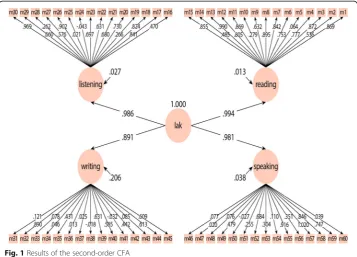
In the next step, the structural values obtained were reported on the model. This fig-ure is shown below (Fig.1).
Based on the second-order CFA, the figure above reveals how LAK explains its con-structs (assessing reading, assessing listening, assessing writing, assessing speaking) in terms of their variance. Firstly, standardized path coefficients were reported as .98 for assessing listening, .99 for assessing reading, .89 for assessing writing, and .98 for
Table 3Model-fit indices derived from second order CFA
Fit indice Cut off for good fit Value Comment
Chi-square/df < 2.5 1.41 Good fit
RMSEA < .08 .028 Good fit
CFI > .90 .981 Good fit
Table 4Factor loadings for each item
Factor Item no Factor loading SE t R-square
Assessing reading 1 0.869* 0.021 41.055 0.755
2 0.536* 0.040 13.342 0.287
3 0.872* 0.019 46.981 0.760
4 0.777* 0.022 35.885 0.603
5 0.064 0.058 1.110 0.004
6 0.753* 0.031 24.012 0.567
7 0.842* 0.020 41.343 0.708
8 0.895* 0.022 40.634 0.801
9 0.632* 0.039 16.402 0.400
10 0.279* 0.053 5.238 0.078
11 0.869* 0.019 46.619 0.756
12 0.805* 0.020 39.951 0.648
13 0.990* 0.018 55.177 0.980
14 0.485* 0.047 10.282 0.235
15 0.855* 0.027 31.767 0.730
Assessing listening 16 0.470* 0.045 10.354 0.221
17 0.841* 0.021 40.876 0.707
18 0.824* 0.021 39.164 0.679
19 0.266* 0.058 4.587 0.071
20 0.730* 0.024 30.613 0.533
21 0.680* 0.039 17.548 0.463
22 0.631* 0.027 23.514 0.398
23 0.697* 0.024 29.423 0.486
24 −0.043 0.059 −0.728 0.002
25 0.021 0.059 0.351 0.000
26 0.902* 0.018 48.991 0.814
27 0.576* 0.033 17.316 0.332
28 0.262* 0.052 5.025 0.069
29 0.660* 0.026 25.784 0.435
30 0.969* 0.020 48.969 0.940
Assessing writing 31 0.121 0.066 1.847 0.015
32 0.889* 0.031 28.386 0.791
33 0.078 0.062 1.267 0.006
34 −0.046 0.071 −0.644 0.002
35 0.431* 0.054 7.975 0.186
36 0.013 0.062 0.207 0.000
37 0.025 0.076 0.330 0.001
38 −0.018 0.066 −0.269 0.000
39 0.631* 0.045 14.132 0.398
40 0.585* 0.044 13.245 0.343
41 −0.033 0.062 −0.530 0.001
42 0.442* 0.051 8.680 0.195
43 0.085 0.062 1.371 0.007
assessing speaking. That means, one standard deviation change in LAK (1.000) would lead to 0.994 standard deviation change in assessing reading, .986 standard deviation change in assessing listening, .891 standard deviation change in assessing writing, and .981 standard deviation change in assessing speaking, all of which are good indicators of variance explanation. In addition to this, the error variance values were found as .027 for assessing listening, .013 for assessing reading, .206 for assessing writing, and .038 for assessing speaking. In other words, these values mean that LAK explains 97% variance of assessing listening, 98% variance of assessing reading, 80% variance of asses-sing writing, and almost 96% variance of assesasses-sing speaking. In short, as all these values suggest, the model presents a perfect model-data fit in terms of explaining LAK and its constructs.
Reliability analysis
In developing and validating measurement instruments, presenting the statistical values related with the reliability is another important factor. The following table gives the Cronbach alpha coefficients of LAKS in total and its sub-constructs (Table5).
The findings above reveal that Cronbach alpha coefficient of LAKS in total was .91 which is a highly satisfactory value, and it shows that LAKS has a statistically high reli-ability to be used as a measurement tool. When the table is examined, it is also seen that the Cronbach alpha value for assessing reading appeared to be .88, again referring to a high level of reliability. The Cronbach alpha coefficient for assessing listening sub-construct was obtained as .78, which means that the scale has internal consistency at an acceptable level. The Cronbach alpha coefficient calculated for assessing writing sub-construct was found out as .49. Since the value is below the acceptable limit of .60 (Hulin et al.2001), this construct resulted in a lower confidence in internal consistency.
Table 4Factor loadings for each item(Continued)
Factor Item no Factor loading SE t R-square
45 0.609* 0.042 14.467 0.371
Assessing speaking 46 0.077 0.059 1.301 0.006
47 −0.019 0.067 −0.290 0.000
48 0.076 0.061 1.257 0.006
49 0.479* 0.044 10.964 0.229
50 −0.027 0.059 −0.463 0.001
51 0.255* 0.061 4.194 0.065
52 0.684* 0.033 20.660 0.468
53 0.304* 0.052 5.803 0.092
54 0.110 0.063 1.759 0.012
55 0.916* 0.018 50.230 0.839
56 0.350* 0.053 6.616 0.123
57 1.020* 0.014 73.086 1.00
58 0.845* 0.026 32.142 0.715
59 0.747* 0.033 22.386 0.557
60 0.039 0.063 0.613 0.002
Finally, the Cronbach alpha coefficient for assessing speaking was found to be .65, which is again an acceptable value for the internal consistency.
In addition to the reliability values above, item-total correlations related with each item were also calculated under each skill. The following table presents the values for the items (Table6).
When the item-total correlation values in the above table are examined, it is seen that items 5 and 10 in reading are relatively low in size. The coefficients obtained for other items in the construct of assessing reading were satisfactory. As for the construct of assessing listening, it is seen that the correlation value obtained for items 9, 10, and 13 in this subtest was relatively low and the other items had satisfactory values. The third construct was assessing writing and in this construct, it is seen that most of the items had low-level correlation values. Finally, the last construct of the scale was assessing speaking, and it is seen that the item-total correlation values obtained for most of the items are below .50 and relatively low in size.
When all the item-total correlation values are examined, it can be concluded that several items under each construct have a relatively low level of item-total correlation. However, after this statistical analysis, three academicians who significantly contributed
Fig. 1Results of the second-order CFA
Table 5Reliability analysis for Language Assessment Knowledge Scale (LAKS) and its sub-constructs
Constructs Cronbach alpha
Language Assessment Knowledge Scale .91
Assessing reading .88
Assessing listening .78
Assessing writing .49
to initial validation process of LAKS were asked to provide expert opinion on those items. Based on their expert opinion, it was decided that these items were important for the content validity of the scale and their contribution to LAKS in general was sig-nificant in terms of measuring language teachers’assessment knowledge. Besides, con-sidering model-data fit and reliability coefficients of the constructs, it can be said that the scale presented satisfactory statistical values with those items. Due to all these rea-sons, the items with relatively low level of item-correlation values were decided to be kept in the scale.
Discussion
After a tough validation process including the opinions of teachers, academicians, and test-ing practitioners, LAKS was administered to 542 EFL teachers worktest-ing in higher education contexts. The findings derived from the statistical analysis showed that LAKS had a good model-data fit, and the factor loadings and reliability values were at a satisfactory level. However, writing and speaking constructs had relatively low factor loadings, but they were decided to be kept in the scale due to their high contribution to the content validity.
In its final form (see Additional file1), LAKS was developed as a scale consisting of four constructs; assessing reading, assessing listening, assessing speaking, and assessing writ-ing, with 15 items for each and 60 items in total. The scale includes the items which spe-cifically refer to the language assessment knowledge of EFL teachers in assessing each skill. In that sense, LAKS makes a unique contribution of the research and practical un-derstanding of language assessment knowledge in the literature. The instruments in the literature focusing on assessment literacy of language teachers either include items all of which are related with general assessment literacy (Impara et al. 1993; Campbell et al. 2002; Mertler and Campbell2005) or their items require self-reports answers at percep-tion level (Tao2014; Vogt and Tsagari2014; Kremmel and Harding: Towards a compre-hensive, empirical model of language assessment literacy, forthcoming). By including Table 6Item-total correlation coefficients of the items under each skill
Item no
Item-total correlation
Assessing reading Assessing listening Assessing writing Assessing speaking
1 .686 .363 .082 .109
2 .382 .586 .410 −.009
3 .660 .536 .100 .124
4 .564 .204 .009 .282
5 .048 .476 .264 −.037
6 .583 .490 .106 .201
7 .632 .372 .014 .444
8 .720 .449 .106 .176
9 .481 .024 .314 .046
10 .191 .039 .314 .580
11 .699 .625 .040 .284
12 .608 .327 .311 .637
13 .797 .141 .018 .583
14 .312 .439 .235 .484
items specifically focusing on the knowledge of language teachers on assessing each skill and requiring direct responses from them make LAKS a unique research instrument to measure language assessment knowledge of teachers.
Conclusion
Considering the paucity of research focusing on language assessment literacy and the urgent need for an instrument to measure language assessment knowledge, as the core of language assessment literacy, among language teachers, this study aimed to develop language assessment knowledge scale—LAKS. After a thorough validation process which included literature review, meetings with testing and assessment practitioners, expert opinion, and a piloting process, LAKS with 60 items and 4 constructs (assessing reading, assessing listening, assessing writing, assessing speaking) was completed by 542 EFL teachers working at higher education context. The findings derived from second-order confirmatory factor analysis revealed a good model-data fit. Though some of the items in assessing writing and assessing speaking constructs had low factor load-ing and item-total correlations, they were not removed from the scale based on the ex-pert opinion considering their significant contribution to the content validity of the scale. Besides, the scale demonstrated satisfactory levels for reliability according to the Cronbach alpha analysis. Based on all the validation and statistical procedures, it can be concluded that LAKS can be used as a valid and reliable instrument to measure EFL teachers’language assessment knowledge.
The major underlying reason behind developing a measurement tool on language as-sessment knowledge is the urgent need in this field. In other words, in addition to its statistical and procedural validation, LAKS not only presents a baseline for researchers interested in this field but also creates an initial framework to understand assessment knowledge level of language teachers. Besides, this scale might be used not only as the first step to identify the needs of in-service teachers and to develop training programs, it might also have implications for pre-service teacher training programs in preparing future teachers to be more equipped to the field.
A major limitation of this study could be that the scale was developed and validated in Turkish higher education context. Thus, the findings could only be interpreted within the unique features of this context. However, this limitation can also be a sug-gestion for further research studies. Validation of LAKS in different countries and edu-cational contexts will contribute to our understanding of language assessment literacy of teachers from various groups. Besides, new items that are regarded as crucial in assessing language skills can also be added to LAKS in order to enrich its components and scope. For these reasons, it can be said that validation of LAKS with this study will serve as a baseline for further studies that will focus on language assessment knowledge of teachers in different contexts throughout the world.
Additional file
Additional file 1: Language Assessment Knowledge Scale–LAKS. (DOCX 21 kb)
Acknowledgements
This study is a part of the PhD dissertation entitled as“Developing and validating language assessment knowledge
scale (LAKS) and exploring the assessment knowledge of EFL teachers”and completed by Elçin ÖLMEZER-ÖZTÜRK in
Funding
No funding was received from any specific funding agencies in the public, commercial, or not-for-profit sectors.
Availability of data and materials
Data and material are available.
Authors’contributions
To conduct the study, EOO and BM worked collaboratively throughout the research process. Both authors read and approved the final manuscript.
Competing interests
The authors declare that they have no competing interests.
Publisher’s Note
Springer Nature remains neutral with regard to jurisdictional claims in published maps and institutional affiliations.
Received: 29 June 2018 Accepted: 29 November 2018
References
Alderson, J. C. (2000).Assessing reading. Cambridge: Cambridge University Press.
Bachman, L. F. (1990).Fundamental considerations in language testing. Oxford: Oxford University Press.
Bailey, K. M. (1998).Learning about language assessment: dilemmas, decisions, and directions. Boston: Heinle & Heinle.
Baker, B. A., & Riches, C. (2017a). The development of EFL examinations in Haiti: collaboration and language assessment
literacy development.Language Testing.https://doi.org/10.1177/0265532217716732.
Brown, H. D. (2003).Language assessment: principles and classroom practices. White Plains, NY: Pearson Longman.
Buck, G. (2001).Assessing listening. Cambridge: Cambridge University Press.
Byrne, B. M. (2012).Structural equation modeling with Mplus. Basic concepts, applications, and programming. New York:
Routledge.
Calderhead, J. (1996). Teachers: beliefs and knowledge. In D. C. Berliner & R. C. Calfee (Eds.),Handbook of educational
psychology(pp. 708–725). New York: Simon & Schuster Macmillian.
Campbell, Y., Murphy, J. A., & Holt, J. K. (2002). Psychometric analysis of an assessment literacy instrument: applicability to
preservice teachers. InPaper presented at the meeting of the Mid-Western Educational Research Association, Colombus, OH.
Çokluk, Ö.,Şekercioğlu, G., & Büyüköztürk,Ş. (2012).Sosyal bilimler için çok değişkenli istatistik: SPSS ve LISREL uygulamaları.
Ankara: Pegem Akademi.
Coombe, C., Davidson, P., O’Sullivan, B., & Stoynoff, S. (Eds.). (2012).The Cambridge guide to second language assessment.
Cambridge: Cambridge University Press.
Fulcher, G. (2012). Assessment literacy for the language classroom.Language Assessment Quarterly, 9(2), 113–132.
Fulcher, G., & Davidson, F. (2007).Language testing and assessment: an advanced resource book. London: Routledge.
Fulcher, G., & Davidson, F. (2012).Routledge handbook of language testing. London and New York: Routledge.
Harris, D. P. (1969).Testing English as a second language. New York: McGraw-Hill.
Hatipoğlu, Ç. (2015). English language testing and evaluation (ELTE) training in Turkey: expectations and needs of pre-service
English language teachers.ELT Research Journal, 4(2), 111–128.
Heaton, J. B. (1990).Writing English language tests(2nd ed.). Cambridge: Cambridge University Press.
Hughes, A. (1989).Testing for language teachers. Cambridge: Cambridge University Press.
Hulin, C., Netemeyer, R., & Cudeck, R. (2001). Can a reliability coefficient be too high?Journal of Consumer Psychology, 10(1),
55–58.
Impara, J. C., Plake, B. S., & Fager, J. J. (1993). Teachers’assessment background and attitudes toward testing.Theory Into
Practice, 32(2), 113–117.
Inbar-Lourie, O. (2008). Constructing a language assessment knowledge base: a focus on language assessment courses.
Language Testing, 25(3), 385–402.
Inbar-Lourie, O. (2017). Language assessment literacy. In E. Shohamy, I. G. Or, & S. May (Eds.),Language testing and assessment
(pp. 1–14). New York, NY: Springer.
Lam, R. (2015). Language assessment training in Hong Kong: implications for language assessment literacy.Language Testing,
32(2), 169–197.
Li-tze, H., & Bentler, P. M. (1999). Cutoff criteria for fit indexes in covariance structure analysis: conventional criteria versus new
alternatives.Structural Equation Modeling: A Multidisciplinary Journal, 6(1), 1–55.
Luoma, S. (2004).Assessing speaking. Cambridge: Cambridge University Press.
Malone, M. E. (2013). The essentials of assessment literacy: contrasts between testers and users.Language Testing, 30(3), 329–
344.
Mertler, A. C. (2005). Secondary teachers’assessment literacy: does classroom experience make a difference?American
Secondary Education, 33(1), 49–64.
Mertler, C. A., & Campbell, C. (2005). Measuring teachers’knowledge and application of classroom assessment concepts:
development of the assessment literacy inventory. InPaper presented at the annual meeting of the American Research
Association, Montreal, Quebec, CanadaRetrieved fromhttps://eric.ed.gov/?id=ED490355.
Scarino, A. (2013). Language assessment literacy as self-awareness: understanding the role of interpretation in assessment
and in teacher learning.Language Testing, 30(3), 309–327.
Tao, N. (2014).Development and validation of classroom assessment literacy scales: English as a foreign language (EFL) teachers in a Cambodian higher education setting. PhD dissertation. Australia: Victoria University. Retrieved fromhttp://vuir.vu.edu. au/25850/1/Nary%20Tao.pdf
Taylor, L. (2009). Developing assessment literacy.Annual Review of Applied Linguistics, 29, 21–36.
Tsagari, D., & Vogt, K. (2017). Assessment literacy of foreign language teachers around Europe: research, challenges and future
prospects.Papers in Language Testing and Assessment, 6(1), 41–64.
Vogt, K., & Tsagari, D. (2014). Assessment literacy of foreign language teachers: findings of a European study.Language
Assessment Quarterly, 11(4), 374–402.