Volume 4 Issue 2 Article 6
October 2015
Dissecting Electronic Arts' Spore: An Analysis of the Illicit Transfer
Dissecting Electronic Arts' Spore: An Analysis of the Illicit Transfer
of Copyright Ownership of User-Generated Content in Computer
of Copyright Ownership of User-Generated Content in Computer
Software
Software
Andrew P. Connors
Follow this and additional works at: https://digitalcommons.liberty.edu/lu_law_review
Recommended Citation Recommended Citation
Connors, Andrew P. (2015) "Dissecting Electronic Arts' Spore: An Analysis of the Illicit Transfer of Copyright Ownership of User-Generated Content in Computer Software," Liberty University Law Review: Vol. 4 : Iss. 2 , Article 6.
Available at: https://digitalcommons.liberty.edu/lu_law_review/vol4/iss2/6
DISSECTING ELECTRONIC ARTS’
SPORE
: AN
ANALYSIS OF THE ILLICIT TRANSFER OF COPYRIGHT
OWNERSHIP OF USER-GENERATED CONTENT IN
COMPUTER SOFTWARE
Andrew P. Connors†
ABSTRACT
This Note addresses the legality of a new kind of “shrink-wrap” End User License Agreement (EULA) contained within a computer software installation that purports to transfer copyright in works created with the software from the user of the software to the manufacturer of the software. This Note analyzes the enforceability of this type of contract in the context of Electronic Arts’ much-lauded computer game, Spore. Rather than a conventional game that relies on in-house graphic designers and animators for its content, Spore relies on the collective creativity of its millions of users to make most of the content in the game. By way of a built-in three-dimensional modeler, users create advanced three-three-dimensional objects, including virtual organisms, buildings, vehicles, and spaceships, which are uploaded to a central server and distributed to all game users. Subsequently, the individual users download copies of these uploaded objects on their local machines automatically. Hence, the users interact with content created by other users, rather than the graphic designers and animators employed by the computer game manufacturer. Because case law supports the enforcement of this kind of “shrink-wrap” license, this unique EULA represents a novel threat to the intellectual property interests of authors of creative works. Hence, this Note argues that Congress should amend Title 17, Chapter 2 of the United States Code in order to preclude the enforcement of this type of contract, to the extent that it misappropriates the legitimate intellectual property interests of authors of creative works and subverts the policy underlying federal copyright protection.
I. INTRODUCTION
An author has important, exclusive rights in his creative work.1 These
rights, collectively known as “copyright,” provide an author with a monopoly2 on the work for a limited time.3 The government grants such
rights because it recognizes that the provision of a unique reward to the author of a creative work ultimately benefits the public by encouraging the author to unleash his creative genius to the public.4 Copyright does not need
to remain exclusively with the author; the author is free to transfer copyright ownership to a third party.5 However, as the government
specially confers the right on the author, the author may only transfer his copyright ownership voluntarily.6 Otherwise, the author transfers copyright
ownership not as a reward for unleashing his creative genius to the public, but as the result of an unwitting, involuntary transfer.7 This Note addresses
such a transfer.
This Note addresses the legality of a new kind of “shrink-wrap” End User License Agreement (EULA) contained within a computer software installation. The EULA purports to transfer copyright in creative works made with the software from the software user to the software manufacturer. Despite the apparent involuntary and extra-contractual nature of such an EULA, case law supports the enforcement of this kind of “terms later” license.8 Accordingly, this unique EULA represents a novel threat to
the federally recognized copyright interests of authors in their creative works.9 Hence, this Note argues that Congress should amend Title 17,
1. For instance, an author has the exclusive right to reproduce his work, to sell copies of his work to the public, and to display his work publicly, among other exclusive rights. See 17 U.S.C. § 106 (2006).
2. See supra note 1 and accompanying text.
3. The time limit for the monopoly varies according to the status of the work. In the case of an independent author, the copyright will subsist for his lifetime plus seventy years. See 17 U.S.C. §§ 301–305 (2006).
4. Sony Corp. of Am. v. Universal City Studios, Inc., 464 U.S. 417, 429 (1984). 5. See generally 17 U.S.C. § 201 (2006) (detailing copyright ownership and transfer thereof).
6. See infra notes 28-32 and accompanying text. 7. See supra note 4 and accompanying text.
8. See generally ProCD, Inc. v. Zeidenberg, 86 F.3d 1447 (7th Cir. 1996) (setting forth the justification for the enforcement of a shrink-wrap license agreement).
Chapter 2 of the United States Code10 in order to preclude the enforcement
of this type of contract, to the extent that it misappropriates the legitimate interests of authors and corrupts the underlying policy of federal copyright recognition.
Part II of this Note addresses the legal and technical background surrounding the transfer of copyright ownership by way of an EULA and provides an overview of the constitutional foundations of copyright law, including the policy considerations underlying the right. This Part also examines the statutory provisions of copyright enacted by Congress under its Article I, Section 8 powers11 (collectively referred to as the “Copyright
Act”).12 Part II pays particular attention to the protection of the computer
graphics that are the subject of this Note, as well as the statutory provisions relevant to the transfer of copyright ownership. This Part follows with an examination of the contemporary legal rationale for the enforcement of shrink-wrap license agreements, as explained in the Seventh Circuit’s seminal decision in ProCD, Inc. v. Zeidenberg.13 Part II concludes with an
overview of Spore, the computer software that is the focus of this Note. Part III examines the application of copyright to the user-generated content in Spore. It first examines whether user-generated content in Spore
is entitled to copyright protection. Concluding that the user-generated content satisfies federal copyright requirements, Part III then examines the enforceability of the shrink-wrap EULA in Spore. This Part pays particular attention to both the case law regarding such licenses and the requirements for transfer of copyright ownership under the Copyright Act.
Given the apparent enforceability of the EULA under a ProCD regime, Part IV of this Note recommends that Congress should amend the Copyright Act in order to appropriately preclude the enforceability of this type of agreement. This action would maintain the legitimate interests of authors and software manufacturers by returning to the policy considerations underlying federal copyright protection.
Part V concludes this Note.
10. This chapter deals with copyright ownership and transfer. See generally 17 U.S.C. §§ 201–205 (2006).
11. U.S.CONST. art. I, § 8, cl. 8.
12. For ease of use, the author will use the term “Copyright Act,” even though Congress has amended federal copyright law several times under numerous acts.
II. BACKGROUND
A. Legal Background
As John Locke has suggested, an author’s right to the exclusive exploitation of his work exists partly because the author takes things available to all14 and applies his labor to those things to create something
new.15 In view of that principle, the Founders endeavored to protect the
intellectual property of authors in the U.S. Constitution, which empowers Congress “[t]o promote the Progress of Science and useful Arts, by securing for limited Times to Authors . . . the exclusive Right to their respective Writings.”16 As James Madison explained in The Federalist
Papers, the right to a creation naturally belongs to its creator; according to Madison, Great Britain had already recognized this principle before the founding of America.17 Because the right was limited in duration under the
proposed U.S. Constitution, Madison reflected that the public naturally benefited from the progress in artistic works encouraged by this intangible property right.18 As the U.S. Supreme Court has explained, U.S. copyright
law “is intended to motivate the creative activity of authors . . . by the provision of a special reward, and to allow the public access to the products of their genius after the limited period of exclusive control has expired.”19
Hence, the limited monopoly authorized by the federal Constitution and enabled by Congress seeks to benefit the public, rather than a private
14. Things such as words, notes, colors, etc.
15. Although Locke did not write directly on intangible intellectual property rights, his writings support the moral underpinnings of both tangible and intangible property rights. As Locke explained:
Though the earth, and all inferior creatures, be common to all men, yet every man has a property in his own person: this no body has any right to but himself. The labour of his body, and the work of his hands, we may say, are properly his. Whatsoever then he removes out of the state that nature hath provided, and left it in, he hath mixed his labour with, and joined to it something that is his own, and thereby makes it his property. It being by him removed from the common state nature hath placed it in, it hath by this labour something annexed to it, that excludes the common right of other men: for this labour being the unquestionable property of the labourer, no man but he can have a right to what that is once joined to, at least where there is enough, and as good, left in common for others.
JOHN LOCKE, SECOND TREATISE OF GOVERNMENT 19 (C.B. Macpherson ed., Hacket
Publishing Co. 1980) (1690). 16. U.S.CONST. art. I, § 8, cl. 8.
17. THE FEDERALIST NO. 43 (James Madison).
18. Id.
party.20 However, the public can attain this benefit only if the government
grants the reward of a limited monopoly to the author.21 This unique reward
provides the incentive necessary to encourage private creative genius and for the private party to release that creative genius to the public.22
A copyright immediately vests in the author of a copyrightable work upon creation of the work.23 To be copyrightable, the work must be (1) an
original work of authorship, (2) fixed in any tangible medium of expression, and (3) capable of being perceived, reproduced, or otherwise communicated.24 Original works of authorship include “pictorial, graphic,
and sculptural works,” among other works.25 The author of such a work has
the exclusive right to reproduce the work and to display the work publicly, among other rights.26 In the case of an artistic image, the author of the work
has the exclusive right to reproduce the image in any kind of article, not merely the kind of article in which the artistic image was originally embodied.27
Because an author has a special relationship with his work,28 and since
his copyright in the work is a potentially valuable monopoly,29 Congress
has recognized that a transfer of copyright ownership30 from an author to a
third party should not occur haphazardly.31 The author must intentionally
transfer copyright ownership to a third party for a valid transfer to occur.32
This explains why Congress imposed a writing requirement on the transfer of copyright ownership.33 In fact, Congress went even further by expressly
forbidding the involuntary transfer of copyright ownership.34 However,
20. Id. 21. Id. 22. Id.
23. 17 U.S.C. § 201(a) (2006). 24. Id. § 102(a).
25. Id. § 102(a)(5). 26. Id. § 106. 27. Id. § 113(a).
28. In other words, an author, by inputting his labor into his work, creates something that is inextricably tied to him. See supra note 3 and accompanying text.
29. Sony Corp. of Am. v. Universal City Studios, Inc., 464 U.S. 417, 429 (1984). 30. Copyright ownership not only includes outright transfers of copyright, but also includes exclusive licenses. See 17 U.S.C. § 101 (2006) (defining “transfer of copyright ownership”).
31. Alice Haemmerli, Take It, It’s Mine: Illicit Transfers of Copyright by Operation of Law, 63WASH.&LEE L.REV. 1011, 1011-13 (2006).
32. Id.
33. The copyright act includes a typical “statute of frauds” which requires a transfer of copyright ownership to be signed and in writing. See 17 U.S.C. § 204 (2006).
Congress created an exception to the writing requirement by allowing a transfer of copyright ownership to occur by “operation of law.”35 At least
one court has held that the author must consent to a transfer of copyright ownership by operation of law, and hence this apparent exception to the requirement of a volitional transfer actually bolsters the requirement.36
However, in an increasingly technological society, even an electronic writing conceivably satisfies the writing requirement,37 and a voluntary
transfer could occur, at least in the eyes of the law, by way of a suspect shrink-wrap EULA contained within a computer software installation.38
In the seminal case of ProCD, Inc. v. Zeidenberg, the United States Court of Appeals for the Seventh Circuit enforced the provisions of a shrink-wrap EULA contained within a computer software installation, despite the fact that the software developer presented the EULA to the software user long after the user had purchased the software.39 Under
traditional Uniform Commercial Code (UCC) analysis, the court should have confined itself to the original purchase of goods in order to determine the terms of the contract.40 In other words, under the conventional UCC
analysis, a contract existed once the user exchanged money for software with a vendor at the point of sale.41 Flouting traditional contract law
requiring a bargained-for exchange and mutual assent, the court enforced the “terms later” presented by the EULA at installation, even though the user did not agree to the terms during the initial transaction.42 The court
reached its holding based on the novel theory that the user voluntarily agreed to the terms of the transaction because the user did not return the software after learning of the objectionable EULA, or the even more extraordinary theory that, had the user known about the EULA at the time of purchase, he would have theoretically agreed to it.43 Other courts have
since followed the lead of ProCD and enforced the provisions of similarly
35. Id. § 204(a).
36. Brooks v. Bates, 781 F. Supp. 202, 204-05 (S.D.N.Y. 1991).
37. See, e.g., Electronic Signatures in Global and National Commerce Act, 15 U.S.C. §§ 7001–7006 (2006) (providing for the enforceability of a purely electronic contract).
38. For a thorough discussion, see Roger C. Bern, “Terms Later” Contracting: Bad Economics, Bad Morals, and a Bad Idea for a Uniform Law, Judge Easterbrook Notwithstanding, 12J.L.&POL’Y 641(2004).
39. ProCD, Inc. v. Zeidenberg, 86 F.3d 1447 (7th Cir. 1996). 40. Bern, supra note 38, at 647-49.
41. Id.
suspect shrink-wrap license agreements.44 Accordingly, the prevalence of
courts that are willing to enforce such seemingly involuntary agreements risk the enforcement of a similar agreement that transfers ownership of copyright, even though such enforcement would be contrary to the fundamental precepts of American copyright law.45 We now examine one
such EULA.
B. A Computer Game with a Suspect EULA
Historically, computer game companies have employed large teams of graphic artists and animators to produce appropriate graphics and animations for their games.46 Under this traditional framework, computer
game manufacturers own the copyrights to the particular graphics and animations contained within their games.47
However, a new methodology of creating the intellectual property contained within computer games has arisen that brings ownership of copyright into question. Electronic Arts (EA), a leading publisher, developer, and distributor of computer games,48 has created a method to
“procedurally generate” graphic animations.49 Instead of relying on
animators to preconceive of ways to animate particular three-dimensional models (3D models), procedural generation creates animations on the fly.50
44. See, e.g., Meridian Project Sys., Inc. v. Hardin Const. Co., 426 F. Supp. 2d 1101, 1106-07 (E.D. Cal. 2006) (citing approvingly to ProCD in order to enforce a shrink-wrap EULA); SoftMan Prods. Co.v. Adobe Sys., Inc., 171 F. Supp. 2d 1075, 1085 (C.D. Cal. 2001) (citing to ProCD in order to enforce a shrink-wrap EULA); Brower v. Gateway 2000, Inc., 676 N.Y.S.2d 569, 572 (N.Y. App. Div. 1998) (citing to ProCD to enforce the terms of a shrink-wrap agreement).
45. Congress forbids involuntary transfer of copyright. 17 U.S.C. § 201(e) (2006); Haemerlli, supra note 31, at 1011-13.
46. Steven Johnson, The Long Zoom, N.Y. TIMES, Oct. 8, 2006 (Magazine), at 3,
available at http://www.nytimes.com/2006/10/08/magazine/08games.html?_r=1 (last visited Nov. 18, 2008).
47. Copyright in a work for hire, such as game animations, vests in the corporation by statute, and likely by contract. See 17 U.S.C. § 201(b) (2006).
48. Electronic Arts is the second largest computer game company based on market capitalization. ERTS: Industry: Multimedia & Graphics Software, http://finance.yahoo.com/q/in?s=ERTS (follow “Multimedia & Graphics Software” hyperlink under Industry/Category heading) (last visited Nov. 7, 2009).
49. For example, procedural generation is able to determine how a modeled animal with long legs and hooves should behave. See Greg Kasavin, E3 06: Spore Creature Editor Hands On (May 10, 2006), http://www.gamespot.com/pc/strategy/spore/news.html?sid=6150118 (last visited Sept. 13, 2008).
Hence, the computer game intelligently animates user-supplied 3D models.51 Using this technology, EA has created a computer game called
Spore where the user creates much of the content in the game.52
To much fanfare, EA released Spore, the first game built on the above-described technology.53 In Spore, the game user guides a virtual organism
through stages of life: from the primordial ooze, to sentience, to space, and beyond.54 Through this progression, the user “evolve[s]” his virtual
organism by editing it with a powerful 3D modeling tool.55 The user utilizes
a similar tool to create buildings, vehicles, and spaceships for his or her virtual organism’s “[c]ivilization” at progressing stages of the game.56
Hence, the user does not passively interact with game objects that the computer game developer has placed in the game.57 Instead, the user creates
those game objects by using a non-trivial tool similar to the tools that a graphic artist would use to design those same game objects.58 Through
another technology known as “asynchronous sharing,” the local software uploads a user’s creations59 to a central server while it simultaneously
downloads creations previously uploaded in this manner by other users.60
Hence, in addition to his or her own creations, a user’s local game world is populated with the various creations of other game users.61
In order to facilitate this creation-sharing and to provide for the sale of creation-related merchandise,62 the Spore EULA contains some suspect
51. Id.
52. See generally Matt Vella, Spore: A Universe To Play In, BUSINESSWEEK.COM,Sept.
8, 2008, http://www.businessweek.com/innovate/content/sep2008/id2008095_995160.htm (last visited Dec. 21, 2008) (a mainstream review of Spore, a game using the above-described technology that emphasizes the game’s strong reliance on user-generated content).
53. Id.
54. Marielle Messing, An Intelligently Designed Game, NEWSWEEK BLOG, Apr. 20, 2008, http://www.blog.newsweek.com/blogs/current/archive/2008/04/20/your-intelligent-design-here.aspx (last visited Sept. 14, 2008).
55. Id. 56. Id.
57. See supra notes 54-56 and accompanying text.
58. This is in contrast to the traditional game development framework. See supra note 46 and accompanying text.
59. These creations include the user’s creature, buildings, vehicles, and spaceships. 60. See Marielle Messing, An Intelligently Designed Game, NEWSWEEK BLOG, Apr. 20,
2008, http://www.blog.newsweek.com/blogs/current/archive/2008/04/20/your-intelligent-design-here.aspx (last visited Sept. 14, 2008). Asynchronous sharing has also been dubbed “massively single-player online gam[ing].” See id.
61. Id.
language under the heading of “Intellectual Property Rights” and the subsection “Your Contributions,” stating:
In exchange for use of the Software, and to the extent that your contributions through use of the Software give rise to any copyright interest, you hereby grant EA an exclusive, perpetual, irrevocable, fully transferable and sub-licensable worldwide right and license to use your contributions in any way and for any purpose in connection with the Software and related goods and services, including the rights to reproduce, copy, adapt, modify, perform, display, publish, broadcast, transmit, or otherwise communicate to the public by any means whether now known or unknown and distribute your contributions without any further notice or compensation to you of any kind for the whole duration of protection granted to intellectual property rights by applicable laws and international conventions.63
Hence, the EULA purports to transfer the exclusive “bundle of rights”64 that
ordinarily and properly belong to the author of a creative work to a third party that has merely provided the tools to create the work. The EULA requires the transfer despite the U.S. Constitution’s explicit requirement that the author receive these exclusive rights and despite the underlying public policy concerns of federal copyright law.65 Further, this suspect
transfer of copyright ownership is not confined to one game. EA has expressed a willingness to produce more games using the above-described technology, and presumably under the same constricting licensing terms.66
Accordingly, this Note examines the propriety of the EULA’s purported transfer of copyright ownership in further detail below.
Users can also create a comic book featuring their creations by visiting http://www.mashon.com/spore/ (last visited Oct. 18, 2009). Additionally, users can create figurines of their creatures at http://www.sporesculptor.com/ (last visited Oct. 18, 2009).
63. END USER LICENSE AGREEMENT (Spore DVD-ROM, rel. Sept. 7, 2008) (shown to
the user at installation), available at http://www.ea.com/portal/pdf/legal/Spore_End_User_ License.pdf.
64. The “bundle of rights” includes the right to reproduce the work and publicly display the work, among other rights. See 17 U.S.C. § 106 (2006).
65. See supra notes 14-22 and accompanying text.
66. See Brian D. Crecente, ‘Spore’ Is the New Video Game of Life, ROCKY MOUNTAIN
NEWS, Sept. 4, 2008,
III. DISSECTING ELECTRONIC ARTS’ SPORE
A. A User’s Copyright
As the Spore EULA alludes to,67 a user’s creation may not meet
copyright requirements. If this is the case, then the problematic nature of a transfer of ownership of the unique “bundle of rights” associated with the creation is moot, since no such rights exist. To be copyrightable, the creation must be:
(1) an original work of authorship,
(2) fixed in any tangible medium of expression, and
(3) capable of being perceived, reproduced, or otherwise communicated.68
Whether a user’s creation is “original” within the meaning of the Copyright Act depends on the nature of the work itself.69 Further, the extent that
Spore’s 3D modeling tool allows for a reasonable amount of artistic creativity is also a consideration, since the user must provide the creative genius behind the work, rather than EA and its employees. If Spore’s 3D modeling tool lacks substantive depth, then the creation is nothing more than the outgrowth of EA’s creative genius, and hence the user has no copyright interest in the creation, as the creation is nothing more than one of a finite number of permutations of the game, all of which rightly belong to EA.70 Hence, this Part analyzes whether a user has a copyright interest in
his Spore creation. This Part concludes that a user’s work can satisfy all three requirements of the Copyright Act, and is therefore copyrightable.71
1. Original Work of Authorship
We start our analysis with originality, a cornerstone provision of the Copyright Act.72 Congress intentionally left “original work of authorship”
67. The Spore EULA carefully does not suggest that a user has a copyright interest, explaining that a transfer of copyright ownership occurs “to the extent that [the user’s] contributions through use of the Software give rise to any copyright interest.” END USER
LICENSE AGREEMENT,supra note 63, § 2.B.
68. 17 U.S.C. § 102(a) (2006).
69. That is, a work with no originality is not copyrightable. See supra Part II.A. 70. That is, the work is nothing more than a part of the original work that is the computer software.
71. A user that creates something that is not original, either because of the trivial nature of the work or because the work is a copy of a famous work, would not have a copyright interest in the work. See supra Part II.A.
undefined, content to rely on the courts to define the term.73 Accordingly,
the U.S. Supreme Court has held that “[o]riginal, as the term is used in copyright, means only that the work was independently created by the author (as opposed to copied from other works), and that it possesses at least some minimal degree of creativity.”74 As the Court further explained,
“the requisite level of creativity is extremely low; even a slight amount will suffice.”75 So long as the work possesses some creative spark, the work is
original—no matter how humble, crude, or obvious the creative element might be.76 Original works of authorship include pictorial, graphical, and
sculptural works,77 which include “two-dimensional and three-dimensional
works of fine, graphic, and applied art, . . . models, and technical drawings.”78 Accordingly, the United States Court of Appeals for the Tenth
Circuit has acknowledged that three-dimensional digital models, like those created by Spore users, “can be employed to create vivid new expressions fully protectable in copyright.”79
Spore includes several similar 3D modeling tools.80 The user interacts
with these tools during various stages of the game.81 In the early stages of
the game, the user plays as a single virtual organism (a “creature”), seeking food while avoiding predators.82 As the user acquires food, he gains “DNA
points” that eventually allow the user to “evolve” his creature, or manipulate it with the 3D modeling tool.83 Eventually, a user’s creature
establishes a civilization, at which point the user can create buildings with a similar 3D modeling tool.84 In the later stages of the game, the user enters
space, at which point he creates a spaceship with another 3D modeling tool.85 Although all of these 3D modeling tools offer the potential for the
73. Id.
74. Feist Publ’ns, Inc. v. Rural Tel. Serv. Co., 499 U.S. 340, 345 (1991). 75. Id.
76. Id.
77. 17 U.S.C. § 102(a)(5) (2006).
78. Id. § 101 (further defining “pictorial, graphic, and sculptural works,” among other terms).
79. Meshwerks, Inc. v. Toyota Motor Sales U.S.A., Inc., 528 F.3d 1258, 1265 (10th Cir. 2008).
80. See supra notes 49-55 and accompanying text. 81. Id.
82. Id.
83. See Messing, supra note 54. 84. Id.
creation of copyrightable works, this Note will use the creature-creator tool as an example.86
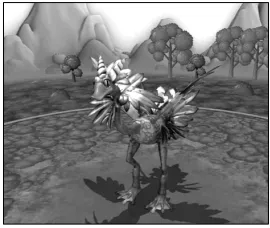
A user’s creature could look something like this:
Figure 1. A Creature Made in Spore87
In designing his creature, a user has the choice of a multitude of parts.88 The
user may stretch and skew the parts, including the central body of the creature, as he sees fit.89 The user may place the parts in any position.90 The
game does not confine the user to real-world conventions.91 Thus, the user
may create one-eyed creatures, creatures with parts in odd places, creatures with three legs, and any number of other peculiar and creative configurations.92 As of this writing, EA’s centralized Spore server contains
approximately 123,000,000 user creations, all varying in creative merit.93
Ultimately, originality is subjective in nature, and a user’s creation may or may not satisfy the minimal level of creativity required by the U.S.
86. Spore also includes a tool for outfitting creatures with interesting clothing, for creating music to associate with a creature, and for molding the creature as a less-complex organism in the “primordial ooze.” As these tools lack the complexity of the other tools in the game, they are not analyzed in this Note.
87. Flynn DeMarco, Spore Creature Creator (June 11, 2008), http://www.gamepro.com/ article/previews/191568/spores-creature-creator/ (last visited Nov. 18, 2008).
88. See Kasavin, supra note 49; Messing, supra note 54. To get a sense of the described functioning of the creature tool, the reader may also download a free, deprecated version of the Spore Creature Creator at http://www.spore.com/.
89. See Kasavin, supra note 49; Messing, supra note 54. 90. See Kasavin, supra note 49; Messing, supra note 54. 91. See Kasavin, supra note 49; Messing, supra note 54. 92. See Kasavin, supra note 49; Messing, supra note 54.
Supreme Court.94 Given the possibilities of the creature-creator tool,
however, a user’s creation of a copyrightable work appears possible, and individual creations, like the one above, appear to have the minimal artistic merit required.95
EA certainly seems to think so. When EA first shipped Spore, it needed to include some starter creations to populate local game worlds with content, since users had not yet had the chance to create the various creatures, buildings, vehicles, and spaceships that the game required to function properly.96 Accordingly, EA commissioned a graphic designer to
create several creatures to populate the game world.97 Unlike game users,
the designer retained a copyright interest in his creations and now collects royalties on merchandise sales.98 This suggests that EA acknowledges the
artistic creativity in game creations, and hence the originality required to obtain a copyright to a work. This serves to bolster the notion that a user’s in-game creation potentially has the originality required for copyright protection.
2. Other Criteria
The Copyright Act further requires that a copyrightable work be fixed in a tangible medium of expression and be capable of perception, communication, or publication.99 The Copyright Act provides for the
satisfaction of these elements by “the aid of a machine or device.”100
Accordingly, the United States Court of Appeals for the Ninth Circuit has held that an image stored on a computer’s hard disk is fixed in a tangible medium of expression.101 Similarly, this type of image is perceived,
94. See supra notes 74-76 and accompanying text.
95. See, e.g., Roth Greeting Cards v. United Card Co., 429 F.2d 1106, 1109-10 (9th Cir. 1970) (holding that copyright subsisted in certain greeting cards even though the individual components of the greeting cards were not original; the particular alignment of these individual components was original); Alfred Bell & Co. v. Catalda Fine Arts, 191 F.2d 99, 104-05 (2d Cir. 1951) (holding copyright subsisted in certain mezzotint paintings, even though the paintings undergoing the mezzotint process were not the work of the producer of the paintings).
96. See supra notes 59-61 and accompanying text.
97. Daily Mail Reporter, Engineer Becomes Successful Artist After Stroke Rewires His Brain, MAIL ONLINE, (Aug. 20, 2008),
http://www.dailymail.co.uk/sciencetech/article-1046768/Engineer-successful-artist-stroke-rewires-brain.html (last visited Nov. 18, 2008). 98. Id.
99. 17 U.S.C. § 102(a) (2006). 100. Id.
communicated, or published when it is displayed on a computer screen.102
Since users can display the creatures on a computer monitor, and because they are fixed on a user’s hard drive or on EA’s central server, the 3D models created by Spore users satisfy the final copyright requirements. Since a user’s creation satisfies copyright requirements, under the Copyright Act, those rights initially vest in the user.103
B. Enforcement of the Shrink-Wrap EULA
If, however, the Spore EULA is valid, then the user’s copyright ownership immediately transfers from the user to EA.104 EA certainly has
legitimate interests that warrant the provision of a license from the user to EA; for instance, EA must ensure that it maintains an appropriate intellectual property interest in user creations to facilitate the sharing of creations between the local game worlds.105 EA also markets various
merchandise to users related to their creations, such as t-shirts, comic books, and figurines.106 EA, however, only requires a non-exclusive license
to maintain these interests, since EA’s ability to carry out merchandising activities is not affected by the author concurrently exploiting his work as he sees fit.107 The exclusive license purportedly granted by the EULA to EA
is just that—exclusive. If the user were to attempt to reproduce his work outside the confines of the game world, it would be entirely possible under this regime for EA to sue the user for copyright infringement.108 This begs
the question: would a court enforce the transfer-of-copyright-ownership provision of this shrink-wrap EULA? This Part further analyzes this issue and concludes that a court that follows the ever-increasing trend set by
102. Id.
103. 17 U.S.C. § 201(a) (2006).
104. See END USER LICENSE AGREEMENT,supra note 63, § 2.B.
105. Messing, supra note 54. 106. See supra note 62.
ProCD would enforce this provision, notwithstanding the Copyright Act’s requirement that a transfer of copyright ownership be voluntary.
1. Voluntary Transfer of Copyright Ownership
Congress sought to ensure that transfers of copyright ownership were “unequivocally intentional” when it amended the Copyright Act in 1976.109
Accordingly, Congress amended the Copyright Act to require the transfer of copyright ownership to occur by a signed writing,110 although it excluded
transfers “by operation of law” from this requirement.111 Despite this
exception, Congress expressly forbids the involuntary transfer of copyright ownership in the Copyright Act.112 At least one court has recognized that
“operation of law” cannot transfer copyright ownership without the express or implied consent of the copyright owner.113 Hence, all of the ways that an
author of a creative work can transfer copyright ownership require the knowledge and consent of the author.
The fact that Congress intended to require an author of a creative work to knowingly and voluntarily transfer his copyright ownership is further strengthened by the writing requirement of the Copyright Act. The Copyright Act requires an author of a creative work to transfer copyright ownership in the work by way of a signed writing, notwithstanding those transfers executed by operation of law.114 Courts encountering this issue
traditionally juxtapose the writing requirement with an impermissible oral agreement transferring copyright ownership.115 Hence, courts interpret this
portion of the Copyright Act to preclude an oral transfer of copyright ownership,116 but not necessarily an electronic writing. This is because of
the policy considerations underlying the writing requirement of the Copyright Act.117 The writing requirement “prevents misunderstandings by
spelling out the terms of a deal in black and white, forces parties to clarify their thinking and consider problems that could potentially arise, and encourages them to take their promises seriously because it’s harder to backtrack on a written contract than on an oral one.”118 An electronic
109. Haemmerli, supra note 31, at 1011-12. 110. 17 U.S.C. § 204(a) (2006).
111. Id.
112. Id. § 201(e).
113. Brooks v. Bates, 781 F. Supp. 202, 205 (S.D.N.Y. 1991). 114. 17 U.S.C. § 204(a).
115. See, e.g., Effects Assoc., Inc. v. Cohen, 908 F.2d 555, 556-57 (9th Cir. 1990). 116. Id.
document achieves these same ends. This further suggests that Congress had no concern for precluding electronic writings, but only oral agreements. Additionally, a recent federal statute allows for the enforcement of contracts executed entirely in electronic form.119 Under the Electronic
Signatures in Global and National Commerce Act (“E-SIGN Act”), “a signature, contract, or other record relating to [an interstate commerce transaction] may not be denied legal effect, validity, or enforceability solely because it is in electronic form.”120 The E-SIGN Act expressly states that it
does not “limit, alter, or otherwise affect any requirement imposed by a statute, regulation, or rule of law relating to the rights and obligations of persons under such statute, regulation, or rule of law other than a requirement that contracts or other records be written, signed, or in nonelectronic form.”121 Accordingly, the E-SIGN Act further suggests that
a transfer of copyright ownership may occur by way of an electronic writing with an electronic signature. This leaves us with one final question: can a third party receive copyright ownership from an author who transfers that interest by way of the instant EULA, since the author does so with knowledge and consent in some sense, but fails to voluntarily transfer the ownership interest in the purest sense of that term?
2. An Enforceable Agreement Under ProCD
A court that follows ProCD jurisprudence would likely enforce the instant EULA, since ProCD suggests that shrink-wrap EULAs are actually voluntary contracts, despite their after-the-fact nature.122 In ProCD, the
United States Court of Appeals for the Seventh Circuit enforced an EULA contained within a computer software installation, even though the purchaser of the software could not know of the license terms when he purchased the software at the point of sale.123
Under the conventional wisdom of the Uniform Commercial Code (UCC), a user’s purchase of software at the retail point of sale constitutes an acceptance of the retailer’s offer to sell the software by placing the software on the store shelf, instantly forming a contract.124 Under this
reasoning, the later presentation of a license agreement either constitutes a confirmation of the contract, or it constitutes a modification of the contract,
119. See Electronic Signatures in Global and National Commerce Act, 15 U.S.C. §§ 7001–7006 (2006).
120. Id. § 7001(a)(1).
121. Id. § 7001(b)(1) (emphasis added).
122. See supra notes 39-45 and accompanying text.
enforcement of each of which the UCC precludes under sections 2-207 and 2-209, respectively.125
In contrast, the Seventh Circuit reasoned that the transaction included additional terms at the point of sale, because the software box included a disclaimer, which, in small print, indicated that use of the software was conditioned on an enclosed EULA.126 The court viewed the inclusion of this
condition as “reasonable,” since it was unreasonable to expect the software developer to attach the entire EULA to the box.127 The court further viewed
the condition fair in light of the fact that if the software purchaser did not agree to the terms of the EULA, the purchaser could return the software for a refund.128 The court finally assured itself of the voluntary nature of the
contract by suggesting that the economic efficiency of the transaction implied that the purchaser accepted the inherent cost of this kind of purchase.129 The court did recognize, however, that a shrink-wrap license is
not enforceable if it is unconscionable or violates a rule of positive law.130
Since it is usually difficult to demonstrate unconscionability,131 a positive
law exception serves as the only realistic possibility for preserving the copyright interests of authors of creative works under the Spore EULA. Hence, the positive law exception of an involuntary transfer of copyright ownership may serve to defeat the enforceability of the Spore EULA and preserve the user’s copyright interest in his creative work.
However, a Spore user appears to voluntarily accept an offer qualified by a shrink-wrap EULA in the same way that the user accepted the additional conditions of the shrink-wrap EULA in ProCD. The Spore box includes a statement indicating that the user must agree to an included license agreement in order to play the game, just like the user in ProCD.132 At
installation, the Spore user agrees to the EULA and has the option to return the software, just like the user in ProCD.133 The Spore user also separately
agrees to an EULA when he creates an online account in order to facilitate
125. See id. at 648. 126. Id. at 650. 127. Id. at 651. 128. Id. at 653.
129. See ProCD Inc. v. Zeidenberg, 86 F.3d 1447, 1450, 1451-52 (7th Cir. 1996) (explaining the inherent costs associated with common transactions with terms unknown to the purchaser at the time of purchase).
130. Id. at 1450.
131. See, e.g., Dumais v. Am. Golf Co., 150 F. Supp. 2d 1182, 1191-92 (D.N.M. 2001). 132. SPORE (DVD-ROM, rel. Sept. 7, 2008). The reader can find the notice on the back
the sharing process integral to the game.134 This goes beyond the facts of
ProCD. Hence, under the ProCD regime, Spore users appear to be bound by the EULA, and this seems to comply with the positive law requirement of the Copyright Act that a user voluntarily transfer ownership of his copyright, at least as that term is understood under ProCD and under federal copyright law.135
IV. CONGRESS SHOULD AMEND THE COPYRIGHT ACT
Although the Spore EULA appears to satisfy the requirement of a voluntary transaction under federal copyright law and the ProCD regime, the special nature of a transfer of copyright ownership still casts a shroud over the transaction. Given the rather daunting language presented by the EULA and the rigorous legal knowledge required to appreciate its implications, a typical user likely lacks the sophistication to appreciate the rights given up by the user when agreeing to the requirements of the EULA.136 While failure to know the terms of a contract does not ordinarily
excuse a person from the terms of a contract,137 the special nature of the
transfer of copyright ownership heightens the status of the transaction.138
Therefore, although the user appears to voluntarily accept the EULA under a strict understanding of the law, deference to the special protection afforded to authors of creative works along with the underlying policy considerations of federal copyright law warrants additional federal statutory protections for the rights of authors in their creative works.139
Rather than vest ownership of a copyright in an artistic work, the EULA, as enforced, vests ownership in a third party that provides the tool used to create the work.140 Under a traditional understanding of copyright, a
paintbrush salesman could not claim copyright over those things created by customers with his paintbrushes.141 To put it in modern terms, Microsoft
134. Id.
135. See supra Part II.B.
136. See supra Part II.B and note 60.
137. See, e.g., Stawski v. Stawski, 43 A.D.3d 776, 778 (N.Y. 2007) (“One need not be an attorney or a Fulbright scholar to know the folly of signing a legal document without an understanding of its import.”).
138. See supra notes 28-32 and accompanying text. 139. Id.; see supra notes 14-22 and accompanying text. 140. See supra note 63.
could not claim that it owned the rights to something created with Word.142
While American copyright law requires the author to reap the rewards of his creative genius, the EULA turns the tables and actually deprives the author of the ability to reap the rewards of his work.143 The exclusive
license purportedly granted by the EULA is just that—exclusive. If the author were to attempt to produce his work outside the confines of the game world, it would be entirely possible under this regime for the game manufacturer to sue the author for copyright infringement.144 Instead of
providing an incentive to spur creative genius of authors as required under the Federal Constitution and federal copyright law, the Spore EULA prevents the creator from reaping the incentive and instead confers the reward on a third party that is not responsible for the creative genius behind the work.145 Without the incentive provided by federal law, the public
suffers, as it ultimately benefits from the reward initially conferred on authors.146 Accordingly, Congress should amend Title 17, Chapter 2 of the
United States Code in order to preclude the enforcement of shrink-wrap EULAs that purport to transfer copyright ownership of works created by users of the software to the software manufacturer to the extent that such a license misappropriates an author’s legitimate copyright interest in his creative work.
While EA certainly has a legitimate interest in protecting the integrity of its software and seeking reasonable profits from the sale of related merchandise, EA does not require a perpetual, exclusive license to promote this interest. Hence, Congress should amend the Copyright Act to provide that the transfer of copyright ownership may not occur by way of an EULA whose terms are not fully disclosed to a user at the point of sale prior to purchase. Since transfer of copyright ownership does not include non-exclusive licenses,147 amending the Copyright Act in this way would
appropriately protect the interests of game manufacturers wishing to utilize the unique potential for profits presented by the technology underlying
Spore. More importantly, such an amendment would adequately preserve the interests of authors in their copyrighted works, consistent with the
142. Cf. Part II.A. 143. See supra note 108.
144. See 17 U.S.C. § 501 (2006) (providing that a copyright owner, which includes an exclusive licensee, may bring an infringement suit against any unauthorized infringer, even the original author). Such an infringement suit entails other registration requirements outside of the scope of this Note.
145. See supra notes 14-22 and accompanying text. 146. Id.
rationale underlying copyright protection provided by the U.S. Constitution.148
By returning the unique reward of a limited monopoly to the author of a creative work, the type of amendment proposed by this Note would provide an appropriate incentive for an author to release his work to the public and exploit it accordingly.149 Without such an amendment, while typical users
of Spore and like software programs will no doubt produce many creations within the confines of the game world, a well-informed user that seeks to exploit his creative work outside the game world will have a disincentive to do so, since he will risk an infringement suit. Hence, the current regime potentially deprives the public of the creative genius of the author, instead confining the genius to the whims of the game manufacturer. Further, the author is left with no monetary reward if the manufacturer exploits his work beyond the limited realm of the digital images and merchandise related to the game. Accordingly, Congress should amend the Copyright Act to correct these warped incentives and return to the proper scheme of private and public benefits mandated by the Federal Constitution and federal copyright law.150
V. CONCLUSION
Federal copyright recognition exists to reward the creativity of authors, not third parties that happen to provide the tools of the trade to those authors. After all, the limited commodity that the law seeks to increase is creativity and the product of that creativity. As a constitutional matter, this policy exists to benefit the public, not the author. As a moral matter, an author shares a special bond with his creative work. For these reasons, Congress has recognized that an author cannot involuntarily transfer ownership of his copyright to a third party. Yet, this is precisely what EA has attempted to do by including the peculiar terms in Spore’s EULA that govern user-generated content. When taken with the decision of the court in
ProCD, the shrink-wrap EULA included with Spore poses a unique threat to the traditional framework governing transfer of copyright ownership. Accordingly, Congress should amend Title 17, Chapter 2 of the United States Code to properly preclude the enforcement of this shrink-wrap agreement, and thereby preserve the fundamental policy underlying copyright law.
148. See supra notes 14-22 and accompanying text. 149. Id.