150
USING OF THE GOAL PROGRAMMING METHOD IN
OPTIMIZATION OF PAPER PRODUCT
Fatemeh Fotoohi Khankahdani1, Samira Hajatmandi2, Maedeh Khoshhal3, Maryam Mohamad Gholizadeh4
1
,2,3,4 –M A Student of Business Management, Science and Research Branch, Islamic Azad University, Rasht, IranAbstract
When linear programming applications become more complex, especially multiple conflicting objectives are considered simultaneously, there is a strong need for tools. One way to deal with such cases is called goal programming (GP). Because of the linear programming is inflexible. When you encounter a problem and conflict with multiple objectives. Can not properly get solve to the problem as a result it used goal programming method.
Keywords: goal programming - GP - Operations Research Introduction:
Although goal programming was developed as an extension of linear programming, but more than a mere extension or continuation of the linear program is ideal. Armani is planning to decide on the ideal levels of analysis and multiple objectives(5).
Also goal programming, knows the permissible deviation from the target. Therefore, flexibility is making in the decision processes (2). Finally, goal programming, multiple conflicting objectives, preferences, decision-makers makes blend with the allowed changing and balance between goals. Idealized plan for carrying out are used three types of analysis:
1. Determine the resources required to achieve the desired goals set
2. Determine the degree of achievement of the objectives with the resources available. 3. Make or provide a satisfactory solution under varying sources and prioritize goals. Idealized Planning concepts:
Idealized planning backbone is composed of three important concepts Deviations, the priority and goals importance and objectives dimensions A - Deviations:
Deviations are slightly more or less than the amount upon which the objectives are achieved.
B - Prioritize objectives:
Objectives of idealized planning to prioritize are 3 different ways: sequentially, elementary, or a combination of both (3).
1. Order Gradation: according to their importance in this approach goals are ordered. The main objective is to determine the priority level P1. It is inappropriate and misleading. The second objective is to determine the importance P2. And so on.
2. Fundamental gradation: In this method, each deviation is assigned a specific weight of these weights indicate the relative importance of each of these deviations (4).
3. Combination of both: these techniques provide the objective function will be explained. Prioritize objectives is shown in the objective function coefficients will be described later (1). C - Range Goals: The goal programming objective function is to minimize the sum of unfavorable deviations are trying weighted according to their importance. Despite the range of distortions is different, such sum may be a little sensitive to: d1 may be that the benefit is measured in terms of dollars. The d2 can be expressed in terms of market share. It is better solving the basic rating (7).
151
Birch Paper Company is composed of three parts. Section A produces page papers which are sold to the C, B sections and markets out of company, section B are generated boxes that will be sold Part to C and markets out of company. Section C makes a type of the special paper products that are sold to Serzerv book companies. X3 is the first product and x4 the second product. It is essential for the production of resource materials that can be received or is provided through the internal sources (from section A or B) or purchase from a vendor outside the company. The seller can provide the materials outside the company if they are purchased in section B or part of the requirement that will be agreed.
Table 1: Sections B, A can also sell their products on the open market, Related Info is shown in the table below.
Margin Cost per unit
Selling price per unit Amount Product 112 168 280 X1 Page Paper 162 288 450 X2 Boxes 192 288 480 X3 One particular product 86 391 480 X4
Featured Products II
Solution method:
problem initial determination of optimal production schedule the weeks of the experiences X1, X2, X3, X4, which should make maximum profit margin. Linear programming
formulation is as follows:
4 86 3 162 1
112x x x
MAXZ
Certain restrictions on the relationship between technology and products are as follows:
150 4 3 100 4 143 3 2 100 4 333 3 2 1 x x x x x x x x x
Answer of linear programming for this problem is as follows:
150 4 , 3 , 50 2 , 0
1 x x x
x
At week 450, $ 21 profit
This production table was used regardless to the financial requirements of below: (available cash) (net working capital)
67000 4 391 3 288 2 288 1
168 x x x x
)
Cash Available
( 16000 4 70 3 86 2 80 1150 x x x x
)
Net Working Capital
(
New solving a linear programming problem as follows:
150 4 , 0 3 , 55 , 28 2 , 44 , 21
1 X X X
X
The whole profit in 2948, 20 per week rose to $ 72,000 in cash when they need an Answer rigid linear programming to estimate the packet. Management wasn't able to use linear programming and no long-term plan for getting about producing and financing requirements was presented. Although obtaining financing obligations reduced profits and led to overtime. This led to the resignation of the CEO and the new CEO Ms. Beare was informed decisions when planning solution was to use it.
Goal programming method:
152 150 4 3 2 0 1 0 100 4 143 3 2 1 0 100 4 333 3 2 1 x x x x x x x x x x x x Ideal constraints:
In addition to the primary objective is to profit money there are two requirements: (net working capital and cash) in terms planning idealized targets appear as follows: (most important, cash) (working capital) (profit)
72000 1 1 4 391 3 288 2 288 1
16x x x x d d
) Most important, cash ( 16000 2 2 4 70 3 86 2 80 1
150 x x x x d d
) Working Capital ( 23000 3 3 4 89 3 192 2 162 1
112 x x x x d d
) Profit (
(most important, cash) (working capital) (profit)Profit goal is 23,000, which is clearly higher than the old plan profit, Management wants to know the degree to which the target can be achieved and finally the marketing requirements are added:
That being: X1=20
C 4
x1 d 4 d 4 20The primary objective GP (adverse deviations are included) is:
1 1 2 2 3 3 4 4 4 4 minz pd p d p d p d p d
There is offset adverse effects on four ratios (which comes from within the quarter, which being (x1 = 20) This is advisable that weight based on the deflection determined, and these appears in 2 on d− and 9 on d+.
These can be summarized as follows:
pd pd pd pd pydy
z 1 1 2 2 3 3 2 4 4 9
Table 2: Computer solutions for the case of BIP
d-d+ RHS value Constraint 0 0 72000.00 C1 875.10 0 16000.00 C2 1985.40 0 23000.00 C3 11.13 0 20.00 C4 0 0 100.00 C5 37.37 0 100.00 C6 0 0 150.00 C7
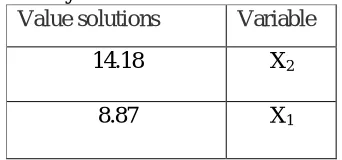
b) Analysis of decision variables:
153
X4 150.00
c) Performance analysis based on objective:
Table 3: Performance analysis based on objective No achievement
Excellence
0 P1
875.10 P2
1985.40 P3
22.26 P4
Interpretation issues:
Section A- analysis of deviations: objective constraints (in this problem the constraints C1-C4)
(C1) most important goal will be fully achieved (save cash) (C2) Working capital is $ 875.
(C3) Earnings: deviation 985/1 is available in the dollar; profit only is $ 21 / 015.
(C4) Solution is 8/87 = x1, Means that there is a negative deviation 13/11. Constraint system (C5-C7 in This problem)
(C5) of limitations are being fully exploited. (C6) there is auxiliary 37/37.
(C7) restrict to fully occur.
Note that there is a limited system type of less than or equal to an auxiliary equivalent. (Excess d+ at a greater than or equal to restrictions obtains).
Conclusion
Objective results were as follows:
1. Objective of the cash needs, the excess is acquisition.
2. Working with capital levels, the profit 504/14 or $ 496/1 dollar respectively.
3. Profits increased slightly from 104/21 to the dollar hit $ 10/458/21 (has been associated with deviation of $ 90/541/1). It seems that the profit is not so much associated with allergy(6).
Required to 20 production completely relieve the units of x1, means that 20 = d4 reach to a weight of 2 to 40 units, which have been associated with high achievement.
References:
1. Abtahi. H& Armen.M.(1993), Engineering Methods, Publications Ghomes.
2. Asgharpoor, MJ. (1995)."Operations Research and the Management Decision, Volume I", Tehran University, the sixth edition.
3. Hamd,T.(1999). Introduction to Operations Research. Translate by Mohammad Bagher bazargan Volume I, Academic Press Center.
154
5.Gilani nia, SH. (2009). Optimization of City Management, Gill inscription. .
6.Ftankin. G. Moore,(1970), MANUFACTURING MANAGEMENT, Irwin Inc.