DEMOGRAPHIC RESEARCH
A peer-reviewed, open-access journal of population sciences
DEMOGRAPHIC RESEARCH
VOLUME 35, ARTICLE 53, PAGES 1549–1562
PUBLISHED 20 DECEMBER 2016
http://www.demographic-research.org/Volumes/Vol35/53/
DOI: 10.4054/DemRes.2016.35.53
Descriptive Finding
Estimating male fertility in eastern and
western Germany since 1991:
A new lowest low?
Christian Dudel
Sebastian Kl ¨usener
c
2016 Christian Dudel & Sebastian Kl¨usener.
1 Introduction 1550
2 Data 1550
3 Methods 1553
3.1 Imputation methods 1553
3.2 Sensitivity analyses 1553
4 Results 1554
5 Conclusion 1558
6 Acknowledgments 1558
Demographic Research: Volume 35, Article 53
Descriptive Finding
Estimating male fertility in eastern and western Germany since 1991:
A new lowest low?
Christian Dudel1
Sebastian Kl ¨usener2
Abstract
BACKGROUND
Research on fertility differentials between eastern and western Germany after German reunification in 1990 has focused on the fertility of women. Trends in the fertility of men are rarely studied due to data constraints and methodological challenges.
OBJECTIVE
This paper aims to close this gap by analyzing fertility differentials between eastern and western German males over the period 1991–2013. We consider different approaches to estimate male fertility and investigate variation in fertility trends, levels, and timing.
METHODS
We use German birth register data to estimate age-specific fertility rates and total fertility rates. As the paternal age is unknown for a non-negligible proportion of births, we com-pare imputation techniques and conduct sensitivity analyses. For the population at risk we employ adjusted numbers that attempt to account for the overcount in the population of childbearing age in the 1990s and the 2000s.
RESULTS
The trends and differences in the fertility of eastern and western German men are roughly similar to those observed among women. However, male fertility levels are lower, and male and female fertility vary in terms of timing. The total fertility rate of eastern Ger-man males in 1994 of 0.74 is likely to represent a record low. Whereas the fertility levels of eastern German women recently surpassed those of western German women, the fer-tility levels of eastern German men are still lower than those of their western German counterparts.
1Max Planck Institute for Demographic Research, Konrad-Zuse-Str. 1, 18057 Rostock, Germany, Tel: (+49)
0381 2081 221, E-Mail: [email protected]
2Max Planck Institute for Demographic Research, Konrad-Zuse-Str. 1, 18057 Rostock, Germany, Tel: (+49)
CONTRIBUTION
We compare methods to estimate male fertility trends.
1. Introduction
While we have ample data and research on the fertility of females, much less is known about the fertility of males (Coleman 2000; Poston, Baumle, and Micklin 2006). Until very recently, only a few developed countries published statistics on births by the age of the father on a regular basis (a good overview on longer time series of data can be obtained from the UN Demographic Yearbooks). If data on births by the age of the father are available, there is often a large number of missing values. This constitutes a challenge in deriving age-specific fertility rates (ASFRs) and summary measures like the total fertility rate (TFR). However, a number of recent publications (e.g., Dudel 2014; Nis´en et al. 2014; Nordfalk, Hvidtfeldt, and Keiding 2015) have expanded the small body of literature on this topic (e.g., Brouard 1977). We believe it is important to focus on the fertility of males as well as of females for a number of reasons. For example, in aging societies such as Germany, in which large shares of the population are childless – but where adult children frequently serve as caregivers for their elderly parents – the fertility of males becomes relevant when seeking to forecast the demand for and the costs of elderly care (Haberkern and Szydlik 2008). This issue of male fertility might be particularly relevant for eastern Germany, where the sex ratios among cohorts born between 1970 and the early 1990s are skewed due to the higher outmigration rates of women (mostly to western Germany; K¨uhntopf and Stedtfeld 2012).
In this paper we use German birth register data to estimate the ASFRs and the TFRs for both eastern and western German males from 1991 up to 2013. While the register data provide us with information on the age of the mother for virtually all births, the age of the father is unknown for a non-negligible proportion. The missing values are not randomly distributed, as they occur among nonmarital births only. Using imputation methods and sensitivity analyses, we estimate missing paternal ages. In order to account for shortcomings in the published German population estimates in the 1990s and the 2000s, we employ adjusted numbers based on procedures by Kl¨usener et al. (2016) that are also implemented in the Human Mortality Database.
2. Data
Demographic Research: Volume 35, Article 53
women living in Germany. However, information is missing for births in two smaller federal states at the beginning of the observation period (Saarland: 1991; Mecklenburg-Western Pomerania: 1991–1994). Data confidentiality regulations do not allow us to extract cross-tabulations from the register that contain cell counts of one and two. In order to comply with this regulation when looking at young and old ages with a small number of births, we had to reduce the age range for which we derive the birth counts by single age to the age range 17–59 for fathers and 16–45 for mothers. The lowest and the highest age categories are open age classes. As the data does not allow us to distinguish between former West and East Berlin, we treat Berlin as part of eastern Germany. Information on the place of residence is available for mothers only, so that we decided to base our analysis on the assumption that the father of each newborn child was living in the same region as the mother. Given that western and eastern Germany are large regions, we expect that this limitation does not introduce substantial bias.
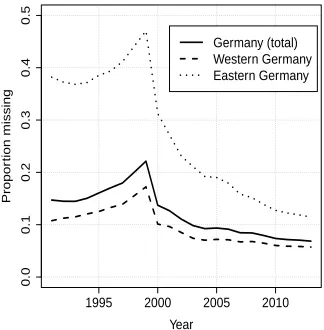
The German birth register provides information on the age of the mother for virtually all births. While before 2000 the age of the father was recorded for marital births only, since 2000 it has also been recorded for nonmarital births on a voluntary basis. As we can see in Figure 1 and Figure 2, the share of births without information on the paternal age has decreased drastically since 2000. Figure 1 shows the trends in the overall proportion, while Figure 2 displays the proportion of missing cases conditional on maternal age. Darker colors indicate high proportions of missing values.
Figure 1: Proportion of births with no information on age of father
1995 2000 2005 2010
0.0
0.1
0.2
0.3
0.4
0.5
Year
Propor
tion missing
Germany (total) Western Germany Eastern Germany
Figure 2: Proportion of births with no information on age of father by year and age of mother
(a) Germany (total)
Year
Age of mother
16 18 20 22 24 26 28 30 32 34 36 38 40 42 44
1991 1993 1995 1997 1999 2001 2003 2005 2007 2009 2011 2013 0.0 0.2 0.4 0.6 0.8 1.0
(b) Western Germany
Year
Age of mother
16 18 20 22 24 26 28 30 32 34 36 38 40 42 44
1991 1993 1995 1997 1999 2001 2003 2005 2007 2009 2011 2013
(c) Eastern Germany
Year
Age of mother
16 18 20 22 24 26 28 30 32 34 36 38 40 42 44
1991 1993 1995 1997 1999 2001 2003 2005 2007 2009 2011 2013
Source: FDZ 2016; own calculations.
Demographic Research: Volume 35, Article 53
3. Methods
3.1 Imputation methods
We apply four approaches to impute missing information on the age of the father. The first and simplest variant assumes that the information is missing at random (Heitjan and Basu 1996) conditional on the age of the mother, year, and region (eastern/western Germany). As an example, consider births to western German mothers aged 30 in 1995 for which information on the paternal age is missing. For these births we assume that the distribution of the paternal age is similar to that of births to western German mothers aged 30 in 1995 for which the paternal age is known. Conditioning on the age of the mother is crucial, as it accounts for the fact that the share of births for which the age of the father is unknown is particularly high among young mothers (Figure 2). We believe this is preferable over a simple redistribution using the paternal age distribution among the births for which paternal age is known, as this would result in many rather old fathers being ‘linked’ to young mothers. To derive our fertility estimates, we combine the estimated ages for the missing cases with those cases for which the age of the father is known.
The assumptions of our first approach might be rather strong. Most obviously, whether information is missing depends on the marital status of the parents, as the age of the father can be missing for nonmarital births only. We thus implemented three al-ternative estimation approaches that solely focus on nonmarital births. These can only be implemented for the data from 2000 to 2013 as we require information on the age of the father for at least some nonmarital births. The second approach is similar to the first, except that it just focuses on nonmarital births. The third approach is based on linear regression, controlling for maternal age, maternal age squared, maternal employment sta-tus, and the federal state where the mother lives. The fourth approach is based on pairwise nearest neighbor matching and controls for the same variables. For a description of the third and fourth approach see the supplementary materials.
3.2 Sensitivity analyses
In order to ensure the general reliability of our estimates, we decided to implement sensi-tivity analyses in which we assume that fathers’ ages in births with missing values differ significantly from fathers’ ages in births with complete data. In these sensitivity checks we focus on our first imputation approach as it is the only one that allows us to derive estimates for the complete observation period.
Germany (Huinink 1988; Schmitt 2005) as well as for other developed countries (Kolk 2015). To the best of our knowledge, no negative age differences or age differences of six or more years have been reported for developed countries. This means that both scenarios are unlikely and should provide reasonable bounds for the true age differences in cases with missing information. In turn, the resulting fertility rates based on these scenarios can be interpreted as the upper and lower bounds for the true fertility rates. A detailed description of how this approach has been implemented is given in the supplementary materials.
4. Results
Demographic Research: Volume 35, Article 53
Figure 3: Total fertility rate in 1991 to 2013
(a) Males (imputation variant 1)
1995 2000 2005 2010
0.8
1.0
1.2
1.4
Year
T
otal f
er
tility r
ate
Germany (total) Western Germany Eastern Germany
(b) Males (sensitivity analysis)
1995 2000 2005 2010
0.8
1.0
1.2
1.4
Year
T
otal f
er
tility r
ate
(c) Females
1995 2000 2005 2010
0.8
1.0
1.2
1.4
Year
T
otal f
er
tility r
ate
Source: FDZ 2016; Kl ¨usener et al. 2016; own calculations.
1.30 (east), while the respective numbers for males are 1.25, 1.27, and 1.14. The ratio of male to female TFR is around 0.93 for western Germany and 0.87 for eastern Germany. These findings are similar to those for other developed countries (Dudel 2014). They are in part related to the fact that males have children over a wider age range than females. Moreover, the ratio of males to females is also relevant. It is is higher in eastern Germany than in western Germany; therefore, births are distributed across relatively more men, leading to a lower TFR and a lower male to female TFR ratio in eastern Germany. For instance, the sex ratio of males to females for the ages 20–39 is 1.02 for western Ger-many in 2013, while it is 1.08 for eastern GerGer-many. As suggested by Keilman, Tymicki, and Skirbekk (2014), the male TFR can be predicted well using the female TFR and the sex ratio for the ages 20–39. More specifically, they propose to multiply the ratio of the female TFR to the sex ratio at ages 20–39 by a factor of 0.971. Contrasting male TFRs as derived according to their approach with our own estimates results in an average abso-lute deviation of 0.04 for western Germany, and 0.02 for eastern Germany for the period 1991–2013.
For eastern German males in 1994 we obtain a TFR of 0.74, which is even lower than the TFR reported for eastern German females for the same year (0.85; the Federal Statistical Office reports a value slightly below 0.8 for 1994 for eastern Germany without West Berlin). The latter is usually considered to be the record holder for lowest-low fertility (e.g., Goldstein and Kreyenfeld 2011) and is close to being the minimum level of period fertility in peacetime (Golini 1998). Sensitivity analyses yield a male TFR between 0.72 and 0.78 for eastern Germany in 1994. Thus, we consider it unlikely that this new lowest-low is an artifact of our estimation method. Female and male TFR trends differ when we look at recent shifts in the position of eastern and western Germany. While the TFR of eastern German women has been higher than that of western German women since 2008, eastern German men have been (up to 2013) unable to catch up to their western German counterparts.
Demographic Research: Volume 35, Article 53
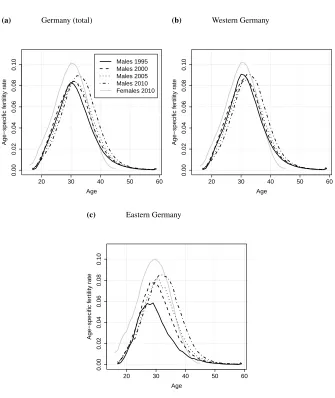
Figure 4: Schedule of age-specific fertility in 1995, 2000, 2005, and 2010
(a) Germany (total)
20 30 40 50 60
0.00
0.02
0.04
0.06
0.08
0.10
Age
Age−specific f
er
tility r
ate
Males 1995 Males 2000 Males 2005 Males 2010 Females 2010
(b) Western Germany
20 30 40 50 60
0.00
0.02
0.04
0.06
0.08
0.10
Age
Age−specific f
er
tility r
ate
(c) Eastern Germany
20 30 40 50 60
0.00
0.02
0.04
0.06
0.08
0.10
Age
Age−specific f
er
tility r
ate
5. Conclusion
In this paper we tested a number of imputation approaches to derive estimates on male fertility levels from birth register data in which information on the age of father is missing for a considerable number of cases. The findings of our sensitivity analysis suggest that simple approaches can be used to derive reliable approximations of male fertility levels. This conclusion is of broad importance for research on male fertility, as many birth regis-ters lack information on the age of the father for a significant number of cases (see, e.g., Nordfalk, Hvidtfeldt, and Keiding 2015).
In both parts of Germany we can observe that compared to females, male TFRs and ASFRs are lower while the male mean age at childbearing is higher. The TFR for eastern German males in 1994 of 0.74 seems to be the lowest TFR ever recorded in peacetime. A similarity to the East–West differences in female fertility is that eastern German males continue to have their children earlier than their western German counterparts. However, eastern German male fertility remains below western German levels, whereas eastern German women have recently overtaken western German women. One important expla-nation for this observation is the ratio of males to females of reproductive age, which is considerably higher in eastern Germany than in western Germany.
6. Acknowledgments
Demographic Research: Volume 35, Article 53
References
Billari, F.C., Goisis, A., Liefbroer, A.C., Settersten, R.A., Aassve, A., Hagestad, G., and Speder, Z. (2011). Social age deadlines for the childbearing of women and men.
Human Reproduction26(3): 616–622. doi:10.1093/humrep/deq360.
Brouard, N. (1977). Evolution de la f´econdit´e masculine depuis le d´ebut du si`ecle.´
Population32(6): 1123–1158.doi:10.2307/1531392.
Coleman, D.A. (2000). Male fertility trends in industrial countries: Theories in search
for some evidence. In: Bledsoe, C., Lerner, S., and Guyer, J. (eds.).Fertility and the
male life cycle in the era of fertility decline. Oxford: Oxford University Press: 29–60.
Dudel, C. (2014). Vorausberechnung von Verwandtschaft: Wie sich die gemeinsame
Lebenszeit von Kindern, Eltern und Großeltern zuk¨unftig entwickelt. Beitr¨age zur Bev¨olkerungswissenschaft, Vol. 45. Opladen: Budrich.
Forschungsdatenzentrum der Statistischen ¨Amter des Bundes und der L¨ander (FDZ)
(2016). Geburtenstatistik 1991–2013. Wiesbaden: Statistisches Bundesamt.
Goldstein, J.R. and Kreyenfeld, M. (2011). Has East Germany overtaken West Germany?
Recent trends in order-specific fertility. Population and Development Review37(3):
453–472.doi:10.1111/j.1728-4457.2011.00430.x.
Golini, A. (1998). How low can fertility be? An empirical exploration. Population and
Development Review24(1): 59–73.doi:10.2307/2808122.
Haberkern, K. and Szydlik, M. (2008). Pflege der Eltern: Ein europ¨aischer
Ver-gleich. K¨olner Zeitschrift f¨ur Soziologie und Sozialpsychologie 60(1): 78–101.
doi:10.1007/s11577-008-0004-y.
Heitjan, D.F. and Basu, S. (1996). Distinguishing ‘missing at random’ and ‘missing
completely at random’.The American Statistician50(3): 207–213.
Huinink, J. (1988). Die demographische Analyse der Geburtenentwicklung mit
Lebensverlaufsdaten. Allgemeines Statistisches Archiv72(4): 359–377.
Keilman, N., Tymicki, K., and Skirbekk, V. (2014). Measures for human reproduction
should be linked to both men and women. International Journal of Population
Research2014.doi:10.1155/2014/908385.
Kl¨usener, S. and Goldstein, J.R. (2016). A long-standing demographic east–west divide
in Germany. Population, Space, and Place22(1): 5–22. doi:10.1002/psp.1870.
Kl¨usener, S., Grigoriev, P., Scholz, R.D., and Jdanov, D.A. (2016). Adjustment of
(MPIDR working paper; forthcoming).
Kolk, M. (2015). Age differences in unions: Continuity and divergence among Swedish
couples between 1932 and 2007. European Journal of Population31(4): 365–382.
doi:10.1007/s10680-015-9339-z.
K¨uhntopf, S. and Stedtfeld, S. (2012). Wenige junge Frauen im l¨andlichen Raum:
Ursachen und Folgen der selektiven Abwanderung in Ostdeutschland (BiB Working Paper; 3/2012). Wiesbaden: Bundesinstitut f¨ur Bev¨olkerungsforschung.
Nis´en, J., Martikainen, P., Silventoinen, K., and Myrskyl¨a, M. (2014). Age-specific
fertility by educational level in the Finnish male cohort born 1940–1950.Demographic
Research31(5): 119–136.doi:10.4054/DemRes.2014.31.5.
Nordfalk, F., Hvidtfeldt, U.A., and Keiding, N. (2015). TFR for males in Denmark:
Calculation and tempo-correction. Demographic Research 32(52): 1421–1434.
doi:10.4054/DemRes.2015.32.52.
Poston, D.L., Baumle, A.K., and Micklin, M. (2006). Epilogue: Needed research in
demography. In: Poston, D.L. and Micklin, M. (eds.).Handbook of population. New
York: Springer: 853–881.
Schmitt, C. (2005). Kinderlosigkeit bei M¨annern: Geschlechtsspezifische Determinanten
ausbleibender Elternschaft. In: T¨olke, A. and Hank, K. (eds.). M¨anner: Das
vernachl¨assigte Geschlecht in der Familienforschung. Wiesbaden: VS Verlag f¨ur Sozialwissenschaft: 18–43.