R E S E A R C H
Open Access
Study protocol: Randomised controlled trial to
evaluate the impact of an educational programme
on Alzheimer
’
s disease patients
’
quality of life
Hélène Villars
1*, Virginie Gardette
2,3, Amélie Perrin
1, Christophe Hein
1, Sophie Elmalem
1, Eva de Peretti
1,
Audrey Zueras
1, Bruno Vellas
1,3and Fati Nourhashémi
1,3Abstract
Introduction:Therapeutic education is expanding in the management of Alzheimer’s disease (AD) patients. Several studies have revealed a positive impact of therapeutic educational programmes on the caregiver’s burden and/or quality of life. However, to date, no study has evaluated its impact on the quality of life of the AD patient.
Methods:The THERAD study (THerapeutic Education in Alzheimer’s Disease) is a 12-month randomised controlled trial that started in January 2013. This paper describes the study protocol. THERAD plans to enroll 170 dyads (AD patient and caregiver) on the basis of the following criteria: patient at a mild to moderately severe stage of AD, living at home, receiving support from a family caregiver. The main outcome is the patient’s quality of life assessed by the Logsdon QoL-AD scale at 2 months, reported by the caregiver. The study is being led by geriatricians trained in therapeutic education at Toulouse University Hospital in France. To date, 107 caregiver/patient dyads have been recruited.
Conclusion:This is the first trial designed to assess the specific impact of a therapeutic educational programme on the AD patient’s quality of life. The final results will be available in 2015.
Trial registration:[ClinicalTrials.gov: NCT01796314] Registered 19 February 2013
Introduction
Therapeutic education in the care of Alzheimer’s disease (AD)-affected patients has only recently been instigated [1-8]. Indeed, it seems difficult to implement such pro-grammes because of the following two characteristics of the disease: memory loss and anosognosia. The patient’s abilities to acquire skills and modify his/her behaviour are often deeply affected by the disease. The caregiver, who bears a substantial burden that can have adverse effects on his/her physical and mental health, conse-quently appears to be the real beneficiary of those ap-proaches [5,6]. For this reason, most of the studies in the field of therapeutic education in AD have focused on the impact of therapeutic educational programmes on the caregiver’s outcomes [2,4-8]. Several works have demonstrated positive results, such as an improvement
in the caregiver’s quality of life (QoL) [7] and a decrease in their depression [5,6] and burden [2]. As regards the AD patient, a few studies have evaluated the effective-ness of psychoeducational interventions on his/her be-haviour [9], functional autonomy [3] or cognitive status [1]. The large majority of studies have evaluated multidi-mensional interventions including educational activities (associated, as appropriate, with respite, psychological support and/or pharmacological treatment). Two trials showed that this type of multidimensional intervention decreases the behavioural and psychological symptoms of dementia [9,10].
A meta-analysis suggests that the most effective inter-ventions for both patient (behavioural and psychological symptoms of dementia) and caregiver (burden) are those with an intensive psychoeducational programme for caregivers accompanied by a follow-up [11]. In a litera-ture review [12], four studies demonstrated positive re-sults of combined intervention programmes including psychoeducational components on both patients and * Correspondence:[email protected]
1
Geriatric Department, University Hospital, 170 avenue de Casselardit, 31059 Toulouse Cedex, France
Full list of author information is available at the end of the article
caregivers [13-16]. In these programmes, the mental health of the AD patient was improved [13,14] and ad-mission to long-stay care was delayed [15,16]. Lastly, among more recent studies, the Danish Alzheimer Inter-vention Study randomised controlled trial conducted in Denmark has demonstrated that a psychosocial counsel-ling and support programme for outpatients with mild AD and their primary caregivers leads to a small, al-though nonsignificant, difference in the patient’s depres-sion (assessed by the Cornell depresdepres-sion scale score [17]) in the intervention group [1].
These studies have not specifically studied the patients’ QoL as an outcome – except for the Danish Alzheimer Intervention Study, but its intervention was not exclu-sively educative – and were not methodologically de-signed for this purpose. In the Therapeutic Education in Alzheimer’s Disease (THERAD) study we chose to evaluate the impact of an educational programme on the AD patients’QoL, given the results in the literature and those of a feasibility study we have conducted. QoL seems to be a global and relevant criterion that meets the overall objectives of any therapeutic educational ac-tion in the care of dementia as well as in most chronic diseases [18,19]. However, the validity of self-reported QoL assessments for demented patients is a critical issue [20]. Many questions have been raised about the ability of patients with dementia to estimate their QoL [20]. For this reason, self-rating of the QoL is replaced by proxy rating in a large majority of clinical trials involving AD patients, and can be considered a valid outcome [19,21,22]. In the THERAD study, we also chose to use the caregiver’s rating of the QoL. We will also raise the reasons for our choice in the Discussion. It has been shown that a multidimensional approach including, but not involving only, therapeutic education could improve the AD patient’s QoL [23].
For all these reasons, it was reasonable to assume that a better understanding of the disease by the family care-giver can have a positive impact on his/her coping strat-egies and indirectly on the AD patient’s QoL. We therefore designed the THERAD study. The trial ad-dresses community-dwelling patients suffering from mild to moderately severe AD who receive support from a family caregiver. This paper describes the study proto-col. In our opinion, when attempting to support the pa-tient/caregiver dyad in AD, therapeutic education is expected to be an especially effective tool, as well as in many chronic diseases [24,25].
Methods
Study design
The THERAD study is a monocentric, randomised, single-blind, controlled trial and has been registered on clinicaltrials.gov since 19 February 2013 [ClinicalTrials.
gov: NCT01796314]. The AD patient/caregiver dyads in the intervention group receive a therapeutic educational programme and the dyads in the control group benefit from usual care. The THERAD study will enrol 170 dyads, 85 in the intervention group and 85 in the con-trol group. The entry and follow-up procedures are illus-trated in Figure 1. The study protocol was approved by the French Ministry of Health. Informed consent was obtained from all enrolled participants. The Toulouse University Hospital has delivered ethical approval. Blind-ing of raters is performed in a sBlind-ingle-blind experimental design: participants know the full facts (group session), but not the experimenters. The randomisation was done with STATA® Version 11.0. We performed a blocked randomisation. We used a block of four, of fixed size, without stratification. The allocation procedure was conducted by the Department of Epidemiology of the Toulouse University Hospital in Toulouse, France. The randomisation list is printed and kept in this depart-ment, protected by a password. At enroldepart-ment, a fax is sent by the THERAD study group to this department, together with the participant code and information re-garding assignment. The investigators are unaware of the randomisation list. The assignment is concealed for the raters at follow-up visits.
Participants
AD patients suffering from mild to moderately severe stages of the disease and their primary caregivers are eli-gible for inclusion. The diagnosis of AD is based on the clinical criteria of AD according to the Diagnostic and Statistical Manual of Mental Disorders (fourth edition) [26]. Each patient undergoes magnetic resonance im-aging or a computed tomography scan and biological tests. We are targeting mild to moderately severe stages of the disease defined by the Mini-Mental Score Exam-ination score [27], with scores of 26 to 11/30. We are enrolling community-dwelling patients receiving support from a family caregiver. The caregiver is defined as a nonprofessional person living with the patient or provid-ing support to him/her at least three times a week or for 8 hours a week. Patients of both sexes with no age limit are eligible. Participants are being recruited from the memory clinic and the geriatric units of the Toulouse University Hospital in France. The inclusion period began in January 2013, with an expected duration of 18 months. To date, 107 dyads have been enrolled.
Sample size
score between trial arms, with an alpha risk of 5% and a beta risk of 20%, and anticipating 20% attrition, 85 dyads are required per group. The total sample size required for the study is 170 dyads (85 per arm).
Primary outcome measure
Our primary outcome measure is a change in the pa-tient’s QoL at 2 months, determined by the Logsdon QoL-AD scale, assessed by the primary caregiver [28].
Preliminary visit:
Pre-screening of potential patients affected with mild to moderately severe Alzheimer’s disease living in the community and receiving support from a family caregiver
Inform patient and caregiver about the THERAD Study
Baseline visit (screening, inclusion, randomization) Agreement to participate
Clinical examination and Comprehensive Geriatric assessment (CGA)
Assessment of judgement criteria Screen for eligible criteria
Enrol and randomly allocate to intervention or control group (n=85 each)
Intervention arm, group A (n=85) Control arm, group B (n=85) Patient pre-screening and selection
Exclude: patients withno caregiver, institutionalised patients, patients included in another study
Exclude: severely affected patients (MMSE <11), caregiver providing less than 8 hours per week, or 3 times a week.
M6 Visit: Assessment of Judgment criteria +CGA
M12 Visit: Assessment of Judgment criteria + CGA M0 Visit = Assessment of Judgment criteria
+ Comprehensive geriatric assessment (CGA)
M2 Visit = Assessment of Judgment criteria + CGA Therapeutic
education
program
Educational diagnosis
Collective session 1 (S1)
Educational process assessment Collective session 2 (S2)
Collective session 3 (S3)
Collective session 4 (S4)
We chose the patient’s QoL criterion because it is a multidimensional criterion that can be assessed by vali-dated tool. We chose the Logsdon QoL-AD scale be-cause it has been validated in our population [29]. This scale can be completed by the patient or the caregiver.
Considering that self-report could be difficult for mild to moderately severe AD patients, we chose to use hetero-evaluation by the caregiver as primary outcome, as in many clinical trials involving AD dyads and target-ing the patient’s well-betarget-ing [30]. The caregivers are instructed to carry out the rating of the QoL according to the instructions for interviewers provided by Logsdon and colleagues [28]. They are asked to fill in the scale as a self-administered 13-item questionnaire, concerning their relative’s QoL. We tried to minimise the risk of an experimenter’s bias by using a method of collection of data that does not require active involvement of an interviewer.
Nevertheless, we are collecting the self-assessed Logs-don QoL-AD as a secondary outcome.
Secondary outcome measure
The secondary endpoints are: the frequency and severity of the patient’s behavioural and psychological symptoms of dementia assessed by the NeuroPsychiatric Inventory [31]; the patient’s functional autonomy assessed by the Activities of Daily Living scale [32] and the Instrumental Activities of Daily Living scale [33]; the patient’s QoL assessed by the Logsdon QoL-AD scale, self-reported; the primary caregiver’s burden assessed by the Zarit Bur-den Inventory [34]; the primary caregiver’s QoL assessed by the Nottingham Health Profile [35]; and the primary caregiver’s mood assessed by the mini-Geriatric Depres-sion Scale [36].
We are collecting these data at 2 months, 6 months and 12 months. Lastly, we are collecting information on factors that can influence QoL, as demonstrated in the literature, such as acute disease for both the patient and his/her primary caregiver, change in home care support, hospitalisation or institutionalisation [37].
Detailed study scheme
The entry and follow-up procedures are illustrated in Figure 1.
All visits are being performed by geriatricians who are hospital practitioners trained in therapeutic education. Written agreement to participate is being obtained from all participants (patients and caregivers).
The baseline visit (M0) concerns both the patient and the caregiver. In both the intervention group (group A) and the control group (group B), the patient receives a consultation led by a geriatrician. This includes a clin-ical examination and comprehensive geriatric assess-ment (Mini-Mental Score Examination, weight, one-leg
balance, sensorial impairment, co-morbidities, pharmaco-logical and nonpharmacopharmaco-logical therapies) [38]. The out-comes concerning the patient are assessed at baseline by: Logsdon QoL-AD reported by the primary caregiver and patient; and the Activities of Daily Living, the Instrumental Activities of Daily Living and the NeuroPsychiatric Inventory reported by the caregiver. The secondary out-comes concerning the caregiver are assessed by the mini-Geriatric Depression Scale, the Zarit Burden Inter-view and the Nottingham Health Profile, self-reported.
At the end of the baseline visit, each patient/care-giver dyad is randomly allocated to group A or group B (Figure 1). The random number is generated by a com-puterised generator using block randomisation. The block size is concealed from all researchers. As described in the intervention section and in Figure 1, at the end of the baseline visit the dyads of the intervention group (group A) receive the first step of the intervention: the educa-tional diagnosis (cf. Intervention).
The second 2-month visit (M2) also involves the dyads of both groups A and B, but the first part differs be-tween groups. As described in Intervention, at the begin-ning of M2 the participants in the intervention group (group A) benefit from the last part of the intervention and its assessment. The participants of both groups then receive a clinical examination, comprehensive geriatric assessment and assessment of endpoints.
Participants in groups A and B receive a follow-up visit at 6 months and at 12 months, including the assess-ment of the primary and secondary endpoints.
Intervention
The intervention consists of a therapeutic educational programme. The total duration of intervention is 2 months. The intervention is composed of two individual sessions (M0 and M2) (for both patients and caregivers) and four group sessions (for caregivers only) between M0 and M2.
developed by the French Ministry of Health [42]. This tool is a booklet specifically designed for patients. It is per-formed as a semi-directive interview with patient-centred communication techniques, and educational techniques. The patient can also note his/her thoughts about daily life in the booklet. This educational diagnosis is then linked with that of the caregiver so that the team can establish a semi-tailored plan with learning priorities for the caregiver depending on the patient’s educational diagnosis (for example, to adapt his/her communication style in stressful situations). The intervention is supported by the use of a monitoring scheme established at this step, used during the follow-up sessions. Indeed, therapeutic patient education is a continuing process adjusted to disease course and patient lifestyle. A formal document is delivered to patients, called the‘Alzheimer’s Card’, also developed by the French Ministry of Health [43]. This card is kept by the patient. It includes information on disease management (for example, name of the family practitioner, drugs taken, telephone number of the relatives) and provides counselling in legible and understandable form for cognitively impaired subjects.
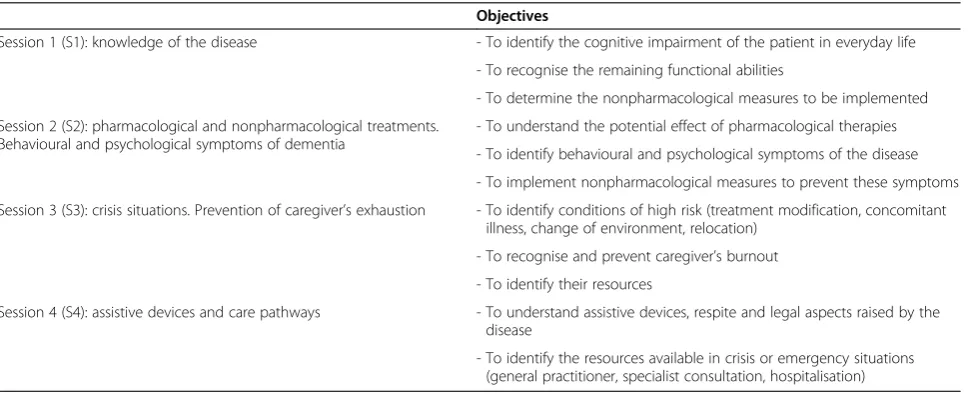
Then caregivers benefit from four group sessions, one per week for a month. These sessions are conducted in small groups (six to eight caregivers) and last 3 hours each. They aim towards allowing people to gain better understanding of their relative’s illness, have their con-cerns addressed and have their feelings expressed. We have planned four group sessions for caregivers, each focusing on a specific aspect of the disease: Session 1 (S1) – knowledge of the disease, understanding of the symptoms, functional abilities; Session 2 (S2) – treat-ment (pharmacological and nonpharmacological as-pects), behavioural and psychological symptoms of dementia in daily living; Session 3 (S3) –management
of crisis situations and prevention of caregiver’s exhaus-tion; and Session 4 (S4)– assistive devices, home care support and care pathways. Table 1 describes the objec-tives and topics of the group sessions.
Each session is adaptable to the objectives of the par-ticipants in each group. The goal we intend to achieve during these group sessions is to develop the caregivers’ coping strategies. It is also part of the educational process to offer them emotional support.
The sessions are led by a geriatrician (S1 and S2) and a nurse (S2, S3 and S4), both trained in therapeutic edu-cation, in tandem with stakeholders belonging to the geriatric department: a pharmacist (S2), a psychologist (S3) and a social worker (S4). The pedagogic methods and tools are those currently used in therapeutic educa-tional programmes [40]. We use tools such as storytell-ing or drawstorytell-ings that allow us to explore the subject’s representations and worries [44]. We also use computer-based activities and brainstorming, as commonly used in health education.
Patients can also receive written documents, when needed, to support the educative process delivered to their relatives during group sessions.
After the group session, the dyads benefit from an in-dividual visit at M2. This is the continuation of the edu-cational process with a reformulation of their personal objectives: ‘achieved’,‘to reach’,‘new goals’and‘acquired skills’. We try to deliver additional advice based on this evaluation, to both the patient and the caregiver. The patient is interviewed, using the booklet, on his/her well-being.
We are also collecting data regarding the participants’ satisfaction. These qualitative data are part of the educa-tional process.
Table 1 Educational objectives of the group sessions in the intervention group of the THERAD study
Objectives
Session 1 (S1): knowledge of the disease - To identify the cognitive impairment of the patient in everyday life
- To recognise the remaining functional abilities
- To determine the nonpharmacological measures to be implemented
Session 2 (S2): pharmacological and nonpharmacological treatments. Behavioural and psychological symptoms of dementia
- To understand the potential effect of pharmacological therapies
- To identify behavioural and psychological symptoms of the disease
- To implement nonpharmacological measures to prevent these symptoms
Session 3 (S3): crisis situations. Prevention of caregiver’s exhaustion - To identify conditions of high risk (treatment modification, concomitant illness, change of environment, relocation)
- To recognise and prevent caregiver’s burnout - To identify their resources
Session 4 (S4): assistive devices and care pathways - To understand assistive devices, respite and legal aspects raised by the disease
- To identify the resources available in crisis or emergency situations (general practitioner, specialist consultation, hospitalisation)
Analysis
Data are collected in the Access database and SAS soft-ware (developped by the SAS institute based in Cary, North Carolina, USA) will be used to perform the statis-tical analysis. Intention-to-treat analysis using a linear mixed model will be performed, adjusting for patient (disease severity) and caregiver (burden) characteristics and occurrence of life events that may interfere with the patient’s QoL. Attrition of dyads has been taken into ac-count. At the moment, at the 12-month visit, there is less than 5% attrition. Moreover, the total sample size re-quired for the study was calculated anticipating a risk of 20% attrition to take into account this phenomenon, which is particularly important in our population [45].
Discussion
The THERAD study started in January 2013. To date, 107 dyads have been included. The final results will be avail-able in 2015. By transmitting knowledge, expertise and skills to the AD patient’s caregiver [46], we hypothesised that the patient’s QoL can improve. QoL assessment pro-vides a format to express whether an intervention has made an important difference to the patient’s life, but its measurement is a challenge in AD [20,21,28,47]. Indeed, the abstract nature of QoL limits its use to individuals who have the cognitive capacity to understand the con-cept, a capacity that is gradually lost in neurodegenerative diseases such as AD (for example, the comprehension of the item‘you as a whole’or‘you in general’) [21]. For this reason, self-rating of the QoL is often replaced by proxy rating. However, it has been shown that there could be dif-ferences on QoL ratings between patients, caregivers and theoretical models [48]. Caregivers consistently rate the patient’s QoL lower [14,49], not only because of cognitive function [22,50,51] but also because of the caregiver’s bur-den or depression [22,49,50,52,53] and the patient’s de-pressive symptoms [54]. Acknowledging the problem of potential bias of proxy reports, we chose a proxy rating for QoL in the THERAD study, for several reasons. Firstly, it has been demonstrated with increasing severity of the dis-ease that patient ratings must mostly be replaced by proxy ratings [55,56], even if Logsdon and colleagues showed in 2002 that patients can rate their own QoL until the late stages [28]. This last study showed that the correlation be-tween caregiver’s rating and patient’s rating was greatest for subjects in the middle tertile of cognitive function, and the recruitment of our centre for the THERAD study is mainly moderately affected patients. Then in our routine practice we found that it was difficult to estimate the pa-tient’s QoL with self-rating. First, the patient’s ability to identify changes or to make choices among options in a scale is affected by lack of insight, due to anosognosia [30,54]. Moreover, cognitive impairment, with varying deficits of memory, attention, judgement, insight and
communication, influences the ability of individuals to comprehend questions or make comparisons in com-plex domains [47]. Then, at the moderately severe stage of the disease, patients must receive important help from the rater to complete the scale, which can intro-duce a real bias–the experimenter’s bias. For all these reasons we chose to use the caregiver’s rating of the AD patient’s QoL. We also decided to add self-rating methods as a secondary outcome in the THERAD study, because it has been demonstrated that self-rating and caregiver’s ratings are complementary and should be treated separately [20].
During the follow-up visits, we check the influence of the intervention on the carer’s perception of QoL by col-lecting, at each visit, data concerning his/her burden and depression. Indeed, burden and depression have been pointed out to influence the caregiver’s rating of the QoL [22,49,50,52,53]. We also collect data regarding pa-tient’s cognition, which can also influence the caregiver’s rating of the QoL. The intervention in itself is designed to improve caregivers’knowledge and to modify their at-titude or behaviour, but not to specifically decrease their burden or improve their mood. Furthermore, psycho-social interventions have shown mild to modest efficacy in mitigating caregiver burden in high-quality meta-analyses. Many studies showed improvements in care-giver burden-associated symptoms (for example, mood, coping, self-efficacy) even when caregiver burden itself was minimally improved [57]. We thus hypothesised that the potential effect of our intervention would not be linked to a lesser caregiver’s burden that might modify his/her as-sessment of the patient’s QoL, but to an improvement in the patient’s QoL itself. There are similar data regarding patient’s depression [58] and cognitive function outcome, on which psychoeducational interventions have not dem-onstrated any positive impact [1]. Lastly, psychoeduca-tional intervention providing caregiver education can decrease behavioural and psychological symptoms of dementia [13,59] but these symptoms have not been corre-lated with the caregiver’s rating of the QoL [60].
Of course, this study had limitations, mainly its lack of statistical power. Use of the caregiver’s rating of the AD patients QoL can also be considered a limitation, in a combined intervention programme, but this limitation ap-pears to be minimal. Indeed the educational programme was not specifically designed to improve the caregivers’ burden or depression, factors that have been pointed out to influence caregiver’s perception of the patient’s QoL. However, acknowledging this problem of proxy rating, we chose to add self-rating methods as a secondary outcome in the THERAD study. Moreover, it has been demon-strated that self-rating and caregiver’s ratings are comple-mentary and should be treated separately [20]. This improvement in patients’QoL was in accordance with the evidence from the literature. As mentioned earlier, a sys-tematic review has shown that multidimensional ap-proaches including, but not involving only, therapeutic education, caregiver support and respite improve the pa-tient’s QoL [23]. In addition, it has been shown that thera-peutic educational programmes can improve patients’ QoL in many chronic diseases [61,62].
However, our feasibility study showed no significant differences in patients’ functional autonomy or care-givers’burden over time. This is also consistent with the results in the literature. Indeed, the randomised con-trolled AIDMA study (psycho-educational programme assistance to caregivers of Alzheimer’s patients) [3] has not demonstrated any positive result on the patient’s functional independence measured by the Disability As-sessment for Dementia [63]. In our opinion, an improve-ment in functional autonomy did not constitute an appropriate primary outcome measure for this type of intervention, in the light of the disease’s evolution. This study has, by contrast, shown an increased ‘sense of competence’ of the caregiver measured by the Sense of Competence Questionnaire [64]. Given the evidence from the literature and our daily experience, we hy-pothesise in the THERAD study that therapeutic educa-tion of both primary caregivers and AD patients could improve the AD patient’s QoL. If the efficacy of this type of approach is proven, and persists in the year after in-clusion, then it will be important to implement such programmes in the care plan of AD patients.
Conclusion
The THERAD study is the first trial designed to assess the specific impact of a therapeutic educational programme on the AD patient’s QoL. By helping AD patients’ care-givers to develop coping strategies and to increase their knowledge of the disease, we believe that the patient’s QoL could improve. If so, a corollary benefit would appear, such as a reduction in hospitalisations – which are fre-quent in this population, particularly in emergency depart-ments [65]. The final results of this study may indicate
whether such an approach needs to be implemented in the care plan of AD patients.
Abbreviations
AD:Alzheimer’s disease; M0: baseline visit; M2: 2-month visit; QoL: quality of life; QoL-AD: Quality of Life in Alzheimer’s disease; THERAD: Therapeutic Education in Alzheimer’s Disease.
Competing interests
BV is a board member for Astra, Eisai, Elan, Exhonit, GSK, Lilly, Medivation, MSD, Nestlé, Nutricia, Pfizer, Pierre-Fabre, Roche, Sanofi, Servier, TauRx Therapeutics and Wyeth; and received grants from Avid, BMS, Elan, Exhonit, GSK, Ipsen, Lilly, Medivation, Pfizer, Pierre-Fabre, Roche, Servier, TauRx Therapeutics and Wyeth.
Authors’contributions
HV was responsible for the concept of the study and preparation of manuscript. VG was responsible for the methodological design of the study and analysis of data. AP was responsible for acquisition of subjects and drafting the manuscript. CH, SE and EdP were responsible for acquisition of subjects, collection of data and revision of the manuscript. AZ was responsible for collection of data, trial monitoring and revision of the manuscript. BV was responsible for supervision of the research group and revision of the manuscript. FN was responsible for correcting the manuscript, supervision of the study and revision of the manuscript. All authors read and approved the final version of the manuscript.
Acknowledgements
Thanks to Lucy Hollington for her help in translation.
Author details
1Geriatric Department, University Hospital, 170 avenue de Casselardit, 31059
Toulouse Cedex, France.2Department of Epidemiology and Public Health, Adresse 37, allées Jules Guesde, 31073 Toulouse Cedex, France.3Inserm U
1027, University Toulouse III, F-31073 Toulouse, France.
Received: 25 January 2014 Accepted: 8 September 2014
References
1. Waldorff FB, Buss DV, Eckermann A, Rasmussen ML, Keiding N, Rishøj S, Siersma V, Sørensen J, Sørensen LV, Vogel A, Waldemar G:Efficacy of psychosocial intervention in patients with mild Alzheimer’s disease: the multicentre, rater blinded, randomised Danish Alzheimer Intervention Study (DAISY).BMJ2012,345:e4693.
2. Martin-Carrasco M, Martin MF, Valero CP, Millan PR, Varcia CI, Montalban SO, Vasquez AL, Piris SP, Vilanova MB:Effectiveness of a psychoeducational intervention program in the reduction of caregiver burden in Alzheimer’s disease patients’caregivers.Int J Geriatr Psychiatry2009,
24:489–499.
3. de Rotrou J, Cantegreil I, Faucounau V, Wenisch E, Chausson C, Jegou D, Grabar S, Rigaud AS:Do patients diagnosed with Alzheimer’s disease benefit from a psycho-educational programme for family caregivers? A randomised controlled study.Int J Geriatr Psychiatry2011,26:833–842. 4. Gerdner LA, Buckwalter KC, Reed D:Impact of a psychoeducational
intervention on caregiver response to behavioral problems.Nurs Res
2002,51:363–374.
5. Sorensen S, Pinquart M, Duberstein P-O:How effective are interventions with caregivers. An updated meta-analysis.Gerontologist2002,42:356–372. 6. Devor M, Renvall M:An educational intervention to support caregivers of elders with dementia.Am J Alzheimers Dis Other Demen2008,23:233–241. 7. Kuzu N, Beser N, Zencir M, Sahiner T, Nesrin E, Ahmet E, Binali C, Cagdas E:
Effects of a comprehensive educational program on quality of life and emotional issues of dementia patient caregivers.Geriatr Nurs2005,
26:378–386.
8. Tompkins AS, Bell PA:Examination of a psychoeducational intervention and a respite grant in relieving psychosocial stressors associated with being an Alzheimer’s caregiver.J Gerontol Soc Work2009,52:89–104. 9. Hinchliffe AC, Hyman IL, Blizard B, Livingston G:Behavioural complications
of dementia: can they be treated?Int J Geriatr Psychiatry1995,10:839–847. 10. Callahan CM, Boustani MA, Unverzagt FW, Austrom MG, Damush TM,
collaborative care for older adults with Alzheimer disease in primary care: a randomized controlled trial.JAMA2006,295:2148–2157. 11. Brodaty H, Green A, Koshera A:Meta-analysis of psychosocial
interventions for caregivers of people with dementia.J Am Geriatr Soc
2003,51:657–664.
12. Smits CH, de Lange J, Dröes RM, Meiland F, Vernooij-Dassen M, Pot AM:
Effects of combined intervention programmes for people with dementia living at home and their caregivers: a systematic review.Int J Geriatr Psychiatry2007,22:1181–1193.
13. Romero B, Wenz M:Concept and effectiveness of a treatment program for patients with dementia and their relatives. Results from the Bad Aibling Alzheimer Disease Therapy Center.Z Gerontol Geriatr2002,35:118–128. 14. Teri L, Logsdon RG, Uomoto J, McCurry SM:Behavioral treatment of
depression in dementia patients: a controlled clinical trial.J Gerontol B Psychol Sci Soc Sci1997,52:159–166.
15. Dröes RM, Breebaart E, Meiland FJ, Van Tilburg W, Mellenbergh GJ:Effect of Meeting Centres Support Program on feelings of competence of family carers and delay of institutionalization of people with dementia. Aging Ment Health2004,8:201–211.
16. Brodaty H, Gresham M:Effect of a training programme to reduce stress in carers of patients with dementia.BMJ1989,299:1375–1379.
17. Alexopoulos GS, Abrams RC, Young RC, Shamoian CA:Cornell scale for depression in dementia.Biol Psychiatry1988,1:271–284.
18. Thomas P, Lalloué F, Preux PM, Hazif-Thomas C, Pariel S, Inscale R, Belmin J, Clément JP:Dementia patients caregivers quality of life: the PIXEL study. Int J Geriatr Psychiatry2006,21:50–56.
19. Schölzel-Dorenbos CJ, Ettema TP, Bos J, Boelens-van der Knoop E, Gerritsen DL, Hoogerveen F, de Lange J, Meihuizen L, Dröes RM:Evaluating the outcome of interventions on quality of life in dementia: selection of the appropriate scale.Int J Geriatr Psychiatry2007,22:511–519.
20. Bosboom PR, Alfonso H, Almeida OP:Determining the predictors of change in quality of life self-ratings and carer-ratings for community-dwelling people with Alzheimer disease.Alzheimer Dis Assoc Disord2013,
27:363–371.
21. Novelli MM, Dal Rovere HH, Nitrini R, Caramelli P:Cross-cultural adaptation of the quality of life assessment scale on Alzheimer disease.Arq Neuropsiquiatr2005,63:201–206.
22. Naglie G, Hogan DB, Krahn M, Black SE, Beattie BL, Patterson C, Macknight C, Freedman M, Borrie M, Byszewski A, Bergman H, Streiner D, Irvine J, Ritvo P, Comrie J, Kowgier M, Tomlinson G:Predictors of family caregiver ratings of patient quality of life in Alzheimer disease: cross-sectional results from the Canadian Alzheimer’s Disease Quality of Life Study.Am J Geriatr Psychiatry
2011,19:891–901.
23. Mason A, Weatherly H, Spilsbury K, Arksey H, Golder S, Adamson J, Drummond M, Glendinning C:A systematic review of the effectiveness and cost-effectiveness of different models of community-based respite care for frail older people and their carers.Health Technol Assess2007,
11:1–157.
24. Hartmann M, Bäzner E, Wild B, Eisler I, Herzog W:Effects of interventions involving the family in the treatment of adult patients with chronic physical diseases: a meta-analysis.Psychother Psychosom2010,79:136–148. 25. Wolff JL, Rand-Giovannetti E, Palmer S, Wegener S, Reider L, Frey K,
Scharfstein D, Boult C:Caregiving and chronic care: the guided care program for families and friends.J Gerontol A Biol Sci Med Sci2009,
64:785–791.
26. American Psychiatric Association:Diagnostic and Statistical Manual of Mental Disorders.4th edition. Washington: American Psychiatric Association; 1994. 27. Folstein MF, Folstein SE, McHugh PR:‘Mini-mental state’. A practical
method for grading the cognitive state of patients for the clinician. J Psychiatr Res1975,12:189–198.
28. Logsdon RG, Gibbons LE, McCurry SM, Teri L:Assessing quality of life in older adults with cognitive impairment.Psychosom Med2002,64:510–519. 29. Lechowski L, Harboun M, Dieudonné B, Hernandez K, Tortrat D, Forette B,
Teillet L, Vellas B:Clinical features of ambulatory patients over 80 years of age followed for Alzheimer’s disease. French prospective multicenter study REAL.FR.Rev Med Interne2003,24:307–313.
30. Rabins PV, Black BS:Measuring quality of life in dementia: purposes, goals, challenges and progress.Int Psychogeriatr2007,19:401–407. 31. Cummings JL, Gray MM, Rosenberg-Thompson S, Carusi DA, Gornbein J:
The Neuropsychiatric Inventory: comprehensive assessment of psychopathology in dementia.Neurology1994,44:2308–2314.
32. Katz S, Ford AB, Moskowitz RW:The index of ADL: a standardized measure of biological and psychosocial function.JAMA1963,185:914–919. 33. Lawton MP, Brody EM:Assessment of older people: self-maintaining and
instrumental activities of daily living.Gerontologist1969,9:179–186. 34. Zarit S, Reever I, Bach-Peterson I:Relatives of impaired elderly: correlates
of feeling of burden.Gerontologist1980,20:649–655.
35. Boyer F, Novella JL, Morrone I, Jolly D, Blanchard F:Agreement between dementia patient report and proxy reports using the Nottingham Health Profile.Int J Geriatr Psychiatry2004,19:1026–1034.
36. Clement JP:Development and contribution to the validation of a brief French version of the Yesavage Geriatric Depression Scale.Encéphale1997,23:91–99. 37. Sampson EL, Gould V, Lee D, Blanchard MR:Differences in care received
by patients with and without dementia who died during acute hospital admission: a retrospective case note study.Age Ageing2006,35:187–189. 38. Epstein AM, Hall JA, Besdine R, Cumella E Jr, Feldstein M, McNeil BJ, Rowe
JW:The emergence of geriatric assessment units. The‘new technology of geriatrics’.Ann Intern Med1987,106:299–303.
39. Therapeutic Patient Education: Continuing Education Programmes for Health Care Providers in the Field of Prevention of Chronic Diseases: Report of a WHO Working Group[http://apps.who.int/iris/bitstream/10665/ 108151/1/E63674.pdf?ua=1]
40. Bodenheimer T:Disease management–promises and pitfalls.N Engl J Med1999,340:1202–1205.
41. Logsdon RG, McCurry SM, Teri L:Time-limited support groups for individuals with early stage dementia and their care partners: preliminary outcomes form a controlled trial.Clin Gerontol2006,30:5–19. 42. Outil d’éducation pour la santé.Maladie d'Alzheimer: Un outil d'éducation
pour la santé[http://www.inpes.sante.fr/50000/OM/alz/pdf/guid_patient.pdf] 43. Carte Alzheimer.Carte de soins et d'urgence Maladie d'Alzheimer[http://
www.service-public.fr/actualites/00756.html]
44. Bruttomesso D, Gagnayre R, Leclercq D, Crazzolara D, Busata E, d’Ivernois JF, Casiglia E, Tiengo A, Baritussio A:The use of degrees of certainty to evaluate knowledge.Patient Educ Couns2003,51:29–37.
45. Coley N, Gardette V, Toulza O, Gillette-Guyonnet S, Cantet C, Nourhashemi F, Andrieu S, Grand A, Vellas B:Predictive factors of attrition in a cohort of Alzheimer disease patients. The REALFR study.Neuroepidemiology2008,31:69–79. 46. Thinnes A, Padilla R:Effect of educational and supportive strategies on
the ability of caregivers of people with dementia to maintain participation in that role.Am J Occup Ther2001,65:541–549. 47. Rabins PV, Kasper JD:Measuring quality of life in dementia: conceptual
and practical issues.Alzheimer Dis Assoc Disord1997,11:100–104. 48. Gerritsen DL, Dröes RM, Ettema TP, Boelens E, Bos J, Meihuizen L, de Lange
J, Schölzel-Dorenbos CJ, Hoogeveen F:Quality of life in dementia, opinions among people with dementia, their professional caregivers, and in literature.Tijdschr Gerontol Geriatr2010,41:241–255.
49. Thorgrimsen L, Selwood A, Spector A, Royan L, de Madariaga LM, Woods RT, Orrell M:Whose quality of life is it anyway? The validity and reliability of the Quality of Life-Alzheimer’s Disease (QoL-AD) scale.Alzheimer Dis Assoc Disord2003,17:201–208.
50. Sands LP, Ferreira P, Stewart AL, Brod M, Yaffe K:What explains differences between dementia patients’and their caregivers’ratings of patients’ quality of life?Am J Geriatr Psychiatry2004,12:272–280.
51. Konagaya Y, Watanabe T, Ohta T, Takata K:Relationship between quality of life (QOL) and cognitive function among community-dwelling elderly. Nihon Ronen Igakkai Zasshi2009,46:160–167.
52. Conde-Sala JL, Garre-Olmo J, Turró-Garriga O, López-Pousa S, Vilalta-Franch J:
Factors related to perceived quality of life in patients with Alzheimer’s disease: the patient’s perception compared with that of caregivers. Int J Geriatr Psychiatry2009,24:585–594.
53. Black BS, Johnston D, Morrison A, Rabins PV, Lyketsos CG, Samus QM:
Quality of life of community-residing persons with dementia based on self-rated and caregiver-rated measures.Qual Life Res2012,21:1379–1389. 54. Sousa MF, Santos RL, Arcoverde C, Simões P, Belfort T, Adler I, Leal C,
Dourado MC:Quality of life in dementia: the role of non-cognitive factors in the ratings of people with dementia and family caregivers.Int Psychogeriatr2013,25:1097–1105.
55. Roick C, Hinz A, Gertz HJ:Is quality of life in dementia patients validly estimable?Psychiatr Prax2007,34:108–116.
57. Adelman RD, Tmanova LL, Delgado D, Dion S, Lachs MS:Caregiver burden: a clinical review.JAMA2014,12:1052–1060.
58. Bruvik FK, Allore HG, Ranhoff AH, Engedal K:The effect of psychosocial support intervention on depression in patients with dementia and their family caregivers: an assessor-blinded randomized controlled trial. Dement Geriatr Cogn Dis Extra2013,3:386–397.
59. Dröes RM, Breebaart E, Ettema TP, van Tilburg W, Mellenbergh GJ:Effect of integrated family support versus day care only on behavior and mood of patients with dementia.Int Psychogeriatr2000,12:99–115.
60. Logsdon RG, McCurry SM, Teri L:Evidence-based interventions to improve quality of life for individuals with dementia.Alzheimers Care Today2007,
8:309–318.
61. Peytremann-Bridevaux I, Staeger P, Bridevaux PO, Ghali WA, Burnand B:
Effectiveness of chronic obstructive pulmonary disease-management programs: systematic review and meta-analysis.Am J Med2008,
121:433–443.
62. Norris SL, Engelgau MM, Narayan KM:Effectiveness of self-management training in type 2 diabetes: a systematic review of randomized controlled trials.Diabetes Care2001,24:561–587.
63. Gelinas I, Gauthier L, McIntyre M:Development of a functional measure for persons with Alzheimer’s disease: the disability assessment for dementia.Am J Occup Ther1999,53:471–481.
64. Vernooij-Dassen M, Kurz X, Scuvee-Moreau J, Dresse A:The measure of sense of competence in caregivers of patients with dementia. Rev Epidemiol Sante Publique2003,51:227–235.
65. Fox C, Maidment I, Moniz-Cook E, White J, Thyrian JR, Young J, Katona C, Chew-Graham CA:Optimising primary care for people with dementia. Ment Health Fam Med2013,10:143–151.
doi:10.1186/s13195-014-0066-1
Cite this article as:Villarset al.:Study protocol: Randomised controlled
trial to evaluate the impact of an educational programme on Alzheimer’s disease patients’quality of life.Alzheimer's Research & Therapy20146:66.
Submit your next manuscript to BioMed Central and take full advantage of:
• Convenient online submission
• Thorough peer review
• No space constraints or color figure charges
• Immediate publication on acceptance
• Inclusion in PubMed, CAS, Scopus and Google Scholar
• Research which is freely available for redistribution