University of New Orleans University of New Orleans
ScholarWorks@UNO
ScholarWorks@UNO
University of New Orleans Theses and
Dissertations Dissertations and Theses
Spring 5-19-2017
Awkward Silence
Awkward Silence
Paul Richey
University of New Orleans, [email protected]
Follow this and additional works at: https://scholarworks.uno.edu/td
Recommended Citation Recommended Citation
Richey, Paul, "Awkward Silence" (2017). University of New Orleans Theses and Dissertations. 2364. https://scholarworks.uno.edu/td/2364
This Thesis is protected by copyright and/or related rights. It has been brought to you by ScholarWorks@UNO with permission from the rights-holder(s). You are free to use this Thesis in any way that is permitted by the copyright and related rights legislation that applies to your use. For other uses you need to obtain permission from the rights-holder(s) directly, unless additional rights are indicated by a Creative Commons license in the record and/or on the work itself.
Awkward Silence
A Thesis
Submitted to the Graduate Faculty of the University of New Orleans
in partial fulfillment of the requirements for the degree of
Master of Fine Arts
By
Paul David Richey
B.F.A Mississippi State University, 2012
Acknowledgements
I am eternally grateful to the members of my thesis committee, Aaron
McNamee, Cheryl Hayes, and Kathy Rodriguez for giving me the support
and freedom that I rarely deserved but desperately needed. I also want to
thank the rest of the faculty of UNO for their support, insight, and never
being afraid to ask the hard questions. Thank you to my family and friends
for all your love and unending support. And to Lizzie, for being there from
Table of Contents
List of Figures ... IV Abstract ... V
Introduction ... 1
Minimalism ... 4
Formalism ... 9
Process and Material ... 10
Candidacy ... 14
Awkward Silence ... 17
Conclusion ... 26
Bibliography ... 28
List of Figures
Figure 1. Cradle ... 5
Figure 2. Square One ... 9
Figure 3. Plowshare ... 9
Figure 4. Lament ... 16
Figure 5. Futile Devices (Installation View) ... 17
Figure 6. Awkward Silence (Installation View) ... 18
Figure 7. The End (Installation View) ... 19
Figure 8. A Song for Our Grandfathers ... 22
Abstract
My work has a strong formal quality and a deep relation to
minimalism without ever buying into it. Through tension and inserting my
personal experience into the making of the work, but not always within the
meaning of the work, I leave the viewer to draw their own conclusions.
Introduction
Nearly a decade ago I walked into my first day of college at
Mississippi State University with the dream that when I graduated I would
move on to a life as a highly paid Graphic Designer. Those visions started
to fade away as I started work in some of my foundations courses; I’d never
really made art before I got to college, it hadn’t hit me as a thing I wanted to
do yet. Over Fall Break of the first semester I went to New York City for the
second time (my first time to look at art) with a group from school that was
mixed between studio artists and graphic designers. As the week went on I
felt myself feel less like Graphic Design was the thing for me as I walked
around museums and galleries and found myself immersed in one of
Jackson Pollock’s giant canvases at MoMA. I can’t even begin to tell you
where I first heard of or saw Pollock’s work as a kid growing up in Pearl,
Mississippi, but I can tell you that it has always stuck with me and every
time I see his work in a gallery or museum it’s like greeting an old friend.
The next semester I took my first sculpture class of any kind and had
my life forever changed. Our first assignment was an “Everyday Multiples”
project, which required us to go to the dollar store and find a product that
and create a sculpture from it. I ran across some traditional slotted
clothespins and decided that this was what I had to use. After quite a few
failed attempts at making something happen, I lined a long row of the
clothespins up and wrapped wire around their prongs and heads, I then
proceeded to roll them into a bundle. From there, I knew something else
needed to happen, so I did what any 18-year-old boy in a sculpture class
would do, I lit the propane torch and set the bundle ablaze. What happened
next changed my world forever.
For our critique, my professor invited a few thesis year students to
join us. When my turn came one of the older students began to describe
what the piece made him feel. The way I had the clothespins standing on
their prongs made them look like human figures and the wire I had wrapped
around them along with the blackened surface from burning the wood
created this image of slaves on a ship for him and all the history involved
with that. In that moment, he got choked up and almost started to cry and
that was when I first realized the power that art could hold, the power to
reach deep inside someone and affect their emotions in this mysteriously
My intention with that piece was never to create a commentary on
slavery or race. I don’t know if I even had an intention besides fulfilling the
requirements of the assignment because I was eighteen and still thought I
was going to be some hot shot designer. This one assignment, this single
moment in time, completely changed everything and started me on the
journey I’m still travelling on today. A few months later I took my first
Graphic Design class and unsurprisingly did not find the same sort of
satisfaction that came with sculpture and I knew for sure that the decision I
had come to some months prior was the right one.
My work most often begins with an image in my mind, I usually sketch
these ideas right away so that I won’t forget them and so I can try to flesh
out what the piece is going to be once I bring it to life. From there, I
approach the work as a formal investigation of form and material, but
somewhere along the way, a deeper sense of meaning will sometimes rise
to the surface. Tension plays a large part in a lot of my work and exploring
that idea has become important to me. I grew up an only child in a
Mississippi town (where I never truly fit in), so tension, anxiety, loneliness,
and feeling out of place are normal to me. I think that these emotions show
of these feelings to this day. Therefore, my work comes from a very
personal place instead of an academic or art-historical place, which makes
it frustrating to discuss in an academic context because so much of the
academics of art is based only in the formal rather than the emotional
qualities of the work. I am interested in the potential of the emotional
aspects of the work just as much as I am in exploring the potential of
materials within my work.
Minimalism
My work has been compared to Minimalism since undergrad.
My work is simple in many ways but it is certainly not Minimalist by
definition, according to James Meyer:
…Minimal art tends to consist of single or repeated geometric forms. Industrially produced or built by skilled workers
following the artist’s instructions, it removes any trace of emotion or intuitive decision-making, in stark contrast to the Abstract Expressionist painting and sculpture that preceded it during the 1940s and 1950s. Minimal work does not allude to anything beyond its literal presence, or its existence in the physical world. Materials appear as materials; colour (if used at all) is non-referential. Often placed in walls, in corners, or directly on the floor, it is an installational art that reveals the gallery as an actual place, rendering the viewer conscious of moving through this space.1
Figure 1. Cradle, 2014.
My earlier square sculptures (fig. 1) were often misread as Minimalist
while I did use repeated geometric forms (squares) to build them, they were
all hand cut by me to similar sizes and nothing was ever exact because I
was cutting thousands at a time. I used a low-cost luan, a type of plywood,
in its raw state without any sanding or paint - the edges rough from being
cut on a band saw and the heads of the nails I used to assemble the pieces
and the holes they created were all visible in the final product. These
used to make them but the assembly was completely intuitive: each square
was placed according to how it fit with the piece nailed before it.
Where Minimalism claims to be non-referential and alluding only to
itself and its own objecthood, my work alludes to something, even if that
something is simply the material, process, or something more. The shapes
that form in my mind that later become the sculptures I build come from my
subconscious creating an amalgamation of the things I’ve seen in my
life-simple, abstract representations of the structures of my environment. With
my titles, I try to give some clue as to what I feel about the meaning of a
work but even then, I want the names to be slightly vague so that the
viewer can still wonder and not simply take what is given to them. I enjoy
using titles of songs as it adds another layer to the emotional response the
viewer has to the piece, depending upon their knowledge of a particular
song. The sculptures aren’t illustrations of the song and the use of song
titles acts as a suggestion of my state of mind while making a particular
work.
My work also differs from Minimalism in the way I scale and finish the
pieces. A lot of the work in Minimalism used industrial material in a raw
most of the artists in their process since they weren’t the ones carrying out
the production of the pieces in many cases. However, the bravado of
sculpture isn’t just limited to Minimalism. Historically, sculpture was created
as a monument to something, whether it was God, gods, kings, or the
sculptors themselves. In his “Notes on Sculpture: Part 2,” Robert Morris
discusses size of sculpture and its relation to intimacy:
That is, besides providing the condition for a set of
responses, large-sized objects exhibit size more specifically as an element. It is the more conscious appraisal of size in monuments that makes for the quality of “scale.” The
awareness of scale is a function of the comparison made between that constant, one’s body size, and the object. Space between the subject and object is implied in such a comparison. In this sense space does not exist for intimate objects. A larger object includes more of the space around itself than does a smaller one. It is necessary literally to keep one’s distance from large objects in order to take the whole of any one view into one’s field of vision. The smaller the object the closer one approaches it and, therefore, it has
correspondingly less of a spatial field in which to exist for the viewer.2
Whereas Morris’ sculptures are objects that take up a large amount
of space, my sculptures usually remain at an intimate scale that rarely gets
much bigger than human size. The pieces that do reach a more human
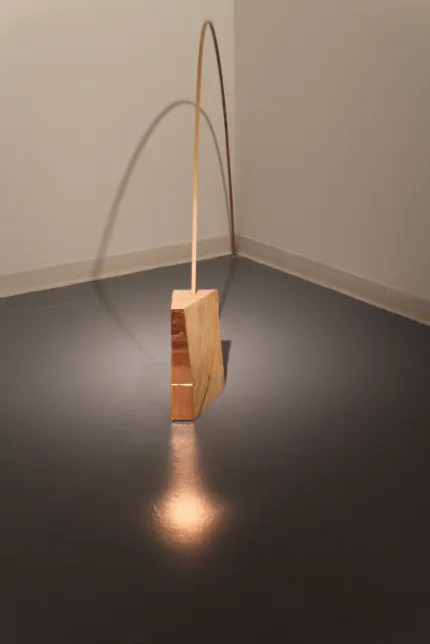
proportion encourage the viewer to approach them. For example, Square
One (fig. 2) is a little over six feet tall but only weighs around five pounds.
The piece is made up of a thin plank of Yellow Cedar that is curved from
the floor and held in place by a block of Douglas Fir with a beveled edge
attached to the wall at the top of the curve. Even though the tension of the
plank is unnerving in a certain way, the scale and finish of the piece invites
the viewer closer and eases the anxiety of the piece. If Square One were
made of steel, it would become a very menacing sculpture but being made
from wood and including that little bit of turquoise at the top makes it
inviting even if the tension of the plank might make the viewer
apprehensive. If it was twenty feet tall, it would become much more
menacing than if it were one foot tall. If you compare my piece Plowshares
(fig. 3) to Square One, even though it isn’t that much smaller, the seemingly
fragile nature of the thin, bent pole changes the viewers feelings. They may
still feel nervous or anxious but it isn’t from fear of the piece, rather a fear
for it. Square One feels as though it could come free from the wall and
Figure 2. Square One. 2016 Figure 3. Plowshares. 2017
Formalism
Ultimately, I’m a Formalist. Form and the actual making of the
art is what concerns me the most. But in saying that I also have to
acknowledge that the work comes from somewhere within me and my
preferences, experiences and skill set allow for layered readings of the
work if the viewer can decipher it. I’ve always had a hard time explaining
how I feel about Formalism and how in the last thirty years we’ve been in a
place in contemporary art that often doesn’t focus on the form as much as
my work. Dave Hickey sums up my feelings fairly well in his essay
Formalism:
Formalists analyze events that have already happened. They don’t teach us how to “enjoy” art. They investigate the
consequences of parts (words, notes, colors) that usually remain unrecognized to us…
…I want to emphasize the fact that formalism doesn’t do dictionary, darling; it doesn’t do answers; it doesn’t do
pictures of art; and it doesn’t do coerced looking. Formalism speculates on the intensity and possible longevity of tangible art that elicits an instantaneous visual or emotional
confirmation.3
This is how I feel and in part what I’ve been trying to say about my
work but haven’t been able to successfully articulate. Maybe the critical
theory I’ve studied led me to believe that I was wrong for thinking these
things. Martin Puryear is chief among artists whose work and thoughts on
art I admire. His descriptions of what he values in art are much the same as
mine and the work that I’ve made for my thesis exhibition, Awkward
Silence:
I value the referential quality of art, the fact that a work can allude to things or states of being without in anyway representing them. The ideas that give me rise to a work can be quite diffuse, so I would describe my working process as a kind of distillation—trying to make coherence out of things that seem contradictory. But coherence is not the same as
resolution. The most interesting art for me retains a flickering quality, where
opposed ideas can be held in tense coexistence.4
Process and Material
Most of the wood I use in my work is from trees that are
indigenous to Mississippi and/or the South. Every time I cut into the
material, I’m hit with the familiar smell that reminds me of home. Pine
specifically reminds me of the first warm days after winter, when the sun
heats up the fallen pine straw and the smell permeates the air, a blessing
and a curse as it foretells the humid summer days to come.
I’m not sure when exactly I made up my mind that wood was going to
be my go-to material but, looking back, I can see why it happened. That
first piece I made in undergrad was made of wood and the effect on my
instructor and classmates in that critique was such that the desire to
continue exploring wood as material was planted in my mind. I enjoy the
associative properties of wood, the memories that a certain smell or look of
wood can bring forth. Ursula von Rydingsvard, who is known for her
monumental Cedar sculptures, said in an interview with NPR that she,
4Elderfield, John, Michael Auping, and Martin Puryear. Martin Puryear. New York:
“…wants to break people’s sentimental attachment to wood, ‘which is you
know, in the land of the elves or in a storybook for children…I don’t want
the cuteness associated with the wood, or even the nostalgia.’”5 I don’t
agree with this description of wood being some fairy tale material; it
certainly can be if your intent is to make something whimsical with it, but
that is in those certain cases. Some of the nostalgia associated with wood
is important to what I want my work to achieve, whether it elicits a longing
or simply sparks a memory, without a precedence for wood in people’s
lives, there would be less for them to relate to in my work. After my
grandfather died when I was in 8th grade, another family member built a
Cedar chest that we put some of his belongings in. Now, whenever I smell
Aromatic Cedar, I think of opening that chest and remembering my
grandfather.
I’m ambivalent about using steel or other materials in my work.
There’s something too cold about steel for me. It’s very unforgiving and its
industrial associations make it difficult to get away from a feeling of utility,
although I haven’t completely given up on it for use in my future practice.
5
The one metal I have had success with is bronze. During my first semester
at the University of New Orleans, I found a severed bird wing on the floor of
the foundry while sweeping up and preparing for an aluminum pour. What I
initially intended to be an experiment with the foundry process became a
successful bronze of a bird’s wing.
As the bird’s wing was somewhat impossible to make a mold of to
cast in wax (as is the normal process with bronze) because the feathers
would have separated as the silicone was poured around it, I instead
attached the wing to a wax cup and sprue and poured the investment
mixture of plater and sand directly over that. The investment is the mold
that is eventually filled with bronze after the wax is melted out of a normal
casting, but in this case I essentially cremated the remains of the bird wing
and blew out the ashes with an air hose to prepare for the pouring of the
bronze. What has come from this process of casting birds are these very
odd pieces that I don’t quite know how to finish. I later found a dead Finch
and cast it whole using the same process as the wing with great success.
The bronzes themselves become these beautiful little monuments to the
dead birds. Historically, bronze was used to create large scale statues to
this small scale, especially with the final product being such a detailed mold
of a bird, the pieces really speak to the fragility and beauty of life and how
there is more than one way to be immortal. Now, this dead Finch is forever
memorialized in bronze. For now the bronzes remain incomplete because I
haven’t been able to determine how they need to be finished. Can they
simply exist by themselves as objects or do they need an added element
such as a wooden base or perch? Only time will tell if they become finished
pieces.
I have also worked directly with foundry wax to make molds for
bronze with some success. Though casting sheets of wax and then cutting
them up into a geometric form and using a hot plate to melt the wax and
give it texture, I found a way to make a bronze piece that still showed the
gesture of how it was made. I’ve only made one piece this way but it was
made with the intention of attaching it to a carved wooden piece which I
realize now was somewhat detrimental to the piece itself. I didn’t have a
sketch of what the carved element would look like, instead I attached the
bronze to a block of Spanish Cedar and began to carve away at it in a way
that attempted to respond to the bronze form but in my mind, fell short of
Candidacy
My candidacy semester was an extremely difficult one. I was
feeling extremely low and directionless in the program, I thought of whether
I should drop out or soldier on daily. On top of those feelings, my dad was
diagnosed with Parkinson’s after a summer spent worrying if he had ALS
(his brother died of that when I was 19) and the year before that watching
the end effects of Parkinson’s on my grandfather after he received a late
diagnosis. Things weren’t easy but I found a way to use those emotions in
the work I was making. I failed my first run at candidacy and for my second
review I made new sculpture and reworked my outline, the former did a lot
more for my future in the program than the latter.
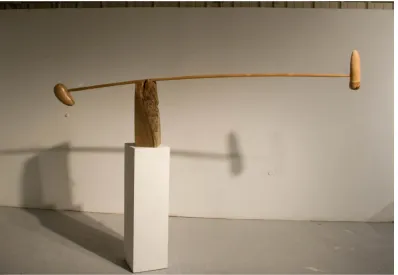
The piece I made was Lament (fig. 4). At the time, I was trying to find
a way to balance what I wanted out of art, school, life, and the hand I was
being dealt by these things. It made sense that I was drawn to a form that
was balancing two objects and being bent under the weight of them. The
chunk of Oak that acted as the fulcrum was one I pulled from a firewood
pile at a campground just outside of the town where I went to undergrad.
gathered a dozen or so rough sawn Oak boards from the pile and a few
other various chunks of wood; most of which I used in the pieces I made.
Figure 4. Lament. 2015.
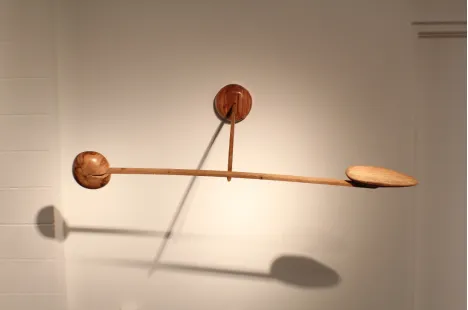
From Lament, I began to investigate this idea of balance with a piece
I called Futile Devices (fig. 5). I was misguidedly trying to be more like
Martin Puryear without fully knowing myself as an artist yet. I was trying to
add to the elements of balance I used in Lament, so I added a pole that
extended from the wall to add a new point of tension that also acted as the
fulcrum for this piece. The result was a piece that succeeded but never
Figure 5. Futile Devices, 2015.Installation view, 2017.
Awkward Silence
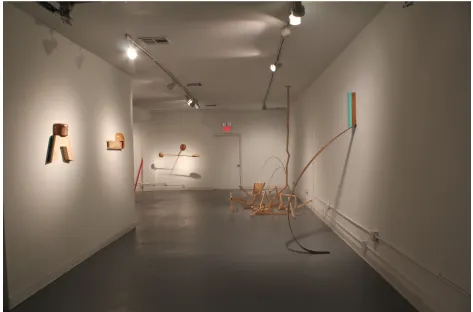
The title of my show, Awkward Silence (fig. 6), comes from
those early critiques at the University of New Orleans where I didn’t know
what I was trying to say and where I felt I didn’t want to say anything, that
the work should speak for itself. My reticence there came from not wanting
to put myself in the work, I only wanted to talk about the work in a formal
way but the formal isn’t all that’s there. I know the viewer won’t understand
understand the tension and are hopefully reminded of their personal
tensions.
Figure 6. Awkward Silence. Installation view, 2017.
The day after I installed my work for the show, Futile Devices fell and
one of the carved pieces split. Instead of repairing the broken piece, I left
the pieces on the floor. I relit the piece and decided to change the name to
The End (fig. 7). I knew from the beginning that it would be a tough piece to
hang and keep up, so I wasn’t surprised when I heard that it fell but I wasn’t
to show if a piece failed or broke but I didn’t have a good answer at the
time; this still might not be the best answer but it works in this instance.
Figure 7. The End. Installation view, 2017.
My first instinct was to repair the piece or just remove it but I soon
realized that I didn’t have to. If my aim is to make work that reflects on my
experience in the world and the experience of being human, then it doesn’t
feel right to repair a broken piece that is only broken because of the events
set in motion by its creation. If you go skydiving and your parachute doesn’t
are people who have benefactors that are always there to clean up their
messes and they never really live a true life. Crash your Mercedes, get a
newer Mercedes. When Futile Devices fell, it became the conclusion of the
show and of this body of Graduate work. Taking it out of the show or
repairing it and leaving no trace of what happened would have been a
disservice to the show, my work, and myself. Whereas leaving it in doubles
down on what I am working towards in my work; I don’t think that I’ve
reached the goal but I know I’m closer than I was. Leaving a broken piece
as it lies in the show recognizes the reality that life doesn’t go the way we
plan it and we all die one day. It also recognizes that these wooden works
carry the scars of where they’ve been in the same way that humans do,
even though ours aren’t always visible.
The moment that Futile Devices became The End helped my
show-title, Awkward Silence, to be even more poignant than it already was with
my choice of sculptures. The viewer needs time with the pieces to see
everything there is to be seen within the piece, aesthetic and otherwise.
The title also deals with my feelings of anxiety whenever I am asked to
discuss or explain my work, my answers always begin with an awkward
now lying broken on the floor, my hope is that the viewer sees it as a
broken piece, not as something staged and that it almost becomes like a
funeral for the piece. Moving it and installing it somewhere else turns the
piece into something staged rather than something that came together
during the time between the piece falling, my contemplation about fixing it,
and ultimately deciding to just leave it in the space as-is.
The piece A Song for Our Grandfathers (fig. 8) uses some of my
feelings of nostalgia that I spoke of earlier to create a piece that is a bit of a
memorial to my own grandfather. The Cedar I used reminds me of the trunk
I spoke of earlier and the plywood form and dark green I chose for the
bottom half of the piece are another symbol of my grandfather because he
worked for Southern Pine which is a power company; the plywood form
loosely resembles the base of a transmission tower and the green is the
Figure 8. A Song for Our Grandfathers. 2017.
Most of the other work in Awkward Silence has to do with the material
relationships and the overarching formal and conceptual theme of tension
that I have recently been exploring with the work. The only exception to this
Figure 9. September (Of Towers and Innocence). 2016.
Innocence is a strange thing. Where does it come from, where does it
go? I am old enough to remember O.J. Simpson’s car chase on the news,
the Oklahoma City bombing, Columbine, and a high school shooting in my
I remember most vividly, the tragedy that became reality rather than mere
happenstance in my psyche was September 11, 2001. I remember like it
was yesterday, sitting in my Sixth-Grade Spanish class watching the news
as images of the second plane hitting the towers flooded in. It wasn’t
recorded, it was happening, the towers were falling in real time. This was
the moment I lost my innocence, along with the rest of my generation.
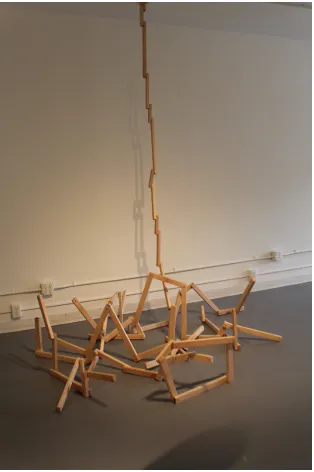
The sculpture, September (of towers and innocence), is about this
occurrence. I never set out with that intention but as the piece has lived and
I’ve heard people’s reactions and associations of it with childhood toys, I
realized that this moment is where it came from. When I began that piece, I
was thinking about units, structures, and how to simplify the art I was trying
to make so that it could illicit a more visceral reaction from the viewer and
from myself. I wasn’t playing with wooden blocks at age eleven but I was
certainly still playing with Legos. In a certain sense, every time I begin to
make a sculpture, I’m dealing with a sense of play, setting to work on a
piece always makes me feel like a kid in a candy store. I really let the
sense of play come out in September, I created these blocks that came in
three lengths with holes drilled in them for connecting like you would find in
after the blocks were cut to size and had their sharp edges rounded. I first
thought about using a modified slip joint to connect the pieces so that they
would become more interchangeable, or not having the pieces able to be
connected at all, just existing in stacks. Somewhere in the process I
decided to drill the holes and, using dowels, to connect them and create the
various sections of the piece.
For the presentation in my thesis show, I decided to suspend one of
the sections of blocks from the ceiling. When I realized how for me, this
piece related to a loss of innocence and the fact that as a child the goal of
playing with blocks was to build the tallest tower, I knew that this piece had
to extend higher than the eighteen or so inches off the floor in some areas.
I don’t expect everyone who views this piece to see the correlations I see
with life after September 11th, but I do feel that most people will be able to
come away with some feeling of how they felt when they were young and
the potential of our dreams and the world seemed so infinite, when the
world seemed so big. I wonder how long someone will look at this piece
and think longingly about blocks and childhood before some twisted form of
reality comes rushing to them and says how foolish it is for adults to think
doesn’t matter if someone understands the meaning I associate with the
work because the works can stand without the obligation.
Conclusion
I doubt that I will ever be able to answer all the questions
people might have about my work and I don’t know if I necessarily want to.
Most days I can’t answer all my own questions about my work. As an artist,
I don’t care whether people like or don’t like my work anymore, the far more
important thing is whether I am in control of my materials or not and that
the work succeeds as art. I think that I’m getting closer every day to being
able to fully control and manipulate these materials. My work is rooted
firmly in a formalist approach but it isn’t opposed to the fact that any work
you make has the potential to become more than what I anticipated.
Awkward Silence was a success. People came opening night and
responded to the work. They asked questions I couldn’t answer and
questions that I could. That night made me realize that I’ve spent too much
time trying to chase after and recreate a moment that I experienced with
that first critique nearly a decade ago. It also made me realize that though I
may not have cried that day, I was equally a part of that viewer’s
intended to make through his eyes. That was the moment I became an
artist but I’ve spent all this time since trying to become what I was already. I
had a professor in undergrad who always told us that, “every day we are
one step closer to becoming who we’ve always been.”6 He also shared this
poem by the Swedish diplomat Dag Hammarskjold:
Thus it was
I am being driven forward Into an unknown land. The pass grows steeper, The air colder and sharper. A wind from my unknown goal Stirs the strings
Of expectation.
Still the question: Shall I ever get there? There where life resounds, A clear pure note
In the silence.7
This poem has become a mantra, a prayer, and a process in my life and
with every piece of art that moves from my head, to a sketchbook, and
eventually to objecthood.
6Funderburk, Brent. Personal Communication. May, 2012
7Hammarskjold, Dag, W.H. Auden. Markings. New York: Alfred A. Knopf,
Bibliography
Baudrillard, Jean, and Sylvere Lotringer. The Conspiracy of Art: Manifestos, Interviews, Essays. New York: Semiotext, 2005.
Elderfield, John, Michael Auping, and Martin Puryear. Martin Puryear. New
York: Musesum of Modern Art, 2007.
Hammarskjöld, Dag, W.H. Auden. Marking. New York: Vintage Books,
2006.
Hickey, Dave. Pirates and Farmers. London: Ridinghouse, 2013.
Meyer, James. Minimalism. London: Phaidon, 2010.
Michel, Karen. Interview with Ursula von Rydingsvard. Weekend Edition Sunday. NPR, April 23, 2013.
Morris, Robert. “Some Notes on the Phenomenology of Making.” Artforum.
April 1970. Vol.8. p62-66.
Nauman, Bruce, and Janet Kraynak. Please Pay Attention Please: Bruce
Nauman’s Words: Writings and Interviews. Cambridge, MA: MIT Press,
2005
Sandler, Irving. American Art of the 1960s. New York: Harper et Row,
1992.
Sandler, Irving. Art of the Postmodern Era: From the Late 1960s to the
Early 1990s. New York: IconEditions, 2004.
Weschler, Lawrence. Seeing is Forgetting the Name of the Thing One
Vita
Paul was born in Torrance, California in 1990. He received his BFA in
Sculpture from Mississippi State University in 2012. In 2014 he was