DST SEMINAR ON
Application of Computers to Bibliographical
Information Processing : Some Developments in India (Bangalore)(10-13 July 1978)
SIMPLIFIED PROCEDURES FOR THE GENERATION OF POPSI ENTRIES USING COMPUTER
F J DEVADASON, V BALASUBRAMANIAN and B NAGESWARA RAO, Documentation Research and Training Centre, Indian Statis-tical Institute, Bangalore-1.
0 INTRODUCTION
Postulate-based Permuted Subject Indexing (POPSI) is an Indexing procedure helpful in;
1) Formulating subject headings;
2) Deriving subject index entries for a catalogue and index to a book, etc;
3) Determining the subject of reader's query in a consistent and helpful way;
A) Formulating a strategy for searching information about a subject in a catalogue or other surro-gate filer
5) Deriving a base for the presentation of ideas in the text of a document (3); and
This procedure is based on S R Ranganathan's General Theory of Library Classification as
modified and improved upon from time to time (1 ,2). 1 CCMPUTERIZATION OF POPSI
Computer programs for the generation of POPSI were developed by IK 'Ravichandra Rao, the latest version of which first reads in a parameter card giving the diffe-rent indicator digits used in the POPSI string to help identify each of the descriptors. Then it reads in the full POPSI string and constructs a table of 60 entries (Lead Table) each entry having 3 fields of 3 character length. The first field in each entry in the table is used to point to "Lead Term", the second field to point to the preceding or principal facet of the Lead Term and _the third field to point to the preceding facet when the Lead Term is a speciator. After constructing Lead Table, using the pointer in field 1 of the first entry, the Lead Term is brought into an area called FIRST-DESCRIPTORS. Similarly, using the pointers available in fields 2 and 3, the corresponding descriptors are brought into areas called SECOND-DESCRIPTORS and THIRD-DESCRIPTORS. If any of these descriptors have '< ' (less than sign), used to indicate higher order levels of concepts or ' = '
(equal to sign), used to indicate speciator of kind 2, then the descriptors are inverted and stored back in the respective areas (SECOND-DESCRIPTORS,
THIRD-DESCRIPTORS ).
A facet from the FIRST-DESCRIPTORS is brought into
Computerisation of POPSI
another area called BUFFA. Then descriptors from SECOND-DESCRIPTORS and THIRD-SECOND-DESCRIPTORS ,are attached to the facet and stored in two different areas called BUFFB and BUFFC. The Lead Term Section thus constructed in BUFFC is attached with the 'Short Display' formed in another area called SHORT-DISP and written onto a magnetic tape along with the 'Reference Section' containing the refe-rence number. The next facet from the FIRST-DESCRIPTORS is brought into BUFFA and the cycle is repeated for all the facets in it. A detailed algorithm for these steps is given by IK Ravichandra Rao (4).
2 SCOPE OF THE PAPER
Certain modifications in generating the entries have been suggested by A Neelameghan and Mr MA Gopinath and the procedure is being improved upon to make it more efficient. The modifications suggested mainly deal with which term(s) should form the context term(s) of a particular Lead Term. When the rule for deciding this changes, the program written should also be changed if it incorporates the rule for the decision within Its algorithm. If a program is written in such a way that this decision is done by the indexer and coded at the input stage and the program written follows the coded rules, then modifications in indexing may not affect the program developed. But input preparation will be slightly more difficult. It should be noted here that PRECIS
follows this approach, in the sense that all the diffe-rent rules required to manipulate a particular term in a
In this paper, we are presenting two programs for generating POPSI entries, in which the first program is general in its application, in the sense that the input codes decide the formation of entries especially the context terms and the second, which does not take any
extra codes at the input and formulates the entries accord-ing to a saccord-ingle rule.
3 INPUT CODE BASED METHOD 31 Input Data
Each of the facets/speciators forming a POPSI string is separately punched each onto a separate card along with codes to denote the Round, Facet, Level, the dumber of lower order levels of facets, speciator Kind 1 or Kind 2 of the term(s) concerned and the codes of the preceding term fit to form the context term as decided by the indexer.
32 Input Format
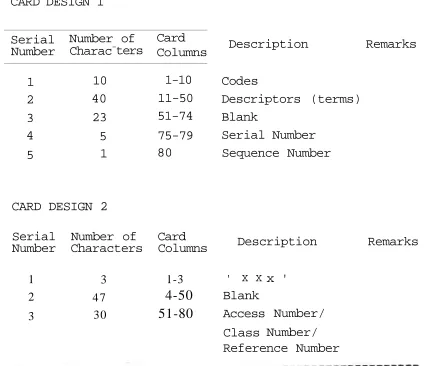
The input format consists of two fields. Column 1 to 10 is the 'Codes Field' and Columns 11 to 50 is the
'Term Field'. The Codes Field has two sub-fields. 1) the codes for the Term (R1L1F1H1), and
2) the codes for the Context Term (R2L2F2H2)
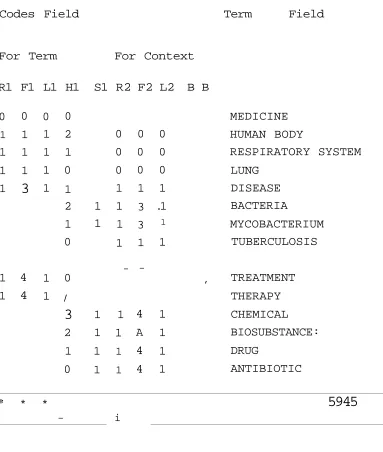
(See Fig 2). The details of the input format are given in Fig 1 giving the card designs. The end of an input string is denoted by a card having three asterisks in columns 1, 2 and 3 and the reference or index number
Computerisation of POPSI
from columns 51 to 80. A sample list of input cards is given in Fig 3.
33 Procedure
• The algorithm for generation of POPSI using the in-put cards in the format described above is very simple. It consists of only three distinct steps, namely:
•
1) Term Table building;
2) Short-display formation; and
3) Lead and context term(c) generation. 331 Term-Table Building
Each card is read and stored in a table conse-* cutively by incrementing the index value of the table element for each card. When three asterisks are sensed in columns 1 to 3 of a card, then Term-Table building is terminated and the index/reference/class number in the asterisked card is stored in a separate location called REF-NO. The total number of cards built in the Term-Table is also stored in another location N and also WN. 332 Short-Display Formation
The short-display is formed of all the lowest level descriptors in each of the facet. • This is easily done by selecting those descriptors having a ' o' in column 4
(subfield H1). This short-display is stored in the memory location SHORT-DISP.
333 Lead and Context Term(s) Generation
accommo-dating three different context term(s) for a particular lead term. A synonym can occur as a lead term, but not as a context term.
The generation starts from the bottom of the table (the last entry in the table) using the total number of cards (N) stored in the Term-Table as index. Some of the steps in generating the entries from the Term-Table are given below:
1. Move 1 to X.
2. Move N (Number of cards stored in the Term Table) to Y, WN (If a string has 10 cards ex-cluding the '3 star' card, then N = Y = 10). 3. Move the term in the Yth entry in the
Term-Table to Xth term position in the LEAD CONTEXT area . If the term has '/' in subfield H1 go to step 8.
4. Store the codes for the Context Term R2F2L2 H2 in C-C.
5. Depending upon the code in subfield F2 indicat-ing the fundamental category, put , in the LEAD-CONTEXT, and a blank if the term is a Basic Subject speciator.
6. Add 1 to X.
7. If X > k (LEAD-CONTEXT area has provision for one Lead Term and 3 Context Terms) go to Step 12; else
8. Subtract 1 from Y.
9. If Y<.1, go to step 12; else
Computerisation of POPSI
of the Yth entry in the Term-Table (Y is decre-mented in step 8 ) .
1.1 If it matches, go to step 3; else go to step 8. 12. Move blank to the recently inserted comma
(as this is the last term in the LEAD-CONTEXT).
13. Attach LEAD-CONTEXT with SHORT-DISP and REF-NO. 14. Write the index entry on to tape.
15. Move 0 to X.
16. If WN < 1, stop execution; else 17. Subtract 1 from WN.
18. Move WN to Y. Go to step 3.
A set of generated entries following this procedure are given in the Appendix A .
4 RULE INCORPORATED METHOD 41 Input Data
As in the previous method, each of the facets/
speciators forming a POPSI string is separately punched, each on to a card along with the codes to denote Round, Facet, Level, the number of lower order levels of facets, speciator kind 1 or kind 2 of the term(s) concerned;
without any codes for the Context Term for it. The input format is the same as that for the previous method
4Z Procedure
The procedure for generating the different entries is the same as that of the previous method for Term-Table building and Short-Display formation. The procedure for formation of the Lead and Context Term(s) is done accord-ing to the followaccord-ing rule. For a given term kept in the lead the immediately preceding facet/speciator term(s) belonging to the lowest level upto a maximum of three
(i.e. immediately preceding terms having '0' in subfield H1) are formed as Context Terms. This rule is not in accordance with the current practice in POPSI, but we feel that this will give a more specific Lead Section entry than that in the current practice of making the context the immediately preceding facet and not facet/ speciator.
A list of generated entries following this procedure is given in the Appendix-B.
5 PRINTING THE ENTRIES
The generated entries could be sorted using the
sort program available in the computer system and printed using a print program 'POPRINT' developed for this pur-pose. It has an option which is selected by a control card to indicate whether the class number/reference number in each index entry is to be right justified or left justified.
C o m p u t e r i s a t i o n of POPSl
6 CONCLUSION
It is possible to write a program to generate the input format for the 'Rule incorporated method' directly from POPSI strings, provided all the indicators are given in the string. It is also desirable to have many routines, each incorporating a set of rules and select the options as required. Though the 'input code based
method' is general in its application, it solely depends on the input codes and leaves the burden of deciding about the entries to the indexer. In the case of a synonymous term (indicated by a '/' in subfield H 1) an entry is generated using it as Lead Term. Instead, a 'See' reference entry could be generated. Provision
should be made to either include or exclude the basic subject term in the lead/context. We hope these two methods
described are quite simple and useful. The programs are written in IBM Cobol and are raw and require further refinements.
7 ACKNOWLEDGMENT
We are grateful to Prof A Neelameghan for his en-couragement and guidance in the development of these programs.
8 BIBLIOGRAPHICAL REFERENCES
NEELAMEGHAN (A) and GOPINATH (M A ) . POPSI in practice. (Paper presented at the DRTC Annual Seminar on Subject Indexing. Dec 1975).
NEELAMEGHAN (A) and GOPINATH (M A ) . Postulate-based Permuted Subject Indexing (POPSI). (Lib Sc.
12; 1975 Sept; p 79).
RAVICHANDRA RAO (I K ) . Computerisation of POPSI. (Lib Sc. 13; 1976 Sept-Dec. Paper J ) .
Computerisation of POPSI
CARD DESIGN 1
Serial Number 1 2 3 4 5 Number Charac-10 40 23 5 1 of ters Card Columns 1-10 11-50 51-74 75-79 80
CARD DESIGN 2
Serial Number of Card Number Characters Columns
1 2 3 3 4 7 30 1-3
4-50
51-80
Description Remarks Codes Descriptors (terms) Blank Serial Number Sequence Number Description Remarks' X X
Blank Access Class x ' Number/ Number/ Reference Number
R1 F1 L1 H1 R2 F2 B B
Descriptors from full version of POPSI string
Level indicator
F a c e t i n d i c a t o r . 0 = BS, 1 = P, 2 = MM, 3= MP, 4 = E, e t c
Round I n d i c a t o r : Same as f o r R1,
Speciator Indicator. 1 = Speciator of kind 1. 2 = Speciator of kind 2, etc
Hierarchy Indicator of the term. Indicates how many subordinate terms (UTS) to it consecutively occur in the string
Level indicator. 1= First level. 2 - Second level.
Facet indicator : Same as for F2.
Round indicator. 1 = First round 2 = Socond round, etc.
F i g 2 : INPUT CODING DETAILS Left blank
Left blank
Computerisation of POPSI
Codes Field Term Field
For Term For Context
R1 F1 L1 H1 S1 R2 F2 L2 B B
0 1 1 1 1 1 1 * 0 1 1 1
3
4 4 * 0 1 1 1 1 1 1 * 0 2 1 0 1 2 1 0 0 /3
2 1 0 -1 1 1 1 1 1 0 0 0 1 1 1 1 -1 1 1 1 i 0 0 0 1 3 3 1 -4 A 4 4 0 0 0 1 .1 1 1 , 1 1 1 1 MEDICINE HUMAN BODY RESPIRATORY SYSTEM LUNG DISEASE BACTERIA MYCOBACTERIUM TUBERCULOSIS TREATMENT THERAPY CHEMICAL BIOSUBSTANCE: DRUG ANTIBIOTIC5945
R1 F1 0 0. 1 1 1 1 1 1 1 3 1 4 1 4 * * L1
0
1 1 1 1 1 1 * Hi 0 2 1 00
1
1
0
0 / 3 2 1 0S
1 1 1 1 1 1 1R2 F2 L2 H2 B
MEDICINE HUMAN BODY RESPIRATORY SYSTEM LUNG DISEASE BACTERIA MYCOBACTERIUM TUBERCULOSIS TREATMENT THERAPY CHEMICAL BIOSUBSTANCE DRUG ANTIBIOTIC 5945
Fig 4 : Input Cards
Computerisation of POPSI
APPENDIX - A
ANTIBIOTIC- TREATMENT, TUBERCULOSIS DISEASE
Medicine, Lung; Disease-Tuberculosis: Treatment-Antibiotic 5945
BACTERIA DISEASE, LUNG, MEDICINE
Medicine, Lung; Disease-Tuberculosis-.Treatment-Antibiotic 5945
BIOSUBSTANCE TREATMENT, TUBERCULOSIS DISEASE
Medicine, Lung; Disease-Tuberculosis : Treatment-Antibiotic 5945
CHEMICAL TREATMENT, TUBERCULOSIS DISEASE
Medicine, Lung; Disease-Tuberculosis : Treatment-Antibiotic 5945
DISEASE, LUNG, MEDICINE
Medicine, Lung; Disease-Tuberculosis Antibiotic 5945
DRUG TREATMENT, TUBERCULOSIS DISEASE Medicine, Lung: Disease-Tuberculosis Antibiotic 5945
HUMAN BODY, MEDICINE
Medicine, Lung; Disease-Tuberculosis ; Treatment-Antibiotic 5945
:
Treatment-LUNG, MEDICINE
Medicine, Lung; Disease-Tuberculosic : Treatment-Antibiotic 5945
MYCOBACTERIUM DISEASE, LUNG, MEDICINE
Medicine, Lung; Disease-Tuberculosis : Treatment-Antibiotic 5945
RESPIRATORY SYSTEM, MEDICINE
Medicine, Lung.; Disease-Tuberculosis ; Treatment-Antibiotic 5945
THERAPY, TUBERCULOSIS DISEASE, LUNG
Medicine, Lung; Disease-Tuberculosis : Treatment-Antibiotic 5945
TREATMENT, TUBERCULOSIS DISEASE, LUNG
Medicine, Lung; Disease-Tuberculosis . Treaxment-Antibiotic 5945
TU. ERCULOSIS DISEASE, LUNG, MEDICINE
C o m p u t e r i s a t i o n of POPSI
APPENDIX - B.
ANTIBIOTIC TREATMENT, TUBERCULOSIS, LUNG
Medicine, Lung; Tuberculosis: Treatment-Antibiotic 5945
BACTERIA DISEASE, LUNG, MEDICINE
Medicine, Lung; Tuberculosis: Treatment-Antibiotic 5945
BIOSUBSTANCE TREATMENT, TUBERCULOSIS, LUNG
Medicine, Lung; Tuberculosis: Treatment-Antibiotic 5945
CHEMICAL TREATMENT, 'TUBERCULOSIS LUNG
Medicine, Lung; Tuberculosis: Treatment-Antibiotic 5945
DISEASE, LUNG, MEDICINE
medicine. Lung; Tuberculosis; Treatment-Antibiotic* 5945
DRUG TREATMENT, TUBERCULOSIS, LUNG
Medicine, Lung; Tuberculosis; Treatment-Antibiotic 5945
HUMAN; BODY, MEDICINE
Medicine, Lung; Tuberculosis; Treatment-Antibiotic 5945
LUNG, MEDICINE
Medicines Lung; Tuberculosis; Treatment-Antibiotic 5945
MYCOBACTERIUM DISEASE, LUNG, MEDICINE
Medicine, Lung; Tuberculosis. Treatment-Antibiotic 5945
RESPIRATORY SYSTEM, MEDICINE
Medicine, Lung; Tuberculosis: Treatment-Antibiotic 5945
THERAPY, TUBERCULOSIS, LUNG, MEDICINE
TREATMENT, TUBERCULOSIS, LUNG, MEDICINE
Medicine, Lung; Tuberculosis: Treatment-Antibiotic
TUBERCULOSIS, LUNG, MEDICINE
Medicine, Lung; Tuberculosis: Treatment-Antibiotic