The Development of an IFC-based Lifecycle Costing Prototype
Tool for Building Construction and Maintenance
- Integrating Lifecycle Costing to nD modelling
C. Fu
1, S. Kaya, M. Kagioglou G. Aouad
School of Construction & Property Management, Salford University, Salford, UK
Abstract: Life-cycle costing (LCC) plays a very important role in the cost estimation and control of a building project. Although a number of LCC software tools have been developed in various CAD systems, the LCC applications based on interoperable data models, which can enhance comprehensive use of design information and historical data generated in various CAD systems, is still rare. The development presented in this paper focuses on interoperability issues in IT-based LCC applications and on improving LCC decision-making based on cost performances of various options of constructing techniques and materials, excluding energy calculations This is a part of the pilot studies of the nD modelling project, which aims to explore a series of IT-based multi-disciplinary building design and analysis applications that are associated with an integrated model through an interoperable data standard – Industry Foundation Classes (IFC). The LCC tool is fully compliant to the system architecture of the nD modelling tool, and is based on the integrated nD modelling interfaces, which are IFC compliant and integrated with an interactive virtual reality environment. The functions of the LCC tool also provide integrated costs, database management and automatic calculations of some complicated LCC algorithms. These demonstrate potential solutions to the conventional problems to the LCC – data store and retrieve and calculation. The details of this development, including the functions, interfaces and auxiliary tools supporting this development, are described throughout the paper.
Key Words: Lifecycle Costing, nD Modelling, Industry Foundation Classes, Virtual Reality, Decision-Making
Introduction
The initial capital cost of ownership, also the most visible one, represents only a small proportion of the total cost of ownership (OGC, 2003). The Royal Academy of Engineering (Evans, et al, 1998) estimated that the life cycle cost of a building is five times as much as its initial capital cost. The total cost of ownership, besides acquisition, includes the subsequent support, and maintenance costs. These constitute the life cycle cost of a facility. Often, focussing on the initial capital costs, clients have difficulties in understanding the inter-dependant relations between the capital and life cycle costs of buildings (Barrett and Stanley, 1999). To prevent this confusion, any decision on buildings and their life cycle should be backed by appropriate life cycle costing data and procedures which involve complex trade-off options during the design phase, where the major decisions are made (Akhlaghi, 1987).
In the 1980s, Brandon (1987), and Flanagan and Norman (1984) realised the significance of life cycle costing data as means to make more reliable decisions in construction and property field. However, despite its significance, two problems regarding the effective utilisation of LCC remained unsolved. Firstly, collecting and storing the data is problematic because of the lack of frameworks, systems and mechanisms (Fischer and Kunz, 2004; Clift and Bourke, 1999; Chanter and Swallow,
1Address for correspondence: Dr. Fu, School of Construction & Property Management, Salford
1996; Flanagan and Norman, 1984). The required data for LCC flows into the process from all parties in the construction supply chain, including material and maintenance suppliers, architects, and surveyors (Robinson, 1996). The transported data is not always compatible across all parties, in which case each party needs to translate the data into their recognisable format. Authors (Faraj et al., 2000; Kartam, 1994) underlie the importance of integrated construction applications that could improve the relationships between the different parties involved in construction.
Secondly, LCC becomes an exhaustive process when practiced manually. It could concern thousands of building elements and a number of construction-type options and maintenance activities (Robinson, 1996; Bakis, et al, 2003) for each building component at detailed design stages. In addition, during the life-cycle cost analysis, a simple change in the building material and its specification might take long hours of re-calculations. It is therefore difficult for users to manipulate the large design and LCC information. For instance, complex interrelations between different types of costs and components might make it difficult to select the best possible option, as improvements in one area might have negative effects in others. The selection of the best option might be further complicated by the fact that other factors besides life cycle costs, such as aesthetics and ease of use, might also be deemed important (Bakis, et al. 2003).
This paper addresses these two problems by developing
an LCC tool
based on the application of Industry Foundation Classes (IFC) as an interoperable building information model. This LCC tool is developed as part of the British Engineering and Physical Sciences Research Council (EPSRC) funded research project called: From 3D to nD Modelling in the University of Salford’s School of Construction and Property Management. The project aims to implement building information modelling (BIM) methods and technologies to assess entire building designs on multiple and integrated aspects of construction throughout the whole building project lifecycle with respect to time, cost, accessibility, sustainability, maintainability, acoustics, crime and thermal requirements. It is demonstrated in this paper that an IFC-compliant LCC tool can support users to make decisions by carrying out nD-driven evaluations of different construction types for each building component, and monitor the total life cycle costs, in the aspects mentioned above, of a building project in respect to the design information.From 3D to nD Modelling
In recent years, the term of ‘nD modelling’ is becoming an escalating idiom associated with IT applications in building design. This concept is derived from increased interest and research in building information integration and interoperability, and follows the expansion of 3D CAD modelling with various attributes in an attempt to improve the efficiency and effectiveness of design and construction processes (Lee et al, 2003).
The term ‘3D model’, in these intelligent CAD systems, not only refers to 3D geometric information of building elements, but also colour, texture and material of building objects. Research and application of 3D modelling in the last few years has shown the extreme dynamism of demonstrating the alternatives for building design. The researchers in Stanford (Liston and Fischer, 1998; Koo and Fischer, 2000) have gone one step further and introduced 4D Modelling, a combined intelligent 3D virtual reality (VR) model with construction activities integrated to display the progress of construction works over time. It has been proved to be able to improve communications in the construction process and reduce the duration and cost of a building project
,
whilst providing a solution to link design and construction scheduling information. In comparison with static 3D models, 4D models can also be seen as a kind of dynamic 3D models.Based on BIM-based 3D CAD systems, the use and usability of 4D Modelling was extended to decision making in construction projects. Using a single project database Tanyer and Aouad (2004) demonstrated the opportunities of utilising 4D modelling in creating ‘what if’ scenarios for project participants. GalliCon (Aouad, et al, 2001a ) and OSCON (Open System for Construction) (Aouad, et, al, 1997) were used for developing the automatic construction costing and scheduling based on design outcome in BIM-based 3D CAD systems. This has led to the conceptualisation of expanding the theory and application of BIM-based 3D CAD systems and 4D applications to include broader aspects of built environment design and construction.
nD Modelling aims to integrate additional design and construction aspects with BIM-based 3D models and 4D applications to enhance a comprehensive “what-if” analysis throughout the lifecycle of a building project. It aimed to develop an IT infrastructure, methodologies and technologies that will facilitate the integration of time, cost, buildability, accessibility, sustainability, maintainability, acoustics, lighting and thermal requirements (University of Salford, 2004). In this respect an nD model is also an extension of the building information model, which incorporates multi-aspects of design information required at each stage of the lifecycle of a building facility. Based on a unified 3D building information models, nD Modelling targets on exploring the possibility and potential of establishing an integrated information repository and an integrated mechanism to carry out the multi-criteria (multi-dimensions) checking for building design through an interoperable data standard. This helps to improve the decision-making process and building performance by enabling true ‘what-if’ analysis to be performed to demonstrate the real cost in terms of the variables of design issues (Lee et al, 2003).
A key issue of nD modelling is the establishment of an integrated information repository that contains overall information of building design, construction and management, including all attributes of each building component and relationships between these components. Essential to this is the adoption of a standard building information model specification to store and exchange design information.
Today, there are several types of building information modelling specifications broadly adopted in research and development of the AEC industry– STEP (the Standard for the Exchange of
IFC is developed by the International Alliance for Interoperability (IAI). Although it is also represented in the EXPRESS language, IFC is a kind of modelling specification that particularly focuses on the product and process modelling in the AEC (Architecture/Engineering/ Construction)/FM (Facility Management) industry. The IFC model defines an integrated schema to depict the main physical and logical building objects, their characteristics and their inter-relationship in the form of a class hierarchy of AEC objects. Also, the IFC hierarchy covers the core project information such as building components, the geometric and material properties of building product, project costs, schedules, and organizations. Moreover, IFCs enable interoperability among AEC/FM software applications and this means the end users in this area can share data through IFC files. Today, most of the major CAD systems of architecture design can support the export of drawings into IFC model files. So far, IAI has made public several versions of IFC files including version 1.5.1, 2.0, 2.X, and it is continually updating IFC to include more and more building design and construction and facility management information (IAI, 2004).
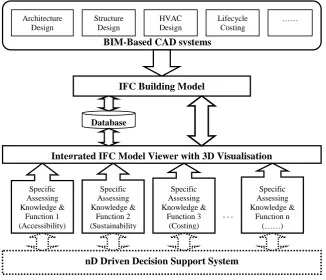
In the nD Modelling project, the IFC’s have been adopted as the specification of its data models. The flow chart in Fig. 1 shows integrated system architecture of the nD modelling tool. The nD modelling tool is designed to enable users to conduct multi-criteria evaluation, analysis and decision support.
Following the logic of Figure 1, the scenario of the nD modelling system can be portrayed as follows:
• Starting from the top of the diagram, multidisciplinary design information is generated by the various design teams using different BIM-based CAD systems. Thus, the CAD drawings should consist of building-component-oriented objects associated with 3D geometric information and relationships between these objects. As described earlier, these are the basic constituents of a BIM. An IFC model as a standard BIM actually inherits these types of information from the BIM-based CAD drawings. Therefore, in order to obtain proper IFC model files, CAD design drawings have to be produced in a BIM-based CAD.
• The next step is to convert the CAD drawings into IFC model files. Today, the major BIM-based architecture design CAD systems, such as Architecture Desktop produced by AutoDesk, Microstation produced by Bentley and ArchiCAD developed by Graphisoft, can
IFC Building Model
Integrated IFC Model Viewer with 3D Visualisation
Specific Assessing Knowledge & Function 1 (Accessibility) Specific Assessing Knowledge & Function 2 (Sustainability Specific Assessing Knowledge & Function 3 (Costing) Specific Assessing Knowledge & Function n (……)
nD Driven Decision Support System
…
DatabaseFig. 1 The architecture of nD Modelling Tool
Architecture Design Structure Design …… HVAC Design BIM-Based CAD systems
support the export of multiple versions of IFC files, especially the IFC 2.X version. Some CAD systems can even allow users to select different levels of detailed design information in CAD drawings to be exported to IFC files, such as the detail of doors and windows. Different levels of the detailed information will affect the file-sizes of IFC models.
• An IFC model viewer was developed as an integrated interface for the nD modelling tool to provide users with an interactive environment to browse an IFC model file and conduct nD assessment on an IFC model. Some of the processes or results of nD driven assessments can be visualised and simulated on this interface. The IFC viewer plays an important interface for users in relation to the information in an IFC model. It can enable users to easily retrieve information from an IFC file, and also visually reveal the information as 3D models, which can be easily understood by all parties involved in a project. This viewer consists of three major functions. Firstly it allows users to view all of the building components of an IFC file and some simplified and inherited links between these components. ‘Tree-view’ is the best form to present these components in an inherited structure. Secondly it visually reveal an IFC model. Virtual Reality Modelling Language (VRML) is used to represent an IFC model in 3D virtual reality world. The advantages of the VRML technique is that it allows users to interactively navigate a 3D model and conduct some interactive actions on any objects of a 3D VRML model. Finally it lists out all the attributes of a building component selected from either the tree-view or the 3D VRML window. In addition, the nD model tool may also use relational databases to permanently or temporally store a part of an IFC model or other additional information beyond an IFC model file, such as design criteria and relevant constraints.
• Based on the IFC compliant viewer, a limited number of assessing functions (sub-tools), which focus on various aspects and phases of building design, construction and facility management, were developed separately. Each sub-tool can only concentrate on assessment and analysis in one aspect of building design. The LCC tool developed here is a typical sub-tool of the nD modelling tool.
• The decision support system is a high-level intelligent, knowledge-based system, is proposed as an additional development of the nD modelling prototype. This should be able to synthesise the outcomes from the multi-aspects assessments, identify and structure the problems and conflicts among the assessed results, and finally produce a range of suggestions and options of the solutions to the decision-makers.
The Development of The Lifecycle Costing (LCC) Tool
This IFC-compliant LCC tool was an extension of previous research in LCC which was based on the platform of Architecture Desktop (ADT) version 2.0 and undertaken by the joint collaboration between the Robert Gordon University and the University of Salford (Aouad, et. al. 2001b). Key principles, algorithms and part of the data in the database of LLC used in this development are adopted from the previous research. These include a special database - Resource Database, which stores performance and cost data of difference types of building components. The calculating methods and algorithms of LCC are based on the principle of Building Cost Information System, (BCIS) (Bakis, et al. 2003). In the Resource database, each type of building component is linked to a number of cost options, which consist of the costs of material components, relevant constructing and maintaining activities and frequency of replacement. Besides the Resource Database, another Microsoft Access© database called “Project Database” was also used to store the information of
each individual building project. The “Project Database” contains the building project information, building elements information and relevant constructing options, which are specified in the LCC tool.
IFC specification, and additional operations, such as IFC object searching, changing, and creating (Adachi, 2002). Another auxiliary tool used in this development is the IFC-VRML converter developed by KLine Systems in Japan, which can convert an IFC file (.ifc) into a 3D VRML file (.wrl). Due to only the executive file provided, rather than API (Application Programming Interface) or SDK (Software Development Kit), this tool has to be run separately in the IFC viewer to generate a VRML file with a same file name. By using this tool, users can set some visual attributes to each type of physical building element, such as the level of the geometric detail, colours, transparent and lighting attributes. In addition, users can also select certain types of building components to be converted into a VRML file. Every object in the VRML file converted by this tool contains an IFC Global ID, which ensure the same identity of an object in both an IFC model file and its converted VRML model.
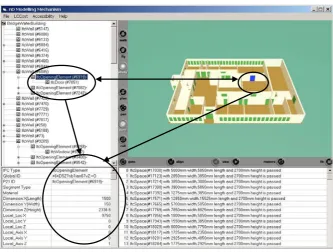
As described earlier, the nD Modelling prototype tool was designed to have an integrated IFC viewer, which can enable users to visually browse the building components and their attributes of an IFC model file. The multi-dimensions (aspects) assessment functions, of course including LCC, retrieve and reveal IFC data through this IFC viewer. This viewer as shown in Fig. 2 consists of three main parts – tree-view of building elements; the 3D VRML models, which provides the users an interactively visual environment to walk or fly through a building; the attribute list of a selected element from tree-view or VRML model. In addition, there is a table on the bottom-right of the window, which displays the results of nD evaluations. If one building component is selected in the tree-view window or the VRML window, it will be reflected (highlighted) in the other windows. For instance, once a door is selected in the VRML window, the door element will automatically be found and highlighted in the tree-view; and its attributes will be listed in the attribute table as well. This inter-connected function can help users to easily retrieve and understand the information in an IFC model.
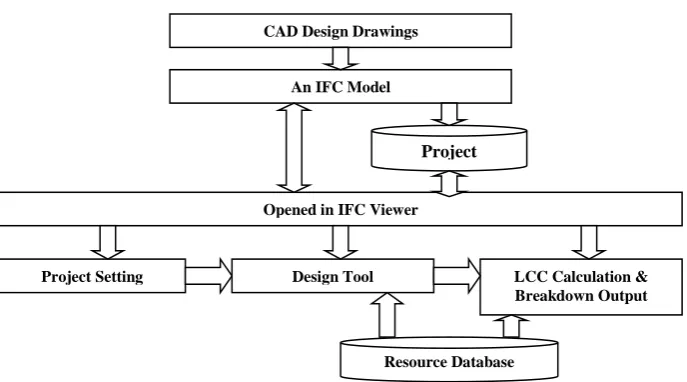
Fig. 3 shows the information flows of the LCC tool, which is consistent to the nD system architecture (Fig. 1). It illustrates the main function modules of the LCC tool and the information flows among these modules and the relevant databases.
The LCC tool based on the IFC viewer consists of three main LCC function modules. It starts from the “Project Setting” module, which will initially show the basic information of the building project inherited from CAD systems. These include Client Name, Building Name, Building Type and so on. Another important part in this module is that users have to specify the parameters of the “LCC Setting”, namely Distribute Code, Life Expectancy, Discount Rate. The second module is “Design Tool”, which provides users with an interactive environment to compare and assign different constructing options to each building component based on their cost performances. These options include a number of material components, relevant constructing or maintaining activities and the costs of these materials and activities, which are stored in the Resource Database. The third module is “LCC Calculation”, which can summarize the final costs and provides breakdown details of the costs of a building project throughout each year of the whole life expectancy defined by users in the “Project Setting”. After the “Project Setting”, users need to pick up a building component from the tree-view or the VRML model in the IFC viewer, and then activate the Design Tool in the LCC column in the menu. Then the “Design Tool” of the LCC tool lists out all the constructing options for the type of the selected building component from the Resource Database. Users can use the functions of the Design Tool to compare the different constructing options and make their final decision based on their lifecycle cost performances. The information of the settings and the final option of the constructing type selected for each building element are saved in the Project Database. After all of the components of a building are assigned with the better-chosen constructing types and materials, the LCC Calculation module can then work out the overall construction and maintenance costs of the building. In addition, the breakdown costs of each year throughout the life expectancy of the building can also be calculated and revealed in tables and cash-flow charts. The following sections illustrate and provide more details of the main interfaces of these modules.
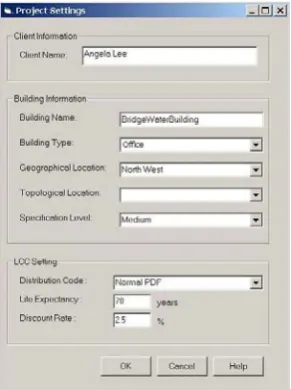
The initial inputs of Project Setting include (Fig. 4):
• The basic information about a building project such as Building Name, Building Type, Geographical Location, Specification Level, which should inherited from the initial design information, and can also be amend at here as well;
• Distribution Codes;
• Life Expectancy, which specify the duration of a building;
• Discount Rate, which is a crucial factor to the LCC calculation based on BCIS.
CAD Design Drawings
An IFC Model
Opened in IFC Viewer
Project Setting Design Tool LCC Calculation & Breakdown Output
Resource Database Project
The Design Tool is a central part of the LCC tool. It provide users with a number of options of materials and constructing techniques of each type of building components, and their cost performance over the years of their lifecycle (Fig. 5, Fig. 6, Fig. 7). This enables users to compare different options based on their cost performances and achieve the better decisions in term of lifecycle costs. Fig. 5 is the first interface of the “Design Tool” module. Once a building component is picked up from the IFC viewer, users have to choose a certain element of this building component. For instance, as shown in the element table in Fig. 5, there are two elements for an external wall – External Wall Element and Wall Finish Element. The “Statue” in the element table indicates whether the detailed information related this element has been specified in the Resource Database. After an element of a building component being selected, users have to go to the Select Type, which will give users a number of difference options of the constructing type.
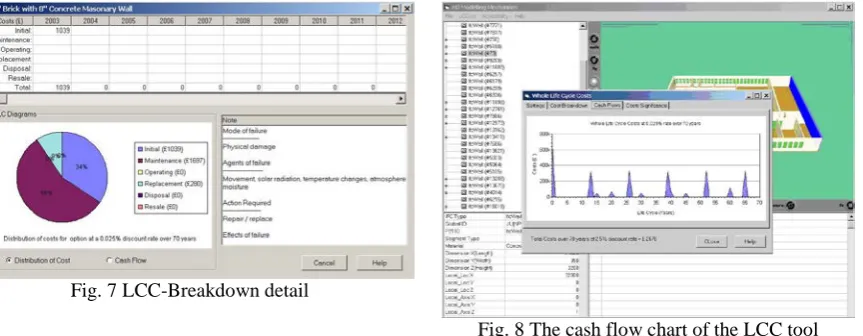
Fig. 6 shows the options of various constructing types and the linear chart of their costing performances. In the dialogue of this window, users can change some variables, such as discount rate, and analysis period. Once a variable changed, the cost performance linear chart changes instantly so that users can compare the cost performances of these constructing types under the difference circumstances. Moreover, users can also select one of these constructing types and click “View Detail” to see the breakdown details of the costs in each year (Fig. 7) and components of the costs. All these functions aim to provide users with more detailed information of the different
Fig. 4 LCC-Project Setting
Fig. 5 LCC-Setting Objects
constructing types, and enable users finally make the better decision on the constructing type for each building element.
Once all of the elements of a building have been assigned with the proper constructing types in the way described above, the overall costs of a building project throughout the whole lifecycle can then be worked out by this tool automatically and displayed in the breakdown table or the chart of cash flows (see Fig. 8) by simply selecting the LCC Calculation in the LCC menu. The relevant maintenance activities, which will be conducted in each year through the building lifecycle, are also be retrieved from this tool.
As a pilot study of the nD modelling research project, this prototype was demonstrated to a wide variety of stakeholders and experts in a number of national and international workshops to collate comments and assess the validity and usability of the tool. The advantages identified are as follows: Firstly, this IFC-based LCC tool demonstrates the interoperable delivery of building design information across different CAD systems. The tests proved that this LCC tool can take the IFC model files generated in different CAD systems, such as Autodesk Architecture Desktop, ArchiCAD and so on. And secondly, in comparison to other IFC-based developments, which rely on expensive commercial tools, such as IFC viewers and EDM (Express Data Manager) database, the development techniques adopted in this case are more practical and cost effective due to the easily accessible auxiliary tools, such as IFC ActiveX Component, and IFC-VRML converter and so on. This can not only reduce the cost of the IFC –based developments, but also promote the flexibility of the IFC-based development. Moreover, the feedback also addresses that the lack of real historical data of LCC collected from previous projects is still a major barrier to apply this tool in practice. It is also suggested that the selection of construction materials and techniques is not only determined by their costs, rather it is mostly determined by architectural and structural requirements. Thus, this necessitates that users should either possess relevant knowledge of architecture and structure design, or consult with architects or structure engineers before they make any changes.
Conclusions
This paper firstly has reviewed the importance of interoperability in lifecycle costing and identified the problematic areas in the utilisation of LCC. The nD modelling notion and technology have also been introduced as the foundations supporting this development. The integrated architecture of the nD modelling prototype is designed with the capability of interoperability through the application of IFC models to effectively inherit design information from various incompliant CAD systems, and the functionality of comprehensive assessments on multiple aspects of building design. It also shows that the IFC viewer of nD modelling plays an integrated interface to provide user with an interactive environment to browser details of an IFC model.
Fig. 7 LCC-Breakdown detail
The details of functions and interfaces of the LCC tool are introduced as a handy tool to enhance the LCC activities. It demonstrates the capability to handle the data collection and store of lifecycle costing, and the automatic calculation of lifecycle costs, which can also immediately react to any changes made by users. The applications of this tool will help to reduce exhausting manual works and improve the effective and efficiency of lifecycle costing. Moreover, the techniques and auxiliary tools, which are adopted in this development to deal with the IFC models, are presented as practical and more cost effective related to IFC-based developments. In conclusion, this paper suggests that the LCC tool can assist users to achieve better decisions of lifecycle costing based on a comprehensive comparison of all the possible options.
The future research and development of this LLC tool will look at the lifecycle costing of building service and energy consumption. This aims to provide a more comprehensive use in industrial applications. As such the energy consumption cost analysis will also be incorporated with the evaluation of energy efficiency in nD modelling prototype tool.
References
Adachi, Y. 2002: Overview of IFC Model Server Framework, The international conference of ECPPM 2002 – eWork and eBusiness in Architecture, Engineering and Construction, Sept. 9-11, Portoroz, Slovenia.
Akhlaghi, F. 1987: Life cycle costing – A tool for decision making, Facilities (8) 6, pp 4-10.
Aouad, G., Child, T., Marir, F., Brandon, P. 1997: Open Systems for Construction (OSCON) Draft Industrial Report, http://www.scpm.salford.ac.uk/siene/osconpdf.pdf, reviewed in 2003.
Aouad, G., Sun, M., Bakis, N., Swan, W. 2001a: Supporting Partners: Final Report of GalliCon project, http://www.scpm.salford.ac.uk/siene/gallicon.pdf, reviewed in 2003.
Aouad, G., Bakis, N., Amaratunga, D., Osbaldiston, S., & Sun, M. 2001b: An Integrated Life cycle Costing Database – A Conceptual Framework, the Proceedings of ARCON (Association of Construction Researchers Conference), School of Construction and Property Management, The University of Salford, UK. Pp. 421-432.
Bakis, N., Kagioglou, M., Aouad, G., Amaratunga, D. 2003: An Integrated Environment for Life Cycle Costing in Costruction, the 20th CIB W78 Conference on Information Technology in Construction, Auckland, New Zealand, 23-25 April 2003
Barrett, P. and Stanley C. 1999: Better Construction Briefing, UK: Blackwell Science.
Brandon, p. 1987: Life Cycle Appraisal – Further Considerations, in eds Alan Spedding, Building Maintenance and Management, London: E&FN Spon.
Chanter, B and Swallow, P. 1996: Building Maintenance Management, London: Blackwell Science.
CIOB 2002: Treasury Adjusts Discount Rate for Construction Costs and Benefits,
http://www.coibinternational.org/PAGES/Latestnews
Clift, M., and Bourke, K. 1999: Study on whole life costing, BRE Report, CRC.
Evans, R, Haryott, R, Haste, N and Jones, A 1998: The Long Term Costs of Owning and Using Buildings, London: Royal Academy of Engineering.
Faraj, I., Alshawi, M., Aouad, G., Child, T., Underwood, J. 2000: An Industry Foundation Classes Web-based Collaborative Construction Environment: WISPER”, Automation in Construction, Elsevier Science Publishers, vol 10, pp. 79–99.
Fischer M. and Kunz, J. 2004: The Scope and Role of Information Technology in Construction, CIFE, Stanford University.
Flanagan, R & Norman, G. 1984: Life Cycle Costing for Construction, London: Surveyors Publication.
IAI 2004: International Alliance for Interoperability Web Site, http://www.iai-international.org/, reviewed in 2004.
Koo, B. and Fischer, M. 2000: Feasibility Study of 4D CAD in Commercial Construction, Journal of Construction Engineering and Management, ASCE, 126(4), pp. 251-260.
Lee, A., Marshall-Ponting, A., Aouad G., Wu, S., Koh, I., Fu, C., Cooper, R., Betts, M., Kagioglou, M., Fischer, M. 2003: Developing a Vision of nD-Enabled Construction, UK: Construction IT Centre for Excellence.
Liston, M. K. and Fischer, M. 1998: Generating, evaluating and visualizing construction schedules with 4D-CAD tools, Automation in Construction, 7 (6) pp 433-447
Office of Government Commerce (OGC) 2003 Achieving Excellence in Construction – Procurement Guide 07: Whole-life costing and cost management, Crown.
Robinson, J. (1996) Plant and equipment acquisition: a life cycle costing case study, Facilities, 14(5/6), 21–5.
Stone, P.A. 1980: Building Design Evaluation: Costs-in-Use, 3rd Edn, London: E. & F.N. Spon.
Tanyer, A.M.; Aouad, G. 2004: "Moving beyond the Fourth Dimension with an IFC Based Single Project Database", Automation in Construction, Volume 14, Issue 1, January 2005, Pages 15-32.
University of Salford 2004: nD Modelling, Available at: <URL: