IMPLEMENTATION OF AN AVID ELEMENTARY PROGRAM IN A TECHNOLOGY-RICH ENVIRONMENT
by Molly J. Large
A dissertation
submitted in partial fulfillment of the requirements for the degree of Doctor of Education in Educational Technology
Boise State University
BOISE STATE UNIVERSITY GRADUATE COLLEGE
DEFENSE COMMITTEE AND FINAL READING APPROVALS
of the dissertation submitted by
Molly J. Large
Dissertation Title: Implementation of an AVID Elementary Program in a Technology- Rich Environment
Date of Final Oral Examination: 03 March 2017
The following individuals read and discussed the dissertation submitted by student Molly J. Large, and they evaluated her presentation and response to questions during the final oral examination. They found that the student passed the final oral examination.
Ross Perkins, Ph.D. Chair, Supervisory Committee Norm Friesen, Ph.D. Member, Supervisory Committee Chris Haskell, Ed.D. Member, Supervisory Committee
iv DEDICATION
To Cami - you provide the motivation to keep learning, innovating, and leading change in education.
To Keara and Tyler – I could not be more proud of the amazing adults you have become. I am forever grateful for your love and acceptance.
To Mom and Dad – despite all my odd choices in life, you never doubted in my abilities. I wish you could have seen this.
To all of my other moms and dads; Jerry and Janice, Lynne and Marlon, and Billie – your love and support bring joy to my life.
To Barb and Mark – in so many ways, we couldn’t be more different. But you have each served as an example, and helped me be a better person.
To my siblings, far and wide - I am blessed by having each and every one of you in my life.
v
ACKNOWLEDGEMENTS
I am beyond fortunate to work for and with the teachers at my site. Every day I learn something new about who I want to be and how I want to live my life. I am forever indebted to those who shared their experiences, their knowledge, and their classrooms with me.
My sincere appreciation goes to Dr. Ross Perkins for his guidance and support, particularly when accepting my dream job necessitated a change in my dissertation topic. I am also thankful for the support of Dr. Norm Friesen and Dr. Chris Haskell, who asked challenging questions that helped me to find my road map.
vi ABSTRACT
The purpose of this study was to explore the innovations that occurred as the AVID Elementary program was implemented in a technology-rich school environment and the ways in which those innovations were communicated and adopted across the school. It examined how the AVID Elementary program functioned at the site and how teachers developed technology-enabled alternatives to traditional AVID strategies and materials.
The primary question for this study was “How is AVID Elementary implemented in a technology-rich environment?” A qualitative ethnographic case study methodology was appropriate for this study, and the study was conducted through an ethnographic lens that explored the patterns and relationships that influenced the adoption and diffusion of AVID strategies and tools. With little research currently available about innovations to traditional AVID strategies to meet the needs of a technology-rich environment, this study addressed a gap in the literature and lead to further questions for study, and may provide guidance that may inform other sites as they integrate technology in the implementation of an AVID Elementary program.
vii
viii
TABLE OF CONTENTS
DEDICATION ... iv
ACKNOWLEDGEMENTS ...v
ABSTRACT ... vi
LIST OF TABLES ... xiii
CHAPTER ONE: INTRODUCTION ...1
Brief Overview of AVID ...3
Purpose and Justification for the Study ...4
Research Questions ...8
Summary ...9
CHAPTER TWO: REVIEW OF LITERATURE ...11
Introduction ...11
Advancement Via Individual Determination (AVID) ...11
History of AVID ...11
AVID Elementary ...13
AVID eBinders ...16
AVID Successes...16
Diffusion of Innovation...18
Innovation Implementation ...21
ix
Affordances of Web 2.0 Tools ...25
Digital Organization and Personal Information Management ...29
Summary ...31
CHAPTER THREE: CONTEXT ...33
School Profile...33
Technology ...36
Staff ...38
Introduction to AVID ...39
Policy Context ...39
Site Reaction ...40
CHAPTER FOUR: METHODOLOGY ...43
Qualitative Research Methodologies ...43
Design of the Study ...45
Theoretical Framework ...48
Goals of the Study ...50
Data Collection and Analysis...51
Data Analysis and Reporting ...57
Credibility and Reflexivity ...60
Summary ...64
CHAPTER FIVE: RESULTS AND DISCUSSION ...66
Overview ...66
AVID Summer Institute: Introduction to AVID Elementary ...67
x
Goal setting ...68
Following the Rules ...71
Resistance ...72
Context ...72
Frustration and Doubt ...74
Crisis: AVID Student Assessment Process ...75
Context ...75
Jumping Through Hoops...78
Compliance ...80
Analog Strategies in a Digital Environment ...82
Context ...82
Initial Self Study ...83
Stealing and Building ...87
Innovation and Adaptation Phase ...88
Context ...88
Ready for Risk-taking ...88
Getting Organized (Digitally) ...90
Student Collaboration ...92
Pushing Back ...93
Learning from Failure ...94
Going Public ...96
Next Steps ...99
xi
CHAPTER SIX: ANALYSIS ...102
Change and Teacher Agency ...104
Agency and Self-Efficacy ...106
Opinion Leadership ...107
Peer support ...109
Values compatibility ...110
External Change Agents ...112
Compatibility ...114
Complexity and Trialability ...115
Affordances of Technology Tools ...116
Observability ...117
Culture...118
Positionality ...120
Practical Implications and Recommendations for Further Study ...121
Conclusion ...123
CHAPTER SEVEN: REFLECTION ...126
Learning as a Leader ...127
Learning as a Researcher ...130
Conclusion ...132
REFERENCES ...133
APPENDIX A ...145
Grandview WICOR Walk Form ...145
xii
xiii
LIST OF TABLES
Table 3.1 Demographic data comparison (2014-2015 School Year) ... 34
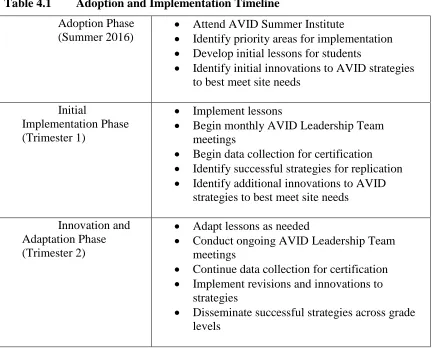
Table 4.1 Adoption and Implementation Timeline ... 48
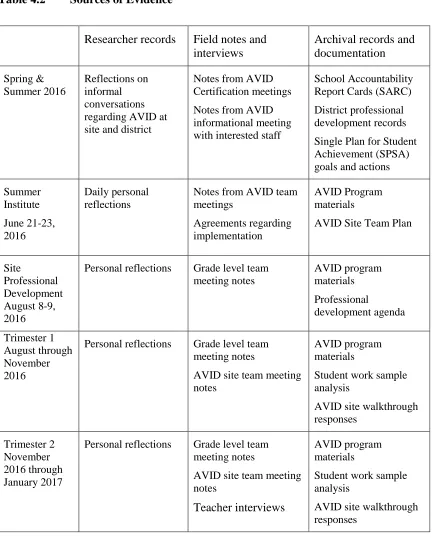
Table 4.2 Sources of Evidence ... 55
Table 4.3 Application of Ethnographic Best Practices ... 56
Table 4.4 Example of Theme Development ... 60
CHAPTER ONE: INTRODUCTION
Innovation in the classroom can never be just a question of implementing a recommendation derived from research. It is always a process of negotiation, involving the teacher's overall educational ideology, the learner's expectations and preferences and local constraints that determine what is feasible. (Ellis, 1990, p. 68).
In the fall of 2015, the Board of Education for the Liberty Unified School District1 acknowledged that Advancement Via Individual Determination (AVID) was a research-based program that was particularly well suited to the students in the district, noting that students enrolled in the AVID program at the high school level seemed to be more successful with college preparatory courses. At the middle school, AVID students were more likely to complete assignments and return homework. The Board directed all school sites to implement AVID in the coming school year, expanding the program into elementary schools. The district believed that students exposed to the AVID program in the elementary grades would develop and internalize the organization, note-taking and critical thinking skills necessary for rigorous high school courses. The superintendent notified elementary school principals that they would need to make arrangements to send teachers to an AVID Summer Institute in the summer of 2016, and the district allocated funds to support that mandate. At Grandview Elementary, several teachers immediately began to voice their concerns based on their understanding of the AVID program
according to experiences with their own children and their belief that AVID was incompatible with the site culture of technology integration (D. McCoy, personal communication, April 11, 2016). This study documents the journey taken by the school staff as they adapted and innovated within the implementation of the AVID Elementary program.
For the purposes of this study, innovation was defined as the generation of processes and products that are new to users (Birkinshaw, Hamel, & Mol, 2008; Rogers, 2003). Drucker (1998) suggested that opportunities for innovation can occur when there are incongruities between what exists and what is required, when an existing process is insufficient, and when new knowledge or changes in perception create a need for a different response. Innovation thus represents the ways in which people create new processes and objects to respond to changing conditions and address unmet needs (DeMaria, 2013). Therefore, the ways in which teachers generate strategies and tools to meet the broad goals of the AVID Elementary program while honoring existing
knowledge and systems represent innovations.
Grandview Elementary where the AVID Elementary program was implemented shaped the storyline for this study.
Brief Overview of AVID
Advancement Via Individual Determination (AVID) was developed by Mary Catherine Swanson in 1980 as a way to improve results for her underachieving students (Mathews, 2015). The original mission of the AVID program was to ensure that the least served students, those who had been receiving Bs and Cs, would succeed in a rigorous college preparatory path and increase their enrollment in four-year colleges (Swanson, 1989). The program historically serves students who are (a) economically disadvantaged, (b) ethnically underrepresented in colleges and universities, (c) generationally from homes in which they would be first in their family to go to college, and (d) currently enrolled in regular education classes (Mathews, 2015). AVID’s core model centers around an elective class at each high school grade; increasingly, however, AVID is seen as a school-wide endeavor (Watt, Powell, Mendiola, & Cossio, 2006). AVID encourages changes in school procedures and norms that support the goals of the program and extends beyond the sections of AVID electives to permeate throughout the school (Watt, Powell, Mendiola, and Cossio, 2006).
Traditionally, AVID has been focused on high school and to a certain extent, middle school. In the past decade, however, AVID programs have been expanding to elementary schools (Mathews, 2015). AVID Elementary focuses on specific
leadership, and (d) systems (AVID Center, n.d.a) and will be described in detail in Chapter 2. Consistent with their goal of improving college readiness and success, AVID includes organizational tools, strategies, and materials that have remained largely unchanged since the inception of the program in 1980. In today’s technology-rich classroom, classic AVID materials such as a three-inch binder and spiral notebooks for every subject seem redundant and anachronistic. Rogers (2003) argued that the
incompatibility with cultural values can block the adoption of an innovation; therefore, in schools and districts that have made substantial investments in technology and have shifted to a technology-enabled model of instruction, a requirement to use the traditional AVID materials may well predict that the AVID program will not be successful.
Purpose and Justification for the Study
implementation, the affordances of Web 2.0 tools are to be used by teachers to further the AVID goals of writing to learn, organization, and collaboration. Choi and Moon (2013) suggest there is an inherent advantage in studying the innovations that occur as users adopt and adapt particular programs. Therefore, this study will document the process, providing a detailed analysis of the steps taken, the challenges faced, and results obtained for both teachers and students. Conclusions from this study may serve to provide insight for schools that have technology-rich environments but are new to AVID, as well as for sites that are experienced with AVID but are just beginning to incorporate technology tools.
AVID has historically been fertile ground for study, focusing on the AVID program through the lens of leadership traits, characteristics of effective AVID elective teachers at high school, college readiness and college retention rates among AVID graduates, and perception studies of students, parents, and teachers (Huerta, Watt, & Reyes, 2013; Lozano, Watt, & Huerta, 2009; Mendiola, Watt, & Huerta, 2010; Watt, Huerta, & Alkan, 2011). As of the 2014 school year, there were 5,007 K-12 school sites implementing an AVID program, including 1,453 in California alone (AVID Center, 2016).
member was unaware of any published studies that address digital organization or elementary implementation of AVID (D. Piazza-Ramsey, personal communication, March 14, 2016). A search of the literature through the university library revealed dozens of studies done at the secondary and post-secondary levels on AVID programs, along with a small number that study middle school student success. The majority of studies have examined underserved high school student populations, particularly in California and Texas. A review of dissertations published in the ProQuest Dissertation and Thesis database found 1,049 dissertations that studied various components of the AVID program since 1991. Based on author keyword choices, none of the dissertations specifically addressed the AVID Elementary program or the role of technology in any AVID program.
Implementing an AVID Elementary program in a technology-rich environment may require staff to draw upon foundational research about AVID’s strategies, including Bandura’s social learning theory and Costa’s inquiry method and levels of questioning, in order to incorporate the affordances of Web 2.0 tools in a meaningful way. The AVID model provides opportunities for students to co-construct meaning, use academic language to develop their content knowledge, and write in a variety of ways to boost learning (AVID Center, 2016). Consistent with the Common Core State Standards and the STEM focus of the school site, technology tools may provide further opportunities for students to write to authentic audiences, such as their peers, their school community, and members of other social groups. Teachers may foster academic discourse in the
Johansson (2006) suggested that opportunities for innovation occur when different fields, knowledge, and cultures intersect. As the AVID Elementary program intersects with existing technology tools and skills at the site, teachers may be able to develop innovations that meet the AVID Elementary foundational goals in novel ways. Using diffusion of innovation theory (Rogers, 2003) as a theoretical model, this study explored the ways in which the adapted components of the AVID Elementary program were communicated and adopted throughout the site. De Jong, Marston, and Roth (2015) claimed that innovations consist of actions that occur within a specific context or model. Therefore, this study framed a description of innovations within the context of a
technology-rich school site.
While Rogers (2003) indicated that an innovation is a process or product
considered new by the user, new combinations of ideas and practices that occur when two established fields intersect are also considered innovations (Johansson, 2006). In this case, the AVID Elementary program is mandated by the district. The ways in which the tools are adopted and reinvented to match the technology-rich context of the school site can be considered innovations for all the staff at the school. Communication channels were described in detail within the context of the study, using relevant data from field observations of professional development, team meetings, and classroom
This study used a qualitative case study methodology to examine the context and conditions related to the implementation of an AVID Elementary program and the ways in which digital tools were integrated in a manner consistent with AVID philosophy and strategies. Although not all schools have one-to-one technology programs in place before implementing AVID Elementary, it is not unique. This study explored a case of a
technology-rich school in a predominantly socio-economically disadvantaged urban and suburban area, implementing an AVID Elementary program in a manner that capitalized on the technology already in place. Context is a major component of a case study
(Creswell, 2012). Therefore, this study examined the system as a whole in order to best understand the ways in which the AVID program components and the technology integration strategies in place at the site overlapped, meshed, or resulted in a disconnect between the two for implementing teachers.
Research Questions
This study focused on the diffusion and implementation of AVID strategies and materials in a technology-rich environment. It explored the complexities associated with implementing a program conceived before technology was readily available in a school in which technology integration was a cornerstone of the school’s culture and identity. The primary research question to be addressed was as follows:
1. How does AVID Elementary get implemented in a technology rich environment? In answering the primary research question, the following sub-questions were also explored:
What were the challenges encountered as teachers adapted and/or reinvented the traditional AVID materials and strategies?
In what ways did teacher perceptions of AVID and of technology change during the implementation process?
Summary
This qualitative case study addressed a gap in the literature regarding the implementation process of a school-wide AVID Elementary program. In addition, it explored the innovations that occur when traditional AVID strategies and methodologies are adapted and implemented in a technology-rich environment. The history of and research behind AVID, models of technology integration, and affordances of various tools will be examined in Chapter 2 through the lens of diffusion of innovation model. In Chapter 3, a “detailed rendering” (Creswell, 2012, p. 472) of the school history, culture, and stakeholders will deliver a context for this study.
CHAPTER TWO: REVIEW OF LITERATURE Introduction
This chapter begins with an overview of the AVID Elementary program, as that serves as a critical foundation for the context of the case. Next, the review of literature explores diffusion of innovation theory (Rogers, 2003) and innovation implementation theory (Klein & Sorra, 1996) to frame the innovations that were expected to occur in the process of implementing the AVID Elementary program. As data was collected and analyzed in the study, Rogers’ theories of perceived attributes and Klein and Sorra’s values-fit proposition provided a structure to examine ways in which the AVID Elementary program components were adapted and then adopted at the site. Teacher agency and self-efficacy were explored in terms of their impact on the ways in which teachers embrace or fail to embrace new programs. Finally, affordances of Web 2.0 tools were addressed. The choices that teachers made about how to adapt to the traditional components of the AVID Elementary program were based upon their perceptions of the affordances of various Web 2.0 tools to meet both program and academic goals.
Advancement Via Individual Determination (AVID)
History of AVID
requirements before they graduated (Mathews, 2015). According to founder Mary Catherine Swanson (2000),
AVID pedagogy emphasizes methodologies that empower students to take responsibility for their own learning. AVID coaches students to develop the academic and interpersonal skills that allow them to take rigorous college prep courses. By developing their "perceived confidence" through their involvement in AVID, students' lives are changed dramatically by new opportunities available to them. (p. 26)
The AVID program was adopted by the San Diego County Office of Education in 1986 and began to be disseminated throughout the county (AVID Center, n.d. a). In 1989, the program expanded into Riverside County and began providing summer professional development institutes for teachers. The AVID program incorporated as a nonprofit in 1992 as the AVID Center. Throughout the 1990s, the focus of AVID was on high school students in the academic middle (students who typically earn Bs and Cs) and who lack college-going models at home. Swanson (2000) described these students as having college potential but also as lacking the support required to be successful in challenging courses. She promoted the belief that these underrepresented students could be successful in college preparatory courses with support to strengthen their academic skills and
interpersonal relationships. The AVID curriculum provides students with a framework for writing, organization, and collaboration (Mathews, 2015).
As the research on the success of the AVID program for high school students accumulated, the program began to be implemented in middle schools and elementary schools (Gira, 2004). According to Ward (2008), the strategies used by the AVID elective class tend to diffuse throughout the school in the form of Cornell notes, Socratic
fourth and fifth grade were better able to focus on college preparatory skills in middle school and advanced placement courses in high school. Based on studies demonstrating the effects of AVID programs on advanced placement (AP) and honors class participation and on significantly increased college-going rates for AVID participants, the state of California began to fund AVID professional development and support in 1996 (AVID Center, n.d.a.; Matthews, 2015; Swanson, 2000). In addition, AVID programs were able to access grant monies through expanded partnerships with the College Board, based on their reputation for increasing participation in AP courses and encouraging students to take the SAT for college admission (Mathews, 2015).
AVID Elementary
In 1999, a desire for a smooth transition from elementary to secondary education prompted initial explorations of modified AVID strategies for upper elementary students (McAndrews, 2006). A pilot took place in 2002, the first training for upper elementary teachers began in 2006, and AVID Elementary was officially launched in 2007 (AVID Center, n.d. a; Mathews, 2015). According to the AVID Center, AVID Elementary is a foundational component of the AVID College Readiness System that “focuses on specific AVID Essentials to ensure quality and consistency as a transformational system” (AVID Center, n.d. a, para. 1). AVID Elementary is designed for self-contained, multi-subject classrooms to provide a foundation for the AVID College Readiness System as
readiness gap through strategies embedded into daily instruction of all classrooms at designated grade levels (AVID Center, n.d.b)
According to AVID Elementary (n.d.b), the implementation of AVID Elementary is centered on the philosophy that students can be taught a growth mindset, which will allow them to succeed academically and fulfill their aspirations. This foundational program was initially offered for fourth- through sixth-grade students in self-contained, multi-subject classrooms that fed into AVID elective programs at both the middle and high school levels. The AVID Elementary program has four Essentials, or areas of focus: (1) instruction using WICOR, which stands for writing to learn, inquiry, collaboration, organization, and reading to learn across content areas; (2) a school-wide culture of college readiness; (3) leadership that supports and facilitates AVID implementation; and (4) systems that utilize accountability, assessment, and calibration to ensure
implementation with fidelity across the grade levels (AVID Center, n.d.b). These Essentials represent the elements that AVID considers important and are the areas in which schools are required to rate themselves as part of the AVID certification process.
three-column notes, Cornell notes, dialectical journals, and peer editing. Inquiry and collaboration strategies encouraged by AVID practitioners include Socratic dialogue, carousel brainstorming, concept mapping, and the use of student consultants.
Organization strategies typically revolve around a three-ring binder, with a specific set of tabs and materials. Although there is no specific required model for each of these
elements, AVID Elementary site teams must determine the ways in which each element will be addressed at each grade level (AVID Center, n.d.b). Grade level teams then adapt the strategies in a way that they feel is most appropriate for their students, taking
advantage of the technology they have available to them at their grade level. In this study, the 16 teachers in attendance at the AVID Summer Institute collaborated to determine two areas of focus for the first implementation year: (a) writing to learn and (b) reading to learn.
Student success skills, as defined by AVID, include skills in communication, self-advocacy, time management, goal setting, and assessment. Heavily influenced by
Bandura’s Social Cognitive Theory (Bandura, 1986), the AVID Elementary program includes specific instruction for students in the use of observation, imitation, and
modeling as strategies to learn from one another. Consistent with Bandura’s work on self-efficacy (1986), the AVID Elementary program includes models for student goal setting, reflection, and peer coaching. In addition, specific lessons in developing a growth
mindset and building interpersonal relationships are considered hallmarks of effective implementation (Dweck, 2006).
Organizational skills, as implemented in the AVID program, include time
and thinking to perform the process itself, must be explicitly taught and the practice embedded in instruction. In AVID materials, Costa’s levels of questioning are part of baseline instruction, helping students to understand the different levels of intellectual functioning inherent in questions of what, how, and why (Costa, 1985).
AVID eBinders
In 2013, AVID Center identified a need to create a digital model of their organizational tool, the classic three-inch, three-ring binder. According to the AVID Center guidance on implementing digital organizational tools (2015), an eBinder is a “collection of apps that work together to organize digital notes, class documents, assignments, and events in order to maximize accessibility and collaboration” (p. 8). There is no guidance regarding the specific tools to be used; rather, the eBinder planning document recommends that sites select a technology tool that best reflects site technology tools already in place. A search of the literature reveals no studies on the effectiveness of eBinders as an alternative tool for student organization. However, Clark’s (2012) findings of no significant difference in the learning benefits between the uses of any particular medium might suggest that an eBinder approach is simply a substitution and would have little or no effect on student outcomes.
AVID Successes
enroll in college, in numbers exceeding local and national averages. Moreover, the authors found that 89% of AVID graduates were still enrolled in college after two years. While Farkas (1997) noted empirical issues with the attrition rates and the lack of adjustment for control variables in the Mehan study, it is nonetheless listed in AVID literature as evidence of program success (AVID Center, 2016). In July 2006, the United States House of Representatives acknowledged the success of the AVID program with Resolution 576, which noted that AVID “has provided academic and motivational support that has enabled more than 95% of the over 257,000 underperforming students who have been in its program to go on to college” (H. Res. 576, 2006, Paragraph 1).
In a controlled study of high school seniors, Lozano, Watt, and Huerta (2009) found that there were significant differences in college anticipations (expectations of level of higher education degree) between students in the AVID program and the general population of high school students. Students enrolled in a high school AVID elective are significantly more likely to take AP courses, higher level mathematics courses, and courses that provided college credit than their non-AVID peers (Watt, Huerta, & Lozano, 2007). Parker, Eliot, and Tart (2013) reported that the nine African American college students in their case study felt AVID had increased their interest in education in general and college specifically, while also providing the necessary note-taking skills to
Since 1991, more than 1,000 authors of doctoral dissertations have studied the impact and outcomes of AVID programs in the high school, middle school, and community college setting with mixed results. Contributing to the literature on the relationship between AVID participation and college preparation, Hodges (2013) found that students who received instruction in AVID methodologies had statistically
significant greater mathematics achievement on Algebra end-of-course exams. AVID students had significantly higher grades than their non-AVID counterparts when pre-program academic achievement was controlled for (Bailey, 2002). Pugh (2015) found positive correlations between AVID and attendance. However, he found that AVID participation was only positively correlated with grade point average for one subgroup (African American students) in his study.
Diffusion of Innovation
The process by which an innovation is diffused throughout a community is influenced by four major factors: (a) what the innovation is, (b) how information about the innovation is communicated, (c) time, and (d) the community into which the innovation is being
introduced (Rogers, 2003).
Although much diffusion of innovation research has addressed the ways in which individuals progress through the process of adopting an innovation, the theory has worked for organizational adoptions as well. According to Rogers (2003), an
organization is a group of individuals who work together on common goals. In some cases, organizations make decisions about innovations to adopt based on input from a small number of individuals with influence, power, or expertise about the innovation. This process, called “authority innovation-decisions” by Rogers (2003), takes the initiation phase out of the diffusion process. Instead, the diffusion of innovation in the organization becomes a study of implementation. School districts and schools can be considered organizations, and within each, there are a number of “authority innovation-decisions” (Rogers, 2003, p.28), in which a small number of individuals with power or expertise make choices about materials or programs to adopt. However, within that decision model, teachers retain the authority to make decisions about what pedagogies to use and what technologies to integrate based on their perceptions of usefulness.
implementation process. Rather, it was used as an interpretive lens to examine the many decisions individuals and teams made as they developed, implemented, and adapted innovations to address program requirements, using the technology tools and resources available to them at the school site to best meet the needs of their students. As discussed in Chapter 5, teachers determined which tools and strategies of the AVID Elementary program to prioritize and which to adapt or reinvent to take advantage of the technology resources and skills at the school site.
Referencing his theory of perceived attributes, Rogers (2003) stated that an innovation’s attributes in terms of trialability, observability, relative advantage, complexity, and compatibility will influence the rate of diffusion of that innovation. Trialability is the degree to which users can test an innovation by implementing it on a small scale. Observability refers to how visible the results of an innovation are to others. Relative advantage is the degree to which an innovation is perceived as an improvement over the current practice or model. Complexity is the perception of how difficult an innovation is to implement. Compatibility refers to the perception of whether an
innovation is consistent with the adopter’s existing values, beliefs, and past experiences (Rogers, 2003). Surry (1997) remarked that sociological and interpersonal factors often play a significant role in the adoption of an innovation, as well.
implementers; adopters make policy decisions about an innovation, whereas
implementers are those who must apply the innovation in their practice. Adopters may or may not be implementers and vice versa. This disconnect between decision-makers and implementers may lead to a reinvention of the innovation.
Reinvention within the diffusion of an innovation refers to the morphing that takes place as the innovation diffuses within a social system and is adopted by users (Rogers, 2003). Reinvention occurs for a variety of reasons, including the
unpredictability of how the original innovation performs when put to use by an individual or organization. Rogers (2003) underscores the malleability of innovation when he stated the following:
Instead of simply accepting or rejecting an innovation as a fixed idea, potential adopters on many occasions are active participants in the adoption and diffusions process, struggling to give their own unique meaning to the innovation as it is applied in their local context. Adoption of an innovation is thus a process of social construction. (p. 179)
Reinvention involves “diverse forms of deletion, addition, and/or alterations in the design, features, and functions of the innovation,” which occur as new programs are implemented (Choi & Moon, 2013, p. 292). As new ideas and existing knowledge intersect, reinvention creates new products and innovations that may be better suited to the prevailing culture (Johansson, 2006). These innovations then must be disseminated throughout the organization and implemented in a systematic way for the innovations truly to be considered as adopted by an organization.
Innovation Implementation
innovations rarely go as planned, and users tend to adapt and adopt new innovations to best meet their needs. According to Klein and Sorra (1996), innovation implementation is the “process of gaining targeted employees' appropriate and committed use of an
innovation” (p. 1055). They further define implementation as “the critical gateway between the decision to adopt the innovation and the routine use of the innovation within an organization” (p. 1057). The model of innovation implementation rests on an
assumption of authority innovation-decision (Rogers, 2003) and explains the ways in which individuals in an organization implement or fail to implement a given innovation. Klein and Sorra (1996) posited that implementation is a function of the organization’s climate regarding a particular innovation and the perceptions of organization members’ regarding the ways in which the given innovation fits with their values. Dong, Neufeld, and Higgins (2008) concluded that implementations are more likely to be successful when both climate of implementation and values-fit are strong.
In the innovation implementation model, climate refers to the structures in place institutionally to support innovation and the perceptions that group members have of those structures (Klein & Sorra, 1996). A strong climate is one that supports,
incentivizes, and holds members accountable for the innovation (Jacobs, Weiner, Reeve, Hofmann, & Christian, 2015). Choi and Moon (2013) identified three factors contributing to a strong implementation climate: (a) providing professional development, (b) the use of incentives and disincentives, and (c) removing obstacles around the use of the innovation.
implementation of innovations (Klein & Sorra, 1996). Klein and Sorra indicated that group values represent commonly shared beliefs about what is important to the
organization, how the organization should be perceived, and how the organization should function.
Top-down decision-making is common in American public schools (Spain, 2016). Decisions are handed down, sometimes with little regard for the teachers’ context, which typically has its own well-defined sets of norms and practices (Scheerens, 2012). In the case of AVID Elementary at the site being studied, teachers’ perception that a required element of AVID Elementary was a 3-ring binder caused initial strong resistance, since such an implementation was at odds with their values. An implementation model that allowed for adaptation and reinvention was required in order to ensure that the values-fit was strong. Support in the form of time, funding, and a commitment to ongoing
professional development represent a strong climate for implementation of innovations. Agency and Self-Efficacy
teachers “to be the kind of teacher they wanted to be” (p. 714). Agency is thus the autonomous action that self-efficacy enables.
Teachers come to the profession with a wide range of knowledge and aptitudes and develop further as they progress through their teaching career (Buxton et al., 2015). Teachers with greater professional knowledge and skills are more likely to evidence agency (Biesta, Priestley, & Robinson, 2015). These more-experienced teachers are more likely to engage in experimentation and activism as they explore new strategies and share with their peers (Buchanan, 2015). Peer learning and peer communication are strongly related to teacher agency (Bridwell-Mitchell, 2015). Teachers routinely compare their practices with those of others and receive feedback that influences their instruction. As Priestly (2012) noted, agency is also strongly connected to context and is frequently transactional as teachers work within their social constructs. Bandura (2000) found that collective efficacy, that is, the belief in a group’s ability to effect change, creates a much stronger force in terms of motivation, perseverance, and ultimately accomplishments.
agency can be a foundation of change as teachers interpret and adapt a given model or reform. Bower and Parsons (2016) further suggested that alignment with teacher
perceptions, beliefs and values is necessary for the successful adoption of even mandated programs.
Affordances of Web 2.0 Tools
Although teachers at the site currently integrate technology into many aspects of teaching and learning, a careful analysis of the affordances of various tools was required in order to effectively adapt the AVID curriculum in a way that was faithful to the intent of the strategies. Teachers approached this task in a variety of ways, sometimes
innovating individually and sometimes working with their peers to identify a tool with the best affordances for a given task. As they developed innovations to the AVID Elementary program, individual teachers and grade level teams were informed by their knowledge of the affordances of Web 2.0 tools and influenced by their exposure to and knowledge of particular applications, websites, and tools. Web 2.0 activities should be designed with specific goals that are meaningful to the group, using tools that have the most appropriate set of affordances for the activity (Hsu, Ching, & Grabowski, 2014). Stahl, Koschmann, and Suthers (2006) suggested that technology tools cannot by themselves define practice but are only relevant based on the ways in which such tools are used by learners to make meaning. Thus, Web 2.0 tools might be used to provide a context for demonstration of understanding and a purpose for using new content and vocabulary. Brown, Collins, and Duguid (1989) suggested that knowledge is a product of the activity in which it is produced. Specifically, they claimed that a concept “will
and activities inevitably recast it in a new, more densely textured form” (p. 33). Blogging, microblogging, and discussion forums all have the potential to create a situated learning environment in which students can develop understanding through ongoing interaction with the concepts and with their peers.
The AVID Elementary program emphasizes social learning as a critical
component of quality instruction (AVID Center, n.d.a). Web 2.0 tools, by their nature, “value the participatory culture, to emphasize collaborative learning and peer to peer interaction, to promote active participation and interactive multi-way communication, and to engage learners in knowledge creation activities” (Ching & Hsu, 2011, p. 794). Dohn (2009) also noted that participation, production, dialogue, and collaboration are inherent in Web 2.0 tools, which are believed to be effective tools for fostering active engagement and collaboration in the learning process. Blogs, for example, have the potential to be both interactive and collaborative through the use of hyperlinked media or through content and comments from and with readers of the blog (Ducate & Lomicka, 2008).
Hsu, Ching, and Grabowski (2014) identified three characteristics of
technological use of tools that constitute effective uses. First, the tool must allow users to build on each other’s work as they create products together. Second, it must allow users to easily exchange ideas throughout the process. Third, the tool must strengthen
technology tools, in addition to evaluating growth in student content knowledge and academic skills.
According to Hsu, Ching, and Grabowski (2014), blogs have demonstrated their worth as effective Web 2.0 applications for publishing and sharing learning progress and achievement, for supporting collaborative tasks, and for building authentic communities of practice in a meaningful context. In addition, they found that microblogs, such as Twitter, are effective for communicating ideas and disseminating products. According to McGrail and Davis (2011), “academic blogging provides a space for modeling and developing the literacy processes, critical thinking, reflection, questioning, and social practices engendered by this communicative technology” (p. 416). Students must use language to their benefit, connecting with the culture of their audience through
appropriate vocabulary, voice, and linguistic complexity. Miceli, Murray, and Kennedy (2010) found that teacher voice was a critical element in students’ respectful interaction; the AVID Elementary program includes a Socratic dialogue protocol which teachers use to explicitly model reflection, questioning, and social practices in teaching these skills to students. The consistent use of a common protocol ensures that all students will have multiple opportunities to apply these skills in a variety of situations, with expectations at different times for short or long responses, responses to single posts or synthesis of two or more posts, and responses that provide encouragement or constructive criticism.
to learn. Ducate and Lomicka (2008) suggested that reading and writing online are often collaborative activities, whereby students are able to participate both socially and
academically. Student collaboration can occur during many phases of writing
development, according to the teacher’s instructional emphasis (Baker et al., 2014). For example, students might use small group dialogue to discuss key points of the content, collaborate as a whole class to develop a pre-writing graphic organizer, or conduct peer-editing and commenting on each other’s drafts as ways to improve their written language outputs. Consistent with Stahl, Koschmann, and Suthers’ (2006) recommendations for further research, teachers will utilize technologies that are fundamentally social and contain built-in affordances “to mediate and encourage social acts that constitute group learning and lead to individual learning” (p. 421). Many technology tools with social learning capabilities are already in use at the school site. However, such tools are not necessarily being used in a way that takes greatest advantage of their affordances.
Web 2.0 tools have the potential to "bring learners together" and support academic meaning-making activities in conjunction with social interaction (Stahl, Koschmann, & Suthers, 2006). Ducate and Lomicka (2008) described social networked learning as taking place “with and in a community” (p. 9), underscoring that it is a concept that teachers tend to want to foster, whether in an online environment or face to face. Teachers might foster that sense of community through the supports for
collaboration built into Web 2.0 tools, such as embedded email, chat or instant
to take full advantage of the “participatory, interactive, collaborative and social aspects” (Ching & Hsu, 2011, p. 782) of Web 2.0 tools and leverage the use of such tools to improve learning outcomes. By using digital tools such as blogging, microblogging focused on collaborative annotation, peer editing, and discussion forums, students will engage with content and concepts in a situated learning environment that provides social networking and peer collaboration opportunities.
Digital Organization and Personal Information Management
Teaching students to effectively manage information is one of the core elements of the AVID program (AVID Center, 2016). There is increasing redundancy and
duplication of information as mobile devices allow users to capture analog information and store it in a digital format for easier retrieval (Jones, 2012). As the amount of information available grows, it becomes increasingly important to have strategies to manage digital information items (Park, 2011). Jones (2007) described information items as documents, files, webpages and/or messages “in a persistent form that can be created, stored, moved, given a name and other properties, copied, distributed, deleted,
transformed, and so forth” (p. 461). Cabanac, Chevalier, Chrisment, and Julien (2010) suggested that the ability to find information in one’s personal information management space is a key to successful knowledge work. A personal information management process is one in which users find, keep, and manage information in organized folders and subfolders which reflect the association of ideas and topics in a hierarchical manner (Jones, 2007).
Chrisment, & Julien, 2010). In order for a user to be productive, the organization of information must be logical, hierarchical and multi-layered, with a clear definition and purpose of each label (Jones, 2007). Khoo et al. (2007) described two types of folder organizational structures: broad tree structures with a large number of folders at the top level and few sub-folders nestled within each folder; and deep tree structures with a small number of top-level folders containing many layers of sub-folders within each. Broad tree structures provide faster access to folders but increase the time needed to scan for
particular files, while deep tree structures allow faster scanning of each folder but may require more clicks to reach the desired file (Bergman, Whittaker, Sanderson, Nachmias, & Ramamoorthy, 2010).
In early studies of computer users, Barreau and Nardi (1995) found that the majority of people preferred to search for information using hierarchical folder searching, using naming cues to guess which folder a file is in, then browsing the information in the folder, and repeating the process if the desired file isn’t located. More recent studies confirmed the preference for location searching, with the added strategy of using the sorting features of the software or platform in order to more quickly locate files and information (Khoo, Luyt, Ee, Osman, Lim, & Yong, 2007). Clearly labeled folders for inactive files were found to help reduce visual clutter and made it easier for users to find the file they were seeking (Bergman, Beyth-Marom, & Nachmias, 2008). Naming conventions that incorporate topic, time and/or people also play a crucial role in a user’s ability to find information within their own personal information space (Park, 2011).
information management. Students rarely manage and archive their digital information as a planned or regular activity, and have limited knowledge of strategies and processes that would allow for efficient curation of their files. They wrote:
“Digital information, unlike analogue information stored on traditional media, depends on technology that makes it accessible and usable. And since every new technology can create new problems or new issues, students... need to be aware of all the issues that ensure long-term preservation and long-term access to their digital data and documents.” (Krtalić, Marčetić, and Mičunović, 2016. Conclusion Para. 5)
Summary
The Advancement Via Individual Determination (AVID) program is one that is based upon the belief that organization, note-taking, critical reading, and inquiry skills are requisite skills for success in college courses. To meet these needs, the program provides a set of scaffolds for students in the areas of writing, inquiry, collaboration, organization, and reading. Its incorporation into elementary schools such as Grandview is based upon the hypothesis that teaching these skills to students earlier in their educational career will result in increased opportunities for success. Both Rogers’ (2003) theories of perceived attributes and Klein and Sorra’s (1996) values-fit proposition provide a structure by which to examine ways in which program components were implemented, adapted and adopted at the site. As innovations were implemented, their diffusion across the site was influenced by their perceived attributes of complexity, trialability, and observability. Further, their compatibility with site cultural values influenced implementation, adaptation, and adoption.
(Buchanan, 2015). Externally imposed events such as mandates and accountability policies frequently impact both teacher self-efficacy and teacher agency (Priestley, Edwards, Priestley, & Miller, 2012). The ways in which teachers respond to mandates and new program adoptions such as AVID Elementary is related to their sense of agency as they interpret, adapt and communicate with one another about the program (Bridwell-Mitchell, 2015).
Technology tools cannot by themselves define practice but are only relevant based on the ways in which such tools are used by learners (Stahl, Koschmann, &
Suthers, 2006). Affordances of technology tools are an inherent part of their functionality such as those found in specific types of Web 2.0 tools. It is imperative that technology tools were identified and selected based on their affordances and values-fit for site culture (Rogers, 2003), while ensuring consistency with the goals of the AVID Elementary program. Digital organization and personal information management can support the needs of those implementing a program that formerly required paper-based accounting of student work (Jones, 2007; Park, 2011).
Taken together, the components found in this literature review lay the
CHAPTER THREE: CONTEXT
A critical requirement of case study research is a thorough grasp of the case (Creswell, 2012). Further, ethnographic methods mandate sufficient description to be able to deeply understand the perspectives of participants (Schensul, Schensul, &
LeCompte, 2013). This chapter provides a detailed demographic description of the school along with a brief history as relevant to this study. A description of the technology in place and vignettes that illustrate the ways in which technology was used are provided in order to create the sense of place called for in ethnographic research (Bhatti, 2012). It further situates the study within the policy context of the time, providing a foundation for the research questions and goals of the study.
School Profile
Liberty Unified School District is located in the western United States,
approximately 70 miles east of a major metropolitan area. During the 2014-15 school year, the district’s schools served more than 19,000 students residing in rural and suburban communities of two cities and the unincorporated area between them. The district currently operates twelve elementary schools, four middle schools, three comprehensive high schools, a virtual academy, and a continuation high school.
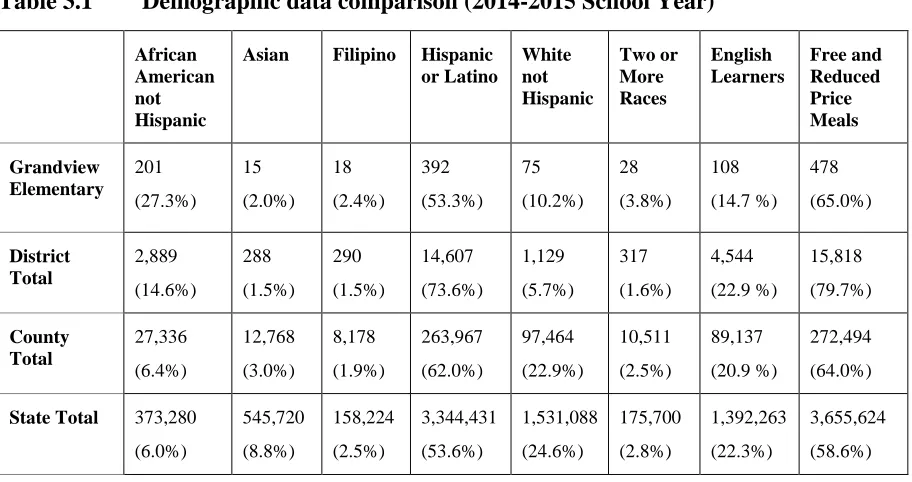
English learners (15%) is slightly lower than the state average of 22%, and the 65% qualifying for free or reduced-price meals is higher than the state average of 59%. Table 3.1 below illustrates student demographic data for Grandview Elementary as compared to the district, county, and state. For the past seven years Grandview Elementary has been on a trajectory of increased enrollment from both inter- and intra-district transfers. The school has been recognized with numerous local, state and federal awards for its academic achievement and innovative programs.
Table 3.1 Demographic data comparison (2014-2015 School Year)
African American not Hispanic
Asian Filipino Hispanic or Latino White not Hispanic Two or More Races English Learners Free and Reduced Price Meals Grandview Elementary 201 (27.3%) 15 (2.0%) 18 (2.4%) 392 (53.3%) 75 (10.2%) 28 (3.8%) 108 (14.7 %) 478 (65.0%) District Total 2,889 (14.6%) 288 (1.5%) 290 (1.5%) 14,607 (73.6%) 1,129 (5.7%) 317 (1.6%) 4,544 (22.9 %) 15,818 (79.7%) County Total 27,336 (6.4%) 12,768 (3.0%) 8,178 (1.9%) 263,967 (62.0%) 97,464 (22.9%) 10,511 (2.5%) 89,137 (20.9 %) 272,494 (64.0%)
State Total 373,280
(6.0%) 545,720 (8.8%) 158,224 (2.5%) 3,344,431 (53.6%) 1,531,088 (24.6%) 175,700 (2.8%) 1,392,263 (22.3%) 3,655,624 (58.6%)
In 2010, Liberty Unified School District gave Grandview Elementary the
high-quality STEM program. Additionally, the principal encouraged staff members to present at a wide variety of professional education conferences, often with students as
co-presenters or aides.
Today, teachers design lessons based on the state-adopted Common Core State Standards (CCSS) for math and English language arts and state-adopted Next Generation Science Standards (NGSS) in interdisciplinary units to create a pathway of STEM
learning experiences. By aligning literacy skills with science and engineering concepts, Grandview teachers ensure that all students read rigorous scientific works, write
informational text and presentations, and generate products that show a mastery of scientific content knowledge and skills. Since 2011, Grandview has recorded among the highest science CST scores in Oak Valley County. In every year since 2011, more than 70% of Grandview fifth graders have scored at proficient or advanced levels on the California State Test (CST) for Science, compared to a statewide average of 55%. In 2015, despite an influx of new students who had not participated in a STEM model prior to arriving at Grandview, only 6% of students scored Far Below Basic, compared to an average of 17% across the county.
I was hired as principal of Grandview mid-year of 2015 to replace a principal who had accepted a promotion to the district office. I quickly became aware of the sense of self-efficacy among the majority of staff. Teachers and classified staff informed me repeatedly that there was a “Grandview way,” which was perceived by staff as
expressed the belief that meaningful use of technology was vital to student preparedness, and shared that they felt they had made substantial strides in the use of technology for teaching and learning. Student agency, as demonstrated by the ways in which Grandview students used their communication skills to present to each other, to the community, and even at education conferences, was firmly embedded in the site culture.
Technology
As this study began, students in third through fifth grade were using iPads daily for much of their work in all subject areas. The district maintained a Google Apps for Education (GAFE) domain, and all students had accounts that provided access to Google Docs. The district also maintained a learning management system, Haiku, for all staff and students. Classrooms were equipped with Apple TVs so that staff and students could mirror their devices for whole group presentation. PDF Notes, an app that allows students to annotate PDF documents directly, were used consistently for the majority of
worksheet-type assignments. ExplainEverything, a collaborative whiteboard application, was used by fifth grade students, while third and fourth grade students used the ShowMe application as an interactive whiteboard. Other apps, including iMovie and Pages, were used by a small number of teachers with a small number of students. Chromebooks in kindergarten through second grade were used by students to access web-based resources, including the district intervention program. Second grade teachers used Google
Classroom to share links and documents with their students.
The following vignettes, based on classroom observations conducted in March, 2016, are indicative of the ways in which teachers facilitated student use of technology in math instruction at Grandview:
In Ms. Johnson’s fourth grade classroom, students participated in math rotations, working in small groups to solve problems related to equivalent fractions,
decimals, and money. A variety of physical manipulatives were available to every table group, and students used the manipulatives to solve the problems they had been given. Once the group agreed on a solution, a member of the team would use their iPad to capture images to explain their work and their responses. At one table, the discussion centered around how best to arrange the manipulatives to show their understanding. When a student proposed using annotations over the photos within Google Slides, the group agreed they could use that approach, and rearranged their manipulatives so that they would have room in the picture to add a text box. One student took the picture with his or her iPad and the group
were unable to find symbols for greater than or less than on their keyboards, a student wrote the symbol on a small piece of paper and inserted it into the arranged manipulatives. This time the group deemed the photo sufficient to meet the objective, and added it into a Google Slide presentation, sharing it with the group. As the group proceeded through the math rotations, different students took charge of taking the necessary image and adding it to the shared presentation. Because the group could not agree upon who should submit the final product, two of the four group members submitted the presentation to the teacher through Google Classroom.
Math rotations in Mr. Hill’s third grade class involved small groups working on different assignments. One group met with the teacher for individualized support, using a chalkboard application on their iPad to write and erase answers. Another group uses an online leveled curriculum called Moby Max to watch instructional videos and practice math strategies and algorithms individually on their iPads. One group of students used fraction tile manipulatives as they collaborated on their responses to workbook questions. The fourth group accessed virtual
manipulatives on their iPads, working on problems that could not be represented using the physical manipulatives available in the classroom.
Staff
Grandview Elementary has 27 general education teachers, two special education teachers, two part-time intervention teachers, and a certificated instructional coach. The average class size for all grades is 30 students. Many members of the staff have been at Grandview for their entire teaching careers. Of the 27 full time teachers, five are probationary (less than two years of experience in the district). The mean number of years of experience is 11.4, with the newest teacher having taught for four months and the most experienced teacher in her thirty-third year.
and Talented Education (GATE). Five members of the teaching staff have presented at national conferences in the past three years. All staff members are daily users of email, and all teachers administer district benchmark assessments online. In addition, all grade level teams keep their grade level lesson plans either in Haiku, the district adopted learning management system (LMS) or in Google Docs.
Professional development related to the integration of technology has occurred in both formal and informal settings. A review of staff development agendas over the past three years indicates that there has been technology training included in approximately 60% of the meetings. During the 2015-2016 school year, the district provided two
additional days of professional development for teachers as a part of their contract; one of these days included sessions on use of GAFE tools and Haiku. Site monthly newsletters include a “tech tip” introducing a productivity, organization, or interaction application. That application is then modeled in the monthly staff meeting in a way that gives teachers opportunities to use the application as a student might.
Introduction to AVID
Policy Context
(LCAP). At the district level, significant resources were allocated to support the implementation, and administrative staff were instructed that implementation of the program would be a regular part of Principal meetings and evaluations.
Three elementary schools had already begun piloting AVID Elementary, and the Superintendent and his Cabinet said that they were pleased with the changes they were seeing. Per a presentation at the monthly elementary principals’ meeting, attendance was up, grades were higher, and there were fewer parent complaints about homework and communication. The three principals were also pleased with the results. According to one principal, having AVID Elementary as a base philosophy helped to drive a more rigorous writing program across her school, even among teachers who had not attended the AVID Summer Institute in July 2015 (A. Garcia, personal communication, November 3, 2015). Site Reaction
intrigued by the idea. I provided additional professional development about the goals of AVID, aligning the AVID goals with the elements of practice that had earned Grandview Elementary the designation of P21 Exemplar School. In addition, I provided them with the AVID Elementary Crosswalk Tool (AVID Center, n.d.c), delineating the overlap between the Common Core State Standards, the Framework for 21st Century Learning, and the AVID core program elements. Regional AVID staff expressed a commitment to coaching our site through the reinvention of the AVID program to ensure program compatibility while also meeting the needs of staff and students. In addition, the Liberty Unified superintendent expressed his support for site implementation of the AVID Elementary program in a way that met local needs.
In requiring the program at all sites, the district allocated significant resources, slightly more than ten thousand dollars, to each site expressly to support sending cadres of teachers to the 2016 AVID Summer Institute. The district paid each sites’ AVID registration fee, AVID site library costs, and the annual AVID membership fee of approximately four thousand dollars out of centralized Title I funds. In addition, I allocated approximately six thousand dollars in site funds to send additional staff members. My goal was to ensure that all teachers that desired to attend the AVID Summer Institute would be able to do so. Although teachers were not paid to attend the summer institute, their travel and registration were paid for by the district and/or site.
At Grandview, the leadership team began to discuss how to ensure that the AVID program was designed and implemented in a way that was tailored specifically to
principal. Every member of the fifth-grade team wanted to attend, specifically stating that they felt they were the most important group to be trained so that they could prepare students for middle school AVID routines. At every other grade level, at least two teachers asked to participate. Three additional teachers were unable to attend during the dates of the 2016 Summer Institute due to other commitments but asked to be part of the implementation team so that their input could be included in the design of the program at Grandview.
CHAPTER FOUR: METHODOLOGY
Ethnographic case study is a qualitative research methodology that uses close, prolonged observation to create a thick description of dynamic phenomena through the lens of a researcher’s involvement in the group (Schensul, Schensul, and LeCompte, 2013). In this chapter I provide a description of and rationale for the methodology of the study, and explain the structure of the data collection and analysis process. Given that this study is situated at a school site, an ethnographic case study was the best methodology to capture the complex interactions of people and processes in play during the
implementation of the new AVID Elementary program. As both a principal and a researcher, I have a unique access to the staff at the site, an embedded interest in supporting the collaborative culture in place, and a deep understanding of the program being implemented. Over the nine-month study period, I attended AVID Elementary training as a participant, conducted formal and informal classroom visits, and observed teacher interactions. In addition, I interviewed a convenience sample of eight teachers to gain an understanding of how they perceived the implementation of the AVID
Elementary program.
Qualitative Research Methodologies
(Creswell, 2012). There is significant overlap between case study and ethnography (Angers & Machtmes, 2005; Nunan, 2010). By using an ethnographic lens, this study allowed for deep exploration of the actions and perceptions of a bounded group of teachers over time, providing a rich understanding of the implementation of the AVID Elementary program.
Bhatti (2012) suggested that ethnographic methods rely on researchers’
involvement in and commitment to the setting they are studying. As principal of the site being studied, I am deeply committed to the setting and the participants. According to Schensul, Schensul, and LeCompte (2013), “ethnography seeks to understand the human world and its internal and external phenomena from the perspective of the people being studied rather than solely from the researcher’s own perspective or a specific theoretical lens” (p. 2).
As schools are social learning contexts, the study reflected the ways in which teachers at the site learn from and with each other, situating the narratives in the social and cultural context of the site (Parthasarathy, 2008). In addition, the ethnographic lens helped to situate the study in space and place, providing the reader with the context necessary to determine the study’s generalizability (Beaulieu, Scharnhorst, & Wouters, 2007). This study was chronological, documenting and analyzing the experiences as they occurred. It used a narrative voice, enhancing the reader’s sense of verisimilitude through vignettes and the personal stories of participants and of myself. According to Creswell (2012):
Because my central question asked how a process occurs in a particular environment, qualitative case study was an appropriate design choice. Although the literature revealed a theoretical model for the ways in which the innovations developed within the AVID Elementary program may diffuse, the specifics of how the innovations may be adapted or reinvented could not be predicted. My purpose in this study was to develop an in-depth understanding of the process of adaptation and reinvention of AVID Elementary within a technology-rich elementary school and to provide the reader with a detailed understanding of what occurred that could be generalized to other contexts. Therefore, a narrative case study design was the most appropriate research design for my purpose.
Design of the Study
Case studies focus on a particular situation, event, program, or phenomenon. The case itself is important for what it reveals about the phenomenon and for what it might represent. This specificity of focus makes it an especially good design for practical problems – for questions, situations, or puzzling occurrences arising from everyday practice. (Merriam, 2009, p. 43)
According to Merriam (2009), “a case study is an in-depth description and
was a particular instance of a process, bounded by the timeframe of adoption and initial implementation, as well as by the participant group (Merriam, 2009).
Merriam and Simpson (2000) emphasized the sociocultural nature of case study, with the social group being the unit of study. The sociocultural aspect of this study led me to use an ethnographic lens as I sought to understand the implementation process from the point of view of those being studied rather than solely from my own perspective (Schensul, Schensul, & LeCompte, 2013). Angers and Machtmes (2005) operationalized ethnographic case study as “prolonged observations over time in a natural setting within a bounded system” (p. 777). According to Parthasarathy (2008), in ethnographic case study, the researcher looks for patterns within a given context, and explores relationships and understandings that are part of the culture. An ethnographic lens is an appropriate tool to document a process within a specific, dynamic context (Angrosino, 2008). Mosley-Howard and Evans (2000) suggested that, because ethnographic case studies explore a phenomenon from the perspective of participants, they “lend themselves to a richer, more in-depth understanding of the findings” (p. 435).
This study explored the evolving shared patterns of behavior and belief within the context of implementation of an AVID Elementary program at a specific school site, one in which students’ use of technology is already part of the established culture. The case was bounded by the introduction, adaptation, and first phase of diffusion of the