See discussions, stats, and author profiles for this publication at: https://www.researchgate.net/publication/235704523
Environment and Harvest Time Affects the Combustion Qualities of Miscanthus
Genotypes
Article in Agronomy journal · September 2003
CITATIONS 160
READS 139
11 authors, including:
Some of the authors of this publication are also working on these related projects:
FarmVille-in-realView project
Suitability of semi-natural grassland biomass for bioenergy production through combustionView project Iris Lewandowski
University of Hohenheim
203PUBLICATIONS 7,431CITATIONS
SEE PROFILE
Gottlieb Basch Universidade de Évora
87PUBLICATIONS 1,692CITATIONS
SEE PROFILE
Uffe Jørgensen Aarhus University
108PUBLICATIONS 2,666CITATIONS
SEE PROFILE
Michael B. Jones Trinity College Dublin
127PUBLICATIONS 4,421CITATIONS
SEE PROFILE
All content following this page was uploaded by Iris Lewandowski on 11 July 2016.
BIOFUELS
Environment and Harvest Time Affects the Combustion Qualities
of
Miscanthus
Genotypes
I. Lewandowski,* J. C. Clifton-Brown, B. Andersson, G. Basch, D. G. Christian, U. Jørgensen, M. B. Jones, A. B. Riche, K. U. Schwarz, K. Tayebi, and F. Teixeira
ABSTRACT The reasons for these requirements can be summa-rized as follows. Biomass with moisture contents below
Miscanthusspp. are high-yielding perennial C4grasses, native to
200 to 250 g kg⫺1 fresh matter can be stored safely Asia, that are being investigated in Europe as potential biofuels.
Production of economically viable solid biofuel must combine high without the danger of self ignition (Clausen, 1994) and biomass yields with good combustion qualities. Good biomass com- burns more efficiently while ash lowers the heating value bustion quality depends on minimizing moisture, ash, K, chloride, N, of the biomass and causes slagging of the boiler heat and S. To this end, field trials at five sites in Europe from Sweden exchangers (Hartmann et al., 1999). High levels of K to Portugal were planted with 15 different genotypes includingM.⫻ are undesirable because it decreases the ash melting giganteus,M. sacchariflorus,M. sinensis, and newly bredM. sinensis
point, but critical levels will depend on combustion
tech-hybrids. Yield and combustion quality at an autumn and a late winter/
nique. Chloride can lead to corrosion through reaction
early spring harvest were determined in the third year after planting
with water to form HCl or with K to form gaseous
when the stands had reached maturity. As expected, delaying the
KCl, both of which are corrosive and reduce boiler life
harvest by three to four months improved the combustion quality of
(Baumbach et al., 1997). Furthermore, high chloride
all genotypes by reducing ash (from 40 to 25 g kg⫺1dry matter), K
(from 9 to 4 g kg⫺1dry matter), chloride (from 4 to 1 g kg⫺1dry concentrations can lead to emissions of dioxine and
matter), N (from 5 to 4 g kg⫺1 dry matter), and moisture (from furane (Siegle and Spliethoff, 1999). Nitrogen
concen-564 to 291 g kg⫺1fresh matter). However, the delayed harvest also
trations in biofuels need to be as low as possible to
decreased mean biomass yields from 17 to 14 t ha⫺1. There is a strong
minimize fertilizer off-takes and to reduce emissions
interaction among yield, quality, and site growing conditions. Results of NO
x during combustion. To avoid SO2 emissions, show that in northern regions of Europe,M. sinensishybrids can be
biomass S concentrations also need to be as low as
recommended for high yields (yielding up to 25 t ha⫺1), butM. sinensis
possible.
(nonhybrid) genotypes have higher combustion qualities. In mid- and
To date, most research onMiscanthussp. as an energy
south Europe,M.⫻giganteus(yielding up to 38 t ha⫺1) or specific
crop has concentrated on maximizing the yield of a
high-yieldingM. sinensishybrids (yielding up to 41 t ha⫺1) are more
vigorous clone known as M. ⫻ giganteus in different
suitable for biofuel production.
climates. Although recent papers have also described trials with a range ofMiscanthusgenotypes (Eppel-Hotz et al., 1998), only one attempt has been made to study
T
he perennialC4grassMiscanthussp. combinessev-the quality of sev-the biomass of different genotypes for eral properties that make it a promising crop for
combustion (Jørgensen, 1997). This work demonstrated the production of solid biofuel feedstock. It has a high
the importance of delayed harvest time and the antago-yield potential and is an environmentally benign crop
nism between yield and quality for three genotypes at that can be grown with very low pesticide and fertilizer
one site in Denmark. In the present paper, we extend inputs (Lewandowski et al., 2000). Production of
eco-this preliminary work by investigating the key character-nomically viable solid biofuel fromMiscanthusspp. must
istics relevant for biofuel combustion in 15Miscanthus
combine both high biomass yields and good combustion
genotypes, some of them newly bred hybrids, grown at qualities. Good biomass combustion quality depends
five sites in Europe. largely on minimizing moisture, ash, K, chloride, N,
and S.
MATERIALS AND METHODS
I. Lewandowski, Utrecht Univ., Copernicus Inst. for Sustainable Dev.
Field Trials
and Innovation, Dep. of Sci., Technol., and Soc. (STS), Padualaan 14, 3584 CH Utrecht, the Netherlands; J.C. Clifton-Brown and M.B.
The origins of the 15 genotypes have already been described Jones, Bot. Dep., Trinity College, Univ. of Dublin, Dublin 2, Ireland;
in Clifton-Brown et al. (2001b). Briefly, of the 15Miscanthus
B. Andersson, Svalo¨f Weibull AB, S 268 81, Svalo¨v, Sweden; G.
genotypes selected, there were four acquisitions ofM.⫻
gigan-Basch, K. Tayebi, and F. Teixeira, Departamento de Fitotecnica,
teus (No. 1–4), one M. sacchariflorus (No. 5), five hybrids Universidade de E´ vora, Herdade da Mitra, P-7001 Evora/Codex,
Por-tugal; D.G. Christian and A.B. Riche, Rothamsted Exp. Stn., Harpen- from crosses withM. sinensisandM. sacchariflorus(No. 6–10), den, Hertfordshire AL5 2JQ, United Kingdom; and U. Jørgensen and and five wildM. sinensis(nonhybrid) genotypes (No. 11–15). K.U. Schwarz, Danish Inst. of Agric. Sci., Dep. of Soil Sci., Res. Cent. These genotypes exhibit a range of characteristics, including Foulum, P.O. Box 50, 8830 Tjele, Denmark. Received 3 Sept. 2002. differences in flowering time and senescence rate.
*Corresponding author ([email protected]).
All genotypes were micropropagated by explants to ensure genetic uniformity and planted at five sites in Sweden, Den-Published in Agron. J. 95:1274–1280 (2003).
mark, England, Germany, and Portugal in spring 1997 at a American Society of Agronomy
677 S. Segoe Rd., Madison, WI 53711 USA density of 2 plants m⫺2. The trial was a randomized block trial
LEWANDOWSKI ET AL.: COMBUSTION QUALITY OFMISCANTHUSGENOTYPES 1275
Table 1. Site characteristics for the European locations of the field trials. Soil types are described according to USDA nomenclature, and total elemental concentrations were determined. Crop growing conditions in 1999 are generalized by mean air temperature and total rainfall (⫹irrigation) between April and September. Harvest dates following the 1999 growing season are shown in conjunction with the period (days) between harvests, the total rainfall, and the minimum air temperature.
Growing season
Soil Soil analysis (Apr.–Sept. 1999) Harvest date Period between harvests
Country Lat, long Type pH N P K C Air Rain Irrig. Autumn Winter Days Rain Air min
g kg⫺1 ⴗC mm mm ⴗC
Sweden 55ⴗ60ⴕN, Aeric 6.7 0.7 0.074 0.069 18 13.8 416 0 18 Oct. 1999 7 Feb. 2000 112 219 ⫺15.9
14ⴗ00ⴕE Endoaquept
Denmark 56ⴗ30ⴕN, Typic 5.9 0.7 0.028 0.072 11 13 409 0 18 Oct. 1999 14 Feb. 2000 118 221 ⫺11.5
09ⴗ35ⴕE Fragiudalf
England 51ⴗ48ⴕN, Aquic 6.9 0.7 0.009 0.097 8 14.4 364 0 3 Nov. 1999 28 Jan. 2000 88 152 ⫺5
00ⴗ21ⴕW Paleudalf
Germany 48ⴗ40ⴕN, Vertic 7.4 1.1 0.063 0.195 16 14.9 410 0 21 Nov. 1999 2 Feb. 2000 71 191 ⫺17.8
09ⴗ00ⴕE Eutrudept
Portugal 38ⴗ32ⴕN, Aquic 6.4 0.4 0.038 0.042 5 20.2 147 496 6 Oct. 1999 10 Jan. 2000 96 190 ⫺3.1
09ⴗ13ⴕW Xerofluvent
with three replications (except Portugal). Plot size was 7 by Statistical Analysis
7 m. Representative soil samples were taken to a depth of 90
When data were normally distributed, analysis of variance cm. Observations and measurements reported here are from
(ANOVA) was used to determine significant differences. In-the third growing season (1999) because previous studies have
teractions among location, genotype, and harvest time are
shown Miscanthusspp. stands have by then reached ceiling presented with the mean squares. For multiple comparisons
yields. Irrigation was only used at the Portuguese site (see between genotypes within each country and harvest, the
mini-Table 1). mum significant difference (MSD) atP⫽0.05 was calculated
Within the growing season, start of flowering, stem density, from the Tukey test. All statistics used the software Data Desk
and leaf greenness were monitored. Determination of autumn v4.1 (Data Description, Ithaca, NY).
greenness(an indication of senescence) is described in Clifton-Brown et al. (2001b). Each autumn, a sample of 2-m2ground
RESULTS AND DISCUSSION
area was harvested from within the central plot area (avoidingborder effects) to assess the total aboveground productivity. Autumn yields over the 3 yr following establishment
Another sample of at least 2 m2was harvested in late winter/
for all 15Miscanthusgenotypes at five locations in Eu-early spring (dates in Table 1). Cutting height of the stems
rope were presented in Clifton-Brown et al. (2001b) was 5 cm above ground. Moisture concentration of a
subsam-where it was shown that yield increased each year for ple was determined after drying at 80⬚C until constant weight,
the first 3 yr except where a genotype failed to overwin-and dry matter yield was calculated at each harvest. The
pro-ter. As reported in Clifton-Brown et al. (2001b),M.⫻
portion of leaf dry weight to total yield was assessed from the
giganteusandM. sacchariflorusdid not survive the first shoots of one plant by separating the leaf lamina at the ligule
winter in Denmark and Sweden; therefore, no data are from the stem.
presented for these genotypes at these locations. Differ-ences between genotypes in overwintering characteris-Chemical Analysis
tics are discussed in detail in Clifton-Brown and
Lewan-Before chemical analysis, the dried subsamples used for dowski (2000). In climates where M. ⫻ giganteus
determination of moisture content were milled through a survives the winter, stands normally reach ceiling yields
1-mm sieve. The samples from all locations were collected for that site within three growing seasons when the
and analyzed by the same laboratory. Samples were analyzed planting density is ⬎2 plants m⫺2 and weeds are
con-for ash, K, Cl, N, and S concentrations. Ash concentrations trolled (Clifton-Brown et al., 2001c). In this paper, we
were determined by loss on ignition at 550⬚C. The N concentra- present biomass yield and quality data for two harvests
tions of the plant and the soil samples were analyzed using
made following the third growing season: one in autumn the Dumas method (LECO, St. Joseph, MI). For the
determi-at the end of the growing season when aboveground nation of K and S concentrations, 500-mg plant samples were
biomass is at its peak and a second delayed harvest in digested with 4 mL of nitric acid and 1 mL of hydrogen
perox-late winter/early spring when the crop has had time to ide in closed PTFE vessels in a pressurized microwave
diges-ripen. tion system (MLS 1200, MLS GmbH, Leutkirch, Germany),
and K and S were determined in digests by inductively coupled
Delayed Harvest and Yield
plasma optical emission spectrometry (ICP-OES, LeemanPS1000, Leeman Labs, Hudson, NH). The National Institute
Delayed harvest resulted in a mean yield reduction of Standards and Technology (NIST) Standard Reference
Ma-of 35% (from 17 to 14 t ha⫺1 dry matter) (Table 2).
terial 1575 (Pine Needles) was used for quality control.
Chlo-Yield losses decreased with the length of the period ride was extracted with boiling water (VDLUFA, 1996) and
between the autumn and winter harvests. For example, determined by ion chromatography.
the greatest yield losses were recorded in Sweden (aver-Phosphorus and K concentrations of the soil were analyzed
age 53%) when there was a 112-d delay while the lowest according to methods described in VDLUFA (1997). The C
losses were recorded in Germany (23%) where harvest-concentration in the soil was determined by nondispersive
observa-Table 2. Autumn and winter yields of 15Miscanthusgenotypes grown at five locations in Europe in the third growing season following planting. The four genotype groups wereM.⫻giganteus(Gig),M. sacchariflorus(Sac),M. sinensishybrids (Sin-H), and naturally occurring diploidM. sinensis(Sin).
Sweden Denmark England Germany Portugal
Genotype EMI
group no.† Autumn Winter Autumn Winter Autumn Winter Autumn Winter Autumn Winter
Dry matter yield, t ha⫺1
Gig 1 13.8 9.2 22.8 17.5 37.8 19.6
2 16.8 12.7 24.3 19.5
3 18.7 12.2 25.7 19.5 36.8 26.4
4 14.6 12.1 29.1 20.7 34.7 25.3
Sac 5 1.4 0.4 11.1 6.3 12.6 12.7 35.2 22.4
Sin-H 6 19.3 11.2 16.4 8.8 15.7 11.3 20.0 14.3 27.2 15.3
7 11.0 10.4 6.0 17.7 12.3 17.0 9.4 40.9 31.9
8 24.7 13.3 15.9 9.3 6.5 5.4 19.2 14.2 21.0 13.2
9 14.2 0.9 0.5 15.8 12.8 10.3 5.9 26.3 18.5
10 20.5 14.7 18.2 10.9 14.0 11.1 19.1 14.2 20.3 12.2
Sin 11 15.4 10.1 15.0 8.6 8.0 6.5 12.8 10.3 16.2 11.6
12 15.3 8.4 12.4 6.8 7.0 5.5 10.9 9.6 16.3 14.2
13 17.3 10.3 11.2 7.3 10.9 7.3 12.3 11.1 22.4 17.6
14 13.8 8.8 9.9 8.1 4.6 3.1 10.4 8.9 20.0 14.6
15 9.7 7.1 6.8 4.9 5.9 4.5 9.1 6.8 16.1 13.4
Mean 16.1 10.5 10.8 6.5 12.1 8.8 17.0 13.0 26.5 18.3
Tukey‡ 10.2 5.7 5.9 2.5 7.4 3.3 15.3 7.6 18.0 12.5
† EuropeanMiscanthusImprovement project number.
‡ Tukey test applied to calculate the minimum significant difference between genotypes within a site and within a year atP⫽0.05.
tions were made in a recent study in Ireland whereM.⫻ genotypes (no. 11–15). In most countries, the lowest
giganteusshowed a steady reduction in the harvestable moisture contents were measured in the biomass of the
biomass after the first frost in autumn (Clifton-Brown early flowering and senescing M. sinensis genotypes et al., 2001a). These losses were mainly caused by leaf (Table 4).
and upper-stem detachment. In a few exceptional cases Although delayed harvest in winter reduced moisture where genotypes were growing poorly, yields in late contents recorded inM.⫻giganteus, M. sacchariflorus, winter were reduced to zero through detachment and and mostM. sinensishybrids, these were still above the lodging of the weak stems (M. sinensis hybrids no. 7 threshold of 250 g kg⫺1 fresh matter set by Clausen
and 9 in Sweden, Table 2). (1994) for safe storage of stalky biomass. There are
several options to reduce the moisture content below
Biomass Quality
this target: (i) harvest as late as possible, i.e., just before shoot emergence in spring; (ii) store the harvested bio-Delaying harvest time from autumn until late wintermass in bundles at the side of the field; or (iii) barn-reduced moisture concentrations in all genotypes at all
dry with forced ventilation. All have associated costs sites (Tables 3 and 4). As with harvestable yield,
reduc-in terms of yield reduction and handlreduc-ing (Huisman et tion in moisture was associated with the length of the
al., 1997). period between autumn and winter harvest (Tables 1
Ash, K, and Cl concentrations were significantly influ-and 4). In all countries, there was a positive correlation
enced by harvest time, site conditions, and genotype between winter harvest moisture concentration and
(Tables 3, 5, 6, and 7). Delayed harvest time reduced greenness in autumn (see Table 8 in Clifton-Brown et
ash concentrations by a mean of 28% in Portugal and al., 2001b). An extreme case is that of theM. sinensis
England and 42, 50, and 54% in Germany, Sweden, and hybrid no. 7, a very late-senescing genotype. In Portugal,
Denmark, respectively. Previous studies have shown this genotype had a moisture of 400 g kg⫺1fresh matter,
almost double that of the early senescing M. sinensis that leaves have higher ash concentrations than stems
Table 3. Statistical analysis using ANOVA for all countries, genotypes, and harvests. Mean squares (MSQ) and probability (P) are reported for each characteristic.
Yield Moisture Ash K Cl N S Leaf share
Source df MSQ P MSQ P MSQ P MSQ P MSQ P MSQ P MSQ P MSQ P
Country 4 2 959 *** 558 *** 181.8 *** 4.14 *** 7.8 *** 1.12 *** 0.0244 *** 12 734 ***
Genotype 14 1 318 *** 1 706 *** 13.7 *** 3.50 *** 0.9 *** 0.28 *** 0.0130 *** 1 775 ***
Country⫻genotype 46 775 *** 606 *** 26.2 *** 1.20 *** 0.3 *** 0.35 *** 0.0064 *** 1 576 ***
Harvest time 1 323 ns† 27 218 *** 54.4 *** 9.02 *** 3.1 *** 0.25 * 0.0030 ** 1 646 ***
Country⫻harvest time 4 21 ns 1 940 *** 9.9 ** 1.15 ** 1.4 *** 0.09 ns 0.0034 *** 1 502 ***
Genotype⫻harvest time 14 141 ns 611 *** 11.2 *** 0.67 ** 0.3 *** 0.17 *** 0.0009 ns 99 ns
Country⫻genotype⫻
harvest time 44 71 ns 394 *** 5.0 *** 0.45 ** 0.2 *** 0.07 ns 0.0016 *** 386 ***
Error 228 97 92 2.1 0.26 0.0 0.05 0.0006 96
LEWANDOWSKI ET AL.: COMBUSTION QUALITY OFMISCANTHUSGENOTYPES 1277
Table 4. Moisture concentration at autumn and winter harvests of 15Miscanthusgenotypes grown at five locations in Europe in the third growing season following planting. The four genotype groups wereM.⫻giganteus(Gig),M. sacchariflorus(Sac),M. sinensis
hybrids (Sin-H), and naturally occurring diploidM. sinensis(Sin).
Sweden Denmark England Germany Portugal
Genotype EMI
group no.† Autumn Winter Autumn Winter Autumn Winter Autumn Winter Autumn Winter
Moisture, g kg⫺1fresh weight
Gig 1 601 408 513 425 486 373
2 572 393 506 397
3 573 432 493 393 497 241
4 599 370 510 411 507 287
Sac 5 645 303 592 347 554 362 536 329
Sin-H 6 567 215 660 257 520 338 521 395 538 302
7 636 687 354 553 417 552 431 520 400
8 544 264 571 283 571 258 581 424 491 191
9 662 729 517 603 445 570 493 535 357
10 608 266 588 307 510 279 517 310 547 218
Sin 11 598 216 609 225 471 209 550 231 557 244
12 605 211 602 212 453 195 504 210 549 200
13 611 253 641 245 452 256 530 260 565 258
14 565 205 602 227 420 239 504 234 541 179
15 545 196 631 244 424 260 528 227 636 161
Mean 594 228 633 289 528 323 529 347 536 267
Tukey‡ 76 49 59 43 76 125 87 104 82 148
† EuropeanMiscanthusImprovement project number.
‡ Tukey test applied to calculate the minimum significant difference between genotypes within a site and within a year atP⫽0.05.
(Lewandowski and Kicherer, 1997). Consequently, it and this probably led to the higher Cl concentrations in the biomass harvested at these sites (Wieck-Hansen, was not surprising to observe that ash concentrations
were associated with the proportion of harvested leaf 1996) although in Portugal, high Cl concentrations were recorded in the biomass despite the fact that K fertilizer material. Leaf share in the harvested biomass fell from
31 to 19% in the autumn and winter harvests, respec- was applied as K2SO4. Here, irrigation water containing
Cl was used for irrigation. Furthermore, Cl concentra-tively. In Sweden, Denmark, England, and Germany,
M. sinensis(no. 11–15) andM. sacchariflorus(no. 5) had tion may also be related to the proximity of the site to the sea because wind-born sea spray can deposit NaCl. the lowest ash concentrations. However, in Portugal,
M. sinensishad higher ash concentrations than all other Nitrogen concentrations of the harvested biomass fell
between autumn and winter (Tables 3 and 8) at all sites, genotypes (except no. 8 and 10) because a new flush
of shoots grew from the early flowering M. sinensis and significant differences between the N concentra-tions of different M. sinensis hybrids were found genotypes (no. 11–15) in late summer, and they did not
senesce during the winter. (Table 8). However, no systematic variation between
countries was observed that could indicate the occur-In the harvested plant material, large intersite
varia-tions in Cl concentravaria-tions were observed (Table 3, mean rence oflow-Nhybrids, despite previous reports of an association between genotypes with lower leaf shares square⫽7.8). Lowest Cl concentrations were found in
biomass harvested in Germany (Table 7). In Sweden, and lower N concentrations (Beuch and Boelke, 1996; Lewandowski and Kicherer, 1997). Translocation from Denmark, and England, K fertilizer was applied as KCl,
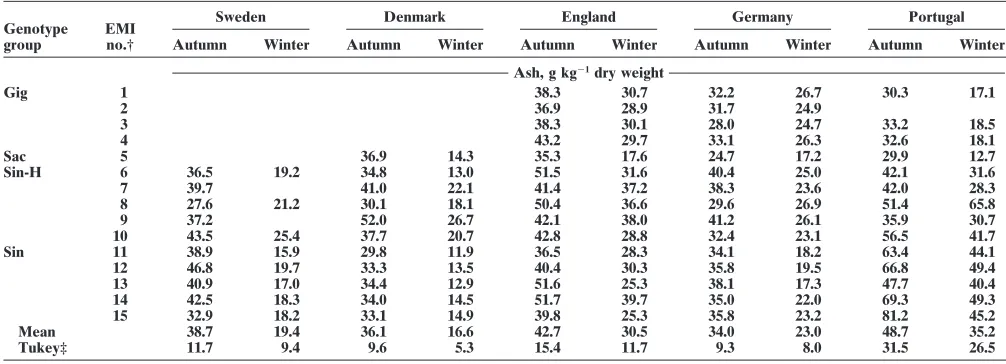
Table 5. Ash concentration at autumn and winter harvests of 15Miscanthusgenotypes grown at five locations in Europe in the third growing season following planting. The four genotype groups wereM.⫻giganteus(Gig),M. sacchariflorus(Sac),M. sinensishybrids (Sin-H), and naturally occurring diploidM. sinensis(Sin).
Sweden Denmark England Germany Portugal
Genotype EMI
group no.† Autumn Winter Autumn Winter Autumn Winter Autumn Winter Autumn Winter
Ash, g kg⫺1dry weight
Gig 1 38.3 30.7 32.2 26.7 30.3 17.1
2 36.9 28.9 31.7 24.9
3 38.3 30.1 28.0 24.7 33.2 18.5
4 43.2 29.7 33.1 26.3 32.6 18.1
Sac 5 36.9 14.3 35.3 17.6 24.7 17.2 29.9 12.7
Sin-H 6 36.5 19.2 34.8 13.0 51.5 31.6 40.4 25.0 42.1 31.6
7 39.7 41.0 22.1 41.4 37.2 38.3 23.6 42.0 28.3
8 27.6 21.2 30.1 18.1 50.4 36.6 29.6 26.9 51.4 65.8
9 37.2 52.0 26.7 42.1 38.0 41.2 26.1 35.9 30.7
10 43.5 25.4 37.7 20.7 42.8 28.8 32.4 23.1 56.5 41.7
Sin 11 38.9 15.9 29.8 11.9 36.5 28.3 34.1 18.2 63.4 44.1
12 46.8 19.7 33.3 13.5 40.4 30.3 35.8 19.5 66.8 49.4
13 40.9 17.0 34.4 12.9 51.6 25.3 38.1 17.3 47.7 40.4
14 42.5 18.3 34.0 14.5 51.7 39.7 35.0 22.0 69.3 49.3
15 32.9 18.2 33.1 14.9 39.8 25.3 35.8 23.2 81.2 45.2
Mean 38.7 19.4 36.1 16.6 42.7 30.5 34.0 23.0 48.7 35.2
Tukey‡ 11.7 9.4 9.6 5.3 15.4 11.7 9.3 8.0 31.5 26.5
† EuropeanMiscanthusImprovement project number.
Table 6. Potassium concentration at autumn and winter harvests of 15Miscanthusgenotypes grown at five locations in Europe in the third growing season following planting. The four genotype groups wereM.⫻giganteus(Gig),M. sacchariflorus(Sac),M. sinensis
hybrids (Sin-H), and naturally occurring diploidM. sinensis(Sin).
Sweden Denmark England Germany Portugal
Genotype EMI
group no.† Autumn Winter Autumn Winter Autumn Winter Autumn Winter Autumn Winter
K, g kg⫺1dry weight
Gig 1 6.1 5.1 11.4 10.1 4.7 3.7
2 7.7 6.2 12.4 10.1
3 10.0 8.8 9.6 10.8 7.0 4.4
4 7.9 5.9 13.2 9.8 7.8 3.4
Sac 5 8.8 2.9 7.8 3.6 9.4 7.0 6.5 2.9
Sin-H 6 8.8 3.7 10.9 2.1 7.3 5.1 10.6 4.3 10.4 3.4
7 11.2 11.2 4.5 12.1 8.2 12.2 6.4 7.7 4.3
8 6.1 4.3 10.3 4.5 6.8 3.2 10.1 6.8 4.5 3.6
9 9.8 15.8 2.6 10.7 10.5 11.6 6.1 8.5 2.5
10 12.7 4.8 12.8 6.7 9.1 4.6 9.4 6.6 12.1 4.1
Sin 11 10.1 2.6 8.0 1.8 4.3 2.9 5.7 2.5 7.6 3.3
12 10.5 2.5 8.1 1.3 4.6 1.8 5.6 2.6 8.3 2.6
13 12.3 2.4 12.9 1.7 6.5 2.9 7.9 3.1 9.3 4.4
14 6.6 1.7 9.2 1.2 3.9 2.2 6.0 2.9 5.7 2.8
15 7.0 1.2 11.0 1.3 3.6 2.2 6.6 2.9 11.4 2.5
Mean 9.5 2.9 10.8 2.8 7.2 4.9 9.5 6.1 8.0 3.4
Tukey‡ 5.9 3.4 5.2 2.0 3.6 4.1 4.0 4.6 7.9 5.2
† EuropeanMiscanthusImprovement project number.
‡ Tukey test applied to calculate the minimum significant difference between genotypes within a site and within a year atP⫽0.05.
the shoots to the rhizomes also account for wintertime ences between genotypes and countries (see mean reductions in the N concentration of the delayed har- squares in Table 3 for relative importance). Average vested biomass (Christian et al., 1997). Translocation autumn S concentrations were highest in Denmark effectiveness from the shoots to the rhizomes is certainly (0.63 g kg⫺1) and Portugal (0.75 g kg⫺1), but these values
influenced by both genotype and local climatic interac- did not differ significantly from the other countries tions. Autumn frost kills shoots and may reduce or pre- (0.46–0.51 g kg⫺1). In Denmark, the genotypes that
con-vent effective N translocation. Consequently, late flow- tained the highest S concentrations were theM. sinensis
ering and senescing genotypes such as M.⫻giganteus hybrids, but in Germany,M.⫻giganteusand in Portu-(no. 1–4),M. sacchariflorus (5), and some M. sinensis gal, M. sinensis had the highest S values. Although a hybrids translocate less than early flowering and senesc- significant effect of the harvest time on S values was
ingM. sinensis genotypes (no. 11–15) in climates with found in Germany and England, negligible reductions
autumn frosts. However, in Portugal where irrigation of S concentrations were recorded with the delayed was used, new green shoots grew from the base of the harvest elsewhere.
M. sinensisplants after flowering in June so that mineral concentrations of harvested M. sinensisbiomass were
Overall Performance of Genotypes
even higher than in the later-maturing genotypes.The most suitable genotypes for the production of The S concentration of plant material varied between
0.22 and 1.27 g kg⫺1dry matter, with significant differ- solid biofuels should combine high yields and good
com-Table 7. Chloride concentration at autumn and winter harvests of 15Miscanthusgenotypes grown at five locations in Europe in the third growing season following planting. The four genotype groups wereM.⫻giganteus(Gig),M. sacchariflorus(Sac),M. sinensis
hybrids (Sin-H), and naturally occurring diploidM. sinensis(Sin).
Sweden Denmark England Germany Portugal
Genotype EMI
group no.† Autumn Winter Autumn Winter Autumn Winter Autumn Winter Autumn Winter
Chloride, g kg⫺1dry weight
Gig 1 5.2 3.0 1.7 1.0 3.7 3.2
2 6.3 3.8 1.6 0.9
3 6.5 4.3 1.6 1.0 4.2 2.7
4 6.5 3.7 1.8 0.9 4.3 2.6
Sac 5 5.9 1.5 6.0 2.3 1.6 0.8 4.8 2.6
Sin-H 6 4.9 1.7 5.5 0.8 5.0 2.6 1.6 0.6 5.2 1.8
7 3.9 5.9 1.1 5.6 4.7 1.9 0.7 6.4 2.6
8 2.9 1.6 4.0 1.5 3.9 1.4 1.3 0.7 2.5 1.3
9 3.4 5.3 0.9 3.2 3.4 2.3 0.8 3.1 1.5
10 5.4 2.8 4.6 1.7 4.6 1.6 1.3 0.9 4.6 1.0
Sin 11 5.9 0.9 4.4 0.6 3.0 1.0 1.5 0.4 4.5 1.7
12 5.3 0.7 4.4 0.6 3.0 0.8 1.3 0.3 3.9 1.4
13 6.1 0.8 6.6 0.6 4.5 1.6 1.5 0.3 6.6 2.0
14 2.8 0.4 4.4 0.5 2.3 1.0 1.0 0.3 2.9 1.0
15 3.5 0.5 5.1 0.5 3.3 1.4 0.8 0.2 9.8 1.1
Mean 4.4 1.2 5.1 0.9 4.6 2.4 1.5 0.7 4.8 1.9
Tukey‡ 2.4 1.5 1.5 0.2 2.0 1.7 1.0 0.4 3.9 1.9
† EuropeanMiscanthusImprovement project number.
LEWANDOWSKI ET AL.: COMBUSTION QUALITY OFMISCANTHUSGENOTYPES 1279
Table 8. Nitrogen concentration at autumn and winter harvests of 15Miscanthusgenotypes grown at five locations in Europe in the third growing season following planting. The four genotype groups wereM.⫻giganteus(Gig),M. sacchariflorus(Sac),M. sinensis
hybrids (Sin-H), and naturally occurring diploidM. sinensis(Sin).
Sweden Denmark England Germany Portugal
Genotype EMI
group no.† Autumn Winter Autumn Winter Autumn Winter Autumn Winter Autumn Winter
N, g kg⫺1dry weight
Gig 1 3.7 2.9 4.3 4.4 4.6 2.1
2 3.4 2.4 4.4 4.3
3 3.9 3.0 4.1 4.1 4.7 2.0
4 3.6 2.6 4.9 3.6 4.8 2.0
Sac 5 7.4 3.9 4.6 1.9 3.5 2.6 4.8 1.4
Sin-H 6 4.0 3.2 6.0 3.9 3.3 3.1 4.6 3.1 6.7 4.0
7 5.7 6.6 5.8 4.8 4.2 5.9 4.9 4.9 2.2
8 4.7 4.7 5.5 4.7 3.5 3.2 4.3 5.0 3.8 3.7
9 5.3 9.4 6.8 6.1 4.4 6.7 5.0 5.8 3.7
10 7.7 5.8 6.8 6.2 3.6 3.5 4.2 4.3 6.8 3.9
Sin 11 6.0 3.5 6.0 3.8 3.2 3.2 3.3 2.4 7.0 5.6
12 5.2 3.4 6.5 3.6 3.1 2.9 4.3 2.5 7.0 4.7
13 4.5 3.1 5.7 3.7 3.7 2.6 4.6 2.7 6.0 5.0
14 3.3 4.1 5.6 4.0 3.1 3.2 3.1 2.4 6.3 4.4
15 3.5 3.5 4.9 4.0 3.0 2.7 3.4 3.2 7.5 5.2
Mean 5.0 3.9 6.4 4.6 3.8 3.1 4.4 3.6 5.7 3.6
Tukey‡ 2.2 2.9 1.5 1.6 1.9 1.9 1.9 2.3 2.6 2.8
† EuropeanMiscanthusImprovement project number.
‡ Tukey test applied to calculate the minimum significant difference between genotypes within a site and within a year atP⫽0.05.
bustion qualities. The data presented here show that be noted that lower thresholds (6 g N kg⫺1dry matter
and 1 g Cl kg⫺1 dry matter) have been discussed for
delayed harvest led to significant improvements in
com-bustion quality for all genotypes. Because harvesting wood biomass (Obernberger, 1998), but these are too demanding for stalky biomass such asMiscanthusspp. and drying costs decrease with falling moisture contents,
winter or early-spring harvests are probably more eco- and straw.
For the Swedish and Danish sitesM. sinensishybrid nomical than autumn harvests (van den Heuvel, 1995;
Huisman et al., 1997). no. 6 offers a good compromise between optimizing
yield and quality because, compared with otherM.
si-The highest biomass yields in winter were recorded
forM. sinensishybrid no. 10 in both Sweden and Den- nensishybrids, it is characterized by low moisture, ash,
K, Cl, N, and S concentrations at harvest. At the German mark (Table 3). However, the concentrations of ash, K,
Cl, N, and S of genotype no. 10 were relatively high in and English sites M. ⫻ giganteus performed best in terms of yield, and apart from high K concentrations, both Denmark and Sweden. High-yielding genotypes
are often characterized by the maintenance of green its quality is as good as, or better than, theM. sinensis
hybrids. In England, the M. sinensis hybrids no. 6, 7, leaf late into the growing season and late flowering.
While these characteristics lengthen the effective grow- and 9 outyielded M.⫻ giganteus. However, their ash and N concentrations were higher than those ofM.⫻
ing season, they have the disadvantage of maintaining
higher mineral and water contents than the earlier-sen- giganteus so that no advantage of these new hybrids overM.⫻giganteuswas apparent. In Portugal, the
stay-escing genotypes at harvest. Therefore, as with many
crops, there is an antagonism between yield and quality, green genotype no. 7 outyielded all other Miscanthus
genotypes, but due to late senescence, the moisture, K, and the best choice of genotypes may depend on the
demands of the biomass user. and ash concentrations of this genotype were signifi-cantly higher than forM.⫻giganteus.
To date, biomass fuel standards only exist for certain fuels in a small number of European countries (IER, 2002). Standards are available for wood chips in Austria,
CONCLUSIONS
firewood and agricultural residues and by products inItaly, and wood pellets and briquettes in Germany and We have shown for Miscanthus genotypes grown across Europe from Sweden to Portugal that local envi-Sweden. In 1997, a European Union standardization
initiative began developing biomass fuel standards, and ronmental conditions at a site had strong effects on yield and chemical composition. Delayed harvesting time it is expected that these will be published during 2003.
However, these fuel standards will have to be adjusted proved an effective strategy for improving the quality of the biomass of all Miscanthus genotypes. The pro-for (i) the combustion technique (e.g., type of
combus-tion unit and size), (ii) the type of fuel (e.g., wood or cesses that influence the genotypic differences in quality at delayed harvest were time of senescence of shoots, stalky biomass), and (iii) the fuel format (e.g., pellets or
chips). Targets discussed for biomass fuels are moisture rate of translocation of minerals to the rhizome, leaf detachment, and leaching.
concentrations from 200 to 300 g H2O kg⫺1fresh matter,
N concentrations below 10 to 20 g kg⫺1, and Cl concen- As expected, the highest-yielding genotypes at a
par-ticular site did not produce the highest quality biomass. trations ⬍3 g kg⫺1 (IER, 2002). We have shown here
mance ofM.⫻giganteusduring a 10 year field trial in Ireland.
sinensis hybrids, had higher yield potentials due to a
Aspects Appl. Biol. 65:153–160.
longer growing season than early flowering and senesc- Clifton-Brown, J.C., and I. Lewandowski. 2000. Overwintering prob-ing genotypes, such as nonhybridM. sinensisgenotypes. lems of newly establishedMiscanthusplantations can be overcome At more northerly sites, where nonhybrid M. sinensis by identifying genotypes with improved rhizome cold tolerance.
New Phytol. 148:287–294. flowered later, yields from these genotypes become more
Clifton-Brown, J.C., I. Lewandowski, B. Andersson, G. Basch, D.G. competitive. Selected hybridM. sinensis combined (i)
Christian, J. Bonderup-Kjeldsen, U. Jørgensen, V. Mortensen, A.B. the overwintering capacity essential for reliable stand Riche, K.U. Schwarz, K. Tayebi, and F. Teixeira. 2001b. Perfor-survival with (ii) an optimal length of the growing season mance of 15Miscanthusgenotypes at five sites in Europe. Agron.
J. 93:1013–1019. for high yields and (iii) high combustion qualities. For
Clifton-Brown, J.C., S.P. Long, and U. Jørgensen. 2001c.Miscanthus
midlatitudes in Europe where winters are mild,M. ⫻
productivity. p. 46–67.InM.B. Jones and M. Walsh (ed.) Miscan-giganteusis probably the preferred genotype.
thus—for energy and fibre. James and James Sci. Publ., London. As the setting of quality standards for biomass may Eppel-Hotz, A., S. Jodl, W. Kuhn, and K. Marzini. 1998. Miscanthus: be expected in future to reduce gaseous emissions and New cultivations and results of research experiments for improving the establishment rate. p. 780–783.InH. Kopetz et al. (ed.) Biomass to avoid technical problems in the combustion units,
for energy and industry. Proc. Int. Conf., 10th, Wu¨rzburg, Germany. it is likely that these standards will become the main
8–11 June 1998. CARMEN, Rimpar, Gemany.
determinant for selection of genotypes. However, as the Hartmann, H., L. Maier, and T. Bo¨hm. 1999. Quality of solid biofuels— newly bred M. sinensis hybrids showed considerable database and field trials. p. 273–279.InR.P. Overend and E. Chor-net (ed.) Proc. Biomass Conf. of the Americas, 4th, Oakland, CA. quality variation from site to site, it can be anticipated
29 Aug.–2 Sept. 1999. Vol. 1. Elsevier Sci., Oakland, CA. that genotypes suitable for most ecological regions of
Huisman, W., P. Venturi, and J. Molenaar. 1997. Costs of supply Europe can be selected following further breeding.
chains ofMiscanthus giganteus. Ind. Crops Prod. 6:353–366. [IER] Institut fu¨r Energiewirtschaft und Rationelle Energieanwen-ACKNOWLEDGMENTS dung (Institute for Energy Economics and Rational Energy Usage). 2002. Standardisation of biological solid fuels. AZ: 97NR055, Final
This work was funded by the EC contract no. FAIR3 CT- Rep. IER, Stuttgart, Germany.
96–1392. Thanks to the Ihinger Hof field station, Sabine Jørgensen, U. 1997. Genotypic variation in dry matter accumulation Schneider, and Birgit Beierl for technical assistance; Dr. Jo¨rn and content of N, K and Cl inMiscanthusin Denmark. Biomass
Breuer from Landesanstalt fu¨r Chemie, Hohenheim for labo- Bioenergy 12:155–169.
ratory analyses; Jens Bonderup Kjeldsen and Kaj Eskesen for Lewandowski, I., J.C. Clifton-Brown, J.M.O. Scurlock, and W. Huis-man. 2000. Miscanthus: European experience with a novel energy their assistance in the Danish field experiment; and Nicola
crop. Biomass Bioenergy 19:209–227. Yates in Rothamsted.
Lewandowski, I., and A. Kicherer. 1997. Combustion quality of bio-mass: Practical relevance and experiments to modify the biomass
REFERENCES quality ofMiscanthus⫻giganteus.Eur. J. Agron. 6:163–177.
Obernberger, I. 1998. Utilization of solid biomass in combustion plants Baumbach, G., U. Zuberhu¨bler, and V. Siegle. 1997. Emissions from
with special consideration for ash forming elements. (In German.) industrial and commercial combustion of biomass and wood. (In
dbv-Verlag, Graz, Austria. German.) Ecomed, Landsberg (Lech), Germany.
Siegle, V., and H. Spliethoff. 1999. Physical and chemical basis for Beuch, S., and B. Boelke. 1996. Influence of harvest quantity and
combustion. (In German.) p. 88–94.InFachagentur Nachwach-biomass losses on the nutrient cycle ofM.⫻giganteus. (In German.)
sende Rohstoffe e.V. (ed.) Leitfaden Biomasse, Gu¨lzow, Germany. p. 569–572.InProc. Conf. Kongreband VDLUFA, Trier,
Ger-Van den Heuvel, E.M.J.T. 1995. Pretreatment technologies for energy many. 16–21 Sept. 1996.
crops. Final Rep. of Novem Project 355300/0302. BTG, Enschede, Christian, D.G., A.B. Riche, and N.E. Yates. 1997. Nutrient
require-the Nerequire-therlands. ment and cycling in energy crops. p. 799–804. InN.E. Bassam,
VDLUFA. 1996. Methods in environmental analysis, wet extraction R.K. Behl, and B. Prochnow (ed.) Sustainable agriculture for food,
under pressure. Band VII. VDLUFA-Verlag, Darmstadt, Germany. energy and industry. Vol. 2. James & James, Braunschweig,
VDLUFA. 1997. Soil analysis: Method book series I. VDLUFA-Germany.
Verlag, Darmstadt, Germany. Clausen, J.C. 1994. Processing of fuel for combustion. p. 111–117.In
Wieck-Hansen, K. 1996. Parameters influencing straw quality impor-Fachagentur Nachwachsende Rohstoffe e.V. (ed.) Biomass for heat
tant for burning in boilers. p. 75–88.InFachagentur Nachwach-production—technology, problems and approach to problem
solv-sende Rohstoffe e.V. (ed.) Biomasse als festbrennstoff. Schriften-ing. (In German.) Schriftenreihe Nachwachsende Rohstoffe. Vol.
reihe nachwachsende rohstoffe. Vol. 6. Landwirtschaftsverlag 2. Landwirtschaftsverlag, Mu¨nster, Germany.
Clifton-Brown, J.C., M.B. Jones, and J. Breuer. 2001a. Yield perfor- Mu¨nster, Germany.