PRIMARY RESEARCH
Alcohol consumption in Austrian physicians
Edda Pjrek
*, Leo Silberbauer , Siegfried Kasper and Dietmar Winkler
Abstract
Background: Alcohol is one of the leading exogenous causes for adverse health consequences in Europe. The aim of the present study was to examine the pattern of alcohol consumption in Austrian physicians.
Methods: A telephone survey was conducted in 400 office-based physicians in Austria. Our questionnaire included the four questions of the CAGE questionnaire and questions to assess alcohol consumption on the previous day. Results: 131 participants (32.8%) completed the interview. 3.8% of the subjects had a CAGE score of 2 or higher indicating a problem with alcohol, but this rate was not statistically different from numbers reported for the general population (4.1%). 46.6% of our subjects had drunken alcohol on the previous day. Compared to the general popula-tion, the rate of having drunk alcohol yesterday was higher in both gender of our sample, but the amount of alcohol drunk was significantly lower. Doctors in rural areas had drunken alcohol more frequently and in greater quantities on the previous day than those in urban areas. There was a positive correlation between age and the amount of drinking on the previous day, and between age and CAGE scores. Furthermore, subjects who had consumed alcohol yesterday obtained higher scores on the CAGE.
Conclusions: Our findings indicate that the rate of Austrian physicians with problematic alcohol consumption is similar to the general population. Physicians in rural areas and older doctors might be of higher risk for alcohol abuse. Keywords: Alcohol abuse, Alcohol problem, Alcohol consumption, Problematic drinking, Physicians, Epidemiology
© The Author(s) 2019. This article is distributed under the terms of the Creative Commons Attribution 4.0 International License (http://creat iveco mmons .org/licen ses/by/4.0/), which permits unrestricted use, distribution, and reproduction in any medium, provided you give appropriate credit to the original author(s) and the source, provide a link to the Creative Commons license, and indicate if changes were made. The Creative Commons Public Domain Dedication waiver (http://creativecommons.org/ publicdomain/zero/1.0/) applies to the data made available in this article, unless otherwise stated.
Background
According to the WHO, alcohol intake in Europe is the highest in the world [1]. Austria is among the top coun-tries in regard to per capita alcohol consumption among the OECD member countries [2, 3] with an estimated 4.9% prevalence of alcohol dependence (7.5% for males and 2.5% for females) in the general population [1]. Alco-holism is a substance abuse disorder that adversely affects virtually every organ system [4]. Patients frequently have poor insight into the disorder and have to be made aware of the negative long-term consequences by their physi-cians [5].
Problematic drinking of physicians has not only been of scientific interest in the past because doctors with alco-hol abuse may provide a lesser standard of care [6] and be more prone to errors [7]. Health professionals play a leading role in alcohol control in the society and their
positions are important in the development of health pol-icies [8]. Furthermore, physicians function as role mod-els regarding health behavior [9], and their personal life style and prevention habits are a strong predictor of their counseling and screening of patients for health issues [10]. Finally, medical doctors’ behavior is a marker as how significant certain health problems are perceived in a society [11].
The question whether physicians drink more or less alcohol than the general population has not been answered unanimously. Several studies found elevated rates of problematic drinking [12–16], while others did not report significant differences [17, 18]. However, it is difficult to compare these results due to cultural dis-crepancies as well as differences in samples, outcome parameters and methodology. In Middle Europe, stud-ies on alcohol drinking in physicians were conducted in Germany [18] and Switzerland [16]. Wurst et al. [19] investigated the prevalence of drinking problems in doc-tors in one of the nine federal countries of Austria. The present study was aimed to build on these results and
Open Access
to investigate the use of alcohol in physicians in Aus-tria in a nationwide study. Specifically, we intended to investigate whether physicians in Austria showed differ-ences regarding problematic drinking and regarding the amount of alcohol intake compared to published results of the Austrian general population (Austrian Health Sur-vey, N = 25,130) [20]. With regard to subgroup analysis, we hypothesized higher rates of problematic drinking and higher alcohol consumption for male physicians, for doctors working in surgical disciplines, and in older physicians.
Methods
A cross-sectional telephone survey was conducted in a sample of 400 random Austrian office-based physicians. Data of potential subjects were retrieved using the official online directories of the medical chambers of the nine federal states of Austria. The required number of partici-pants from each federal state was calculated according to the number of inhabitants in this state. Participants were selected with equal numbers from medical specialties of the following two subgroups: the conservative disciplines consisted of general medicine, internal medicine, psy-chiatry, and neurology. The surgical disciplines consisted of surgery, traumatology, orthopedics and gynecology. Half of the doctors worked in private practice, the other half had contracts with health insurances. We ensured an equal sex distribution of study subjects. When one of the participants could not be reached, a replacement was drawn from the same stratum.
Our questionnaire included the CAGE test [21] fol-lowed by an assessment of the alcohol consumption on the previous day (yesterday method [22, 23]). These test items were selected to ensure comparability of our results to the Austrian Health Survey [20] that had employed this methodology. The CAGE test is a screening test for problematic drinking and potential alcohol problems, and consists of four yes–no questions (1) Have you ever felt you should Cut down on your drinking? (2) Have people Annoyed you by criticizing your drinking? (3) Have you ever felt bad or Guilty about your drinking? (4) Have you ever had a drink first thing in the morning to steady your nerves or to get rid of a hangover (Eye opener)? CAGE is an acronym for keywords in these questions. A score of two or more yes answers is considered indicative of problematic alcohol use [24]. The CAGE is a valid screen-ing technique with a sensitivity of 93% and a specificity of 76% for the identification of problematic drinking [25]. Alcohol consumption on the previous day was qualita-tively and quantitaqualita-tively inquired, and the results were converted into Austrian standard drinking units (SDU). One Austrian SDU is equivalent to an alcoholic beverage
with an ethanol content of 20 g [26]. The assessment of alcohol drinking on the day before the interview has been utilized before to minimize bias of underreporting of alcohol consumption [27].
The offices of the physicians were contacted by tele-phone on business days at their actual opening hours. We asked for permission to conduct an interview and after-wards explained the purpose of the study. At the request of the study participant, another contact was made at a later date. Statistical analysis was conducted using the R Project for Statistical Computing (version 3.4.3) [28] together with the packages gmodels [29] and reshape2 [30]. Univariate non-parametric tests (Mann–Whitney U test, Fisher’s exact test, Chi-squared test, Kendall rank correlation coefficient) were used to examine differences in regard to study subgroups. The p ≤ 0.05 level of signifi-cance (two-tailed) was adopted. The Bonferroni–Holm correction was applied to the p values of comparisons with the Austrian Health Survey, but the subgroup analy-ses were not corrected because they were explorative in nature. Results are presented as arithmetic mean ± stand-ard deviation.
Results
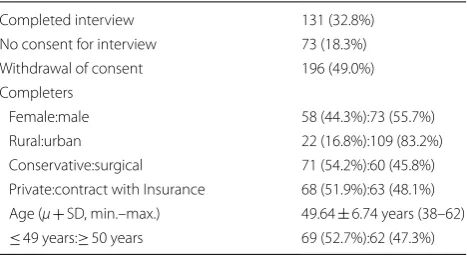
Of 400 participants, 131 (32.8%) completed the tel-ephone interview, 73 (18.3%) refused to participate a priori and 196 (49.0%) withdrew their consent to par-ticipate after explanation of the objectives of the study or at some later time during the interview (Table 1). Com-pleters did not have a different distribution in terms of gender (p = 0.915), geographic location (rural vs. urban) of their medical practice (p = 0.585), medical specialty (χ2 = 1.747, df = 7, p = 0.972), or presence of contracts
with health insurances (p = 0.238) compared to the total sample. Mean age was 49.6 ± 6.7 (min.–max.: 38–62) years. The mean CAGE sum score was 0.20 ± 0.59 and five subjects (3.8%) had a score of 2 or higher indicating problematic drinking (CAGE score ≥ 1 in 17 subjects: 13.0%). The rate of subjects with a CAGE score of ≥ 2 was not significantly different from the rate published in the
Table 1 Demographic properties of the sample of 400 Austrian physicians
Completed interview 131 (32.8%)
No consent for interview 73 (18.3%)
Withdrawal of consent 196 (49.0%)
Completers
Female:male 58 (44.3%):73 (55.7%)
Rural:urban 22 (16.8%):109 (83.2%)
Conservative:surgical 71 (54.2%):60 (45.8%) Private:contract with Insurance 68 (51.9%):63 (48.1%) Age (μ+ SD, min.–max.) 49.64 ± 6.74 years (38–62)
Austrian Health Survey [20] (3.8% vs. 4.1%; χ2 = 0.027,
df = 1, pcorr = 1.000). The rate of elevated CAGE scores
was also not different, when analyzing females (1.7% vs. 1.6%; χ2 = 0.006, df = 1, p
corr = 1.000) and males (5.5% vs.
6.8%; χ2 = 0.201, df = 1, p
corr = 1.000) separately.
61 (46.6%) study subjects answered the question about having drunk alcohol yesterday in the affirmative. A comparison of our results with the general popula-tion yielded a significantly higher rate of having drunk alcohol yesterday in female (39.7% vs. 15%; χ2 = 27.652,
df = 1, pcorr < 0.0001) and male physicians (52.1% vs. 33%;
χ2 = 11.988, df = 1, p
corr = 0.002). However, the number
of SDU was significantly lower in female (0.50 ± 0.68 vs. 1.1; Z = − 5.845, pcorr < 0.0001) and male physicians
(0.64 ± 0.71 vs. 1.9; Z= − 7.220, pcorr < 0.0001) compared
to the general population.
Subgroup analyses
The CAGE sum score (0.32 ± 0.95:0.17 ± 0.52; Z = − 0.201, p= 0.841) and the rate of subjects with CAGE scores ≥ 2 (9.1%:2.8%; p = 0.196) were not sig-nificantly different by geographical area. However, physicians in rural areas were significantly more likely to have drunk alcohol on the previous day than col-leagues in urban areas (rural vs. urban: 68.2%:42.2%; p = 0.035) and had also drunk a higher number of SDU (0.86 ± 0.71:0.52 ± 0.69; Z= − 2.244, p = 0.025).
We did a median split of the sample by age (≤ 49 years vs. ≥ 50 years) and observed that older physicians had higher sum scores on the CAGE (0.35 ± 0.83:0.06 ± 0.24; Z = − 2.640, p = 0.008) and were more likely to have elevated CAGE scores (8.1%:0.0%; p = 0.022). Older doctors had not drunk alcohol more frequently on the day before (44.4%:44.9%; p = 0.728) and the number of SDU consumed was not significantly higher than in younger colleagues (0.71 ± 0.84:0.46 ± 0.53; Z = − 1.342, p = 0.180). However, age was significantly correlated with the number of SDU (τ = 0.148. p = 0.037) and also with CAGE sum scores (τ = 0.228. p = 0.002). Subjects, who admitted to having drunk alcohol yesterday, had signifi-cantly higher CAGE sum scores (0.38 ± 0.84:0.04 ± 0.20; Z = –3.208, p= 0.001), and had a higher rate of CAGE scores ≥ 2 (8.2%:0.0%; p = 0.020). Furthermore, the num-ber of SDU was higher in subjects with elevated CAGE scores (2.00 ± 0.71:0.52 ± 0.64; Z = − 3.578, p = 0.0003).
We did not find any statistically significant gender dif-ferences regarding the rate of subjects with a CAGE score ≥ 2 (female:male = 1.7%:5.5%; p = 0.382), the sum score on the CAGE (0.14 ± 0.48:0.25 ± 0.70; Z = − 0.838, p = 0.402), the percentage of subjects who had drunk alcohol yesterday (39.7%:52.1%; p = 0.164), or the number of SDU consumed on that day (0.50 ± 0.68:0.64 ± 0.71; Z = − 1.259, p = 0.208). Regarding subgroup of medical
specialty (conservative vs. surgical disciplines) or sta-tus of contract with health insurances, we also did not observe any significant subgroup differences on the out-come parameters.
Discussion
To our best knowledge, this is the first study investigat-ing alcohol consumption in physicians usinvestigat-ing the yester-day method. Furthermore, this is the first survey on this topic that has employed telephone interviews rather than mailings. A particular strength of this study in con-trast to many of the previous reports is the possibility of comparing this sample with a large cohort of the general population. The percentage of Austrian physicians with problematic drinking was not significantly different from the general population. Nevertheless, even a similar per-centage can be considered as too high because of physi-cians’ function as models for health-related behavior and as opinion leaders in public health. Alcohol dependency is a reversible condition with a good prognosis when treated early. The relapse rate for physicians, who have been treated and monitored for substance abuse, is about 2–3 times lower than in the general population [31, 32]. Therefore, it is important to create a climate, where doc-tors with problematic drinking are identified early and receive treatment rather than having to fear to be subject to disciplinary action.
Medical doctors had about 1.5 (males) to 2.5 (females) times higher rates of alcohol consumption on the previ-ous day than the general population, but consumed about 2 (females) to 3 (males) times lower amounts. We can speculate that due to their demanding jobs doctors are more prone to the attempt of stress regulation with alco-hol, but are sufficiently aware of the dangers of the sub-stance to use only smaller quantities. A similar pattern of a higher frequency of drinking but with lower quanti-ties was only reported by McAuliffe et al. [33], but they compared physicians with pharmacists and not with the general population. However, other studies [17, 18] also described lower amounts of alcohol consumed by physi-cians. When comparing our data with the general popu-lation, it is noteworthy that the level of education might influence the consumption of alcohol: Persons with a higher education admitted more frequently to having drank alcohol yesterday (primary school: 30.4%, second-ary school 45.5%, university level: 39.3%) and they con-sumed higher quantities of alcohol in a further analysis of data of the capital Vienna from the Austrian Health Survey [34].
has focused on differences regarding this regional dif-ferentiation. Increased urbanization was associated with a decline of alcohol consumption on a national level in Austria [35], but the literature on urbanization and alco-hol yielded conflicting evidence [36–39]. Moreover, it has become increasingly difficult in many countries to recruit enough physicians, who are prepared to work in the countryside [40, 41]. Working conditions in rural areas might be more stressful for doctors, which could be an important health-related factor influencing alcohol use.
Our results indicate that physicians aged 50 years and above showed problematic drinking more often, which is in line with studies that also recognized older physicians as a risk group [13, 14, 33, 42]. This age trend is unique as alcohol consumption and abuse in the general population show a decrease with age in Austria [20] and elsewhere [43–45]. Our cross-sectional methodology does not give us the opportunity to infer causality, but previous stud-ies hypothesized that younger physicians might have a higher risk-awareness regarding alcohol [46]. However, as these age effects were already described 30 years ago, the persistence of this phenomenon in more recent sam-ples rather suggests that alcohol drinking in older doc-tors reflects a learned behavior in susceptible individuals undergoing increased work stress [47].
We were unable to ascertain gender differences of alco-hol intake in our study. While male doctors had numeri-cally higher alcohol use, this did not reach statistical significance, which might indicate a power problem, but it is also possible that female physicians increasingly adopt male drinking behaviors thus reducing traditional gender differences [48]. A closing female–male gap in alcohol use (gender convergence) has also been reported for the general population during the last 100 years [49]. Interestingly, Austrian doctors from the surgical group were also not more likely to use or abuse alcohol than their colleagues in the conservative group, which is in contrast to the findings of a number of prior studies [14, 15, 18].
It is particularly difficult to get physicians to partici-pate in surveys. Despite adequate methodology, previous studies yielded response rates as low as 6.1% [13] and also the only published study from Austria had a low response rate of 18.6% [19]. Compared to this survey, our study had an about 75% higher response rate (32.8%) probably owing to the interviews by telephone [50]. To achieve higher response rates, future studies investigating physi-cians should employ multimodal interview techniques, i.e., emails, web-based forms, telephone interviews, include an incentive and seek support of the respective medical association [51, 52]. Despite the fact that partici-pants were not different concerning their demographic properties from the total sample, our survey might still
be limited because of the relatively low rate of completed interviews. The particularly high rate of withdrawal of consent itself might be indicative of low openness regard-ing questions concernregard-ing personal drinkregard-ing habits. In fact, many physicians broke off the interview because they considered the questions about alcohol consump-tion as “too personal”. As previous studies demonstrated that heavy drinkers are less likely to respond to or refuse to participate in surveys [53, 54], we might suspect that alcohol consumption might be considerably higher in physicians who did not complete the interviews. How-ever, there are also studies that failed to identify dif-ferences between responding and non-responding physicians in surveys [55].
To be able to contact physicians of our sample by their business telephone number, we had to conduct the interviews on working days. For a comparison with other studies it is important to keep in mind that Fri-days and SaturFri-days, where alcohol consumption is gen-erally higher [56, 57], were not included as previous days. In the Austrian Health Survey [20], the rates for alcohol consumption on the previous day were about 50.8% on Fridays and Saturdays.
Conclusions
Our study indicates that physicians in Austria do not show more problematic drinking but consume alcohol more frequently albeit in lower quantities than the gen-eral population. Older physicians and those working on the countryside might belong to an at-risk-population. Future studies should be aimed to investigate the rea-sons underlying this pattern of substance intake.
Abbreviations
CAGE: acronym for Cut down–Annoyed–Guilty–Eye opener; OECD: Organisa-tion for Economic Co-operaOrganisa-tion and Development; SDU: standard drinking unit; WHO: World Health Organization.
Acknowledgements
The authors would like to thank the physicians for taking their time in par-ticipating in our survey. We would like to thank Dr. Alexander Pfaffeneder for performing interviews for our study.
Authors’ contributions
EP and DW designed the study. LS and SK reviewed the protocol. Data were collected under the supervision of DW and EP. DW wrote the initial draft of the manuscript. All authors helped critically revise the article and approved the final manuscript. The article is the authors’ original work, has not received prior publication (except for congress abstracts), and is not under consideration for publication elsewhere. All authors read and approved the final manuscript.
Funding
Availability of data and materials
The interviewees were promised that no non-aggregated individual data would be published. However, more information can be made available upon reasonable request from the corresponding author as long as anonymity of the interviewees remains guaranteed.
Ethics approval and consent to participate
The project was submitted to and reviewed by the Ethics Committee of the Medical University of Vienna, but deemed as being exempt from formal ethi-cal approval. The interviews were performed after information on the study and oral consent of the study subjects.
Consent for publication
Not applicable because this article does not present any non-aggregated individual data of study subjects.
Competing interests
LS is recipient of a DOC Fellowship of the Austrian Academy of Sciences at the Medical University of Vienna. SK received grants/research support, consulting fees and/or honoraria within the last 3 years from Angelini, AOP Orphan, Cel-egne, Eli Lilly, Janssen-Cilag, KRKA-Pharma, Lundbeck, Mundipharma, Neuraxp-harm, Pfizer, Sanofi, Schwabe, Servier, Shire, Sumitomo Dainippon, and Takeda. DW received lecture fees/authorship honoraria from Angelini, Lundbeck, ProMente Austria, and Medizin Medien Austria. The other authors report no financial or other relationship possibly relevant to the subject of this article.
Received: 27 April 2019 Accepted: 2 September 2019
References
1. World Health Organization. Global status report on alcohol and health. Geneva: WHO Press; 2014. ISBN 978-9-24-069276-3.
2. OECD. Health at a glance 2017: OECD indicators. Paris: OECD Publishing; 2017. p. 2017.
3. OECD. Alcohol consumption (indicator). 2019. https ://doi.org/10.1787/ e6895 909-en. https ://data.oecd.org/healt hrisk /alcoh ol-consu mptio n.htm. Accessed 15 Aug 2019.
4. Chase V, Neild R, Sadler CW, Batey RG. The medical complications of alcohol use: understanding mechanisms to improve management. Drug Alcohol Rev. 2005;24(3):253–65.
5. Spithoff S, Kahan M. Primary care management of alcohol use disorder and at-risk drinking: part 2: counsel, prescribe, connect. Can Fam Physi-cian. 2015;61(6):515–21.
6. Wallace JE, Lemaire JB, Ghali WA. Physician wellness: a missing quality indicator. Lancet. 2009;374(9702):1714–21.
7. Gallagher AG, Boyle E, Toner P, Neary PC, Andersen DK, Satava RM, et al. Persistent next-day effects of excessive alcohol consumption on laparo-scopic surgical performance. Arch Surg. 2011;146(4):419–26.
8. Schmitz HP. The global health network on alcohol control: successes and limits of evidence-based advocacy. Health Policy Plan. 2016;31(Suppl 1):i87–97.
9. Oberg EB, Frank E. Physicians’ health practices strongly influence patient health practices. J R Coll Physicians Edinburgh. 2009;39(4):290–1. 10. Frank E, Rothenberg R, Lewis C, Belodoff BF. Correlates of physicians’
prevention-related practices. Arch Fam Med. 2000;9:359–67. 11. Davis R. When doctors smoke. Tobacco Control. 1993;2(3):187–8. 12. Hughes PH, Brandenburg N, Baldwin DC Jr, Storr CL, Williams KM,
Anthony JC, et al. Prevalence of substance use among US physicians. J Am Med Assoc. 1992;267(17):2333–9.
13. Joos L, Glazemakers I, Dom G. Alcohol use and hazardous drinking among medical specialists. Eur Addict Res. 2013;19(2):89–97. 14. Ohida N, Otsuka Y, Kaneita Y, Nakagome S, Jike M, Itani O, et al. Factors
related to alcohol consumption among Japanese physicians. Asia Pac J Public Health. 2018;30(3):296–306.
15. Rosta J, Aasland OG. Female surgeons’ alcohol use: a study of a national sample of norwegian doctors. Alcohol Alcohol. 2005;40(5):436–40. 16. Sebo P, Bouvier Gallacchi M, Goehring C, Kunzi B, Bovier PA. Use of
tobacco and alcohol by Swiss primary care physicians: a cross-sectional survey. BMC Public Health. 2007;7:5.
17. Frank E, Segura C. Health practices of Canadian physicians. Can Fam Physician. 2009;55(8):810–811.e817.
18. Rosta J. Hazardous alcohol use among hospital doctors in Germany. Alcohol Alcohol. 2008;43(2):198–203.
19. Wurst FM, Rumpf HJ, Skipper GE, Allen JP, Kunz I, Beschoner P, et al. Estimating the prevalence of drinking problems among physicians. Gen Hosp Psychiatry. 2013;35(5):561–4.
20. Klimont J, Kytir J, Leitner B. Österreichische Gesundheitsbefragung, 2006/2007: Hauptergebnisse und methodische Dokumentation. Vienna: Statistik Austria; 2007.
21. Ewing JA. Detecting alcoholism. The CAGE questionnaire. J Am Med Assoc. 1984;252(14):1905–7.
22. Knibbe RA, Bloomfield K. Alcohol consumption estimates in surveys in Europe: comparability and sensitivity for gender differences. Subst Abuse. 2001;22(1):23–38.
23. Stockwell T, Zhao J, Chikritzhs T, Greenfield TK. What did you drink yesterday? Public health relevance of a recent recall method used in the 2004 Australian National Drug Strategy Household Survey. Addiction. 2008;103(6):919–28.
24. Williams N. The CAGE questionnaire. Occup Med. 2014;64(6):473–4. 25. Bernadt MW, Mumford J, Taylor C, Smith B, Murray RM. Comparison of
questionnaire and laboratory tests in the detection of excessive drinking and alcoholism. Lancet. 1982;1(8267):325–8.
26. Uhl A, Bachmayer S, Strizek J. Handbuch Alkohol – Österreich: Band 1 – Statistiken und Berechnungsgrundlagen. 7th ed. Vienna: Gesundheit Österreich GmbH; 2017.
27. Stockwell T, Zhao J, Greenfield T, Li J, Livingston M, Meng Y. Estimating under- and over-reporting of drinking in national surveys of alcohol con-sumption: identification of consistent biases across four English-speaking countries. Addiction. 2016;111(7):1203–13.
28. R Core Team. R: a language and environment for statistical computing. Vienna: R Foundation for Statistical Computing. 2018. https ://www.R-proje ct.org/.
29. Warnes GR, Bolker B, Lumley T, Johnson RC. gmodels: various R program-ming tools for model fitting. R package version 2.16.2. 2015. https :// CRAN.R-proje ct.org/packa ge=gmode ls.
30. Wickham H. Reshaping data with the reshape package. J Stat Softw. 2007;21(12):1–20.
31. McLellan AT, Skipper GS, Campbell M, DuPont RL. Five year outcomes in a cohort study of physicians treated for substance use disorders in the United States. BMJ. 2008;337:a2038.
32. Domino KB, Hornbein TF, Polissar NL, Renner G, Johnson J, Alberti S, et al. Risk factors for relapse in health care professionals with substance use disorders. J Am Med Assoc. 2005;293(12):1453–60.
33. McAuliffe WE, Rohman M, Breer P, Wyshak G, Santangelo S, Magnuson E. Alcohol use and abuse in random samples of physicians and medical students. Am J Public Health. 1991;81(2):177–82.
34. Urbas E, Bachinger E. Österreichische Gesundheitsbefragung 2006/07 – Ergebnisse für Wien. Vienna: Stadt Wien; 2015.
35. Eisenbach-Stangl I, Allamani A. Alcohol consumption, alcohol consump-tion-related harm and alcohol control policy in Austria: do they link up? Subst Use Misuse. 2014;49(12):1619–32.
36. Joutsenniemi K, Martelin T, Kestila L, Martikainen P, Pirkola S, Koskinen S. Living arrangements, heavy drinking and alcohol dependence. Alcohol Alcohol. 2007;42(5):480–91.
37. Klein H, Pittman DJ. Regional differences in alcohol consumption and drinkers’ attitudes toward drinking. Am J Drug Alcohol Abuse. 1993;19(4):523–38.
38. Schifano F. Is urbanization a risk factor for substance misuse? Curr Opin Psychiatry. 2008;21(4):391–7.
39. Sundquist K, Frank G. Urbanization and hospital admission rates for alcohol and drug abuse: a follow-up study of 4.5 million women and men in Sweden. Addiction. 2004;99(10):1298–305.
40. Curran V, Rourke J. The role of medical education in the recruitment and retention of rural physicians. Med Teach. 2004;26(3):265–72.
41. Heinz A, Jacob R. Medizinstudenten und ihre Berufsperspektiven. Bun-desgesundheitsblatt. 2012;55:245–53.
•fast, convenient online submission •
thorough peer review by experienced researchers in your field • rapid publication on acceptance
• support for research data, including large and complex data types •
gold Open Access which fosters wider collaboration and increased citations maximum visibility for your research: over 100M website views per year •
At BMC, research is always in progress.
Learn more biomedcentral.com/submissions
Ready to submit your research? Choose BMC and benefit from: 44. Johnson FW, Gruenewald PJ, Treno AJ, Taff GA. Drinking over the life
course within gender and ethnic groups: a hyperparametric analysis. J Stud Alcohol Drugs. 1998;59(5):568–80.
45. Moore AA, Gould R, Reuben DB, Greendale GA, Carter MK, Zhou K, et al. Longitudinal patterns and predictors of alcohol consumption in the United States. Am J Public Health. 2005;95(3):458–65.
46. Rosta J. Prevalence of problem-related drinking among doctors: a review on representative samples. German Med Sci. 2005;3:Doc07.
47. Armeli S, Dehart T, Tennen H, Todd M, Affleck G. Daily interpersonal stress and the stressor-vulnerability model of alcohol use. J Soc Clin Psychol. 2007;26(8):896–921.
48. Fleming PJ, Agnew-Brune C. Current trends in the study of gender norms and health behaviors. Curr Opin Psychol. 2015;5:72–7.
49. Slade T, Chapman C, Swift W, Keyes K, Tonks Z, Teesson M. Birth cohort trends in the global epidemiology of alcohol use and alcohol-related harms in men and women: systematic review and metaregression. BMJ Open. 2016;6(10):e011827.
50. Sinclair M, O’Toole J, Malawaraarachchi M, Leder K. Comparison of response rates and cost-effectiveness for a community-based survey: postal, internet and telephone modes with generic or personalised recruitment approaches. BMC Med Res Methodol. 2012;12:132. 51. Jones TL, Baxter MA, Khanduja V. A quick guide to survey research. Ann R
Coll Surg Engl. 2013;95(1):5–7.
52. McCluskey S, Topping AE. Increasing response rates to lifestyle surveys: a pragmatic evidence review. Perspect Public Health. 2011;131(2):89–94.
53. Wilson P. Improving the methodology of drinking surveys. Statistician. 1981;30(3):159–67.
54. Lynn P, Clarke P. Separating refusal bias and non-contact bias: evidence from UK national surveys. Statistician. 2002;51(3):319–33.
55. Kellerman SE, Herold J. Physician response to surveys. A review of the literature. Am J Prev Med. 2001;20(1):61–7.
56. Kushnir V, Cunningham JA. Event-specific drinking in the general popula-tion. J Stud Alcohol Drugs. 2014;75(6):968–72.
57. Lau-Barraco C, Braitman AL, Linden-Carmichael AN, Stamates AL. Differ-ences in weekday versus weekend drinking among nonstudent emerg-ing adults. Exp Clin Psychopharmacol. 2016;24(2):100–9.
Publisher’s Note