_____________________________
Abstract
Privatization is considered an initial step toward market economy, restructuring financial and economic sector that enables competition in the economy. Privatization is the most painful process in economy where beside legal establishment and political will, it includes also the aspect of fairness and honesty. Analysis of this process is based on the models and comparisons between Kosovo and countries of central and Eastern Europe, in order to give a clearer picture on the overall process of privatization in Kosovo
Methodology that is used to analyze this issue is based on empirical results and also qualitative interpretation of the models and also on studying particular asset privatization process. A widely discussed case of privatization in Kosovo is that of Post and Telecom of Kosovo (PTK). Since each company has its own value, I have focused my appraising analysis on the financial statements with a special observation on Cash Flow from Operation, as the most significant indicator on showing how company is using her physical and human recourses to generate money. I have based my research on using methodology of discounted cash flow from operation analysis, even though the company valuation was done using net cash flow from operation analysis. Cash Flow valuation then was discounted by the T-bonds interest rate.
Ing. Florin ALIU
Privatization Process in Kosovo
_____________________________
This paper tries to bring a conclusion that privatization process in Kosovo have not brought the results excepted, firstly by setting an inappropriate price of assets and lastly by restructuring overall privatization sector and the overall industry. Kosovo, consequently, lost a big opportunity to create a competitive environment of financial industry: starting from the banking industry followed the pension trust which remained at their initial steps of development.
Keywords: Privatization, Transformation, Post and Telecom of Kosovo, Market Economy, Cash Flow, Eastern and Central Europe.
1. Introduction
The goal of the paper is focused on Transformation of economic system in Kosovo through describing trends of economic developments during privatization process, with a thick focus in legislative framework of privatization, liberalization of the market, and country’s journey toward reaching sustainable economic growth. By observing post-soviet union countries privatization process, their wrongness, their right moves done, forms and models used on their marathoner’ economic transformation this paper attempts to draw a comprehensive line of these countries and transformation models of Kosovo, a country in transition.
Yugoslav socialist system, somehow different to some extent from the other communist countries, produced a philosophy that was based on the approach to property, foreign investments and developed a concept of social owned companies.
Analysis presented in the third part of this paper are done by observing empirical and analytical data, were a particular case of asset privatization of a most profitable state company in Kosovo will be explained in details.
1.1. Privatization process in Eastern and Central Europe
_____________________________
so on. In the case of Poland, the privatization process was constructed to include also employees as part of process and their opinion for the form of privatization; workers were granted with 10 % from the total shares of the enterprises. Also Czechoslovakia wanted to get relieved from her state companies in the beginning of her transition with a voucher plan.1Concerning privatization of small companies they were realized through auction and this didn’t show any immense problem in overall process. Giant enterprises or the big waves of privatization went through the slowly process. At the same time market requirements were constrained in providing necessary legal framework to protect market environment from the privatization of those giant companies, setting up institution for privatization such as agencies for privatization, considering the consequences that market would experience after these giant companies get privatized, finding the right buyers, questions in the vein of would he have enough capital in order to realize all the necessary investment that would enable restructuring of the SOE, which is the destiny of workers after the privatization process and so on. Privatization contained two or three main methods of privatizing state enterprises: selling them to domestic capital, selling to outsider (foreign investors), and giving other scheme. One form of privatization was voucher plan which enclosed spreading shares through public offering such as Czech model. Privatizing these companies was necessary to establish sustainable legal framework in order to protect overall process and investors, frequently this was ensured via respected ministries such as that of finance or economy with delegate control into specific agency which would ensure the general process.
Major inflow of foreign capital started after the democratization of communist countries, the fear was that foreign companies will pick only profitable SOE-s. In order to sell these large enterprises, required huge amount of fresh capital where this might only be realized through savings of population, state has used savings of the population to privatize domestic companies through voucher plan, consequently transformation of the ownership went from the state owned enterprises to state banks. Banks were the last agent that were privatized, that’s why banking sector became so complex through privatization process. Czech economy went through
1 Marie Lavigne, (1999), “The economics of transition from socialist economy to market
_____________________________
voucher process which got complicated since there was a conflict of interest in between state banks and closed end funds that were created to represent concerns of shareholders in restructuring Czech state companies; closed-end funds that were fashioned didn’t have enough expertise in the fields of restructuring state owned companies. While restaurants and small size companies in the first rounds or in the first waves of privatization, they were offered to domestic capital. The other form of privatization is called spontaneous privatization when insiders are declaring the privatization, managers and workers of specific SOE Company at one moment are giving the plan and the method to the government for the form of privatization.2
In 1990 compounding structure of state owned enterprises in the ex-soviet union countries was such as: Czechoslovakia with 97%, East Germany 96%, Soviet Union 96%, Poland 81%, China 74%, and Hungary 65%. In the Western countries, participation of the state enterprises in the economy was such as: France 16%, Austria 14.5%, Italy 14%, Turkey 11.2%, United Kingdom 11%, West Germany 10.7%, Denmark 6.3%, Greece 6%, Spain 4,1%, Netherland 3.6%, United states 1.3%.3
Poland had 3177 state owned industrial enterprises in the end of 1988, privatization started first in industry sector and services sector and later on in utilities, railway, and transportation. The output and employment was concentrated in top 100 firms.
2 Marie Lavigne, (1999), “The economics of transition from socialist economy to market
economy”, MacMillan Press, page 165.
3 Jeffrey Sachs, David Lipton, and Lawrence H. Summers, (1990), “Privatization in Eastern
_____________________________
Table 1: Poland: Size Distribution of State Enterprises, 1990
Sales Net income Employment
Number of
enterprises Bn of US dollars % of total Bn of US dollars % of total Thousands of workers % of total
Top 100 18.1 39 2.9 43 711 18
Top 200 23.1 49 3.6 53 1,036 26
Top 300 26.5 57 4.0 59 1,261 31
Top 400 29.1 62 4.4 65 1,461 36
Top 500 30.9 66 4.6 68 1,612 40
Total of socialized industrial
sector 46.8 100 6.8 100 4,051 100
Source: David Lipton, Jeffrey Sachs, Lawrence h. Summers (1990). Lista 500 and Informacja Stotystyczna.
Note: Firms are ranked by sales.
a. Data are analyzed from January through June of 1990. b. Employment refers to 1989 employment levels.
c. Sixteen firms have been dropped from the top 500 firms. We use the remaining 484 firms as a proxy.
As we can see from the figure we notice quite easily that the concentration of the privatization was focused in 100 hundred state owned industrial companies according to sales, net incomes and employments. Also the other obstacle for the state enterprises was the fact that current managers were not adaptable for the unclear waters of the market economy, they needed to be adjusted toward market system and replaced by the new managers. 4
1.2. Yugoslav system
Factors that made Yugoslavia in the direction of experiencing growth were also the decentralization choice, process that redistributed profits among workers. Yugoslav enterprises were making analysis according and in change of market streams, using data that were provided by national
4 David Lipton, Jeffrey Sachs and Lawrence H. Summers, (1990), “Privatization in Eastern
_____________________________
institutes and National Bank of Yugoslavia in arrange to anticipate production for next year.5
There are different types of instruments that Yugoslav government was using in reaching her purpose for the economic growth such as: fiscal instruments, credit instruments, foreign trade instruments and price instruments et cetera. Salaries were totally determined via enterprises, according to the performance and productivity of the employees, there were instruction from the government in which cases the salaries cannot be augmented and these were cases of monopolies are any comparative advantage that was created from SOE-s in the market. Not all prices were experiencing movements according to the market forces, some prices had upper limit, authorities were strongly interested to get explanations from the enterprises why prices are going up and at the same time authority gave them rights to refuse requirement for price incline.6
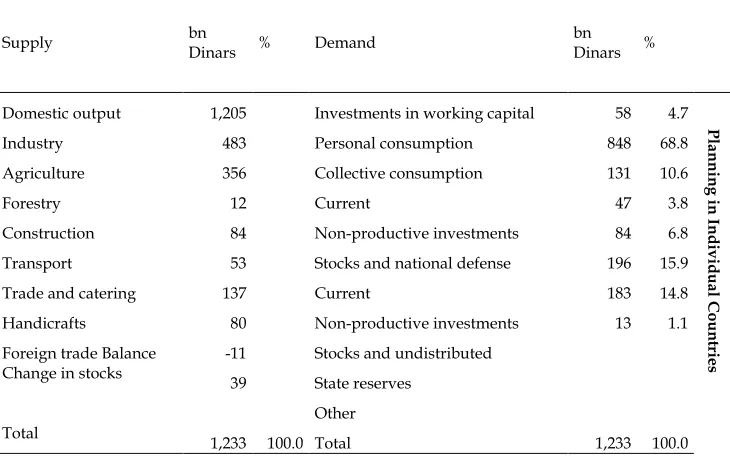
Table 2: Yugoslav supply and demand for consumer goods, 1956
Supply bn Dinars % Demand bn Dinars %
Domestic output 1,205 Investments in working capital 58 4.7
Plannin
g i
n
Ind
ividual Coun
tries
Industry 483 Personal consumption 848 68.8
Agriculture 356 Collective consumption 131 10.6
Forestry 12 Current 47 3.8
Construction 84 Non-productive investments 84 6.8
Transport 53 Stocks and national defense 196 15.9
Trade and catering 137 Current 183 14.8
Handicrafts 80 Non-productive investments 13 1.1
Foreign trade Balance -11 Stocks and undistributed
Change in stocks 39 State reserves
Other
Total 1,233 100.0 Total 1,233 100.0
Source: Sirotkovic J. (1961, pp. 187-188)
5 Jaroslav Vanek , “Economic Planning in Yugoslavia”, Cornell University.
_____________________________
Table six is showing how got balanced demand and supply in the Yugoslav economy. According to the ranking as in all communist or centralized systems the main item is industry followed by the agriculture, forestry, construction, transport, and trade and catering and so on.
And in the other side followed by the demand items: starting with personal consumption as a major item, followed by collective consumption, non-productive investments et cetera.
Yugoslav economy had some characteristics of western economies with socialist concept within it, enterprises had extensive degree of decentralization, they were based with the goal of profit, and they were paying taxes to the state according to the law provided for them from the federal parliament which was the uppermost institution of the country. The remained profit they could spread among employees or reinvest inside SOE, short term financing activities were typically the same with those from the western countries, they were applying with projects in order to obtain credits (lending).Concerning long term investments, they were regularly directed from the state to stimulate innovation and diminish costs with new technology, mostly they were provide by the National Bank For Investments which used to be centralized institution. In short terms planning SOE-shad to be adjusted according to the market mechanism, but concerning long term planning they were helped through the hand of the state.7
Banking sector of Yugoslavia had two layouts. National Bank of Yugoslavia which was established in Belgrade and the other banks of the republics were treated as commercial banks, like whole economic system banks were owned from workers. Bank of Yugoslavia was providing the same services as national banks in the western countries such as; estimating economic growth and according that injecting the economy with the money supply or vice versa.8
“For the most part, governments in transition countries succeeded in establishing the foundations for building commercial banking sectors early in the transition period. However, developing efficient banking sectors required the completion of three interrelated tasks namely, the resolution of
7 Jaroslav Vanek , “Economic Planning in Yugoslavia”, Cornell University.
8 John Bonin, Iftekhar Hasan, Paul Wachtel, (2008), “Banking in Transition Countries”,
_____________________________
non-performing loans, the privatization and the establishment of effective regulatory institutions.”9
Inflation as a macroeconomic phenomenon characterized all ex -communist countries during transition period, for Yugoslavia hyperinflation used to be devastating. Hyperinflation was the highest and longest recorded ever in historical economic data, in January of 1994 the hyperinflation reached his highest level 313 million percent which is the second after the Hungarian hyperinflation which lasted 24 month. There were different sources that caused hyperinflation, first it was the budget deficit which was financed through money supply and later on war in Bosnia and Croatia which was totally financed as a result of printed money from Central Bank, shortages as a result of embargo that UN (United Nation) imposed to Yugoslavia. Fiscal deficit from 3% of the GDP that was in 1990 reached 28% of the GDP in 1993 and also 71% of total expenditures, which created a big decline in output of the economy. Money on hand measured via M1 declined from 15% to 7%, during hyperinflation period dropped down from 3% to 0.2%. The Yugoslavia economy was experiencing the period of dollarization, all the transaction were made in dollars. Central Bank of Yugoslavia lost her control over money supply and supervision of money; central banks of the Republics were printing money in hidden way. 10
“In conclusion the evidence supplied by now suggests that money supply fuelled Yugoslavian Hyperinflation by monetizing various deficits and the control over the money creation was lost. Economic decisions were based on current and expected exchange rate movements. And on the other hand money supply figures were known only to experts. “11
1.3. Privatization process in Kosovo
Privatization in Kosovo didn’t start since 2003. There were many reasons but the major cause was the political status of Kosovo which wasn’t well defined till 2007, not well defined property rights and major documents of the cadastre where taken away from the Serbian forces when they moved back to Serbia in 1999. Special Spin-off which is considered the most
9 Ibid, page 8.
10 Amadou Dem, Gabriela Mihailovici- Hui Gao, “Inflation and hyperinflation in the 20-th
century – caused and patterns”, Columbia University, School of international and public affairs, pages: 16-17-18.
_____________________________
important and most complicated form of privatization since of the impact on the economy and huge number of workers that these companies were carrying out. This form of privatization signify transferring the ownership to new proprietor in purpose of creating a New-Co, liabilities remain responsibility of the PAK (power electricity, water supply, accounts payable and so forth). New investor must sign mandatory agreement with PAK concerning the number of employees and amount of the investment that must be realized during the following years mentioned in convention.
In the region of East Ana Morava, Social Owned Enterprises used to employee around 17000 workers, after the privatization process they do not employee yet 10% of them.12
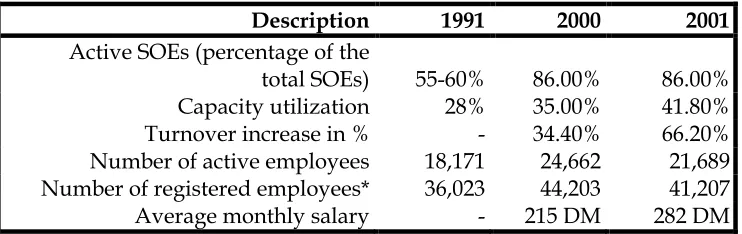
Table 3: Overview of economic activities of SOE-s in Kosovo
Description 1991 2000 2001
Active SOEs (percentage of the
total SOEs) 55-60% 86.00% 86.00%
Capacity utilization 28% 35.00% 41.80%
Turnover increase in % - 34.40% 66.20%
Number of active employees 18,171 24,662 21,689
Number of registered employees* 36,023 44,203 41,207
Average monthly salary - 215 DM 282 DM
*This refers to the total number of employees on companies' books Source: RIINVEST (2002, pages 10- 11)
12 Muhamet Brajshori, (2012), “Kosovo's privatization process is under scrutiny”, Southeast
_____________________________
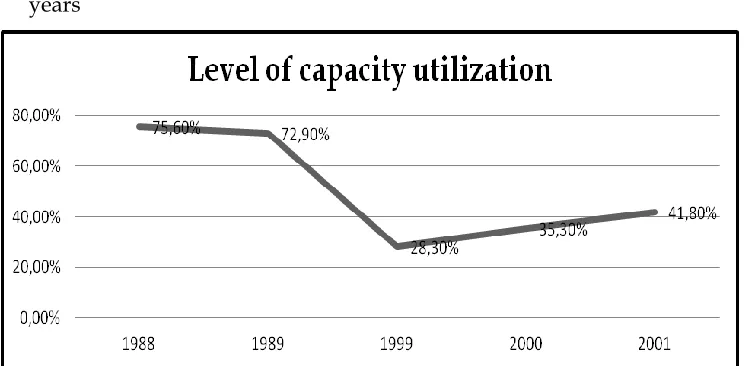
Figure 1: Level of capacity utilization in Kosovo during the following years
Source: RIINVEST (2002, pages 10- 11)
From the survey done by the Riinvest institute was noticed that SOE-s mainly were suffering from the shortage of the capital, already half of them declared that shortage in the capital was their main barrier in realizing their current activities, the other handicap was lack of appropriate technology that would fulfill the requirements and standards of the market constrains in order to realize „economy of scale“.13
1.4. Present Value of PTK (Post and Telecom of Kosovo)
Cash flow from operation is a significant indicator that tells how well the company is using her human and physical recourse to generate cash, usually companies that are in the early stages of establishment face a negative cash flow from operation because most of their operating activities are financed from their financing activities. Kosovo during privatization process faced inclined streams of economists that gave different ideas for the price of the company in case, the only instrument that determines the price of the company is through efficient markets. But as the countries like Kosovo is hard to believe that the flow of information is reliable and on time, we can talk for weak market. In these markets investors are opposed
13 Riinvest-Institute for Development Research (2002) Socially Owned Enterprises and Their
_____________________________
with asymmetry of information (even by the initial fact that financial statements face lack of accuracy and reliability). Each company has a value, the methods for valuation depends on the context and the market where that particular company is operating, for countries that do have efficient financial markets similar to that of United States where the top listed companies (blue chips) are permanently appraised through technicians and fundamental analysts. In the initial public offering (IPO) usually stocks of the companies are undervalued at least 18% then after markets forces adjust her price during the day.
Fundamental analyst bases their current valuation of the company on models like: Dividend Discount Model (DDM), Cash Flow from Operation Models, Capital Asset Pricing Models (CAPM) and so forth. Technical analysts base their prediction of stock prices usually looking back on the past prices.
Kosovo companies face a lot of problems with converting their receivables into cash, in general economy face problems with cash liquidity. So you can’t base assessments of companies resting on revenues because there are a lot of companies that maybe in the income statements demonstrate a lot of revenues but just a small part of it is converted on cash. That’s why the company valuations are hardly accurate even though based on the general fact that income statement and balance sheet are easier to get manipulated, cash flow is less prone of manipulation. That’s why cash flow from operation is significant indicator to get the right valuation of the company.
After a lot of discussion concerning the price of our most profitable public company Post and Telecom, I gathered my energies and streamed them into finding the right model to determine the price of the PTK.
Company is not listed on the stock market, as models mainly are based on the prices that company currently has on the stock market. So I have determined valuation of the company based on the model that recognizes these constrains.
_____________________________
calculation of the present value and is quite clear that model is conservative.
Discount rate I have obtained from the interest rates of the government bonds which are in the region of 3.5%. There is also another approach toward getting discount rate which is based on weighted average cost of capital WACC.
The reason why I didn’t set discount rate according to the weighted cost of capital(WACC) was because the current formula requires interconnection and returns from stock market which Kosovo doesn’t have it.
WACC=Wd*Rd (1-T) +Ws*Rs
According to this formula cost of common equity (Rs) you have to find it from the CAPM and decompose it into three main variables the determine cost of common equity (Rs):
1. Risk free rate (RFR), rate that you obtain from short term government bonds (Kosovo rate is 3.5%).
2. Return on the market (RM) – mainly is used one proxy similar to Standard and Poor’s or any other market return which Kosovo doesn’t have the stock market and result we can’t calculate RM. 3. Beta risk- is impossible to derive it without stock market, because it
measures the volatility of the market toward your particular stock. For instance if Beta=1.2, than if the Stock Market goes up (incline) by 1% than your common stock will go up 1.2%.
Table 4: Post and Telecom of Kosovo Cash Flow Statements
Years 2007 2008 2009 2010 2011 2012 Average
Net Cash flow from Operations (000) Euro
40985 37583 -146433 55000 72485 67761 21230.16
Source: This table represents the authors’ own calculations using cash flow statements of Post and Telecom of Kosovo, Financial Statements – publicly available14
_____________________________
DCF
* *
=
DCF =
Source: Author’s own calculation
Explanation: This financial mathematical calculation is based on Cash Flow Discount Model and it is adopted by the author for the needs of this research paper. In this calculation, the author has not included Cash Flow from Operations, by keeping a conservative approach, by involving only Net Cash Flow from Operation (which is deducted for dividend payments which are allocated to the Government15)
DCF (Dividend Cash Flow) during the years, where g- growth rate of cash flow during the years, r- discount rate and CF1- cash flow of first year:
g = 1.01 r = 0.035 CF1 = 21230.16 years=50
_____________________________
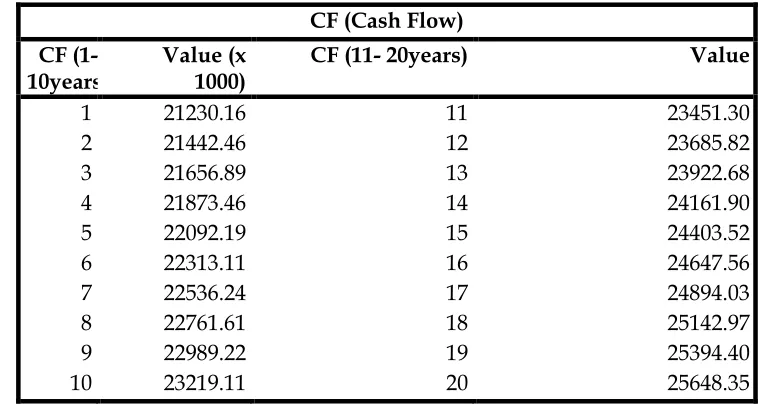
Table 5: Cash Flow Projections (The author’s own calculations)
CF (Cash Flow) CF (1-
10years) Value (x 1000) CF (11- 20years) Value
1 21230.16 11 23451.30
2 21442.46 12 23685.82
3 21656.89 13 23922.68
4 21873.46 14 24161.90
5 22092.19 15 24403.52
6 22313.11 16 24647.56
7 22536.24 17 24894.03
8 22761.61 18 25142.97
9 22989.22 19 25394.40
10 23219.11 20 25648.35
Source: Author’s own calculation
_____________________________
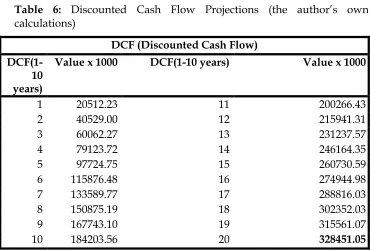
Table 6: Discounted Cash Flow Projections (the author’s own calculations)
DCF (Discounted Cash Flow)
DCF(1-10 years)
Value x 1000 DCF(1-10 years) Value x 1000
1 20512.23 11 200266.43
2 40529.00 12 215941.31
3 60062.27 13 231237.57
4 79123.72 14 246164.35
5 97724.75 15 260730.59
6 115876.48 16 274944.98
7 133589.77 17 288816.03
8 150875.19 18 302352.03
9 167743.10 19 315561.07
10 184203.56 20 328451.05
Source: Author’s own calculation
Explanation: As financial markets deal with unknown quantities and unknown qualities, what financial market appraises currently, it would affect their results tomorrow. That’s why when investors purchase companies, they do that because of the expectations that they have for the future, such as: profits, cash flow, assets. That’s why DCF converts expectations of future cash flows to the current state (present value of the company). According to my model which recognizes limitation that the future variables contain toward affecting profit and cash flow, such as: new entries in the industry, viber, internet, and so on, the present value of PTK is 328.451.050 (approximately three hundred and twenty eight million euro).
2. Conclusion
_____________________________
privatization process, Kosovo has last the chance to create a stock market like many countries of the Central and Eastern Europe did during the privatization, Kosovo also lost a chance to involve people of the Kosovo in the privatization to become part in the ownership structure of the SOE-s, in order not to concentrate capital in small group of people. Restructuring of the market economy part of it linked with privatization process in Kosovo has enabled competition in many sectors and industries which is the beauty of capitalism but also has created some monopolies or market concentration in areas such as: banking industry, pension fund, distribution of power electricity, airports and telecommunication industry, which according to the basic microeconomic principles in those areas we have market failure.
Part of the paper treats in theoretical and ideological form privatization process in eastern and central Europe, her anomalies and their transformation into the new era – capitalist system. According to the economic data and years corresponding with it, we can strongly believe and briefly say that communism started to escape from her ideology, from her mission of equalization, from her approach of uniformity in the moment when the economy started to downgrade not because of her natural cycles but because of her shortages in her philosophical approach toward developments. Centralization was the magic word of communist systems not because this was providing better economic future for the society but this was the way to keep the control in overall society, control was very close or the same with the word fear-terror. We can briefly say that economic system was the one who destroyed communism, communist economic model didn’t produce economic growth, dissatisfactions among people was increasing not just because of inequality but mainly because of demolition in all economic aspects. All countries that went through the transitional valleys like Kosovo now were facing the same anomalies of not sustainable legislative framework, unstructured economy associated with unfinished privatization process.
List of References
_____________________________
Bonin, J., Hasan, I., Wachtel, P., (2008), “Banking in Transition Countries”, Oxford Handbook of Banking. Available from:
http://people.stern.nyu.edu/pwachtel/images/Wachtel_BankingTrans itionCountries_Sept2013.pdf, [last accessed 22.11.2013]
Brajshori, M., (2012), “Kosovo privatization process is under scrutiny”, Southeast European Times in Pristina. Available from:
http://www.setimes.com/cocoon/setimes/xhtml/en_GB/features/seti mes/features/2012/03/21/feature-04, [last accessed 02.02.2013]
Dem, A., Mihailovici, G., Gao, H. “Inflation and hyperinflation in the 20th century – caused and patterns”, Columbia University, School of International and Public Affairs,
http://www.itulip.com/Select/hyperinflation.pdf, [last accessed
20.02.2014]
Lavigne, M., (1999), “The economics of transition from socialist economy to market economy”, MacMillan Press LTD, 2ND edition.
Riinvest-Institute for Development Research (2002) Socially Owned Enterprises and Their Privatization, Research Report, June, 20, 2002. Available from: http://riinvestinstitute.org/publikimet/pdf/10.pd, [last accessed 13.12.2013]
Sachs, J., Lipton, D., Summers, L., (1990), “Privatization in Eastern Europe: Case of Poland”, Harvard University, World Institute for Development Economic Research. Available from:
http://earthinstitute.columbia.edu/sitefiles/file/about/director/pubs/ brookings0990.pdf [last accessed 30.11.2013]
Sirotkovic J., (1961), “Problemi Privrednog Planiranja u Jugoslaviji”, Zagreb.