Issues
ISSN: 2146-4138
available at http: www.econjournals.com
International Journal of Economics and Financial Issues, 2018, 8(4), 126-132.
Analysis of Financial Performance on Profitability with Non
Performance Financing as Variable Moderation (Study at Sharia
Commercial Bank in Indonesia Period 2012–2016)
Muhammad Yusuf
1, Surachman Surjaatmadja
2*
1STIE Indonesia Banking School, Jakarta, Indonesia, 2STIE Indonesia Banking School, Jakarta, Indonesia. *Email: surachman.
ABSTRACT
Profitability is the ability of banks in generating profits effectively and efficiently. The purpose of this study is to determine the effect of capital adequacy ratio (CAR) and financing to deposit ratio (FDR) on profitability (proxies with return on assets [ROA]) with non performing financing (NPF) as a moderation variable. The population of this study is sharia commercial banks in Indonesia period 2012–2016 which amounted to 12 banks. This study uses purposive sampling method for sampling, the selection of samples with certain criteria, so that this research samples obtained as many as 11 banks. The data used in this research is secondary data. Data analysis used is multiple linear regression analysis. Meanwhile, to test the effect of the moderating variable on the influence between independent variable and dependent variable using moderated regression analysis. The results showed that partially, CAR and FDR have a significant positive effect on profitability and BOPO have a significant negative effect on profitability. While the NPF has no significant effect on the relationship between CAR with profitability and the relationship between FDR with profitability, while the NPF has a significant negative effect on the relationship between BOPO with profitability. However, NPF as a moderating variable has an insignificant influence (unable to moderate) the CAR relationship to ROA and NPF as moderating variable has an insignificant influence (unable to moderate) FDR relation to ROA and NPF as moderating variable has significant negative effect (able to moderate) BOPO relationship to ROA sharia public bank in Indonesia period 2012–2016.
Keywords: Sharia Commercial Bank, Capital Adequacy Ratio, BOPO, Financing to Deposit Ratio, Non Performing Financing, Profitability
JEL Classifications: M21, O61
1. INTRODUCTION
Profitability is the ability of a company in generating profit within a certain period, which is usually calculated with profitability ratios (Said and Ali, 2016). In this study the profitability ratio is proxies through return on assets (ROA). ROA serves to measure the effectiveness of companies in generating profits by utilizing the assets owned. The greater the ROA owned by a company, the more efficient the use of assets so that it will enlarge profit (Wahyuningsih et al., 2015). Large profits will attract investors because the company has a high rate of return. This research focuses on the use of the ROA ratio, because the researcher wants to know the extent to which the ability of banks to generate profits derived from assets whose funds mostly come from public funds
at Figure 1.
This research in principle is conducting further tests of empirical
findings on the effects of capital adequacy ratio (CAR), financing to deposit ratio (FDR), as independent variables and non performing financing (NPF) as a moderating variable to profitability. The reason for determining the independent variables
is taken because of previous researches there are inconsistent
results (research gap), so it is still necessary to re-examine these
variables in order to implement the latest state of sharia banking
in Indonesia. The object of this study is the sharia commercial banks in Indonesia for the period of 2012–2016. The reason for
choosing the object of this research is because sharia bank is one of the fastest growing industries in Indonesia, it is marked
by the increasing number of conventional banks that eventually
1.1. The Research Problem
Based on the background that has been explained, the formulation of the problem in this research is, whether CAR, FDR and BOPO positively affect the ROA at Sharia Commercial Bank in Indonesia and whether NPF can moderate CAR, FDR and BOPO on ROA at Sharia Commercial Bank in Indonesia?
1.2. Objectives and Advantage Research
To test and analyze the effects of CAR, FDR and BOPO on ROAs on Sharia Commercial Banks in Indonesia and to test and analyze whether NPFs can moderate CAR, FDR and BOPO against ROA at Sharia Commercial Banks in Indonesia.
1.3. The Scope of Research
This research uses CAR, FDR and BOPO as independent variable and ROA as Dependent variable, while NPF as moderation
variable. The object of this research is sharia commercial bank in
Indonesia. Sharia public bank publishes annual audited financial statements during the period 2012-2016.
2. LITERARTURE REVIEW
Stewardship theory is a theory coined by Donaldson and Davis, this theory explains the circumstances in which the manager (steward) overrides his personal interests to achieve organizational goals and act in accordance with the wishes of the owner (principal).
Stewardship theory, is a theory built on philosophical assumptions about human nature that are essentially trustworthy, capable of acting with full responsibility, have integrity and honesty against others. If the stewardship theory assumption is applied in the management of the company, stewardship theory sees management as a credible party to act as well as possible for the public and stakeholders, (Bentley et al., 2013).
The stewardship theory in this study is considered to explain
that Islamic banks as principal in managing funds will override
personal interests and maximize their performance to achieve organizational goals, such as increased profitability. Similarly, in the case of financing, customers as stewards who have been given
the trust by Islamic banks to manage some funds will try as much
as possible to restore the funds provided.
2.1. Profitability
Profitability is the ability of a company to earn profits in relation
to sales, total assets and capital itself, thus for long-term investors
will be very important with this profitability analysis (Said and Ali, 2016). Profitability also has an important meaning in maintaining the company’s long-term survival, because profitability indicates whether the company has good prospects in the future. Thus each company will always try to improve profitability, because the higher level of profitability of a company then the better describes the ability of high profit company (Limakrisna and Juju, 2008).
2.2. CAR
Capital is used to assess how much the bank’s ability to assume risks that may occur. A high level of capital will increase the cash reserves that can be used to expand its credits, so a high level of solvency will open up greater opportunities for banks to increase their profitability. On the contrary, a low solvency bank will reduce the bank’s ability to increase its profitability, even reduce the public trust so that it will adversely affect the continuity of its business (Jones, 2007).
This level of capital adequacy can be measured by comparing capital with third party funds and comparing capital with risky
assets.
2.3. FDR
One of the bank’s liquidity rating is by using FDR. FDR is the ratio of the ratio of financing provided by Islamic banks with third party funds collected by banks. The FDR ratio is used to measure the bank’s ability to repay its debts and repay its depositor, and to meet the demand for the proposed loan (Wahyuningsih et al., 2015).
The amount of FDR will affect profitability. FDR value indicates the effectiveness of the bank in distributing the financing if the FDR value shows the percentage is too high then the more risky condition of bank liquidity, on the contrary if too low then the
bank is considered not effective in collecting and channeling
Source: OJK, Sharia banking statistics (2015)
funds obtained from customers thus affecting the profits earned. The higher the FDR, the higher bank profits (Wardana and Widyarti, 2015).
This ratio is also an indicator of vulnerability and ability of a
bank. While banking practitioners agree that the safe limit of a
bank’s FDR is about 80%. But the tolerance limit is between 85% and 100%. Based on the provisions stipulated in Bank Indonesia Circular Letter No. 26/5/BPPP dated May 29, 1993, the amount of FDR or LDR set by BI should not exceed 110% (Lemiyana and Litriani, 2016).
2.4. Operational Cost to Operating Income (BOPO)
Operational efficiency or BOPO basically affects the bank’s
performance, i.e. to indicate whether the bank has used all its
production factors appropriately (Wibowo and Syaichu, 2013).
According to (Aulia, 2016), to show the efficiency of a bank is to determine the level of BOPO, therefore it must be known operational costs and operating income first. The smaller the BOPO, the better because the bank has a very good level of efficiency. The existing BOPO category consists of a very poor efficiency level above 96%, very good at less than 80%. The level of efficiency is quite good until well ranged between 80 and 95%.
2.5. NPF
NPF is a credit or non-performing financing where the debtor can’t meet the payment of loan arrears within the agreed timeframe in the agreement (Wibowo and Syaichu, 2013). Credit or financing risks arise when banks can’t recover their claims on loans or
investments that are being made.
2.6. Development of Hypotheses
2.6.1. Influence of CAR on ROA at Sharia commercial bank in Indonesia
CAR is a ratio that shows how far all bank assets that contain risks (credit, inclusion and securities of bills at other banks)
are funded from bank capital funds, in addition to obtaining funds from sources outside banks, such as public funds, loans
(debt), and others (Sofiati and Limakrisna, 2017). (Wibowo and Syaichu, 2013) stated that the CAR variable has a positive effect on profitability, the higher the CAR, the bank profitability will also increase because the bank is able to finance the risky assets. Based on the above it can be formulated hypothesis as follows:
H1: CAR positively affects ROA at Sharia commercial bank in
Indonesia.
2.6.2. Influence of FDR on ROA at Sharia commercial bank in Indonesia
FDR is a liquidity ratio that describes a bank capable of providing funds to be withdrawn by depositors by relying on credit/financing as a source of liquidity. The lower FDR indicates that a bank is less able to maintain its liquidity levels seen from the lack of effectiveness in lending/financing (Wardana and Widyarti, 2015). Conversely, the higher the FDR within certain limits, the greater the profit of banks with the assumption that banks channel funds for effective financing.
According to (Said and Ali, 2016) with large third party funding, bank revenues (ROA) will increase. So FDR has a positive effect on ROA.
Research conducted by (Lemiyana and Litriani, 2016) found that FDR had a positive and significant effect on ROA. Based on the above it can be formulated hypothesis as follows:
H2: FDR positively affects ROA at Sharia commercial bank in
Indonesia.
2.6.3. Effect of NPF moderation on the relationship between CAR to ROA at Sharia commercial bank in Indonesia
NPFs are the number of troubled credits and may not be billed.
The greater the NPF value the worse the performance of the bank
(Wibowo and Syaichu, 2013). Based on the theory, NPF reflects financing risk, the higher this ratio indicates the quality of sharia bank financing is getting worse. So with the large number of troubled financing, of course, can lead to loss of opportunity to earn income from financing provided to affect earnings and gain a negative impact on ROA.
According to (Wahyuningsih et al., 2015) the impact of the Non Performing Loan is an increase in unaided interest and impact on ROA and ROE. This is supported by research by (Niode and Chabachib, 2016) stating that NPF has a significant negative impact on ROA. Based on the above it can be formulated hypothesis as follows:
H3: NPF moderates the influence between CAR, against ROA.
Effect of NPF Moderation on the relationship between FDR on ROA at Sharia Commercial Bank in Indonesia. NPFs are the number of troubled credits and and may not be billed. The greater the NPF value the worse the performance of the (Wardana and Widyarti, 2015). Based on the theory, NPF reflects financing risk, the higher this ratio indicates the quality of sharia bank financing is getting worse. So with the large number of troubled financing, of course, can lead to loss of opportunity to earn income from financing provided to affect earnings and gain a negative impact on ROA.
According to (Simatupang and Franzlay, 2016), Capital Adequacy and lending rate have a positive effect on profitability. While the interaction between credit risk with the level of capital adequacy
and interaction between credit risk and credit disbursement rate
has a significant influence on profitability.
Research conducted by (Inayatillah and Subardjo, 2017), The results showed that the ratio of capital adequacy and lending have a positive effect on profitability, while the ratio of nonperforming loans negatively affect profitability. The ratio of nonperforming loans positively affects the relationship of capital adequacy to profitability, the ratio of nonperforming loans positively affect the relationship between the ratio of lending to profitability. Based on the above it can be formulated hypothesis as follows:
2.7. Conceptual Framework
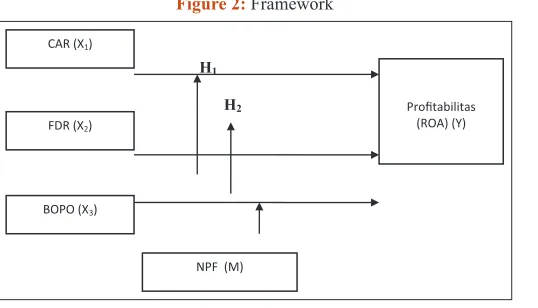
Based on literature review and reinforced by previous research it is assumed that CAR, FDR, and Operational Cost to Operating Income (BOPO) have an effect on profitability (ROA) with NPF as moderation. The framework of this study can be described as
follows at Figure 2.
3. METHODOLOGY
This research uses quantitative descriptive research, that is research
which is then processed and analyzed to be taken conclusion, it means research done is research which emphasize its analysis on numerical data (number). Data analysis used in this research that is, descriptive statistic. classic assumption test and hypothesis test, so as to produce a conclusion that will clarify the description of the object under study.
The population in this study are 11 Sharia Commercial Banks (BUS) which have made annual financial statements from 2012 to 2016 which have been reported in Bank Indonesia publication report through www.ojk.go.id website. In this study did not use the sample, but using the population because all data in this study is the population data in the form of secondary data.
The sampling technique used in this research is purposive sampling. The method of purposive sampling is the method of sampling based on the subjective considerations of the researcher
where the conditions made as criteria include: Sharia Commercial Bank which publishes financial statements during the observation period that is 2012–2016 and Sharia commercial banks that have
complete data based on the variables studied during the period
2012–2016. A total of 11 sharia commercial banks, the number of years of research for 5 years (2012 until 2016), the number of samples of research 55 samples.
Variables in this study consist of Independent Variable (X), in this research is CAR (X1), FDR (X2). BOPO (X3). Dependent variable (Y), in this research is ROA (Y).
Moderation Variable (M), in this research is NPF. In this research, the data collection method used is the secondary data collection method that is sourced from the financial report in the form of annual report of Sharia (BUS) Commercial Bank, but limited only for Report from 2012 until 2016. Data collection Technique, based
on time of data collection, this study is time series, since data is collected for 4 consecutive years from 2012 to 2016 on 11 Sharia Commercial Banks which have made financial report and have
been reported in Bank Indonesia publication report.
3.1. Research Model
The analysis model used in this research is multiple linear regression analysis using SPSS version 23 statistical tool. Hypothesis testing done in this research is by using multiple linear regression with analysis technique of moderated regression analysis, where in the regression equation contain elements of
interaction or multiplication between two or more independent variables. The regression equation for this research is as follows at Table 1.
4. RESULT AND DISCUSSION
4.1. Influence of CAR on ROA at Sharia Commercial
Bank in Indonesia
Based on the result of hypothesis test, the value of CAR variable regression coefficient is 0147 and tcount 3.840 with significance value 0.000. So, it can be concluded that the CAR has a significant positive effect on ROA in sharia commercial banks in Indonesia period 2012–2016, so H1 accepted.
The results showed that the increasing CAR then ROA will also increase. With high capital banks can flexibly to put their funds into profitable investments so that it can improve customer confidence because of the possibility of banks get a high profit. If the bank’s capital is fulfilled, it is expected that the losses experienced can be covered by the capital owned by the bank. So that with the
closing of the loss, then the operational activities of the bank will
not experience a significant fluctuation.
The minimum CAR value of sharia bank based on research is 11.03% which means that the bank has met the minimum capital of BI standard, which is 8%. CAR above 8% indicates an increasingly
stable banking business, due to a large public trust. This is because
banks will be able to assume risk from risky assets. Based on the theory, banks that have CAR above 8% is very good because the
bank is able to bear the risks that arise.
CAR has the function of identifying, measuring, controlling, and
controlling the risks arising from the management of bank assets.
The higher the CAR, the higher the capital itself is used to finance
its earning assets or to recover losses from assets investments. This
H1
H2
H3
CAR (X1)
FDR (X2)
Profitabilitas (ROA) (Y)
NPF (M) BOPO (X3)
Figure 2: Framework
Table 1: Persamaan Regresi Linier Berganda
No Persamaan struktural
1 Y=f (X1, X2.X3)
2 ROAit=αit+β1CARit+β2FDRit+β3BOPOit-β3NPFit+εit (1)
ROAit=αit+β1CARit-β2NPFit-β3CARit*NPFit+εit (2)
ROAit=αit+β1FDRit-β2NPFit-β3FDRit*NPFit+εit (3)
ROAit=αit+β1FDRit-β2NPFit-β3BOPOit*NPFit+εit (4)
3 ROAit=αit+β1CARit+β2FDRit+β3BOPOit-β3NPFit+β4CARit*N PFit+β5FDRit*NPFit+β6BOPOit*NPFit+εit
is because every asset placement besides potentially generating profit also has the potential to create risk. Therefore, capital should also be used to maintain the possibility of risk of loss on investment in assets, especially those from third party funds or the community. Increasing the role of assets as a profit producer should be simultaneously coupled with consideration of risks that may arise in order to protect the interests of the owners of funds.
In accordance with the bigger theory of CAR, the bank profits
will be greater, because the scope of business banks become more stable with adequate capital reserves. However, keep in mind that capital that is too strong can disrupt the productivity of the asset then the bank must recognize the capital capabilities required to perform operations so that not too solvable and difficult for banks in obtaining profit.
The results of this study support research conducted by (Siahaan et al., 2016) which states that the CAR has a positive effect on ROA, the statement is supported by research conducted (Wibowo and Syaichu, 2013) stating that the CAR has a positive effect on ROA.
4.2. Influence of FDR on ROA at Sharia Commercial
Bank in Indonesia
Based on the hypothesis test results obtained value of regression coefficient of FDR variable of 0.054 and t count 3.518 with a significance value of 0.001. Thus, it can be concluded that FDR has a significant positive effect on ROA in sharia bank in Indonesia period 2012–2016, so H2 is accepted.
The results of this study indicate that by channeling the financing
as much as possible then the bank will also get a high income as well, either from the income margin of sale and purchase, rental
and income derived from the profit sharing so that in the end will increase profit and cause a positive relationship to profitability. Therefore, the success of a bank in achieving profit or profit requires the service of financing as its main services, in accordance with targets and plans set by the bank. Distribution of financing
is the allocation of funds or funnel funds that have been collected
from the community to the needy in the form of loans.
The existence of financing disbursement activities will affect the profitability of banks. With the financing disbursed will increase the bank’s income. A good level of credit disbursement shows that the bank is able to maintain its profitability well. The good credit distribution is the credit distribution which still pay attention to the bank’s liquidity so that the bank’s sustainability and profitability can be maintained. Therefore, any increase in financing disbursement will be followed by an increase in bank profitability. In other words, the higher the FDR will increase the ROA, so the financial performance of the bank will be better with the assumption that the bank is able to channel the financing effectively so that the number of problematic financing will be
small.
The results of this study in accordance with stewardship theory
that can be understood in the channeling of banking institutions
financing. Sharia banks as principals who entrust their customers
as stewards to manage some funds will make every effort to
recover the funds.
The results of this study support the research conducted by (Wahyuningsih et al., 2015) which states that FDR has a positive effect on profitability, the statement is reinforced by research (Aulia, 2016) which states FDR have a significant positive effect on profitability.
4.3. BOPO Influence on ROA at Sharia Commercial
Bank in Indonesia
Based on the result of hypothesis test, BOPO variable regression coefficient value is −0.079 and tcal −7.004 with significance value 0.000. So, it can be concluded that BOPO has a significant negative effect on ROA in sharia bank in Indonesia period 2012–2016, so that H3 accepted.
The results show that if BOPO increases, then the ROA obtained will decrease. This condition occurs because any increase in Bank operating costs that are not accompanied by an increase in operating income will result in reduced profit before tax, which in turn will decrease ROA. Thus, BOPO negatively affects ROA. This high ratio of BOPO is not only caused by opex (operational expenses), but also caused by the reserves formed due to problem financing (NPF). Some Islamic banks make more reserves because
in the midst of economic conditions as now NPF must increase.
Investment costs, especially the salaries of employees, also cause the high BOPO. So the level of bank efficiency in carrying out its operational activities affect the level of profitability of the bank. If operational activities are done efficiently (BOPO low) then the income generated by the bank will rise.
In accordance with its function as an intermediary party, the efficiency of a bank greatly affects the size of the return that will be obtained. The more efficient the operations performed by the bank, the profits obtained by the bank will be greater. This is in accordance with the theory that the greater the BOPO, the more decreased the performance of banks and ROA obtained by banks
will also decline.
The average value of BOPO of sharia bank based on research is 83.80% which means that the bank has a good enough efficiency
level, because the average value is still in BI standard, which is
below 90%.
The results of this study support research conducted by (Wibowo and Syaichu, 2013) which states that BOPO variable has a significant negative effect on ROA.
4.4. CAR Effect on ROA with NPF as Moderation Variables
occurs because there are inconsistencies in the relationship
between capital adequacy with ROA and the average level of NPF of sharia banks is also still relatively low i.e., 3.93% causing NPF has no significant effect on the relationship of CAR to ROA.
Generally in banks, nonperforming loans are categorized as earning assets of banks that are doubtful collectivity. To maintain the security of the depositors’ funds, the central bank required
the commercial banks to provide non-performing loans. Thus,
the greater the amount of nonperforming loans held by the bank, the greater the amount of reserve funds that must be immediately provided, as well as the greater the costs they should bear to make the reserve fund. Of course this affects the profitability of the bank’s business.
From these results, sharia banks are expected to use their capital effectively in conducting their operations to generate profits. Based on the theory of capital adequacy serves to accommodate the risk of losses that may be faced by banks, therefore Islamic banks should maximize the capital adequacy of existing in order to reduce NPF which impact on increasing ROA.
The results of this study do not support research conducted by (Wahyuningsih et al., 2015) which states that NPF has a significant effect on CAR relationship to ROA.
4.5. Influence of FDR on ROA with NPF as Moderation Variables
Based on the result of hypothesis test of equation one obtained value of regression coefficient of FDR variable 0.054 and T account 3.518 with significance value 0.001. While the result of hypothesis test equation of two obtained value of regression coefficient of interaction of variable of FDR with NPF equal to 0.002 and T account 0.625 with value of significance 0.535. From
the description, it can be concluded that NPF as a moderating
variable has no significant effect on the relationship of FDR to ROA in sharia bank in Indonesia period 2012–2016.
The results of this study indicate that NPF is not able to moderate the relationship of FDR to ROA. This happens because the average level of NPF of sharia banks is low, that is 3.93% so it can still be controlled and does not affect profitability. The Bank always keeps the NPF ratio below 5%, this condition also causes the NPF has no significant effect on the relationship of FDR to ROA.
The BI regulation that regulates every outstanding loan increment must be covered by the earning assets reserve by debiting the earning expense account of earning assets and crediting the allowance for the write-down of earning assets, so that any increase of the loan will increase the cost of earning assets that will ultimately affect ROA. Thus, this process will help the sharia bank to always keep the NPF maximum 5% of the total outstanding loans provided by the bank at the end of the financial statements period after the
issuance of the reserve account of deletion and crediting the NPF
account or non-performing financing according to BI regulations.
NPF is related to the risk of problem financing faced by the bank. If the bank has a high amount of bad financing, then the bank will
try to first evaluate their performance by temporarily stopping its financing distribution until the NPF is reduced. So the NPF level does not affect the level of profitability (ROA) of the bank. It can
be concluded that NPF has no effect on the relationship between
FDR to ROA.
From these results, sharia banks are expected to be more effective
and selective in channeling financing. Because financing
channeling is the spearhead of banking services where financing
is the main source of bank income, therefore sharia banks should
pay attention to the distribution of financing in order to decrease the NPF which affects the increase of ROA. Poor quality of financing will increase the risk, especially if the financing distribution is done by not applying the prudent principle so that the bank will bear the risk. The presence of non-performing financing causes the financing disbursed to provide little results.
The results of this study do not support research conducted by (Niode and Chabachib, 2016) which states that NPF has significant effect on FDR relation to ROA.
4.6. BOPO Effect on ROA with NPF as Moderation Variables
Based on the result of hypothesis test of one equation, BOPO variable regression coefficient value is −0.079 and t Account −7.004 with significance value 0.000. While the result of hypothesis test two got coefficient value of BOPO variable interaction regression with NPF equal to −0.006 and T account −3.978 with significance value 0,000. From the description, it can be concluded that NPF as a moderating variable has a significant negative effect on the relationship of BOPO to ROA in sharia bank in Indonesia period 2012–2016.
The results of this study indicate that NPF is able to moderate the relationship of BOPO to ROA. This is because any increase in operational costs will result in reduced profit before tax which will ultimately lower the profit or profitability of the bank. In addition, the existence of unbalanced competition in banking causes the inefficiency of management that affects the income
and the emergence of nonperforming loans that can lead to decline
in profits. High NPF will increase the cost, so that the potential to decrease in profits resulting from inefficient bank operating activities. Conversely, the lower the NPF will reduce the cost to bear the losses caused by non-performing financing and affect the profit increase (ROA) obtained by sharia commercial banks
in Indonesia.
5. CONCLUSIONS
Based on the results of research on the effect of CAR, FDR, BOPO on profitability with NPF as moderating variables in sharia bank in Indonesia period 2012–2016, it can be drawn conclusion as follows: CAR and FDR have significant positive effect to ROA of sharia bank in Indonesia period 2012–2016, while BOPO has a significant negative effect on ROA of sharia bank in Indonesia period 2012–2016. While in moderation, the result that NPF as
moderation variable does not have the effect of not being able
Indonesia period 2012–2016 while NPF as moderation variable has significant negative effect that means NPF able to moderate BOPO relationship to ROA sharia bank in Indonesia period 2012–2016.
Sharia Commercial Bank is expected to pay more attention to the level of capital adequacy, FDR, and BOPO because this variable has a significant effect on the profitability of sharia banks. This study also shows that NPF variables can be moderate for CAR, FDR and BOPO variables, and Investors are expected
in investment decision making to consider the level of capital
adequacy, FDR, and BOPO of sharia commercial banks without ruling out other factors that influence it.
REFERENCES
Aulia, F. (2016), Pengaruh Car, Fdr, Npf, dan bopo terhadap profitabilitas (Return On Equity) (Studi Empiris pada Bank Umum Syariah di Indonesia Periode Tahun 2009-2013). Diponegoro Journal of Management, 5(6), 1-10.
Bentley, P.J., Coates, H., Dobson, I.R., Goedegebuure, L., Meek, V.L. (2013), Academic job satisfaction from an international comparative
perspective: Factors associated with satisfaction across 12 countries.
In: Job Satisfaction around the Academic World. Dordrecht: Springer. p239-262.
Inayatillah, Y., Subardjo, A. (2017), Pengaruh pembiayaan bagi hasil, jual beli, FDR, NPF terhadap profitabilitas bank syariah. Jurnal Ilmu Dan Riset Akuntansi, 6(12), 1-9.
Jones, S.C. (2007), Fast cars, fast food, and fast fixes: Industry responses to current ethical dilemmas for Australian advertisers. Journal of Public Affairs, 15(1), 14-21.
Lemiyana, L.L., Litriani, E. (2016), Pengaruh NPF, FDR, BOPO terhadap return on asset (ROA) pada bank umum Syariah (Studi Kasus pada Bank Umum Syariah di Indonesia Tahun 2005 -2010). I-Economic
Journal, 2(1), 1-19.
Limakrisna, N., Juju, U. (2008), Pengaruh sinergi, kredibilitas, kepemilikan baru, budaya, tata kelola perusahaan pada kinerja bank pasca privatisasi. Trikonomika, 7(2), 97-105.
Niode, N.N., Chabachib, M.C.M. (2016), Pengaruh car, pembiayaan, Npf, Dan Bopo Terhadap ROA bank umum syariah di Indonesia periode 2010-2015. Diponegoro Journal of Management, 5(3), 1-13. Said, M., Ali, H. (2016), An analysis on the factors affecting profitability
level of Sharia banking in Indonesia. Banks and Bank Systems, 11(3), 28-36.
Siahaan, E., Gultom, P., Lumbanraja, P. (2016), Improvement of employee banking performance based on competency improvement and placement working through career development (case study in Indonesia). International Business Management, 10(3), 255-261. Simatupang, A., Franzlay, D. (2016), Capital adequacy ratio (CAR),
Non performing financing (NPF), Efisiensi operasional (BOPO) dan financing to deposit ratio (FDR) terhadap profitabilitas bank umum Syariah di Indonesia. Administrasi Kantor, 4(2), 466-485.
Sofiati, N.A., Limakrisna, N. (2017), Holistic marketing implementation to increase company trust and image on state banking industries (a customer survey on customers of state banks in West Java province). International Journal of Applied Business and Economic Research, 15(6), 117-130.
Wahyuningsih, T., Oemar, A., Suprijanto, A. (2015), Pengaruh car, NPF, FDR, BOPO, DAN GWM terhadap laba perusahaan (ROA) pada bank umum syariah di Indonesia. Journal of Accounting, 1(1), 9-17. Wardana, R.I.P., Widyarti, E.T. (2015), Analisis pengaruh CAR, FDR,
NPF, BOPO, dan size terhadap profitabilitas pada bank umum syariah di Indonesia (Studi Kasus Pada Bank Umum Syariah di Indonesia Periode 2011-2014). Diponegoro Journal of Management, 4, 1-12. Available from: http://www.ejournal-s1.undip.ac.id/index.php/dbr. Wibowo, E.S., Syaichu, M. (2013), Analisis pengaruh suku bunga, inflasi,