A REFLECTION ON TEACHER QUESTIONING TYPES
Kasih Elisabet Roostini1
Atma Jaya Catholic University
email: [email protected]
Abstract: This small-scale research is expected to serve as a reflective means for teachers so that they can explore their questioning types in their own classroom. It analyzed questioning types used by three teachers of general English classes. The questioning types were classified based on three dimensions—purpose, form, and function. The purpose-based questioning types, based on Long and Sato’s findings (1983), were classified into two: referential and display. The form-based questioning types, based on the classification of question types by Celce-Murcia and Larsen-Freeman (1999) and Biber et al. (1999), were classified into four major types: yes/no-questions, wh-yes/no-questions, tag yes/no-questions, and alternative questions. The function-based questioning types, based on Long and Sato’s findings (1983), were classified into three sub-types: comprehension checks, confirmation checks, and clarification requests. The data, obtained from three recorded class meetings, were transcribed and analyzed to see what questioning types each teacher employed and to obtain the number and percentage distribution of questioning types each teacher used. The results showed that referential questions were more frequently used than display questions at higher levels. There were a substantial number of incomplete questions, a form-based questioning type that did not belong to the classification of form-based questioning types employed in this study. The predominant use of incomplete questions in a communicative classroom should be reviewed as this questioning type required accuracy, rather than promoting language practice. The third type, the function-based questioning types, did not occur frequently at all the three stages. This study suggests that teachers use incomplete questions less frequently and try to use other form-based questioning types. It also encourages teachers to reflect on their own teaching and pursue their professional development.
Keywords: teacher reflection, questioning types, teacher questions
Abstrak:Penelitian berskala kecil ini diharapkan dapat menjadi alat refleksi bagi para pengajar untuk mengeksplorasi jenis pertanyaan mereka dalam kelas mereka sendiri. Penelitian ini menganalisis jenis pertanyaan yang digunakan oleh tiga pengajar kelasGeneral English. Jenis pertanyaannya digolongkan berdasarkan tiga hal - tujuan, bentuk, dan fungsi. Jenis pertanyaan berdasar tujuan, didasarkan pada penemuan Long dan Sato (1983), digolongkan menjadi dua : referential dan
display.Pertanyaan berdasar bentuk, didasarkan pada jenis pertanyaan menurut Celce-Murcia dan Larsen-Freeman (1999) dan Biber dkk. (1999), digolongkan menjadi empat jenis besar: pertanyaan ya/tidak, pertanyaan-wh,pertanyaan tag, dan pertanyaan alternatif. Jenis pertanyaan berdasar fungsi, didasarkan pada penemuan Long dan Sato (1983), digolongkan menjadi tiga sub-tipe : pengecekan pemahaman, pengecekan konfirmasi, dan permintaan klarifikasi. Data penelitian,
1
diperoleh dari rekaman tiga pertemuan kelas, ditranskripsikan dan dianalisis untuk dilihat jenis pertanyaan apa yang digunakan oleh setiap pengajar dan agar diperoleh jumlah dan persentase distribusi jenis pertanyaan yang digunakan setiap pengajar. Hasil penelitian menunjukkan bahwa pertanyaanreferentiallebih banyak digunakan dibandingkan dengan pertanyaandisplaypada level yang lebih tinggi. Ada jumlah yang substansial dari pertanyaan yang tidak lengkap, jenis pertanyaan berdasar bentuk yang tidak termasuk kepada penggolongan jenis pertanyaan berdasar bentuk yang digunakan dalam penelitian ini. Penggunaan yang lebih berpengaruh dari pertanyaan tidak lengkap dalam kelas yang komunikatif harus diulas karena jenis pertanyaan ini membutuhkan keakuratan, dibandingkan dengan promosi praktik bahasa. Tipe ketiga, jenis pertanyaan berdasar fungsi, tidak banyak terdapat dalam semua tiga tahapan yang ada. Penelitian ini menyarankan pengajar untuk tidak terlalu sering menggunakan pertanyaan tidak lengkap dan mencoba untuk menggunakan jenis pertanyaan berdasar bentuk yang lain. Penelitian ini juga mendorong para pengajar untuk merefleksi pengajaran mereka dan mengejar perkembangan profesional.
Kata kunci:teacher reflection, questioning types, teacher questions
Attending teacher training courses or workshops to pursue professional development is not only common for teachers but also practical. It is especially practical and less time-consuming compared to doing research. However, if teachers seek improvement in their teaching performance, they need to start by reflecting on their own teaching experience—which could be an initial step to doing research. Bartlett (1990, p. 204) points out that “improvement of teaching may be achieved through reflection.” This reflection may provide teachers an opportunity to explore their potentials through their own teaching experience, as it is “more than ‘thinking’ and focuses on the day-to-day classroom teaching (Bartlett 1990).” Moreover, this reflection on teaching is more effective if it is done systematically through research. By doing research in their own classroom, teachers can gain experience of being teacher-researchers. I was also led to the thought of trying to conduct research in my own classroom in order to understand what it meant by this reflective teaching more thoroughly. This study was then conducted based on my motivation to pursue professional development through reflective teaching.
How often do we find ourselves so dependent on our questions that when we can’t think of any questions to ask we lose our confidence in front of our students? How often do we find ourselves frustrated when our students do not respond to our questions? From time to time, these questions cross my mind. I even wonder if I ask too many questions at a time. Having taught English for over twelve years, I cannot count how many times I find myself in such stressful situations. Despite the teaching skills and experiences I have gained, I never think the questioning skill is easy to learn. It is not easy to learn as there are no books that can give us advice on how to come up with the right questions to fix such situations as above. At times, I can rely on our teaching experiences to find solutions to this problem. However, it is difficult to rely solely on my experiences as they have never been recorded.
my research will even enrich our teaching experience. As for teachers, their classroom experience is the best teacher in that they learn to be better teachers through classroom experience. In their classroom, they learn to develop different teaching techniques to help their students. In their classroom, they learn to cope with problems concerning the students, the teaching materials, the teaching aids, the classroom atmosphere, and so forth. In their classroom, they stumble and fall, struggling with success and failure of their efforts in becoming professional teachers. Classroom experience seems to have played such a major role in teachers’ development. However, according to Richards and Lockhart (1994, p. 4),
experience is insufficient as a basis for development…Experience is the starting point for teacher development, but in order for experience to play a productive role, it is necessary to examine such experience systematically.
Therefore, if they seek professional development, they cannot simply rely on their classroom experience. They cannot expect to receive feedback or criticism from their course coordinator, colleagues or students either. In reality, based on my own experience, seldom do teachers receive such feedback or criticism. Therefore, it is essential that they start to think of observing and investigating their own classroom systematically to obtain valuable benefits for their teaching development. As Nunan (1989, p. 13) points out “a major benefit of the observational and investigative activities is that they provide a powerful professional development tool,” observing and investigating my own classroom can help me learn to evaluate my own teaching performance more systematically.
Acting as a fisherman—who is supposed to skillfully fish students’ ideas—is such an inevitable task for a teacher. Considering the difficulty I have experienced in dealing with the skill(s) of questioning, I am eager to see how my colleagues cope with similar situations. Thus, this collaborative action research is expected to be a beneficial means to obtain an explanation. Even though the aim of this research is not to bring about a drastic change—but practically to encourage teachers to improve themselves—according to Nunan (1992, p. 18), it still qualifies as action research. He disagrees that action research must necessarily be concerned with change. Furthermore, it is hoped to reveal teachers’ strengths and potentials, which hopefully inspire them to pursue their professional development.
The underlying idea of this research is to investigate teachers’ questioning types and their distribution in three EFL classes of different levels. This study aims to present teachers with a range of teacher questioning types so that teachers can reflect over their own teaching performance. The purpose is not just to provide an analysis of teacher questioning types but to also actively provide the participating teachers with feedback. The results are expected to act as a mirror for the participating teachers to reflect over their own classroom situation and their teaching performance. This process of self-criticism that is created may encourage teachers to be more critical towards their questioning types and prompt them to pursue professional development and in particular to improve the quality of their teaching skill. In turn this will lead to improved and more effective questions in the classroom. However, I have to admit that this is not complete action research yet, but rather this is half-way to the completed action research. Hopefully, in the future there will be another opportunity to complete this research as action research is supposed to be conducted.
206). Requests are also excluded in this research as they are not real questions. The response expected by a request question is not a verbal response, but rather a physical action. Another limitation is concerned with data collection. During the data collection, the voice recorder succeeded in recording the teachers’ voices, but failed to clearly record all the students’ voices.
Previous Studies and Theoretical Framework
This study views question types from three dimensions: the purpose of questioning, question forms, and functions of questions. The first dimension, based on Long and Sato’s findings (Long & Sato, 1983), is related to the purpose of questioning: referential and display questions. The purpose of using a referential question is to seek information, while the purpose of using a display question is to elicit language practice (Richards & Schmidt, 2002).
Long and Sato (1983) compared the questions that occurred in informal native/non-native (NS-NNS) conversation and teacher-learner interaction in a second language classroom. Based on their findings, referential questions, which accounted for 76% of all questions asked in NS-NNS conversation outside classrooms, made up only 14% asked by teachers. Despite the recommendation of many writers on second language teaching methodology, communicative use of the target language makes up only a minor part of typical classroom activities. Display questions still predominated in teacher-learner interaction in the classroom (Long and Sato, 1983).
Long and Sato’s findings (1983) were then confirmed by Pica and Long (Pica & Long in Banbrook & Skehan, 1989, p. 142), who compared the performance of experienced against inexperienced teachers. Both types of teachers were found to use more display than referential questions. Meanwhile, Banbrook and Skehan (1989) argued that “it is by no means easy to categorize questions into display and referential.” They even suggested that attempts at quantifying data into discrete and directly observable categories were hazardous. Categorizing questions may merely be based on the researcher’s own assumptions, especially when the researcher is just an observer—regardless of his or her presence in the classroom being observed.
Following Long and Sato’s research on question types (Long and Sato, 1983), Brock (1986) conducts further research in order to determine if higher frequencies of referential questions have an effect on adult ESL classroom discourse. Based on her research findings, she learns that “learners’ responses to referential questions are on average more than twice as long and more than twice as syntactically complex as their responses to display questions” (Brock 1986, p. 55). The subjects of her research are four groups of Non-Native English students and four Native English speakers—who are assigned to a treatment and a control group. The control-group teachers do not receive any training about the difference between display and referential questions nor are they informed about the subject and the purpose of the research. On the other hand, the treatment-group teachers receive short training about the difference between display and referential questions and are informed about the purpose of the research—which is to investigate the effect on classroom language of an increase in the number of referential questions asked by the teacher (Brock 1986, p. 52).
referential questions, the treatment-group teachers seem to have been successful in eliciting more responses from the students. The students then produce longer and syntactically more complex responses, use far more connectives, and take more turns to speak. The abundant use of connectives could be a sign of learners’ efforts in avoiding communication breakdowns in order to obtain successful communication. However, there is no significant difference in the number of comprehension checks or clarification requests employed by the control and the treatment groups.
The second dimension is based on Celce Murcia and Larsen-Freeman’s (1999) and Biber et al.’s (1999) classification of question forms. They classify questions into four major types: yes/no-questions, wh-questions, tag questions, and alternative questions. The first type, yes/no-questions, is specified further into five subtypes: focused yes/no-questions, uninverted yes/no-questions, contracted negatives in negative yes/no-questions, uncontracted negatives in negative yes/no-questions, and elliptical yes/no-questions. The second type, wh-questions, is also specified further into five subtypes: unmarked wh-questions, uninverted wh-questions, emphatic wh-questions with ever, negative wh-questions, and elliptical wh-questions. The third type, tag questions, is specified into two subtypes: unmarked tag questions and unsystematic tag questions. The fourth type, alternative questions, is not specified any further.
Biber et al. (1999, p.211)’s corpus findings show that questions are “many times more common in conversation than in writing.”
The high frequency of questions in conversation is natural, considering that the situation is interactive, with a constant give-take among participants. … News and academic prose, on the other hand, are non-interactive and naturally make less use of questions.
Furthermore, they found out that “questions are most typically expressed by full independent clauses in the written registers, while nearly half the questions in conversation consist of fragments or tags” (Biber et al., 1999, p. 211). Fragments frequently occur because of the shared context among the participants. Meanwhile, question tag is frequently used to seek agreement and to keep the conversation going, and the most common type of question tag is negative. Their findings also showed that “yes/no questions are predominant among independent clauses in conversation as they are often used as comment questions”. Meanwhile, wh-questions make up a relatively low percentage, which indicates that “questions in conversation used less to seek information than to maintain or reinforce the common ground among the participants” (Biber et al. 1999, p. 212).
The third dimension is based on Long and Sato’s findings (1983). It is related to the function of questioning. There are three subtypes of questioning based on the function, namely comprehension checks, confirmation checks, and clarification requests. The first subtype, comprehension checks, is defined as “any expressions by a speaker to establish whether that speaker’s previous utterance has been understood by the interlocutor” (Long & Sato, 1983, p. 275). These expressions commonly occur with tag questions. Comprehension checks can also be expressed with “repetitions of all or part of the same speaker’s preceding utterance spoken with rising intonation”, or “by utterances like Do you understand?” (Long & Sato, 1983, p. 275, original emphasis). In other words, they can be simply expressed by “Do you know what I mean?”
involve exact or semantic, complete or partial repetition of the previous speaker’s utterance, are encoded as either yes/no or uninverted (rising intonation) questions (there is a presupposition of a ‘yes’ answer), and serve either to elicit confirmation that their listener had heard and/or understood that previous speaker’s utterance correctly or to dispel that belief.
They can practically be expressed with questions such as Do you mean X? For example, the teacher first partly repeats the student’s words, but then fully repeats them to confirm that what he or she just heard is true.
Long and Sato (1983, p. 276) define the third subtype, clarification requests, as “any expressions by a speaker designed to elicit clarification of the interlocutor’s preceding utterance.” Question forms used to express clarification requests are focused and inverted yes/no-questions, wh-questions, and tag questions. When the interlocutor receives this request, he or she may either repeat what he or she has just said or supply completely new information. The choice of using this request “implies no presupposition on the speaker’s part that he or she has heard an understood the interlocutor’s previous utterance” (Long & Sato, 1983, p. 276). Clarification requests are not only expressed with questions. They can also be expressed in declarative clauses like “I don’t understand, and through imperatives likeTry again” (Long & Sato, 1983, p. 276, original emphasis). In addition, questions such as What do you mean? can simply express these requests.
Even though research concerning teachers’ questions has been done, this action research is still worth conducting. In Long and Sato’s (1983) and Brock’s (1986) research studies, referential questions play a significant role in facilitating classroom interaction. Compared to display questions, referential questions are more effective in stimulating learners’ language production.
METHODOLOGY
This research employed the first and sixth of Grotjahn’s eight paradigms (Grotjahn in Nunan 1992, pp. 4-6). The first paradigm is called exploratory-interpretive as this is a non-experimental research design that is to collect non-numerical or qualitative data, and to use interpretive analysis. The sixth paradigm, which is called exploratory-quantitative-statistical, is then used to classify the data and find the frequency distribution of questioning types from the data corpus. The data were presented in the numerical form; this study, however, focused on the qualitative interpretation of the data. The data were obtained by using a voice recorder and then analyzed by using established linguistic references to classify questioning types and questioning strategies. Their classifications are therefore based on an established source, rather than being “based on the researcher’s own assumptions”. Three dimensions of questioning types were used as the bases of the research analysis to answer the first research question.
pre-intermediate, and the last two (5 and 6) intermediate and upper-intermediate. The first four levels (1 to 4) focus on listening and speaking, whereas the latter two (5 and 6) focus on reading and writing. In practice, however, students’ speaking ability takes priority over their writing ability.
I asked for each teacher’s and students’ consent to allow me to record their classroom talks by using a voice-recorder. Each of the teachers kept the voice recorder hidden from the students’ sight in order to reduce the effect of obstructiveness on the teaching-learning process during the recording—despite the fact that the teachers were inevitably aware of its presence. I was not present to observe the other teachers’ classrooms during the recording. Three meetings of each level were recorded, but only one of each was transcribed. Each class meeting lasted for 120 minutes (twice a week). The recorded classroom talks were then transcribed, analyzed, and classified based on the three dimensions of questioning types. The data were obtained from the transcriptions of the classroom talks.
FINDINGS AND DISCUSSION
In general, the three teachers used various questioning types not only to promote classroom interaction, but also to encourage the students to communicate in a real-life setting, to build a closer connection with the students, and to help the students deal with difficulty in expressing themselves—because of their limited vocabulary. However, the finding showed that each teacher asked a substantial number of questions throughout the lesson, which raised a question: do teachers have to ask such a lot of questions to promote classroom interaction? Apparently, 290 questions in 120 minutes showed the teacher’s dominance of the classroom talk. This first reflection on the number of the questions made it more interesting to probe into the questioning types.
Categorizing the questions based on purpose of questioning is not an easy task. Assumptions inevitably prevailed over each teacher’s purpose of questioning during the data analysis prior to data classification. Display questions are easy to identify, especially when the teachers and the students were discussing particular sections of the student book such as articles, dialogues, or exercises. It was also practically easy to recognize referential questions, particularly when the teachers asked the students some “personal” questions regarding their family, experiences, interests, and other personal matters. Nevertheless, there were subtle cases, in which I found it meticulously difficult to categorize the questions into the referential or display category. Paying attention to the teacher’s tone and intonation or the students’ responses helped me understand the context more holistically so that I was able to grasp the purpose of each question and determined which type it belonged to.
Purpose-Based Questioning Types
questions, those employed at the post-elementary and intermediate were related or even derived from the display questions.
Table 1.The Number and Percentage Distribution of Purpose-based Questioning Types
Teacher
Number of Questioning Types
Total Referential Questions Display questions
Number Percentage Number Percentage
A 96 33.10% 194 66.90% 290
B 146 62.13% 89 37.87% 235
C 122 53.98% 104 46.02%. 226
Most referential questions in class A—my own class—occurred during the first 16 minutes of the meeting. I asked 64 questions out of the 96 referential questions. There was this habit of starting the class with casual talk in order to encourage the students to communicate in a real-life setting before I led the students to the planned class activities. All the questions I asked were about particular things that the students were familiar with, such as a national holiday celebrated in their country, traditional foods, and hairstyles. But the topics of our talk were not part of the lesson, and the questions that occurred during the casual talk were not prefabricated questions. They occurred spontaneously, rather than planned. In the following excerpt, we could see how one question led to another spontaneously (T stands for Teacher, S stands for Student, and Ss stands for Students):
[1] T: What do you prepare? Food, clothes, or …? S: Food.
T: You cook, then? S: Yeah…
T: Are you going to cook anything special tomorrow? S: Sompyon.
T: What is it like? What is it like (pause) sompyon? S: What is it like?
T: What is it like? S: Traditional food.
T: Is it (pause) What are the ingredients? S: Sweet sesame…
Teacher B’s referential questions were evenly distributed throughout the lesson. In fact, some of her referential questions were derived from display questions. When she had to explain the meaning of some phrases or expressions, she used her students’ knowledge or personal experience to help her students understand those phrases. In the following example the teacher was trying to explain the phrasal verborder out:
[2] T: What’s the meaning oforder out? (pause)Order out? S: (inaudible)
T:Order outmeans you call by phone (pause) you call by phone to have (pause) pizza delivered. That’sorder out. Many restaurants er (pause)
they have facilities to receive an order by phone (pause) like (she mentioned two famous fast-food restaurants) (pause) Do you know (she mentioned a famous local restaurant)?
S: Yeah.
S: Yeah.
T: Do you order (pause) it by phone? S: No.
In the case of teacher C, her referential questions were related to classroom routines; questions such as “What else” or “Anything else?”—which occurred fourteen times during the lesson. However, most referential questions were related to the lesson. For example, the teacher used referential questions to lead the students to the planned class activity at the beginning of the class.
[3] T: What century are we now? What century are we now? S: Twenty first century.
T: Twenty first century, okay. So, what do you think the biggest invention. In twenty first century? (pause) What are the biggest inventions in twenty first century?
S: Nanno technology.
T: Nanno technology? Okay. What else?
Form-Based Questioning Types
Originally, the data were classified into the four major types of questions as those classified by Celce-Murcia and Larsen-Freeman (1999) and Biber et al. (1999). A different type was found in this research: incomplete questions, which did not belong to any of those four major categories. Incomplete questions are questions which occur in the form of declarative clauses that are not complete. They are used by the speaker to ask the interlocutor to complete, e.g. “Walk to the …?” and “Our class starts at …?”
According to Celce-Murcia and Larsen-Freeman (1999, p. 270), elliptical yes/no-questions presuppose no answer or express no particular emotion. However, in this research, it was found out that the teachers employed elliptical questions as confirmatory remarks. In most cases, they used this type of question to confirm the answer. It should be admitted that in some cases, these questions expressed surprise or disbelief.
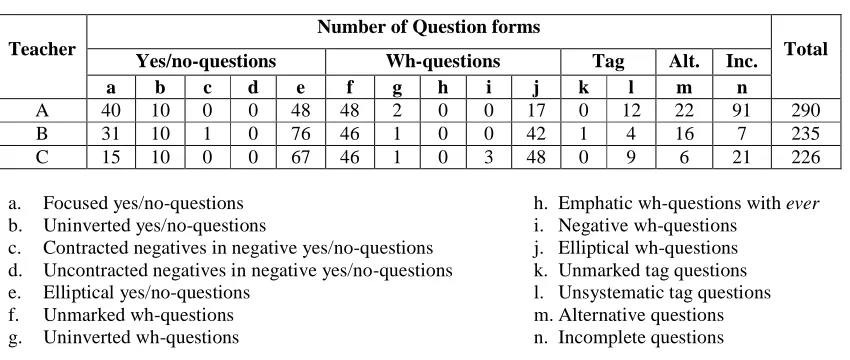
Table 2.The Number Distribution of Form-based Questioning Types
Teacher
Number of Question forms
Total
Yes/no-questions Wh-questions Tag Alt. Inc.
a b c d e f g h i j k l m n
A 40 10 0 0 48 48 2 0 0 17 0 12 22 91 290
B 31 10 1 0 76 46 1 0 0 42 1 4 16 7 235
C 15 10 0 0 67 46 1 0 3 48 0 9 6 21 226
a. Focused yes/no-questions b. Uninverted yes/no-questions
c. Contracted negatives in negative yes/no-questions d. Uncontracted negatives in negative yes/no-questions e. Elliptical yes/no-questions
f. Unmarked wh-questions g. Uninverted wh-questions
h. Emphatic wh-questions withever i. Negative wh-questions
j. Elliptical wh-questions k. Unmarked tag questions l. Unsystematic tag questions m. Alternative questions n. Incomplete questions
wh-questions, which occurred in the forms of incomplete clauses, phrases, or fragments. Interestingly, unmarked tag questions, which are commonly used by native speakers of English on a daily basis, were rarely used. Instead, it was unsystematic tag questions that occurred more frequently. Likewise, uninverted wh-questions were also rarely used, since they occurred only once at the post-elementary level. Two questioning types—uncontracted negatives in negative yes/no-questions and emphatic wh-questions with ever—were not used at all by the three teachers.
Incomplete questions, accounting for 31.38% or almost a third of the total questions used, outnumbered the other types that I used in my class. In most cases, I used this question type to help students who had trouble doing their exercises, which resulted in my dictating almost every line of the answer to them.
[4] T: (student’s name), can you tell me the nearest department store? S: (Inaudible)?
T: No, department store. Where is it? Winkle department store. How do I get there? So, it’s easy here. You can say (pause) S: Go to the corner.
T: Go to the corner of Fourth and State, and then turn …? S: Left. Turn left.
T: Turn left on Fourth Avenue. S: Turn left on Fourth Avenue.
T: And walk for …? And walk for one …? S: Walk for …one block.
T: One block? Yeah. And then turn …?
S: And then turn left on Main Street, and it is on the right.
The second and third most-frequently used question forms in my class were elliptical yes/no-questions and wh-questions. Elliptical yes/no-questions occurred in the form of incomplete clauses, phrases, and fragments respectively, such as follows:
[5] You know the salted egg? [6] Three days off?
[7] Walnut?
Likewise, teacher B most-frequently used elliptical yes/no-questions, as in [8] and [9] below, even though she alsoexplored the most variety of the question forms.
[8] (Do) You mean the citizen?
[9] (Are they your) Your children’ shoes?
Teacher C also most-frequently employed elliptical yes/no questions, as in [10] and [11], and elliptical WH-questions, as in [12] and [13].
[10] X, (do) have any experience? [11] (Is there) Any special occasion? [12] (It was) Caused by what? [13] Whose turn (is it now)?
dominate nearly half the questions in conversation. Even every fourth question in conversation is a question tag, and the most common type of questions tag is negative (Biber et al. 1999, p. 211). However, in all these three classes, question tags were rarely employed. Instead of using unmarked tag questions, the teacher used unsystematic tag questions. Of the seven questions occurred, right was used as a substitute for the auxiliary in six questions, and the other was you mean?
[14] There have been a lot of inventions, right? [15] Service center, you mean?
Question [15] was supposed to be a form of yes/no-question: do you mean service center?
Function-Based Questioning Types
The function-based questioning types did not frequently occur in the three classes. Identifying these function-based questioning types is the subtlest task in comparison with identifying the other questioning types. However, I figured out that teachers’ tones were a helpful instrument. Rising tones indicates that the speaker is not clear about what she/he has just heard; the speaker is asking for clarity or further explanation. Falling tones indicates that the speaker is somewhat sure of what she/he has just heard; the speaker is confirming that what she/he has just heard is true.
Yet, this category is the most interesting to analyze, as this category reflects teachers-students interaction. Through this category, we can see how each teacher communicates and/or negotiates with the students to reach an understanding. The fact that there were some Korean and Japanese students in each class and that the teachers neither understand nor speak Korean and Japanese made it interesting to see how they bridged the ‘gap’ between them. There was indeed a gap because of the different languages. Problems such as unclear pronunciation or complex sentences might have resulted in students’ confusion. However, it was surprising that these three questioning types were not frequently used in the three classes.
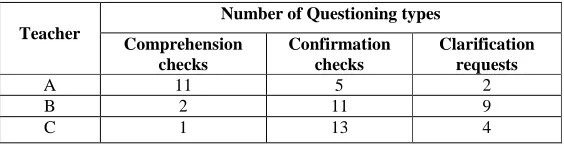
Table 3. The Number Distribution of Function-based Questioning Types
Teacher
Number of Questioning types
Comprehension checks
Confirmation checks
Clarification requests
A 11 5 2
B 2 11 9
C 1 13 4
Most of the time I repeated my questions when making comprehension checks, as in [16].
[16] T: What is it like (pause) sompyon? S: What is like?
T:What is it like? S: Traditional.
[17] S: (Muttering in Korean) You know brown? T:Palm sugar?Palm sugar?
S: Palm?
In making clarification requests, I also made guesses and provided my students with some words, as in [18], as I realized that the students had a limited range of vocabulary to express their thoughts.
[18] S: Boil (pause) boil (pause)
T: Boil (pause)Boil(pause)what?Rice? S: Yeah.
T: Vegetables?
S: No. Rice. Sweet like powder (pause)
In class B, the number of confirmation checks was not significantly bigger than that of clarification requests. Confirmation checks occurred as an expression of disbelief, as in [19] below.
[19] S: If you drink a lot of water in Indonesia we have got a (pause) stone (pause) T:Stone?
S: (saying words in Korean) T: Kidney!
S: Kidney?
T: Kidney (pause) Usually the stone is located here.
In the following example, teacher B made another clarification request when she completely did not understand the student’s word.
[20] T: What did you drink? Soju or beer? S: Kang.
T:Kang? S: Can! Can!
T: Oh, can! How many cans?
In excerpt [21] below, teacher C had difficulty in understanding the student’s utterance. It was not because they mispronounced the word, but because they pronounced it in their native language—Indonesian—not in English. The teacher seemed not to think that the student did so; consequently, she seemed very confused to learn that it was an Indonesian word. Furthermore, the teacher made efforts to guess the words the students were trying to pronounce correctly, as in [22].
[21] T: Caused by what?
S: (inaudible) sun (inaudible) T: Sorry?
S: (inaudible) T:Culture?
S: Tauco (pause) tauco (pause) T: Tauco? Oh, really? In Indonesia? [22] T: Others?
T: Protective? S: Tif (pause) T:Tif? S: Thief.
T: Tif (pause) Thief! In the store…
Reflecting on my experience and my two fellow teachers, I learned that as teachers we might have misinterpreted the task of encouraging students to talk by asking them questions. We might think that by answering our questions, students learned to communicate. However, we need to review the way we ask questions, as we might have dominated our classroom talk through our questions.
CONCLUSION
In general, the three teachers used various questioning types not only to promote classroom interaction, but also to encourage the students to communicate in a real-life setting, to build a closer connection with the students, and to help the students deal with difficulty in expressing themselves—because of their limited vocabulary. The results of this research showed that each of the three teachers involved in this research were found to ask a substantial number of questions during the two-hour lesson.
Between the purpose-based questioning types, display questions were extensively used at the pre-elementary level, whereas referential questions were more frequently used in the other two higher levels. The function-based questioning types did not frequently occur in the three classes. At the pre-elementary level, it was comprehension checks that was the most frequently used, whereas at the higher levels, it was confirmation checks. They occurred most frequently at the intermediate level. Meanwhile, clarification requests occurred most frequently at the post-elementary level, but rarely occurred at the pre-elementary level.
The most crucial finding in this research is the predominance of incomplete questions, which belonged to the form-based questioning types. In a communicative class, students are supposed to have adequate opportunity to practice speaking. Incomplete questions require short responses—either words or phrases. They do not stimulate long responses and do not give students freedom to practice using the language structures they have learnt. These questions require accuracy, rather than promoting language practice. This study, therefore, suggests that teachers use incomplete questions less frequently, and try to explore other form-based questioning types.
REFERENCES
Banbrook, L. and Skehan, P. (1989). “Classrooms and Display Questions.” in C. Brumfit and S. Mitchell, Research in the Language Classroom (pp. 141-152). London: MEP/The British Council.
Bartlett, L. (1990). “Teacher Development through Reflective Teaching.” in J. C. Richards and D. Nunan (Eds.),Second Language Teacher Education (pp. 202-214). New York: Cambridge University Press.
Biber, D., Johansson, S., Leech, G., Conrad, S., and Finegan, E. (1999). Longman Grammar of Spoken and Written English.Essex: Pearson Education Limited.
Brock, C. A. (1986). “The Effects of Referential Questions on ESL Classroom Discourse.” TESOL Quarterly20(1), pp. 47-81.
Celce-Murcia, M. and Larsen-Freeman, Diane. (1999).The Grammar Book.Boston: Heinle & Heinle.
Long, Michael H. and Sato, C. (1983). “Classroom Foreigner Talk Discourse: Forms and Functions of Teachers’ Questions,” in Seliger, H. W. and Long, M. H. (Eds.) Classroom Oriented Research in Second Language Acquisition. Rowley, Mass.: Newbury House.
Nunan, D. (1989).Understanding Language Classrooms. Hertfordshire: Prentice Hall.
Nunan, D. (1992). Research Methods in Language Learning. Cambridge: Cambridge University Press.
Richards, J. C., and Lockhart, C. (1994). Reflective Teaching in Second Language Classrooms. Cambridge: Cambridge University Press.
APPENDIX
SAMPLES OF DATA CLASSIFICATIONS OF TEACHERS’ QUESTIONS A. Questioning Types
The purpose-based questioning types
No. Referential Questions Display Questions
1. What is it like, sompyon? How come? 2. What are the ingredients? Are you sure?
3. Palm sugar? So, you must be where?
The form-based questioning types
No. Focused yes/no-questions Uninverted yes/no-questions
1. Can you find me? It’s on the left?
2. Excuse me, is there a restaurant near here? You’re ready for number five?
No. Contracted negative in negative yes/no-questions
1. Isn’t that using this?
No. Elliptical yes/no-questions
1. Doing the house chores? 2. You mean the citizen?
No. Unmarked wh-questions
1. What does it mean byused to? 2. How do you begin your question? 3. Why are they moving the heavy boxes?
No. Uninverted wh-questions
1. You sleep how long?
No. Negative wh-questions
1. Why didn’t you go there and then ask?
No. Elliptical wh-questions
1. What kind of exercise? 2. Order out?
4. In Japan, what animal?
No. Tag questions Alternative questions
1. You know the difference between foot and leg, don’t you?
X, you have any brothers or sisters?
No. Unsystematic tag questions Incomplete questions
1. There have been a lot of inventions, right? So LASER stands for …?
2. So, laser is used in surgery, right? Based on this context, it’s not waste, but …?
The Function-based questioning types
Comprehension Checks Confirmation Checks Clarification Requests
T: D, can you tell me the nearest department store? S: (inaudible)
T: No, department store, where
is it?
S: I think (pause) people (inaudible)
T:You mean the citizen? S: Ya (pause)
T: The population…
T: Others? S: …tif… T: Protective? S: Tif… T:Tif? S: Thief.