Issues
ISSN: 2146-4138
available at http: www.econjournals.com
International Journal of Economics and Financial Issues, 2018, 8(5), 266-275.
Exploring the Key Factors Affecting Development of Bond
Market in Bangladesh: An Application of Exploratory Factor
Analysis
Noor Nahar Begum
1*, Md Aktar Kamal
21Department of Finance and Banking, Faculty of Business Studies, Bangladesh University of Professionals, Bangladesh, 2Department of Management, Faculty of Business Studies, Bangladesh University of Professionals, Bangladesh.
*Email: [email protected]
ABSTRACT
An efficient and well-functioning government bond market is often considered important to the smooth functioning of financial markets more generally. To enhance corporate bond financing, it is important to examine factors that affect the effective development of bond markets in Bangladesh. The aim of this study was to determine key factors affecting the development of bond market in Bangladesh. The study was conducted over 60 respondents from financial institutions by using convenient sampling technique. For data collection structured questionnaire has been used. The questionnaire was developed with 5-point Liker scale where, 1 refers to “strongly disagree” and 5 refers to strongly agree. The study attempts to identify the determinants of bond market development in Bangladesh economies through examining the relationship of bond issuance with selected key financial and economic
factors. Major determinants for bond market development in Bangladesh include developing the money market, strengthening the government’s debt and cash management capacity, reforming the national savings scheme, reducing issuance costs for corporate bonds, broadening the investor base, increasing transparency in the secondary market, creating and enabling legal and regulatory framework, strengthening the credit rating industry.
Keywords: Bond Market, Factor Analysis, Capital Market
JEL Classifications: G1, G2, G4
1. BACKGROUND
The Financial sector is a fundamental sector of any financial system of a country, which affects its investment in business environment, financial prospects and social magnitude, as well as poverty. An immense empirical and logical literature propose that in addition to other economic factors, the country’s degree of financial sector development depends on performance of long term economic growth and welfare. The financial markets are the crucial point of financial sector, perform an essential function within the universal economic system such as alluring and allocating of savings, setting interest rates and discovering the prices of financial assets (Rose, 2003). A well extended financial sector is highly dependent on the intense associations of financing from equity market, bond market, and banks. In both developing and developed countries, the government bond market formulates the structure of a securities market. For the economic development of a country,
a good performing domestic bond markets are incredibly crucial as they assist long term financing for facilities like infrastructural development, housing and private sector development etc. But it is difficult to develop a well functioning diversified bond market.
South Asian countries total of only 5.5% of country’s GDP (Mujeri and Rahman, 2008).
Inspired and motivated by the above mentioned bond market, this research is taken to assess the efficacy of selected bond market of some developed countries by different qualitative methods of impact assessment in order to put some policy recommendation for the vibrant bond market development in Bangladesh. This paper tries to find some prerequisites to develop a vibrant bond market for the sustainable economic development.
The main objective of this study is to exploring the key factors, which are affecting the developments of the Bond Market in Bangladesh.
2. LİTERATURE REVİEW
Available literature found that Bond markets attained importance after financial crisis in East Asia during 1997. The crisis forced to reconsider influence of financial market in economic growth. Numerous limitations of banking systems including currency mismatches, maturity and moral hazard problems were identified (Barry and Pipat, 2004). According to Eichengreen and Luengnaruemitchai (2004) among different determinates to issue bonds, size and liquidity play important role for the firms. A study conducted by Thumrongvi et al. (2013) over thirty eight countries recommended that a well established stock market contributes economic development. They found that dominance of bank credits are negatively related with domestic bond market development. They further recommended that economic development is also positively associated with government bond. On the other hand contribution of corporate bond is mixed from positive to negative based on size and diversity of financial structure.
In order to identify the prerequisites of bond market development in Asian Countries Bhattacharyay (2013) attempted to examine the connection of bond issuance with some selected key economic and financial factors. sHe concluded that bond market development in Asia depends on the economy size, the level of economic growth, openness, the variability of exchange rate, the dominance of bank, and inconsistent interest rate. Hakansson (1999) indentified different benefits of an established bond market in his study. According to him sound financial structure largely depends on established bond market. He suggested that transparent reporting system, availability of financial experts, efficient and effective mechanism of corporate reform and proper liquidation policy are vital determinates for developing a sound bond market. Herring and Chatusripitak (2000) also found consistency with Hakansson (1999). They recommended that not having a well-established bond market may diminish the efficient growth of an economy and consequently raise the vulnerability in financial system to a financial crisis. Moreover Eichengreen et al. (2008) find contradictory results concerning a number of the institutional and corporate governance factors, like economy with strong creditor rights have small private bond markets. According to them private bond capitalization varies with a partial amount of policy variables along with country characteristics. They concluded that Size of Country, development level, financial system, geographical and
historical factors are critical for bond market development. Some Policy variables like macroeconomic stability, openness to trade, protection of investor, cost associated with contract enforcement and privatized pension also have power on economic development.
A recent study conducted by Bae (2012) analyse the factors affecting the development of bond market in China, conducting survey on forty three developing and developed countries during the period of 1990–2009. This research differentiates among finance, private and public bond market. According to the finding the level of economic growth is measured on the basis of GDP per capita. Fiscal balance plays important role in government bond market with larger deficit lending. In case of financial bond GDP per capital is most vital factor while low rate of interest, established government bond and dominance of banks have significant influence on market development for corporate bond. Aktaruzzaman et al. (2008) explained that the small bond market in Bangladesh faces different challenges originating from numerous sources including extreme dependence on bank credit, domination of primary auction based activity in government debt instruments, lack of yardstick yield curve, and absence of product variation. They recommended some policies and actions in several areas like decrease in interest on government savings instruments and registration fees, tax release on income of bonds/debentures, ranking of bond instruments by sovereign rating agency. Jahur (2009) conducted a study on bond market in Bangladesh by taking a personal interview from twenty two financial executive of companies has identified six important barriers to the development of bond market in Bangladesh. In this study he has graded six important impediment to the development of bond market in Bangladesh in order of their magnitude like (i) risk and return (ii) liquidity and government policy (iii) issue management (iv) investment policy factor (v) macro economic and regulatory factor (vi) market and issue related factors. Misir et al. (2010) suggested following measures to improve Bangladesh bond market: (i) Develop a sovereign yield curve (ii) government should act as a credible Issuer and market establisher (iii) flexible SLR for strengthening institutional investor (iv) forming sound environment for retail and foreign investor (v) developing ground for primary dealers (vi) form secondary market (vii) ensuring transparency and disseminating information in the secondary market (viii) formulating negotiated dealing (ix) initiating delivery versus payment system (x) establishing bond index (xi) adopting the improvement agenda recommended by different expert committees (xii) establishing qualitative strength. In a recent study by Pradhan et al. (2016) find that bond market development and the four macroeconomic covariates may be long-run causative factors for economic growth. As a result, policy makers seeking to foster economic growth are warned to check multi-causal studies involving all these variables before setting their policies.
research gap. This study gap persuaded the researcher to carry out the current research.
3. RESEARCH METHODOLOGY
With regard to research methodology, this study have been used a fully integrated mixed method of research including desk review (research), a questionnaire survey, and semi structured interview. The rationale of using this method in this study is that it considered applications to practice and policy as well as theory and research based knowledge (Tashakkori and Teddlie, 2010). However, more emphasis has been given on the qualitative methodology. In addition, this study conducted an interview with financial analyst and industry expert groups.
3.1. Sample Design
The population of this study is total Capital Market sector. The target population areas were Dhaka and Chittagong, Bangladesh and sample data is collected from financial analyst and executives of banking and nonbanking financial institution of Bangladesh. There are 30 listed banks and 23 listed non-banking financial institutions. The Banking sector has been divided into four parts: Regulatory body i.e., Bangladesh Bank (BB), first generation, second generation and third generation bank. To answer the quantitative proportion of research questions with relating to the development of bond market non probabilistic convenient sampling technique has been designed. For quantitative data purpose target sample have selected from the total set of population listed in Stock Exchanges in Bangladesh. Data have collected from 60 participants consist of financial analyst and financial executives. Out of them, 10 sample from each part of the banks and 20 samples from nonbank financial institutions.
3.2. Data Collections
3.2.1. Primary data
The primary data has been collected by sending the questionnaire to the target participants through email and face to face interviews. The primary data collected through interview from financial executives, and financial analyst. To collect primary data a structured questionnaire consisting of 12 questions was developed, using a 5-point Likert Scale ranging from strongly agree (1) to strongly disagree (5).
3.2.2. Secondary data
Data has been collected from the available public sources. The secondary data has been collected from the following sources: BB, Securities and Exchange Commission (SEC), Dhaka Stock Exchange, Central Depository Bangladesh Limited, World Bank, Asian Development Bank, Bank for International Settlement, Debt Management Department, Research publications from Policy Analysis Unit of BB, Economic Relations Division, Finance Division, Ministry of Finance-GOB, Donor publications, Government publications, Journals, Working papers, Newspaper clippings, and Website materials.
3.3. Data Analysis
Relevant research papers and reports from South-Asian and global perspective have been analyzed to find out the important determinants
for developing vibrant bond markets in Bangladesh. To analyze the factors relating to the development of bond market have been used for data analysis. The data thus collected through questionnaire survey has been tabulated first and then analyzed with the support of different financial and descriptive statistical tools like mean, mode, sum, ranking, comparison among the factors etc. and factor analysis were done. The factors have been ranked according to lowest total sum which indicates more positive answer from respondents.
4. RESULTS
The following tables describe about the factors that determine the development of corporate bond market in Bangladesh. The factors have been divided into five segments.
4.1. A Stable Political Environment
Table 1 describes about the factors that determine a stable political environment. The respondents given their preferences among the factors. According to the respondents’ perspective political stability ranked as 1 and they are neutral about their choice. Weak investors rights ranked 2, government policy ranked as 3, strengthening of institutions ranked as 4 and finally the promulgation of new constitution ranked as 5.
4.2. The Macro-economic Environment
A large numbers of factors have been identified under the macro-economic environment segment. The factor alternative finance has been ranked as (1) excessive govt. bond has been ranked as (2) ınterest rate exchange rate and inflation has been ranked as (3) low foreign investors participation and control on capital flows (4) current tax regime 6, disproportionate taxes 7 and finally high level and long term strategic decision ranked as 8. For the factors High level and long term strategic decision, Interest rate, exchange rates and inflation and Low foreign investor participation respondents are neutral about their opinion. Respondents are agreed about the factors: Current tax regime, disproportionate taxes, excessive govt. bond, Alternative finance, and control on capital flows [Table 2].
4.3. Supervision and Regulation
Table 3 describes about the segment supervision and regulation. There are 7 factors under this segment. Respondents ranked the factor lack of requisite experience, skill and expertise as 1and they are strongly agree about their opinion. Less expertise authorities ranked as 2 and respondents are agreed about it. Disclosures requirements ranked as 3, less information flow ranked as 4, lack of effective coordinating mechanism ranked as 5 and the respondents are agreed about their opinion. The factor self regulatory function and the factor monitored by relevant supervisor are ranked 6 and 7 respectively. Respondents are neutral about these factors.
4.4. Effective Market İnfrastructure
Table 1: Factors determining a stable political environment
Statistics Statistics for
variables Political stability Weak investor rights Govt. policy Strengthening of institutions Promulgation of new constitution
N
Valid 60 60 60 60 60
Missing 0 0 0 0 0
Mode 3 3 2 3 3
Sum 137 142 164 166 183
Rank 1 2 3 4 5
Table 2: Factors determining macro-economic environment
Statistics Statistics for variables
Current
tax regime Disproportionate taxes govt. bondExcessive Alternative finance exchange rates Interest rate, and inflation
High level and long term strategic
decision
Low foreign investor participation
Control on capital
flows
N
Valid 60 60 60 60 60 60 60 60
Missing 0 0 0 0 0 0 0 0
Mode 2 2 2 2 3 3 3 2a
Sum 176 191 132 120 134 211 147 147
Rank 6 7 2 1 3 8 4 4
Table 3: Factors determining supervision and regulation
Statistics Statistics for variables
Lack of requisite experience, skill
and expertise
Less information
flow Less expertise authorities requirementsDisclosure regulatory Self function
Monitored by relevant supervisor
Lack of effective coordinating
mechanism
N
Valid 60 60 60 60 60 60 60
Missing 0 0 0 0 0 0 0
Mode 1 2 2 2 3 3 2
Sum 113 130 119 125 173 193 132
Rank 1 4 2 3 6 7 5
Table 4: Factors determining effective market infrastructure
Statistics Statistics for variables
Absence of an effective government benchmark yield curve
Absence of effective information dissemination system
Expeditious and efficient
offering
Absence of formal automated centralized system
An effective market-making
system
Lack of credible and effective credit
rating agencies
N
Valid 60 60 60 60 60 60
Missing 0 0 0 0 0 0
Mode 3 2 4 1 3 2
Sum 144 113 211 158 182 179
Rank 2 1 6 3 5 4
Table 5: Factors determining diversified intermediaries
Statistics Statistics for variables
Lack of appreciation and
understanding
Competition in financial intermediation
and a reduction
Regulatory framework has not sufficiently recognized
Institutional investors are subject
to restriction
Narrow investor
base
Securitization has been relatively underdeveloped
N
Valid 60 60 60 60 60 60
Missing 0 0 0 0 0 0
Mode 2 2 1 2 1 2
Sum 130 125 125 107 102 117
ranked as 3 and the respondents are strongly agreed about it. Lack of credible and effective credit rating agencies factor ranked as 4 agreed about it. The factor an effective market-making system ranked as 5 and respondents are neutral about their opinion. The last factor expeditious and efficient offering ranked as 6 and the respondents are disagreed about their opinion.
4.5. Diversified İntermediaries
The last segment is diversified intermediaries and it consists of 6 factors. Here the respondents ranked the factor narrow investor base as 1 and strongly agreed. The factor ınstitutional investors are subject to restriction ranked as 2, securitization has been relatively underdeveloped ranked as 3, competition in financial intermediation and a reduction ranked as 4 and the respondents are agreed about their opinion for these factors. Regulatory framework has not sufficiently recognized also ranked as 4 as the sum value are same but investors are strongly agreed about it. Finally, the factor Lack of appreciation and understanding ranked as 6 and respondents are agreed about their opinion [Table 5].
4.6. Comparisons Among the Factors
Table 6 shows the comparison among the factors that determine the development of Corporate Bond Market in Bangladesh. After comparison the factor diversified intermediaries ranked as
1, supervision and regulation ranked as 2, the macro-economic environment ranked as 3, A stable political environment ranked as 4 and effective market infrastructure ranked as 5.
4.7. Factor Analysis
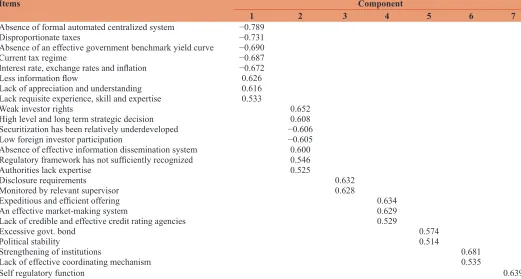
Factor analysis is a tool which helps to reduce large number of variables to a smaller number of accepted underlying hypothetical entities called factor (Fruchter, 1967). The objective of factor analysis is mainly: Minimizing data and substantive interpretation. It attempts to simplify the diverse relationship by detecting common dimensions or factors that exist among a set of observed variables. It also links together the dissimilar variables and as a result provides insight into the underlying structures of the data (Dillion and Goldstein, 1984). In this study, “principal component matrix” of factor has been analyzed to discover the factors determining development of bond market in Bangladesh (Table 7).
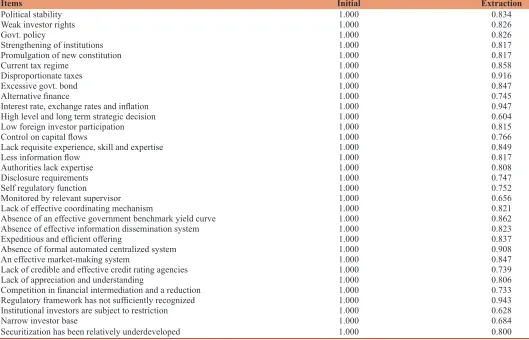
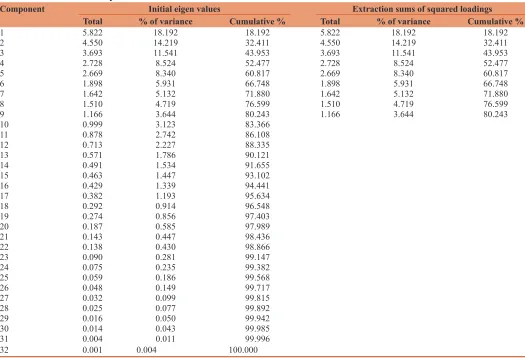
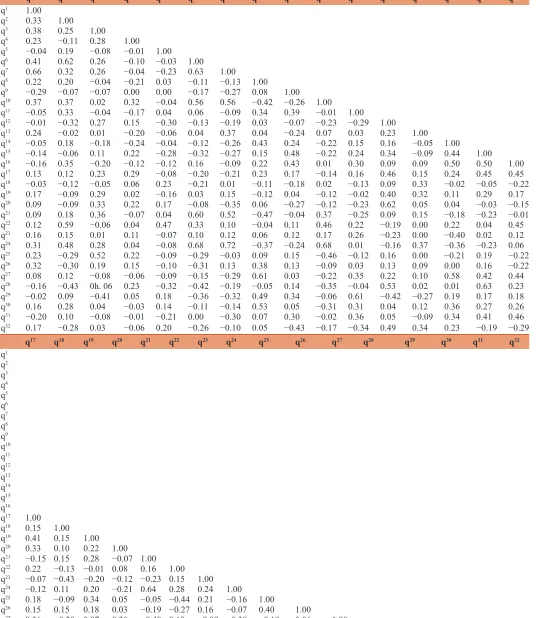
Principal component factor (Appendix Table 1 - communalities) clarifies more variance that the loadings obtained from any method of factoring. In order to define the group membership, an algorithm may be used to uncover a structure purely on the basis of the correlation structure of the input variables. Then the number of principal components to be retained in the study has been decided on the basis of Kaiser’s criterion (1958) of Eigen value >1. The factor model indicates seven distinct factors loading without any misclassification: Factors 1–7. In Sppendix Tables 3 and 4 the correlation matrix of the variable and name of the variables are explained.
Factor 1 includes 8 variables which are absence of formal automated centralized system, disproportionate taxes, absence of an effective government benchmark yield curve, current tax Table 6: Comparisons among the factors
Factors Sum Average Rank
A stable political environment 792 158.40 4
The macro-economic environment 1258 157.25 3
Supervision and regulation 985 140.71 2
Effective market infrastructure 987 164.50 5
Diversified intermediaries 706 117.67 1
Table 7: Principal component matrix
Items Component
1 2 3 4 5 6 7
Absence of formal automated centralized system −0.789
Disproportionate taxes −0.731
Absence of an effective government benchmark yield curve −0.690
Current tax regime −0.687
Interest rate, exchange rates and inflation −0.672
Less information flow 0.626
Lack of appreciation and understanding 0.616
Lack requisite experience, skill and expertise 0.533
Weak investor rights 0.652
High level and long term strategic decision 0.608
Securitization has been relatively underdeveloped −0.606
Low foreign investor participation −0.605
Absence of effective information dissemination system 0.600
Regulatory framework has not sufficiently recognized 0.546
Authorities lack expertise 0.525
Disclosure requirements 0.632
Monitored by relevant supervisor 0.628
Expeditious and efficient offering 0.634
An effective market-making system 0.629
Lack of credible and effective credit rating agencies 0.529
Excessive govt. bond 0.574
Political stability 0.514
Strengthening of institutions 0.681
Lack of effective coordinating mechanism 0.535
Self regulatory function 0.639
regime, ınterest rate, exchange rates and inflation, less information flow, lack of appreciation and understanding, lack of requisite experience, skill and expertise., This factor explains 20.05% of the total variations existing in the variable set. This factor has significant factor loadings on these variables which have formed this major cluster.
Factor 2 explains 15.70% of the total variations existing in the variable set. This includes variables are weak investor rights, high level and long term strategic decision, securitization has been relatively underdeveloped, low foreign investor participation, absence of effective information dissemination system, regulatory framework has not sufficiently recognized and lack of expertise authorities. This factor has moderate factor loadings on these variables which has formed second important cluster with respect to the variation.
Factor 3 explains 12.10% of the total variations existing in the variable set. This factor includes disclosure requirements and monitored by relevant supervisor. Factor 4 explains 9.40% of the total variations existing in the variable set. This factor includes expeditious and efficient offering, an effective market-making system, and lack of credible and effective credit rating agencies.
Factor 5 explains 7.12% of the total variations existing in the variable set. Excessive govt. bond and political stability.
Factor 6 explains 5.80% of the total variations existing in the variable set. This factor includes strengthening of institutions and lack of effective coordinating mechanism.
Factor 7 explains 4.60% of the total variations existing in the variable set. This factor includes Self regulatory function. So this factor is less important factor among the seven factors. Together the seven factors explain almost75% of the variance (total in Appendix Table 2 total variance explained).
5. DİSCUSSİON AND CONCLUSİON
The debt securities market in Bangladesh remains at an initial stage. This empirical study has identified that well-functioning bond markets sharp the effectiveness of monetary policy operations and thereby accelerates the desired effect on the real economy. The study demonstrates that the seven factors discussed in this research can have a significant impact for developing vibrant bond market in Bangladesh. Market infrastructure development and an allowing environment for the bond market development by promoting the depository activity along with arrangements of clearing and settlement, promoting money market development, strengthening cash and debt management capacity of government, establishing legal and regulatory framework, form in the credit rating engineering, executing education program for investor, encouraging bond market development by reformatting the SEC rules on issuance of bonds, strengthening atmosphere for asset backed securitization and infrastructure bonds can ensure well established bond market in Bangladesh.
6. POLİCY IMPLİCATİONS
The study has some implications. Firstly, this study provides empirical evidence on the factors affecting bond market development, thus ultimately contributing to the money market and economic expansion of the country. Secondly, the present study advised the policy maker, economic planners, SEC, entrepreneur and investors to focus on key factors that are affecting the well-functioning bond markets and money market. Finally, the investigation and findings of this study will help the future researcher in the field of money market development.
7. LİMİTATİONS
The present study has a number of limitations. Firstly, the study was based on data collected from financial analyst and executives of banking and nonbanking financial institution of Bangladesh. Secondly, the survey instrument was mainly constructed with Likert scale, there could be the chance of central tendency bias, acquiescence bias and social desirability bias. Finally, this study was confined to only 60 respondents of banking and nonbanking financial institution located in Dhaka, Bangladesh and therefore it may not be representative one in terms of relationships in other developing countries. In spite of these limitations, the findings of the study will reflect the scenario of the development of well-functioning bond market for ensuring established capital market in Asia almost same and identical.
8. FUTURE DİRECTİONS FOR FURTHER
RESEARCH
This study has conducted on banking and non banking financial institutions of Bangladesh. Potential researchers can widen the scope of the study by taking data from other sectors. Research can also be conducted by taking the lessons from developed countries rather than Asian countries. Moreover, the study can also be done on the selection of highly/less significant variable(s) influencing the effectiveness of bond market development.
REFERENCES
Aktaruzzaman, M., Rahman, M.H., Rahman, M.H. (2008), Prospects and
challenges of bond market development in Bangladesh. Policy Note
Series: Bangladesh Bank, 901, 1-8. Available from: https://www. bb.org.bd/pub/research/policynote/pn0901.pdf.
Bae, K.H. (2012), Determinants of Local Currency Bonds and Foreign Holdings: Implications for Bond Market Development in the People’s
Republic of China. ADB Working Paper Series on Regional Economic Integration, 97, Asian Development Bank, Manila. Available from:
https://www.adb.org/sites/default/files/publication/29788/wp97-bae-determinants-local-currency-bonds.pdf.
Barry, E., Pipat, L. (2004), Why Does not Asia Have Bigger Bond Market. Bank for International Settlement (BIS). p30.
Available from: https://www.eml.berkeley.edu//~eichengr/research/
asianbondmarkets17apr904bisformat.pdf.
Bhattacharyay, B.N. (2013), Determinants of bond market development
Dillion, W.R., Goldstein, M. (1984), Multivariate Analysis: Methods and Applications. London: John Wiley and Sons.
Eichengreen, B., Luengnaruemitchai, P. (2004), Why Doesn’t Asia Have Big-ger Bond Markets? NBER Working Paper, 10576. Cambridge,
MA: National Bureau of Economic Research.
Eichengreen, B., Panizza, U., Borensztein, E. (2008), Bond Markets in Latin America: On the Verge of a Big Bang? Cambridge: MIT Press. p247-290.
Fruchter, B. (1967), Introduction to Factor. London: Von Nothland. Hakansson, N. (1999), The Role of a Corporate Bond Market in an
Economy and in Avoiding Crises. Research Program in Finance. Berkeley, CA: Institute of Business and Economic Research, UC Berkeley.
Herring, R., Chatusripitak, N. (2000), The Case of the Missing Market:
The Bond Market and Why it Matters Financial Development. Asian
Development Bank ADB Institute Working Paper (11).
Jahur, M.S. (2010), Developmnt of bond market in Bangladesh: Issues,
status and policies. Management Research and Practice Chittagong
Stock Exchange Ltd, 2(3), 299-313.
Misir, M.A., Mohsin, M., Kamal, A. (2010), Contemporary ıssues in bond market development in Bangladesh: Experience and evidence from Asian countries. The Bangladesh Accountant, 66(37), 25-33. Mujeri, M.K., Rahman, M.H. (2008). Financing Long Term Investment
in Bangladesh: Capital Market Development Issues. Bangladesh:
Policy Paper, Bangladesh Bank. p0905.
Pradhan, R.P., Arvin, M.B., Bennett, S.E., Mahendhiran, N., John, H.H. (2016), Bond market development, economic growth and other
macroeconomic determinants: Panel VAR evidence. Asia-Pac
Financial Markets, 23(2), 175-201.
Rose, P.S. (2003), Money and Capital Markets: Financial Institution and
Instruments in a Global Market Place. 8th ed. Chicago: McGraw Hill
Higher Education. p4-7.
Tashakkori, A., Teddlie, C. (2010), Sage Handbook of Mixed Methods
in Social and Behavioral Research. Chicago: SAGE Publications.
Thumrongvi, P., Kim, Y., Pyun, C.S. (2013), Linking the missing market:
The effect of bond markets on economic growth. International
Review of Economics and Finance, 27, 529-541.
APPENDIX: FACTOR ANALYSIS TABLES
Table 1: Communalities
Items Initial Extraction
Political stability 1.000 0.834
Weak investor rights 1.000 0.826
Govt. policy 1.000 0.826
Strengthening of institutions 1.000 0.817
Promulgation of new constitution 1.000 0.817
Current tax regime 1.000 0.858
Disproportionate taxes 1.000 0.916
Excessive govt. bond 1.000 0.847
Alternative finance 1.000 0.745
Interest rate, exchange rates and inflation 1.000 0.947
High level and long term strategic decision 1.000 0.604
Low foreign investor participation 1.000 0.815
Control on capital flows 1.000 0.766
Lack requisite experience, skill and expertise 1.000 0.849
Less information flow 1.000 0.817
Authorities lack expertise 1.000 0.808
Disclosure requirements 1.000 0.747
Self regulatory function 1.000 0.752
Monitored by relevant supervisor 1.000 0.656
Lack of effective coordinating mechanism 1.000 0.821
Absence of an effective government benchmark yield curve 1.000 0.862
Absence of effective information dissemination system 1.000 0.823
Expeditious and efficient offering 1.000 0.837
Absence of formal automated centralized system 1.000 0.908
An effective market-making system 1.000 0.847
Lack of credible and effective credit rating agencies 1.000 0.739
Lack of appreciation and understanding 1.000 0.806
Competition in financial intermediation and a reduction 1.000 0.733
Regulatory framework has not sufficiently recognized 1.000 0.943
Institutional investors are subject to restriction 1.000 0.628
Narrow investor base 1.000 0.684
Securitization has been relatively underdeveloped 1.000 0.800
Table 2: Total variance explained
Component Initial eigen values Extraction sums of squared loadings
Total % of variance Cumulative % Total % of variance Cumulative %
1 5.822 18.192 18.192 5.822 18.192 18.192
2 4.550 14.219 32.411 4.550 14.219 32.411
3 3.693 11.541 43.953 3.693 11.541 43.953
4 2.728 8.524 52.477 2.728 8.524 52.477
5 2.669 8.340 60.817 2.669 8.340 60.817
6 1.898 5.931 66.748 1.898 5.931 66.748
7 1.642 5.132 71.880 1.642 5.132 71.880
8 1.510 4.719 76.599 1.510 4.719 76.599
9 1.166 3.644 80.243 1.166 3.644 80.243
10 0.999 3.123 83.366
11 0.878 2.742 86.108
12 0.713 2.227 88.335
13 0.571 1.786 90.121
14 0.491 1.534 91.655
15 0.463 1.447 93.102
16 0.429 1.339 94.441
17 0.382 1.193 95.634
18 0.292 0.914 96.548
19 0.274 0.856 97.403
20 0.187 0.585 97.989
21 0.143 0.447 98.436
22 0.138 0.430 98.866
23 0.090 0.281 99.147
24 0.075 0.235 99.382
25 0.059 0.186 99.568
26 0.048 0.149 99.717
27 0.032 0.099 99.815
28 0.025 0.077 99.892
29 0.016 0.050 99.942
30 0.014 0.043 99.985
31 0.004 0.011 99.996
32 0.001 0.004 100.000
Table 3: Correlation matrix
q1 q2 q3 q4 q5 q6 q7 q8 q9 q10 q11 q12 q13 q14 q15 q16
q1 1.00
q2 0.33 1.00
q3 0.38 0.25 1.00
q4 0.23 −0.11 0.28 1.00
q5 −0.04 0.19 −0.08 −0.01 1.00
q6 0.41 0.62 0.26 −0.10 −0.03 1.00
q7 0.66 0.32 0.26 −0.04 −0.23 0.63 1.00
q8 0.22 0.20 −0.04 −0.21 0.03 −0.11 −0.13 1.00
q9 −0.29 −0.07 −0.07 0.00 0.00 −0.17 −0.27 0.08 1.00
q10 0.37 0.37 0.02 0.32 −0.04 0.56 0.56 −0.42 −0.26 1.00
q11 −0.05 0.33 −0.04 −0.17 0.04 0.06 −0.09 0.34 0.39 −0.01 1.00
q12 −0.01 −0.32 0.27 0.15 −0.30 −0.13 −0.19 0.03 −0.07 −0.23 −0.29 1.00
q13 0.24 −0.02 0.01 −0.20 −0.06 0.04 0.37 0.04 −0.24 0.07 0.03 0.23 1.00
q14 −0.05 0.18 −0.18 −0.24 −0.04 −0.12 −0.26 0.43 0.24 −0.22 0.15 0.16 −0.05 1.00
q15 −0.14 −0.06 0.11 0.22 −0.28 −0.32 −0.27 0.15 0.48 −0.22 0.24 0.34 −0.09 0.44 1.00
q16 −0.16 0.35 −0.20 −0.12 −0.12 0.16 −0.09 0.22 0.43 0.01 0.30 0.09 0.09 0.50 0.50 1.00
q17 0.13 0.12 0.23 0.29 −0.08 −0.20 −0.21 0.23 0.17 −0.14 0.16 0.46 0.15 0.24 0.45 0.45
q18 −0.03 −0.12 −0.05 0.06 0.23 −0.21 0.01 −0.11 −0.18 0.02 −0.13 0.09 0.33 −0.02 −0.05 −0.22
q19 0.17 −0.09 0.29 0.02 −0.16 0.03 0.15 −0.12 0.04 −0.12 −0.02 0.40 0.32 0.11 0.29 0.17
q20 0.09 −0.09 0.33 0.22 0.17 −0.08 −0.35 0.06 −0.27 −0.12 −0.23 0.62 0.05 0.04 −0.03 −0.15
q21 0.09 0.18 0.36 −0.07 0.04 0.60 0.52 −0.47 −0.04 0.37 −0.25 0.09 0.15 −0.18 −0.23 −0.01
q22 0.12 0.59 −0.06 0.04 0.47 0.33 0.10 −0.04 0.11 0.46 0.22 −0.19 0.00 0.22 0.04 0.45
q23 0.16 0.15 0.01 0.11 −0.07 0.10 0.12 0.06 0.12 0.17 0.26 −0.23 0.00 −0.40 0.02 0.12
q24 0.31 0.48 0.28 0.04 −0.08 0.68 0.72 −0.37 −0.24 0.68 0.01 −0.16 0.37 −0.36 −0.23 0.06
q25 0.23 −0.29 0.52 0.22 −0.09 −0.29 −0.03 0.09 0.15 −0.46 −0.12 0.16 0.00 −0.21 0.19 −0.22
q26 0.32 −0.30 0.19 0.15 −0.10 −0.31 0.13 0.38 0.13 −0.09 0.03 0.13 0.09 0.00 0.16 −0.22
q27 0.08 0.12 −0.08 −0.06 −0.09 −0.15 −0.29 0.61 0.03 −0.22 0.35 0.22 0.10 0.58 0.42 0.44
q28 −0.16 −0.43 0h. 06 0.23 −0.32 −0.42 −0.19 −0.05 0.14 −0.35 −0.04 0.53 0.02 0.01 0.63 0.23
q29 −0.02 0.09 −0.41 0.05 0.18 −0.36 −0.32 0.49 0.34 −0.06 0.61 −0.42 −0.27 0.19 0.17 0.18
q30 0.16 0.28 0.04 −0.03 0.14 −0.11 −0.14 0.53 0.05 −0.31 0.31 0.04 0.12 0.36 0.27 0.26
q31 −0.20 0.10 −0.08 −0.01 −0.21 0.00 −0.30 0.07 0.30 −0.02 0.36 0.05 −0.09 0.34 0.41 0.46
q32 0.17 −0.28 0.03 −0.06 0.20 −0.26 −0.10 0.05 −0.43 −0.17 −0.34 0.49 0.34 0.23 −0.19 −0.29
q17 q18 q19 q20 q21 q22 q23 q24 q25 q26 q27 q28 q29 q30 q31 q32
q1
q2
q3
q4
q5
q6
q7
q8
q9
q10
q11
q12
q13
q14
q15
q16
q17 1.00
q18 0.15 1.00
q19 0.41 0.15 1.00
q20 0.33 0.10 0.22 1.00
q21 −0.15 0.15 0.28 −0.07 1.00
q22 0.22 −0.13 −0.01 0.08 0.16 1.00
q23 −0.07 −0.43 −0.20 −0.12 −0.23 0.15 1.00
q24 −0.12 0.11 0.20 −0.21 0.64 0.28 0.24 1.00
q25 0.18 −0.09 0.34 0.05 −0.05 −0.44 0.21 −0.16 1.00
q26 0.15 0.15 0.18 0.03 −0.19 −0.27 0.16 −0.07 0.40 1.00
q27 0.36 −0.20 0.07 0.20 −0.40 0.19 −0.09 −0.38 −0.10 0.06 1.00
q28 0.41 0.10 0.35 0.06 −0.17 −0.30 −0.07 −0.28 0.32 0.09 0.08 1.00
q29 0.14 −0.16 −0.37 −0.19 −0.70 0.18 0.37 −0.41 −0.11 0.29 0.34 −0.07 1.00
q30 0.37 0.08 0.20 0.15 −0.37 0.17 0.05 −0.11 0.08 0.07 0.27 0.19 0.26 1.00
q31 0.27 −0.37 0.08 0.02 −0.16 0.25 −0.05 −0.17 −0.24 −0.27 0.57 0.02 0.15 0.00 1.00
Table 4: Name of the factors in correlation matrix
q1 - Political stability
q2 - Weak investors right
q3 - Govt. policy
q4 - Strengthening institutions
q5 - Promulgation of new constitutions
q6 - Current tax regime
q7 - Disproportionate taxes
q8 - Excessive govt. bond
q9 - Alternative finance
q10 - Interest rate, exchange rate and inflation
q11 - High level and strategic decision
q12 - Low foreign investor participation
q13 -Control on capital flows
q14 - Lack requisite experience, skill and expertise
q15 - Less information flow
q16 - Authorities less expertise
q17 - Disclosure information
q18 - Self regulatory function
q19 - Monitored by relevant supervisor
q20 - Lack of effective coordinating mechanism
q21 - Absence of an effective government benchmark yield curve
q22 - Absence of an effective information dissemination system
q23 - Expeditious and efficient offering
q24 - Absence of formal automated centralized system
q25 - An effective market-making system
q26 - Lack of credible and effective credit rating agencies
q27 - Lack of appreciation and understanding
q28 - Competition in financial intermediation and reduction
q29 - regulatory framework has not sufficiently recognized
q30 - Institutional Investor are subject to rejection
q31 - Narrow investor base