RESEARCH
Agricultural mechanization, a key
to food security in developing countries:
strategy formulating for Iran
Mohammad Emami
1, Morteza Almassi
1*, Hossein Bakhoda
1and Issa kalantari
2Abstract
Background: Mechanization is a multi-dimensional concept and widely used in agriculture. There is, however, a major difference between the application of mechanization in developed and developing countries The develop-ing countries tend to design their own strategies in food security given the challenges they face in all aspects of their economy including feeding a growing population, reducing poverty, protecting the environment, managing the effects of climate change and fighting malnutrition all which may further contribute to a reduction in economic growth and political instability. The goal of the strategies, with the help of appropriate technologies, is to lead to a sustainable agricultural development and, ultimately, food security. The policy making in each country should be based on its own conditions. This article uses Iran as an example of a developing country and considers the country’s specific climate as well as political and economic conditions to present development-oriented policies for achieving sustainable food security based on agricultural mechanization that may be adaptable to other developing countries. The main objective of this paper is to identify and provide guidelines to the current and future challenges of Iran’s food security, and it argues that for any strategy to succeed in producing a sustainable agricultural production, it will need a proper analysis and a formulation of an appropriate mechanization plan.
Methods: To achieve the objective of a self-sustaining agricultural mechanization strategy, a SWOT analysis tech-nique was used to identify the strengths, weaknesses, opportunities and threats and help us provide a framework by which policies can be defined. The framework includes internal and external factors that affect the development of agricultural mechanization and seek to provide ideas for agricultural development with the help of mechanization. These factors were then prioritized using the Hierarchical Analysis Method, and based on the obtained results, the final strategies were extracted and prioritized by the Technique for Order of Preference by Similarity to Ideal Solution (TOPSIS), a multi-criteria decision analysis method.
Results and conclusion: According to the results, weaknesses and threats were the most important factors. Environ-mental threats, especially water shortages, economic problems as well as availability of the mechanization fleet and compatibility of the equipment within the country’s agricultural system were identified as the most important factors affecting the agricultural development. In order to achieve sustainable food security, with regards to the identified factors the necessary recommendations and Governmental-support policies in the agricultural sector were presented: 1. reforming the country’s planting pattern according to the climatic conditions considering the relative advantage of agricultural production, 2. modernizing the mechanization fleet; 3. investing in research and development of agriculture and modern knowledge; the production and import of agricultural machinery and modern technologies according to their suitability with the country’s conditions and future needs of the country; strengthening of the sup-ply chain and maintenance services.
© The Author(s) 2018. This article is distributed under the terms of the Creative Commons Attribution 4.0 International License (http://creativecommons.org/licenses/by/4.0/), which permits unrestricted use, distribution, and reproduction in any medium, provided you give appropriate credit to the original author(s) and the source, provide a link to the Creative Commons license, and indicate if changes were made. The Creative Commons Public Domain Dedication waiver (http://creativecommons.org/ publicdomain/zero/1.0/) applies to the data made available in this article, unless otherwise stated.
Open Access
*Correspondence: [email protected]
1 Department of Agricultural Mechanization, Science and Research Branch, Islamic Azad University, Tehran, Iran
Background
Agricultural mechanization today has a very broad meaning. This broad meaning includes production, dis-tribution and utilization of a variety of tools, machinery and equipment for the development of agricultural land, planting, harvesting and primary processing [3, 15, 19, 25]. Today, the debate on development of agricultural mechanization turns into the debate on improving of agricultural techniques as well as helping them improve the sustainability of the entire agricultural system [19]. Evidence suggests that mechanization has a major impact on demand and supply of farm labor, agricultural profit-ability, and a change in rural landscape [24] and can be defined as an economic application of engineering tech-nology to increase the labor efficiency and productivity. The United Nations Food and Agriculture Organization (FAO) and the United Nations Industrial Development Organization (UNIDO) concluded that the goal of agri-cultural mechanization is to reduce labor. Increasing productivity by updating executive operations in order to gain more power, increasing the level of cultivated land, moving toward industrialization and strengthen-ing the market for rural economic growth and ultimately improving the livelihoods of farmers are the goals of mechanization [11, 12, 15].
In the pre-industrial stage in Western countries, one of the strategies to increase agricultural production was mechanization. At this stage, the agricultural sector used high-capacity machinery for crop operations that were suitable for large land and replacement of labor. His-tory shows that agricultural mechanization has led to rapid industrialization in the western hemisphere. More recently in the twenty-first century, many Asian countries have embraced this western thinking and implemented mechanization policies in accordance with their own particular circumstances [5]. Mechanization technology changes with industrial growth in the country and eco-nomic and social progress of the farmers. While the loss of interest in agriculture by land owners and the lack of access to agricultural labor force for farm operations are among the most important social and economic issues in highly industrialized countries, increasing the area of cultivation and increasing labor productivity are the requirements of mechanization in developing countries. Therefore, mechanization technology requires dynamic and regional conditions [27]. For example, mechanization in countries such as the USA and Canada has dramati-cally changed from the perspective of cultivating based on the time of initial deployment, but in many developing
countries, agriculture still has a strong dependence on labor [24]. To this end, developing countries, on their path to achieving food security, need to design their own strategies for agriculture.
Achieving food security in an environmentally sustain-able way is one of our greatest challenges [4]. To this end, policies must be selected that, with the help of appropri-ate technology, will lead to sustainable development of agricultural production in developing countries and ulti-mately will lead to sustainable food security.
World food security and developing countries
witnessed a deepening dependence on food imports, and this trend continues at a high rate. However, the Arab Spring showed that availability of food at afford-able prices is still a prominent feature of many economic, social and political perspectives in the Middle East [1]. On the other hand, the World Food Crisis (2006–2006) has led many countries to reassess their dependence on imports for a significant portion of their food consump-tion [9]. These countries imposed trade restricconsump-tions and moved toward self-sufficiency. Due to the high prices and fluctuations of the market during this period, it was obvious that these countries would be concerned about the excessive dependence on the world food markets and take on such policies.
But on the contrary, some policymakers believe that food security will be achieved by considering compara-tive advantage in agricultural production, reducing trade restrictions and strengthening and development of inter-national food trade [7]. This article, based on evidence from Iran, provides policies for achieving sustainable food security in developing countries. These develop-ment policies are based on agricultural mechanization.
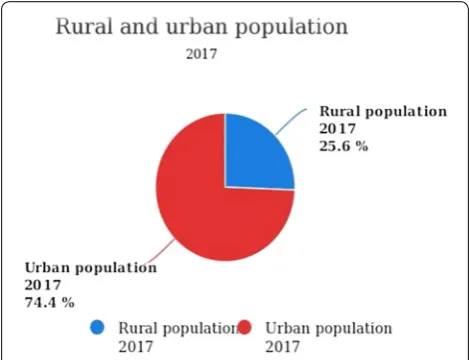
Iran is the second largest country in the Middle East, both in terms of size and population. A quarter of Iran’s population lives in rural areas (Fig. 1). And 21.2% of the total working population of the country are employed in the agricultural sector [10]. Despite having oil revenues, agriculture plays an important role in the economy of Iran. Despite the declining share of agricultural sector in gross domestic product (GDP), this figure is estimated at about 12% in 2017 (Fig. 2).
Agricultural development has long been at the heart of Iran’s food and agricultural policies. But statistics show the deep dependence of food security on imports. For
example, the dependence ratio for grain imports in Iran is 28.7% in 2014, and the country’s food imports are still high (Fig. 3). The exploitation of water resources in Iran, with more than 70% above the global average, is inef-ficient [17]. Meanwhile, 74% of Iran’s land, about 120 million hectares, is inappropriate for agriculture [18]. It is expected that in the years to come, there will not be enough water even for such a small amount of agricul-tural land. These conditions along with its political and international issues and its foreign policies, make the future of agriculture and food security in Iran more dif-ficult and challenging. Under these circumstances, Iran must identify current challenges and focus on the future of food and agriculture.
Agricultural mechanization strategy and food security
Considering the necessity of identifying and responding to the current and future challenges of food security in order to lead, collaborate and design the related strat-egies [30], this paper, by examining the current state of Iran and identifying challenges and threats, seeks to pro-vide strategies to promote the role of agricultural mecha-nization in agricultural development as a solution to the achievement of food security.
Any attempt to increase agricultural production with-out considering a proper mechanization strategy would never have a positive outcome [20]. A sustainable agricul-tural mechanization strategy is a planning strategy that contributes to the goal of sustainable agriculture, and at the same time accepts food self-sufficiency and generates economic and inclusive growth as well as social benefits [19].
Increasing food production along with maintaining natural resources is not an easy task. The second green revolution, which in the second half of the last century was able to produce more than twice the amount of food, is currently not in a good position. The growth rate of major cereal yields (wheat, rice and corn) is declining. Increasing food production requires resource-friendly methods, and this will require the development of new mechanization technology [26]. There are many technol-ogy options, but there is relatively scarce evidence of sup-porting decision making in the form of technology [23]. While one of the major constraints on developing and modernizing production in developing countries is the low level of engineering technology in agriculture [12]. Despite its many values and undeniable benefits, which are briefly mentioned above, mechanization is still con-sidered as an input, such as other inputs, like fertiliz-ers, seeds, and chemical protection products and in the most optimistic way, it is one of the combined manage-ment tools aimed at maximizing farmers’ productiv-ity and profits [8]. Despite the impact of agricultural
mechanization on the agricultural production process, due to the lack of comprehensive research on the extent of the effect of mechanization components on the pro-duction and its fields of application, there were always differences of opinion and doubts about the role of mech-anization in the agricultural sector. This has prevented the stabilization and improvement in agricultural mech-anization in the agricultural sector and even in the sec-tors of industry and services in developing countries. For example, the FAO report on the state of mechanization in the African countries [12] indicates that most African countries have not taken serious plans for sustainable mechanization, and efforts have failed to reach mecha-nization issues due to the micro, rather than macro, approaches. Studies show that crop production is more beneficial in areas where agricultural mechanization is
provided [15]. According to the research conducted in mechanized agricultural areas, yields were significantly higher than non-mechanized areas. The use of pesti-cides was also more effective, and the land and fertilizers were used optimally. This is the need of the world today, achieving food security by preserving natural resources for future generations.
Methods
The purpose of agricultural policy is to develop appro-priate and sustainable guidelines for promotion of effi-cient agricultural practices that guarantee food security, generate employment for citizens, provide raw materi-als for all agricultural industries, and materi-also to acquire for-eign currency. Agriculture can work with other sectors of the economy to achieve faster development, poverty
0 5 10 15 20 25 30
1960
1962
1964
1966
1968
1970
1972
1974
1976
1978
1980
1982
1984
1986
1988
1990
1992
1994
1996
1998
2000
2002
2004
2006
2008
2010
2012
2014
Fig. 2 Agricultural value added. Source: World Bank (OCT 28, 2017)
11 12 10
13 12
15 15 14
11 10
8 7
6 5
4 4 5
6 7 7 7 9
0 2 4 6 8 10 12 14 16
reduction and environmental sustainability [3, 6, 20]. This usually requires upgrading of infrastructure and injection of technology to advance production from the early stages of agriculture to mechanical systems through a suitable political framework [3]. Also, economic devel-opment studies have focused on the importance of addressing the fundamental constraints on elimination of poverty in general and improvement in the performance of smallholder farmers. Many proven technologies and planting improvement practices have promise to boost agricultural production and reduce poverty in develop-ing countries [21]. Here is where agricultural mechani-zation plays its role, and therefore developing countries need to design a new strategy based on mechanization. Various activities involved in the formation of a strat-egy can be divided into three stages: (1) status analysis; (2) strategy development; and (3) strategy approval [12]. All three stages were conducted in this research. The selection of appropriate policies to promote the role of agricultural mechanization in agriculture to achieve food security is the ultimate goal of this research. Poli-cies create the parameters in which development pro-grams are implemented. The strategy determines what resources should be available for development programs and how to identify, mobilize, deploy and maintain these resources for implementation of these programs [20]. On the other hand, mechanization planning requires a quan-titative evaluation of the mechanization index and its impact on agricultural production (yield) and economic factors (cost of cultivation, deployment of harmful and mechanical force and economic advantage) [27]. In order to achieve this goal, considering strengths, weaknesses, opportunities and threats (SWOT), a matrix was created as a political and analytical framework. The framework includes internal and external factors that influence the development of agricultural mechanization and seeks to provide ideas for agricultural development with the help of agricultural mechanization. These factors were prioritized by AHP hierarchical analysis method. At the next stage, the strategies were extracted according to the obtained results. In the final section, strategies were pri-oritized by TOPSIS method.
Study design and data collection
In this research, data were collected from a combination of primary and secondary sources to analyze the role of agricultural mechanization in agricultural develop-ment and the achievedevelop-ment of sustainable food security in developing countries. The preliminary data were taken from the Ministry of Agriculture’s official statistics, Sta-tistical Centre of Iran, the Agricultural Mechanization Development Center, as well as the Ministry of Com-merce of Iran. Secondary data were collected from the
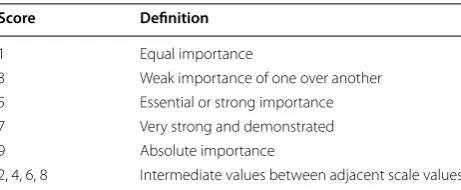
stakeholders during the interviews. Experts were selected using the Sampling Snowball method. This technique is a sequential targeted sampling method that can be used in a multi-criteria decision-making process in which the researcher, after identifying the individuals introduced by an expert, asks them to introduce one or more other spe-cialists. These experts included government employees in the areas of planning, implementation, monitoring and evaluation of mechanization, private sector, research and educational institutions, university professors and Ph.D. students in mechanization. Using questionnaires distrib-uted among them, internal factors (strength and weak-ness) and external factors (opportunities and threats) were identified. In this study, 22 factors were agreed as internal and external factors. By identifying strategies and internal and external factors, comparative question-naires were designed to compare the factors together. A pairwise comparison was performed by hierarchical anal-ysis method (AHP). A binary comparison was performed based on scale of 1–9. The principles of this comparison scale are shown in Table 1 [29].
Results
Identifying internal and external factors
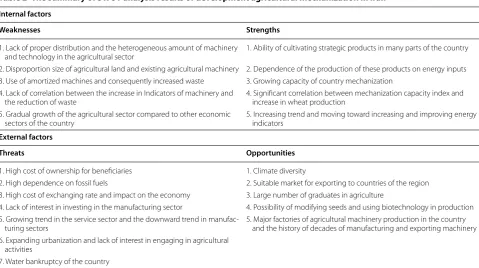
According to the results obtained and the findings of pre-vious researches of experts, and based on the designed questionnaire, they identified weaknesses, strengths, opportunities and threats (Table 2).
Twenty-two factors were identified as internal and external factors. Disturbances in the form of macro-economic factors on one hand and environmental con-straints on the other especially the water crisis, are among the most important factors identified along with the status of Iran’s agricultural mechanization fleet.
Prioritizing the factors
At this stage of the research, the identified internal and external factors were prioritized by hierarchical analysis method (Table 3).
Based on the findings of this section, the weaknesses were identified as the most effective factor compared to other factors with an importance coefficient of 0.467. The threats were identified as the next effective factor, with
Table 1 The fundamental scale of AHP
Score Definition
1 Equal importance
3 Weak importance of one over another
5 Essential or strong importance
7 Very strong and demonstrated
9 Absolute importance
an importance coefficient of 0.277, and subsequently, the strengths and opportunities were prioritized, respec-tively, with importance coefficients of 0.160 and 0.095.
These results indicate that the weaknesses and threats are more important in the current challenges of Iran compared to the strengths and the opportunities, lead-ing Iran to the more defensive or more conservative strategies.
Due to the higher coefficient of importance of weak-nesses in comparison to threats, it is necessary to pay more attention to internal factors in the agricultural sector and mechanization of Iran rather than external factors.
Prioritizing the sub‑actors
Prioritizing the sub-factors based on internal and exter-nal factors was the next step in this study. At this stage,
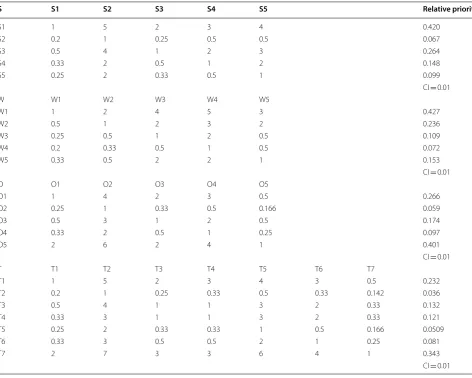
sub-factors were prioritized in four groups and were compared to other sub-factors (Table 4).
The weaknesses SWOT factor has the most importance among internal and external factors, and the most impor-tant sub-factor is the lack of proper distribution and the heterogeneous amount of machinery and technology to the agricultural sector. The importance coefficient of this sub-factor is estimated at 0.427. This suggests that despite the high agricultural mechanization coefficient in Iran, distribution of machinery in this country has not been done properly. Also, many new technologies in the agricultural sector have not been properly utilized. The second weakness, which earns the second rank, with an importance coefficient of 0.236, also emphasizes this issue. The disproportion size of agricultural land and existing agricultural machinery is identified as the sec-ond most important sub-factor. These sub-factors both
Table 2 The summary of SWOT analysis results of development agricultural mechanization in Iran
Internal factors
Weaknesses Strengths
1. Lack of proper distribution and the heterogeneous amount of machinery
and technology in the agricultural sector 1. Ability of cultivating strategic products in many parts of the country 2. Disproportion size of agricultural land and existing agricultural machinery 2. Dependence of the production of these products on energy inputs 3. Use of amortized machines and consequently increased waste 3. Growing capacity of country mechanization
4. Lack of correlation between the increase in Indicators of machinery and
the reduction of waste 4. Significant correlation between mechanization capacity index and increase in wheat production 5. Gradual growth of the agricultural sector compared to other economic
sectors of the country 5. Increasing trend and moving toward increasing and improving energy indicators External factors
Threats Opportunities
1. High cost of ownership for beneficiaries 1. Climate diversity
2. High dependence on fossil fuels 2. Suitable market for exporting to countries of the region
3. High cost of exchanging rate and impact on the economy 3. Large number of graduates in agriculture
4. Lack of interest in investing in the manufacturing sector 4. Possibility of modifying seeds and using biotechnology in production 5. Growing trend in the service sector and the downward trend in
manufac-turing sectors 5. Major factories of agricultural machinery production in the country and the history of decades of manufacturing and exporting machinery 6. Expanding urbanization and lack of interest in engaging in agricultural
activities
7. Water bankruptcy of the country
Table 3 Pairwise comparison of SWOT factors
Strength Weakness Opportunity Threat Importance degree of SWOT factors
Strength 1 0.333 2 0.5 0.160
Weakness 3 1 4 2 0.467
Opportunity 0.5 0.25 1 0.333 0.095
Threat 2 0.5 3 1 0.277
underline the poor distribution of agricultural ery in Iran, and suggests that the distribution of machin-ery across the country is not proportionate to the size of Iran’s agricultural land. After the land reforms at the time of the former regime in Iran, the division of agricul-tural land has been one of the issues that policymakers point to as a barrier to Iranian agricultural development. This problem however can be resolved by planning and subsequent distribution of machinery, appropriate to the demand. The gradual growth of the agricultural sec-tor, in comparison with other economic sectors of the country, has been ranked third, with an importance coef-ficient of 0.153. In recent years, development of the vari-ous economic sectors of Iran has not been coordinated. The service sector in Iran has had the highest develop-ment rate, and after the agreedevelop-ment on the nuclear pro-gram between Iran and the P5 + 1, the oil sector has been well developed. The agricultural sector and the industrial sector did not have significant development and have a
small share of gross domestic product. The two follow-ing sub-factors are related to the amount of waste, as well as the contribution of mechanization to reducing this amount. Given the role that mechanization plays in dif-ferent stages of production, it can have an effective con-tribution to reducing agricultural waste. The statistics in Iran however, indicate low correlation between mecha-nization and reduction of agricultural waste. The use of amortized machines, lack of scheduled plans and lack of attention to timeliness costs are among the reasons for this low correlation. Statistics show that the amount of agricultural and food waste in Iran is very high. Correct management of agricultural mechanization can play an important role in reducing waste and, consequently, in achieving food security. Threats, after weaknesses, rank second in terms of importance (Table 3). Among the sub-factors in this group, water bankruptcy, with an impor-tance coefficient of 0.343, has the highest rank. Iran has been in crisis for many years and today the crisis has
Table 4 Relative priority of each SWOT sub-factors
S S1 S2 S3 S4 S5 Relative priority
S1 1 5 2 3 4 0.420
S2 0.2 1 0.25 0.5 0.5 0.067
S3 0.5 4 1 2 3 0.264
S4 0.33 2 0.5 1 2 0.148
S5 0.25 2 0.33 0.5 1 0.099
CI = 0.01
W W1 W2 W3 W4 W5
W1 1 2 4 5 3 0.427
W2 0.5 1 2 3 2 0.236
W3 0.25 0.5 1 2 0.5 0.109
W4 0.2 0.33 0.5 1 0.5 0.072
W5 0.33 0.5 2 2 1 0.153
CI = 0.01
O O1 O2 O3 O4 O5
O1 1 4 2 3 0.5 0.266
O2 0.25 1 0.33 0.5 0.166 0.059
O3 0.5 3 1 2 0.5 0.174
O4 0.33 2 0.5 1 0.25 0.097
O5 2 6 2 4 1 0.401
CI = 0.01
T T1 T2 T3 T4 T5 T6 T7
T1 1 5 2 3 4 3 0.5 0.232
T2 0.2 1 0.25 0.33 0.5 0.33 0.142 0.036
T3 0.5 4 1 1 3 2 0.33 0.132
T4 0.33 3 1 1 3 2 0.33 0.121
T5 0.25 2 0.33 0.33 1 0.5 0.166 0.0509
T6 0.33 3 0.5 0.5 2 1 0.25 0.081
T7 2 7 3 3 6 4 1 0.343
exceeded the warning threshold. The continuation of this process is a threat not only to the agriculture of Iran, but also to its civilization. After the water crisis, the High cost of ownership for beneficiaries is in the second place, while the high cost of exchange rates in the economy of Iran is in the third place. These sub-factors both will ultimately lead to a low level of investment in the agricul-tural sector. This factor, with an importance coefficient of 0.121, ranks next. Dependence on fossil fuels, urbaniza-tion and development of the service sector and declining trend of manufacturing sectors are among the following sub-factors.
The third factor is the Strengths, with an importance coefficient of 0.160. In terms of importance of the sub-factors, the ability of cultivating strategic products in many parts of the country, with an importance coeffi-cient of 0.420, is ranked first. The growing capacity of the country mechanization is ranked second, and the sub-factor of the significant correlation between mechaniza-tion capacity index and increase in wheat producmechaniza-tion is ranked third. The two following sub-factors are related to energy indicators. Increasing trend and moving toward increasing and improving energy indicators, with an importance coefficient of 0.099, is in the fourth place and the dependence of the production of these products on energy inputs is in the fifth place. The increasing trend of energy indicators on one hand and the dependence of production on these indicators on the other indicate that Iran should maintain the status quo and try to improve these indicators.
In the ranking of opportunities sub-factors in Iran, major factories of agricultural machinery production in the country and the history of decades of manufac-turing and exporting machinery, with an importance coefficient of 0.401, ranked first. The country’s climate diversity ranked second. Iran is a country with four sea-sons throughout the year. This feature provides a decent opportunity for policymakers to have more options to manage the food market in the country. The large num-ber of graduates in agricultural, with an importance
coefficient of 0.174, is the third most important sub-factor. The large number of graduates gives Iran the opportunity to make its agriculture more scientific, as an example, Iran can take steps in the field of biotechnol-ogy and seed improvement. The possibility of modifying seeds and using biotechnology in production is in the fourth place. This sub-factor is reinforced with the help of the former sub-factor, the large number of experts in Iran. The last sub-factor is the suitable market for export-ing to countries of the region, which Iran can plan for it as an appropriate opportunity.
Extracting strategies
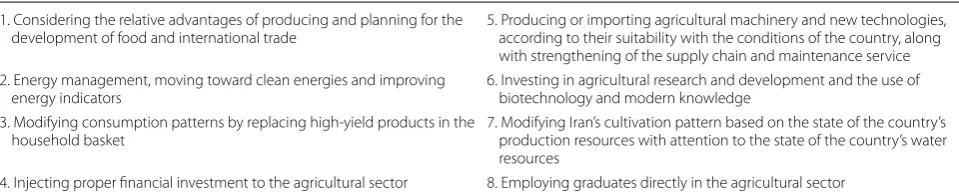
After studying internal and external factors, strengths, weaknesses, opportunities and threats and their ranking, finally, according to the political, economic, social and environmental structure of the country, eight final strate-gies were proposed by the experts (Table 5).
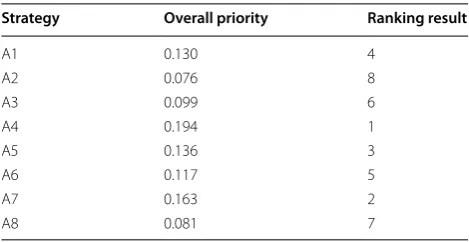
The extracted strategies were prioritized using the TOPSIS method. At first, each of the eight strategies was ranked based on the sub-factors (Table 6) and finally they ranked accordingly (Table 7).
Discussion
According to Table 7, Injecting proper financial invest-ment into the agricultural sector, with an importance coefficient of 0.194, was ranked first. Despite its promi-nent role in achievement of food security, Iran’s agri-cultural sector is considered the weakest among the economic sectors. Low development of this sector over the years and lack of interest in investing in it is alarm-ing. As such policymakers should prioritize strategies to strengthen this sector and support it. Earlier, FAO, in a report reviewing the state of agricultural mechani-zation in African countries [12], presented strategies to achieve lasting effects, such as political will and commit-ment at the highest possible level, allocating funds to the agricultural sector and providing appropriate loans to small farmers. These proposals were presented by FAO, due to the weakness of the private sector and the lack
Table 5 Suggested strategies
Suggested strategies
1. Considering the relative advantages of producing and planning for the
development of food and international trade 5. Producing or importing agricultural machinery and new technologies, according to their suitability with the conditions of the country, along with strengthening of the supply chain and maintenance service 2. Energy management, moving toward clean energies and improving
energy indicators 6. Investing in agricultural research and development and the use of biotechnology and modern knowledge 3. Modifying consumption patterns by replacing high-yield products in the
household basket 7. Modifying Iran’s cultivation pattern based on the state of the country’s production resources with attention to the state of the country’s water resources
of government intervention agricultural investment and commerce, which seems to be in line with the situation in Iran.
Modifying Iran’s cultivation pattern based on the state of the country’s production resources with attention to the state of the water resources is ranked second with an importance coefficient of 0.163. The severe water crisis in Iran, or in other words, bankruptcy of water, has put the country in a difficult position. According to this situation, Iran must not only take more water-efficiency measures, but must also reform its cultivation pattern based on the need for water for agricultural products and available water resources. And, if necessary, implement “not to do farming” Project in the required areas.
Producing or importing agricultural machinery and new technologies, according to their suitability with the conditions of the country, along with strengthening of the supply chain and maintenance service is ranked third with an importance coefficient of 0.136. The need for investment in the supply chain of machinery as a short-term solution, along with technical training and proper management for businesses and service and mainte-nance, are among the suggestions of researchers [26]. The use of machines that are unsuitable for the country’s condition, on one hand, and the worn-out fleet of agri-cultural machinery in many parts of the country on the other, makes it necessary to modernize the fleet and to distribute it more appropriately throughout the country, which is possible due to the existence of tractor and com-bine factories in Iran and their history.
Considering the relative advantages of producing and planning for development of food and international trade is ranked third with an importance coefficient of 0.130. Food security is one of the responsibilities of the government of each country. One of the most impor-tant dimensions of food security is food availability. The government is required to distribute a decent num-ber of calories in the country based on the nutritional needs of its population. This amount of energy will be supplied either through domestic production or
through imports. According to this strategy, it is rec-ommended that Iran, to establish this dimension of food security, considers the relative advantages of pro-duction as its agenda. If a product or several products have no comparative advantage in production, instead of spending resources for its production, the country should strengthen its international trade by import-ing the needed products and avoid the problem of this dimension of food security, and at the same time, use its resources appropriately to maximize productivity in production.
The next strategy is investing in agricultural research and development and the use of biotechnology and its new knowledge. This strategy ranked with an importance coefficient of 0.117. Due to the limitation of arable land in Iran, the country must move toward increasing produc-tivity per unit area. New technologies and biotechnology are among the things that make this possible for each country and for this reason, Iran should invest in agri-cultural research and development. Seed modification, genetic modification, etc., are among the many ways to develop agriculture and achieve sustainable food security. Researchers believe that the development of food secu-rity is possible through the development and promotion of technology. These achievements are mainly attributed to increased use of crop improvement methods. These results highlight the role of improved methods for pro-moting agricultural productivity among small farmers [21]. Researchers are also strategizing with emphasis on technology transfer and planning for the development of agricultural mechanization. It is suggested that the first step is to remove the obstacles that mechanization faces including the fact that small farmers do not have the financial ability to move to mechanized cultivation require government support. The government support at the executive and legislative levels, supporting aca-demic education, providing appropriate technology and services, and moving toward the assembly and produc-tion of agricultural machinery are among these propos-als [20]. The emphasizing on research and development, the selection and transferring appropriate technologies for the region, optimal use of energy resources, increas-ing the number of machinery, trainincreas-ing, providincreas-ing loans to farmers, as well as providing tax rebates are among the proposed policies in this area [2]. Iran also can take steps to maximize the productive use of resources using precision farming technology, given the country’s water crisis. Modifying consumption pattern by replacing high-yield products in the household basket is the sixth ranked strategy that is related to the dimension of food utiliza-tion. Modifying this pattern requires long-term cultural and social planning. Dietary habits in Iran are not only rooted in different cultures in this country, but also
Table 7 Overall priority of each strategy
Strategy Overall priority Ranking result
A1 0.130 4
A2 0.076 8
A3 0.099 6
A4 0.194 1
A5 0.136 3
A6 0.117 5
A7 0.163 2
closely related to religious beliefs. To achieve this, vari-ous government and community-based organizations, such as the media, social networks and NGOs, can play a significant role. Employing graduates directly in the agri-cultural sector, with a 0.081 significance factor, is the next strategy. Iran has a large number of agricultural graduates and has a major need for agriculture production based on science and technology, which has been addressed in pre-vious strategies. The government can, with proper plan-ning, use this potential to develop its agricultural sector and move toward reducing unemployment. Energy man-agement, moving toward clean energies and improving energy indicators, is the last strategy with an importance coefficient of 0.076. Considering the abundant oil and gas resources of Iran, there seems to be less interest in moving toward such energies in the country. Most of the country’s environmental crises are caused by pollution from fossil fuels.
Conclusions
In this research, we identified the weaknesses, strengths, threats and opportunities facing Iran’s agricultural devel-opment to achieve the main objective of the research. In the next step, these factors were prioritized, with weak-nesses and threats having the highest score in prioritizing by hierarchical analysis method. Environmental threats especially water bankruptcy; unfavorable conditions of Iran’s arable land; economic problems; lack of proper development in agricultural sector in comparison with other economic sectors; exhaustion and disproportion of the mechanization fleet with conditions of the coun-try were considered as the most important problems fac-ing the country’s agricultural development. To achieve sustainable food security, with regards to the identified factors and considering the opportunities and strengths of Iran, with the future in mind, the necessary strate-gies were presented in this paper. Stratestrate-gies are classified in the category of defensive policies with respect to the importance coefficients of weaknesses and threats com-pared to the other factors. Government support policies in the agricultural sector; reforming the country’s plant-ing pattern accordplant-ing to the climatic conditions; tak-ing into account the relative advantage of agricultural production as well as modernizing Iran’s mechanization fleet, investing in agricultural research and development and moving toward modern knowledge; given the large number of agricultural graduates in Iran; the produc-tion or import of agricultural machinery and modern technologies, according to their suitability with the coun-try’s conditions and future needs; along with strengthen-ing of the supply chain and maintenance services were among these strategies that were prioritized by the TOP-SIS method.
Authors’ contributions
The authors collaboratively designed the study, performed the literature review and analysis, and wrote and edited the manuscript. All authors read and approved the final manuscript.
Author details
1 Department of Agricultural Mechanization, Science and Research Branch, Islamic Azad University, Tehran, Iran. 2 Department of Environment, Tehran, Iran.
Acknowledgements Not applicable.
Competing interests
The authors declare that they have no conflict of interest to the publication of this article. There are no patents or copyrights relevant to this work. There are no relationships or activities to disclose that could be perceived to have influence the submitted work.
Availability of data and materials
The datasets generated and analyzed during the current study are available from the corresponding author on request.
Consent for publication
The authors hereby consents that the Publisher publishes the Work in Agricul-ture & Food Security.
Ethics approval and consent to participate
This study does not involve any human, animal or plant subjects, and materi-als. The authors have read and agreed to its content and that the manuscript conforms to the journal’s policies and this project has been considered by the Ethics Committee and ethical approval is granted.
Funding
The authors received no financial support for the research and/or authorship of this article. No financial relationships exist with any entities that could be perceived to influence the submitted work.
Publisher’s Note
Springer Nature remains neutral with regard to jurisdictional claims in pub-lished maps and institutional affiliations.
Received: 4 February 2018 Accepted: 28 February 2018
References
1. Abi Said M, Hakimi A, Babar Z, Bush R, Chaaban J, Crist JT, Mundy M. Food security and food sovereignty in the middle east. Washington, DC: Georgetown University; 2012.
2. Ahmad T. Agricultural mechanization research and development in the Islamic Republic of Pakistan. Beijing: United Nations Centre for Sustain-able Agricultural Mechanization; 2015.
3. Akinbamowo RO. A review of government policy on agricultural mecha-nization in Nigeria. J Agric Ext Rural Dev. 2013;5(8):146–53.
4. Alemu MH, Olsen SB, Vedel SE, Kinyuru JN, Pambo KO. Can insects increase food security in developing countries? An analysis of Kenyan consumer preferences and demand for cricket flour buns. Food Secur. 2017;9(3):471–84.
5. Amongo RC, Larona ML. Agricultural mechanization policies in the Philippines. Beijing: United Nations Centre for Sustainable Agricultural Mechanization; 2015.
6. Byerlee D, Janvry AD, Sadoule E, Townsend R, Klytchnikova I. Agricultral for development. Washington, DC: The World Bank; 2008.
7. Clapp J. Food self-sufficiency: making sense of it, and when it makes sense. Food Policy Issue. 2017;66:88–96.
• We accept pre-submission inquiries
• Our selector tool helps you to find the most relevant journal
• We provide round the clock customer support
• Convenient online submission
• Thorough peer review
• Inclusion in PubMed and all major indexing services
• Maximum visibility for your research
Submit your manuscript at www.biomedcentral.com/submit
Submit your next manuscript to BioMed Central
and we will help you at every step:
9. FAO. The state of food insecurity in the world (economic crises—impacts and lessons learned). Rome: FAO; 2009.
10. FAO. FAO statistical pocketbook. Rome: FAO; 2015.
11. FAO and UNIDO. Agricultural mechanization in Africa … Time for action: planning investment for enhanced agricultural productivity. Rome: FAO; 2008.
12. Fonteh MF. Agricultural mechanization in Mali and Ghana: strategies, experiences and lessons for sustained impacts. Rome: FAO; 2010. 13. Graaf JD, Kessler A, Nibbering JW. Agriculture and food security in
selected countries in Sub-Saharan Africa: diversity in trends and opportu-nities. Food Secur Issue. 2011;3:195–213.
14. Grebmer KV, Bernstein J, Prasai N, Amin S, Yohannes Y, Towey O, Nabarro D. Global hunger index getting to zero hunger. Washington, DC: IFRIP; 2016.
15. Haruna IM, Junior JA. Mechanization practice: a tool for agricultural development in nigeria: a case study of Ifelodun local government area of Kwara State. Int J Basic Appl Sci. 2013;2(3):98–106.
16. Joffre OM, Castine SA, Philips MJ, Senaratna Sellamuttu S, Chandra-balan D, Cohen P. Increasing productivity and improving livelihoods in aquatic agricultural systems: a review of interventions. Food Secur. 2017;9(1):39–60.
17. Lehane S. The Iranian water crisis. Nedlands: Future Directions Interna-tional; 2014.
18. Mesgaran MB, Madani K, Hashemi H, Azadi P. Iran’s land suitability for agriculture. Sci Rep. 2017;7:7670.
19. Mrema G, Soni P, Rolle RS. A regional strategy for sustainable agricultural mechanization: sustainable mechanization across agri-food chains in Asia and the Pacific region. Bangkok: FAO; 2014.
20. Negrete JC. Strategies for technology transfer of agricultural mechaniza-tion in Mexico. Int Res J Adv Agric. 2015;1(1):1–11.
21. Pan Y, Smith SC, Sulaiman M. Agricultural extension and technology adoption for food security: evidence from Uganda. New York: Institute for International Economic Policy; 2015.
22. Ritzema RS, Frelat R, Douxchamps S, Silvestri S, Rufino MC, Herrero M, van Wijk MT. Is production intensification likely to make farm households food-adequate? A simple food availability analysis across smallholder farming systems from East and West Africa. Food Secur. 2017;9(1):115–31. 23. Rosegrant MW, Koo J, Cenacchi N, Ringler C, Robertson R, Fisher M,
Sab-bagh P. Food security in a world of natural resource scarcity, the role of agricultural technologies. Washington, DC: IFPRI; 2014.
24. Schmitz A, Moss CB. Mechanized agriculture: machine adoption, farm size, and labor displacement. AgBioForum. 2015;18(3):278–96. 25. Simalenga T. Entrepreneurship in mechanized agriculture
technology-oriented operations. Agric Mech J (AMA). 2000;31(3):61–88. 26. Sims B, Kienzle J. Mechanization of conservation agriculture for
small-holders: issues and options for sustainable intensification. Environments. 2015;2015(2):139–66.
27. Singh G. Estimation of a mechanisation index and its impact on production and economic factors a case study in India. Biosys Eng. 2006;93(1):99–106.
28. Sundaram KJ, Dawe D, Haen DH, Stamoulis K, Wiebe K. The state of food insecurity in the world 2012: economic growth is necessary but not sufficient to accelerate reduction of hunger and malnutrition. Rome: FAO; 2012.
29. Triantaphyllou E. Multi-criteria decision making methods: a comparative study. Dordrecht: Springer; 2000.
30. Walport M. Global food security strategic plan 2011–2016 updated November 2013. Global Food Security; 2013.