RESEARCH
Synthesis, structural determination
and antimicrobial evaluation of two novel
Co
II
and Zn
II
halogenometallates as efficient
catalysts for the acetalization reaction
of aldehydes
Assila Maatar Ben Salah
1, Lilia Belghith Fendri
2, Thierry Bataille
3, Raquel P. Herrera
4and Houcine Naïli
1*Abstract
Background: Complexes of imidazole derivatives with transition metal ions have attracted much attention because of their biological and pharmacological activities, such as antimicrobial, antifungal, antiallergic, antitumoural and antimetastatic properties. In addition, imidazoles occupy an important place owing to their meaningful catalytic activ-ity in several processes, such as in hydroamination, hydrosilylation, Heck reaction and Henry reaction. In this work, we describe the crystallization of two halogenometallate based on 2-methylimidazole. Their IR, thermal analysis, catalytic properties and antibacterial activities have also been investigated.
Results: Two new isostructural organic-inorganic hybrid materials, based on 2-methyl-1H-imidazole, 1 and 2, were synthesized and fully structurally characterized. The analysis of their crystal packing reveals non-covalent interactions, including C/N–H···Cl hydrogen bonds and π···π stacking interactions, to be the main factor governing the supramo-lecular assembly of the crystalline complexes. The thermal decomposition of the complexes is a mono-stage process, confirmed by the three-dimensional representation of the powder diffraction patterns (TDXD). The catalytic structure exhibited promising activity using MeOH as solvent and as the unique source of acetalization. Moreover, the antimi-crobial results suggested that metal-complexes exhibit significant antimiantimi-crobial activity.
Conclusion: This study highlights again the structural and the biological diversities within the field of inorganic– organic hybrids.
Keywords: Halogenometallate, X-ray diffraction, Thermal analysis, Antibacterial activities, Hydrogen bonds, Supramolecular architecture, Catalysis
© The Author(s) 2018. This article is distributed under the terms of the Creative Commons Attribution 4.0 International License (http://creativecommons.org/licenses/by/4.0/), which permits unrestricted use, distribution, and reproduction in any medium, provided you give appropriate credit to the original author(s) and the source, provide a link to the Creative Commons license, and indicate if changes were made. The Creative Commons Public Domain Dedication waiver (http://creativecommons.org/ publicdomain/zero/1.0/) applies to the data made available in this article, unless otherwise stated.
Open Access
*Correspondence: [email protected]
1 Laboratoire Physicochimie de l’Etat Solide, Département de Chimie, Faculté des Sciences de Sfax, Université de Sfax, BP 1171, 3000 Sfax, Tunisia
Full list of author information is available at the end of the article Introduction
The chemistry of organic–inorganic hybrid materials constitutes one of the most flourishing areas of research in solid-state chemistry [1–3]. These hybrids are of inter-est because of their wide range of technologically advan-tageous properties, astounding compositional breadth,
and exceptional diversity of structure. Thus, as a result of structural integration of organic cations and inorganic counterparts, magnetic [4–6], optical [7, 8], metallic con-ductivity [9] and catalytic [10, 11] properties have arisen in this class of chemical hybrid systems. Moreover, these materials may be used as model compounds for biologi-cal applications [12].
and biological applications. Various metal complexes, especially these containing imidazole groups, occupy an important place owing to their meaningful catalytic activity in several processes, such as in hydroamination [13–16], hydrosilylation [17, 18] Heck reaction [19–23] and Henry reaction [24]. In addition, imidazoles play an important role in medicinal chemistry, because many of its derivatives have demonstrated significant biological activity. For example, in many metalloenzymes the imida-zole rings of histidines play a pivotal role in metal-enzyme coordination. In consequence, the metal complexes of imidazoles have been widely used as model compounds of metalloenzymes [25–29]. It is well known that metal ions present in complexes accelerate the drug action and the efficacy of the organic therapeutic agents [30]. The pharmacological efficiencies of metal complexes depend on the nature of the metal ions and the ligands [31]. It is declared in the literature that different ligands and differ-ent complexes synthesized from same ligands with dif-ferent metal ions possess difdif-ferent biological properties [30, 32, 33]. So, there is an increasing requirement for the discovery of new hybrid compounds having antimicrobial activities. However, this work has been quite selective. In this study, as an extension of our efforts into the develop-ment of new metal based antimicrobial complexes with 2-methylimidazole [34], we describe the crystallization of bis(2-methyl-1H-imidazolium)tetrachlorocobaltate(II) (C4H7N2)2[CoCl4] (1) and bis(2-methyl-1H-imidazolium)
tetrachlorozincate(II) (C4H7N2)2[ZnCl4] (2), along with
their crystal packing and crystal supramolecularity analy-ses. Their IR, thermal analysis, catalytic properties and antibacterial activities have also been investigated.
Experimental section Materials
All the employed chemicals [Cobalt(II) chloride hexahy-drate (CoCl2·6H2O), Zinc(II) chloride (ZnCl2),
Hydro-chloric acid (HCl; 37%) and 2-methyl-1H-imidazole (C4H6N2)] were commercial products (Sigma-Aldrich),
which were used without further purification. All culture media and standard antibiotic were purchased from Bio-Rad laboratories, France).
Synthesis
The two new compounds (C4H7N2)2[CoCl4] (1) and
(C4H7N2)2[ZnCl4] (2) were obtained by slow
evapora-tion, at room temperature. 2-Methyl-1H-imidazole (2mim) was dissolved with either CoCl2·6H2O or ZnCl2
in 10 mL of distilled water and hydrochloric acid HCl (pH ≈ 2.5) with the metal/amine molar ratio of 1:2. The clear solutions were stirred for 10 min until the complete dissolution and allowed to stand at room temperature. Transparent block crystals with the specific color of the
metal appeared after few days. Then, the products were filtered off and washed with a small amount of distilled water before being dried in ambient air. Otherwise, they are also stable for a long-time in normal conditions of temperature and humidity.
Single‑crystal data collection and structure determination Small crystals of the two compounds 1 and 2 were glued to a glass fiber mounted on a four-circle Nonius KappaCCD area-detector diffractometer with graphite monochromatized Mo Kα radiation, using an Oxford Cryosystems cooler. Data col-lection, absorption corrections frame scaling and unit cell parameters refinements were carried out with CrysAlisCCD and CrysAlisRED [35]. The structures analyses were car-ried out with the monoclinic symmetry, space groups C2/c, according to the automated search for space group available in Wingx [36]. Structures of 1 and 2 were solved with direct methods using SHELXS-97 [37] and refined by a full-matrix least squares technique with SHELXL-97 [37] with aniso-tropic thermal parameters for all non H-atoms. H atoms bonded to C and N atoms were positioned geometrically and allowed to ride on their parent atoms, with C–H = 0.95 Å and N–H = 0.88 Å. The drawings were made with DIA-MOND program [38]. The main crystallographic data and refinement parameters are presented in Table 1.
Infrared spectroscopy
All IR measurements were performed using a Perkin Elmer 1600FT spectrometer. Samples were dispersed with spectroscopic KBr and pressed into a pellet. Scans were run over the range 400–4000 cm−1.
Thermal analyses
TGA–DTA measurements of 1 and 2 were performed on raw powders with a TGA/DTA ‘SETSYS Evolution’ (Pt crucibles, Al2O3 as a reference) under air flow (100 mL/
min). The thermograms were collected on 9 mg samples in the temperature range from 25 to 650 °C (heating rate of 5 °C/min).
Powder X‑ray diffraction
The variable-temperature X-ray powder diffraction (VT-XRPD) for 1 and 2 was performed with a PANalytical Empyreanpowder diffractometer using CuKα radiation (λKα1 = 1.5406 Å, λKα2 = 1.5444 Å) selected with the
Catalytic studies
Complex 1 (4.7 mg, 0.01292 mmol) or 2 (4.8 mg, 0.01292 mmol) and aldehydes 3a–i (0.323 mmol) were dissolved in MeOH (0.25 mL) in a test tube. The resulting mixture was stirred at 40 °C during 24 h. The reactions were monitored by thin-layer chromatography. The yield of the reaction is given by 1H NMR.
Antimicrobial activity
Antimicrobial activity was essayed against three species of Gram negative bacteria [Salmonella typhimurium (ATCC 19430), Pseudomonas aeruginosa (ATCC 27853), Kleb-siella pneumonia (ATCC 13883) and five species of Gram positive bacteria (Enterococus faecalis (ATCC 9763), Bacillus thuringiensis (ATCC 10792), Staphylococcus aureus (ATCC 25923), Micrococcus luteus (ATCC 4698) and listeria]. All microorganisms were stocked in appro-priate conditions and regenerated twice before using.
Antimicrobial activity assays were performed accord-ing to the method described by Berghe and Vlietinck [39].
Steril enutrient agar medium was prepared and distrib-uted into Petriplates of 90 mm diameter. A suspension of the previously prepared test microorganism (0.1 mL of 106 UFCmL−1) was spread over the surface of agar plates
(LB medium for bacteria). Then, bores (3 mm depth, 5 mm diameter) were made using a sterile borer and loaded with a concentration of 5 mg/mL of all samples. Before incubation, all petri dishes were kept in the refrigerator for 2 h to ena-ble pre-diffusion of the substances into the agar. After that, they were incubated at 37 °C for 24 h. Ampicillin was used as positive reference. The diameters of the inhibition zones were measured using a ruler, with an accuracy of 0.5 mm. Each inhibition zone diameter was measured three times (in two different plates) and the results were expressed as an average of the radius of the inhibition zone in mm.
Results and discussion Infrared spectra
The IR active bands of the 2-mim ring as well as the stretching vibrations of the N–H bond could be identified Table 1 Crystal data and structure refinement details for (C4H7N2)2[CoCl4] (1) and (C4H7N2)2[ZnCl4] (2)
Compound (1) (2)
Chemical formula (C4H7N2)2[CoCl4] (C4H7N2)2[ZnCl4]
Compound weight 366.96 373.40
Temperature (K) 100 (2) 100 (10)
Crystal system Monoclinic Monoclinic
Space group C2/c C2/c
a (Å) 26.9330 (17) 26.871 (8)
b (Å) 7.8842 (2) 7.9031 (18)
c (Å) 15.0925 (5) 15.077 (5)
β (°) 111.001 (5) 111.23 (5)
V (Å3) 2991.9 (2) 2984.5 (15)
Z 8 8
ρcal (g cm−3) 1.629 1.662
Crystal dimension, mm3 0.45 × 0.37 × 0.13 0.50 × 0.42 × 0.12
Habit-colour Block, blue Block, transparent
μ (mm−1) 1.85 2.35
θ range (deg) θmin= 2.7, θmax= 30.7 θmin= 2.7, θmax= 30.7
Index ranges − 26 ≤ h ≤ 38 − 38 ≤ h ≤ 29
− 10 ≤ k ≤ 10 − 9 ≤ k ≤ 11
− 21 ≤ l ≤ 21 − 21 ≤ l ≤ 21
Unique data 4253 4197
Observed data [I > 2σ(I)] 3254 3731
F(000) 1480 1504
R1 0.053 0.050
wR2 0.132 0.121
GooF 1.012 1.17
No. param 156 157
Transmission factors Tmin= 0.334; Tmax= 0.804 Tmin= 0.387; Tmax= 0.766
in the IR spectra of both compounds (Fig. 1). Indeed, it is known that the narrow bands at 3147.3 and 3120.9 cm−1,
for 1 and 2 respectively, correspond to the νC–H
stretch-ing modes of the 2-mim rstretch-ing [40]. Moreover the stretch-ing vibration ν(NH) has been identified at 2724 and 3752 cm−1, for 1 and 2, respectively. This agrees well with
the structural study which proved the protonation of the 2-mim cation. The bands located in the region 1400– 1650 cm−1 are assignable to C–C and C–N stretching
vibration of 2-mim ring. The νC=N mode can be found at
1438 and 1492 cm−1 for 1 and 2, respectively.
Addition-ally, the vibrational bands from 1002 to 1438 cm−1 can
be assigned to the ring stretching frequency of the 2-mim cation (νring) [41]. Finally, the bands remaining in the
686–859 cm−1 region can be associated with the
defor-mations of the imidazole ring.
Crystal structure
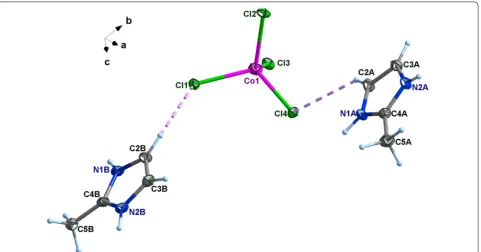
Compounds 1 and 2 are isostructural, confirmed by their single crystal structural analyses (Table 1). Compound 1 was taken as an example to understand the struc-tural details. Complex 1 crystallizes in the monoclinic centrosymmetric space group C2/c and its basic struc-ture unit consists of one [CoCl4]2− ion and two
crystal-lographically inequivalent 2-mim cations, as shown in Fig. 2.
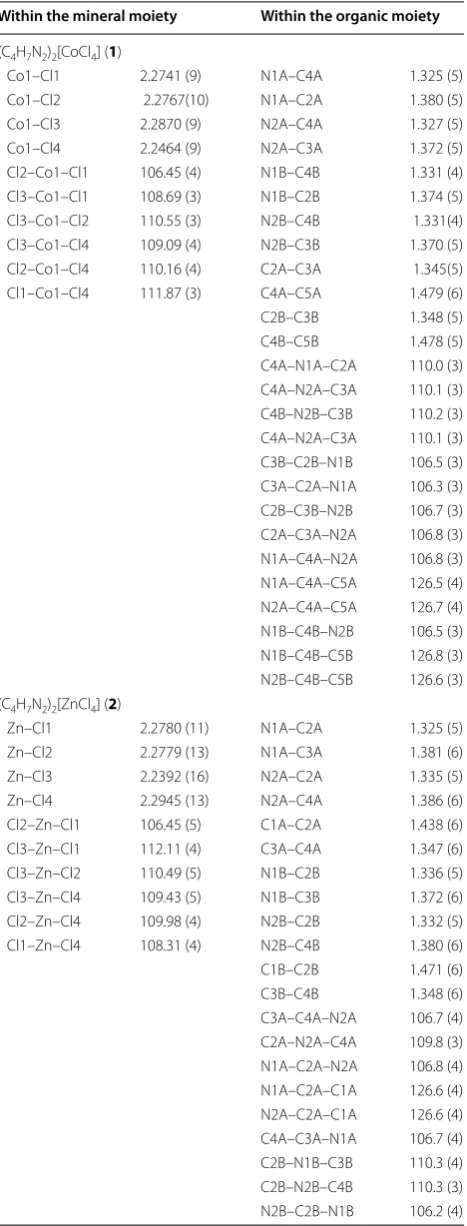
The Co(II) ion is tetrahedrally bound by four chlo-rine atoms, with Co–Cl bond distances ranging from 2.246(9) to 2.287(9) Å and Cl–Co–Cl bond angles between 106.45(4)° and 111.87(3)°, which are slightly deviated from the ideal value of 109.28° (Table 2). There-fore, the coordination geometry around the CoII ion can
be described as a slightly irregular tetrahedron. Cobalt atoms are stacked one over the other along the three crystallographic axes and are isolated from each other with a shortest distance Co⋯Co = 7.330(4) Å which is more than the sum of the van der Waals radii of the cobalt ions tetrahedrally coordinated (4 Å). Hence, there Fig. 1 The infrared absorption spectra of compounds 1 and 2,
dispersed in a KBr pellet
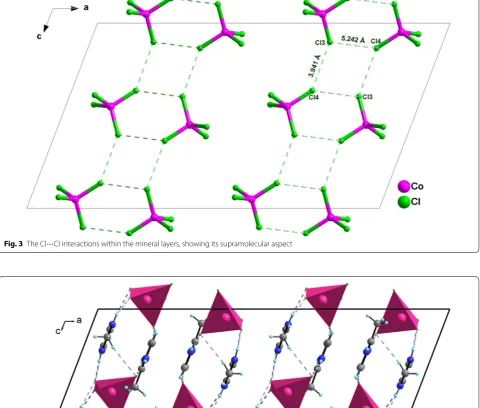
is no metallophilic Co⋯Co interaction in this compound as proposed by Das et al. [42]. One of the main cohesive forces responsible for molecular arrangements of halogen derivatives is the pattern of halogen⋯halogen intermo-lecular interactions. It is worth mentioning here, that in bis(2-methyl-1H-imidazolium)tetrachlorocobaltate(II) the shortest Cl⋯Cl contacts between copper sites related by unit cell translations along the a or c directions are 5.242 and 3.941 Å, respectively, thus proving the weak halogen interactions in these directions (Fig. 3).
As far as the cation is concerned, all the bond lengths and bond angles observed in aromatic rings of the 2-mim present no unusual features and are consistent with those observed in other homologous derivates (Table 2) [40,
43]. The 2-methylimidazolium cation is essentially planar (maximum deviation from the mean plane through the imidazole ring is 0.0150 Å).
The packing of the structure can be regarded as alter-nating stacks of anions and layers of cations. The iso-lated molecules are involved in many intermolecular interactions leading to layers that are parallel to bc plane (Fig. 4). These layers are stabilized and governed signifi-cantly through extensive C/N–H⋯Cl hydrogen bonding between the inorganic and organic moieties and π⋯π stacking interactions between the aromatic rings of the amine molecules themselves (Table 3). Indeed, the C⋯Cl distances vary from 3.422 (4) to 3.628 (4) Å, while the N⋯Cl distances vary from 3.160 (3) to 3.273 (3) Å. The centroid–centroid distance and dihedral angle between the aromatic rings are 3.62 Å and 0.00°, respectively, dis-playing typical π⋯π stacking interactions (Fig. 5). These values are almost comparable to the corresponding val-ues for intermolecular π⋯π interactions, showing that π⋯π contacts may further stabilize the structure. Then, both C/N–H⋯Cl and π⋯π stacking interactions are the driving forces in generating a three-dimensional supra-molecular network.
Thermal decomposition
The two compounds show similar thermal behavior, which further support their isomorphic structures. Thus, for simplicity the thermal properties of 1 only have been discussed. Thermogravimetric analyses of compound 1 were undertaken in the temperature range from 25 to 650 °C under flowing N2 atmosphere with a heating
Table 2 Selected bond distances (Å) and angles (°) for 1 and 2
Within the mineral moiety Within the organic moiety
(C4H7N2)2[CoCl4] (1)
Co1–Cl1 2.2741 (9) N1A–C4A 1.325 (5)
Co1–Cl2 2.2767(10) N1A–C2A 1.380 (5)
Co1–Cl3 2.2870 (9) N2A–C4A 1.327 (5)
Co1–Cl4 2.2464 (9) N2A–C3A 1.372 (5)
Cl2–Co1–Cl1 106.45 (4) N1B–C4B 1.331 (4)
Cl3–Co1–Cl1 108.69 (3) N1B–C2B 1.374 (5)
Cl3–Co1–Cl2 110.55 (3) N2B–C4B 1.331(4)
Cl3–Co1–Cl4 109.09 (4) N2B–C3B 1.370 (5)
Cl2–Co1–Cl4 110.16 (4) C2A–C3A 1.345(5)
Cl1–Co1–Cl4 111.87 (3) C4A–C5A 1.479 (6)
C2B–C3B 1.348 (5)
C4B–C5B 1.478 (5)
C4A–N1A–C2A 110.0 (3)
C4A–N2A–C3A 110.1 (3)
C4B–N2B–C3B 110.2 (3)
C4A–N2A–C3A 110.1 (3)
C3B–C2B–N1B 106.5 (3)
C3A–C2A–N1A 106.3 (3)
C2B–C3B–N2B 106.7 (3)
C2A–C3A–N2A 106.8 (3)
N1A–C4A–N2A 106.8 (3)
N1A–C4A–C5A 126.5 (4)
N2A–C4A–C5A 126.7 (4)
N1B–C4B–N2B 106.5 (3)
N1B–C4B–C5B 126.8 (3)
N2B–C4B–C5B 126.6 (3)
(C4H7N2)2[ZnCl4] (2)
Zn–Cl1 2.2780 (11) N1A–C2A 1.325 (5)
Zn–Cl2 2.2779 (13) N1A–C3A 1.381 (6)
Zn–Cl3 2.2392 (16) N2A–C2A 1.335 (5)
Zn–Cl4 2.2945 (13) N2A–C4A 1.386 (6)
Cl2–Zn–Cl1 106.45 (5) C1A–C2A 1.438 (6)
Cl3–Zn–Cl1 112.11 (4) C3A–C4A 1.347 (6)
Cl3–Zn–Cl2 110.49 (5) N1B–C2B 1.336 (5)
Cl3–Zn–Cl4 109.43 (5) N1B–C3B 1.372 (6)
Cl2–Zn–Cl4 109.98 (4) N2B–C2B 1.332 (5)
Cl1–Zn–Cl4 108.31 (4) N2B–C4B 1.380 (6)
C1B–C2B 1.471 (6)
C3B–C4B 1.348 (6)
C3A–C4A–N2A 106.7 (4)
C2A–N2A–C4A 109.8 (3)
N1A–C2A–N2A 106.8 (4)
N1A–C2A–C1A 126.6 (4)
N2A–C2A–C1A 126.6 (4)
C4A–C3A–N1A 106.7 (4)
C2B–N1B–C3B 110.3 (4)
C2B–N2B–C4B 110.3 (3)
N2B–C2B–N1B 106.2 (4)
Table 2 continued
Within the mineral moiety Within the organic moiety
N2B–C2B–C1B 126.6 (4)
N1B–C2B–C1B 127.2 (4)
C4B–C3B–N1B 106.8 (4)
rate of 5 °C/min, leading to the simultaneous TGA/DTA profiles. The simultaneous (TG–DTA) curves and the three-dimensional representation of the powder diffrac-tion patterns are shown in Figs. 6 and 7, respectively.
As shown in Fig. 6, the small mass gain observed at room temperature on the TG curve is explained by the strong hygroscopic character of the sample, as also observed when the sample is ground for XRPD analysis. Fig. 3 The Cl⋯Cl interactions within the mineral layers, showing its supramolecular aspect
According to the TG curve, it is evident that compound 1 undergoes a single stage weight loss observed between 150 and 460 °C, accompanied by an intense endother-mic peak at 195 °C and a shoulder endotherendother-mic peak at 425 °C, on the DTA thermogram. This mass loss corre-sponds to the elimination of the organic moiety and two
chloride atoms, (observed weight loss, 64.01%, theoreti-cal, 64.57%). This decomposition process is confirmed by the three-dimensional representation of the powder dif-fraction patterns (Fig. 7). Indeed, the TDXD plot reveals that the precursor, (C4H7N2)2[CoCl4], remains crystalline
until 170 °C, while being subject to thermal expansion from room temperature, and then undergoes a complete structural destruction to become amorphous. The corre-sponding oxides, CoO and Co3O4, crystallize from 350 °C
(ZnO for compound 2).
Catalytic study
The transformation of a carbonyl group into an acetal is one of the most recurrent methods for protecting carbonyl groups in organic synthesis [44]. However, although this is an extensive explored approach, it still presents some inconveniences that should be over-come [45–56]. Therefore, the development of new cata-lytic structures to successfully perform this protection is of high interest for the progress of this field. Despite the number of reported works regarding this reaction, to the best of our knowledge the use of Co- [57, 58] and Zn-based catalysts [59, 60] has been less explored in the literature until now. In this spectrum of properties, we envisioned the possibility of testing the effectiveness of our metallic species in the acetalization reaction of alde-hydes as a benchmark process.
In order to explore the efficiency of both candidates, we firstly tested their activity in the model acetalization reac-tion depicted in Table 4. Both catalytic structures shown the same order of reactivity at room temperature (com-pare entries 1–4 and 6–9). With a more concentrated reaction medium and 4 mol% of catalyst better yields are obtained (compare entries 2 and 4, and entries 7 and 8). At 40 °C catalyst 2 exhibited a slightly better reactivity Table 3 Hydrogen-bonding geometry (Å, °) for 1 and 2
Symmetry codes for 1: [(i) x, y − 1, z; (ii) x, − y, z − 1/2]; Symmetry codes for 2: [(i) x, y + 1, z; (ii) x, − y − 1, z + 1/2]
D–H⋯A d (D–H)
(Å) d (H(Å) ⋯A) d (D(Å) ⋯A) ∠(°) D–H⋯A
(C4H7N2)2[CoCl4] (1)
N1A–H1A⋯Cl4 0.88 2.43 3.273 (3) 161
N2A–H2A⋯Cl4i 0.88 2.51 3.213 (3) 174
N1B–H1B⋯Cl1 0.88 2.31 3.188 (3) 173
N2B–H2B⋯Cl2ii 0.88 2.30 3.160 (3) 167
C2A–H2A1⋯Cl4 0.95 2.75 3.422 (4) 128
C3A–H3A⋯Cl4i 0.95 2.75 3.532 (4) 141
C2B–H2B1⋯Cl1 0.95 2.69 3.576 (4) 155
C3B–H3B⋯Cl2ii 0.95 2.71 3.628 (4) 163
(C4H7N2)2[ZnCl4] (2)
N1A–H1A⋯Cl4i 0.88 2.34 3.222 (4) 176
N2A–H2A⋯Cl4 0.88 2.45 3.281 (4) 158
N1B–H1B⋯Cl1 0.88 2.30 3.158 (4) 164
N2B–H2B⋯Cl3ii 0.88 2.32 3.199 (4) 173
Fig. 5 Crystal packing arrangement showing the π⋯π stacking interactions between the aromatic rings
with an almost complete conversion of the process (com-pare entries 5 and 10). Although CH(OMe)3 is the
com-monly used source of acetalization in the protection of carbonyl compounds, interestingly, only MeOH is used in our protocol as the most accessible source.
After this screening, and with the best reaction condi-tions in hand, we extended our strategy to different sub-stituted aldehydes as shown in Table 5. As reported in Table 5, the desired acetals 4b–i were obtained with very good yields. The developed methodology was successfully applied to all aromatic aldehydes examined 3a–i giving rise to really clean reaction crudes. Interestingly, neither inert atmosphere nor dry or other special conditions were needed to carry out the reactions. As a proof of fact, the reactions were performed in the absence of catalysts, demonstrating the efficiency of our catalytic species, since no reaction was observed in the background pro-cesses (< 5%). It seems that the electronic effects over the aromatic ring affects to the reactivity of the process, since activated aldehydes, with electron-withdrawing groups in their structure, rendered better yields in comparison with non-activated ones (compare entries 1–5 with entries 6–8). Further catalytic studies are actually ongoing in our laboratory in order to explore additional reactions with both catalytic species.
In order to gain insight about the most active specie of our structures, we carried out some control experiments using the simplest species described in Scheme 1. In this sense, CoCl2 and ZnCl2 were used as direct precursors
of the crystalline structures 1 and 2, under the best reac-tion condireac-tions above described in Table 5. Surprisingly, these metal species did not provide the acetalization reaction of aldehyde 3a. Then, we focused on the contra ion of the crystal structures 1 and 2, that is an imidazo-lium cation. First, imidazole was tested in the reaction as plausible catalyst but the reaction did not work as expected, since this process is acid promoted. In contrast, Fig. 7 TDXD plot for the decomposition of 1 in air (7 °C h−1 from 20 to 670 °C)
Table 4 Screening of the reaction conditions to optimize the acetalization process
Otherwise indicated: a mixture of aldehyde 3a (0.323 mmol) and catalysts 1 or
2 (4 mol%) in 0.25 mL MeOH, was stirred at 40 °C for 24 h. After this time the
reaction crudes were analysed by 1H NMR
a Yields of 4a [61] determined by 1H-NMR spectroscopy
Entry Complex
(mol%) MeOH (mL) Temperature (°C) Yield (%) a
1 1 (2) 0.25 r.t. 65
2 1 (4) 0.25 r.t. 78
3 1 (6) 0.25 r.t. 78
4 1 (4) 0.50 r.t. 59
5 1 (4) 0.25 40 92
6 2 (2) 0.25 r.t. 63
7 2 (4) 0.25 r.t. 83
8 2 (6) 0.25 r.t. 71
9 2 (4) 0.50 r.t. 67
the generated chlorohydrate salt activated the reaction in a 68% as a weak acid catalyst. Since the crystal struc-tures 1 and 2 bear two imidazolium molecules, the use of an 8 mol% of the acidic specie was also explored giving rise to an 86%. The activity observed with the imidazo-lium salt supports that the reactivity found with catalysts 1 and 2 is directly related with this salt species instead of the metal atom. This finding is also in agreement with the similar results observed when both species, 1 and 2, were initially screened (Table 4). However, at this point we cannot discard a plausible synergic effect of the whole complex structure, since the results obtained with cata-lysts 1 and 2 are slightly better (Table 4, entries 5 and 10, respectively) than the results obtained just with imi-dazolium salt (Scheme 1). A possible acidification of the most acid proton in the imidazolium structure as a result of the interaction with the metal complex anion could be
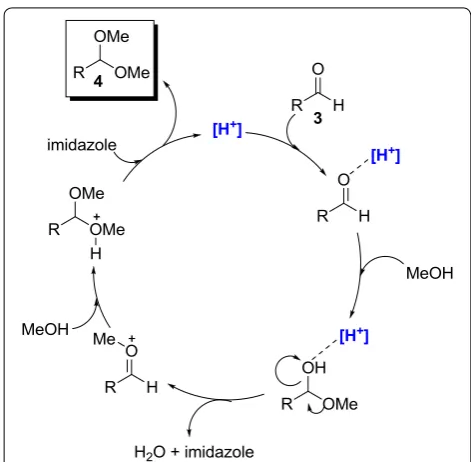
tentatively suggested. Although more studies should be necessary to support the mechanism of this process using complexes 1 and 2, a plausible catalytic cycle is proposed in Scheme 2 and the role of imidazolium salt, represented as H+, is depicted. The weak acid would be involved in
the first step of the cycle activating the aldehyde to pro-mote the addition of the first molecule of MeOH [65].
In‑vitro antimicrobial activity
In this part and by way of comparison, we chose to study the antibacterial activity of the organic–inor-ganic hybrid metal(II) halides with 2-methylimidazole. Then the synthesized compounds as well as the cop-per complex based on 2-mim, recently published [34], were screened for their in vitro growth inhibiting activ-ity against Gram-positive (Enterococus faecalis, Bacillus thuringiensis, Staphylococcus aureus, Micrococcus luteus and listeria) and Gram-negative (Salmonella typhimu-rium, Pseudomonas aeruginosa and Klebsiella pneumo-nia) bacteria. The antibacterial activity was measured as the diameter of the clear zone of growth inhibition and the results were presented in Table 6. As can be seen in this table, (C4H7N2)2[CoCl4] (1), (C4H7N2)2[ZnCl4] (2)
and (C4H7N2)[CuCl3(H2O)] (3) possessed variable
inhi-bition zones among the tested microorganisms ranging from 11 to 24 mm at the tested concentration (5 mg/mL). Cobalt complex was found to have a significant antibac-terial activity against the Gram-negative bacteria tested compared to Gram-positive bacteria. In fact, compared to the ampicillin, (C4H7N2)2[CoCl4] has the same
diam-eter inhibition zones (24 mm) against K. pneumoniae. (C4H7N2)2[CoCl4] exhibits a greater activity (20 mm)
than the ampicillin against S. Typhimurium. According to the results presented in Table 6, (C4H7N2)2[ZnCl4] was
found to have a moderate activity against E. faecalis, P. aeruginosa and S. Typhimirium. No inhibition zones were observed for all the tested chemical compounds against B. thuringiensis and M.l. In fact, from these results can be deduced that these two Gram-positive bacteria were found to be very resistant. The antimicrobial results sug-gested that Co-complex exhibits higher biologically activ-ity against microbial tested strains in comparison to the ampicillin antibiotic.
Conclusions
Two new isostructural organic–inorganic hybrid mate-rials, based on 2-methyl-1H-imidazole, 1 and 2, were synthesized and fully structurally characterized. The basic unit structure of these compounds consists of one [MIICl
4]2− ion and two crystallographically inequivalent
2-methylimidazolium cations. Furthermore, the analy-sis of their crystal packing reveals non-covalent interac-tions, including C/N–H⋯Cl hydrogen bonds and π⋯π Table 5 Scope of the acetalization reaction using
cata-lyst 2
a Yields determined by 1H-NMR spectroscopy
b Reaction performed in the absence of catalyst
Entry R Product Yield (%)a
1 4-ClPh, 3b 4b [62] 93
2 3-ClPh, 3c 4c [62] 81
3 4-BrPh, 3d 4d [62] 81
4 4-NO2Ph, 3e 4e [62] 94
5 4-CNPh, 3f 4f [63] 94
6 4-PhPh, 3g 4g [64] 67
7 Ph, 3h 4h [62] 75
8 1-Naphthyl, 3i 4i [62] 70
9b 3-NO
2Ph, 3a 4a < 5
stacking interactions, to be the main factor governing the supramolecular assembly of the crystalline complexes. In view of the pivotal role of noncovalent interactions in the design of new materials, the theoretical calcula-tion method of noncovalent interaccalcula-tions (NCI) is found to be an effective tool to understand the formation of these complex materials. The thermal decomposition of the complexes is a mono-stage process, confirmed by the three-dimensional representation of the powder dif-fraction patterns (TDXD). Additionally, we have demon-strated the efficiency of both metal complexes to act as catalysts in the acetalization reaction under very mild
conditions in the presence of MeOH, as the solvent of the reaction and as the unique source of acetalization. Moreover, the antimicrobial results suggested that metal-complexes exhibit significant antimicrobial activity. This study, in conjunction with the previous one [34], high-lights again the structural and the biological diversities within the field of inorganic–organic hybrids.
Abbreviations
2mim: 2-methyl-1H-imidazole; DTA: differential thermal analysis; TGA: thermo-gravimetric analysis; IR: infrared; XRPD: X-ray powder diffraction.
Authors’ contributions
All authors contributed to the discussion of the ideas which have resulted in the development of the strategy and descriptions of the methodology presented in this paper. AMBS performed the assays and prepared the manuscript. LBF was responsible for the antimicrobial activity assays. RPH conducted the catalytic studies. HN revised the manuscript. All authors read and approved the final manuscript.
Author details
1 Laboratoire Physicochimie de l’Etat Solide, Département de Chimie, Faculté des Sciences de Sfax, Université de Sfax, BP 1171, 3000 Sfax, Tunisia. 2 Unité Enzymes et Bioconversion, Ecole Nationale d’Ingénieurs de Sfax, PB 1173, 3038 Sfax, Tunisia. 3 Ecole Nationale Supérieure de Chimie de Rennes, 11 Allée de Beaulieu, 35708 Rennes cedex 7, France. 4 Laboratorio de Organocatálisis Asimétrica, Departamento de Química Orgánica, Instituto de Síntesis Química y Catálisis Homogénea (ISQCH), CSIC-Universidad de Zaragoza, C/Pedro Cerbuna 12, 50009 Saragossa, Spain.
Acknowledgements
The authors would like to thank gratefully the Faculty of Chemistry, University of Wroclaw, Poland, for supplying single-crystal data collection. The authors are grateful, likewise, to Pr. Abdelmottaleb Ouederni for his assistance in TGA/DTA measurements of this study (The Unit of Joint Service of Researche National School of Engineers of Gabes, University of Gabes, Tunisia). Ministerio de Economía, Industria y Competitividad MINECO-FEDER CTQ2017-88091-P is also acknowledged for financial support of our research.
Competing interests
The authors declare that they have no competing interests.
Availability of data and materials
Crystallographic data for CCDC-1433265 (1) and CCDC-1433266 (2) can be obtained free of charge from The Cambridge Crystallographic Data Centre via https://www.ccdc.cam.ac.uk/data_request/cif
Publisher’s Note
Springer Nature remains neutral with regard to jurisdictional claims in pub-lished maps and institutional affiliations.
Received: 18 July 2017 Accepted: 15 February 2018
References
1. Matulková I, Cihelka J, Pojarová M, Fejfarová K, Dušek M, Vaněk P, Kroupa J, Krupková R, Fábry J, Němec I (2012) A new series of 3,5-diamino-1,2,4-triazolium (1+) inorganic salts and their potential in crystal engineering of novel NLO materials. CrystEngComm 14:4625–4636
2. Evans OR, Lin W (2001) Crystal engineering of nonlinear optical materials based on interpenetrated diamondoid coordination networks. Chem Mater 13:2705–2712
Scheme 2 Tentative mechanistic cycle
Table 6 Antibacterial activity of 1, 2 and 3 against Gram (+) and Gram (−) bacteria strains
nd not detected
Bacteria strains Inhibition zone diameter (mm)
1 2 3 Ampicillin
Gram +
S. aureus 11 ± 0.5 nd nd 40 ± 0.5
E. faecalis 13 ± 0.5 13 ± 0.5 nd 26 ± 0.5
Listeria 15 ± 0.5 nd 13 ± 0.5 33 ± 0.5
B. thuringiensis nd nd nd 36 ± 0.5
M. l nd nd nd 20 ± 0.5
Gram −
K. pneumoniae 24 ± 0.5 nd 11 ± 0.5 24 ± 0.5
P. aeruginosa 13 ± 0.5 11 ± 0.5 nd 23 ± 0.5
3. Zhang XM, Tong ML, Chen XM (2002) Hydroxylation of N-Heterocycle ligands observed in two unusual mixed-valence CuI/CuII complexes. Angew Chem Int Ed 41:1029
4. Lacroix PG, Malfant I, Bénard S, Yu P, Nakatani K (2001) Hybrid molecular-based magnets containing organic NLO chromophores: a search toward an interplay between magnetic and NLO behavior. Chem Mater 13:441 5. Clemente-León M, Coronado E, Martí-Gastaldo C, Romero FM (2011)
Mul-tifunctionality in hybrid magnetic materials based on bimetallic oxalate complexes. Chem Soc Rev 40:473
6. Fadhel H, Houcine N, Samia Y, Turnbull MM, Tahar M, Thierry B (2011) Syn-thesis, characterization and magnetic properties of four new organically templated metal sulfates [C5H14N2][MII(H2O)6](SO4)2, (MII = Mn, Fe Co, Ni). Dalton Trans 40:11613
7. Matulková I, Cihelka J, Fejfarová K, Dušek M, Pojarová M, Vaněk P, Kroupa J, Šala M, Krupková R, Němec I (2011) Semi-organic salts of aniline with inorganic acids: prospective materials for the second harmonic genera-tion. CrystEngComm 13:4131
8. Clemente-León M, Coronado E, Galán-Mascarós JR, Gómez-García CJ, Canadell E (2000) Hybrid molecular materials based upon the photochromic nitroprusside complex, [Fe(CN)5NO]2−, and organic π-Electron donors. synthesis, structure, and properties of the radical salt (TTF)7[Fe(CN)5NO]2 (TTF = Tetrathiafulvalene). Inorg Chem 39:5394 9. Coronado E, Galán-Mascarós J, Gómez-García CJ, Laukhin V (2000)
Coex-istence of ferromagnetism and metallic conductivity in a molecule-based layered compound. Nature 408:447
10. Yaghi OM, O’Keeffe M, Ockwig NW, Chae HK, Eddaoudi M, Kim J (2003) Reticular synthesis and the design of new materials. Nature 423:705 11. Houcine N, Fadhel H, Tahar M, Mac Leod TCO, Kopylovich MN, Kamran MT,
Pombeiro AJL (2013) 2-Dihydromethylpiperazinediium-MII (MII= CuII, FeII, CoII, ZnII) double sulfates and their catalytic activity in diastereoselective nitroaldol (Henry) reaction. Dalton Trans 42:399
12. Erer H, Yeşilel OZ, Darcan C, Büyükgüngör O (2009) Synthesis, spectro-scopic, thermal studies, antimicrobial activities and crystal structures of Co (II), Ni (II), Cu (II) and Zn (II)-orotate complexes with 2-methylimidazole. Polyhedron 28:3087
13. Alvarado E, Badaj AC, Larocque TG, Chem Lavoie G G (2012) N -Heterocy-clic carbenes and imidazole-2-thiones as ligands for the gold(I)-catalysed hydroamination of phenylacetylene. Eur. J 18:12112
14. Burling S, Field LD, Messerle BA, Rumble SL (2007) Late transition metal catalyzed intramolecular hydroamination: the effect of ligand and sub-strate structure. Organometallics 26:4335
15. Burling S, Field LD, Messerle BA, Turner P (2004) Intramolecular hydroami-nation catalyzed by cationic rhodium and iridium complexes with bidentate nitrogen-donor ligands. Organometallics 23:1714 16. Burling S, Field LD, Messerle BA (2000) Hydroamination of alkynes
cata-lysed by a cationic rhodium (I) complex. Organometallics 19:87 17. Elgafi S, Field LD, Messerle BA, Turner P, Hambley TW (1999) Rhodium
complexes containing bidentate imidazolyl ligands: synthesis and struc-ture. J Organomet Chem 588:69
18. Elgafi S, Field LD, Messerle BA, Hambley TW, Turner P (1997) Synthesis of novel ruthenium complexes containing bidentateimidazole-based ligands. J Chem Soc Dalton Trans 13:2341
19. Done MC, Rüther T, Cavell KJ, Kilner M, Peacock EJ, Braussaud N, Skelton BW, White A (2000) Novel cationic and neutral Pd(II) complexes bearing imidazole based chelate ligands: synthesis, structural characterisation and catalytic behaviour. J Organomet Chem 607:78
20. Liu YM, Lin YC, Chen WC, Cheng JH, Chen YL, Yap GPA, Sun SS, Ong TG (2012) Synthesis and characterization of para-pyridine linked NHC palladium complexes and their studies for the Heck-Mizoroki coupling reaction. Dalton Trans 41:7382–7389
21. Huynh HV, Jothibasu R (2011) Syntheses and catalytic activities of Pd(II) dicarbene and hetero-dicarbene complexes. J Organomet Chem 696:3369
22. Yang WH, Lee CS, Pal S, Chen YN, Hwang WS, Lin IJB, Wang JC (2008) Novel Ag(I), Pd(II), Ni(II) complexes of N, N′-bis-(2,2-diethoxyethyl) imidazole-2-ylidene: synthesis, structures, and their catalytic activity towards Heck reaction. J Organomet Chem 693:3729
23. Rüther T, Done MC, Cavell KJ, Peacock EJ, Skelton BW, White AH (2001) Novel methylpalladium (II) complexes bearing tridentate imidazole-based chelate ligands: synthesis, structural characterization and reactivity. Organometallics 20:5522
24. Omar K, Walid R, Thierry B, Kamran TM, Kopylovich MN, Houcine N (2013) Inorganic-organic hybrid double sulfates as catalysts of the diastereose-lective nitroaldol reaction. J Organomet Chem 136:741–742
25. Cheruzel LE, Cecil MR, Edison SE, Mashuta MS, Baldwin MJ, Buchanan RM (2006) Structural and spectroscopic characterization of copper(II) com-plexes of a new bisamide functionalized imidazole tripod and evidence for the formation of a mononuclear end-on Cu–OOH species. Inorg Chem 45:319
26. Wallar BJ, Lipscomb JD (1996) Dioxygen activation by enzymes contain-ing binuclear non-heme iron clusters. Chem Rev 96:2625
27. Flint DH, Allen RM (1996) Iron–sulfur proteins with nonredox functions. Chem Rev 96:2315
28. Holm RH, Kennepohl P, Solomon EI (1996) Structural and functional aspects of metal sites in biology. Chem Rev 96:2239
29. Breslow R, Hunt JT, Smiley R, Tarnowski T (1983) Synthesis of some poly-imidazole ligands related to zinc enzymes. J Am Chem Soc 105:5337 30. Siddiqi ZA, Khalid M, Kumar S, Shahid M, Noor S (2010) Antimicrobial and
SOD Activities of novel transition metal complexes of pyridine-2,6-dicar-boxylic acid containing 4-picoline as auxiliary ligand. Eur J Med Chem 45:264–269
31. Delaney S, Pascaly M, Bhattacharya PK, Han K, Barton JK (2002) Oxidative damage by ruthenium complexes containing the dipyrido-phenazine ligand or its derivatives: a focus on intercalation. Inorg Chem 41:1966–1974
32. Serbest K, Colak A, Güner S, Karaböcek S, Kor-mali F (2001) Copper(II)-manganese(II) complexes of 3,3′ -(1,3-propanediyldiimine)bis-(3-methyl-2-butanone)dioxime with superoxide dismutase-like activity. Transit Met Chem 26:625–629
33. Vogel AI (1989) Textbook of practical organic chemistry, 5th edn. Long-man, London
34. Assila MBS, Houcine N, Miroslaw A, Magdalena F (2016) 0D and 1D copper(II) coordination polymers based on 2-methyl-1Himidazole: struc-tural, vibrational and magnetic characterizations. J Organomet Chem 805:42
35. CrysAlis CCD and CrysAlis RED (2010) Xcalibur R software. Oxford Diffrac-tion Ltd, Abingdon
36. Farrugia LJ (1999) WinGX suite for small milecule single crystal crystal-lography. J Appl Cystallogr 32:837
37. Sheldrick GM (2008) A short history of SHELX. Acta Cryst A 64:112 38. Brandenburg K (2012) DIAMOND. Version 3.2i. Crystal Impact GbR, Bonn 39. Harbone JB, Dey PM (1991) Methods in plant biochemistry, vol 6.
Aca-demic Press, London, p 47
40. Hachuła B, Nowak M, Kusz J (2010) Crystal and molecular structure aalysis of 2-methylimidazole. J Chem Crystallogr 40(3):201
41. Naumov P, Ristova M, Šoptrajanov B, Zugik M (2001) Vibrational spectra of bis(acetato)tetrakis(imidazole)copper(II). J Mol Struct 598:235
42. Das S, Hung CH, Goswami S (2003) Blue dimetallic complexes of two heavy metal ions CdII and HgII with an extended nitrogen donor ligand. preparation, spectral characterization, and crystallographic studies. Inorg Chem 42:8592
43. Hachuła B, Pedras M, Pentak D, Nowak M, Kusz J, Borek J (2009) Effect of an industrial chemical waste on the uptake. Acta Crystallogr C 65:215 44. Greene TW, Wuts PGM (1999) Protective groups in organic synthesis, 3rd
edn. Wiley, New York
45. Karimi B, Golshani B (2002) Iodine-catalyzed, efficient and mild proce-dure for highly chemoselective acetalization of carbonyl compounds under neutral aprotic conditions. Synthesis 784–788. https://doi. org/10.1055/s-2002-25775
46. Gopinath R, Haque SJ, Patel BK (2002) Tetrabutylammonium tribromide (TBATB) as an efficient generator of HBr for an efficient chemoselective reagent for acetalization of carbonyl compounds. J Org Chem 67:5842 47. Lee SH, Lee JH, Yoon CM (2002) An efficient protection of carbonyls and
deprotection of acetals using decaborane. Tetrahedron Lett 43:2699 48. Leonard NM, Oswald MC, Freiberg DA, Nattier BA, Smith RC, Mohan RS
(2002) A simple and versatile method for the synthesis of acetals from aldehydes and ketones using bismuth triflate. J Org Chem 67:5202 49. Patel SM, Chudasama UV, Ganesphure PA (2003) Ketalization of ketones
with diols catalyzed by metal(IV) phosphates as solid acid catalysts. J Mol Catal A Chem 194:267
aldehydes and diols catalyzed by water-tolerant and recoverable vanadyl triflate. Org Lett 7:3343
51. Kumar R, Chakraborti AK (2006) Copper(II) tetrafluoroborate as a novel and highly efficient catalyst for acetal formation. Tetrahedron Lett 46:8319 52. Smith BM, Graham AE (2006) Indium triflate mediated acetalization of
aldehydes and ketones. Tetrahedron Lett 47:9317
53. Williams DBG, Lawton MG (2008) Highly atom efficient aluminium triflate catalysed acetal formation. Green Chem 10:914
54. Gregg BT, Golden KC, Quinn JF (2008) Indium(III)trifluoromethanesul-fonate as a mild, efficient catalyst for the formation of acetals and ketals in the presence of acid sensitive functional groups. Tetrahedron 64:3287 55. Miao Z, Xu L, Song H, Zhao H, Chou L (2013) One-pot synthesis of
ordered mesoporous zirconium oxophosphate with high thermostability and acidic properties. Catal Sci Technol 3:1942
56. Zhao S, Jia Y, Song YF (2014) Acetalization of aldehydes and ketones over H4[SiW12O40] and H4[SiW12O40]/SiO2. Catal Sci Technol 4:2618
57. Velusamy S, Punniyamurthy T (2004) Cobalt(II)-catalyzed chemoselective synthesis of acetals from aldehydes. Tetrahedron Lett 45:4917
58. Rajabi FJ (2010) Cobalt (II) schiff base functionalized mesoporous silica as an efficient and recyclable chemoselective acetalization catalyst. Iran Chem Soc 7:695
59. Roy A, Rahman M, Das S, Kundu D, Kundu SK, Majee A, Hajra A (2009) Zinc chloride as an efficient catalyst for chemoselective dimethyl acetalization. Synth Commun 39:590
60. Salem S, Houcine N, Thierry B, Raquel PH (2016) Crystallisation, thermal analysis and acetal protection activity of new layered Zn(II) hybrid poly-morphs. CrystEngComm 18:5365
61. Dear AE, Liu HB, Mayes PA, Perlmutter P (2006) Conformational analogues of Oxamflatin as histone deacetylase inhibitors. Org Biomol Chem 4:3778 62. Ito S, Hayashi A, Komai H, Yamaguchi H, Kubota Y, Asami M (2011)
Mesoporous aluminosilicate-catalyzed allylation of carbonyl compounds and acetals. Tetrahedron 67:2081
63. Langhals H, Becherer T, Lindner J, Obermeier A (2007) The fluorescence labelling of primary amines with perylenetetracarboxdiimides. Eur J Org, Chem, p 4328
64. Barba I, Chinchilla R, Gomez C (1990) Synthesis of phenyl substituted cyclohexa-1,4-dienes and cyclohexa-2,5-dienones by anodic methoxyla-tion of alkylbiphenyls. Tetrahedron 46:7813
![Table 1 Crystal data and structure refinement details for (C4H7N2)2[CoCl4] (1) and (C4H7N2)2[ZnCl4] (2)](https://thumb-us.123doks.com/thumbv2/123dok_us/383992.2035634/3.595.62.537.99.464/table-crystal-data-structure-refinement-details-cocl-zncl.webp)