R E V I E W
Open Access
Heterogeneous catalysts for catalytic CO
2
conversion into value-added chemicals
Ho Seok Whang, Jinkyu Lim, Min Suk Choi, Jonghyeok Lee and Hyunjoo Lee
*Abstract
As climate change becomes increasingly evident, reducing greenhouse gases including CO
2has received growing
attention. Because CO
2is thermodynamically very stable, its conversion into value-added chemicals such as CO,
CH4, or C2H4
is difficult, and developing efficient catalysts for CO2
conversion is important work. CO2
can be
converted using the gas-phase reaction, liquid-phase reaction, photocatalytic reaction, or electrochemical reaction.
The gas-phase reaction includes the dry reforming of methane using CO
2and CH
4, or CO
2hydrogenation using
CO2
and H2. The liquid-phase reaction includes formic acid formation from pressurized CO2
and H2
in aqueous
solution. The photocatalytic reaction is commonly known as artificial photo-synthesis, and produces chemicals from
CO
2and H
2O under light irradiation. The electrochemical reaction can produce chemicals from CO
2and H
2O using
electricity. In this review, the heterogeneous catalysts used for the gas-phase reaction or electrochemical reactions
are discussed, because the liquid-phase reaction and photocatalytic reaction typically suffer from low productivity
and poor durability. Because the gas-phase reaction requires a high reaction temperature of > 600 °C, obtaining
good durability is important. The strategies for designing catalysts with good activity and durability will be
introduced. Various materials have been tested for electrochemical conversion, and it has been shown that specific
metals can produce specific products, such as Au or Ag for CO, Sn or Bi for formate, Cu for C
2H
4. Other
unconventional catalysts for electrochemical CO2
reduction are also introduced.
Keywords:
Carbon dioxide, Dry reforming, Reverse water-shift reaction, Hydrogenation, Electrochemical reduction
Background
Global energy consumption has soared due to increasing
population and industrialization, and anthropogenic
CO
2emissions have rapidly grown because the main
en-ergy resources being consumed today are fossil fuels.
In-creasing CO
2concentration in the atmosphere is leading
to global warming and a range of environmental
prob-lems. Global average temperatures have increased by 0.8
°C over the last 70 years [
1
]. International efforts have
been proposed to reduce CO
2emissions, such as the
multinational Paris agreement. At the same time, many
studies have focused on the development and application
of renewable energy sources as a means of reducing
de-pendence on fossil fuels [
2
,
3
], as well as technologies
for capturing and utilizing CO
2. CO
2utilization would
reduce greenhouse gases in the atmosphere and oceans
where they can do harm, and CO
2can also be used to
produce valuable chemicals [
4
–
6
].
Because CO
2is thermodynamically the most stable
car-bon species, its conversion into value-added products
usu-ally requires the expenditure of considerable energy.
Various chemical processes have been reported that can
convert CO
2into chemicals such as CO, hydrocarbon, or
oxygenated hydrocarbon. Gas-phase reaction, liquid-phase
reaction, electrochemical, and photocatalytic reaction
methods have been reported. Gas-phase reactions include
the dry reforming of methane (CH
4+ CO
2→
2CO + 2H
2),
CO
2hydrogenation (CO
2+ H
2→
CO + H
2O, which is also
called the reverse water-gas shift reaction; CO
2+ 4H
2→
CH
4+ 2H
2O). The liquid-phase reaction includes the
pro-duction of formic acid using CO
2dissolved in aqueous
phase (CO
2(aq) + H
2(aq)
→
COOH). Several review
pa-pers about CO
2hydrogenation can be found in the
litera-tures [
7
–
9
]. However, CO
2hydrogenation or formic acid
formation requires H
2, which is mainly produced from
* Correspondence:[email protected]
Department of Chemical and Biomolecular Engineering, Korea Advanced Institute of Science and Technology, Daejeon 34141, Republic of Korea
methane by steam reforming, which also produces a large
amount of CO
2.
Electrochemical CO
2reduction has received a great deal
of attention recently, but the low solubility of CO
2in
aqueous solution has been a major obstacle. The use of a
gas diffusion electrode has enabled the direct use of
gas-eous CO
2for electrochemical conversion. This
electro-chemical conversion process does not require H
2as a
reactant. Photocatalytic CO
2conversion also received
growing attention because of its similarity to
photosyn-thesis, but the process typically suffers from low
product-ivity and poor stability.
Efficient catalysts can minimize the energy needed for
reactions by reducing the activation energy. Various
cat-alysts are being actively investigated to enhance CO
2conversion and to control selectivity toward specific
tar-get products. In this review, we will focus on the
hetero-geneous catalysts for gas-phase CO
2conversion and
electrochemical CO
2conversion. In the gas-phase CO
2conversion, catalysts used for the dry forming of
me-thane, CO
2hydrogenation producing CO, and CO
2hy-drogenation producing CH
4will be discussed. In the
electrochemical CO
2conversion, the specific catalysts
used to produce CO, formic acid, and hydrocarbons will
be discussed. Reviews of formic acid formation or
photo-catalytic CO
2conversion can be found in the literature
[
10
,
11
].
Catalytic CO
2conversion in gas phase
Dry reforming of methane
The dry reforming of methane (DRM) (Eq. (
1
)) can
con-sume two greenhouse gases (CO
2and CH
4)
simultan-eously and produce synthesis gas (abbreviated syn-gas, a
mixture of CO and H
2). The ratio of H
2to CO products
is 1, which is much lower than other reforming
reac-tions, such as the steam reforming of methane (SRM)
and partial oxidation of methane (POM) (Eqs. (
2
) and
(
3
)). The low ratio of H
2/CO is useful for synthesizing
long chain hydrocarbons via the Fischer-Tropsch
reac-tion [
12
–
14
].
CH
4þ
CO
2→
2CO
þ
2H
2;Δ
H
°¼
247 kJ mol
‐1ð
1
Þ
CH
4þ
H
2O
→
CO
þ
3H
2;Δ
H
°¼
246 kJ mol
‐1ð
2
Þ
CH
4þ
1
.
2
O
2→
CO
þ
2H
2;Δ
H
°
¼
‐
36 kJ mol
‐1ð
3
Þ
The DRM reaction is endothermic, requiring a high
reaction temperature of > 700 °C, which results in high
energy cost [
15
,
16
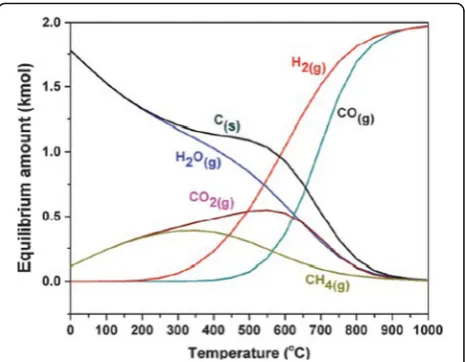
]. Figure
1
shows the DRM
equilib-rium plots at various temperatures and 1 atm [
17
]. The
high temperature is required to attain high product
yield. Side reactions such as the reverse water gas shift
(RWGS) reaction (Eq. (
4
)) or carbon gasification
reac-tion (Eq. (
5
)) can occur. The RWGS reaction affects the
H
2/CO ratio; because the RWGS reaction happens more,
the H
2/CO ratio decreases and CO
2conversion
in-creases. The steam produced from the RWGS reaction
can react with carbon and produce syn-gas.
CO
2þ
H
2→
CO
þ
H
2O
;
Δ
H
°¼
41 kJ mol
‐1ð
4
Þ
C
þ
H
2O
→
CO
þ
H
2;Δ
H
°¼
131 kJ mol
‐1ð
5
Þ
Also, deactivation occurs easily due to sintering and
coke deposition, which degrades long-term durability
[
12
,
18
–
20
]. Carbon is produced due to the Boudouard
reaction and methane cracking (Eq. (
6
) and Eq. (
7
)). The
carbon is thermodynamically the main product at
tem-peratures lower than 570 °C [
17
]. DRM can proceed
above 640 °C with methane cracking. The Boudouard
re-action can
’
t occur above 820 °C. Carbon can be
pro-duced by the Boudouard reaction, and methane cracking
occurs from 570 to 700 °C [
21
]. Coke deposition is
thermodynamically favored at low temperature. The
car-bon produced by methane cracking is likely to react with
steam or carbon dioxide at high temperature. Thus, the
DRM reaction should be performed at high temperature.
2CO
þ
C
→
C
þ
CO
2;Δ
H
°¼
‐
172 kJ mol
‐1ð
6
Þ
CH
4→
C
þ
2H
2;Δ
H
°¼
75 kJ mol
‐1ð
7
Þ
Various heterogeneous catalysts have been developed,
including metal supported catalysts, perovskites, and
solid solution catalysts [
22
–
26
]. Precious metals (Pt, Rh
Fig. 1Thermodynamic equilibrium plots for DRM at 1 atm, 0–1000 °
or Ru) are known to have high activity and durability,
al-though at high price. Non-precious metals (Ni or Co)
have been widely investigated as well. In this section,
each component of DRM catalysts will be explained, and
the strategies to enhance their activity and durability for
DRM will be demonstrated.
Compositions of the catalysts: Metal, supports, promotors
Precious metals such as Pt, Rh and Ru are highly active
for DRM and also resistant against coke deposition [
27
–
30
]. The precious metal-based catalysts show high
activ-ity in spite of the very small amount of metal catalyst
used. For example, the Ru/ZrO
2-SiO
2catalyst shows
high activity and durability, as shown in Fig.
2
, even
though the Ru content was only 0.13 wt% [
31
].
Non-precious metals such as Ni or Co have been used
more for DRM due to their cheap price and abundance
[
32
–
34
]. Ni catalysts have shown a level of activity
com-parable to precious metals [
30
]. Alloyed metal catalysts
are widely used for DRM because they have a different
electronic structure than monometallic materials [
35
].
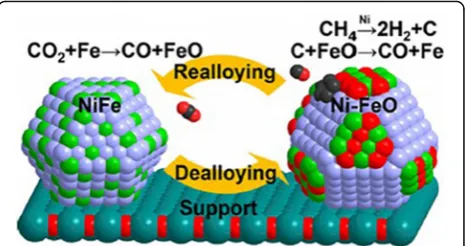
For example, the Ni-Fe alloy catalyst exhibited
interest-ing behavior for DRM, as shown in Fig.
3
. Monometallic
Ni or Fe catalysts have shown poor durability, because
the monometallic Ni catalyst is easily deactivated by
coke deposition, and Fe is inactive for DRM. During the
DRM reaction, the Ni-Fe alloy surface is partially
dized; Ni maintains an oxidation state, while Fe is
oxi-dized by CO
2. The oxidized FeO causes dealloying of the
surface, and the FeO then oxidizes the carbon deposited
on the surface, returning to Fe. The Fe
2+/Fe redox cycle
plays a key role in enhancing durability in the DRM
re-action [
36
].
Supports can affect catalytic activity and durability for
DRM [
37
]. The interaction between a support and metal
can change the dispersion of the metal, resistance
against sintering, and the electronic structure of the
metal [
28
,
31
]. Figure
4
shows the X-ray absorption fine
structure (XAFS) analysis results of Rh catalysts
depos-ited on various supports of Al
2O
3, TiO
2, etc. The X-ray
absorption near edge structure (XANES) analysis in
Fig.
4
a shows that the Rh electronic structure has
chan-ged as a result of the support materials. TiO
2supported
Rh has a metallic character, while
ɣ
-Al
2O
3supported Rh
has an oxidic character. Figure
4
b shows extended X-ray
absorption fine structure (EXAFS) spectra. The Rh-Rh
peak at 0.24 nm has different intensities with various
supports. When the intensity is higher, the Rh-Rh
coord-ination number is higher, indicating lower dispersion.
The support materials affect the dispersion of the metal
and chemical environment. [
28
].
Fig. 2aTEM images of fresh catalyst Ru/ZrO2-SiO2catalyst; the insets indicate high angle annular dark field (HAADF)-scanning transmission
electron microscope (STEM) images.bDRM results for a Ru-based catalyst with a space velocity of 80,000 ml/gcat·h at 800 °C. (Reprinted with permission from ref. [31]. Copyright 2017 Elsevier)
Fig. 3Schematic diagram of the dealloying and realloying behavior
The strong-metal support interaction (SMSI) causes a
high dispersion of metals resulting in small sized metal
nanoparticles with enhanced DRM activity. In addition, it
increases resistance against sintering with enhanced
dur-ability [
31
,
38
,
39
]. The acidity and basicity of the support
also affects catalytic properties. CO
2is activated by
form-ing formate with surface hydroxyl on an acidic support.
CO
2is activated by forming oxy-carbonate on a basic
sup-port. On an inert support such as SiO
2, both CO
2and
CH
4are activated by metal with faster deactivation. A
DRM catalyst supported on an inert material (SiO
2) is
usually less active and less durable than on an acidic
sup-port (Al
2O
3) or basic support (La
2O
3) [
23
,
30
,
40
,
41
].
Promoters have been widely used for DRM. Alkali
metal oxides such as K
2O or CaO have been used to
in-crease the basicity of the catalyst enhancing CO
2adsorp-tion [
42
–
44
]. CeO
2or ZrO
2were used to increase
oxygen mobility [
22
,
45
–
50
]. The transition between Ce
3 +and Ce
4+can occur easily on CeO
2. The coke formed
on Ni sites could be oxidized by using the redox cycle of
CeO
2with enhanced coke-resistivity [
47
]. The surface
hydroxyl group can participate in the DRM surface
reac-tion. Zhu et al. reported that the energy barrier for CH
and C oxidation by surface OH was slightly lower than
the barrier for surface O [
51
]. Ni et al. showed that the
surface hydroxyl groups were increased by adding B
2O
3to Ni catalyst, as shown in Fig.
5
. The surface hydroxyl
groups oxidize the carbon formed from methane
decom-position, with enhanced resistance against coke
depos-ition [
52
].
Coke-resistant catalysts
The key objective of catalysts developed for DRM is how
to prevent coke deposition. Highly durable catalysts
should avoid sintering because large Ni particles have
se-vere coke formation at the surface, while small Ni
nanoparticles do not have carbon deposition. In this
sec-tion, various strategies to control the nano-structures of
catalysts to prevent coke deposition will be discussed.
In order to prevent the sintering of nanoparticles, an
inorganic oxide overlayer was formed on Ni
nanoparti-cles [
53
–
57
]. As shown in Fig.
6
, Ni nanoparticles with
an average size of 5 nm were immobilized on SiO
2spheres, then porous SiO
2overlayers were formed on
the Ni nanoparticles. The resulting Ni/SiO
2@SiO
2cata-lyst showed high durability for DRM; activity was
main-tained for 170 h at 800 °C without Ni sintering [
53
].
Using this nano-structure, the effects of Ni size and
support were evaluated independently. To evaluate the
size effect, various sizes of Ni nanoparticles were
depos-ited; 2.6, 5.2, 9.0, 17.3 nm. CH
4turnover frequency
clearly increased as Ni size decreased. The size effect
could be evaluated exactly because the Ni size was barely
changed even after the DRM reaction at 800 °C. The
dif-ferent metal oxide overlayers of Al
2O
3, MgO, ZrO
2,
TiO
2, SiO
2were formed on Ni/SiO
2with a Ni particle
size of 5.2 nm. The Al
2O
3and MgO overlayers showed
enhanced CH
4turnover frequency, while the other
over-layers hardly showed enhancement [
55
].
Fig. 4Rh K-edgeaXANES spectra andbEXAFS data for Rh catalysts deposited on various supports. (Reprinted with permission from ref. [28].
Copyright 2002 Springer)
Fig. 5Mechanism of carbon suppression on Ni/B2O3–Al2O3catalyst.
Similarly, core-shell structures have been investigated;
an outer shell such as SiO
2separates the catalytic core
material such as Ni nanoparticles while preventing
sin-tering [
58
,
59
]. The core-shell structures have been
widely used in DRM, CO oxidation, and methane
com-bustion reactions [
60
–
62
]. Li et al. developed a Ni
yol-k@Ni@SiO
2catalyst, where a SiO
2shell with Ni
nanoparticles embedded in the middle surrounds a Ni
yolk core. This catalyst was highly active for DRM, and
it maintained activity without sintering for 90 h at 800 °
C [
62
].
Mesoporous materials have been widely used as
sup-ports because they provide a large surface area and facile
mass transfer [
63
,
64
]. Mesoporous Al
2O
3in particular
has been widely used because it can have a strong
inter-action with a metal active phase, and it has high thermal
stability [
65
,
66
]. Conventional impregnation with a
metal precursor might cause pore blockage. Wang et al.
developed ordered mesoporous Ni-Ce-Al oxide for
DRM with self-assembly induced by solvent evaporation
[
67
]. The Ni nanoparticles were uniformly deposited in
the pore channel of the mesoporous support. The
cata-lysts showed high durability because the Ni
nanoparti-cles did not sinter severely due to spatial confinement. It
maintained high DRM activity for 80 h at 700 °C.
CO
2hydrogenation
Reverse water-gas shift reaction
CO
2can react with H
2to produce CO via the reverse
water gas shift reaction. The RWGS reaction was first
observed in 1914 by Bosch and Wild when they tried to
produce H
2from steam and CO over FeO
xcatalyst [
68
].
RWGS can produce syn-gas, which is useful for
synthe-sizing valuable chemicals such as ammonia, methanol,
and fuels, from CO
2[
69
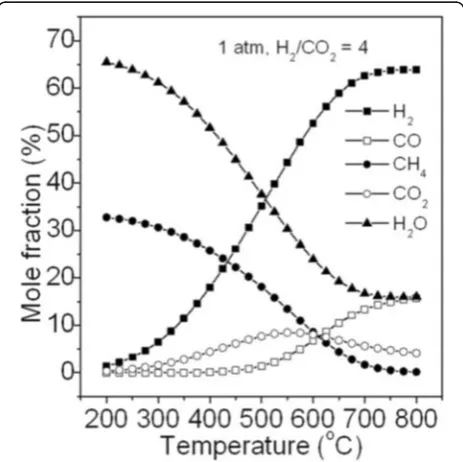
]. However, the RWGS reaction
is endothermic, requiring high temperature, and CO is
the dominant product above 600 °C as can be seen in
Fig.
7
[
70
]. Developing catalysts with high activity and
durability is essential to obtain a maximum yield.
Two reaction pathways, the redox mechanism and
for-mate decomposition mechanism, have been reported for
CO formation from RWGS. A case with a Cu catalyst
followed the redox mechanism; CO
2oxidizes Cu
0to
Cu
+generating CO, and H
2reduces Cu
+to Cu
0forming
H
2O [
71
]. In the formate decomposition mechanism,
CO
2hydrogenates to formate, followed by cleavage of
the C=O bond [
72
]. Catalysts for RWGS should contain
active sites to dissociate hydrogen and adsorb CO
2.
Pre-cious metal-based catalysts have been widely used for
RWGS because of their superior activity for hydrogen
dissociation. The effect of Pt particle size on the
Fig. 6Schematic illustration of Ni/SiO2@SiO2catalyst with high coke resistance for the DRM reaction. (Reprinted with permission from ref. [53].
Copyright 2014 John Wiley and Sons)
Fig. 7Thermodynamic equilibrium of CO2hydrogenation at 1 bar
selectivity of CO and CH
4was identified using rutile
TiO
2as a support. Small Pt particles preferred CO
for-mation. Pt-CO species were the key intermediate
decid-ing CO selectivity in the RWGS reaction [
73
].
The Au@UIO-67 catalyst was synthesized for the
RWGS reaction. UIO-67, which is porous metal-organic
framework, was used to disperse Au nanoparticles, then
the interaction between the metal and support was
en-hanced. Au@UIO-67 showed high activity and CO
se-lectivity for RWGS [
74
]. A Pd
–
In/SiO
2catalyst was
synthesized by the wet impregnation method and used
for RWGS. While the Pd/SiO
2showed 88% CO
selectiv-ity, Pd-In/SiO
2showed 100% CO selectivity without
CH
4formation. The difference was derived from the
modified CO adsorption energy. CO adsorption on the
Pd-In bimetallic surface was much weaker than that on
the Pd surface [
75
].
For the large scale conversion of CO
2, non-precious
metal catalysts are preferred due to cost and scarcity. Ni
and Cu-based catalysts are promising because they also
show high activity and selectivity for RWGS. But they
usually
suffer
from
sintering
at
high
reaction
temperatures.
Various ways of improving thermal stability have been
investigated. Rossi et al. prepared highly dispersed Ni
nanoparticles supported on SiO
2using magnetron
sput-tering deposition. The prepared catalyst showed better
activity at T > 600 °C and stability than a conventional
catalyst prepared by the wet impregnation method [
76
].
Ni/Ce-Zr-O catalysts were synthesized and used for
RWGS. Ni species were incorporated into the lattice of a
Ce-Zr-O solid solution. High activity, stability and
se-lectivity were achieved for the conversion of CO
2to CO
[
77
]. Cu/ZnO catalysts with various Cu/Zn ratios were
synthesized using aurichalcite precursors. The interface
between the Cu and ZnO affected the catalytic activity
for CO
2activation
.As the Cu ratio increased, the Cu
do-main size increased and the CO generation rate
de-creased [
78
]. Zheng at al. prepared CeCu composite
catalysts with different Ce/Cu mole ratios for RWGS.
The Ce
3+-oxygen vacancy-Cu
0structure was stabilized.
Cu sites became more electron deficient following
elec-tron transfer from Cu to Ce, with enhanced adsorption
of CO
2and H
2. The Ce
1.1Cu
1catalyst showed the
high-est catalytic performance for the RWGS reaction [
79
].
Transition-metal carbides (TMCs) are promising for
RWGS because they can dissociate hydrogen and C=O
bonds. With their abundance and low cost, many
re-searchers have reported on TMCs based-catalysts for
RWGS. A recent study revealed that Mo
2C showed
higher CO
2conversion and CO selectivity in the RWGS
than other TMCs such as TiC, TaC, ZrC, WC, and NbC
[
80
]. The experimental and density functional theory
(DFT) results showed that the oxygen binding energy
and activation barriers for oxygen removal were the
main factors for identifying effective catalysts for CO
2reduction.
Willauer et al. prepared K-Mo
2C supported on
γ
-Al
2O
3[
81
]. By modifying with a K promoter, CO
se-lectivity and stability increased, with only 7.3%
deactiva-tion after 68 h. CO
2adsorption was enhanced and CO
2dissociation barriers were reduced on the K-promoted
catalyst. Illas et al. reported that polycrystalline
α
-Mo
2C
catalyst showed 16% CO
2conversion and 99.5% CO
se-lectivity at 673 K in RWGS [
82
]. The presence of a
(101)-Mo/C surface on the catalyst provides active sites
for RWGS. Ma et al. synthesized a highly efficient and
stable Cu/
β
-Mo
2C catalyst for the RWGS reaction [
83
].
Because of strong interaction between the Cu and
β
-Mo
2C which dispersed the Cu particles uniformly on
the support, Cu/
β
-Mo
2C showed high activity and
stabil-ity compared with Pt- and Cu-based catalysts. Recently,
Ajayan et al. reported a metal-free carbon-based catalyst
for CO
2hydrogenation [
84
]. Pyridinic N was doped at
the edge sites of graphene quantum dots. The N dopants
played a key role in inducing thermocatalytic CO
2hy-drogenation activity. CO was produced dominantly at
lower temperatures and CO selectivity increased to 85%
at 300 °C.
Recently,
Ajayan
et
al.
reported
a
metal-free
carbon-based catalyst for CO
2hydrogenation [
84
].
Pyri-dinic N was doped at the edge sites of graphene
quantum dots. The N dopants played a key role in
indu-cing thermocatalytic CO
2hydrogenation activity. CO
was produced dominantly at lower temperatures and
CO selectivity increased to 85% at 300 °C.
CO
2methanation
prepared with high activity for CO
2methanation at
low temperature [
88
].
Light-assisted CO
2hydrogenation
Light is considered an important and ultimate energy
source for CO
2reduction, in a process also known as
artificial photosynthesis. Various semiconductor-based
photocatalysts have been investigated for CO
2reduction
[
89
,
90
]. However, they typically have shown low activity
and poor durability. Instead of using light for exciton
production, light can be used as an auxiliary energy
source to minimize overall energy usage. Recently,
unique light-assisted surface reactions have been
re-ported [
91
–
93
]. They can occur through excitation of
electrons in hybridized orbitals of adsorbed reactant
molecules on the metal catalyst surface.
We recently reported light-assisted CO
2hydrogenation
on heterogeneous metal catalysts [
94
]. Various metals
were tested in a photoreactor by changing temperature,
light intensity, and light wavelength. CO
2conversion
was enhanced on a Ru or Rh catalyst upon light
irradi-ation, as shown in Fig.
8
a. They produced CH
4select-ively. But Pt, Ni, Cu only produced CO without any
enhancement upon light irradiation. As the light
intensity increased, CO
2conversion also increased
linearly, indicating that hot electrons generated upon
light irradiation were responsible for the CO
2conversion
enhancement.
In-situ UV spectroscopy results measured under CO
2flow also confirmed that CO
2adsorbed on the Ru
sur-face can absorb visible light. DFT calculations showed
that the band-gap energy decreased from 8.2 eV for free
CO
2to 2.4 eV for CO
2adsorbed on Ru, as shown in
Fig.
8
b. This small band-gap energy enabled the
absorp-tion of visible light. The DRIFT measurement in Fig.
8
c
shows that CO
2was cleaved to CO with light irradiation
on a Ru catalyst. By using both light and heat, the overall
energy could be reduced to 37% of the case when only
heat was used, to achieve the same CO
2conversion of
15%. Additionally, the CO
2conversion was easily
initi-ated or termininiti-ated simply by turning the light on or off.
Electrochemical CO
2reduction
The electrochemical CO
2reduction reaction (CO
2RR)
involves CO
2conversion on an electrode powered by
electric bias. Because CO
2is highly stable with a linear
molecular shape having two C=O bonds, it requires a
high overpotential to initiate the reaction [
95
]. An
overpotential is the difference between the actual applied
Fig. 8aCO2conversion enhancement with light irradiation at various temperatures,bschematic diagram of hybridized orbital change and hot
potential and theoretical thermodynamic potential.
Het-erogeneous electrocatalysts should be used to reduce the
overpotential. The performance and reaction pathway
highly depend on the electrocatalyst. CO
2is
electro-chemically reduced to chemicals or fuels at the cathode,
and the counter anode reaction is water oxidation
pro-ducing oxygen, typically known as oxygen evolution
re-action (OER) [
96
].
A distinct feature of the electrochemical CO
2re-duction is its compatibility with renewable sources.
Because CO
2is thermodynamically stable, the CO
2conversion involves high energy consumption [
95
,
97
]. This energy can be obtained from renewable
sources, such as solar or wind power, and the
ob-tained
electricity
can
drive
the
electrochemical
CO
2RR. Additionally, electrochemical CO
2conver-sion can be used for renewable energy storage [
95
,
98
]. Since the renewable power is inherently
inter-mittent and undistributed, storing the electricity in
chemical bonds might be useful [
98
]. Fuels such as
CH
4can be used in current conventional power
sys-tems. Various chemicals, from several C
1products to
multi-carbon products, can be directly generated
from electrochemical CO
2RR [
99
–
101
].
Various products can be obtained from the
elec-trochemical CO
2RR. Table
1
shows several
represen-tative
CO
2RR
pathways
with
thermodynamic
standard potentials versus a reversible hydrogen
electrode (RHE) [
96
,
102
]. Neutral pH buffer
elec-trolytes have been widely used for electrochemical
CO
2RR studies, and the potentials at neutral pH
were shown [
96
]. The CO
2RR typically competes
with the hydrogen evolution reaction (HER).
Sup-pressing HER is one of the most important issues in
the development of electrocatalysts for CO
2RR. In
this next section, the electrocatalysts are classified
according
to
products
of
CO,
formate,
and
multi-carbon species. The metals generating each
product are explained. Unconventional catalysts are
additionally introduced.
Metals producing CO: Au, Ag, Zn, and Pd
Au, Ag, Zn, and Pd generate CO as a predominant
prod-uct from CO
2RR [
101
]. CO is an important feed
chem-ical for various chemchem-ical processes [
95
]. The key
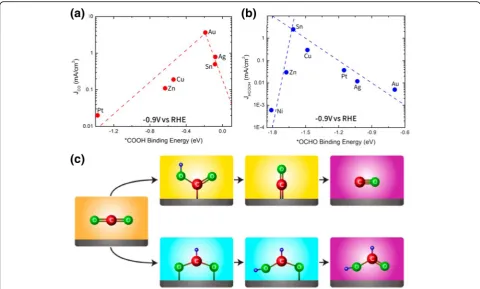
descriptor for CO production is the binding energy of
*COOH. The metals bind to *COOH sequentially
yielding *CO after dehydration, as shown in Fig.
9
[
100
,
103
,
104
]. The reaction pathway toward CO is two
electron-consuming, which is relatively facile [
100
].
When CO is the main product, there is no separation
issue because gaseous CO would be naturally separated
from liquid electrolyte.
Various works controlling the nano-structures of these
metals have been reported to have high CO production
from CO
2RR; monodispersed Au or Ag nanoparticles
[
105
–
108
], ligand-free Au nanoparticles with < 2 nm
[
109
], inverse opal Au or Ag thin films [
110
,
111
],
ultra-thin Au nanowires [
112
], Au nanoneedles with sharp
tips [
113
,
114
], concave rhombic dodecahedral Au
nano-particles with high-index facets [
115
], TiC-supported Au
nanoparticles [
116
], hexagonal Zn particles [
117
],
elec-trodeposited Zn dendrites [
118
], anodized Zn foil [
119
],
small sized Pd nanoparticles with rich edge sites [
120
,
121
], Au electrode with adsorbed CN
−or Cl
−ions [
122
],
Ag nanoparticles with surface-bonded oxygen [
123
],
amine-capped Ag nanoparticles [
124
]. Although it is
hard to compare their performance because of their
different reaction conditions, the conversion of CO
2to
CO usually reaches 90 ~ 100% faraday efficiency at the
relatively low overpotential of 0.4 ~ 0.7 V.
Metals producing formate: Sn, Bi, Hg, Cd, and Pb
Sn, Bi, Hg, Cd, and Pb can produce formic acid
(HCOOH) or formate (HCOO
−) in the CO
2RR [
101
].
The key descriptor toward formate formation is the
binding energy of *OCHO [
103
]. If the electrode surface
is bound to intermediates via oxygen rather than carbon,
formic acid will be generated, as shown in Fig.
13
[
103
].
It was also suggested that formate could be generated
through an *COOH intermediate at some reaction
Table 1
Representative reaction pathways of CO
2RR in neutral pH buffer electrolyte condition with thermodynamic standard
potentials
Reaction in neutral pH buffer electrolyte E0(V vs RHE)
Cathode reaction (CO2RR) CO2+ H2O + 2e−→CO + 2OH− −0.10
(CO2RR) CO2+ 2H2O + 2e−→HCOOH +2OH− −0.02
(CO2RR) CO2+ 5H2O + 6e−→CH3OH + 6OH− 0.03
(CO2RR) CO2+ 6H2O + 8e−→CH4+ 8OH− 0.17
(CO2RR) 2CO2+ 8H2O + 12e−→C2H4+ 12OH− 0.08
(HER) 2H2O + 2e−→H2+ 2OH− 0
conditions [
125
,
126
]. Because the pathway generating
formates follows a two electron pathway, like CO, some
electrocatalysts might exhibit good CO
2RR performance
for formic acid production [
101
]. However, the faradaic
efficiency for formic acid production is usually lower
than that for CO production [
127
]. Nevertheless, formic
acid is the only liquid product which can be obtained
with high selectivity from CO
2RR at this stage [
101
].
Various studies which have controlled the
nano-structures of these metals have been reported for
for-mate production; nanostructured Sn/SnO
xthin film
[
128
], Sn or Sn oxide nanoparticles with < 5 nm [
129
,
130
], reduced SnO
2porous nanowires [
131
], hierarchical
mesoporous SnO
2nanosheets [
132
], electrodeposited Sn
dendrites [
133
], atomic layer deposited Sn or Sn sulfide
on nanoneedle templates [
134
], ultrathin Bi nanosheets
[
135
], oxide-derived Pb [
136
]. Due to toxicity of Hg, Cd,
and Pb, most works have mainly used Sn or Bi. The
for-mate can be obtained with a faraday efficiency of 60 ~
90% at an overpotential of 0.8 ~ 1.4 V [
95
,
101
].
On other metals, the selectivity of CO
2RR can be
con-trolled by changing the reaction conditions to produce
formic acid. For example, CO
2RR on W, Fe, Co, Ni, Zn,
Pt, Rh, and Ir have been investigated at high pressure
[
137
]. They showed significant activity toward formate
formation, although their selectivity was not as high as
Sn or Bi. Pd also exhibited good performance for formic
acid production although it also significantly produced
CO [
138
,
139
].
Metal producing multi-carbon species: Cu
Cu is the only element that can make a C-C bond
dir-ectly from CO
2RR with meaningful selectivity [
95
,
101
].
Multi-carbon products such as C
2H
4can be generated
with Cu. Figure
10
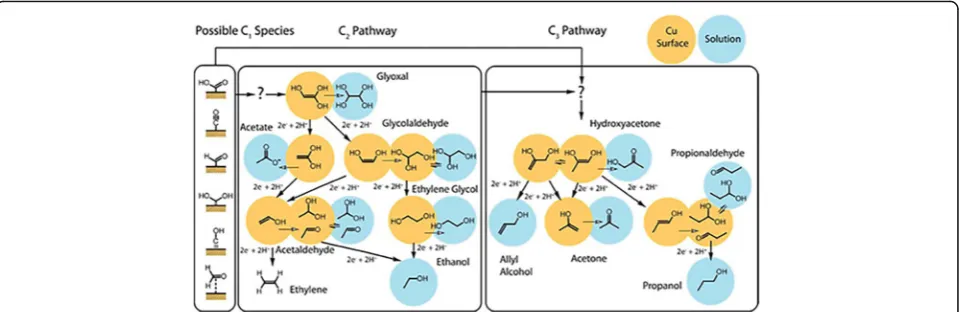
shows the possible products
obtain-able from electrochemical conversion on a Cu electrode.
It was reported that CO, formate, CH
4, C
2H
4, and H
2could be obtained on a Cu electrode [
140
]. Ethanol,
n-propanol, allyl alcohol, a trace amount of methanol,
glycolaldehyde, acetaldehyde, acetate, ethylene glycol,
propionaldehyde, acetone, and hydroxyacetone were
simultaneously observed in the large overpotential
re-gion, higher than 1 V [
140
].
The reaction mechanism of CO
2RR on a Cu electrode
is highly complicated. Figure
10
provides the possible
reaction pathway maps. Many other pathways on the Cu
electrode have also been proposed [
141
–
143
]. The *CO
intermediate is generally regarded to be a key
intermedi-ate for further reduction, because *CO can be obtained
at mild potentials, and C
2H
4was observed only with
sig-nificant concentrations of *CO [
144
–
146
]. The
proton-ation of *CO to *CHO needs to overcome an activproton-ation
Fig. 9Volcano plots of CO2RR activity towardaCO andbHCOOH as a function of binding energies of *COOH, and *OCHO, respectively, and
barrier of 0.74 V, which is considered a
rate-determin-ing step for further reduction to C
1products like
CH
3OH or CH
4[
145
,
147
]. The *CHO transforms to
*CH
2O, *CH
3O, and *CH
4following sequential proton
coupled electron transfer (PCET) [
142
,
147
]. The
*CHO is also a key intermediate for making C-C
bonds via *CO-*CHO coupling [
143
].
Additionally, *CO-*CO coupling can also produce
C-C bonds [
141
,
148
–
150
]. However, the C-C
coup-ling pathway has not been elucidated yet, although it
is known that Cu (100) is the best surface to generate
*CO-*CO coupling with the lowest energy barrier
[
150
,
151
]. As a result, C
2H
4formation is favored on
Cu (100) [
151
–
153
], whereas CH
4is more readily
produced on Cu (111) [
147
,
154
]. The pathways for
further reduction from *CO-*CO or *CHO-*CO to
oxygenates, such as acetate, ethanol, 1-propanol, are
more complicated, because water from the electrolyte
participates in the reaction donating oxygen [
143
,
148
]. Because it is crucial to understand the reaction
mechanism to design better catalysts for CO
2RR,
more studies on mechanism or intermediates, such as
in-situ experiments, are needed.
To tune selectivity, nano-structured Cu electrodes
were studied, including Cu nanofoams [
155
], Cu
nano-wires [
156
–
160
], nanoporous Cu film [
161
], Cu
nano-cubes [
151
–
153
], Cu truncated nanocubes [
153
], Cu
rhombic dodecahedrons [
153
], inverse opal Cu film
[
162
], mesoporous Cu film [
163
], electro-redeposited
Cu [
164
], electrodeposited Cu dendrites [
165
], prism
shaped Cu [
166
], nano-structured Cu by battery cycling
[
150
], hierarchical Cu pillar electrode [
167
], oxide
de-rived Cu [
160
,
168
–
170
]. The best CO
2RR performance
on Cu electrode was 60 ~ 70% faraday efficiency toward
C
2H
4production [
170
,
171
].
Unconventional electrocatalysts
So far, electrochemical CO
2RR with single metal
elec-trodes has been discussed. The studies with single metal
electrodes can provide insight in terms of reaction
mechanisms and the properties of each metal on
CO
2RR. Some unconventional electrocatalysts, such as
oxide-derived metals, alloy metals, carbon materials,
single-atom catalyst, have also exhibited interesting
fea-tures. Distinct selectivity or activity was obtained.
Oxide-derived metals
Recent studies have revealed that oxide-derived metal
electrodes had improved catalytic performance
com-pared to pristine metals [
172
]. The most common way
to prepare oxide-derived electrocatalysts is to oxidize
the metal, then reduce it to its original metallic state.
Oxide-derived Cu produced more C
2products of C
2H
4,
C
2H
6, and ethanol than electro-polished Cu at the same
overpotential [
168
,
170
,
172
]. Even C
3and C
4products
of C
3H
7OH, C
3H
6, C
3H
8, C
4H
10were observed from Cl
ion-adsorbed oxide-derived Cu [
173
]. Oxide-derived Sn
showed much higher current density and faraday
effi-ciency than a pristine Sn electrode for formic acid
pro-duction [
128
,
133
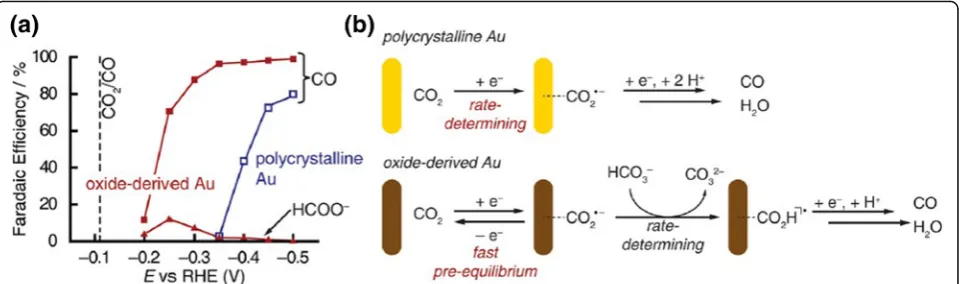
]. Oxide-derived Au [
174
] or Ag [
175
]
showed superior faraday efficiency for CO production,
with 90 ~ 100% at only 0.3 V overpotential, as shown in
Fig.
11
a.
There have been debates on the origin of the
enhance-ment of oxide-derived metal for CO
2RR. Nano-structures
induced in the catalysts or residual subsurface oxygen
have been suggested as the source of the enhancement.
Nano-structured surfaces with rich grain boundaries were
obtained after oxidation-reduction cycling [
176
,
177
]. The
induced surface had more defect sites with higher binding
energy to *CO and higher local pH which increased
Fig. 10Proposed reaction pathways of electrochemical CO2RR on Cu electrode in CO2-saturated 0.1 M KHCO3(aq). (Reprinted with permission
selectivity toward CO
2RR while suppressing HER [
169
,
176
–
178
]. It was also suggested that some oxygen
remained in the subsurface despite the highly reducing
conditions of the CO
2RR. Ambient pressure XPS, in situ
electron energy loss spectroscopy (EELS) experiments,
and DFT calculations showed that the oxygen helped to
activate CO
2on the surface in the initial step, as shown in
Fig.
11
b [
179
,
180
]. However, a contradictory result was
also reported, saying that the residual oxide was very
un-stable in the CO
2RR condition, and that the amount of
oxygen was negligible [
181
].
Alloy metals
By alloying with a secondary metal, the intrinsic catalytic
performance of metal can be modified, and high
selectiv-ity or activselectiv-ity can be obtained for CO
2RR [
101
,
127
].
The enhancement was typically attributed to an
elec-tronic or geometric effect on the alloyed catalysts [
101
,
127
]. The presence of a secondary metal led to
modula-tion in the electronic structure of the active site. The
binding energy between the active site and reaction
intermediate could be tuned, changing the reaction
pathway and the resulting selectivity [
182
–
185
]. The
sec-ondary metal can also change the surface geometric
structure, with different atomic arrangements of reactant
or intermediates. The electronic and geometric effect
has been systematically studied for Au-Cu bimetallic
nanoparticle catalysts with different compositions [
183
,
184
]. Figure
12
a shows that the
d
-band center was
downshifted as Au content increased, and the change in
the electronic structure lowered the binding energy of
*COOH and *CO. The Cu atom was bound to the
oxy-gen end of the *COOH, while the Au atom formed a
Au-C bond [
183
]. The binding strength of each primary
bond and the adsorption configuration were tailored by
changing the composition of the bimetallic particles.
The ordered Au-Cu with three atomic overlayers of Au
showed high performance for CO production due to the
change in binding energy induced by atomic strains
[
184
]. The reaction path to the C-C coupling was
sup-pressed by the geometric property of the ordered Au
3Cu
alloys, producing CH
4[
185
].
The alloy catalysts deviate from the general scaling
relationship of binding strength to intermediates, and
by controlling mixing patterns, they can exhibit
unique selectivity. For example, while ordered
Cu-Pd nanoparticles selectively produced C
1products,
mainly CO, but phase-separated Cu-Pd nanoparticles
produced C
2products, mainly C
2H
4[
185
]. Cu
ensem-ble sites were needed to make C-C bonds, and
neigh-boring Pd sites further helped hydrogenation by
hydrogen spillover.
For multi-electron paths rather than a two-electron
path, the key intermediates of *CHO or *COH should be
formed, but proton-coupled electron transfer on *CO to
form *CHO or *COH is a rate determining step [
101
]. It
was reported that if Cu was alloyed with a metal that
could stabilize O, the adsorption configuration of *CHO
or *COH on the Cu-M sites could be adjusted and their
formation would be favored [
186
]. Consequently, the
overpotential for further reduction decreased and the
se-lectivity of CO
2RR could be controlled. Many other alloy
catalysts were reported for CO
2RR; Cu-In [
187
], Cu-Sn
[
188
] for CO production, Pd-Pt [
189
], Ag-Sn [
190
],
Sn-Pb [
191
], Sn-Pd [
192
], Au-Pd [
193
] for formate
production.
Carbon-based materials
Carbon-based materials have been actively studied as
promising electrocatalysts for electrochemical reactions,
such as the oxygen reduction reaction (ORR), OER, and
HER [
194
,
195
]. Carbon materials have advantages for
electrochemical applications, including facile
transform-ability to various dimensions and shapes [
196
].
Zero-dimensional carbon dots or graphene quantum dots,
one-dimensional
carbon
nanotubes,
two-dimensional
Fig. 11Electrocatalytic CO2RR on oxide-derived Au and polycrystalline Au.aFaraday efficiency of each product as a function of applied potential
graphene, and three-dimensional graphene aerogel can be
produced with well-developed material science techniques
[
97
]. The carbon materials also possess high conductivity,
high surface area, and good chemical and mechanical
stability.
Pure carbon materials are basically inert toward CO
2RR.
However, if heteroatoms such as N are doped in the
car-bon matrix, electrocatalytic activity is greatly enhanced.
Negatively charged N sites are considered active sites for
CO
2RR [
197
–
199
]. N-doping introduces a Lewis base site
to the catalyst, which is beneficial to stabilize CO
2[
196
,
197
]. Various carbon materials, including N-doped carbon
nanotubes [
200
,
201
], N-doped graphenes [
202
], N-doped
graphene quantum dots [
203
] were reported for CO
2RR
following the two-electron pathway. N-doped diamond
produced acetate as well as formate with N-sp
3C active
sites [
204
]. Other dopants such as S or B have also been
used for CO
2RR [
205
,
206
].
Single atom catalysts
Single atom catalysts (SAC) represent atomically
dis-persed metal catalysts on the surface of a support. They
exhibit very distinct electronic structures and adsorption
configurations of reactants and intermediates, with
unique selectivity [
207
]. SACs have been used for
elec-trochemical ORR [
208
,
209
], HER [
210
], formic acid
oxi-dation reaction (FAOR) [
211
], and CO
2RR [
212
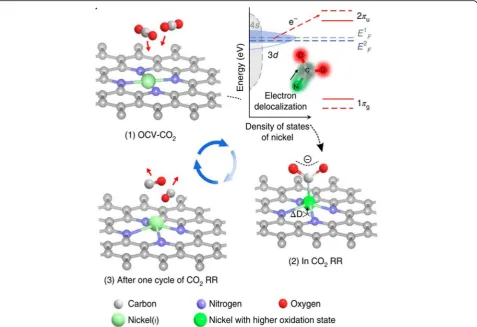
]. Ni
single atoms on N-doped graphene can catalyze CO
2RR
producing CO selectively, as shown in Fig.
13
[
212
].
Other metal atoms of Fe, Co, Mn, and Cu with slightly
different
d
-band structure have shown different
selectiv-ity. The coordination environment neighboring the Ni
single atom has also been reported to affect the
elec-tronic structure and the binding energy of key carbon
intermediates [
213
,
214
]. When Cu was atomically
doped into CeO
2, the oxygen defect sites of the CeO
2regulated the oxidation state of Cu by forming Cu
ion-O vacancy pairs. The single atomic Cu catalyzed
CO
2RR, producing CH
4with 58% faraday efficiency
[
215
]. DFT calculations have also predicted that the
SAC structure can suppress HER while promoting
CO
2RR, with the proper choice of metal atom and
supports [
216
,
217
]. Single atom alloys where a single
atomic metal is located on another metal surface have
also been suggested by computational method as
effi-cient catalysts for CO
2RR [
218
].
Although many intensive efforts have been dedicated
to develop electrochemical CO
2RR, the performance is
still far from the performance obtained from gas-phase
CO
2reduction. To enhance electrochemical CO
2RR
fur-ther, various other efforts have been tried, by tuning
other factors. Electrolyte compositions, pH, and
concen-trations affected activity and selectivity [
96
,
219
–
222
].
Ionic liquids helped the activation of CO
2[
223
,
224
]. An
electric field near the electrode was shown to stabilize
charged intermediates better [
113
,
220
]. The additives
could control selectivity via electron shuttling or the
for-mation of surface films [
225
,
226
]. A gas diffusion
elec-trode (GDE) cell allowed unprecedentedly high current
density [
171
,
227
]. Stability, resistivity to catalyst
poi-sons, and activity on diluted CO
2feed are also important
for practical applications, but they have not yet attracted
much interest at this stage. To develop this technology
to a commercially feasible level, those many factors
should be optimized.
Conclusion and perspectives
Heterogeneous catalysts used for catalytic CO
2conver-sion into valuable chemicals such as CO, CH
4, C
2H
4have been discussed in this review. Because CO
2is
thermodynamically very stable, its conversion usually
Fig.12Tailored properties of Au-Cu alloy nanoparticle catalyst for CO2RR with different compositions.aElectronic structure information obtained
requires a lot of energy, but the production of that
en-ergy also emits considerable CO
2. Obtaining negative
net CO
2emissions is not easy, and the design of efficient
catalysts for CO
2conversion is a key to reducing CO
2emissions.
Catalytic CO
2conversion can occur in gas-phase,
liquid-phase, or electrochemical cells. Because the solubility
of CO
2is quite low in aqueous solution, the CO
2conver-sion in liquid-phase typically suffer from low productivity.
Thus this review mainly focused on the conversion using
gaseous CO
2. Various metals, metal oxides, metal carbides,
and doped carbon materials have been used as catalysts for
CO
2conversion. Synthetic strategies have been developed
to endure high reaction temperatures and minimize coke
formation for dry methane reforming. The CO
2hydrogen-ation can be efficient, but they use H
2gas. The H
2gas is
conventionally produced from methane steam reforming,
which also produces considerable CO
2. If H
2can be
pro-duced from water without CO
2emissions, CO
2hydrogen-ation in gas-phase would be a very powerful tool for
efficient CO
2conversion. The gaseous product of CO or
CH
4have been mainly considered as products from the
CO
2hydrogenation, but liquid products such as formic acid
or dimethyl ether would also have high value. Metal-based
catalysts including precious metal or supported Ni catalysts
have been used for the production of CO or CH
4. Not
many good heterogeneous catalysts have been found for
the production of formic acid, instead homogeneous
lysts have been typically used. Robust heterogeneous
cata-lyst producing formic acid might have high potential.
Catalysts that use both heat and light as energy sources
have been developed, to minimize total energy use.
Electrochemical CO
2conversion has shown improved
productivity using gas-diffusion electrode cells. It is also
very promising because it directly uses CO
2and H
2O for
chemical or fuel production. The technology for
electro-chemical CO
2reduction is in its early stages, compared
to other CO
2conversion technologies, but it is being
in-vestigated very actively. A variety of materials have been
tested as catalysts for electrochemical CO
2reduction,
and the catalysts should be tuned depending on the
tar-get products. Au or Ag produces CO, Sn or Bi produces
formate, and Cu produces hydrocarbons such as C
2H
4.
Considering the cell design of gas-diffusion electrodes,
nano-structured catalysts should be optimized further.
Most studies so far have used concentrated pure CO
2Fig. 13Structural evolution of Ni single-atom sites on graphene during CO2RR (Reprinted with permission from ref. [212]. Copyright 2018
for the conversion. But the conversion of dilute CO
2,
es-pecially in the presence of potential catalyst poisons
such as S compounds, should be investigated more
ac-tively for practical applications.
Abbreviations
CO2RR:Electrochemical CO2reduction reaction; DFT: Density functional theory; DRM: Dry reforming of methane; EELS: Electron energy loss spectroscopy; EXAFS: Extended X-ray absorption fine structure; GDE: Gas diffusion electrode; HER: Hydrogen evolution reaction; OER: Oxygen evolution reaction; ORR: Oxygen reduction reaction; POM: Partial oxidation of methane; RHE: Reversible hydrogen electrode; RWGS: Reverse water gas shift; SAC: Single atom catalysts; SMSI: Strong-metal support interaction; SRM: Steam reforming of methane; TMC: Transition-metal carbide; XAFS: X-ray absorption fine structure; XANES: X-X-ray absorption near edge structure
Acknowledgements Not applicable
Funding
This work was financially supported by the National Research Foundation of Korea (NRF-2017M3D1A1040692) funded by the Ministry of Education, Science and Technology and the Saudi Aramco-KAIST CO2Management Center.
Availability of data and materials Not applicable
Authors’contributions
HL organized the overall structure. HSW wrote the manuscript about DRM, MSC wrote the manuscript about RWGS, JLee wrote the manuscript about light-assisted CO2hydrogenation, JLim wrote the manuscript about CO2RR. All authors read and approved the final manuscript.
Competing interests
The authors declare that they have no competing interests.
Publisher
’
s Note
Springer Nature remains neutral with regard to jurisdictional claims in published maps and institutional affiliations.
Received: 1 November 2018 Accepted: 22 February 2019
References
1. Hansen J, Ruedy R, Sato M, Lo K. Global surface temperature change. Rev Geophys. 2010;48:RG4004.
2. Dincer I. Renewable energy and sustainable development: a crucial review. Renew Sust Energ Rev. 2000;4(2):157–75.
3. Burke MJ, Stephens JC. Political power and renewable energy futures: a critical review. Energy Res Soc Sci. 2018;35:78–93.
4. Alvarez A, Bansode A, Urakawa A, Bavykina AV, Wezendonk TA, Makkee M, Gascon J, Kapteijn F. Challenges in the greener production of formates/ formic acid, methanol, and DME by heterogeneously catalyzed CO2 hydrogenation processes. Chem Rev. 2017;117(14):9804–38.
5. Lim RJ, Xie M, Sk MA, Lee J-M, Fisher A, Wang X, Lim KH. A review on the electrochemical reduction of CO2in fuel cells, metal electrodes and molecular catalysts. Catal Today. 2014;233:169–80.
6. Porosoff MD, Yan B, Chen JG. Catalytic reduction of CO2by H2for synthesis of CO, methanol and hydrocarbons: challenges and opportunities. Energy Environ Sci. 2016;9(1):62–73.
7. Yan N, Philippot K. Transformation of CO2by using nanoscale metal catalysts: cases studies on the formation of formic acid and dimethylether. Curr Opin Chem Eng. 2018;20:86–92.
8. Wang WH, Himeda Y, Muckerman JT, Manbeck GF, Fujita E. CO2 hydrogenation to formate and methanol as an alternative to photo- and electrochemical CO2reduction. Chem Rev. 2015;115(23):12936–73. 9. Li WH, Wang HZ, Jiang X, Zhu J, Liu ZM, Guo XW, Song CS. A short review
of recent advances in CO2hydrogenation to hydrocarbons over heterogeneous catalysts. RSC Adv. 2018;8(14):7651–69.
10. Li K, Peng BS, Peng TY. Recent advances in heterogeneous photocatalytic CO2conversion to solar fuels. ACS Catal. 2016;6(11):7485–527.
11. Gunasekar GH, Park K, Jung KD, Yoon S. Recent developments in the catalytic hydrogenation of CO2to formic acid/formate using heterogeneous catalysts. Inorg Chem Front. 2016;3(7):882–95.
12. Kawi S, Kathiraser Y, Ni J, Oemar U, Li ZW, Saw ET. Progress in synthesis of highly active and stable nickel-based catalysts for carbon dioxide reforming of methane. ChemSusChem. 2015;8(21):3556–75.
13. Pakhare D, Spivey J. A review of dry (CO2) reforming of methane over noble metal catalysts. Chem Soc Rev. 2014;43(22):7813–37.
14. York APE, Xiao TC, Green MLH. Brief overview of the partial oxidation of methane to synthesis gas. Top Catal. 2003;22(3–4):345–58.
15. Kim HY, Park JN, Henkelman G, Kim JM. Design of a highly nanodispersed Pd-MgO/SiO2composite catalyst with multifunctional activity for CH4 reforming. ChemSusChem. 2012;5(8):1474–81.
16. Gallego GS, Batiot-Dupeyrat C, Barrault J, Florez E, Mondragon F. Dry reforming of methane over LaNi1-yByO3+/−delta(B=Mg, Co) perovskites used as catalyst precursor. Appl Catal A. 2008;334(1–2):251–8.
17. Pakhare D, Shaw C, Haynes D, Shekhawat D, Spivey J. Effect of reaction temperature on activity of Pt- and Ru-substituted lanthanum zirconate pyrochlores (La2Zr2O7) for dry (CO2) reforming of methane (DRM). J CO2 Util. 2013;1:37–42.
18. Bian ZF, Das S, Wai MH, Hongmanorom P, Kawi S. A review on bimetallic nickel-based catalysts for CO2reforming of methane. ChemPhysChem. 2017; 18(22):3117–34.
19. Arora S, Prasad R. An overview on dry reforming of methane: strategies to reduce carbonaceous deactivation of catalysts. RSC Adv. 2016;6(110): 108668–88.
20. Aramouni NAK, Touma JG, Abu Tarboush B, Zeaiter J, Ahmad MN. Catalyst design for dry reforming of methane: analysis review. Renew Sust Energ Rev. 2018;82:2570–85.
21. Wang SB, Lu GQM, Millar GJ. Carbon dioxide reforming of methane to produce synthesis gas over metal-supported catalysts: state of the art. Energy Fuel. 1996;10(4):896–904.
22. Kambolis A, Matralis H, Trovarelli A, Papadopoulou C. Ni/CeO2-ZrO2catalysts for the dry reforming of methane. Appl Catal A. 2010;377(1–2):16–26. 23. Sutthiumporn K, Maneerung T, Kathiraser Y, Kawi S. CO2dry-reforming of
methane over La0.8Sr0.2Ni0.8M0.2O3perovskite (M = Bi, Co, Cr, Cu, Fe): roles of lattice oxygen on C-H activation and carbon suppression. Int J Hydrog Energy. 2012;37(15):11195–207.
24. Bhavani AG, Kim WY, Lee JS. Barium substituted lanthanum manganite perovskite for CO2reforming of methane. ACS Catal. 2013;3(7):1537–44. 25. Hu YH. Solid-solution catalysts for CO2reforming of methane. Catal Today.
2009;148(3–4):206–11.
26. Zanganeh R, Rezaei M, Zamaniyan A. Dry reforming of methane to synthesis gas on NiO-MgO nanocrystalline solid solution catalysts. Int J Hydrog Energy. 2013;38(7):3012–8.
27. Garcia-Dieguez M, Pieta IS, Herrera MC, Larrubia MA, Malpartida I, Alemany LJ. Transient study of the dry reforming of methane over Pt supported on different gamma-Al2O3. Catal Today. 2010;149(3–4):380–7.
28. Yokota S, Okumura K, Niwa M. Support effect of metal oxide on Rh catalysts in the CH4-CO2reforming reaction. Catal Lett. 2002;84(1–2):131–4. 29. Menad S, Ferreira-Aparicio P, Cherifi O, Guerrero-Ruiz A, Rodriguez-Ramos I.
Designing new high oxygen mobility supports to improve the stability of RU catalysts under dry reforming of methane. Catal Lett. 2003;89(1–2):63–7. 30. Ferreira-Aparicio P, Guerrero-Ruiz A, Rodriguez-Ramos I. Comparative study
at low and medium reaction temperatures of syngas production by methane reforming with carbon dioxide over silica and alumina supported catalysts. Appl Catal A. 1998;170(1):177–87.
31. Whang HS, Choi MS, Lim J, Kim C, Heo I, Chang TS, Lee H. Enhanced activity and durability of Ru catalyst dispersed on zirconia for dry reforming of methane. Catal Today. 2017;293:122–8.
32. Park J-H, Yeo S, HeO I, Chang T-S. Promotional effect of Al addition on the Co/ZrO2catalyst for dry reforming of CH4. Appl Catal A. 2018;562:120. 33. Park J-H, Yeo S, Kang T-J, Heo I, Lee K-Y, Chang T-S. Enhanced stability of co
catalysts supported on phosphorus-modified Al2O3for dry reforming of CH4. Fuel. 2018;212:77–87.
34. Ay H, Uner D. Dry reforming of methane over CeO2supported Ni, Co and Ni-Co catalysts. Appl Catal B. 2015;179:128–38.
with isolated single palladium atoms in alloy nanoparticles as the main active site. ACS Catal. 2017;7(3):1543–53.
36. Kim SM, Abdala PM, Margossian T, Hosseini D, Foppa L, Armutlulu A, van Beek W, Comas-Vives A, Coperet C, Muller C. Cooperativity and dynamics increase the performance of NiFe dry reforming catalysts. J Am Chem Soc. 2017;139(5):1937–49.
37. Nakamura J, Aikawa K, Sato K, Uchijima T. Role of support in reforming of CH4with CO2over Rh catalysts. Catal Lett. 1994;25(3–4):265–70.
38. Liu DP, Quek XY, Cheo WNE, Lau R, Borgna A, Yang YH. MCM-41 supported nickel-based bimetallic catalysts with superior stability during carbon dioxide reforming of methane: effect of strong metal-support interaction. J Catal. 2009;266(2):380–90.
39. Guo JJ, Lou H, Zhao H, Chai DF, Zheng XM. Dry reforming of methane over nickel catalysts supported on magnesium aluminate spinels. Appl Catal A. 2004;273(1–2):75–82.
40. Ferreira-Aparicio P, Rodriguez-Ramos I, Anderson JA, Guerrero-Ruiz A. Mechanistic aspects of the dry reforming of methane over ruthenium catalysts. Appl Catal A. 2000;202(2):183–96.
41. Zhang ZL, Verykios XE, MacDonald SM, Affrossman S. Comparative study of carbon dioxide reforming of methane to synthesis gas over Ni/La2O3and conventional nickel-based catalysts. J Phys Chem. 1996;100(2):744–54. 42. Alipour Z, Rezaei M, Meshkani F. Effect of alkaline earth promoters (MgO,
CaO, and BaO) on the activity and coke formation of Ni catalysts supported on nanocrystalline Al2O3in dry reforming of methane. Ind Eng Chem Res. 2014;20(5):2858–63.
43. Bellido JDA, De Souza JE, M'Peko JC, Assaf EM. Effect of adding CaO to ZrO2 support on nickel catalyst activity in dry reforming of methane. Appl Catal A. 2009;358(2):215–23.
44. Pechimuthu NA, Pant KK, Dhingra SC, Bhalla R. Characterization and activity of K, CeO2, and Mn promoted Ni/Al2O3catalysts for carbon dioxide reforming of methane. Ind Eng Chem Res. 2006;45(22):7435–43.
45. Therdthianwong S, Therdthianwong A, SiangChin C, Yonprapat S. Synthesis gas production from dry reforming of methane over Ni/Al2O3stabilized by ZrO2. Int J Hydrog Energy. 2008;33(3):991–9.
46. Laosiripojana N, Sutthisripok W, Assabumrungrat S. Synthesis gas production from dry reforming of methane over CeO2doped Ni/Al2O3: influence of the doping ceria on the resistance toward carbon formation. Chem Eng J. 2005; 112(1–3):13–22.
47. Liang TY, Lin CY, Chou FC, Wang MQ, Tsai DH. Gas-phase synthesis of Ni-CeOxhybrid nanoparticles and their synergistic catalysis for simultaneous reforming of methane and carbon dioxide to syngas. J Phys Chem C. 2018; 122(22):11789–98.
48. Bellido JDA, Assaf EM. Effect of the Y2O3-ZrO2support composition on nickel catalyst evaluated in dry reforming of methane. Appl Catal A. 2009; 352(1–2):179–87.
49. Wang N, Chu W, Zhang T, Zhao XS. Synthesis, characterization and catalytic performances of Ce-SBA-15 supported nickel catalysts for methane dry reforming to hydrogen and syngas. Int J Hydrog Energy. 2012;37(1):19–30. 50. Damyanova S, Pawelec B, Arishtirova K, Huerta MVM, Fierro JLG. The effect of CeO2on the surface and catalytic properties of Pt/CeO2-ZrO2catalysts for methane dry reforming. Appl Catal B. 2009;89(1–2):149–59.
51. Zhu YA, Chen D, Zhou XG, Yuan WK. DFT studies of dry reforming of methane on Ni catalyst. Catal Today. 2009;148(3–4):260–7. 52. Ni J, Chen LW, Lin JY, Kawi S. Carbon deposition on borated alumina
supported nano-sized Ni catalysts for dry reforming of CH4. Nano Energy. 2012;1(5):674–86.
53. Han JW, Kim C, Park JS, Lee H. Highly coke-resistant Ni nanoparticle catalysts with minimal sintering in dry reforming of methane. ChemSusChem. 2014;7(2):451–6.
54. Lu JL, Fu BS, Kung MC, Xiao GM, Elam JW, Kung HH, Stair PC. Coking- and sintering-resistant palladium catalysts achieved through atomic layer deposition. Science. 2012;335(6073):1205–8.
55. Han JW, Park JS, Choi MS, Lee H. Uncoupling the size and support effects of Ni catalysts for dry reforming of methane. Appl Catal B. 2017;203:625–32. 56. Gould TD, Izar A, Weimer AW, Falconer JL, Medlin JW. Stabilizing Ni catalysts
by molecular layer deposition for harsh, dry reforming conditions. ACS Catal. 2014;4(8):2714–7.
57. Das S, Ashok J, Bian Z, Dewangan N, Wai MH, Du Y, Borgna A, Hidajat K, Kawi S. Silica-ceria sandwiched Ni core-shell catalyst for low temperature dry reforming of biogas: coke resistance and mechanistic insights. Appl Catal B. 2018;230:220–36.
58. Song H. Metal hybrid nanoparticles for catalytic organic and photochemical transformations. Acc Chem Res. 2015;48(3):491–9.
59. Chaudhuri RG, Paria S. Core/shell nanoparticles: classes, properties, synthesis mechanisms, characterization, and applications. Chem Rev. 2012;112(4):2373–433. 60. Cargnello M, Jaen JJD, Garrido JCH, Bakhmutsky K, Montini T, Gamez JJC,
Gorte RJ, Fornasiero P. Exceptional activity for methane combustion over modular Pd@CeO2subunits on functionalized Al2O3. Science. 2012; 337(6095):713–7.
61. Joo SH, Park JY, Tsung CK, Yamada Y, Yang PD, Somorjai GA. Thermally stable Pt/mesoporous silica core-shell nanocatalysts for high-temperature reactions. Nat Mater. 2009;8(2):126–31.
62. Li ZW, Mo LY, Kathiraser Y, Kawi S. Yolk-satellite-shell structured Ni-Yolk@Ni@SiO2 nanocomposite: superb catalyst toward methane CO2reforming reaction. ACS Catal. 2014;4(5):1526–36.
63. Wang K, Li XJ, Ji SF, Shi XJ, Tang JJ. Effect of CexZr1-xO2promoter on Ni-based SBA-15 catalyst for steam reforming of methane. Energy Fuel. 2009;23(1–2):25–31. 64. Joo SH, Choi SJ, Oh I, Kwak J, Liu Z, Terasaki O, Ryoo R. Ordered nanoporous
arrays of carbon supporting high dispersions of platinum nanoparticles. Nature. 2001;412(6843):169–72.
65. Wu Z, Li Q, Feng D, Webley PA, Zhao D. Ordered mesoporous crystallineγ -Al2O3with variable architecture and porosity from a single hard template. J Am Chem Soc. 2010;132(34):12042–50.
66. Yuan Q, Yin A-X, Luo C, Sun L-D, Zhang Y-W, Duan W-T, Liu H-C, Yan C-H. Facile synthesis for ordered mesoporousγ-aluminas with high thermal stability. J Am Chem Soc. 2008;130(11):3465–72.
67. Wang N, Shen K, Huang LH, Yu XP, Qian WZ, Chu W. Facile route for synthesizing ordered mesoporous Ni-Ce-Al oxide materials and their catalytic performance for methane dry reforming to hydrogen and syngas. ACS Catal. 2013;3(7):1638–51.
68. Bosch C, Wild W. Producing hydrogen. In: Google patents; 1914. 69. Fang KG, Li DB, Lin MG, Xiang ML, Wei W, Sun YH. A short review of
heterogeneous catalytic process for mixed alcohols synthesis via syngas. Catal Today. 2009;147(2):133–8.
70. Gao JJ, Wang YL, Ping Y, Hu DC, Xu GW, Gu FN, Su FB. A thermodynamic analysis of methanation reactions of carbon oxides for the production of synthetic natural gas. RSC Adv. 2012;2(6):2358–68.
71. Gines MJL, Marchi AJ, Apesteguia CR. Kinetic study of the reverse water-gas shift reaction over CuO/ZnO/Al2O3catalysts. Appl Catal A. 1997;154(1–2):155–71. 72. Chen CS, Cheng WH, Lin SS. Mechanism of CO formation in reverse
water-gas shift reaction over Cu/Al2O3catalyst. Catal Lett. 2000;68(1–2):45–8. 73. Chen XD, Su X, Duan HM, Liang BL, Huang YQ, Zhang T. Catalytic performance
of the Pt/TiO2catalysts in reverse water gas shift reaction: controlled product selectivity and a mechanism study. Catal Today. 2017;281:312–8.
74. Xu HT, Li YS, Luo XK, Xu ZL, Ge JP. Monodispersed gold nanoparticles supported on a zirconium-based porous metal-organic framework and their high catalytic ability for the reverse water-gas shift reaction. Chem Commun. 2017;53(56):7953–6.
75. Ye J, Ge Q, Liu CJ. Effect of PdIn bimetallic particle formation on CO2 reduction over the Pd-In/SiO2catalyst. Chem Eng Sci. 2015;135:193–201. 76. Goncalves RV, Vono LLR, Wojcieszak R, Dias CSB, Wender H, Teixeira-Neto E,
Rossi LM. Selective hydrogenation of CO2into CO on a highly dispersed nickel catalyst obtained by magnetron sputtering deposition: a step towards liquid fuels. Appl Catal B. 2017;209:240–6.
77. Sun FM, Yan CF, Wang ZD, Guo CQ, Huang SL. Ni/Ce-Zr-O catalyst for high CO2conversion during reverse water gas shift reaction (RWGS). Int J Hydrog Energy. 2015;40(46):15985–93.
78. Galvan CA, Schumann J, Behrens M, Fierro JLG, Schlogl R, Frei E. Reverse water-gas shift reaction at the Cu/ZnO interface: influence of the Cu/Zn ratio on structure-activity correlations. Appl Catal B. 2016;195:104–11. 79. Zhou GL, Dai BC, Xie HM, Zhang GZ, Xiong K, Zheng XX. CeCu composite
catalyst for CO synthesis by reverse water-gas shift reaction: effect of Ce/Cu mole ratio. J CO2 UTIL. 2017;21:292–301.
80. Porosoff MD, Kattel S, Li WH, Liu P, Chen JG. Identifying trends and descriptors for selective CO2conversion to CO over transition metal carbides. Chem Commun. 2015;51(32):6988–91.
81. Porosoff MD, Baldwin JW, Peng X, Mpourmpakis G, Willauer HD. Potassium-promoted molybdenum carbide as a highly active and selective catalyst for CO2conversion to CO. ChemSusChem. 2017;10(11):2408–15.
83. Zhang X, Zhu XB, Lin LL, Yao SY, Zhang MT, Liu X, Wang XP, Li YW, Shi C, Ma D. Highly dispersed copper over beta-Mo2C as an efficient and stable catalyst for the reverse water gas shift (RWGS) reaction. ACS Catal. 2017;7(1):912–8.
84. Wu JJ, Wen C, Zou XL, Jimenez J, Sun J, Xia YJ, Rodrigues MTF, Vinod S, Zhong J, Chopra N, et al. Carbon dioxide hydrogenation over a metal-free carbon-based catalyst. ACS Catal. 2017;7(7):4497–503.
85. Frontera P, Macario A, Ferraro M, Antonucci P. Supported catalysts for CO2 methanation: a review. Catalysts. 2017;7(2):59.
86. Arandiyan H, Wang Y, Sun HY, Rezaei M, Dai HX. Ordered meso- and macroporous perovskite oxide catalysts for emerging applications. Chem Commun. 2018;54(50):6484–502.
87. Arandiyan H, Wang Y, Scott J, Mesgari S, Dai HX, Amal R. In situ exsolution of bimetallic Rh-Ni nanoalloys: a highly efficient catalyst for CO2 methanation. ACS Appl Mater Interfaces. 2018;10(19):16352–7.
<