Certa
Corresponden
Received: Aug doi:10.11114/j
Abstract Concept that i has become b science. Rega understanding same things circumstance teaching is on the misconcep basic concept results of the s European Fram kind of proble languages to T Keywords: la 1. Introductio Discussions h philosophy. A observed in th different objec has not been b negative impa In order to und other words, t clearly by eve in the studies understanding wrongly or de (Sağır, 2007; Y encounter in f about the scop the field. Com Language Por Level, Langu Multiculturali Teaching, Step important con 2. Method Descriptive re that is existing scanning. Des
ain Basic
nce: Ülker Şen,
gust 19, 2016 jets.v4i10.182
is defined to be oth subject an ardless of whic g and effective need to appe does not com ne of the fields
ptions and mis ts of Turkish l study, it has be mework of Re ems regarding Turkish langua anguage teachin
on
have been mad A complete con
he literature th cts and events, built about wh act upon under
derstand a subj the terms and e eryone without s conducted in g and having an eficiently and c Yükselir, 2006 foreign langua pe field and co mmon Europe rtfolio, Langua
age, Native L ism, Cross-cult p Based Syste ncepts of teachi
esearch method g or that took p scriptive analy
Concept
, Department o
Accepte 2 U
e the intangibl nd object of a v
ch field is in q e agreement be
ar in the min me true, it ma s in which the sunderstanding language teach een identified eference for La g the concepts,
age.
ng, foreign lan
de since the 4 nsensus has no hat the concep , or that indica hat is concept, rstanding.
ject or theory b expressions of any ambiguity n Turkey abo n effective con consequently th 6; Benhür, 2002 ge teaching in ontent of such an Framework age Passport, Language, Mot
tural Learning em, Requireme
ing Turkish lan
d has been used place in the pa ysis has been u
ts of Teac
Ü of Social Sciened: August 24, URL: http://dx
le and general very large field question, the un etween parties nd of people ay result in m
concepts are c gs of concepts hing as a forei that a common anguages: Lea
emerge becau
nguage teachin
4th-5th centur ot been built ab
pt is generally ates a group wh
it seems that
better, the conc f such concepts y and confusio out the concep nsensus. The re hat serious pro 2; Turan, 2002 n general, and i concepts will b k of Reference Language Lea ther Tongue, T g, Culture Tran
ent Analysis, A nguage as a fo
d in this study. ast as it is (Kar
tilized in the a
ching Tur
Ülker Şen nce and Turkis, 2016 O x.doi.org/10.11
designs emerg d ranging from nity of concep s. In other wor who are the misconceptions confused and u by providing ign language i n equivalence arning, Teachin
use of the diff
ng, Turkish lan
ries B.C. abou bout what con y defined as a hose members the researcher
cepts that belon s need to be ex on (Küçük & D pts that play elevant studies oblems emerge 2; Yontar, 1991 in teaching of be helpful abo e for Languag arning Backgr Target Langua nsmission, Lan Authentic Mat oreign language
Research meth rasar, 2008). T analysis of the
Jo I
rkish as a
sh Education, G
Online Publish 1114/jets.v4i10
ging in a mind m philosophy t
pt is important rds, when a co addressees o s, and misund used wrongly.
the literature in special and has not been e ng and Assess ferences of tran
nguage teachin
ut what conce ncept is for tho a variable that
are different ( rs agree about
ng to the releva xplained in suc Demir, 2009). In
an important identified that e in terms of un 1). Therefore, t f Turkish as a f out recognizing ges, Language round / Langu age, Foreign L nguage Learnin terial, Special-e.
hod is a study m The data have b
data. In descr
ournal of Educa Vol. 4, SSN 2324-805X
Published URL
a Foreign
Gazi Universit
hed: August 30 0.1822
that belongs t to linguistics, f t in order to pa oncept is expre of the relevan
derstandings a The aim of thi definitions and d in general te
ensured for the ment." It has b nslations that
ng as a foreign
ept is in sever ousands of yea points out th (Ülgen, 2004). t the fact that m
ant field need t ch a way that th
nteresting resu role in accom t several conce nderstanding a there are conce foreign langua g, understandin e Development uage Biography Language, Mu ng, Language A -Purpose Lang
method that de been obtained b riptive analysis
ation and Trainin , No. 10; Octo X E-ISSN 2 by Redfame P L: http://jets.redf
Languag
ty, Ankara, Tu
0, 2016
to an object or from social sci ave the way fo essed or indic nt concept. W accordingly. L is study is to e d scope fields rms. Accordin e concept of "C been revealed
are done from
language, con
ral fields espe ars. However, e common fea Although a co misconception
to be identified hey will be un ults have been mplishing an epts are concep and having a co epts that we fr age. Having kn ng and compre t Portfolio / E y, Portfolio, L ultilingualism,
Acquisition, L guage Teaching
escribes a circu by means of d s, the obtained
ng Studies ber 2016 324-8068 Publishing fame.com
ge
rkey. thought, iences to or a right ated, the When this Language eliminate of some ng to the Common that this m foreigncept
cially in it can be atures of onsensus ns have a
d well. In derstood obtained accurate ptualized onsensus equently nowledge ehending European Language Culture, Language g are the
Journal of Education and Training Studies Vol. 4, No. 10; October 2016
summarized or interpreted under the headings that were determined beforehand (Altunışık, et al. 2010). In accordance with descriptive analysis, first of all, a framework has been formed about the subject. Then, the concepts that are suitable for the framework have been determined, the concepts have been identified and finally, the usages of the concepts have been interpreted.
3. Findings
According to document analysis results, 20 commonly used concepts about teaching Turkish as a foreign language were identified. These concepts and the definitions of these consepts are presented below:
3.1 Common European Framework of Reference for Languages
European Union countries produce a series of new ideas and projects in order to accomplish the mutual works in the field of education which they previously accomplished in other fields. "Language learning" is one of these ideas and projects. Member states protect the language and culture of the countries and share this fact with other European countries. Furthermore, efforts are made in order to raise the awareness among European citizens about learning more than one foreign language. In order to make the proposed ideas tangible, "Department of Modern Languages" (Sektion ‘Moderner Sprachen’), which is an effective organ of European Council, materializes the language policies of the Council and the decisions taken here are made coherent with the education systems of the Member States (Güler, 2005). Common European Framework of Reference for Languages has been prepared and carried out with the purpose of encouraging the individuals living in Europe to learn more than one language and supplying the necessary need to ensure the continuity of multilingualism and multiculturalism in European continent (Arslan and Coşkun, 2012).This written work is composed of 260 pages and 9 sections. The 1st section states the functions of Common Framework of Reference for Languages and expresses the general language policy of Council of Europe, popularizes the multilingualism, tackles the importance of transmitting the linguistic and cultural difference of Europe and sorts the necessary criteria for all these elements. The 2nd section explains the details of "action-oriented" language learning approach. The 3rd section is about the definition of language use levels and language use competence levels. The 4th section explains the status, fields, institutions and context of language learning, and the connections of individuals related to such factors. The potential skills that need to be owned by a user of Common Framework of Reference for Languages or a language student are explained in the 5th section. The skills that they may improve within the process of language learning are also explained in the same section. The 6th, 7th and 8th sections explain the relationship between "acquiring" and "learning" that are directly related to the language learning and language teaching processes of the text. They also offer suggestions in order to improve the multilingualism ability of the individual. The 9th section, that is the last one, explains the concepts of measuring and assessment in detail considering especially the validity and reliability (Uzun, 2005 op cit., Kır, 2011).
Common European Framework of Reference for Languages We believe that Common European Framework of Reference for Languages , which includes learning, teaching and assessment, needs to be assessed as a concept due to the fact that it is used as a base in Europe in foreign language teaching and teaching of Turkish as a foreign language and that its expression needs to be used as an equivalent concept in the field. This is because there is not any consensus about Turkish translation of the text in the literature. It has been identified that different confusions took place about translation. The headings identified are as follows: Program of Common European Framework of Reference for Languages, Common European Framework of Reference for Languages: Learning, Teaching and Assessment, Common European Framework of Reference for Languages, Learning - Teaching - Assessment, Council of Europe's Common European Framework of Reference for Languages, Common European Framework for Teaching Languages, Common European Framework of Reference for Languages, Teaching and Assessment, Council of Europe's Framework Program on Common Language Criteria, Common European Framework of Reference for Languages: Learning, Teaching, Assessment. A unit has not been ensured about the name of the text in both two different versions of the text that was published in Turkey by the Ministry of National Education. Common European Framework of Reference for Languages that was translated in 2009: Education, Educating, Assessment (MEB (Ministry of National Education), 2009) title has been used but the Common European Framework of Reference for Languages that was translated in 2013: The title of Learning, Teaching and Assessment (MEB, 2013) has been used. At this point, it can be stated that an association is needed about Turkish equivalent of the text in order not to cause any concept contradiction.
3.2 Language Development Portfolio/Language Portfolio
Common European Framework of Reference for Languages that aimed the standardization and to be systematic in language teaching within the scope of the activities of "European Year of Languages" in 2001. Common European Framework of Reference for Languages (Learning, Teaching, Assessment) has been prepared. Language Development Portfolio / European Language Portfolio has been prepared in compliance with the text within the same year.
Journal of Educ
the third forei course book o that enables th language learn language learn Language Por Biography, Po 3.2.1 Languag This documen experiences th the owner of l - Profile of the - Language sk - Summary of - Summary of - Records of c Language Pas within the fram different langu important ling information(G
a. Profile of th
There is no c agencies). Dec learn while gr Table 1. Profil
(Source: Coun The owner of states her/his f
b. Language s
Table 2. Self-e
(Source: Coun In the languag passport withi
cation and Train
gn language a or a reference b he individuals ning process in ning process fr rtfolio is com ortfolio. ge Passport
nt that is a pa hat are acquire language passp e languages th kill profile that f language lear f linguistic and certificates and ssport is a sect mework of Eur uages in a spec guistic and cro Güneyli and De
he languages t
condition of p claration of the rowing.
le of the langu
ncil of Europe, f passport write field of skill.
skill profile tha
evaluation of t
ncil of Europe, ge passport sam
in or out of fo
ning Studies
t university (G book. This port to learn which n or out of the rom planning t mposed of thre
art of Europea ed in language port is compete hat were learnt
t is identified a rning experienc d cross-cultural d diplomas (Co tion that is de ropean Framew cific period of oss-cultural lea emirel, 2006).
that were learn
roving on the e individual is a
uages that were
, Language Pa es down the la
at is determine
the owner of p
, Language Pa mple above, th ormal education
Genç, 2004). E tfolio that is ac h skills at whic school. It also to assessment e sections: La
an Language P learning proc ent at. The con
by the owner according to Eu
ces, l experiences, ouncil of Europ etermined depe work. It also gi
time. In this pa arning experie The features re
nt by the owner
e markings and accepted to be
e learnt by the
ssport, 2010). anguages that s
ed according to
assport within
ssport, 2010). here is a self-ev
n. The owner
European Langu ccepted to be a
ch level they n o paves the way
(http://adp.me anguage Passp
Portfolio, is a ess. Language ntent of the lan of passport wh uropean Comm
pe, Language P ending on skil
ves informatio assport, officia ences which al egarding the co
r of passport w
d writings ma essential. The
owner of pass
she/he has lear
o Common Eur
n or out of form
valuation abou of the languag
uage Portfolio a file belongs to need to improv y for individua b.gov.tr/nedir.p port, Language
record of the e Passport indi nguage passpor
hile growing, mon Framewor
Passport, 2010 lls and commo on about the kn
al features are lso include lan ontent of langu
while growing
ade on languag e table below di
sport while gro
rnt at home or
ropean Framew
mal education
ut the language ge passport ma
Vol.
o does not have o the person w ve themselves als to participa php). e Learning Ba
e language ski icates the langu
rt is as follows
rk Program,
0).
on reference le nowledge of the recorded and a nguage, skills, uage passport i
ge passport (e isplays the lang
owing
r by her/his pe
work
e that was lear arks her/his ow
4, No. 10; Octo
e the feature of who is learning, throughout the ate in the entire
ackground / L
ills, qualificati uages and skil s:
evels of the in e individual in are defined thr , and partial o is demonstrate
except for gov guages that ind
eers while grow
rnt by the own wn proficiency
ober 2016
f being a , is a tool e foreign e foreign
Language
ions and lls which ndividual terms of ough the r certain d below: vernment dividuals wing and
Journal of Educ
her/his own w language pass S/he has B1 l subjects that a radio and TV - has B2 level adopted, whic - B1+/- level relevant langu work, journey - Has A2+ lev people, living - Has A2+ lev letter of ackno We understand (http://adp.me
c. Summary of
This page lists Table 3.Langu
(Source: Coun A table is dem Furthermore,
d. Summary of
Table 4. Langu
(Source: Coun In this sectio country/count to the table ab using regardin languages by s I used".
e. Records of c
Table 5.Recor
(Source: Coun
cation and Train
will according sport has the fo
level of listeni are frequently e programs with l of reading ab ch are about cu of dual conve uage is spoken. y or current issu
vel of product conditions, m vel of writing owledgements. d that the relev eb.gov.tr/nedir.
f language lea
s the language uage learning
ncil of Europe, monstrated in
another table i
f linguistic and
uages that are
ncil of Europe, n of Languag tries in which t bove, tables ar ng my business
staying in betw
certificates an
rds of certifica
ncil of Europe,
ning Studies
to self-evalua ollowing featur ing ability (I c encountered at h respect to cur bility (I can re urrent issues. I
ersation ability . I can attend th ues) without m ional speaking my educational (I can write sh .)
vant individual .php).
arning experien
courses that m status of the o
, Language Pa language pass is presented fo
d cross-cultura
spoken by the
, Language Pa ge Passport, th
the foreign lan re also present s", "The langu ween various la
d diplomas
ates and diplom
, Language Pa
ation table. A res;
can understan t workplace, sc rrent issues an ad the articles can understan y (I can deal w
he conversatio making any pre g ability (I can background an hort, simple no
l preferred the a
nces
made contribut owner of langu
ssport, 2010). sport starting f or other course
al experiences
e language pass
ssport, 2010). he individuals
guage learnt b ted in languag uages that I use
anguages (Mul
mas owned by
ssport, 2010).
According to th
nd the main lin chool and leisu nd my field of i s and reports in nd a contempor with many pro ons about my fi
eparation.) n use a series o
nd my latest jo otes and messa
appropriate op
tion to the own age passport in
from primary s apart from fo
sport owner fo
s are expected y the individua e passport und ed abroad durin lti-lingual grou
the language p
he sample tabl
nes of clear an ure time. I can
interest when t n which the sp rary literary pr oblems that m fields of interes
of sentences in ob with a simp
ages. I can wri
ption and mark
ner of Languag n the level of p
school educati ormal educatio
or education or
d to mark the al is spoken as der the heading
ng my long-te ups, doing info
passport owne
Vol.
le above, the
nd standard sp understand the they are slow a pecific attitude rose.)
ay emerge in st or daily life (
n order to des le language.) ite short and p
ked the conveni
ge Passport. primary school
ion for each f onal institution
r courses
eir cross-cultur s a native langu gs of "The lan rm stay or visi rmal translatio
er
4, No. 10; Octo
owner of the
peeches about e main lines of and clear.) e or view of a
the country w (such as family
cribe my fami
personal letters
ient option acc
l education
formal educatio ns.
ral experience uage or not. In nguages that I it, "Mediating ons)", "Other fi
ober 2016
relevant
familiar f most of
writer is
where the y, hobby,
ily, other
s such as
cordingly
on level.
Journal of Education and Training Studies Vol. 4, No. 10; October 2016
There is a record table in this section involving the diplomas and certificates that the individual has been awarded. The information regarding the diplomas and certificates in Portfolio section of language development portfolio, are indicated in this table.
3.2.2 Language Learning Background /Language Biography
The second section of European Language Portfolio is composed of language learning background or language biography. Mirici (2016) presented the following information about this section of European Language Portfolio:
Language Learning Background is a record of the learner's background of foreign language and enables the learner to determine the language learning objectives, to make progress in the relevant foreign language by evaluating herself/himself depending on the common criteria.
Foreign Language Curriculum Vitae is composed of four sections (http://adp.meb.gov.tr/nedir.php):
a. Story of language learning
In this section, the individual records the information regarding the schools and courses at which the relevant foreign language has been learnt. The necessary explanations with respect to the filling are given in the beginning of the relevant tables.
b. Assessment of language learning process
In this section, the efforts are made to enable individuals to learn the learning process by helping them about realizing what kind of a learner they are. In this section, if necessary, the teachers and parents need to help the children in identifying the proper learning models and marking the appropriate place.
Identification of a learning model for the individual will make it easier for the teacher to help the individual in teaching activities.
c. Language and cross-cultural experiences
In this section, the children will keep a record about how they learnt the relevant foreign language and reflect their experiences regarding the various cultures. The explanations on how to fill the tables are written in the relevant chapters of this section.
d. Personal language accomplishments
In this section, the individual will determine what she/he can do in the relevant foreign language at which level and assess herself/himself in terms of the proficiency in the relevant foreign language. The ones that are selected by individuals as "I can do", represent their acquisitions. What they are not able to do yet, are their objectives. In this way, the objectives of the program also become the objective of the child. The assessments belonging to the individuals here might be different from the assessments belonging to the teachers and parents. The individual will shape her/his studies having regard to the differences of this assessment. The teachers and parents strictly should not intervene the assessments of the student (http://adp.meb.gov.tr/nedir.php).
3.2.3 Portfolio
Portfolio is the part in which the personal studies documenting the accomplishments of the individual about foreign language learning are collected. The individual is allowed to put any study she/he would like to add. The individual updates it and replaces the previous studies with the new ones when necessary. They can use it in any job application or in applying to an educational institution. The individual can observe her/his own progression by checking her/his own studies in the portfolio(Güneyli and Demirel, 2006).
3.3 Language Level
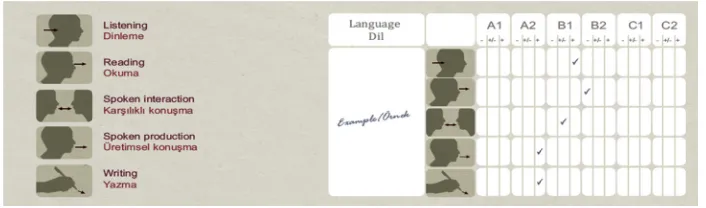
Language level meets the usage level regarding a foreign language. Language skill levels, Council of Europe, Common European Framework of Reference for Languages. They are classified into three levels as (Learning, Teaching, and Assessment) Basic User (A), Independent User (B) and Proficient User (C). These levels are also classified into two sub-levels. Basic User Level, Breakthrough (A1) and Waystage (A2), Independent Level User, Threshold (B1) and Vantage (B2), Proficient User Level is Autonomous / Effective Operational Proficiency (C1) and Mastery (C2).
Journal of Educ
General langu following sec language prof
3.4 Language
Several defini being. Langua and articles ha to the forefron “Language is developing aro organization t multiple-purp into it from va institution tha that cannot be (Aksan, 1995) Language is a by these subj completely, it “Language is a emotions, atti question; givin Based on the d providing the obvious fact th because a hea
3.5 Native Lan
The concepts meanings are follows:
cation and Train
uage proficien ctions in detail ficiencies and g
itions have bee age distinguish ave been writte nt in such studi a natural tool ound such rule that is weave ose that is imp arious angles an at is found to b e thought to be
).
an integrity of p jects in conve
is necessary to a very importa itudes, value j ng order and m definitions abo communicatio hat all the com lthy communic
nguage
of native langu not distinguish
ning Studies
ncies and gram l. Common Eu grammar conte
en made so far a hes the people
en about this su ies:
l that provides es, is a secret a d with voices possible to thin nd whose some be relevant wit e separate from
passwords tha eying message
o be a part of t ant and indispe judgements; tr making a reque ove, it is under on bamong peo mmunication st
cation can only
uage and moth hed a lot. Sağı
Image 1.Lang
Image 2.Lang
mmar contents uropean Fram ents in the field
about languag from living cr ubject. The fol
s to reach an a agreement syst s." (Ergin, 199 nk about at in a e secrets have n th human being m human being
at are coded by es to each oth the relevant so
nsable commu ransmitting th est" (Özbay, 20 rstood that the ople. People c tyles that are e y be establishe
her tongue are f ır (2007) sorte
guage Levels
guage Levels
-s that are exp ework of Refe ds of language
e that is the mo reatures and oth
llowing definit
agreement am tem whose fou 93). Aksan de a moment, wh not been solve g and society; g and society. I
y the subjects th her. In order ociety (Ünalan, unication tool t e accumulatio 001).
most importan an establish co established with ed with langua
frequently use ed the definitio
- English
- Turkish
pected from la ference for Lan e ability depen
ost basic agree her non-living tions that were
mong people, is undation was l
efines the lan ose miscellane ed even today."
and all other t is also an ins
hat will establ to comprehen , 2010). that is used in e on of culture c
nt function of ommunication
hout language age.
d for each othe ons that clarifie
Vol.
anguage levels nguages also p ding on each l
ement tool whic g creatures in th e made about l
s a creature ha laid at unknow nguage as "a
eous qualities e According to fields such as stitution that fo
ish the commu nd the meanin
expressing and concerning the
language is to n without langu e will be depriv
er wrongly and ed the concept
4, No. 10; Octo
s are displaye provided the e language level
ch is peculiar t he nature. Man language conce
aving unique r wn times and is magical asset emerge when y Aksan, "langu science, art, te ormed these el
unication and i ng of these pa
d teaching vario e events lived
o be a fundame uage. However ved of certain e
d the differenc t of native lang
ober 2016
ed in the expected . o human ny books ept came rules but s a social ; having you look uage is an echnique ements."
it is used asswords
ous ideas, d; asking
ental tool r, it is an elements
Journal of Education and Training Studies Vol. 4, No. 10; October 2016
Today, the common language that paved the way for the unification of the languages and dialects, on an unknown date, which became different from each other more or less in terms of voice structure, shapes structure and meaning such as Latin language that became a source for Proto-Turkic, Proto-Mongolic, Pro-Altaic, Roman languages (Korkmaz 1992 op cit., Sağır, 2007).
Source language that constituted the source of the languages which are collected in certain linguistic groups and accepted to be relatives of each other. Altai language is accepted to be the native language of Turkish, Mongolian and Manchu-Tungusic. Latin language is a native language according to Roman languages (Topalaoğlu 1989 op cit., Sağır, 2007). The language that created other languages. For example, Latin language is a native language for Roman languages. Primarily Yakut and Chuvash languages, the Turkish languages and dialects also come from a native language whose beginning is not known (Koç 1992 op cit., Sağır, 2007). The language that paved the way for the birth of one or many languages. For example, Latin language is a native language for Roman languages (Vardar 1988 op cit., Sağır, 2007). For the concept of native language, the equivalent of "the language that derived other languages and dialects apart from itself" is written in Turkish Dictionary.
3.6 Mother Tongue
"Language is the most powerful connection that transforms a society into a nation. It tightly links the individuals with their nation, homeland and history. Language is inherited from generation to generation and makes the individual a ring of the chain between past and future" (Aksan, 1995). What is described in these statements is apparently the mother tongue. According to Aksan, "mother tongue is taught by mother and immediate vicinity in the beginning, then by the associated environment. It is embedded in the subconscious of people forms the most powerful links of individual with society" (Aksan, 1975).
“The foundations of mother tongue are laid in the first fifteen years, the building is established on this foundation in the following fifteen years, the following fifteen years involve the furnishing, decorating and enriching years of the building" (Tural, 2000: 4). Accordingly, the acquisition of mother tongue starts in babyhood period and its foundations are laid in childhood period. According to Ünalan (2010), mother tongue is an important factor for the improvement of personality of individuals increasing the knowledge and ability and complying with society. People acquire their mother tongues by their mothers, fathers and relatives. Then, they learn it from the people they contact As a changing creature, human being starts to obtain the first culture accumulation by means of mother tongue.
Based on the above mentioned definitions of native language and mother tongue, it is observed that the concept of native language needs to be preferred (including the teaching Turkish as a foreign language) instead of the concept of mother tongue when it comes to Turkish education and Turkish teaching.
3.7 Target Language
"Target language" is used for the equivalent of the language that is taught or desired to be taught. In case two languages are used together, the language that is owned by learners can be described as "source language" whereas the language that is taught/learnt is described as "target language." The equivalent of target language is Turkish language in teaching Turkish as a foreign language.
3.8 Foreign Language
Each language apart from the native language is foreign language. Foreign language is different from the native language that is acquired naturally by individual and available nearby the individual just after the birth. Furthermore, foreign language may not be used as a communication tool in a society in which the individual lives. Foreign language is used while establishing communication with the individuals who acquired the relevant language as a native language or who learnt that language as a foreign language as a result of a conscious and planned learning process. (Erden, 2005). In short, foreign language can be defined as the language which is different from native language and acquired by means of teaching instead of the way of acquisition.
3.9 Multilingualism
Journal of Education and Training Studies Vol. 4, No. 10; October 2016
communication and interaction. Individuals have flexibility to use the different features of the abilities they have in order to establish an effective communication with a speaker under different circumstances. For example, the speakers swift from one language or dialect to another in order to express themselves and to understand the people they contact. They can also use the language or dialect in different ways in order to compose more than one written or oral text by recalling the words that exist in mutual accumulation of international field. People who have even some of such information can use a common language. In the circumstances where this mediator is not available, the individuals reveal all linguistic and paralinguistic (mimic, gesture, facial expression) features and simplify the use of language when necessary (MEB, 2009, 3-4- Common European Framework of Reference for Languages: Learning, Teaching, and Assessment).
3.10 Culture
From past to present, the individuals' need of feeling themselves belonging to a community or culture has been considered as one of the prerequisites of being a nation. To put it simply, culture is the existence objective of individuals. Culture also means language, religion, customs and traditions, shortly the accumulation of values which are perceived as the existence, union and continuation reasons for a society. It also means habits, attitudes, delights but most importantly, it is a way of democracy and life style. Culture that comprises literary and artistic products in its structure, is transmitted from generation to generation. It is open for change, has an integrative structure and informs about the feelings of belonging and dependence (Küçük, 2011).
3.11 Multiculturalism
Multiculturalism means living in a society with various cultures together within the framework of harmony and tolerance. The concept of multiculturalism is a concept that has become a current issue with the concept of multilingualism. The language policy of Europe paved the way for the emergence of this concept.
3.12 Cross-cultural Learning
Accepting each other, linguistic and religious pluralism, respect and tolerance are essential in cross-cultural learning that can be identified as obeying a specific cultural structure or assimilating that structure depending on the interaction and communication that are linked with upper-cultures and sub-cultures which are established by the individuals who have different or similar cultural values with each other on the same piece of land. Universal values should also be adopted based on the external factors as well as national values belonging to sub-cultures or upper-cultures (İlkhan 1995 op cit., Küçük, 2011).
In cross-cultural learning that aims to include the differences in whole and is composed of the unification of different values, making a compromise on the subjects of important elements, reciprocal values, beliefs, attitudes, written and oral literature, language, music, religion, moral, aesthetic values and being tolerant to different cultures and identities. The aim is to protect the mutual cultural heritage, unite pluralist values, understand opponent and homogeneous culture(s), interiorise such cultures, eliminate various prejudices arising from history, geography or culture: realise social coalescence, develop empathy towards others, protect cultural diversity without damaging the national culture and become integrated with common/upper culture successfully (Küçük, 2011).
3.13 Culture Transmission
Culture transmission means the transmission of the culture (material or non-material set of values) owned by a society from generation to generation and adopting such cultures. Evaluating this concept within the field of foreign language teaching, it can be identified as conveying the culture that belongs to the language taught to the language learners by means of the texts and material of sub-culture. Culture transmission plays a significant role in foreign language teaching. Language teaching cannot be fulfilled completely if the culture elements belonging to the target language are not included in language teaching. The ways of solving the logic of language and having knowledge about the relevant language are based on having an extensive knowledge about the contents of culture codes .
While implementing a culture transmission in teaching Turkish as a foreign language, mostly the vocabulary, proverbs and sentences that are frequently used in daily life are tackled. For example; more power to your elbow, same to you, may god speed you etc. Thesevocabulary join the teaching process by means of the texts in course books that constitute the foundation of the courses. Features are taught through proverbs and idioms that are important culture elements for foreign people who learn the relevant language at an advanced level. The course books that are used in teaching process are also utilized to a great extent (Erdem, Gün and Karateke 2015).
3.14 Language Learning
Journal of Education and Training Studies Vol. 4, No. 10; October 2016
According to Tura (1983), "foreign language learning means acquiring new sequence that is composed of meanings and sounds, learning different styles of communication functions by means of speaking rules regarding this sequence and using them appropriately and validly. Foreign language teaching is a whole of studies that aim to inform and direct the student in the stage of acquiring a new language sequence.”
3.15 Language Acquisition
The concept of language acquisition was mostly tackled within the concept of mother tongue. However, nowadays it has become a concept field that is tackled independently, and studies are conducted about this subject. The concept of language acquisition has also been included in the literature within the scope of foreign language acquisition as well as the scope of mother tongue acquisition. Language acquisition means the individual's acquiring the language rules, vocal properties and words spontaneously since birth. Language acquisition starts in a natural process spontaneously. It takes place with the vicinity of language that is closely contacted by the individual. Language acquisition is completed to a great extent until the school age period. After school age, it still continues relatively on a low level but systematically. Foreign language acquisition emerges when people acquire any other language as well as the native language.
3.16 Language Teaching
Language teaching is a process that involves the implementation of language learning activities that are conducted within the context of objectives and within the compass of a certain program in school age period. Language teaching can also be defined as a whole of activities that ensure a systematic transmission of knowledge and skills belonging to speaking, reading, writing, listening and grammar fields of language.
3.17 Step Based System
"Step based system" is one of the innovations that was accomplished in foreign language teaching in Turkey. Step based system was adopted in 1988. It is composed of six steps and the duration of each step corresponds to an academic year. The first step is compulsory and the rests are on student's will. After each step, the students who become successful in the exams held at the end of the year receive a certificate. Furthermore, the language can be changed in this system. The classroom size is minimum 8 and maximum 25 in foreign language courses. Weekly course hours were determined as five hours. Students need to receive 70 points out of 100 points in order to be regarded successful in the exams that are held at the end of the year through host system (Özdemir, 2006). A different system failed due to the problems arising from the implementation. It was cancelled in 1989-1990 academic year and previous practices were adopted again. Foreign language courses were made non-compulsory at regular high schools in 1988-1989 academic year and turned into elective courses (Demircan,1988 op cit., Özdemir, 2006).
3.18 Needs Analysis
Needs analysis was used for determining the knowledge and skills that are necessary in order to increase productivity and efficiency in business world especially. In recent years, it has become a concept that is used in the field of foreign language teaching. In the studies which were conducted in the field of needs analysis with respect to language teaching (Çalışkan and Çangal, 2013), the fulfilment of requirement analysis studies are demonstrated as an obligation in teaching approaches that relocate the student to the center. The aim of requirement analysis is to identify the needs of learners that inform about how to organize a course. It also aims to determine the needs of learners which relatively remained at theoretical level.
In light of these findings, it will be possible to prepare an effective program for Turkish teaching field for foreigners, to create educational materials suitable for the needs, plan the education of students depending on their ages, genders, occupations and ethnic origin and conduct measurement-assessment studies fitting for purpose (Çalışkan and Çangal, 2013).
3.19 Authentic Material
Recently, the use of authentic material has become popular in teaching of Turkish as a foreign language. The use of authentic material in teaching of Turkish as a foreign language makes the language teaching more effective and functional. "Authentic materials are the materials that were (not) composed with the purpose of teaching but received from authentic communication environments (Geddes and White, 1978 op cit., Güner and Belet Boyacı, 2015). "Authentic materials are; films television programs, music/video (clips) - radio conversations - interviews, songs - radio games - newspaper/journal articles, cartoons movies - advertisements/announcements - general handbills - brochures, various forms - train/ship tariffs - price lists, programs - airplane/train/bus/museum/concert tickets and guidebooks-bills of fare/recipes" (Od, 2013 op cit., Güner and Belet Boyacı, 2015).
3.20 Special-purpose Language Teaching
Journal of Education and Training Studies Vol. 4, No. 10; October 2016
according to the answers students give to the questions of why they want to learn a foreign language (Temizyürek, Çangal, Yörüsün, 2015). In special-purpose language teaching, special interest fields or work/field of business of the individual are taken into consideration. Nowadays, teaching of Turkish as a foreign language is mostly conducted with general-purpose programs. Teaching of Turkish as a foreign language has started to be conducted recently. There are only a limited number of studies related to this field.
"Teaching of Occupational Turkish" can be given as an example for teaching Turkish as a special-purpose foreign language. Special-purpose Turkish teaching is divided into sub-branches such as teaching of occupational Turkish, teaching of press and media, teaching of tourism Turkish and teaching of educational Turkish. There are several foreign companies that provide service for Turkish speakers and there are various Turkish companies that employ Turkish employees. Foreigners who work in these fields need to learn Turkish expressions, idioms, words and concepts rather than general Turkish in order to make their business lives more efficient. With respect to occupational Turkish, a foreigner working in banking sector needs to learn Turkish terms about banking sector (Temizyürek, Çangal, Yörüsün, 2015). 4. Conclusion
Please indicate the aim of the study in the first sentence and the give a little information about the data collection and analysis tools.
In this study, the basic concepts of Turkish teaching as a foreign language such as Common European Framework of Reference for Languages, Language Development Portfolio/European Language Portfolio, Language Passport, Language Learning Background/Language Biography, Portfolio, Language Level, Language, Native Language, Mother Tongue, Target Language, Foreign Language, Multilingualism, Culture, Multiculturalism, Cross-cultural Learning, Culture Transmission, Language Learning, Language Acquisition, Language Teaching, Step Based System, Requirement Analysis, Authentic Material, Special-Purpose Language Teaching have been described. The use of these concepts within the direction of th definitions will help to prevent the misconceptions and fallacies in the field. The following identifications have been made about the concepts of Turkish teaching as a foreign language:
Several signifieds have been identified in "Common European Framework of Reference for Languages" arising from translation. Although the signifier is mutual, the fact that there are various signifieds may result in misconceptions in mind. These misconceptions also result in moving away from the unity of of literature. It can be stated the expression of "Common European Framework of Reference for Languages: Learning, Teaching and Assessment" needs to be translated into Turkish as "Diller için Avrupa Ortak Başvuru Metni: Öğrenim, Öğretim ve Değerlendirme" in order to ensure the unity of literature, in order to ensure the unity of literature.
The equivalents of the expressions of Language Development Portfolio and Language Portfolio are also used for the same concepts in Turkish. These expressions are also frequently used for each other in the literature. It can be stated that "Language Development Portfolio" needs to be preferred in order to ensure the unity of literature.
The equivalents of the expressions of Language Learning Background and Language Biography also mean the same signified in Turkish language. Therefore, the equivalent of "Language Development Portfolio" needs to be preferred in Turkish language instead of using two different expressions.
It has been identified that the unity has been ensured in Turkish language about the equivalents of the concepts of Basic User (A), Intermediate (B) and Advanced / High (C) Levels within the scope of language skill level concept. Each level is divided into two sub-branches in itself as it is stated in the findings. These sub-branches are preferred to be coded with letters and numbers in the literature instead of words. In other words, (A1) coding is used instead of the concept of Breakthrough that means one of the sub-branches of Basic language skill. A1-A2, B1-B2, C1-C2 means the language skill levels and there is not any misconception in the field about this equivalence.
Mother tongue and native language are another concepts that lead to misconception. The definitions of these two concepts have been made in findings section. The signified was different in the above mentioned concepts whereas the signifier was the same. However, the signified and signifier are separate in these two concepts. Thus, these two concepts should not be used instead of each other.
Target language, foreign language, multilingualism, culture, multiculturalism, cross-cultural learning, culture transmission, language learning, language acquisition, language teaching, step based system, requirement analysis are the concepts of Turkish teaching as a foreign language whose histories date back to old times. However, authentic material, special-purpose language teaching are the new concepts of Turkish teaching as a foreign language.
Journal of Education and Training Studies Vol. 4, No. 10; October 2016
References
Aksan, D. (1975). Anadili. Türk Dili, 285, 423-434.
Aksan, D. (1995). Her yönüyle dil, ana çizgileriyle dilbilim. Ankara: TDK.
Altunışık, R., Çoşkun, R., Yıldırım, E., & Bayraktaroğlu, S. (2010). Sosyal bilimlerde araştırma yöntemleri. Sakarya: Sakarya Kitabevi.
Arslan, A., & Coşku, A. (2012). Avrupa dilleri ortak çerçeve programı: Türkiye ve dünyada neler oluyor? AİBÜ Sosyal Bilimler Enstitüsü Dergisi, 12(20), 1-19. http://dx.doi.org/10.14520/adyusbd.394
Benhür, M. H. (2002). Türkçenin yabancılara öğretiminde tartışılmayan ana kavramlar, Gazi University Institute of Education Sciences, Unpublished PhD Thesis.
Çalışkan, N., & Çangal, Ö. (2013). Yabancilara Türkçe öğretiminde dil ihtiyaç analizi: Bosna-Hersek örneği. Abant İzzet Baysal Üniversitesi Eğitim Fakültesi Dergisi, 13(2), 310-334.
Council of Europe. (2001).Common European Framework of Reference for Languages: Learning, Teaching, Assessment
Council of Europe. (2010). Language Passport.
Erdem, M. D., Gün, M., & Karateke, B. (2015). İleri seviye için hazırlanan Istanbul yabancılara Türkçe öğretim setinin kültür aktarımı açısından incelenmesi. International Journal of Language Academy, 3(1), 8-17. http://dx.doi.org/10.18033/ijla.214
Erden, H. (2005). İngilizce dilbilgisi öğretimi ve yöntemler: İngilizce’nin yabancı dil olarak öğretiminde sınıf içi dilbilgisi öğretimine yabancı dil öğretim yöntemlerinin bakış açılarının karşılaştırmalı incelemesi. Ankara University Institute of Social Sciences, Unpublished Master's Thesis.
Ergin, M. ( 1993) . Türk dil bilgisi. İstanbul: Bayrak.
Genç, A. (2004). Türkiye’de ilk ve ortaöğretim okullarında yabancı dil öğretimi. Bişkek, Kırgızistan-Manas Sosyal Bilimler Dergisi,10, 107-111.
Güler, G. (2005). Avrupa konseyi ortak dil kriterleri çerçeve programı ve Türkiye’de yabancı dil öğretim süreçleri. Trakya Üniversitesi Sosyal Bilimler Dergisi, 6(1), 89-106.
Güner, M., & Belet, B. Ş. D. (2015). Türkçe dersinde dinlediğini anlama becerisinin geliştirilmesinde otantik görev temelli otantik materyallerin etkisi. Turkish Studies International Periodical for the Languages, Literature and History of Turkish or Turkic, 10(11), 757-772.
Güneş, F. (2007). Yapılandırıcı yaklaşımla sınıf yönetimi. Ankara: Nobel Yayın Dağıtım.
Güneyli, A., & Demirel, Ö. (2006). Dil öğretiminde yeni bir anlayış: Avrupa dil gelişim dosyası uygulaması. Cypriot Journal of Educational Sciences,2(2), 110- 118.
Karasar, N. (2008). Bilimsel araştırma yöntemi: kavramlar, ilkeler, teknikleri. Ankara: Nobel Yayın Dağıtım.
Kır, E. (2011). OBM (ortak başvuru metni) bağlamında dil öğretmeni eğitimi ve Türkiye’deki uygulamaları, Ankara University Institute of Social Sciences, Unpublished PhD Thesis.
Küçük, A., & Demir, B. (2009). İlköğretim 6–8. sınıflarda matematik öğretiminde karşılaşılan bazı kavram yanılgıları üzerine bir çalışma. Dicle Üniversitesi Ziya Gökalp Eğitim Fakültesi Dergisi, 13, 97-112.
Millî Eğitim Bakanlığı (2009). Diller için Avrupa ortak başvuru metni: öğrenme, öğretme, değerlendirme. Millî Eğitim Bakanlığı (2013). Diller için Avrupa ortak öneriler çerçevesi: öğrenim, öğretim ve değerlendirme.
Mirici, İ. H. (2016 ). Avrupa dilleri öğretimi ortak çerçeve programı ve Avrupa dil portfolyosu nedir? http://adp.meb.gov.tr/nedir.php last access date: 17.01.2016
Özbay, M. (2001). 0-6 yaş grubu çocuklarındaki dil gelişiminin türkçe öğretimi açısından önemi. Bilig, 17, 98-103. Özdemir, E. S. (2006). Yabancı dil öğretiminde yeni yönelimler. Cukurova University Institute of Social Sciences,
Unpublished Master's Thesis.
Sağır, M. (2007). Ana dil mi, ana dili mi? Turkish Studies / Türkoloji Araştırmaları, 2(2), 540-544.
Temizyürek, F., Çangal, Ö., & Yörüsün, S. (2015). Yabancılara Türkçe öğretiminde iş Türkçesi öğretim programı, ders kitabı ve terimler sözlüğü denemesi: bankacılık örneği. Zeitschrift für die Welt der Türken/ Journal of World of Turks, 7(2), 87-111.
Journal of Educ
Turan, İ. (2002
22(2), 67 Ülgen, G. (20 Ünalan Ş. (20 Yontar, A. (1
Arayışlar
Yükselir, A. (2
analizi yö
This work is l
cation and Train
2). Lise coğraf 7-84.
04). Kavram g
10). Dil ve kül
1991). Farklı
r 1. Sempozyum
2006). İlköğre önteminin etkis
icensed under
ning Studies
fya derslerinde
geliştirme (kur ltür. Ankara: N
yaş gruplarınd
mu-Eğitimde N etim 6. sınıf sos
si.. Cukurova U
a Creative Co
e kavram ve ter
ramlar ve uygu
Nobel Yayınlar daki öğrencile
Nitelik Geliştir syal bilgiler pr
University Ins
ommons Attrib
rim öğretimi ile
ulamalar). Ank rı.
erin bilişsel g
rme. 13- 14 Ni
rogramında ge
stitute of Socia
ution 3.0 Licen
e ilgili sorunlar
kara: Nobel Ya
gelişim ve kav san, 1991. İsta
eçen kavramlar
al Sciences, Un
nse.
Vol.
r. G.Ü. Gazi Eğ
ayınları.
vramsallaştırm anbul.
rın kazanımı v
npublished Ma
4, No. 10; Octo
ğitim Fakültes
ma düzeyleri. E
ve kalıcılığında
aster's Thesis.
ober 2016
i Dergisi,
Eğitimde