REVIEW
Pretreatment for biorefineries: a review
of common methods for efficient utilisation
of lignocellulosic materials
Mats Galbe
*and Ola Wallberg
Abstract
The implementation of biorefineries based on lignocellulosic materials as an alternative to fossil-based refineries calls for efficient methods for fractionation and recovery of the products. The focus for the biorefinery concept for utilisa-tion of biomass has shifted, from design of more or less energy-driven biorefineries, to much more versatile facilities where chemicals and energy carriers can be produced. The sugar-based biorefinery platform requires pretreatment of lignocellulosic materials, which can be very recalcitrant, to improve further processing through enzymatic hydroly-sis, and for other downstream unit operations. This review summarises the development in the field of pretreatment (and to some extent, of fractionation) of various lignocellulosic materials. The number of publications indicates that biomass pretreatment plays a very important role for the biorefinery concept to be realised in full scale. The traditional pretreatment methods, for example, steam pretreatment (explosion), organosolv and hydrothermal treatment are covered in the review. In addition, the rapidly increasing interest for chemical treatment employing ionic liquids and deep-eutectic solvents are discussed and reviewed. It can be concluded that the huge variation of lignocellulosic materials makes it difficult to find a general process design for a biorefinery. Therefore, it is difficult to define “the best pretreatment” method. In the end, this depends on the proposed application, and any recommendation of a suitable pretreatment method must be based on a thorough techno-economic evaluation.
Keywords: Review, Biomass, Pretreatment, Lignocellulosic materials, Biorefinery, Fractionation
© The Author(s) 2019. This article is licensed under a Creative Commons Attribution 4.0 International License, which permits use, sharing, adaptation, distribution and reproduction in any medium or format, as long as you give appropriate credit to the original author(s) and the source, provide a link to the Creative Commons licence, and indicate if changes were made. The images or other third party material in this article are included in the article’s Creative Commons licence, unless indicated otherwise in a credit line to the material. If material is not included in the article’s Creative Commons licence and your intended use is not permitted by statutory regulation or exceeds the permitted use, you will need to obtain permission directly from the copyright holder. To view a copy of this licence, visit http://creat iveco mmons .org/licen ses/by/4.0/. The Creative Commons Public Domain Dedication waiver (http://creat iveco mmons .org/publi cdoma in/ zero/1.0/) applies to the data made available in this article, unless otherwise stated in a credit line to the data.
Background
Lignocellulosic biomass has been suggested as an impor-tant part of a sustainable society for a few decades. It is viewed as an alternative to fossil carbon sources, such as oil, natural gas and coal. An example is the global biofuel production, which in 2016 was estimated to be 137 billion L (3.3 EJ) [1]. Another field of application is for produc-tion of polymers, fertilisers, etc., but the transportaproduc-tion sector is the main consumer of energy-related products. The annual global production of biomass is estimated to be about 4500 EJ of solar energy that is captured per year [2]. Another estimation presents the global annual
production to be 1 × 10¹¹ tons [3]. About 5%, or 225 EJ/ year, is equivalent to almost half of the global energy demand at present. This estimated demand (225 EJ/year) is in line with results from other studies. Berndes et al. [4] gathered data from 17 studies in a review and concluded the contribution from biomass to be between 100 EJ/year and above 400 EJ/year in 2050. The main reasons for the quite large difference are two major uncertainties: avail-ability of land and yield in crop production. In the same publication, the assessed plantation capacity is estimated to yield a sustainable availability between 50 and 240 EJ/ year. Thus, it is very difficult to make accurate estima-tions of the actual amount available. Although global bio-based chemical and polymer production is estimated to be around 50 million tonnes, the historic low price of fossil feedstock together with optimised production
Open Access
*Correspondence: [email protected]
processes have restricted commercial production of bio-based products [5]. Some processes for production of chemicals have already reached the required technical maturity to be produced through biological routes. For example, most lactic acid production takes place through a biological route, while the classical chemical route is less important [6].
The biorefinery concept and full‑scale operation
A biorefinery can be defined as the renewable equivalent of a petroleum refinery, the main difference being the raw material. In the biorefinery, biomass can be converted into a wide range of chemicals and energy carriers, and it can also contribute to the development of circular econ-omy; this concept is based on the model that lignocellu-losic materials, which were used to generate bio-based products can be recovered (to a certain degree), and be recovered and recycled [7]. The International Energy Agency Bioenergy Task 42 defines biorefining as “the sustainable processing of biomass into a spectrum of marketable bio-based products (chemicals, materials) and bioenergy (biofuels, power, heat)” [8]. However, the different types of raw material constitute a tremendous challenge when a large-scale production facility is con-sidered. In Fig. 1, a schematic overview of a potential biorefinery is shown.
Some important considerations have been suggested for the biorefinery concept to become a path forward towards a less fossil-dependent society. The development of biorefineries is a vital key for integration of food, feed, chemicals, fuels and energy production in the future. Combinations of physical and biotechnological processes for production of proteins, but also for platform chemi-cals such as lactic acid will be of importance in the future [9, 10]. Biomass can mitigate, to some extent, the high atmospheric levels of carbon dioxide by replacing fossil fuels; in addition, in many countries around the world, the concept may be important to secure domestic energy carriers and the supply of chemicals. Another aspect is the possibility for erection of new industries in rural areas, where it is likely that many of the large biorefin-eries will be located [11]. Most lignocellulosic feedstock is generally much more complex and recalcitrant than the currently used starchy materials in, e.g. the ethanol industry, which poses a challenge [12]. Nevertheless, a number of demo-scale plants have been put in opera-tion during the last 10–15 years. Several companies have evaluated ethanol production through transforma-tion of cellulose to second-generatransforma-tion sugar products for conversion to ethanol and other chemicals [5]. An easily accessible source (for a quick overview of various facilities worldwide for the production of advanced liquid and gaseous biofuels intended for transport purposes) is
Lignocellulosic crops Lignocellulosic waste
Pretreatment
Hydrolysis
Lignin C6 sugars C5 sugars
Pyrolysis Gasificaon Separaon Fermentaon Chemical reacon
Biodiesel CH4 H2 Ethanol
Chemical Building
blocks
Food and Feed
Polymers and resins
Bio-materials
maintained by the International Energy Agency (IEA Bio-energy, Task 39) [13], which shows that there is a great interest in energy carriers from biomass. Some examples are POET-DSM, who operates a demo-scale plant at TRL 8, in Emmetsburg, Iowa, USA with a capacity of 75,000 t/ year of ethanol. In Finland, the company North European Oil Trade Oy (formerly ST1) is operating a demo plant at TRL 6-7 in Kajaani for production of cellulosic ethanol at a capacity of about 8000 t/year for demonstration of their conversion technology called “Cellulonix”. Similar projects can be found in Brazil (Gran Bio, Bioflex 1), as well as in China (Henan 1), the NREL Integrated Biore-finery Research Facility (IBRF) in Golden (Co, USA), and in several other locations all over the world. However, many earlier projects are now idle or changing focus. An example is a demo plant operated by DuPont in Vonore, TN, US, which is currently idle as DuPont is refocusing on enzyme production. The data gathered from demo-scale plants are extremely important, since they have resulted in large sets of engineering design information, which are necessary for the full-scale design of future biorefineries. However, since most of the recorded data are proprietary information, it is not likely to be acces-sible to the general engineering or science community. In addition, many pulp mills can be considered, to some extent, to be operated as biorefineries. Today, not only pulp is a valuable product, but also tall oil from the kraft process, which can be transformed to a diesel-like liquid fuel [14], soil conditioners from organic materials [15], fibres for textile production [16], lignin [17], vanillin, microfibrillar cellulose [18], and other valuable products, which in the future may be adding to the revenue from pulp production.
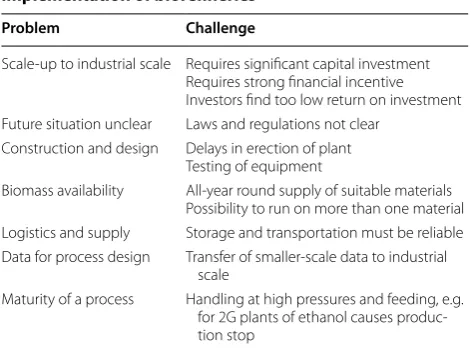
A number of challenges have been identified for imple-mentation of successful future biorefineries, which are summarised in Table 1. Sanford et al. [19] argues that scaling up a successful small-scale operation to a large-scale biorefinery is the first step towards a significant capital investment. Therefore, a very strong economic incentive must be present to justify the investment. In addition, investors also recognise the low return on invested capital and an unstable future situation, as the laws regarding biofuels and biochemicals are not yet long-term stable, which means that the required financial ground is not yet fully prepared for large investments. They also conclude that many biotechnology companies, who have been running a successful early-stage process, have suffered severe problems due to the challenges asso-ciated with scale-up and effects from delays in construc-tion, testing and operation. In some cases, capital costs have been cut by retrofitting existing plants. A number of bottlenecks and possible solutions for commercialisa-tion have been identified by Chandel et al. [5]. Some of
the important factors are: (1) biomass availability, which includes all-year round supply of lignocellulosic biomass at competitive cost, and access to biomass of similar kind to be able to run a biorefinery within a narrow range of operating conditions. (2) All logistics and a fully working supply chain must be available, e.g. transports of low-density materials (straw, bagasse, etc.), as well as storage facilities for continuous operation to be possible. Feed-stock handling and transportation are the most promi-nent costs associated with the biorefinery concept. In the case of biofuel production, as much as 40–60% of the full-scale production costs can be attributed to feedstock [20,
21]. Tao et al. performed process and techno-economic analysis of six biomass pretreatment processes [22]. The overall ethanol production, total capital investment and minimum ethanol-selling price were compared for the selected methods. The result indicates that there was no large difference in economic performance except if a process was operated in a way, which resulted in low glu-cose and ethanol yields. In addition to the factors previ-ously discussed, other important challenges to overcome include process mechanisation; transfer of small-scale laboratory data to engineering design data; and the lack of technical maturity in 2G lignocellulosic technology, such as feeding issues with high-solids suspension to a high-pressure reactor.
Platform chemicals
A number of chemicals—platform chemicals—are more important in the biorefinery concept than other products or intermediate compounds. The reason for their impor-tance is that they can to be used as building blocks for production of high-value chemicals. These often consti-tute chemicals having multi-functional groups that can
Table 1 A selection of challenges for successful
implementation of biorefineries
Problem Challenge
Scale-up to industrial scale Requires significant capital investment Requires strong financial incentive Investors find too low return on investment Future situation unclear Laws and regulations not clear
Construction and design Delays in erection of plant Testing of equipment
Biomass availability All-year round supply of suitable materials Possibility to run on more than one material Logistics and supply Storage and transportation must be reliable Data for process design Transfer of smaller-scale data to industrial
scale
be converted to other groups of useful molecules. An important feature of a platform chemical is its applica-bility for production of a multitude of compounds, such as various forms of plastics, binders, fibres, energy carri-ers, etc. In a joint report from Pacific Northwest National Laboratory (PNNL), National Renewable Energy Labo-ratory (NREL) and the Office of Energy Efficiency & Renewable Energy (EERE), [23] 12 sugar-based building blocks are targeted as the most important. These include 1,4-diacids (succinic, fumaric and malic), 2,5-furan dicar-boxylic acid, 3-hydroxy propionic acid, aspartic acid, glucaric acid, glutamic acid, itaconic acid, levulinic acid, 3-hydroxybutyrolactone, glycerol, sorbitol, and xylitol/ arabinitol. A couple of these are considered to be of more interest in terms of their commercial usefulness: succinic, fumaric, and malic acid, since they today form the basis for many high-value replacement products.
Techno‑economic estimations and life‑cycle analysis (LCA) for biorefineries
Pretreatment is one of the key unit operations in a biore-finery. Thus, it is critical to evaluate the pretreatment step in conjunction with all related equipment and pro-cess solutions in a proposed biorefinery. Life-cycle analy-sis and techno-economic evaluations are important tools for finding suitable and sustainable production methods. It is not possible to evaluate stand-alone pretreatment systems, since they are always part of a larger processing concept for producing fuels and chemicals. These pro-duction processes can, and in most cases do, result in a pallet of products. Some of the pretreatment processes are specialised towards certain products, while oth-ers are more generic for the sugar platform. Regardless of which, since the pretreatment step is integrated with other processing steps it is difficult to predict the data for a life-cycle analysis based on a stand-alone pretreatment process only. The primary energy for the pretreatment may be supplied by a downstream processing step at a higher temperature level, and the pretreatment process may supply secondary heat the rest of the process. Both of these alternatives would make the pretreatment pro-cess a net zero user of energy, which in an LCA analysis of a pretreatment system is one of the major parts, since one of the major LCA “costs” for a biorefinery is the pri-mary energy supply. If a by-product from the biorefinery is utilised, or if an external energy supply is used, this will strongly influence the LCA performance. It is therefore difficult to make an LCA comparison between different pretreatment processes without taking into account the surrounding processes and the integration with these.
However, in terms of techno-economic analysis of pre-treatment, it can be performed to some extent for some of the more mature processes in terms of capital and
expenditure costs (CAPEX) for the processing equip-ment. For less developed processes, the available data are more scarce and unreliable. The comparison between processes at different maturity would likely result in a skewed view on the performance of the different pro-cesses and would provide little general information. As with LCA analysis, a techno-economic analysis there-fore need to be performed on a case-by-case basis for a certain production process integrated with the pretreat-ment process. Several estimations on techno-economic analysis and LCA have been published over the years. Aden and Foust [24], as well as Humbird et al. [25] per-formed a techno-economic analysis on a process based on dilute-acid pretreatment of corn stover followed by enzymatic hydrolysis and fermentation. In the studies, it is concluded that techno-economic analysis plays an important role in process development for targeting of technical as well as economic hurdles, which must be studied for production to be successful. In another study, Barta et al. [26] studied the process economics of com-bined ethanol, biogas, heat and electricity production from industrial hemp. One of the results in the study is that it is important to maximise the recovery of poten-tial energy carriers in the raw material, since feedstock is the largest cost contributor in the process. Similar studies have been presented by Dias et al. [27] on improvement of distillation, cogeneration systems and heat integration based on sugar cane bio-ethanol production, while Joels-son et al. [28] and Börjesson et al. [29] studied potential biorefineries, using agricultural and forestry residues, in terms of techno-economic factors, system integra-tion, LCA and feedstock supply. The study aimed at find-ing suitable locations for a full-scale refinery in Sweden where various factors were evaluated, such as integration with pulp mills, export of heat to district heating systems, etc., Budzinski et al. [30] utilised a hybrid LCA multi-objective optimisation model to evaluate two constraints. The first was based on maximising profit, while the sec-ond was based on minimising global impact on climate change. In the study, ethanol production was found to be more cost-effective than ethylene production; however, in terms of reducing climate impacts ethylene produc-tion was the better alternative. It must be stressed that techno-economic evaluations, as well as LCA cannot be performed without reliable experimental data. In addi-tion, a rather detailed process design together with infor-mation on supply, logistics, economic details, etc., must be available.
Biomass
various plant-based material, such as agricultural, forest and herbaceous matter. Despite great efforts invested worldwide to improve cellulose digestibility, cellulosic biofuels and chemicals have yet to be cost-competitive with their starch-based counterparts. The challenge is primarily due to their high production costs associ-ated with pretreatment and enzymatic hydrolysis (and the raw material itself). The variety of plant species is immense, which has a direct impact on the process concepts for their utilisation. The availability of various types of lignocellulosic materials varies from country to country, and continent to continent. In certain regions, forests are abundant, while agricultural species are more common in other regions. Lignocellulosic mate-rials differ from one species to another. However, the main constituents are basically the same, although the contents of individual carbohydrates, aromatics and other compounds vary: about 50–60% are carbohy-drates, i.e. cellulose and hemicelluloses, 20–30% lignin, while the rest consist of extractives, fatty acids, ash, etc. [31]. Cellulose is made up of cellobiose units, while hemicelluloses finds their structure from a mixture of hexose and pentose sugars, in combination with vari-ous organic acids [32]. Hemicelluloses are more hydro-philic than cellulose and easier to hydrolyse. Lignin is the major non-carbohydrate constituent in lignocellu-losic materials comprising a very complex structure of aromatic compounds. It is associated with both cellu-lose and hemicellucellu-loses and is an important reason for the high strength of many lignocellulosic materials. In general, agricultural crops and hardwood contain more pentose sugars than does softwood [33]. The predomi-nant sugar in most softwood species is mannose, while in hardwood and agricultural species, pentose sugars are in majority [33].
One of the major challenges that the biorefinery con-cept faces to become successful is to find suitable raw materials. It is likely that second-grade or waste materi-als will be the main raw material supply in a biorefinery. This includes straw, bagasse, tree roots, branches, forest thinnings, etc. However, a large part of the published research that deals with woody materials are often based on wood chips of high quality. This is in direct compe-tition with, e.g. the interests of pulp producers. On the other hand, the residues from agricultural operations are in many cases available for conversion to other valuable products. However, to maintain soil quality, such as the level of nutrients, not all straw can be removed from the field; an alternative is to return processed residues to the field. Other types of waste materials include municipal solid waste, waste textile, waste-construction materials, etc. Thus, it calls for very robust and versatile production methods to be able to handle raw materials of different
origin. It is not likely that a biorefinery will be capable of processing all sorts of lignocellulosic materials.
The purpose of biomass pretreatment
The purpose of the biomass pretreatment step has some-what shifted during the last decade(s); previously, the main interest was to use lignocellulosic materials for mainly bioethanol production. The interest in the other main compounds, lignin and hemicelluloses, was lim-ited. Today, it is of great importance to find ways to max-imise the overall yield of the valuable compounds that make up lignocellulosic materials. Pretreatment methods that enable efficient recovery of carbohydrates as well as lignin are desired; however, this all depends on the situ-ation and the final product. The energy requirements in the production process must be met under any circum-stance, either by internal or external integration of high-energy streams, such as in a mill producing pulp, where the excess lignin is the main process-energy supplier. It has been estimated that—in an optimised mill—between 20 and 30% of the lignin is available for other purposes than for internal energy requirements [34].
Pretreatment is a step that is included as one of the first steps in the process, to alleviate access to the raw mate-rial. It is difficult to define “the best” pretreatment for all situations and raw materials; however, it is vital that some important features of the pretreatment method are fulfilled, such as a high recovery of the individual polymers and other compounds in the lignocellulosic material. In addition, the formation of toxic or inhib-iting compounds must be low to decrease the risk for negative effects in, e.g. the enzymatic hydrolysis and fer-mentation steps, if they are part of the process. It is well known that too severe conditions during pretreatment will cause greater degradation of hemicellulosic sugars, which can cause formation of highly toxic compounds, such as furfural, HMF and organic acids. In addition, a plethora of other compounds may be generated; however, furfural and HMF are often used as proxies for the gen-eral content of inhibitory compounds [35]. Preferably, the energy requirement must be as low as possible. It is also an advantage if energy integration between the pretreat-ment step and other parts of the production facility can be implemented, such as utilisation of low-grade steam for distillation purposes. It has also been established that the economic success of a biorefinery is heavily depend-ent on the solid contdepend-ent of the pretreated materials. If too dilute solutions are produced the energy costs for puri-fication may be prohibitively high, which can cause an otherwise well-functioning pretreatment method to be discarded [36].
thereof, denoted physico-chemical. This is a somewhat arbitrary classification, which largely becomes more and more out-dated since the main aim of a successful pre-treatment is now not only to achieve a cellulose fraction that can be easily hydrolysed at a high yield, but also to take care of other constituents. Various forms of “pre-treatment” methods have been used for a long period of time. Already in the 1940s, the Scholler process was a means to hydrolyse wood for production of ethanol for fuel and chemicals. However, the Scholler process is strictly speaking not a pretreatment method, but rather an acid hydrolysis using 0.5% H2SO4 at around 130° for 45 min to hydrolyse cellulose [37]. The definition of the unit operation pretreatment is rather vague. When does acid-catalysed steam pretreatment of a lignocellulosic material become acid hydrolysis instead? Can soda cook-ing of spruce be considered as pretreatment? In general, a pretreatment step is combined with some kind of another treatment, such as enzymatic hydrolysis; however, several of the rather new methods are largely efficient fractiona-tion methods, which makes it difficult to put a label that clearly defines “pretreatment”.
The research area concerning biomass pretreatment is very active. A database search using the keywords “bio-mass AND pretreatment” in Scopus for the period 1973– 2019 results in about 9600 publications, with a suddenly increasing number of publications starting around 2010. At this time, the number went from about 300 to pres-ently more than 1000 publications per year having the aforementioned keywords. One of the reasons for this may be a more efficient classification system, where the authors’ select proper keywords, but it also shows the continuous high interest for fractionation of various lig-nocellulosic materials. It is thus an overwhelming task to cover every aspect of biomass pretreatment in all its forms. Therefore, this review is a selection of currently “hot” methods, as well as a historical perspective of methods that still attracts much attention.
How can different pretreatment methods be assessed? One of the challenges in selecting a pretreatment method is to evaluate the effect of different methods. It is in gen-eral not enough to calculate recovery and yields of the main compounds in the lignocellulosic raw material. These figures are very important, especially when consid-ering the economics of a process. However, they do not fully tell if a pretreatment method is suitable for a cer-tain post-processing step. For instance, if the purpose of pretreatment is to produce ethanol, then several indica-tors can be used to assess the pretreated material. These indicators include estimation of the levels of inhibitor or toxic compounds, such as aldehydes, organic acid, ketones, phenolic compounds, etc., which may have a
detrimental effect on enzymatic hydrolysis and fermen-tation. A seemingly successful pretreatment, in terms of hydrolysis efficacy and yield, may be far too toxic for a fermenting organism to cope with, which can result in a stuck fermentation, such as after a too severe acid-cata-lysed pretreatment [38]. On the other hand, if the pur-pose is to produce, e.g. polymers, gels or binders, other evaluation criteria must be employed. These can include mechanical strength and swelling properties of the poly-mers [39, 40]. Regarding lignin, its reactivity can be an appropriate indicator [41].
Since several platform chemicals have their origin in monomeric sugars, (e.g. glucose), enzymatic hydrolysis of the pretreated material is probably the most impor-tant indicator. This can be a very time-consuming pro-cedure, since enzymatic hydrolysis requires a rather long residence time, often between 24 and 96 h. An approach to reduce the total time and the need for many reactors is described by Studer et al., who developed a high-throughput reaction system [42, 43], where a 96 well-plate unit was employed for both pretreatment and enzymatic hydrolysis. In the system, a 1% solids suspen-sion of a genotype of Populus trichocarpa was tested with an excess of cellulolytic enzymes to speed up the assess-ment procedure. Costa et al. [44, 45] report in studies concerning sugar cane hybrids, a correlation between microscopic characteristics and chemical composition regarding recalcitrance of the sugar cane. Rapid, simple, and efficient screening protocols will be more and more important when selection of modified plants for biorefin-ery purposes is based on certain properties, such as easily accessible carbohydrates for further processing. In addi-tion, the rapidly growing interest for lignin also shows the requirement for procedures to validate the quality and reactivity of the fractionated lignin.
It has to be stressed that although rapid screening methods are of great value, the final testing must be car-ried out at higher solid content than 1–2%. The impact on the overall process costs is very much influenced by the achieved concentrations of sugar or other products. A low concentration adds to the separation and recov-ery costs such that they may become far too high. It is especially important to perform high-solids enzymatic hydrolysis since the conversion of the lignocellulosic materials may become much smaller than expected from low-solids experiments [46].
Modification of lignocellulosic species
total-carbohydrate solubilisation, which is dependent on a number of factors, such as feedstock modification, feedstock choice, biocatalyst choice and augmentation of biological attack (i.e. pretreatment). The latter was performed using either ball milling or CELF (Cosolvent-Enhanced Lignocellulosic Fractionation, a method that involves treatment with aqueous tetrahydrofuran and dilute acid at elevated temperatures). Shen et al. [48] modified genetically switchgrass to reduce lignin content, resulting in less formation of phenolic degradation prod-ucts, while maintaining carbohydrate levels. In another study, Mansfield et al. [12] subjected poplar trees with altered lignin content to steam explosion or organosolv pretreatment (using aqueous ethanol and sulphuric acid as catalyst). Their conclusion was that the low-lignin poplar trees showed a 15% improvement in the conver-sion efficiency resulting in near-complete hydrolysis of the poplar carbohydrates. It has to be mentioned that enzymatic hydrolysis was performed at 2% dry-matter content, which as discussed earlier, is a non-realistic dry-matter concentration in full-scale operation. It is, however, a common method to assess various pretreat-ment methods. Wilkerson et al. [49] carried out a study on poplar where they introduced ester linkages in the lignin structure to improve cell wall digestibility after a mild alkaline pretreatment. The concept of tailoring plants to use cell-wall biosynthesis to modify the natu-rally occurring variety may be an option to grow plants that are more easily deconstructed for biorefinery pur-poses, according to Wilkerson et al. Another study on genetically modified poplar was carried out by Biswal et al., who showed that it was possible to reduce recalci-trance, have more easily extractable cell walls as well as a more rapid growth in the selected poplar species ( Popu-lus deltoides) [50]. In addition, the xylan and the pectin contents were reduced.
Pretreatment and fractionation of lignocellulosic materials The traditional manner of discussing pretreatment meth-ods is often based on a rather loose classification. In gen-eral, the pretreatment methods are regarded as belonging to one of the following categories [51–53]: physical (e.g. milling, grinding, irradiation, sonication); chemical (e.g. alkali, acid, oxidising agents, organic solvents, ionic liq-uids and deep-eutectic solvents); physico-chemical methods (e.g. steam pretreatment w/wo catalyst, wet-oxi-dation and hydrothermolysis), or biological methods. In reality, many variations may be made up of combinations of two or more methods.
Another classification can be made according to the pH of the selected pretreatment method, if pretreatment is performed under acidic, neutral or alkaline conditions. This classification is, of course, not valid for methods
where an organic solvent, an ionic liquid and similar dissolving agents are utilised for pretreatment (unless a catalyst is added that affects the pH). The pH has a very large influence on the outcome of a pretreatment pro-cess. These effects can be described roughly according to the following:
• Low pH, where the desired result is hydrolysis of the hemicelluloses part to monomeric sugars, without formation of inhibiting or toxic compounds, while at the same time keeping the cellulose polymer intact. • Neutral or close to neutral pH, which result in partial
hydrolysis of the hemicelluloses caused by organic acids in the lignocellulosic materials (autohydrolysis). Since the conditions are not severe enough, most of the hemicelluloses will stay in oligomeric or poly-meric form. Lignocellulosic feedstocks that are low in organic acids, such as softwood, will not result in high solubilisation of hemicelluloses.
• High pH, which can result in dissolution of the lignin fraction (such as in pulping of wood, or when organic solvents are employed) while some or most of the hemicelluloses still is found in its solid state.
Acidic conditions result in hemicellulose hydrolysis, which also commonly results in formation of degradation products, such as furfural, HMF, levulinic acid, etc. Car-valheiro et al. [54] have summarised several pretreatment methods where pH is the main cause for the outcome of the procedure. It is obvious how the distribution of the main polymers in a lignocellulosic material changes as the pH moves from low to high values. At low pH, almost all hemicelluloses are removed from the solid material; in contrast, at high pH, lignin is dissolved and cellulose and hemicelluloses constitute the solid fraction (Fig. 2).
used for production of value-added chemicals and fuels without too complicated process designs. A comment about their low value is in place here: as soon as a waste can be utilised, the material cost is likely to increase, which is one of the reasons why it is difficult to make eco-nomic estimations for a full-scale production facility.
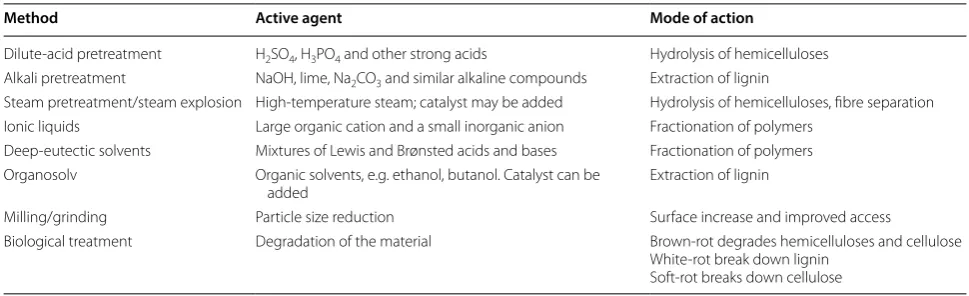
In Table 2, a selection of commonly utilised pretreat-ment methods is summarised. As already pointed out, the vast number of pretreatment-related publications makes it difficult to discuss in detail every pretreatment method. This review summarises frequently applied pre-treatment methods, which can be applied in a biorefinery facility.
Pretreatment methods Acid and alkaline methods
In this section, acid and alkaline methods based on the hydrolytic action at low or high pH are discussed. At low pH, the hemicelluloses fraction hydrolyses, while the cellulose and lignin fractions in general are less affected. At higher pH, it is instead lignin that is solubi-lised, which forms the basis for many pulping processes
for production of high-quality journal paper. Depend-ing on the severity of the pretreatment, the extent to which the solid material dissolves can vary to a high degree. If a high acid concentration is employed at high temperatures, not only hemicelluloses but also cel-lulose converts to oligo- or mono-saccharides. Under even more severe acidic conditions the carbohydrates degrade to other compounds, e.g. furfural, HMF, lev-ulinic acid, etc. Typically, temperatures ranging from 140 to 200 °C and a residence time of minutes to hours are common. Alkaline conditions often have the great-est effect on agricultural residues or herbaceous crops, as these materials in general contains less lignin [55, 56]. An excellent techno-economic analysis of six pretreat-ment technologies (ammonia fibre expansion, dilute acid, lime, liquid hot water, soaking in aqueous ammo-nia and SO2-impregnated STEX) was published 2011, in the CAFI project (Consortium for Applied Fundamen-tals and Innovation) [22], where switchgrass was used for evaluation of the processes. Interestingly, the result shows that the differences between the technologies were limited. However, switchgrass is not very recalcitrant in
Cellulose
Hemicellulose
Lignin b
Cellulose
Hemicellulose
Lignin a
Fig. 2 The effect of pH on pretreatment of lignocellulosic materials: a low pH; b high pH
Table 2 A selection of commonly utilised pretreatment methods
Method Active agent Mode of action
Dilute-acid pretreatment H2SO4, H3PO4 and other strong acids Hydrolysis of hemicelluloses
Alkali pretreatment NaOH, lime, Na2CO3 and similar alkaline compounds Extraction of lignin
Steam pretreatment/steam explosion High-temperature steam; catalyst may be added Hydrolysis of hemicelluloses, fibre separation Ionic liquids Large organic cation and a small inorganic anion Fractionation of polymers
Deep-eutectic solvents Mixtures of Lewis and Brønsted acids and bases Fractionation of polymers Organosolv Organic solvents, e.g. ethanol, butanol. Catalyst can be
added Extraction of lignin
Milling/grinding Particle size reduction Surface increase and improved access
Biological treatment Degradation of the material Brown-rot degrades hemicelluloses and cellulose White-rot break down lignin
contrast to softwood, which may have exhibited larger variation of the estimated costs.
Dahunsi [57] studied the effect of acid or alkaline hydrogen peroxide pretreatment on pineapple peel prior to anaerobic digestion. In the study, based on response surface methodology, they varied the temperature between 75 and 115 °C, the residence time between 6 and 46 min, the H2SO4 concentration was 0–2% (v/v). A simi-lar procedure was employed using alkaline H2O2. The main results from the study were that alkali-enhanced pretreatment yielded a lignin reduction and a biogas pro-duction, which was 67% higher than the corresponding acid treatment. Another observation was that the resi-dence time in the biogas reactor was shorter for the alka-line-treated pineapple peel. In another study by Harun and Goek [58], NaOH was used to carry out pretreat-ment on rice straw. The straw was pretreated at 55 °C for 1 and 3 h, respectively. A concentration of 2–12% (w/v) of NaOH and a ratio of rice straw to NaOH solution of 1:20 (w/v) was applied to all samples. One of the results was that an increase of the glucan content by 85.6% (rela-tive to untreated straw) was achieved using 12% NaOH for 1 h. This condition also resulted in the highest delig-nification of the straw, 79.6%. On the other hand, straw treated for 3 h with 2% NaOH was found to give the high-est total carbohydrate content, 79.2%.
An example of the current biorefinery trend, where val-uable lignocellulosic constituents are utilised for produc-tion of value-added compounds, is the integrated process for coproduction of fermentable sugars and lignin from poplar pellets that was evaluated by Chu et al. [59]. The process was based on alkali-sulphite pretreatment for production of lignin adsorbents and sugars. In the pro-cess, Na2SO3 was used to soak poplar wood pellets prior to a two-stage cook, the first at 130 °C for 30 min, while the second was carried out at 210° for 5 min. After pre-treatment the liquor and the solid residue was separated. After washing, enzymatic hydrolysis on the solid resi-due was performed. The liquid fraction was processed further using nitric acid to yield an adsorbent prod-uct. Over 75% of the original carbohydrate content was released and potentially could be used for fermentation. The adsorbent was tested using lead ions, which resulted in adsorption capacities of 156 and 68 mg g−1, for lignin from pre-hydrolysate and enzymatic hydrolysis residue, respectively. The probable reason for the heavy-metal ion adsorption capacity was suggested to be incorporation of sulphur-containing groups in the lignocellulosic material.
Dilute-acid pretreatment of rice straw in pilot-scale was carried out by Kapoor et al. [60]. A continuous pilot-scale reactor was utilised to pretreat rice straw at a feeding rate of 10 kg h−1 at temperatures ranging from 150 to 166 °C with a fixed residence time of 10 min. All experiments
were conducted for 4 h to secure steady-state conditions. The pH of the slurry was then adjusted to 5.2, after which enzymatic hydrolysis was carried out. Pretreatment using 0.35 wt% acid, 162 °C and 0.65 wt% acid at 152 °C yielded almost the same result in terms of sugar recovery. Over-all, about 65% of the potentially available carbohydrates could be recovered. It was also pointed out that a higher recovery can be achieved by adding more enzymes; how-ever, there is as trade-off between the efficacy of enzy-matic hydrolysis and enzyme dosage since enzymes are expensive.
The SPORL method (sulphite pretreatment to over-come recalcitrance of lignocellulosic) is a technology utilising sulphite in the pretreatment step. This pretreat-ment technology allows lignocellulosic materials to react with a solution of a sulphite salt (with e.g. Na, Mg, or Ca) at a temperature of 160–180 °C, and a pH of 2–4 for about 30 min [61]. After the sulphite cooking, a disk milling operation takes place to generate a fibrous mate-rial for subsequent saccharification (and fermentation). When spruce wood was subjected to SPORL treatment, the overall yield after the saccharification step was found to be 87.9% for glucose and xylose. During the pro-cess, hemicelluloses were dissolved, and about 32% of the lignin fraction was dissolved and sulphonated. The SPORL process was compared with a dilute-acid pre-treatment performed at the same temperature and resi-dence time, which resulted in about 57% recovery of the sugars.
Another technology that has been studied in pilot-scale is the ammonia fibre-expansion method (AFEX). Sarks et al. [62] investigated in two 450 L packed-bed reac-tors pretreatment of corn stover followed by enzymatic hydrolysis and fermentation. The water content in the corn stover was adjusted to 25% before being heated to 80°. Then, biomass was treated with gaseous ammonia at a ratio of ammonia to biomass of 1:1 for 30 min. One of the interesting results is the increase in yield relative to that of laboratory-scale experiments (10 L). The glucose and the xylose release after 48H increased by 19 and 15%, respectively, in the pilot-scale experiments. In addition, ethanol production showed a 15% increase compared to laboratory-scale trials. The reasons for the higher conver-sion is not fully clear. However, improvements were seen already earlier when the transition from a stirred batch reactor to the laboratory-scale equipment was made. The improved conversion has a direct effect on the minimum ethanol-selling price, which was estimated to be about 19% lower.
inorganic matter than larger particles. In contrast, the larger particles had a relatively higher content of carbo-hydrates, but were lower in nitrogen content. The influ-ence of particle size on AFEX-pretreated rice straw was studied by Harun et al. [64] who pretreated milled (2 and 5 mm) and cut (2 and 5 cm) particles. In addition, two levels of severity were employed for each particle size. The less severe experiments were performed at 100 °C for 30 min at a straw: ammonia ratio of 2:, while another set of experiments were conducted using more higher tem-perature (140 °C), longer residence time (50 min), and a ratio of 1:1 of ammonia to straw. Enzymatic hydrolysis of the AFEX-pretreated fractions showed an impact of par-ticle size, in that larger parpar-ticles resulted in lower sugar conversion for the less severe conditions. In contrast, the more severe conditions yielded a higher conversion with increasing particle size. The largest, cut particles signifi-cantly demonstrated a higher conversion than did smaller particles at the highest severity.
The AFEX technology has also been employed for production of livestock feed. The technology was used to upgrade wheat straw in an attempt to reach fodder-level quality. The true IVOMD (in vitro organic mat-ter digestibility), which is a measure for fodder quality, improved on average by 193 g kg−1 to reach an average of 844 g kg−1, which can make a large difference in many
countries. The authors point out the importance of test-ing the pretreated straw regardtest-ing the health effects on the animals and, in addition, if the milk and meat are safe for human consumption. Bals et al. [65] carried out a study on the concentration of acetamide (an ammo-niation by-product) in AFEX-treated crop residues and in milk and meat from cattle and buffalo that had been fed with the material. When the AFEX-treated mate-rial was introduced, the levels of acetamide in the blood increased. It is possible that the levels will decrease over time due to an adaptation by the animal; however, con-tinued research is necessary to assess the risk, if any, for ruminants and humans.
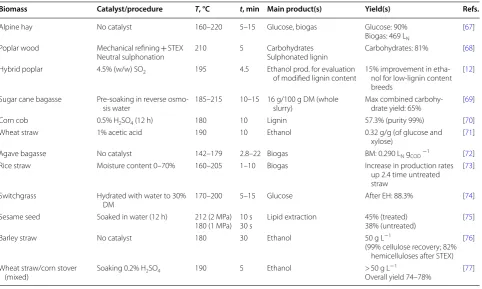
Steam explosion (pretreatment) and extrusion methods Steam explosion (or steam pretreatment) is one of the most widely investigated methods and has been so for a long time. In Table 3, a selection of results from steam pretreatment using typically investigated materials is presented. STEX has been used for many purposes on a large range of lignocellulosic materials, and in combina-tion with other pretreatment procedures. This includes studies on liquid and gaseous fuels production, e.g. ethanol and butanol, or biomethane through anaerobic digestion, respectively. The variation in lignocellulosic materials treated by STEX is very large. They range from
Table 3 Selected steam pretreatment results using various lignocellulosic materials
Biomass Catalyst/procedure T, °C t, min Main product(s) Yield(s) Refs.
Alpine hay No catalyst 160–220 5–15 Glucose, biogas Glucose: 90%
Biogas: 469 LN
[67]
Poplar wood Mechanical refining + STEX
Neutral sulphonation 210 5 CarbohydratesSulphonated lignin Carbohydrates: 81% [68]
Hybrid poplar 4.5% (w/w) SO2 195 4.5 Ethanol prod. for evaluation
of modified lignin content 15% improvement in etha-nol for low-lignin content breeds
[12]
Sugar cane bagasse Pre-soaking in reverse
osmo-sis water 185–215 10–15 16 g/100 g DM (whole slurry) Max combined carbohy-drate yield: 65% [69]
Corn cob 0.5% H2SO4 (12 h) 180 10 Lignin 57.3% (purity 99%) [70]
Wheat straw 1% acetic acid 190 10 Ethanol 0.32 g/g (of glucose and
xylose) [71]
Agave bagasse No catalyst 142–179 2.8–22 Biogas BM: 0.290 LN gCOD−1 [72]
Rice straw Moisture content 0–70% 160–205 1–10 Biogas Increase in production rates
up 2.4 time untreated straw
[73]
Switchgrass Hydrated with water to 30%
DM 170–200 5–15 Glucose After EH: 88.3% [74]
Sesame seed Soaked in water (12 h) 212 (2 MPa)
180 (1 MPa) 10 s30 s Lipid extraction 45% (treated)38% (untreated) [75]
Barley straw No catalyst 180 30 Ethanol 50 g L−1
(99% cellulose recovery; 82% hemicelluloses after STEX)
[76]
Wheat straw/corn stover
(mixed) Soaking 0.2% H2SO4 190 5 Ethanol > 50 g L
−1
food-industry waste to forest and agricultural residues, but also include wood chips from high-quality wood. It is obvious that STEX still is of high interest for biorefinery applications, based on the large number of publications, both past and present.
The term “steam explosion” (STEX) is originally based on the notion that steam, under high pressure inside the cell structure, is rapidly released and expanded when the reactor vessel is de-pressurised. This causes disrup-tion of the cell structure similar to that of an explosive action. The term “steam explosion” is somewhat mislead-ing since an explosion in the physical sense does not take place. However, since there is a loud bang when the mate-rial is suddenly de-pressurised, and the matemate-rial can be brought open to show individual fibres, the term is still widely used. The background is the Madison process for production of fibreboard, which was described already in 1930 [66]. In the process, wood chips are subjected to steam at around 265 °C for a short time, and then pressed to a fibreboard material.
It is not completely clear if the explosion itself is nec-essary to yield an easily hydrolysable material. Brownell et al. [78] investigated the mechanical effect of the pres-sure drop by comparing two sets of experiment: one with a rapid pressure release, and another where 80% of the steam was vented off prior to complete de-pressurisation. The result was that there was no significant difference in the yields of glucose whether the release was from full steam pressure, or from a reduced pressure.
Muzamal et al. [79] evaluated three effects of STEX pretreatment on Norway spruce wood in specially designed STEX experiments at temperatures ranging from 165 to 195 °C:
• The influence of STEX time and pressure, • The effect of pressure-release rate (slow or rapid), • The effect caused by shearing between the chips, and
the material impact with the vessel walls.
Their study showed that STEX pretreatment clearly increases the porosity of the wood fibres. The explosion step alone does not disintegrate the chips. The impact of highly softened wood chips grinding other chips, and effect from the impact against the vessel walls were more important in this regard. STEX enlarges pores in wood through chemical changes during steam treatment, by opening the wood structure with the expansion of vapour inside the tracheid. In summary, all three steps were considered to have a synergistic effect that increases the effectiveness of STEX pretreatment.
Similar studies were performed by Jedvert et al. [80] who utilised mild STEX for production of pulp from Nor-way spruce (Picea abies). The spruce wood was subjected
to temperatures between 115 and 160 °C for 10 min. The study aimed to study the effect of the process conditions on hydrolysis, for kraft cooking of spruce chips, and for alkali extraction experiments. Their conclusion was that mild STEX makes the wood structure more accessible for enzymes and for pulping. Thus, the implementation of mild STEX prior to further treatment can be beneficial as a first step in biorefinery concepts, where further pro-cessing by enzymes are planned. In addition, traditional pulping can be improved by such a treatment, since the distribution profile of cooking chemicals inside the chips appear to be more even. In the study, one of the conclu-sions was that at lower temperatures, the mechanical effect of STEX was of importance.
The size of the chips or straw pieces is likely to have an effect on the overall enzymatic sugar release. Standard pulp chips are rather well defined, about 30 to 50 mm in the fibre direction and 5–10 mm in the cross-fibre direc-tion. Further size reduction can consume large amounts of energy; thus, it is preferable to avoid additional size-reducing steps. DeMartini et al. [81] steam-pretreated aspen (Populus tremuloides) using a standardised wood-chip size at 180 °C for 4–18 min. The resulting pretreated materials were subjected to enzymatic hydrolysis for a residence time ranging from 24 to 168 h. They experi-ments were evaluated by MRI, SEM and staining tech-niques. The study shows that it is possible to have a uniform pretreatment also for wood chips of industrial size. Their conclusion was that the rapid decompression achieved by steam explosion might alter accessibility at lower temperature conditions.
from 1.14 (native poplar) to 1.70 (solid) and 1.86 (liquid), respectively. In addition, SEC results showed that de- and re-polymerisation are the main reasons for the increase in lignin average molecular weight in the solid fraction, while it decreases in the liquid fraction. An important conclusion is that although the lignin structure changed, the backbone structure was not modified to a large degree.
Thus, although STEX has been studied for many years, the conclusion from these studies shows that the over-all effect of STEX is still not clear. However, the higher the temperature, the more important the chemical effect becomes, i.e. the reactions caused by acids and other degradation reactions inside the lignocellulosic mate-rial. The approach to use continuous steam-pretreatment equipment where the lignocellulosic material is trans-ported through the reactor is also a means to increase the reaction rate in comparison with non-stirred batch equipment. In a continuous reactor, the mixing proper-ties are improved largely. Mixing makes it possible to have less severe conditions during the pretreatment step, which is beneficial since non-desired side reactions, such as furfural formation, is promoted by higher tempera-tures. Cornejo et al. [84] used thermochemical pretreat-ment (steam pretreatpretreat-ment) equippretreat-ment to pretreat poplar, wheat straw and pine employing sulphuric acid as a cat-alyst (1–3% for wheat straw; 0–4¤ for pine and poplar). The selected temperatures were between 164 and 192 °C for poplar and pine chips, and ranging from 173 to 187 °C for wheat straw. The residence times were between 5 and 15 min. The purpose was to solubilise the hemicelluloses fraction for transformation to furfural, and for produc-tion of glucose. Very high conversions of cellulose to glucose were achieved after enzymatic hydrolysis: poplar biomass resulted in the highest yield (40 g/100 g DM), while pine only yielded 25 g/100 g DM) over the enzy-matic hydrolysis step. The results are in line with previ-ous results where pine has been shown to be difficult to hydrolyse efficiently [85].
Del Carmen Fong Lopez et al. [86] studied a continuous process combining an alkaline pretreatment and neutrali-sation in a twin-screw extruder. In the study, dehydrated sweet corn co-products (SCC) were exposed to NaOH in concentrations between 3.9 and 8.0% w/w and tempera-tures ranging from 52 to 168 °C. The accessibility of the solid extrudate was assessed by enzymatic hydrolysis at 5% DM. At optimal conditions, a resulting cellulose con-version of about 70% was achieved. The authors state several phenomena that may be involved in the extru-sion process. These include structural biomass modi-fication. In addition, the sugar yield could be improved by a higher temperature, while decreasing the amount of catalyst. To some extent, extrusion of biomass is similar
to the continuous steam-pretreatment method discussed earlier. The motion and the mixing of the lignocellulosic materials improves heat and mass transfer in the reactor. However, the extrusion process results in a much more intense abrasion of the material.
Steam explosion has been used not only as a prepara-tive step prior to enzymatic hydrolysis for further pro-cessing for the sugar-platform concept, but also for enhancing biogas production [67]. In a study performed by Bauer et al., hay was steam pretreated at temperatures ranging from 160 to 220 °C in intervals of 15 °C. The residence times were 5, 10 or 15 min. Subsequently, the steam-pretreated materials were enzymatically hydro-lysed. In comparison with untreated hay, the methane yield increased by about 16%.
Hydrothermal methods
Hydrothermolysis is a method that uses liquid water under pressure at high temperatures. The method is also known as hydrothermal treatment, autohydrolysis, pressure-cooking in water, etc. It has mostly been used in studies regarding hardwood lignocellulosic materials [87–89] and annual plants [90, 91]. The mechanism of hydrothermolysis is believed to be working by auto-ion-isation of water, causing acetyl groups in hemicelluloses to form acetic acid. The dissociated acetic acid catalyses, e.g. carbohydrate degradation and dissolution of hemi-celluloses. Hydrothermolysis has also been evaluated for extraction of lignin and carbohydrates from pine. Ståhl et al. [31] treated pine chips at temperatures ranging from 200–240 °C having a liquid-to-wood ratio of 40:1. Within 10 min, approximately 35% of the lignin was solubilised during hydrothermolysis at 240 °C. This amount of lignin corresponds to about 97 kg per ton of dry wood. If the reaction was extended, increased condensation of lignin took place. Two fractions of lignin were recovered in the liquid phase, which were found to be reactive; in addi-tion, the recovered lignin was sulphur-free, which can be an advantage for use in other applications. The hemi-celluloses fraction was found to be completely liquefied already at 200 °C, where also about 12.5% of the cellulose fraction was dissolved. Ståhl et al. also propose a kinetic model for degradation of xylan, mannan and glucan. The model has a number of constants [18] that were fit to the suggested rate equations. Lignin in the solid residue can be calculated from analytical expressions.
residence time of 60 min (124 g per kg rapeseed flour). However, carbohydrates were obtained at different con-ditions: xylose and glucose reached maximum concentra-tions of 51 g kg−1 (220 °C, 20 min) and 51 g kg−1 (260°, 10 min), respectively. A similar study was performed on pectin from citrus and apple pectin, with the purpose of producing uronic acids [93]. Uronic acids are valuable chemicals that are used in several application, e.g. in the cosmetic industry. The highest yield was 79.7 g kg−1 at a temperature of 150 °C and a residence time of 40 min.
A different application than most other hydrother-molysis investigations was studied by Chu et al. [94]. They explored the direct conversion of a sediment from the conventional kraft-pulping process (black liquor acid sediment) into phenolics. Depolymerisation of black liq-uor lignin is a means to produce intermediates that can be processed further to yield high-value chemicals. In the study, the effects of temperature and residence time were investigated. The temperature was varied between 260– 340 °C, and the maximum residence time was 120 min. The yields of four products—oil phase, aqueous phase, char product and gas phase—were evaluated. Their con-clusion was that direct hydrothermal conversion of the black liquor is a promising method. The selectivity for phenolic compounds, especially catechol was high.
Organic solvents/organosolv/green solvents
Pretreatment aided by an organic solvent is known as organosolv. One of the important features of organosolv methods is the ability to cause biomass dissolution. The organosolv pretreatment method employs organic sol-vents of widely different kinds, such as ethanol [95–97], acetone [97], organic acids (e.g. formic and acetic acid) [96], ethylene glycol [98]. More recently, liquids such as γ-valerolactone [99, 100], methyl isobutyl ketone (MIBK) [101], tetrahydrofuran (THF) mixed with water [102] and 2-methyltetrahydrofuran [103] have been investigated. An excellent review by Zhang et al. [96] on numerous solvents that have been experimentally tested for orga-nosolv, discusses in detail pretreatment using organo-solv. In the review, the pros and cons of many solvents are reviewed in terms of physical properties (e.g. boiling points, solvent polarity, their rating as a green solvent, etc.); in addition, a thorough survey of the effect of the organic solvent on saccharification using cellulolytic enzymes is presented. Organosolv does—as does alkali— remove lignin in rather large amounts. Alkali mainly works by disrupting the bonds between lignin and hemi-celluloses to cleave off ether and ester bonds between carbohydrate and lignin. It also breaks C–C bonds in lignin by hydrolysis [104]. Organosolv acts by cleaving β-aryl-ether bonds either by acidolysis and (or) homolytic
cleavage. In addition, some of the hemicelluloses are dis-solved and degraded to smaller compounds [105].
Ethanol–water mixtures are still one of the most com-mon ways to perform organosolv pretreatment. A catalyst is often added, which enhances the effect of the solvent. Bouxin et al. [95] examined the effect of heated acidi-fied aqueous ethanol treatment on Sitka spruce sawdust [95]. Sulphuric acid having concentrations between 0.75 and 1.25% (w/w) was used as catalyst. The range of pre-treatment temperatures was 150 °C to 180 °C followed by enzymatic hydrolysis. The solid organosolv residue was subjected to a saccharification step. A decrease in lignin content from 35 to 22% did not significantly have an impact on the enzymatic hydrolysis. The highest sacchar-ification yield was obtained at a residence time of 60 min at a temperature of 180 °C, with an ethanol concentration of 60% and 1% H2SO4. Under these conditions, a sacchar-ification yield of 86% was reached. A reduction of pen-tose degradation to furfural was also noticed. A large part of the hemicelluloses sugars was also converted to ethyl glycosides, which is a valuable product as an intermediate in the sustainable production of value-added chemicals. Matsakas et al. [106] used a modified steam-explosion reactor for operation with ethanol instead of steam. They pretreated spruce at a temperature of 200 °C, varying the residence time between 15 and 60 min, the ethanol con-tent between 52 and 65% (v/v), and addition of sulphuric acid (0–1% w/w). The pretreated solid material was pro-cessed using high-gravity SSF at 22% solid content. The highest resulting ethanol concentration was 61.7 g L−1, with a total yield of 68.6% of the theoretical maximum. This is in the same range as reported by Hoyer [107] who reached 65 g L−1 and a yield of 72.1% employing STEX.
the heavy oil fractions. Using liquid CO2, 87% of the GVL could be recovered in the extract, and the rest was found in the raffinate. Six recovery schemes were proposed of which two were considered to become feasible given fur-ther optimisation. It was also pointed out that the pro-cess for water recycling of the washing water must be investigated.
GVL was utilised in a study by Alonso et al. [99]. The solvent has shown high applicability for fractionation of lignocellulosic biomass. By adding an acid to serve as a catalyst, a mixture of GVL, water and acid can dissolve the hemicelluloses and the lignin parts, resulting in a high-purity cellulose residue. The cellulose can be pro-cessed further to produce dissolving pulp for textile-fibre production. A potential advantage of GVL is the manu-facturing process of the compound itself. GVL is pro-duced from levulinic acid, which is a degradation product from hexoses; thus, through hydrolysis of part of the available cellulose into glucose, hydroxymethylfurfural can be dehydrated and yield formic acid and levulinic acid, which is the precursor for GVL [109]. From a safety perspective, GVL has physical properties that makes it suitable for storage and transportation, e.g. a low vapour pressure (3.5 kPa at 80°) [110]. The solubility of lignin increases with increasing GVL concentration in an
aqueous mixture to an estimated optimum of 92–96 wt% GVL. If water is added lignin precipitates, which opens a way for separation and recovery of both lignin and GVL [111].
A combination of two technologies, organosolv and dilute-acid pretreatment was performed by Chin et al. [98] who used ethylene glycol as a first step in pretreat-ing empty fruit bunch at 85° for 45 min with 50% ethylene glycol in the presence of 3% NaOH. The resulting solid fraction was then subjected to a two-stage dilute-acid hydrolysis, where stage 1 was performed with 36–90 wt% H2SO4 at 80 °C for 45 min. Stage 2 employed dilute acid (3–15%) at a temperature of 100 °C for 60 min. The highest release of sugars was about 90%, while the for-mation of degradation products was rather low. The best conditions was found to be an acid concentration of 45% in stage 1 at 65 °C for 30 min, followed by a second step using 12% acid at 100 °C for 120 min.
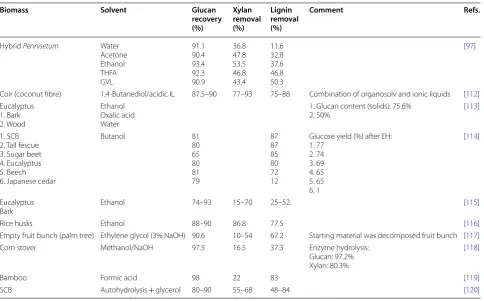
A selection of various biomass materials, which have been pretreated utilising different organosolv-like pre-treatment methods, is presented in Table 4. The number of organic solvents, which have been utilised in the orga-nosolv process, is very large; therefore, only some of the typical solvents, as well as some more recently investi-gated solvents are included.
Table 4 A selection of organosolv methods utilised for pretreatment of lignocellulosic materials
Biomass Solvent Glucan
recovery (%)
Xylan removal (%)
Lignin removal (%)
Comment Refs.
Hybrid Pennisetum Water Acetone Ethanol THFA GVL
91.1 90.4 93.4 92.3 90.9
36.8 47.8 53.5 46.8 43.4
11.6 32.8 37.6 46.8 50.3
[97]
Coir (coconut fibre) 1,4-Butanediol/acidic IL 87.5–90 77–93 75–88 Combination of organosolv and ionic liquids [112] Eucalyptus
1. Bark 2. Wood
Ethanol Oxalic acid Water
1. Glucan content (solids): 75.6%
2. 50% [113]
1. SCB 2. Tall fescue 3. Sugar beet 4. Eucalyptus 5. Beech 6. Japanese cedar
Butanol 81
80 65 80 81 79
87 87 85 80 72 12
Glucose yield (%) after EH: 1. 77
2. 74 3. 69 4. 65 5. 65 6. 1
[114]
Eucalyptus
Bark Ethanol 74–93 15–70 25–52 [115]
Rice husks Ethanol 88–90 86.8 77.5 [116]
Empty fruit bunch (palm tree) Ethylene glycol (3% NaOH) 90.6 10–54 67.2 Starting material was decomposed fruit bunch [117]
Corn stover Methanol/NaOH 97.5 16.5 37.3 Enzyme hydrolysis:
Glucan: 97.2% Xylan: 80.3%
[118]
Bamboo Formic acid 98 22 83 [119]
Ionic liquids
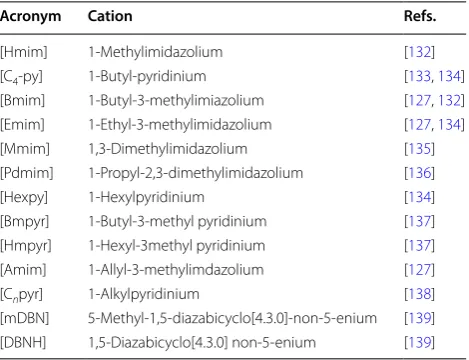
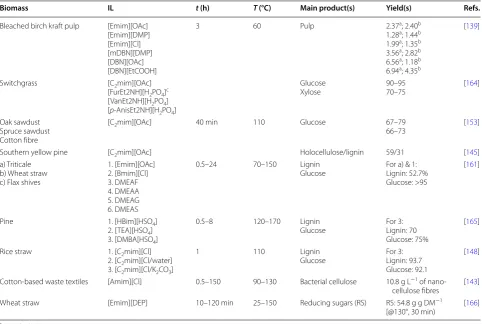
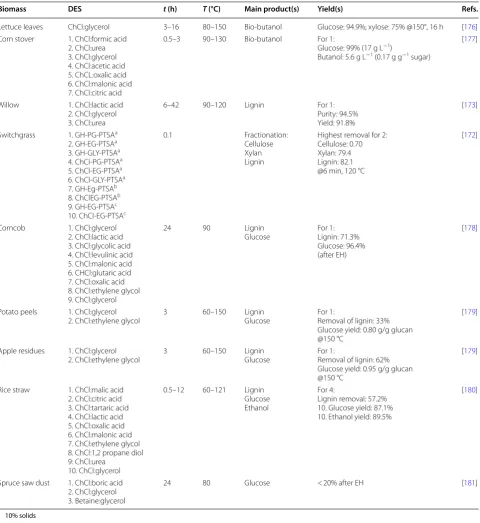
Efficient pretreatment and fractionation methods for production of value-added products heavily relies on the availability of efficient and not too expensive processes. It is also imperative that the products can be recovered at a high yield using common separation and recovery equip-ment. The potential candidates for commercialisation must be safe from health and environmental perspec-tives. A particular interesting group of chemicals is the ionic liquids. Ionic liquids are salts that consist of an inor-ganic anion and an orinor-ganic cation [121–123]. The cations are typically composed of organic cores, e.g. imidazo-lium, phosphonium, pyrrolidinium, cholinium and many more [123]. The combination of a large organic cation, in which the positive part is either sterically hindered or shielded, and a smaller inorganic cation, causes the salts to prefer the liquid state in many systems. ILs are usually divided into two classes, i.e. protic and aprotic ILs [124]. The seed for a virtual explosion in the number of ionic liquids was the discovery of the 1-ethyl-3-methylimida-zolium cation [EtMeim] in 1982 [125, 126]. A drawback at the time was the requirement to avoid moisture enter-ing the IL system. The development has been rapid since and more and more combinations of salts are utilised for very different purposes, such as man-made cellulosic fibres [127] and for extraction of lignin from biomass [128]. The combination of cations and anions making up ionic liquids are almost endless [127]. The possibility to make combinations of various cations and anions is an advantage, since the properties of the IL may change depending on the selected combination, which opens up for fine-tuning of the pretreatment process. Table 5 pre-sents a summary of various combinations of ionic liquids. The acronyms are not always the same in different pub-lications. As mentioned earlier, the number of potential ILs are very large; therefore, only some commonly uti-lised ILs are presented. The ILs have been referred to by a number of notations: Room-temperature ionic liquid, non-aqueous ionic liquid, molten salt, liquid organic salt, and fused salt have all been used to describe salts in the liquid phase [129]. They are non-volatile, non-flammable and have high chemical and thermal stability. Room-tem-perature ionic liquids (RTILs) are of special interest since they can be used at low temperatures (below 100 °C) [129–131].
Ionic liquids have a potentially wide field of applications for biomass processing. A number of areas have been identified, such as fractionation, conversion into chemi-cals, dissolution and hydrolysis. Some hurdles are yet to overcome to make ILs entering in large-scale processes [140, 141]. The separation and recovery of the IL from a mixture of carbohydrates, lignin and proteins can result in challenges for large-scale biorefineries [135, 142]. The
individual lignocellulosic components, such as cellulose, can be recovered by addition of an anti-solvent, e.g. water [143, 144], acetone [145] or ethanol [146] by, for example precipitation. The ILs are usually quite costly (c.f. DESs in the next section) to produce, and the viscosity is high, which makes pumping and mixing quite energy consum-ing. Another issue is their sensitivity to moisture and the recovery cost, which can be very high. Zhou et al. have evaluated, in a very comprehensive review, a number of recovery options, such as distillation, extraction, adsorp-tion, membrane separation (including pervaporation and membrane distillation), etc. [147]. Distillation has often been suggested as the main unit operation to be used for recovery of the ILs. However, the energy cost asso-ciated with distillation is rather high, which may impair the overall feasibility of a large-scale process [147, 148]. Lynam et al. [146] employed direct-contact membrane distillation (DCMD) at low temperatures and ambient pressure (in contrast to pervaporation methods, where lower pressures are used), which was successfully used to separate water from [C2mim][O2CH] and [C2mim] [OAc]. The resulting IL–water mixture must be separated prior to IL recycling because water inhibits IL–biomass pretreatment.
The utilisation of ILs has attracted interest regard-ing their potential effect on environment and health consequences. Gathergood et al. [149] investigated the biodegradability of commonly used ILs. They designed and evaluated ILs containing ester or amide groups in the alkyl side chain. They found that ILs with an ester in a sidechain were generally liquids at room tempera-ture. The [Bmim]-derived ILs were found to have poor or negligible biodegradability. However, if an ester was incorporated in a side chain, the biodegradability
Table 5 A selection of cations commonly used for ionic liquids
Acronym Cation Refs.
[Hmim] 1-Methylimidazolium [132]
[C4-py] 1-Butyl-pyridinium [133, 134]
[Bmim] 1-Butyl-3-methylimiazolium [127, 132] [Emim] 1-Ethyl-3-methylimidazolium [127, 134]
[Mmim] 1,3-Dimethylimidazolium [135]
[Pdmim] 1-Propyl-2,3-dimethylimidazolium [136]
[Hexpy] 1-Hexylpyridinium [134]
[Bmpyr] 1-Butyl-3-methyl pyridinium [137]
[Hmpyr] 1-Hexyl-3methyl pyridinium [137]
[Amim] 1-Allyl-3-methylimdazolium [127]
[Cnpyr] 1-Alkylpyridinium [138]