Vol. 10, No. 1 (2019)
http://www.eludamos.org
The Development of Decision Support Systems in the 1960s as Antecedent of “AI-Rationality”
Rolf F. Nohr
Eludamos Vol. 10, No. 1 (2019) pp. 75–90
Copyright © by Rolf F. Nohr
the 1960s as Antecedent of “AI-Rationality”
ROLF F. NOHR
“Games are media of decision.” (Wiemer 2016, p.23)
“…management of a corporation is a chain of alternate decisions, a sequence of selections.” (Gutenberg 1961, p.111; own translation)
If one asks about the connection between AI and games, the concept of decision
seems an apt focal point for reflecting on this relationship (at least from a historical or genealogical perspective). In fact, decision making may be regarded as the central element of the gaming process.
The decision making process in a given game is usually organized in binary form and oriented toward a final and finite set of goals. This determinative action shapes the game on both formal and ludological levels. At the same time, however, the computer (or better, the algorithm) is also a decision making machine: the deeply logical calculus of the code and the program do not seem to know any 'perhaps'—the system works (literally) according to the logic of 'or', which represents one of the central elements of digital computing. The decision rationality of computers (at the heart of computer games) is characterized by simplification, reduction, symbolic coding, and also by a dynamic of action and reaction (in the sense of decision and consequence). Such observations about the consequential logic of game-based AI inevitably lead to one grand question: Who is the primary decision maker in games— the player or the machine?
Current (popular) discussions about artificial intelligence are renewing a range of theoretical possibilities, conditions and functionalities of future systems, and at the heart of many of these discussions is the concept of decision making. AI systems now decide which face is linked to which identity, what the correct price should be for the same asset delivered by different customers, and many other complex decision points. The most famous (and misleading) example of AI-based decision making is whether or not an autonomous car will drive over a pensioner or a child in the event of an unavoidable accident.1 The decision making concept within digital culture culminates in the (discursive) object of AI. However, the core of decision making (in the game as well as in the computer) can best be understood in a broader sense as a media technology and media praxeology that is closely intertwined with certain operationalities and—above all—rationalities of digital culture. Notably, this media constellation has preconditions that were negotiated at the beginning of computer culture.
this sense, my aim in this essay is to describe a historical, discursive scene that is decisive for a particular strand of AI history, one that is closely linked to the emergence of a specific connection between games and simulation. Developments in the 1960s and 1970s—especially those encompassing decision support systems, operations research, and computer science—appear significant insofar as these innovations were closely related to a specific concept of playfulness. Consequently, the decision support systems (e.g., way finding, NPC interactions) in use today need to be analyzed within a critical framework that accommodates and accounts for the determinative mechanics of the early computer industry. Moreover, it is important to acknowledge that whenever we speak about ‘computer science,’ we are always also talking about a techno-scientific discipline and its attendant epistemologies. This remarkable (and remarkably durable) amalgamation materialized primarily through the rise of the business simulation game. This very specific, model-based game type was developed at the same time—and in many instances, in the same labs as—their close technical software siblings known as Decision Support Systems.
Business Simulation Games
Business simulations became popular after the end of the Second World War in the context of a general change in social control logics. One of the first (more or less) civil simulations was presented by the the American Management Association in 1956 (Ricciardi et al. 1957). At the intersection of corporate management, human resources management, and changing economic paradigms, a specific type of rationality infused the market economy and materialized in the advent of business simulation games. These games were primarily used for training and corporate education, and from the 1950s to the 1970s, these 'serious games' became important playing fields (or testing grounds) for the practice of managerial action control, knowledge transformation, and C-suite adaptation to a new medium (i.e., the computer).
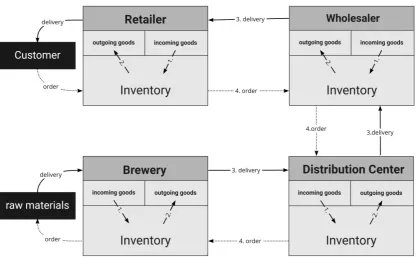
Excursus: Jay Forresters Beer Game
Fig 1: Schematic representation of the Beer Game
The development of strategic economic games for training and further education is deeply intertwined with the advent of the computer into society, but above all to corporate culture. Thus, the establishment of a post-war economic order involves not only a question of changed economic paradigms or global market structures, but also links to the question of how the subject can be coupled to this new order. The topic of education and training became decisive in this emergent process, and it was here that the corporate simulation shed its military roots and developed along a more ludic path. As a result of this transition, simulation games became a recognized and accepted milieu for the playful practice of new rationalities. At the same time, the emergence of computer culture represented another specific and overlapping order of rationality that flowed into these training situations. In the remainder of this essay, my focus will be on an interrogation of the amalgamation of different rationalities and forms of government at this specific intersection.2 I will also address the problem of how these socio-corporate transformations came to alter the subject of the decision making process itself, constructing out of business games a process through which the playing and deciding subject becomes an agent or ‘switching element’ for may be called a supraindividual decision algorithm.
Importantly, such simulation games are not conceivable without an extended context. They are, in fact, materializations of an order of rationality that manifested itself not only in the (sometimes rather marginal) simulation and business games that are the subject of this essay, but also in earlier, more general simulation projects. In the next section I briefly sketch how, on the one hand, the mathematization and scientification of corporate management, and on the other hand, how the possibilities offered by computers led to the creation of a specific proposition that described how human action can be reproduced and predicted (in the sense of its simulatability); such concerns are as relevant today as they were in the 1960s. This focus on the intersection of simulation projects and game applications is motivated by the fact that within the initiation of the game process (i.e., game play), the subject appears at first to be called/hailed into existence. This phenomenon and its decision-based mechanisms also warrants examination.
Decision Systems and Training Units
The computerization of economics was organized in the USA primarily in the field of military logistics and operations research. Methods of logistics modelling and simulation not only signaled the growth of an important intersection between the military and economic use of simulation games, but also the expanding role of computers in the mathematical processing required by such methods. The RAND Corporation was an essential actor and central institutional node in this area of computerization.3
Institute and the Urban Institute, RAND marks the center of a network of think tanks, which after end of the Second World War worked on the legitimization and implementation of 'external' policy-making in the US—that is, policy-making outside the federal government itself. In this context, the RAND Corporation focuses on defense research and political consulting, but has also done considerable work on operations research, experimental gaming, mathematical game theory and—above all—simulation technology.
The Logistics Systems Laboratory (LSL), a 1956 RAND spin-off (Haythorn 1961), deserves considerable attention in an examination of the latter. The LSL used simulation techniques, for instance, to development and implement military training simulations, especially around logistical challenges involving communication and control systems (Geisler 1959, p.360). Moreover, the LSL did pioneering work developing economic decision processes and systems that could assist both military and civilian personnel in the increasingly complex decision making processes they were facing.4 Psychological and mathematical problem-solving strategies were used, for instance, to optimize and rationalize the speed and implementation of a wide range of US decision making systems.5 Training procedures specifically for military decision makers were also developed in the LSL, including the methodical investigation of the 'subjective factor' in decision making processes:
In 1956, the RAND Logistic Department began using the expertise and simulation techniques of the RAND experimental psychologists. As Murray Geisler[6] noted after several years of game simulations, ‘putting people into the simulation helps to ensure the completeness, compatibility and workability of the model being constructed. People thus provide quality control, feedback, and learning qualities which are most helpful and economically desirable in dealing with very large and complex models’” (Klein 2015, p.12).7
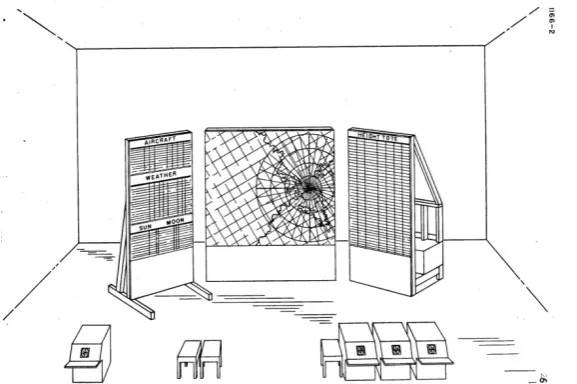
For the LSL, this unique perspective was possible thanks to another RAND spin-off, namely the Systems Research Laboratory (SRL). From 1951 to 1956, the SRL investigated the modelling of subjective decision making strategies with strong focus on human psychology. The SRL relied heavily on the use of simulation games and role-playing: "...the Systems Research Laboratory will be studying particular kinds of models—models made of metal, flesh and blood. Many of the messy and illusive variables of human and hardware interactions will be put into the laboratory" (Chapman 1952, 1).8
airspace. SAGE remains a milestone in the history of computing, and required countless collaborations and start-ups, one of the most important of which was yet another RAND spin-off known as the System Development Corporation (SDC). This company was responsible for the SAGE program’s development of all necessary computer software, as well as for the numerous decision programs, training scenarios, automated learning environments, and routine operator tests required to keep this massive computer-aided decision system running (Baum 1981, 31ff).
Of RAND’s many spin-offs, the SDC became the best known. Founded in 1955 as a system development group specifically for the capacious needs of the SAGE air defense system, SDC quickly developed into the “first computer software company in the world” (cf. Baum 1981, p.40ff).9 In 1957, SDC was spun-off from RAND as a non-profit organization.10 By 1969, however, it had been transformed into a fully operational commercial enterprise providing services not only to the American military but also to the civilian public sector(ibid. 139ff).11 The example of the SDC demonstrates well how a specific system of training and human-machine hybridization developed at the intersection of simulation, game theory, computerization, and training could be readily deployed to adapt human subjects to machine-supported action, and thus become literally 'embodied' in emerging decision support systems.
The efforts of the computer industry, government and corporate think tanks, and software and hardware developers were, by the 1960s, increasingly concentrating their efforts on research areas related to systematization and partial automation of decision making processes—if only to see what was experimentally possible, calculable, and manageable. The training and planning simulations of this time mainly simulated decision actions, which were meant to optimize and rationalize time-sensitive and mission-critical decision processes. All these efforts were undertaken under the central mission to make the 'human factor' better understood and thus controllable and ultimately replaceable (i.e., reduce the ‘human factor’ to a calculable 'switching element' that could be driven by machine algorithms). Donald G. Malcolm, who was significantly entrusted with the development of the management information system (MIS) project at the SDC from 1959, pointed out:
Human factors specialists develop the most appropriate man-machine relationships; data processing experts develop computer programs; and operations research and management specialists aid in the analysis and optimization of the systems. The approach SDC has taken in SAGE (Semi-Automatic Ground Environment) and the other large-scale computer based military control systems under development appears to be useful in solving management information and control problems. This appears to be especially true in the area of management controls […]: the evolution of appropriate management controls in this electronic age (in Malcolm and Rowe (ed.) 1963, pp. vii f).
could also be used to support financial, process, and general decision making in corporate contexts (cf., Pfeffer, Fogler, and Deeley 1971).
The proximity between business simulation research and the projects on decision support is clearly discernable in an early internal self-description of one of the SDC’s systems: "This computer simulation modeled many aspects of a business system— the personnel, the resources, the transactions—and obtained informative results in response to the experimenters’ inputs of varying schedules, numeric values and decisions" (Baum 1981, p.60). Two other MIS definitions of the 1970s make the increasingly co-operative systemization of machine, organizational, and human work even more striking:
A management information system is an organized method of providing past, present, and projection information relating to internal operations and external intelligence. It supports the planning, control, and operational functions of an organization by furnishing uniform information in the proper time-frame to assist the decision making process […] (Kennevan 1970, p.11).
An integrated, man/machine system for providing information to support decision-making functions in an organization. The system utilizes computer hardware and software, manual procedures, management and decision models, and a data base […] (Davis 1974, p.5).
Given these nascent understandings about the emerging field of MIS and cybernetics (to use Norbert Wiener’s comparable term), it is no surprise that the SDC was early on establishing itself as a provider of successful commercial offerings (material and consultative) that were at the intersection of business simulation and MIS systems. By participating in the US military’s various command and control systems (e.g., the SAGE program), the SDC had set a focus on the programming of systems which dealt with organizational and managerial problems and tended towards a latent universality in its claim to validity (Rowan 1958).12 At the same time, these decision
making systems also developed in a broader context. For example, the Jay Forrester Project of System Dynamics (1961)—an important influence on operations research more broadly—aimed at a systematic analysis (and simulatability) of managerial decision making processes. Likewise, discussions about automation processes and especially the cybernetic approaches of researchers like Norbert Wiener and Stafford Beer, had a lasting impact on the ideas of MIS developers. As Dickson notes, the "early views of MIS and organizations consisted of viewing the management process as a cybernetic control system within the organization, relying heavily upon the computer as the control mechanism" (1981, 6).
this expectation (i.e., that the messy and subjective work of military-industrial decision making could be digitally granulized into an objective and logical decision problem) that introduced the idea of the “game” into the field’s emerging professional discourse. Understandably so; the affinity between “games”—here understood as scenarios of symbolic space wherein all action is free of meaningful consequence— and the abstracted arena of military-industrial decision making (e.g., a vast theater of war involving military airspace surveillance), was tremendously appealing to high-level commanders of the military and the global economy alike. The manager responsible for logistics, process planning, or market forecasting now assisted the SAGE radar officer, and both went through playful exercise scenarios to prepare them for the seriousness of everyday life. And though military and corporate objectives differed in how the utility of these emerging tools was framed—five-star generals wanted to optimize command decision chains by eliminating subjective factors while C-suite executives sought to optimize their production decision chains— the potential of automation in both contexts, driven by newly available mainframe computers, augured a revolution in resource management. The structuring principle of automatization (and, consequently, rationalization) thus migrated from the field of physical labor (in the sense of Taylor or Gilbreth), to intellectual activities such as decision making.
Decision Support Systems
Parallel to the rather operational considerations of MIS—designed, as already noted, primarily to serve in a military-industrial context—there were also fairly contemporary projects that were more open, more dedicated to the basic possibilities or epistemologies of decision support or automation. Discussions about so-called
Decision Support System (DSS) fall into this category. The constellation of the DSS can be found not only in Herbert Simons and Allen Newell's General Problem Solver
(GPS)13, but also in the work of researchers like Doug Engelbart, one of the pioneers of the personal computer.14 In 1968, for instance, Engelbart proposed a "hyper collaborative knowledge environment system called NLS (for oNLine System)" (Engelbart and English 1968).15 The core functionality of the NLS was conceptualized as data driven decision making. Although the NLS initially was envisioned as an online conference and knowledge organization system (ideas drawn from Vannevar Bush’s 1945 Memex proposal16), Engelbart clearly also envisioned the NLS as a real-time decision making system (Engelbart 1962).17
In the literature of this time, it is fascinating to observe how various central and marginal stakeholders euphorically took up the banner of programmed decision making (c.f., Haigh 2007, 59).18 The work of Stafford Beer endures as a highlight of this emerging epistemology. As a cyberneticist, Beer penned canonical books like
Cybernetics and Management (1959), as well as developed projects like Cybersyn
(Pias 2005) to control a “central administrative economy in real time” during the government of Salvador Allende (1970-1973) in Chile.
SDC) were interest in winning wars and making money. But as this epistemology spread through industrialized societies, a discursive shift began to occur in many tangential “spaces of action,” a shift characterized by a hybridization of military, economic, pedagogical, and psychological operationalization designed to amalgamate and naturalize the computerization of human decision making. The SDC and the RAND Corporation, alongside all manner of operations research, cybernetics, and mathematical game theory projects, can all be understood as individually and collectively contributing to the rise of a widespread and widely admired epistemology determined by the core idea of an objective control rationality. This epistemology articulated in countless ways the human, social, economic, and even cultural value to be gleaned from the transformation of contingency and reactivity (i.e., subjectivity) into calculable processes that, while not foolproof, purported to lever probability toward any desired end. This is how organizations like the SDC and the RAND Corporation went from being involved almost exclusively in military matters to exploring a wide range of economic, psychological, sociological, and civil projects and applications of MIS. Indeed, both the SDC and RAND, for example, were well represented at the 1958 National Symposium on Management Games, one of the central events at which the differentiation of business simulation games was promoted and sustainably pursued.
Central to this developing opportunity for transdisciplinary collaboration in the early days of computing is the idea of a computer-based DSS, in large part because it had proven to be an effective bundler of significantly different discursive constellations. The process of decision making at that time was increasingly being understood as essential to any future change-strategy, regardless of knowledge domain. Conceptually (and ultimately, materially), such automatic systems relied on a specific understanding of technology (i.e., it’s capacity to usefully ‘de-subjectify’ decision processes) and on a specific rationality (i.e., an underlying logic that valued the algorithmic transformation of a subjective process). These utopian ideas at the heart of DSS ultimately constructed a specific concept of decidability that saw the previously accepted chaos of potential futures faced by any organization (military or commercial) transformed into a relatively uniform, predictable, and manageable plan.
Subject, Game, Decision
As implied above, two different decision making strategies came into conflict in the early computing era, mainly due to how they conceptualized the role of subjectivity: one could either support the autonomy of the subject in decision making or aim to eliminate the subject out of the process altogether. In this context, Niemiec and Walberg (1989, 296ff) distinguish between "computer-managed instruction (CMI)" and "computer-assisted instruction (CAI)":
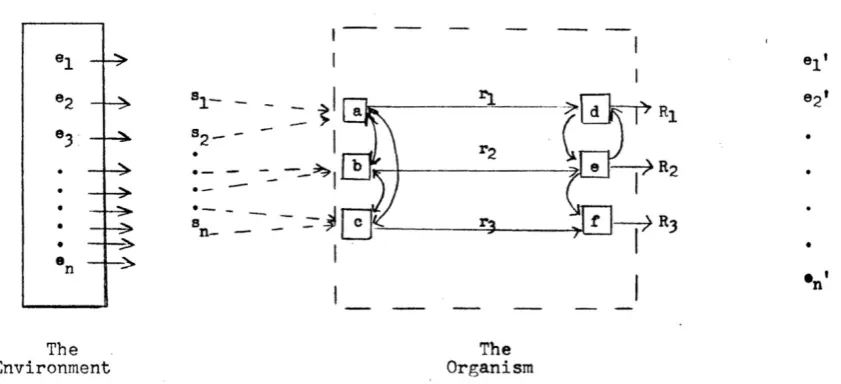
What Niemiec and Walbert suggest here is that the more managerially shaped CMI suspended the subject and off-loaded the concept of learning (including, at a later phase of CMI’s development, the sub-concept of decision making itself)—onto the computer, while the CAI perspective was constituted as a support system, an algorithmic information resource placed alongside the decision making subject. 19 As industry tensions rose about CMI versus CAI as the optimal future for management information systems, a more functional-operational oriented sector of the computer application industry had become focused on the human-machine interface. In the wider context of the RAND Corporation, it was the Systems Research Lab that became most attached to the CMI approach. As efforts at the SRL were concentrated on preparing and optimizing the training of SAGE personnel, it became increasingly clear how strongly the (deciding) subject was determined to be a disruptive factor in the process, a variable that needed excluding. In an initial series of experiments, the SRL tried to isolate decision situations along with the specific subjective parameters (i.e., operator attitudes and behaviors) impacting the efficiency of the SAGE airspace surveillance system. In a second series of experiments, as per standard research protocol, it should have been possible subsequently to conceptualize the deciding subjects as kind of black box, that is, as an admittedly complicated yet consistent 'stimulus-response mechanism' (Fig. 2). By repeatedly testing, analyzing, and describing the outputs of this human operator-cum-black box, it should be possible, proposed the SRL researchers to fully develop and automate a more effective decision system simulation—sans subjective operator—in the future (Chapman 1952). For decades, efforts to advance this project failed, and it wasn’t until the 21st Century’s second decade that rebooted discussions about automatic decision making began to reimagine the problem and usher in a new era of artificial intelligence and machine learning research.
Fig. 3: Schematic Diagram of the environment, the Stimulus, the Organism and its Response.” (Chapman 1952, p.14).
To understand how it is that so wrong-headed a research trajectory was able to secure such organizational devotion (e.g., numerous federal research programs, public and private financial investment, etc.), it is necessary to recognize the Decision Support System for what it was at a large-scale discursive level: a dominant technical and cultural constellation that not only conceptualized a specific intellection of decision making, but also worked to reify that intellection through sustained social promotion of the positive idea of computer as object (i.e., not tainted by subjectivity). Myriad projects were formed around this basic idea, many of which involved research into technologically supported decision processes. By the mid-1970s, decision process research culminated in the concept of DSS and gave a major (if ultimately spurious) boost of credibility to the transformative power of business simulation games.
So how did these early in-roads into computer-based decision making impact today’s understandings? To answer that question first requires two other questions to be addressed: (1) What were the paradigms used to theorize early computer history’s concept of “decision,” and (2) How were these paradigms determined to be suitable for projects such as the SAGE System? Investigating these two questions reveals the pre-history of another game concept, one that had early on become one of the key reference systems of decision research: John von Neumann and Oskar Morgenstern’s (1944) mathematical game theory.
Experimental Decision Research: Game Theory
mainframe computers (e.g., those of Burroughs and IBM), the fate of the decision making subject in corporate and process research was sealed: mathematical game theory and its implementation in operation research resolved (in their way) some of the most vexing problems of decision system design by, in a nutshell, conceptualizing the subject as a manipulable variable (cf., Stussig 1968, p.3; Emshoff and Sisson 1972, p.19-20).
From this perspective, the influence of mathematical game theory can be understood to be a project for systematizing the specifics of subjective action. A kind of strategic action—in the form of an effective, logically legitimized decision—was conceptualized as an ideal deliberative outcome. Within a decade, however, much of the optimism that had buoyed this once-dominant strand of decision research had dissipated. Martin Shubiks, one of the most important protagonists of 1970s operations research, recognized in retrospect that their concept of the “rational decision-maker” was merely a paradigmatic setting of mathematical game theory:
The rational decision-maker model of the human is at best a poor first-order approximation of a far more complex, intelligent creature who is able to make decisions with highly aggregated information in a limited time and with capacity constraints on calculation. (Shubik 1994, p.256)
Such self-critical reflection remained an exception well into the second half of the 20th century. In fact, in the majority of cases, mathematical game theory continued to be used to simplify complex operational DSS projects, implemented in business games to help executives practice their decision making skills, and studied for other practical applications to which it might be put to use. In most cases, its central concept was the 'programmed decision space,' which was based on mathematical and quantifying models. The goal of such models was the description of a formally describable process consisting of a series of linear and mostly binary marginal decisions. Success was defined as a chain of correct decisions—the "one best way" of Gilbrethian work science.
Fundamental to this particular way of thinking about the decision making process is seeing it as a chain of formal operations that have 'consequences'. Importantly, many decision making projects underway at this time did not cleave to this paradigm in the same way. Some projects (e.g. the SAGE project at the SRL), for instance, focused more on the process of decision implementation and much less on the process of
decision making or goal setting. Given its rejection of availabile alternative approaches, then, it seems clear that the DSS—especially through the training scenarios embedded in their business simulations—was far less interested in designing what today might be called “educational games,” and was instead pushing toward simulation environments designed to enervate the subject and thus advance a specific decision making rationality.
understood here as the rule-guided, algorithmic processing of procedural steps.) From this perspective, an optimal win condition is one in which the subject is dissolved. Using the example of the prisoner’s dilemma (developed, incidentally, by RAND researchers Merrill Flood and Melvin Dresher) and its manifold variants within mathematical game theory, Wiemer shows how energetically the elimination of the deciding subject was being pursued in favor of a much more heavily processual model. Moreover, Wiemer demonstrates how the decision rationality of (evolutionary) game theory actually comes to characterize “reasonable action” as irrational.
The rational choice concept operative here is based on the assumption that the subject acts rationally in principle, i.e., always makes a choice that corresponds to his or her own preferences when different options are available. These preferences result from various parameters and can only be relevant for decision making if they are known, stable and transitive (Milgrom and Levin 2004, 4f). Thus, the rational choice approach is not per se inscribed with a “benefit approach,” as mathematical game theory or the concept of homo oeconomicus emphasize. Rather, the rational choice approach initially emphasizes only a single subject’s formal preferences and then creates orders of preference for that subject. In an intersubjective decision making context (i.e., multiple interdependent subjects making decisions), however, multiple decision rationalities emerge out of (1) each subject's frame of reference, and (2) the composite decision making scenario; orders of preference follow from all subjects, individually and combined. Thus, in a problem like the prisoner’s dilemma, the optimal decision (from the perspective of mathematical game theory) is the one that is subjectively irrational: both prisoners must decide to choose a less preferable option in hopes that the other prisoner will do the same. In such scenarios where there are discreet but intersubjective decisions to be made, DSS optimizes for the system, not the subject, the overall problem, not the individual prisoners. In this way, common sense—“protect myself”—becomes irrational.
This example helps illustrate some of the shifting approaches to decidability and the order of knowledge. Mathematical game theory is first and foremost a specialized abstracting procedure with little capacity to account for actual human action in the moment or even to generate operative instructions for action at a later time. Yet when developers began to integrate this type of rationality into their systems, they simultaneously embedded what could reasonably be called an anti-common sense game mechanic. This was the discourse in which business gaming stakeholders began to operate—and one can see why. By capitalizing on the military-industrial and even public exuberance about scientific-mathematical rationality, business games developers had much to gain in terms of prestige and trust, not to mention distribution and sales. On the other hand, the integration of mathematical game theory also forced developers to struggle with a concept of real action—again, a severe limitation within the context of mathematical game theory—which was effectively hobbled by their products’ main selling point (i.e., DSS). Paradoxically, the more scientific business games became, the less effective they were at doing what they were meant to do: teach effective decision making in real-world contexts. Again, Martin Shubik expresses the problem well:
Unfortunately, it has been mistaken by many as “the game theorist's solution to social problems.” (Shubik 1975, p.VIII)
The varying approaches to decision making as they developed at RAND and elsewhere (and routinely focused on the prisoner’s dilemma) raises a further question, one related to the assumptions of economic theory. Here, too, there were debates about how to understand what constituted a “rational choice.” Was it rational if it was reasonably justifiable? Strategic and/or profitable (and if so, for whom)? As with game management theory-based DSS, decision making under certain economic models can also render the most preferable choice completely irrational in the eyes of the subject. Here again, a human subject's preferences may or may not bear any relation to those of a statistically modeled “subject.” This begs the question: does the concept of reason and/or rationality still apply if one assesses decisions not as acts of an real individual but as supraindividual, statistical acts the way that evolutionary mathematical game theorists like Axelrod (1984) and others propose? Wiemer says
While in classical game theory every decision is qualified as a rational decision only by reference to the 'player' as the calculating decision subject, in evolutionary game theory an ecological-evolutionary concept of population is used, which basically progresses without the need for individuals to argue. Instead of a decision emerging as an action of conscious rational individuals, evolutionary game theory proposes a relative distribution of multiplicities, which are understood as the equilibrium of successfully evolving strategies or as behavioral dispositions in a dynamically changing milieu. This represents a change of protagonists on the historical stage of decision making: the figure of the individual as the starting point of freedom of choice and reason is overshadowed by competing concepts of multiplicities (populations), techno-biological simulations, and algorithms as representations of post-sovereign actors" (Wiemer 2016, 25, own translation).
It is thus no coincidence that this form of economic theory—then one of the most important 'users' of mathematical game theory—experienced project challenges similar to DSS thanks to the new approach offered by evolutionary game theory.20
The focus of this article, however, is not a critical discussion of mid-century economic theory, but rather on how the development of various “decision making” techniques came to throw a decades-long discursive shadow over the approaches of being developed in other research quarters, a shadow that continues to haunt AI-based decision systems research and application development—including business games—to this day.
a consequence of this epistemological difference in approaches to decision making, a discursive schism developed during the early 1970s.
In one camp, the recognized complexity—even contradictoriness—of the theoretical concept of decision rationality led to a pragmatization of simulation games, effectively dissociating this branch of application development from the DSS systems that had catalyzed it. Here, the concept of “decision” was allowed to retain a strongly individual subjectivity, even though it might be rendered in a game scenario as a stripped down version of a “real” organizational problem. According to this logic, business games were meant to be training tools for the subject to learn, develop, and test new decision skills, skills that were viewed by developers to be directly tied back to actively acquired experiences in the workplace. Such a pro-subject rationality could only take the scientific-mathematical intricacies of an algorithmic world view so far.
On the other hand, while operational and functional decision support through de-individualized, completely algorithmic, programmed, or statistically embedded decision systems tended to fail miserably in pragmatic applications, it had the advantage of being reliable and predictable—as long as the inputs didn’t vary much. Consequently, systems based on this rationality had a clear appearance as being the 'better' variant where planning and control were deemed key outcomes. Projects built accordingly—with their very specific decision rationalities—formed the foundation for early AI research and became the antecedents of today’s AI rationality.
Unsubjectified Decision Support Systems
After about 1980, AI research saltated erratically, driven by researchers’ conviction that the secret to understanding decision optimization laid restricting the decision problem to a specific context. This approach required a particular logic: decision making had to be divided into (1) a supraindividual process of distinct steps, and (2) various individual, litigable tasks that could be algorithmized. The resulting rationality of this seemingly hybrid approach to decision making posits a predictability of action
and thinking. Yet with a moment’s reflection, it is clear that this model, too, depends on routine calculation and the processing of known variables to determine a decision set comprised of “right action alternatives” for the system, not the subject. Still, because this next generation decision model offers a (superficial) accommodation of a handful subjective variables, it is heralded for its maturity and complexity and kicks off what Galloway eventually terms “algorithmic culture” (Galloway 2006).
Here again, the game enters the space of control, but in a new guise: games (and their serpentine configurations and decision prompts) now fetishize the mode of control. This takes place not only in game scenarios themselves, but also through the logic of information processing within which they exist (Galloway 2006, p.102). The core of the simulation game, for instance, is no longer the unfolding structure of a controllable future or a functioning enterprise, which is secured by a chain of (individually) correct or successful decisions; rather it is the work of the subject “playing” the algorithm of the game, the continuous attempt to understand the game’s algorithms in order to operate them correctly and “win.” For Galloway, this is still CMI rather than CAI, the work of a subject trying to learn and obey the logic of a decision tree, be it in Civilization (MicroProse 1991) or Age of Empires (Ensemble 1997). In fairness, the advanced business games of the late 1970s could be invoked here, which as already noted were built around a supraindividual concept of decision making. They were, in other words, “games” in name alone. They were, in fact,
simulation spaces created for the statistical, mathematical, and prognostic calculation (and thus closure) of futures. These were the projects that tried to represent aspects of the world and its future in calculable ways; along the way, they also contributed significantly to the generation of a teleology built around the transformative power of the algorithm. The world model of Jay Forrester and its use for Club of Rome projects is an (ambivalent) example of such an approach, as are attempts by the likes of Stafford Beers (e.g., Cyberdyn) and the Brookings Institute to simulate and control national economies.21
In such cases, decisions are conceived of as actions subtly but strictly detached from subjects. The bitter irony of these systems is that while they did incorporate players, as subjects they were functionally used as random generators to compensate for the weakness of computers to generate “real coincidences” (see Koller 1969, pp. 80f.). The effect on players was profound. Connected to the logic and rationality of a de-subjectified decision making system, player-subjects were forced to acknowledge the system’s particular economic and control rationality if they were to have any hope of achieving success (i.e., a win). In “games” such as these, in other words, the system being optimized is the not workflow toward an organically-derived solution set; it is the player-subject. And as ever more permutations of free (i.e., subject-eliminating) decision making algorithms are integrated into ever more complex rationalities, the algorithmic culture that emerges provides a veil to obscure the fact that at the heart of such systems is a decision science designed to work beyond the subject and operating through a superordinate logic of success.
Conclusion: George, or: the Birth of an ’AI-Rationality’
“place” of the decision. Such systems, while usually still terminologically marked as “assistants” for “decision preparation” or “decision support,” work epistemologically to withdraw the act of decision from the subject. Today’s DSS and MIS systems, that is, continue to be marked by a rationality that aims to "shift from the chooser to the choice" (Heyck 2012, 104). These same systems are also symptomatic of the ongoing mathematization of management science (in particular) and of decision rationality in general (cf. Locke, 1989).
In a certain sense, business simulations can be read as “support systems,” systems that allegedly assist the subject by limiting, for instance, the choice among many possibilities or orders of complexity. But they also assist player-subjects to situate themselves in a specific order of rationality designed to severely limit the scope of decision processing.
History suggests that even decision research itself will continue to suffer self-induced vitiations. In his book Design for Decision, Irwing Bross (1953) sketches a rigid, mechanistic, ultimately formal-logical image of decision making practice when he outlines the concept of the autonomous, desubjectified "decision maker":
A Decision-Maker is considered to be a machine. Into the machine flows information; out of the machine comes a recommended course of action. The mechanism consists of three basic components. The Prediction System deals with alternative futures. The Value System handles the various conflicting purposes. The Criterion integrates the other two components and selects an appropriate action. It is emphasized that the pragmatic principle is basic for the construction and comparison of Decision-Makers (ibid. p.32).
The decision making process described here is described as a strictly statistical process. Moreover, Bross later argues that his “Decision Maker” is equally at home in the science lab, the corporate board room, the small business, and the kitchen table. No decision is too large or small to be made on the basis of supraindividual, statistical decision variables (p. 255ff.). Indeed, in the final chapter of his book, Bross proposes a future machine called “George”—a statistically based decision support system—which he ultimately regards as problematical for only one reason:
George's evolutionary cousins (the steam engine, the mechanical ditch digger, the punched-card computers, the servo-mechanisms) have sometimes produced technological unemployment in various occupational groups in the human population. If, as I have maintained, man is a decision-making animal and this is man's main claim to distinction, then George (who can make better decisions than any man) threatens to produce technological unemployment on a grand scale. Quite painlessly no doubt (which makes matters worse), George can produce technological unemployment of the whole race of man (ibid. p.265-266).
diagrams, mathematical game theory, Markov chains, algorithms, heuristics, and of course, computers. According to Heyck, decision science’s pioneers
shared a common expectation that such processes could be modeled formally— indeed, they all tended to believe that constructing models is what scientists do— and that such formal models eventually would aid in the rationalization of human choices. In short, they were as optimistic about the power of organized reason as they were pessimistic about the overall rationality of the individual human. (ibid. p.108)
Given this origin story, the step from George to current efforts in AI research and machine learning—or to broader societal discussions about the perils and possibilities of AI—is a small one. The development of an influential form of decision-oriented rationality, one characterized by the embedding of particular kinds of algorithms into game-like business scenarios and other applications, indicates how the idea of automated decision making was continuously developed from the 1960s forward with a clearly discernable ideological orientation. It also seems to reveal the unfortunate fact that as we approach the third decade of the 21st Century, the majority of research concerned with decision making remains fundamentally unchanged, even as it perpetuates a misunderstood and misaddressed conception of decision making as a core competence (and concurrently, a core problem) of AI.22
Thanks to Ken S. McAllister for inspiring discussion and important hints
References
Axelrod, R. (1984) Die Evolution der Kooperation. München: Oldenbourg.
Baum, C. (1981) The System Builders: The Story of SDC. Santa Monica, CA: System Development Corp.
Beer S. (1959) Cybernetics and Management. London: English Universities Press. Bross, I. D.J. (1953) Design for Decision. New York: Macmillan.
Bush, V. (1945) As We May Think. In: The Atlantic Monthly, 7/1945, pp. 101–106. Available at: https://www.theatlantic.com/magazine/archive/1945/07/as-we-may-think/303881/ [Accessed: 2 April 2019].
Burstein, F. and Holsapple, C. (2008) Handbook on Decision Support Systems 1. Basic Themes. Berlin/Heidelberg: Springer.
Campbell-Kelly, M. (2003) From Airline Reservation to Sonic the Hedgehog: A History of the Software Industry. Cambridge, Mass.: MIT Press.
Chapman R. L. , Kennedy, J. L., Newell, Allen and Biel, William C. (1959) The Systems Research Laboratory‘s Air Defense Experiments. Management Science, Vol. 5 (3), pp. 250–269.
Davis, G. (1974) Management Information Systems: Conceptual Foundations, Structure and Development. New York: McGraw-Hill, p. 5.
Dickson, G. W. (1981) Management Information Systems: Evolution and Status.
Advances in Computers (20), pp. 1–33.
Emshoff, J. R. and Sisson R. L. (1972) Simulation mit dem Computer. München: Moderne Industrie.
Engelbart, D. C. and English, W. K. (1968) A research center for augmenting human intellect. AFIPS Conference Proceedings ofthe 1968 Fall Joint Computer Conference. San Francisco, Vol. 33, pp. 395–410.
Engelbart, D. C. (1962) Augmenting Human Intellect: A Conceptual Framework. SRI Project No. 3578. Summary Report. Stanford Research Institute, Menlo Park. Galloway, A. R. (2006) Gaming. Essays on algorithmic culture. Minnesota: University
of Minnesota Press.
Geisler, M. A. (1959) The simulation of a large-scale military activity. Management Science 5 (4), pp. 359–368.
Gutenberg, E. (1961) Grundlagen der Betriebswirtschaftslehre, 1. Bd. Berlin/ Göttingen / Heidelberg: Springer.
Haigh, T. (2007) ›A Veritable Bucket of Facts‹. Ursprünge des
Datenbankmanagementsystems. In Gugerli, D., Hagner, M., Hampe, M., Orland, B., Tanner, J. and Sarasin, P. (eds.): Daten. Nach Feierabend. Züricher Jahrbuch für Wissensgeschichte, 3. Berlin: Diaphanes, pp. 57–98. Haythorn, W.W. (1961) The Use of Simulation in Logistics Policy Research. A Report
of Two Large Experiments Conducted by RAND Corporation. In American Management Association (ed.) Simulation and Gaming. A Symposium. AMA Management Report No. 55, New York: American Management Association, pp. 65–90.
Heyck, H. (2012) Producing Reason. In Solovey, M. (ed): Cold War social science. Knowledge production, liberal democracy, and human nature. New York NY: Palgrave Macmillan, pp. 99–116.
Forrester, J. W. (1961) Industrial Dynamics. Cambridge, Mass.: MIT Press. Kennevan, W. (1970) MIS universe. Data Manager, September, pp. 62–64. Kirsch, W. (1973) Auf dem Weg zu einem neuen Taylorismus? IBM-Nachrichten
Klein, J. L. (2015) Implementation Rationality: The Nexus of Psychology and
Economics at the RAND Logistics Systems Laboratory, 1956 – 1966. Center for the History of Political Economy, Duke University (CHOPE Working Paper, No. 2015-09). Available at: https://hope.econ.duke.edu/sites/hope.econ.duke. edu/files/Klein%20Implementation%20Rationality%20150906_0.pdf
[Accessed: 2 April 2019].
Koller, H. (1969) Simulation und Planspieltechnik. Berechnungsexperimente in der Betriebswirtschaft. Wiesbaden: Gabler.
Locke, R. R. (1989) Management and higher education since 1940. The influence of America and Japan on West Germany, Great Britain, and France. Cambridge: Cambridge University Press.
Malcolm, D. G. and Rowe, A. J. (ed.) (1960) Management Control Systems.
Proceedings of a symposium held at System Development Corporation, Santa Monica, California, July 29-31, 1959. New York: Wiley & Sons.
Milgrom, P. and Levin, J. (2004) Introduction to Choice Theory. [Online]. Available at: https://web.stanford.edu/~jdlevin/Econ%20202/Choice%20Theory.pdf
[Accessed: 2 April 2019].
Neumann, J. v. and Morgenstern, O. (2007 [1944]) Theory of Games and Economic Behavior. Princeton, NJ: Princeton University Press.
Niemiec, R. P. and Walberg, H. J. (1989) From teaching machines to microcomputers: Some milestones in the history of computer-based
instruction. Journal of Research on Computing in Education, 21(3), pp. 263-276.
Nohr, R.F. (2019; forthcoming) Unternehmensplanspiele 1955–1975. Die Geburt der Gamifikation aus Ökonomie, Simulation und Steuerungstechnologien.
Münster: Lit.
Norberg, A. L. and Schwartz, J. I. (1989) Interview with Jules I. Schwartz. Charles Babbage Institute (07.04.1989). Center for the History of Information
Processing. University of Minnesota, Minneapolis. [Online]. Available at:
https://conservancy.umn.edu/handle/11299/107628 [Accessed: 2 April 2019]. Pfeffer, J., Fogler, H.R. and Deeley, T. (1971) Building and Using Computerized
Financial Planning Simulations. Simulation & Games. (2), 2, pp. 213-226. Pias, C. (2005) Der Auftrag. Kybernetik und Revolution in Chile. In Gethmann, D. ,
Stauff, M. (eds.): Politiken der Medien. Zürich: Diaphanes, pp. 131–154. Ricciardi, Franc M., Craft, Clifford J., Malcolm, Donald G., Bellman, Richard, Clark,
Rowan, T. C. (1958) The Recruiting and Training of Programmers. Datamation 4 (3), pp.16–18.
Shubik, M. (1994) Some Musings on Gaming and Simulation. Simulation & Gaming
25 (2), pp. 251–258.
Shubik, M. (1975) Games for society, business and war. Towards a theory of gaming. New York, NY: Elsevier.
Newell, A. and Simon, H. (1961) GPS, A Program that Simulates Human Thought. In Billing, H. (ed.): Lernende Automaten. Bericht über die Fachtagung der Nachrichten-technischen Gesellschaft im VDE (NTG), Fachausschuß 6 ›Informationsverarbeitung‹ in Karlsruhe am 13. und 14. April 1961. München: Oldenbourg, pp. 109–124.
Stussig, H. (1968) Unternehmensplanspiele und Fallstudien des Operations Research. Einleitung zu einer Schriftenreihe der
›Treutextil‹-Treuhandgesellschaft für Entwicklungsrabeiten in der Industrie mbH Düsseldorf. In Baugut, E. (ed.): Zur Unternehmensforschung (Operations Research) für die Textilindustrie/2. Teil II: Die Disposition (optimierbar) in Bereichen der Fertigung, des Vertriebs und der Finanzen. Sonderdruck, pp. 2–6.
Trogemann, G. (2005) Experimentelle und spekulative Informatik. In Pias, C. (ed.):
Zukünfte des Computers. Zürich: Diaphanes, pp. 109–132. Wiemer, S. (2016) Von der Matrix zum Milieu. Zur Transformation des
Entscheidungsbegriffs zwischen homo oeconomicus und evolutionärer Auslese. In Conradi, T., Hoof, F. and Nohr, R. F. (eds.) Medien der Entscheidung. Münster u.a.: Lit, pp.. 23–46.
Zweig, Katharina A. (2018) Wo Maschinen irren können. Fehlerquellen und Verantwortlichkeiten in Prozessen algorithmischer Entscheidungsfindung. Arbeitspapier, Published by Bertelsmann Stiftung: DOI: 10.11586/2018006
Notes
1 These examples are taken from a recent “archetypal” panel discussion on the
opportunities and risks of AI (see Der Tagesspiegel, 9.2.2019: https://www.tagesspiegel.de/berlin/kuenstliche-intelligenz-und-filmwirtschaft-algorithmen-treffen-bessere-entscheidungen-als-menschen/23968352.html).
2 On the invention, differentiation, and “shift” of simulation games from the USA to
other economic regions, see Nohr 2019.
4 “How do you translate the broad findings of normative microeconomics into
detailed, implementable procedures for operations in a system? The RAND Logistics System Laboratory economists, with the help of psychologists, discovered that a big part of the answer was that you have to grow a system. This synthesis included building networks of information flows and feedback loops” (Klein 2015, p.27).
5 “Over the course of a decade, the RAND Logistics Systems Laboratory
conducted game simulations structured by the four separate laboratory problems (LPs) […]. Each iterative man-machine simulation experiment took two years and cost well over a million dollars […]. Each LP employed over 100 staff members, including 25 professional economists, psychologists, mathematicians, and logistics experts from the USAF” (Klein 2015, pp.20-21).
6 Murray Geisler was head of the logistical research program of the RAND
Corporation from 1954 to 1976.
7 Klein 2015 refers here to Chapman 1952.
8 On the history of the SRL, cf. Chapman, et al. 1959.
9 A significant contribution to the history of software was the first sorting algorithm
(“bubble sort”) developed by SDC in 1963. In the 1960s, a multi-user system was developed for the AN/FSQ-32 mainframe computer of DARPA, which was important for the development of networked computer communication at MIT. At the same time, the programming language JOVIAL and the Time-Shared Data Management System (TDMS) were developed at the SDC, both of which were primarily used in military real-time systems (Campbell-Kelly 2003, 36ff).
10 “A word of explanation as to System Development Corporation's interest in this
area is in order. System Development Corporation is a non-profit corporation chartered to ‘receive and administer funds and property exclusively for scientific, educational and charitable purposes for the public welfare and security of the United States of America.’ Under this charter SDC has engaged in developing computerized control systems for the military” (Preface in: Donald G. Malcolm and Alan J. Rowe (ed.) (1963), p.vii).
11 On the history of the SDC, see also Norberg and Schwartz 1989; Baum 1981. 12 The connection between the training programs of the SAGE program and its
“epistemological” aftereffects (e.g., with regard to SLR, RAND and so on) has been documented in detail: Dickson 1981, p.8; Baum 1981; Haigh 2007, pp.61-65.
13 The fact that the early computer and programming cultures was deeply
not only laid the foundation for a specific way of thinking in AI research (and cognitive psychology), it can also be understood as part of a 'paradigm shift' away from the rigid rigorism of the Behaviorist school towards a psychology of decision making beyond stimulus-reaction-logics. The fact that Simons and Newell's approach to MIS research and the business simulation debate did not remain without criticism is shown by Kirsch (1973). Specifically, Kirsch comments that their approach draws an inadmissible analogy between human and informational decision making processes: "Essential motivations of human behavior are neglected. The cognitive information processing system is not motivational neutral, but acts itself as a source of needs, satisfactions, fears, joys, alienations, and so on" (ibid. p.563).
14 Engelbart has worked for the Augmentation Research Center of the Stanford
Research Institute in Menlo Park since 1962. Although his achievements in the development of the computer were often reduced to work on the interface (among other things, he presented the first mouse), his real interest was the computer's ability to solve problems: “At the center of Engelbart's vision was the computer as a medium for expanding human problem-solving competence. His research focused on the development of new tools and interfaces to support the user in dealing with urgent and difficult problems. His hypothesis was that the use of suitable interactive tools will enormously increase human problem-solving competences” (Trogemann 2005, p.121; own translation).
15 The presentation of Engelbart is accessible online: [http://dougengelbart.org/
content/view/276/000/]; 1.4.2019.
16 The Memex is a “knowledge organization and processing instrument” in the form
of a “hypertext-supported file organization,” as “software,” as a “personal or desktop computer,” and as “hardware.” Online: [https://www.theatlantic. com/magazine/archive/1945/07/as-we-may-think/303881/]; 1.4.2019.
17 Burstein and Holsapple 2008 (Chapter 7) provides a comprehensive review of
the history of DSS.
18 Decisive criticism of the projects was rarely articulated at the time. Only with
some temporal distance did a critical discussion of the MIS and DSS research projects finally emerge: “The discussion about the development of management information systems is based on ideas of human behaviour, which are basically pre-scientific in nature. These are apparently self-evident assumptions that are, of course, generally over-simplified and partly idealized” (Kirsch 1973, p.562; own translation).
19 Interestingly, the computer industry has long tended to adopt CAI approaches:
IBM has held a key position in the development of CAI systems for a long time, such as the Coursewriter programming language, explicitly designed for CAI programming for the IBM 1500 system (Niemiec and Walberg 1989, pp.271-272).
20 “Thinking about transformations in the concept of ‘decision,’ which become clear
the tense relationship between algorithms and sovereignty. If decisions are no longer assigned to conscious individuals, but instead to algorithms that gain authority through selection, this is cause for concern” (Wiemer 2016, p.40, own translation).
21 An impressive overview of such projects is given by Guetzkow, H., Kotler, P.,
Schultz, R.P. (eds.) (1972): Simulation in Social and Administrative Science. Overviews and Case-Examples. Englewood Cliffs, NJ: Prentice-Hall.
22 See for instance the Atlas of Automation. Automated Decisions and Participation