Volume 5, Issue 1, 2018, pp. 157-183 Available online at www.jallr.com ISSN: 2376-760X
* Correspondence: Bayan Ibrahim Al-Musnad, Email: bayan_almusnad yahoo.com © 2018 Journal of Applied Linguistics and Language Research
The Role of Motivation and Attitude in Second Language
Learning: A study of Arabic Language Learning among
Foreign Female Nurses in Riyadh, Saudi Arabia
Bayan Ibrahim Al-Musnad *
Lecturer, Department of English language and literature, Al-Imam Muhammad Ibn Saud Islamic University, Riyadh, Saudi Arabia
Abstract
The present paper aims at studying the role of motivation and attitude in second language learning and investigates thoroughly foreign female nurses’ motivation and attitude toward Arabic in Riyadh, Saudi Arabia. The study focuses on the two important factors namely, motivation and attitude. The motivation factor is considered in terms of instrumental and integrative orientations. As for the attitude factor, the study investigates foreign nurses' orientation with reference to their attitude toward learning Arabic and toward native speakers of their host country. The sample of the study consisted of 109 foreign female nurses working in Dr. Sulaiman Al -Habib Hospital in Al-Takhassusi, Riyadh, Saudi Arabia. A questionnaire based on Gardner's Attitude/Motivation Test Battery (AMTB) was used for data collection. The findings showed that the foreign nurses were moderately highly motivated in both instrumental and integrative orientation. The study also revealed that integrative orientation (social and cultural reasons) is higher compared to the instrumental orientation (utilitarian and academic reasons). Regarding the foreign nurses' attitude, the study demonstrated that the foreign nurses had comparatively positive attitudes to learning Arabic and a more or less neutral attitude toward Saudi people. The study concluded with some pedagogical recommendations that may help in directing the motivation and attitude of foreign workers in general and nurses in particular to learn the language of the host country. Further research was suggested to bridge the wide gap between foreign nurses' motivation and reflections in their behavior.
Keywords: Second language learning, Motivation, Attitude, Arabic
INTRODUCTION
All the definitions of language emphasize the value of language as an integral part of human life. The National Institute on Deafness and other Communication Disorders (2010) defined language as “the expression of human communication through which knowledge, belief, and behavior can be experienced, explained, and shared. This sharing is based on systematic, conventionally used signs; sounds, gestures, or marks that convey understood meanings within a group or community" (para. 6). Johnston (2014) defined language as “the process or set of processes used to ensure there is agreement between the sender and receiver for meanings assigned to the symbols and the schema for combining them used for each communication. The symbols themselves, although typically not the accompanying non-verbal activity, are usually described as words. The schema for combining them is usually described as a grammar" (para. 12). The American linguists Bernard Bloch and George L. Trager (1942) formulated the following definition: “A language is a system of arbitrary vocal symbols by means of which a social group cooperates. Every human being is a member of a social group, sometimes of more than one; and every human being depends, in all his social activities, on the use of language ” (p. 5).
On government’s level, many countries have acknowledged the importance of foreign workers' integration with the host country and they assigned rules and regulations for them in order to engage with the community. One of the most important integration polices was language training programs. During the 1960s, Sweden was the first of the six-major European countries to implement linguistic integration policies for foreign workers, "The Swedish Labor recruitment agreement with turkey included a clause that vocational courses and language training for workers going to Sweden may by agreement …be arranged in Turkey with the assistance of Swedish Experts. The expenses shall be borne by the Swedish authorities" (Agreement 1967, Article 11 as cited in Höhne, 2013, pp. 2-3). It was until 1990s that Austria, Belgium, France, Germany, The Netherlands started to pay attention to the labors’ linguistic integration and governments started to finance language courses for guest workers (Höhne, 2013, pp. 1-4 ).
The reflection of European governments' policies to impose learning the language of their countries as one of the job requirements for foreign workers, is shown in their communities where people are fully aware of the value of their language and give raise to the effect of language on culture. Crawford (2011) stated that when U.S citizens hear Spanish and Vietnamese speaking their own language in public and when bilingual government services in Tagalog and Gujarati are not unknown, Americans conclude that the hegemony of English is threatened, and their "way of life" as well.
Arabic in areas such as labor market, industry, culture and others. The anxiety is the number of foreign non- Arabic speaking workers who deal with the locals in English. Many writers in the gulf countries started to raise the issue of foreign workers who deal with Arab locals in English. Al-Khotani (2013) stated that two academics at the Coordinative Symposium of Universities and Institutions Concerned with Arabic Language in Gulf Cooperation Council (GCC) Countries, called to make learning Arabic as one of the requirements for workers who want to work in these countries, "So, a possible solution would be to make Arabic language a requirement, at various scales, for foreign labor coming to work here, taking into account their type and level of jobs"(para. 5).
In health care sector, there is the problem of communication between patients and nurses, for it is most of them are foreigners and do not speak Arabic. In 2008, ALDossary, While and Barriball conducted a health workforce study, the findings of which indicated that despite the majority of patients and their families being Saudi nationals with Arabic as their first language, most healthcare providers including nurses communicate in English. A recent study is conducted by ALMalki, Fitzgerald and Clark (2011) indicates that there is a critical shortage of local nurses in Saudi Arabia resulting in a high proportion of expatriate nurses in all healthcare sectors, especially in the private services. The present research investigates foreign nurses in the health care sector in Riyadh, Saudi Arabia as one of the important sectors in society that faces the issue of foreign workers' lack of Arabic and studies thoroughly their level of motivation toward learning the language.
Research Problem
In spite of the importance of language, expats do not exert an effort in learning the native language of their host country. Not speaking the host country's language is a crucial matter. Therefore, many countries have addressed this problem critically. Expats working and living in the Middle East use English as the language of communication due to their lack of the country's native language. Therefore, they impose on the native people to speak English. The level of motivation and attitude of foreign nurses toward learning Arabic as an L2 in Riyadh, Saudi Arabia is studied in this research as a representation of many languages and countries that suffer this phenomenon.
speaking nurses and patients is the biggest problem that was discussed by most of the participants in health care services.
Significance of the Study
The aim of the study is to address the level of motivation and attitude in learning an L2. In this study, Arabic is taken as one of the languages that faces this phenomenon. The present study studies the problem of learning the Arabic language in Saudi Arabia .Non-Arab workers lack the ability to speak .Non-Arabic and they do not seem to put an effort to learn it as an L2. Different countries around the world have acknowledged the importance of their language as a symbol of their identity, so they impose on foreigners as well as expats to learn their language in order to deal with their people in their native language. As a consequence, native people would never accept a foreigner working in their country without dealing with them in their mother tongue. On the other hand, the attitude of expats in many countries in the Arab world is manifested in dealing with the people of their host country in English.
The study highlights the issue of foreign nurses’ level of motivation and attitude toward the Arabic language and the reasons that underlie it. Therefore, it gives a more insight on the issue to be investigated and studied thoroughly.
Questions of the Study
To achieve the objectives, the present study seeks answers to the following corresponding questions formulated for the current study:
1. Are foreign female nurses motivated to learn Arabic?
2. Are foreign female nurses predominantly integratively or instrumentally motivated toward learning the Arabic language?
3. What are foreign female nurses' attitudes toward learning Arabic? 4. What are the attitudes of foreign female nurses toward Saudi people? LITERATURE REVIEW
The importance of Language
Each country has acknowledged the importance of language as it represents their cultural identity and values. In the United States, language learning programs are given to the Army before heading to the country in which they are engaged in. Gail McGinn, deputy undersecretary of defense for plans, said in an interview, "These Soldiers have backgrounds in countries like Iraq and Afghanistan, and already have a thorough knowledge of the languages and cultures in those areas" (American Forces Press Service, 2007, para. 2).
Language and Thought
who speak both Arabic and Hebrew fluently. The study found that Israeli Arabs’ positive associations with their own people are weaker when they are tested in Hebrew than when they are tested in Arabic. In this study, the bilingual Arab Israelis took the implicit association test in both languages – Hebrew and Arabic – to see if the language they were using affected their biases about the names. The Arab Israeli volunteers found it easier to associate Arab names with “good” trait words and Jewish names with “bad” trait words than Arab names with “bad” trait words and Jewish names with “good” trait words. But this effect was much stronger when the test was given in Arabic; in the Hebrew session, they showed less of a positive bias toward Arab names over Jewish names (Science daily, 2010, para. 3).
"Research in my lab and in many others has been uncovering how language shapes even the most fundamental dimensions of human experience: space, time, causality and relationships to other " (Boroditsky, 2011, p. 64). One of Boroditsky’s studies, published in 2010, speakers of English, Spanish and Japanese watched videos of two guys popping balloons, breaking eggs and spilling drinks either intentionally or accidentally. For each event participants had witnessed, they had to say which guy did it. Looking at the data, Speakers of all three languages described intentional events agentively, saying things such as “He popped the balloon,” and all three groups remembered who did these intentional actions equally well. On the other hand, when it came to accidents, interesting differences emerged. Spanish and Japanese speakers were less likely to describe the accidents agentively than were English speakers, and they remembered who did it less well than English speakers did. This was not because they had poorer memory. Overall, they remembered the agents of intentional events just as well as English speakers did (Boroditsky, 2011).
Language and Culture
Language and culture are inseparable. Once an individual attempts to learn a foreign Language (FL), cultures and values of the native speakers' language are absorbed in his body system unconsciously. Many countries have acknowledged this fact and they put forward a language policy for whoever comes to their country for work.
Rokeach's 1960 study (as cited in Krauss & Chiu, 1998) found that bilingual Hong Kong Chinese students are less dogmatic when they respond to the Dogmatism Scale in English than when they answer the same questionnaire translated into Chinese. It has hypothesized that these bilinguals had learned Chinese and English in different settings at the same time which result in acquiring two distinct cultural knowledge structures reflecting the two languages' cultures. Similar results have been reported by Bond (1983 as cited in Krauss & Chiu, 1998) who asked bilingual Hong Kong Chinese students to complete the Rokeach Value Survey from the perspective of a typical Hong Kong Chinese. Half of the subjects responded to the original (English) questionnaire and the remaining half to a Chinese translation of it. The results showed that those who answered the English version endorsed Western values to a greater extent than those who responded to the Chinese version.
Kramsch (1989) views language as a representation of one's culture and whenever an individual rejects to speak the other individual's language, it implies a rejection to its speakers and culture. In his own words, he states:
Language is the principal means whereby we conduct our social lives. When it is used in contexts of communication, it is bound up with culture in multiple and complex ways ….members of a community or social group do not only express experience. They express facts, ideas or events that are communicable because they refer to the stock of knowledge about the world that other people share. Words also reflect their author's attitudes and beliefs, their point of view that are also those of others. In both cases, language expresses cultural reality… speakers identify themselves and others through their use of language; they view their language as a symbol of their social identity. The prohibition of its use is often perceived by its speakers as a rejection of their social group and their culture. Thus, we can say that language symbolizes cultural reality"(p. 3).
Factors Contributing to Language Learning:
Attitude
Attitude is an essential factor in language learning. Champers (1999) provides the following definition:
Attitude is taken to mean the set of values which a pupil brings to the foreign language learning experience. It is shaped by the pay-offs that she expects; the advantages that she sees in language learning. The values which a pupil has may be determined by different variables, such as experience of learning the target language, of the target language community, experience of travel, the influence of parents and friends and the attitudes which they may demonstrate and articulate (p. 27).
Ajzen (2005) gave a brief definition of attitude as being "An individual favorable and unfavorable attitude toward an object, institution, or event, can be inferred from verbal or nonverbal behavior toward the object, institution, or event in question" (p. 5). He further goes on to clarify the importance of personality traits and attitudes as being more than mere abstractions and most theorists assume that these attitudes and traits have an existence of their own, independent of our efforts to infer them. Indeed once inferred, traits and attitudes are used to explain the person's behavior (Ajzen, 2005, p. 19).
Baker (1992) has justified the importance of attitude in three major reasons. The first reason is that it is a part of every individual's system. Second, attitude survey reflects people's thought and believes. Third, attitude has been studied and investigated for over than sixty years and different topics ranging from religion to languages have used attitudes as an important explanatory variable (pp. 9-10).
Attitudes structure can be described in terms of three components in a model known as the ABC model of attitudes. The Affective component involves a person’s feelings and emotions about the attitude object. For example, "I am scared of spiders”. The Behavioral (or conative) component involves the way the attitude we have influences how we act or behave. For example: “I will avoid spiders and scream if I see one”. The cognitivecomponent involves a person’s belief and knowledge about an attitude object. For example: “I believe spiders are dangerous”. (Mcleod, 2009). Snyder and Debono (1989) have clarified the formation of attitude by calming that:
Attitudes may be formed on the basis of how well they help people behave in ways appropriate to the various reference groups they comprise their social networks. That is, people may maintain their attitude because these attitudes allow them to fit into important social situations and allow them to interact smoothly with their peers (p. 341).
Attitude in language learning refers to people who like the language or like the ones who speak the language. Thus, such people will have a positive attitude in L2 learning. The path of their attitude will be grounded by egopermeability which refers to different readiness of learners to expose their imperfect command of a language and disgrace themselves with inappropriate or awkward utterance (Yang, 2012, p. 16).
The Effect of Attitude on Behavior
In social psychology a key tenet is the assumption that attitudes exert a directive influence on behavior since someone's attitude towards a target, influences the overall pattern of the person's responses to the target. Two theories in particular detailing how this process takes place; the MODE model and the Reasoned -Action model.
The MODE Model
Olson &Fazio (2009) define attitude as" an association in memory between an object and one’s evaluation of it, the strength of this object evaluation association, has some important implications for attitude-behavior processes" (p. 20).
attribute behavioral alternative. That is, their social behavior is planned, people decide on how they behave. It is characterized by the attributes of the attitude object weather it is negative or positive (Ajzen & Fishbein, 2005, pp. 184-189).
The Reasoned-Action Approach
In this approach, it is assumed that social behavior stems from the information or beliefs people possess, these beliefs guide to perform or not perform a certain behavior. Therefore, beliefs are categorized into three kinds: First, people have beliefs about the positive or negative consequences if they performed the behavior, the outcome of these beliefs determine people's attitude toward personally performing the behavior, these beliefs produce behavioral beliefs. Second, people form beliefs based on how individuals or groups would approve or disapprove in performing a particular behavior, these beliefs produce a perceived norm .Third, people carry out behaviors based on beliefs about personal and environmental factors, these beliefs are called perceived behavioral control. Finally, when attitude (Behavioral beliefs), perceived norms and perceived behavioral control are formed, they directly guide the behavior. As a result, the more favorable the attitude, the stronger should be the person's intention to perform the behavior (Ajzen & Fishbein, 2011, p. 20-21). In Ajzen and Fishbein's (2011) words " we now learn that people will intend to (and thus will) perform a behavior if they have a positive attitudes toward personally performing the behavior and if they perceive normative pressure to do so " (p. 21-22).
Motivation
The most distinguished definition of motivation is given by Gardner (1985a) in his Social Psychology and Second Language Learning:
Motivation in the present context refers to the combination of effort plus the desire to achieve the goal of learning the language plus favorable attitude s toward learning the language. That is, motivation to learn a second language is seen as referring to which extent the individual works or strives to learn the language because of a desire to do so and the satisfaction experienced in this activity. (p. 10)
interaction for its own sake will be valued. For the instrumentally motivated performer, interaction always has some practical purpose (P. 22).
Many researchers have emphasized the role of integrative motivation and culture in L2 learning. Gonzalez (2004) points out that one of the primary motivational processes is integrativeness which corresponds to the affective orientation toward the L2 community and willingness to become similar to its valued members (p. 86). Ricento (2005) argued that a learner should be comfortable with a target culture group in order to successfully acquire the language and if the learner identifies with that culture, he or she will more likely be motivated to acquire the target language (p. 897).
One of the models that stressed the fact of the identification with the target group's language is the Acculturation model, developed by Schumann. The major claim of the model is that acculturation, which is a cluster of social-psychological factors, is the major cause of L2 acquisition in natural contexts. Schumann states that any leaner can be placed along a continuum ranging from psychological distance to social-psychological proximity with the speakers of the target language. The degree of language acquisition, then, would correlate with the degree of the learner’s proximity to the target group (Schumann, 1978, 1990 as cited in Barjesteh & Vaseghi, 2012).
The Acculturation model postulates that the best condition for L2 acquisition is obtained when the L2 learners want to assimilate into the target language group. The second best condition occurs when the L2 learners want to adapt to the target language culture for intergroup interaction without assimilating to it. Finally, the least favorable conditions obtain for acquiring the L2 is when the L2 learners wish to remain separated linguistically and culturally from the target language group. (Schumann, 1978, as cited in Barjesteh & Vaseghi, 2012).
Figure 1. Factors acting on motivation (Williams, & Burden, 1997) Summary
All previous research enhances the importance of language in all life aspects. Language constitutes culture, thoughts, beliefs and values. The notion of attitude and motivation are studied thoroughly in the field of L2 to determine their roles in learning an L2. Most researchers believe that motivation and attitude are in one way or another major contributing factor in an L2 learning environment.
METHODOLOGY
The methodology adopted for the present study is a quantitative descriptive research method. Participants answer questions administered to them through a questionnaire. After participants answer the questions, the given responses are described. Details of the study population, instrument, data collection and analysis are discussed in this chapter.
Study Population
The target population of the study is the female foreign nurses working in Dr.Sulaiman AL-Habib in Al-Takhassusi Hospital, Riyadh, Saudi Arabia. They as many expats in Saudi Arabia came to the country without any knowledge of Arabic and they speak English as their L2.
Study Sample
The research sampling method used in this study is random sampling to obtain a more scientific result that could be used to represent the entirety of the population. The selected sample involves a total of 109 female foreign nurses (N =109) from different ages who work and contact with patients on daily basis.
Instrument
The data collection instrument used in the study is a questionnaire. The questionnaire is composed to elicit data on participants' attitude toward Saudi people and learning the Arabic language as well as integrative and instrumental motivation. The questionnaire is developed by adapting Gardner and his associates' Attitude/Motivation Test Battery (AMTB) which is a research instrument that has been developed to assess the major affective components shown to be involved in L2 learning (Gardner, 1985b).
The original AMTB form enlists eight sub-tests using a Likert (1932) seven alternative response format. In each item, individuals are presented with the item followed by the seven alternatives, ranging from 1= strongly disagree to 7= strongly agree (Gardner, 1985b).
items and wordings were made to the AMTB to fill its need. Therefore, as the focus of the study is to examine participants’ integrative and instrumental motivation as well as attitudes toward Saudi people and learning the Arabic language, only four sub-tests were included in the questionnaire. The developed questionnaire following Gardner's model is divided into four sections. The first section (items 1, 2, 3 & 4) is concerned with "Attitudes toward Saudi people". The second section (items 5, 6, 7 & 8) is concerned with “Attitude toward learning Arabic". The third section (items 9, 10, 11 & 12) is concerned with "integrative orientation ". The fourth section (items 13, 14, 15 & 16) is concerned with "instrumental orientation". Under each of the four factors, four items were used to come up with a sixteen statement questionnaire. In addition, the seven – point Likert scale of Gardner's original AMTB was changed into five-point Likert scale, ranging from 1=strongly disagree to 5 = strongly agree.
Data collection
Preliminary permission was obtained from the general manager of Dr.Sulaiman Al-Habib Hospital in Al-Takhassusi, Riyadh, Saudi Arabia. The study was conducted in the year 2014/ 1435 and foreign female nurses cooperated with the researcher by filling out the questionnaire. The questionnaire was anonymous, so that participants would not feel pressured into answering in a certain way, thus lending more reliability to the data.
Data Analysis
After participants had completed the questionnaire, their answers were computed and then analyzed with the Statistical Package for Social Sciences (SPSS). The researcher will give a complete analysis and description of the results in the following chapter. Summary
The methodology used for the present study is a quantitative method and the research instrument is a questionnaire .The study population consists of 109 foreign female nurses working in Dr. Sulaiman AL-Habib in Al-Takhassusi Hospital, Riyadh, Saudi Arabia. The study data was collected in the year 2014/ 1435 and the data was computed and analyzed by using SPSS.
DATA ANALYSIS AND RESULTS
The Questionnaire
This section presents the questionnaire results related to the participants' attitude toward the Arabic language and Saudi people as well as the participants' integrative and instrumental motivation toward Arabic. Participants were asked to respond to sixteen items on a five-point Likert scale; 1= strongly disagree, 2 =disagree, 3= neutral, 4= agree, and 5= strongly agree. The interval width of these values was calculated according to the following equation: Interval width = 𝐻𝑖𝑔ℎ𝑒𝑠𝑡 𝑣𝑎𝑙𝑢𝑒−𝐿𝑜𝑤𝑒𝑠𝑡 𝑣𝑎𝑙𝑢𝑒
𝑁𝑢𝑚𝑏𝑒𝑟 𝑜𝑓 𝑖𝑛𝑡𝑒𝑟𝑣𝑎𝑙𝑠 =
5−1
5 =
Table 1. Ranges for the Intervals of the Five-Point Likert Scale
Attribute Mean Range
(SD) Strongly Agree 4.21-5.00
(A) Agree 3.41- 4.20
(N) Neutral 2.61-3.40
( Dis) Disagree 1.81-2.60
(SD) Strongly Disagree 1.00 -1.80
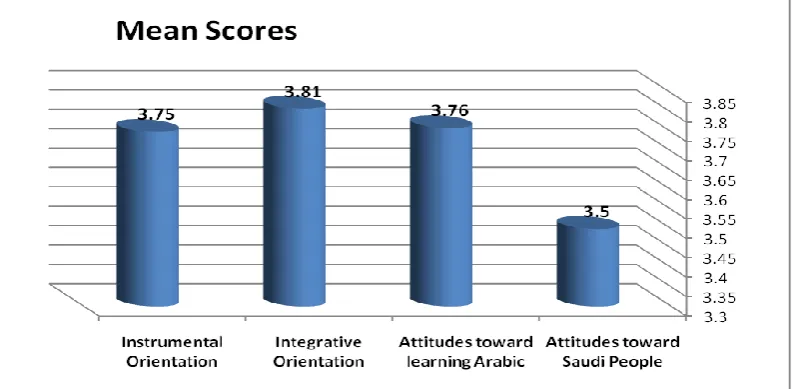
Overall mean scores for the four factors of the questionnaire, namely attitudes toward Saudi people, attitudes toward learning Arabic; integrative orientation and instrumental orientation are presented in Table 2.
Table 2. Mean Scores and Standard Deviations for the four factors of the Questionnaire
Factor M SD Rank
1st factor: Attitudes toward Saudi People 3.50 0.48 4
2nd factor: Attitudes toward learning Arabic 3.76 0.59 2
3rdfactor: Integrative Orientation 3.81 0.60 1
4th factor: Instrumental Orientation 3.75 0.62 3
Total 3.71 0.49
Figure 2. Mean scores for the four factors of the questionnaire
To provide a closer look at the questionnaire results related to the participants' attitude toward Saudi people and learning the Arabic language as well as their integrative and instrumental motivation, Tables 3, 4, 5 and 6 present detailed statistical analysis of each individual factor.
Attitudes toward Saudi People
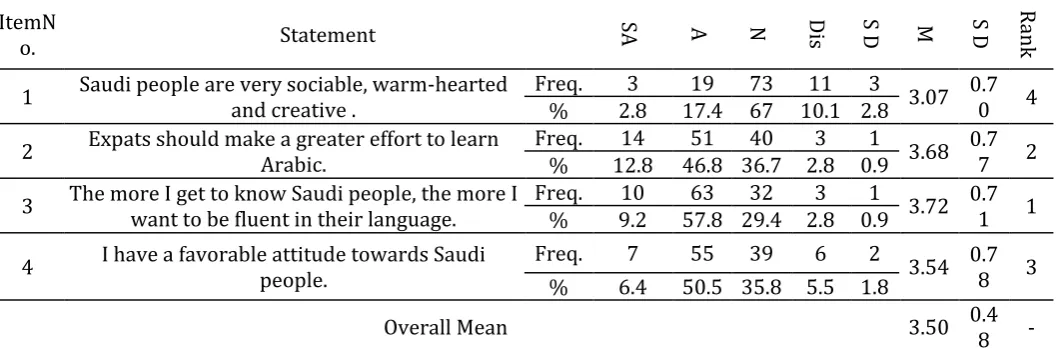
Table 3. Frequency Distributions, Mean scores and Standard Deviations for the Questionnaire Items for Attitudes toward Saudi People
ItemN
o. Statement
SA A N Dis S D M S D Rank
1 Saudi people are very sociable, warm-hearted and creative . Freq. % 2.8 3 17.4 67 10.1 2.8 19 73 11 3 3.07 0.70 4
2 Expats should make a greater effort to learn Arabic. Freq. % 12.8 46.8 36.7 2.8 0.9 14 51 40 3 1 3.68 0.77 2
3 The more I get to know Saudi people, the more I want to be fluent in their language. Freq. % 9.2 10 57.8 29.4 2.8 0.9 63 32 3 1 3.72 0.71 1
4 I have a favorable attitude towards Saudi people. Freq. 7 55 39 6 2 3.54 0.78 3
% 6.4 50.5 35.8 5.5 1.8
Overall Mean 3.50 0.48 -
Table 3 displays the participants' responses to the questionnaire items related to attitudes toward Saudi people. Item number 3 (M= 3.72, SD = 0.71) and item number 2 (M = 3.68, SD = 0.77) reflect clearly the highest level of agreement among participants. These results suggest that the participants were likely to support the idea that the more they get to know Saudi people, the more they want to be fluent in their language. They also believed that all expats should exert effort to learn Arabic. Although participants showed a slightly favorable attitudes toward Saudis in factor number four (M = 3.54, SD = 0.78 ), the lowest level of agreement among all sixteen questionnaire items goes to factor number one when participants were asked if they believe that Saudi people are sociable, warm-hearted and creative with an estimated mean score of (M = 3.07, SD = 0.70).
Attitudes Toward Learning Arabic
Table 4. Frequency Distributions, Mean scores and Standard Deviations for the QuestionnaireItems for Attitudes toward Learning Arabic
Item
No. Statement
SA A N Dis S D M S D Rank
5 I plan to learn as much Arabic as possible. Freq. 12 70 24 1 2 3.82 0.71 2
% 11 64.2 22 0.9 1.8
6 I would really like to learn Arabic . Freq. 14 68 24 1 2 3.83 0.73 1
7 I would make a great effort to learn Arabic even though I could get along in English. Freq. % 8.3 9 61.5 28.4 0.9 0.9 67 31 1 1 3.75 0.66 3
8 I would study Arabic even if it were not required. Freq. % 8.3 9 53.2 33.9 2.8 1.8 58 37 3 2 3.63 0.75 4
Overall Mean 3.76 0.59 -
Table 4 illustrates participants' responses to the questionnaire items related to attitude toward learning Arabic. The participants' highest level of agreement on this factor is shown in item number 6 (M = 3.83, SD = 0.73). Participants revealed that they would really like to learn Arabic. In accordance, they revealed that they would plan to learn Arabic as much as possible with an estimated mean score of (M = 3.82, SD = 0.71) which indicates a very slight difference between them. On the other hand, the lowest level of agreement is shown in item number 7 and 8, suggesting that participants were less likely to support the fact that they would make a great effort to learn Arabic even though they could get along in English (M= 3.75, SD = 0. 66) and they were less likely to support the idea that they would study Arabic even if it is not required with a mean score of (M = 3.63, SD = 0.75).
Integrative Orientation
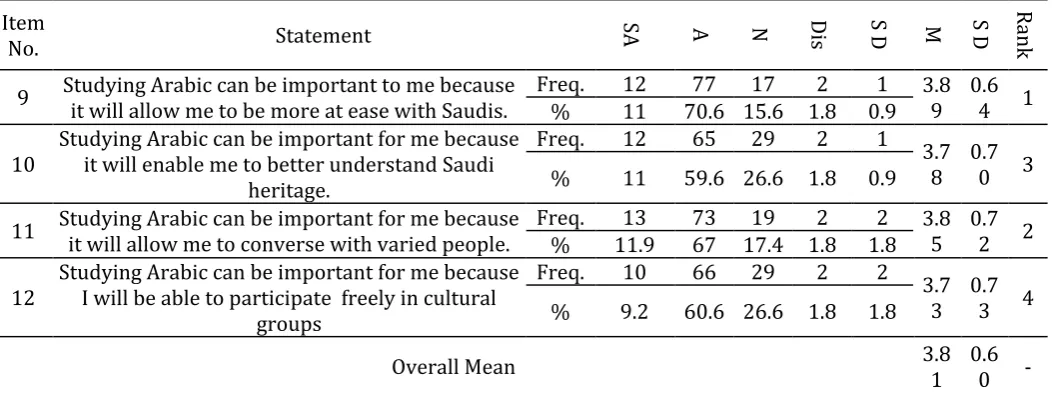
Table 5. Frequency Distributions, Mean Scores and Standard Deviations for the Questionnaire Items for Integrative Orientation
Item
No. Statement
SA A N Dis S D M S D Rank
9 Studying Arabic can be important to me because it will allow me to be more at ease with Saudis. Freq. % 12 11 70.6 15.6 1.8 77 17 2 0.9 1 3.89 0.64 1
10 Studying Arabic can be important for me because it will enable me to better understand Saudi
heritage.
Freq. 12 65 29 2 1 3.7
8 0.7
0 3
% 11 59.6 26.6 1.8 0.9
11 Studying Arabic can be important for me because it will allow me to converse with varied people. Freq. % 11.9 13 73 67 17.4 1.8 19 2 1.8 2 3.85 0.72 2
12 Studying Arabic can be important for me because I will be able to participate freely in cultural
groups
Freq. 10 66 29 2 2 3.7
3 0.73 4
% 9.2 60.6 26.6 1.8 1.8
Overall Mean 3.81 0.60 -
Table 5 depicts the participants’ responses to the questionnaire items related to integrative orientation. The participants admitted that studying Arabic is important because it will allow them to be more at ease with Saudis. This item shows the highest level of agreement on this factor and among all the sixteen factors of the questionnaire (M = 3.89, SD = 0.64). The second highest level of agreement is shown in item number 11 (M =3.85, SD =0 .72) when participants are asked if studying Arabic can be important for them because it will allow them to converse with varied people.
can be important because it will enable them to participate freely in cultural groups. The second lowest level of agreement (M = 3.78 , SD = 0.70) is shown in item number 10, suggesting that participants were less likely to identify with the statement that studying Arabic can be important because it will enable them to better understand Saudi heritage.
Instrumental Orientation
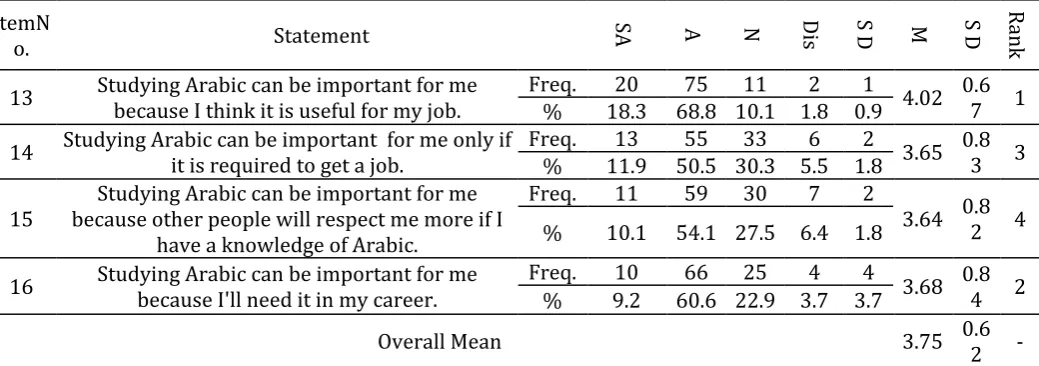
Table 6. Frequency distributions, Mean scores and Standard Deviations for the Questionnaire Items for Instrumental Orientation
ItemN
o. Statement
SA A N Dis S D M S D Rank
13 Studying Arabic can be important for me because I think it is useful for my job. Freq. % 18.3 68.8 10.1 1.8 0.9 20 75 11 2 1 4.02 0.67 1
14 Studying Arabic can be important for me only if it is required to get a job. Freq. % 11.9 50.5 30.3 5.5 1.8 13 55 33 6 2 3.65 0.83 3
15
Studying Arabic can be important for me because other people will respect me more if I
have a knowledge of Arabic.
Freq. 11 59 30 7 2
3.64 0.82 4
% 10.1 54.1 27.5 6.4 1.8
16 Studying Arabic can be important for me because I'll need it in my career. Freq. 10 66 25 4 4 3.68 0.84 2
% 9.2 60.6 22.9 3.7 3.7
Overall Mean 3.75 0.62 -
Table 6 illustrates participants' responses to the questionnaire items related to instrumental orientation. The participants' highest level of agreement on this factor is shown in item number 13 (M = 4.02, SD = 0.67), participants claimed that studying Arabic can be important because they think it is useful for their job. The second highest level of agreement is shown in item number 16 (M=3.68, SD = 0.84), suggesting that participants were likely to support the idea that studying Arabic can be important for me because I'll need it in my career.
On the other hand, the lowest level of agreement is shown in item number 15. Participants were less likely to support the idea that studying Arabic can be important because other people will respect them more if they have a knowledge of Arabic, this item and item number 14 which indicates that studying Arabic can be important for me only if it is required to get a job and are closely ranked with a mean score of (M = 3.65, SD = 0.83) and (M = 3.64, SD = 0. 82) respectively.
Answers to Research Questions and Discussion of Results
To reach the final conclusion of the study, the research questions are answered and discussed in this section.
Research Question # 1
Results of the overall study showed that foreign female nurses’ motivation and attitude are relatively high with a mean score of (M = 3.71). These results give an insight to the level of foreign nurses' motivation toward learning the Arabic language. Although nurses do not speak Arabic, It was surprising to look at these comparatively high levels of motivation among them.
These results strengthen the fact that motivation and attitude are only predicators for language learning and they do not necessarily lead to the learning of that language. Naiman, Frohlich, Stern and Todesco (1996) in their book The Good Language Learner confirmed in their research that attitude and motivation were in many instances the best overall predicators of success in L2 learning. However, they claimed that their results may add several qualifications to the general trend of results. They concluded that an overall positive attitude may be necessarily but not a sufficient condition for success in learning an L2 (p.145). Another support of the present study findings is a study carried out by Soureshjani and Naseri (2011). The study investigated the presence or lack of any possible relationship between the two main variables of the study; motivation and depth of vocabulary knowledge, the results of the study revealed a significant but a very weak positive degree of relationship between them. It is worth noting that Gardner's approach in motivation is characterized by many scholars in the field. Crookes and Schmidt (1991 as cited in MacIntyre, 2002, P. 50-51) criticized the work of Social-psychological approach adopted by Gardner, Lambert and their associates, they argued that the motivation model has been dominated that other approaches of motivation have been neglected. Oxford and Shearin (1994 as cited in MacIntyre, 2002, p.53) argued that the model proposed by Gardner is limited in scope and must be expanded to include a number of other motivational variables. Gardner himself announced in 2005 that "a reason is not motivation". He states that one can want to learn a language for reasons that might reflect an integrative orientation, but unless this is accompanied by other types of motivation it is not motivation. Similarly, we want to learn for reasons that might be classified as instrumental, but without the motivational features, this does not reflect motivation. If one is motivated, he has reasons for engaging in the relevant activities, persists in the activities, attends to the tasks, shows desire to achieve the goal and so on.
Although foreign female nurses do not speak Arabic, they showed a moderately high degree of motivation in learning the Arabic language. This could be due to the fact that in spite of their desire to learn Arabic, they are not seen putting effort to learn it. Another possible interpretation is the fact that their job position demands a lot of working hours. In a study done by Mitchell (2009) to investigate foreign trained nurses (FTNs) working in Saudi Arabia, the results have shown that it is difficult for nurses to have autonomy over practice where the majority of FTNs do not speak Arabic as a first language, and many FTNs learn the language while they work in the Kingdom and hospitals provide rudimentary Arabic instruction for a short program during orientation. One of the Participants in the study disclosed her feelings about the language problem and her work stating, “I want to learn the language, but I can’t. We have staff that translate but you want to do it by yourself. You don’t know if they lost something to the patient, missed something.” (Mitchell, 2009). Another possible interpretation might be due to the fact announced by Imcy (2002) "When one describes the motives in favor of a particular action, such as intgrativeness or additive bilingualism, one must immediately be aware that there will be motives that counteract action, such as fear of assimilation" (p. 58-59).
Research Question #2
Are foreign female nurses predominantly integratively or instrumentally motivated toward learning the Arabic language?
Results of the questionnaire showed that foreign female nurses in Saudi Arabia and in Riyadh in particular are more integratively rather than instrumentally motivated to learn the Arabic language. Integrative orientation received the highest mean score with a total mean score and standard deviation of (M = 3.81, SD = 0.60) among all the four factors of the questionnaire. It was startling that a large proportion of expats highly agreed with the first ranked statement (M = 3.89, SD = 0.64) that Studying Arabic can be important to me because it will allow me to be more at ease with Saudis. Thus, it indicates that foreign nurses strongly sense the need of learning the Arabic language in order to be at ease with the local citizens, the second highest ranked item goes in line with the previous statement where foreign nurses support the idea that Studying Arabic can be important for me because it will allow me to converse with varied people.
motivationand “studying English is important for me because it will allow me to meet and converse with more varied people” was the most commonly selected option.
Another support of the findings is a study conducted by Obeidat (2005) which aims at investigating Malaysian students' attitudes toward Arabic and the impact it has on their first language and cultural identity. The results showed that subjects are more integratively motivated to learn Arabic. This can be attributed to the deep connection between the Malay and Arabic cultures, which may have resulted from the shared belief in Islam. Correspondingly, in a study done by Fernández (2008), participants’ beliefs were addressed using a modified version of BALLI (p. 137-150). Many students agreed or somewhat agreed that they would like to speak the FL, so "they can get to know the speakers better" (Fernández, 2008, p. 144). These results suggest that the learners have decided to learn a particular FL. Similar results are shown in a study where participants were 32 learners of English at two classes in a language academy in Penang, Malaysia. The findings indicate that familiarity with the cultural features of the target language society, on the one hand, and interest toward learning those cultural features, on the other hand, play a significant role in the development of pragmatic comprehension ability in an EFL contexts. The findings also suggest that familiarity with the cultural features of the target language community enhances language learners’ level of pragmatic comprehension (Rafieyan, Abdul Majid, & Eng, 2013). Similarly, In an investigation by M.Tseng (2013), 90 Taiwanese students who were divided into 2 groups: high-proficiency and low-proficiency learners were studied in terms of the relationship between the English proficiency levels of students of EFL and their attitudes toward foreign culture. From the aspect of high proficiency learners, there was a significant correlation between their scores and attitudes towards culture. However, for low proficiency learners, no significant correlation revealed in their attitudes towards culture. The results consolidate the notion that positive attitudes towards culture are highly interrelated with EFL students’ English proficiency levels in Taiwanese contexts.
classroom in Thailand aims to evaluate the use of integrative motivation and instrumental motivation to predict their English language requirements. For the majority of the participants, instrumental reasons for studying English were more important than integrative reasons. A more recent study is the study of one hundred and eleven undergraduate students enrolled in different levels of less commonly taught languages (LCTLs) courses in a large university in West Texas. This study has discovered that the most prevalent primary orientations among learners of Arabic, Chinese, and Russian are career driven. (Pratt et al., 2014)
Another study in favor of instrumental orientation was conducted to determine which of the three types of motivation instrumental, integrative and personal could be the primary source of petroleum engineering students’ motivation towards learning the English language. From the three motivational constructs, instrumental motivation received the highest mean scores, of all the subjects' results (Al-Tamimi & Shuib, 2009). Similarly, In a survey conducted by Li and Pan (2009) in Qingdao Agricultural University reveals that instrumental motivation plays an extremely important role in English majors’ learning; both high achievers and lower achievers have higher instrumental motivation.
Foreign female nurses possessing a relatively high level of integrative motivation is justifiable as their job position demands a lot of contact with natives. As part of their job, nurses need to be loving and caring, and in order to be so, they must integrate with native people in many cultural aspects. This, in turn, will ensure a better understanding between them and their patients. Therefore, they strongly sense the need of learning the country's mother tongue in order to communicate with patients effectively.
Research Question # 3
What are the foreign female nurses' attitudes toward learning Arabic?
The results showed that foreign female nurses' attitudes toward learning Arabic received a total mean score of (M = 3.76) which indicates that they show a relatively positive attitude toward learning the language. There are many studies conducted in accordance to the relevance of attitude toward language learning. One recent study is conducted by Tılfarlıoğlu and Delbesoğlugil (2014) investigating 383 volunteers out of 1867 preparatory level students from Gaziantep University Higher School of FLs, the results may be interpreted as the more positive attitudes students have toward language learning, the more they are successful at FL learning. That is, language attitude may be used while predicting students’ success.
results of one-way ANOVA analysis show that the relationship between proficiency level; high, middle, and low and attitude toward language learning is not significant (Dehebozorgi, 2012). These studies imply in one way or another that even positive attitude toward learning a language cannot predict successful language learning. Therefore, it can be inferred that foreign nurses' relatively positive attitude toward learning Arabic is not the only condition to enhance their language learning, effort and persistence as well as other factors must be accompanied.
Research Question #4
What are the attitudes of foreign female nurses toward Saudi people?
The factor under attitude toward Saudi people received the lowest mean score among all the four factors with a total mean score of (M= 3.50). There are few studies that were done on the effect of attitude toward the native people of a language on language learning. One is a study conducted by Alshaar (1997). The results showed that students with positive attitudes toward English speakers have positive attitudes toward learning English. Considerable correlations were found between affective variables; attitudes and motivation, and learning an L2. Hence, these findings are consistent with those of other researchers. Even though the correlations were not very strong, they were statistically significant. Youssef (2012) claimed that attitudes toward a particular language might be either positive or negative. In this respect, some learners may have negative attitude towards the L2 and want to learn it in order to prevail over people in the community but generally positive attitude strengthens their motivation.
From the above, it can be concluded that in certain cases, negative attitude toward the native people of a certain language may lead them to learn it. As Saudi people are the concern of the present study and foreign female nurses have shown the lowest mean score in this factor among all the motivational and attitudinal factors, a reason for such a low score may be attributed to the cultural differences between the foreign nurses and Saudis that have a huge effect on people's attitudes.
Summary
The results of the present study showed that integrative orientation received the highest mean score among all the four factors of the questionnaire while attitudes toward Saudi people received the lowest mean score. Then, the four research questions addressed in the present study are answered comprehensively. The overall results showed that foreign female nurses had a moderately high level of motivation and a relatively positive attitude toward learning the Arabic language.
SUMMARY OF THE FINDINGS
sample of the presented study. The results of the study provide sufficient answers to the research questions addressed and showed that foreign nurses were both instrumentally and integratively motivated, but their integrative motivation outdid their instrumental one. In other words, the results provide evidence that learning Arabic to be part of the culture of its people is the most driven factor for foreign nurses in learning the language. In reference to the foreign nurses' attitudes toward learning Arabic, the findings revealed that they had relatively positive attitudes toward Arabic language. As for attitudes toward Saudi people, it is worth indicating that the subjects' attitude toward Saudis showed more or less neutral responses. This could be due to the subjects' sociocultural identity. Though the study revealed that the targeted foreign female nurses had a moderately high instrumental and integrative motivations and relatively positive attitudes towards learning Arabic, the fact remains that there is a wide gap between foreign nurses' motivation and reflections in their behavior.
IMPLICATIONS AND RECOMMENDATIONS
In the light of the findings of the study, the following could be recommended:
1. Arabic language institutes should take into account the foreign female nurses' inclination toward integrative motivation. It might be beneficial for institutes to implement more materials that link culture with language more specifically.
2. The study has important implications for the way that Ministry of Health hospitals are managed and their language policy.
3. The challenge for Saudi Arabia is to increase its proportion of indigenous nurses who will be able to deliver culturally appropriate high quality care and to share the Arabic language of their patients. Without this, it may prove difficult to deliver effective health education within nursing work. 4. The governments of the gulf countries and in Saudi Arabia in particular
should take an immediate and initiative step to impose language learning for foreign workers whose position demand a contact with the local citizens before entering the country. Japan's policy in this regard is a good model to follow. Japan accepts candidates for nurses from Indonesia, the Philippines and Vietnam. In 2014, 508 people arrived in Japan to work in these sectors. For such candidates, Japanese language training is given before and after arriving in Japan (Taki, 2014).
6. Institutions and policy makers in the country must cooperate to allot time for foreign workers to learn the host country's language.
7. The findings of the study can be employed as a starting point for providing some pedagogical implications that should be taken into consideration by both government leaders and ministry of labor.
8. Employers may want to invest in their foreign workers by providing Arabic language classes in their workplace or by providing financial support to access community language training classes.
9. Further research on how to bridge the wide gap between foreign nurses' motivation and reflections in their behavior is recommended.
CONCLUSIONS
In conclusion, this study was conducted to provide some insights into the foreign workers' level of attitude and motivation to learn the language of the host country. Especially, foreign workers who work in sectors that demand a daily contact with the locals. Nurses in the health sector are taken as a sample to investigate this phenomenon. Moderately high motivation levels among foreign nurses toward learning the Arabic language can be a great source of knowledge and understanding in order to implement relevant programs or activities to stimulate a motivating learning atmosphere. Foreign nurses and expats' motivation need to be guided in order to become efficient language learners.
Finally, the study provides useful knowledge and information for institutions and governments to reconsider their language policy. Although the data source of the study may not represent all other foreign nurses and workers, the researcher is still confident that the results will give a relative representation and be of a great value to authorities or researchers concerned.
REFERENCES
Ajzen, I., & Fishbein, M. (2011). Predicting and changing behavior: The reasoned action approach. Hoboken: Taylor and Francis.
Ajzen, I., & Fishbein, M. (2005). The influence of attitudes on behavior. In D. Albarracin, B. T. Johnson, & M. P. Zanna (Eds.), The handbook of attitudes (pp. 173-222). Mahwah, NJ: Lawrence Erlbaum Associates Publishers.
Ajzen, I. (2005). Attitudes, personality and behavior. Maidenhead, England: Open University Press.
AlDossary, A., While, A., & Barriball, L. (2008). Health care and nursing in Saudi Arabia. International Nursing Review, 55, 125-128. doi:10.1111/j.1466-7657.2007.00596.x Al-Khotani, S. (2013, May 10). Make fluency in Arabic a condition for foreign workers.
Saudi Gazette.
Alshaar, B. E. (1997). Attitudes and motivation of second language learners in Kuwait
(Master's thesis). Retrieved from
http://lib.dr.iastate.edu/cgi/viewcontent.cgi?article=1280
Al-Tamimi, A., & Shuib, M. (2009). Motivation and attitudes towards learning English: A study of petroleum engineering undergraduates at Hadhramout University of Sciences and Technolog. GEMA Online Journal of Language Studies, 9(2), 29-55. Retrieved from http://www.ukm.my/ppbl/Gema/pp%2029_55.pdf
Al-Khathami, A. M., Kojan, S. W., Aljumah, M. A., Alqahtani, H., & Alrwaili, H. (2010). The effect of nurse-patient language barrier on patients’ satisfaction. Saudi Med, 31(12), 1355-1358. Retrieved from http://www.smj.org.sa/index.php/smj/ article/viewFile/7085/4859
American Forces Press Services. (2007). Army sees importance of language, cultural sensitivities in operations. Retrieved from http://www.army.mil/article/ 3310/Army_Sees_Importance_of_Language__Cultural_Sensitivities_in_Operations/ Baker, C. (1992). Attitudes and language (Vol. 83). Multilingual Matters.
Barjesteh, H., & Vaseghi, R. (2012). Acculturation model for L2 acquisition: Review and evaluation. Advances in Asian Social Science (AASS), 2(4), 579-584. Retrieved from http://worldsciencepublisher.org/journals/index.php/AASS/article/view/675/5 62
Bernaus, M. (n.d). The role of motivation in the learning of English as foreign language. Retrieved from http://www.raco.cat/index.php/bells/article/viewFile/102734 /149124
Bloch, B., & Trager, G. L. (1942). Outline of linguistic analysis. Baltimore, MD: Linguistic Society of America at the Waverly Press.
Boroditsky, L. (2011). How language shapes thought: The languages we speak affect our perceptions of the world. Cognitive Psychology, 63-65. Retrieved from http://psych.stanford.edu/~lera/papers/sci-am-2011.pdf
Brown, H. (2000). Principles of language learning and teaching (4th ed.). New York, NY: Addison Wesley Longman, Inc.
Chambers, G. N. (1999). Motivating language learners. Clevedon, U.K: Multilingual Matters.
Chiu, C., & Krauss, R. M. (1998). Language and social behavior. In G. Lindzey, D. T. Gilbert, & S. T. Fiske (Eds.), Handbook of social psychology (4th ed., pp. 41-88). New York, NY: Oxford University Press.
Crawford, J. (2001, March 7). A nation divided by one language. The Guardian. Retrieved from http://www.theguardian.com/theguardian/2001/mar/08/guardianweekly .guardian weekly11
Dehbozorgi, E. (2012). Effects of attitude towards language learning and risk-taking on EFL student's proficiency. International Journal of English Linguistics, 2(2), 41-48. doi:10.5539/ijel.v2n2p41
Dörnyei, Z. (1998). Motivation in second and foreign language learning. Language Teaching, 31(03), 117-135.
Ellis, R. (1997). Second language acquistion. Oxford: Oxford University Press.
Fazio, R. H., & T, T. (1999). The MODE model of attitude-behavior processes. In S. Chaiken & Y. Trope (Eds.), Dual-process theories in social psychology (pp. 97-116). New York, NY: Guilford Press.
Fernández, C. (2008). Persistence in foreign language study: An investigation of learners' Beliefs. In H. J. Siskin (Ed.), From thought to action: Exploring beliefs and outcomes in the foreign language program (pp. 135-154). Boston, MA: Thomson Heinle.
Gardner, R. C. (1985a). Social psychology and second language learning: The role of attitudes and motivation. London: E. Arnold.
Gardner, R. C. (1985b). The attitude/motivation test battery: Technical report. University of Western Ontario.
Gardner, R. C. (2005). Integrative motivation and second language acquisition. Canadian Association of Applied Linguistics/Canadian Linguistics Association Joint Plenary Talk.
Gardner, R. C. (2010). Motivation and second language acquisition. New York, NY: Peter Lang Publishing, Inc.
The Global Expat Network (Angloinfo). (2014). What is an Expatriate or Expat? Retrieved from http://www.angloinfo.com/about/expatriates/
González, V. (2004). Second language learning: Cultural adaptation processes in international graduate students in U.S. universities. Lanham, MD: University Press of America.
Höhne, J. (2013). Language integration of labour migrants in Austria,Belgium,France,Germany,the Netherlands and Sweden from a historical perspective (VI 2013-101). Retrieved from Berlin Social Science Center website: http://bibliothek.wzb.eu/pdf/2013/vi13-101.pdf
Investopedia. (2014). Retrieved from http://www.investopedia.com/terms /e/expatriate.asp
Johannsen, M. (2014, September 20). What is motivation .Legacee. Retrieved from https://www.legacee.com/motivation-essentials/what-is-motivation/
Johnson, K. (2008). Foreign language learning and teaching (2nd ed.). Pearson Education Limited.
Johnston, W. R. (2008). Language: A definition from first principles - Three grand over the truckstop. Philica, (163). Retrieved from http://philica.com/display_article .php?article_id=136
Kramsch, C. J. (1998). Language and culture. Oxford, OX: Oxford University Press.
Krashen, S. D. (1981). Second language acquisition and second language learning. Oxford: Pergamon Press.
Karout, N., Abdelaziz, S. H., Goda, M., AlTuwaijri, S., Almostafa, N., Ashour, R., & Alradi, H. (2013). Cultural diversity: A qualitative study on Saudi Arabian women's experience and perception of maternal health services. Journal of Nursing Education and Practice, 3(11), 172-182. doi:10.5430/jnep.v3n11p172
MacIntyre, P. D. (2002). Motivation,anxiety and emotion in second language acquisition. In P. J. Robinson (Ed.), Individual differences and instructed language learning. Amsterdam: J. Benjamins Pub.
Maio, G. R., & Haddock, G. (2010). The Psychology of attitudes and attitude Change. London: Sage Publications.
McLeod, S. (2009). Attitudes and behavior. Simply Psychology. Retrieved from http://www.simplypsychology.org/attitudes.html
Metiūnienė , R., & Liuolienė , A. (2006). Second language learning motivation. Santalka, 14(2), 93-98.
Mitchell, J. E. (2009). Job satisfaction and burnout among Foreign –trained nurses in Saudi Arabiz: A mixed-method study (Doctoral dissertation). Retrieved from ProQuest Dissertations and Theses database. (3357443)
Mohamed, R., Ramendran, C., & Yacob, P. (2012). The impact of employment of foreign workers :Local employability and trade union roles in Malaysia. International Journal of Academic Research in Business and Social Sciences, 2(10), 530-541. Naiman, N., Fröhlich , M., Stern, H. H., & Todesco, A. (1997). The good language learner.
Toronto: Multilingual Matters Ltd.
National Institute on Deafness and Other Communication Disorders (NIDSD). (2010, June 7). What Is Voice? What Is Speech? What Is Language? Retrieved from http://www.nidcd.nih.gov/health/voice/pages/whatis_vsl.aspx
Obeidat, M. M. (2005). Attitudes and motivation in second language learning. Journal of Faculty of Education, 18(22), 1-17.
Olsen, M., & Fazio, R. (2009). Implicit and explicit measures of attitudes: The perspective of the MODE mode. In R. Petty, R. Fazio, & P. Brinol (Eds.), Attitudes:Insights from the new implicit measures (pp. 19-64). New York, NY: Taylor&Francis Group,LLC. Oranpattanachai, P. (2013). Motivation and English language achievement of Thai
undergraduate students. Language Education and Acquisition Research Network Language Institute, Thammasat University, 6(1), 27-49.
Pan, G., & Li, P. (2009). The Relationship between motivation and achievement -A survey of the study motivation of English majors in Qingdao Agricultural University. English Language Teaching, 2(1), 123-128. Retrieved from www.ccsenet.org/journal.html
Pratt, C., Sadikova, A., Wei, T., Wang, Y., Dan, Y., & Zaier, A. (2014). Investigating the primary orientations and principal majors of learners of less commonly taught languages. International Journal of Humanities and Social Science, 4(3), 41-53.
Retrieved from
http://www.ijhssnet.com/journals/Vol_4_No_3_February_2014/5.pdf
Pratkanis, A. R., Breckler, S. J., & Greenwald, A. G. (1989). Attitude structure and function. Hillsdale, NJ: L. Erlbaum Associates.
Rafieyan, V., Abdul Majid, N., & Eng, L. S. (2013). Relationship between attitude toward target language culture instruction and pragmatic comprehension development. English Language Teaching, 6(2), 125-132. Retrieved from http://dx.doi.org/10.5539/elt.v6n8p125
Science Daily. (2010, July 13). Person's language may influence how he or she thinks
about other people. Retrieved from
http://www.sciencedaily.com/releases/2010/07/100712115058.htm
Saemann, B. (2009). Motivation in second language acquisition. Norderstedt, Germany: GRIN Verlag.
Sapir, E. (1985). Selected writings in language, culture, and personality. D. Mandelbaum (Ed.). California: University of California Press, Ltd.
Selmer, J. (2006). Language ability and adjustment: Western expatriates in China. Thunderbird International Business Review, 48(3), 347-368. doi:10.1002/tie.20099 Soureshjani, K. H., & Naseri, N. (2011). The interrelationship of instrumental,
integrative,intrinsic, and extrinsic motivations and the lexical-oriented knowledge among Persian EFL language learners. Theory and Practice in language Studies, 1(6), 662-670. doi:10.4304/tpls.1.6.662-670
Stangor, C. (2011). Principles of social psychology. Retrieved from http://catalog.flatworldknowledge.com/catalog/editions/stangor-introduction-to-psychology-1-0
Tahaineh, Y., & Daana, H. (2013). Jordanian undergraduates' motivations and attitudes towards learning English in EFL context. International Review of Social Sciences and Humanities, 4(2), 159-180.
Taki, T. (2014, October 11). Can Japan overcome the 'language barrier' for foreign workers? , East Asia Forum [Fourm Post]. Retrieved from http://www.eastasiaforum.org/2014/10/11/can-japan-overcome-the-language-barrier-for-foreign-workers/
Tseng, A. (2007). The relationship between adult Learners' attitude and their achievement in learning foreign languages. Retrieved from http://http://goo.gl/X8fKDC
Tseng, M. C. (2013). The relationship between attitudes toward foreign culture and English proficiency level in Taiwanese students of English as a foreign language. Study in English Language Teaching, 1(2), 264-274. Retrieved from www.scholink.org/ojs/index.php/selt
Tılfarlıoğlu, F. Y., & Delbesoğlugil, A. B. (2014). Questioning academic success through self-regulation, self-esteem and attitude in foreign language learning (a case study). Theory and Practice in Language Studies, 4(11), 2223-2230. doi:10.4304/tpls.4.11.2223-2230
The Free Dictionary. (2005). Second language - Definition of second language by the free dictionary. Retrieved from http://www.thefreedictionary.com/second+language Williams, M., & Burden, R. L. (1997). Psychology for language teachers: A Social
Constructivist Approach. Cambridge: Cambridge University Press.
Yang, X. (2012). Attitude and motivation in L2 learning among UM Master students. International Journal of Management and Sustainability, 13-22.
Youssef, A. M. (2012). Role of motivation and attitude in introduction and learning of English as a foreign language in Libyan high schools. International Journal of Linguistics, 4(2), 366-375. doi:10.5296/ijl.v4i2.1855