Justification of Composition of the Cream
with Sapropel Extract
Oksana Strus
1, Polovko Natalya
2, Silaeva Lyudmyla
31Department of Drug Technology and Biopharmaceutics, Danylo Halytsky Lviv National Medical University, Lviv, 69, 79010, Ukraine, 2Department of Drug Technology, National University of Pharmacy, Kharkiv, 4, 61168, Ukraine, 3Department of Microbiology, Virology, and Immunology, National University of Pharmacy, Kharkiv, 12, 61002, Ukraine
Abstract
Aim: The aim of the study was to work out the composition of cream with extract of sapropel from Prybych deposits, Volyn region, Ukraine, and to determine its organoleptic, physicochemical indices, structural and mechanical (rheological) parameters, colloidal and thermal stability, as well as to justify the choice of effective preservatives. Materials and Methods: The following materials were employed: Extract of sapropel from Prybych deposits; emulsion base, containing corn oil, emulsifier №1, cetylstearyl alcohol, and purified water. To carry out the research a set of methods (centrifugal, thermal, and potentiomentric), to analyze colloidal and thermal stability, and to determine pH values of the tested samples were used. Rheological properties of the samples were determined on the rotating viscometer. Results: There was determined the influence of the extract on physicochemical and rheological properties of the emulsion base; all the experimental samples remain thermally and colloidally stable and have satisfactory organoleptic properties; incorporation of SE into an emulsion base in a concentration of up to 20% retains structural and mechanical properties of the base. Conclusion: As the results of the carried out experimental investigations, the effect of the SE on physicochemical and rheological properties of its emulsion base. Microbiological research showed that the maximum reduction of the number of viable cells of microorganisms was observed applying as preservatives euxyl K 100 (0.1%) and nisin (0.01%).
Key words: Effectiveness of antimicrobial preservatives, emulsion base, extract of sapropel, rheological properties
Address for correspondence:
Oksana Strus, Department of Drug Technology and Biopharmaceutics, Danylo Halytsky Lviv National Medical University, 69, Pekarska Street., Lviv - 79010, Ukraine. Phone: + 38 032 276-85-84. Mobile: +380675991305. E-mail: [email protected]
Received: 16-03-2018
Revised: 26-12-2018
Accepted: 06-01-2019
INTRODUCTION
A
mong promising raw materials for preparation of medical, veterinary and cosmetic remedies are sapropel, which is a unique natural organic material, containing a large number of carboxylic, humic and amino acids, vitamins, micro- and macro-elements, and possessing a wide range of pharmacological effects, as well anti-inflammatory, reparative, antibacterial, and antioxidant.[1-4]In scientific literature, the term “sapropel” has been used mostly in a generic sense for describing organic-rich fine-grained sediments deposited in stagnant water. In respect to physical and chemical properties, sapropels are diverse materials with different content of organic substances and mineral nutrient concentration.[5]
The current age of sapropel sediments in lakes does not exceed 12,000 years. The composition and properties of sapropel from different
locations vary in wide ranges, due to the productivity of the parent pond, the properties of the surface currents and climatic conditions, etc. An important role in the formation of bottom sediments plays the factor of the lake fluidity.
In Belorussia, Russia and Ukraine sapropel is already used as a raw material for cosmetic applications, balneology, livestock farming, agriculture, and other areas. Sapropel thermal capacity provides a long and deep tissue heating and normalizes blood pressure, assisting the treatment in joints, peripheral nervous system, skin, and inflammation of female genitals. The heated sapropel applications successfully treat phlegmons, mastitis,
ORIGINAL
AR
furunculus, chronic gastritis, gastric ulcer, and duodenum diseases, because these applications stimulate the phagocytes activity, and leading to intensive tissue regeneration.[1]
Despite the undeniable prospects of applications and certain achievements in their investigation, today the products of sapropel processing are not widely used in pharmacy, medicine, including veterinary and cosmetology. In our point of view, it is caused by the chemical composition of sapropel, which depends on the location, conditions of its formation, the diversity of flora and fauna[3] and, as a consequence, the
difficulties in standardization of the natural raw material.
A rich composition of sapropels allows to use them successfully in cosmetology. Sapropelic therapeutic muds exhibit the anti-inflammatory and anti-allergic effect, protect the skin from the damaging effects of free radicals, slow down the aging processes, providing for skin a freshness, firmness, and elasticity, also improve cellular regeneration, moisturize, and increase elasticity and thickness of the keratoid layer of the epidermis.[4,6] The uses of native products and individual
components of sapropels for many years have shown their effectiveness, accessibility, convenience, and safety.
The aim of this research is to work out the composition of cream with SE and to determine its organoleptic, physicochemical indices, structural and mechanical parameters, colloidal and thermal stability, as well as justify the choice of effective preservatives to provide the accordance of the developed cream with the European Pharmacopoeia (EP) requirements, related to its microbiological purity.
MATERIALS AND METHODS
In accordance with investigated organoleptic and consumer properties, thermal and colloidal stability, pH values, structural and mechanical characters of prototype samples, for further experiments concerning development of composition of a cream with sapropel extract was selected the emulsifying base containing 15% of corn oil, 6% of emulsifier No.1 (Lanette SX), 1% of cetostearyl alcohol and purified water.[7] The following
materials were employed: Extract of sapropel from Prybych deposits, located in Volyn region; emulsion base, containing 15% corn oil, 6% emulsifier №1 (Lanette SX, mixture of cetearyl alcohol, sodium lauryl sulfate, and sodium cetearyl sulfate), 1% cetyl stearyl alcohol, and purified water to 100 g.
In development process in terms of the SE cream composition, there were considered basic principles and requirements of the following applicable regulatory items: EP 8.0., 2013 (monographs 04/2010:0132; 5.1.3; 5.1.4)[8] and the State
Standard of Ukraine No. 4765:2007 “Cosmetic creams. General technical conditions”, 2008.[9]
The organoleptic characteristics of the samples of creams were investigated for their appearance, odor, color, consumer
properties, and possible development of features of physical instability (coalescence, flocculation, aggregation of particles, and coagulation).
Determination of acid-base balance (рН values) was conducted by the potentiometric method, applying pH meter pH-150 MI (“Measurement Techniques Ltd.,” Russian Federation) in 10% aqueous solution of the cream in accordance with the EP 8.0., 2013.[8]
Determining the colloidal stability was used the laboratory centrifuge MPW-210 (“Mechanìka precyzyjna,” Poland). Test tubes were filled with 2/3 volume (approximately 9 g) by investigated samples, weighted with an accuracy of 0.01 g and centrifuged for 5 min at speed 5000 rpm; the relative strength of the centrifuge was around 5000 g.[9]
To determine the thermal stability, there were taken 6 glass tubes with a diameter of 15 mm and a height of 150 mm, which were filled with 2/3 the volume of the studied samples and placed in the thermostat ТС-80М-2 at 40–42°С for 24 h. The bases were considered as stable, if the formation of the water phase was not observed in any glass tubes.[9]
Determination of the structural and mechanical (rheological) parameters, according to applicable regulations of the EP 8.0., 2013 (monograph 2.2.10), was conducted on the rotating viscometer Brookfіeld НВ DV-ΙΙ PRO (the USA), applying the rotating type adapter with coaxial cylinders in the range of shear rate from 3.0 to 93.0 s−1 (spindle SC4-21 for 8.3 g
camera). For determining its structural viscosity, the mass of the sample was placed in a tunk and immersed in the liquid spindle, which turned and fixed the value of viscosity (η), shear stress (τr), and shear rate (Dr) that automatically were presented on the display of the device. Determination of structural and mechanical properties of the developed drug was carried out at temperature 13°C, 20°C, and 34°C. Required temperature levels were provided using the ultra-thermostat, which is included in the package of viscometer.[10,11]
To study the effectiveness of preservatives in the cream’s experimental samples with sapropel extract in conditions in vitro, as test strains were used American Type Culture Collection (ATCC) reference strains: Staphylococcus aureus ATCC 6538, Pseudomonas aerugіnosa ATCC 9027, Bacіllus subtіlіs ATCC 6633, Candіda albіcans ATCC 10231, and Aspergіllus brasіlіensіs ATCC 16404. In accordance with the recommendations of the EP 8.0., 2013,[8] the
Each container of the examined sample was inoculated with suspension, which contained one of the test-strains, providing the inoculum of not <105–106 colony-forming
units (CFU) in 1 ml. From each container were removed after inoculation the samples at appropriate intervals, indicated in the EP 8.0., 2013[8]: 2, 7, 14, and 28 days;
the effectiveness of preservatives was evaluated by the log10 reduction in the number of viable micro-organisms against the value, obtained for the inoculum during the subjected period after inoculation. In accordance with EP 8.0., 2013,[8] the presence of not > 100 CFU of aerobic
microorganisms (total aerobic microbial count, TYMC) and 10 CFU yeast and mold fungi (total combined yeasts/ molds count, TYMC) is allowed in 1 g of the nonsterile product for cutaneous application; P. aeruginosa and S. aureus must be absent.
During our previous investigations, there was worked out the emulsion base, containing 15% corn oil, 6% emulsifier № 1 (Lanette SX), 1% cetyl stearyl alcohol, and purified water to 100 g. To study the influence of the extract and the pH value of the developed base were prepared 5, 10, 15, and 20% samples of SE. A liquid extract of sapropel was obtained from the substance with the content of organic matters varying from 40% to 97%. It was processed with 0.1 N alkali and applied the cavitation with the speed 3000 rev/min for 60 min at 50–60 °C to obtain a homogeneous suspension, then the extract was filtered, evaporated in a vacuum evaporator to a ratio of 1:2 and adjusted to pH 7.0 with the citric acid.
Test samples of creams with SE were prepared by the method of phase inversion. Emulsifiers of the oil were melted at 70–80°С. Water was heated (about 10%, according to the method of phase inversion) separately to the same temperature and added into the oil phase. To obtain the water-in-oil emulsion, the homogenizer Polytron PT 3100 D
(“Kinematica AG”, Switzerland) for 5 min at a speed of 3000 rev/min (average speed) was used. The rest portion of a water phase of the same temperature then was added at 55–65°С; a phase inversion occurred. Mixing was continued till the emulsion cooling to room temperature.
RESULTS AND DISCUSSION
Investigations concerning the choice of appropriate constituents, including the basis and suitable excipients, for semi-solid preparations for cutaneous application are significant research items within the development of the composition of promising pharmaceuticals and cosmetics.[12-15]
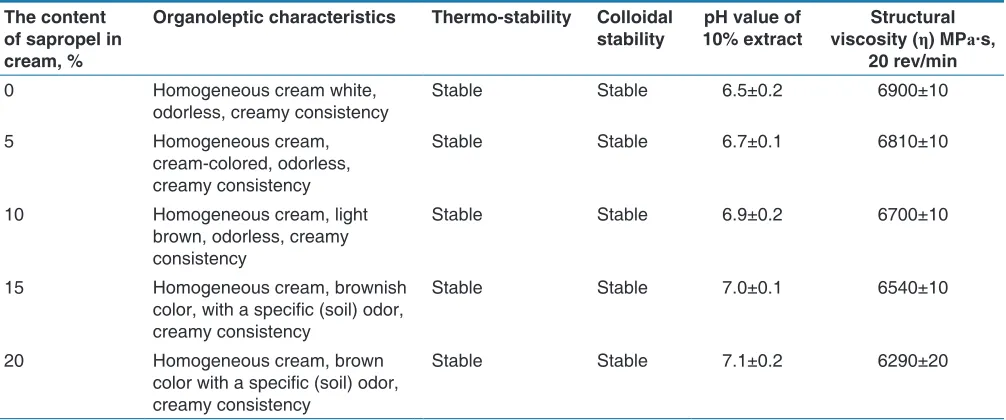
Test samples of SE cream, yielding various content of sapropel in cream (0%, 5%, 10%, 15%, and 20%), were assessed for organoleptic properties, pH values, thermal indices, and colloidal stability. The dependence of the structural and mechanical properties of the cream from the extract concentration was also determined. The research outcomes are presented in Table 1.
The results of the carried out experiments show that an increase in the amount of sapropel extract in emulsion bases leads to a slight increase in pH value and a decrease of the viscosity of the cream. Test samples of different quantitative content of SE in the emulsion bases are thermally and colloidally stable, exhibiting satisfactory organoleptic properties.
The rheograms [Figure 1] demonstrate the ability of extract to dissolve the base in a small degree, but the cream base provides the appropriate structural and mechanical properties - plasticity and minor thixotropic characteristics. It allows using the developed base without extra correction of the composition under incorporation of SE in concentrations of up to 20%.
Table 1: Properties of experimental samples of emulsion bases, n=5
The content of sapropel in cream, %
Organoleptic characteristics Thermo‑stability Colloidal
stability 10% extractpH value of viscosity (Structural η) MPа·s,
20 rev/min
0 Homogeneous cream white,
odorless, creamy consistency Stable Stable 6.5±0.2 6900±10
5 Homogeneous cream,
cream‑colored, odorless, creamy consistency
Stable Stable 6.7±0.1 6810±10
10 Homogeneous cream, light
brown, odorless, creamy consistency
Stable Stable 6.9±0.2 6700±10
15 Homogeneous cream, brownish
color, with a specific (soil) odor, creamy consistency
Stable Stable 7.0±0.1 6540±10
20 Homogeneous cream, brown
color with a specific (soil) odor, creamy consistency
The next stage of the investigation was to study the choice of the preservative for cream prototypes in accordance with the requirements of the EP 8.0., 2013.[8] The results of studies,
carried out by other research groups,[12,16,17] caused the choice
of the antimicrobial preservatives as possible ingredients of the composition of the cream with sapropel extract in the current investigation.
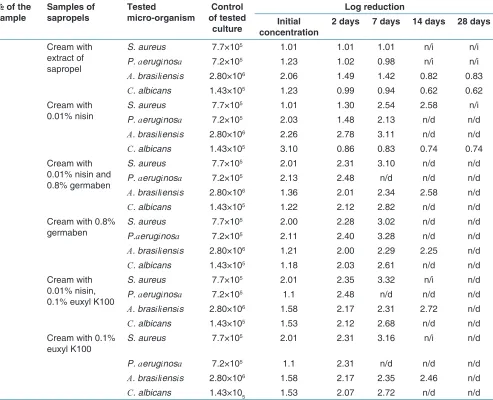
To select an effective preservative for the SE, we have produced the samples with the following preservatives: The sample № 2 contained nisin in a concentration of 0.01%; the sample № 3 - nisin 0.01% and germaben II International Nomenclature of Cosmetic Ingredients (INCI): Propylene glycol, diazolidinyl urea, methylparaben, and propylparaben - 0,8%; the sample № 3 - germaben 0.8%, the sample № 4 - nisin 0.01% and euxyl K 100 (INCI: Benzyl alcohol, methylchloroisothiazolinone, and
Figure 1: Rheogram of the dependence of shear stress (τr)
on shear rate (Dr) of the cream test samples at 20°С, where 1 ‑ emulsion base; 2 ‑ the sample of the 5% SE cream; 3 ‑ the sample of the 15% SE cream; 4 ‑ the sample of the 10% SE cream; 5 ‑ the sample of the 20% SE cream
Table 2: The effectiveness of preservatives in the composition of experimental samples of creams with sapropel extract
№ of the
sample Samples of sapropels Tested micro‑organism of tested Control
culture
Log reduction Initial
concentration 2 days 7 days 14 days 28 days
1 Cream with
extract of sapropel
S. aureus 7.7×10⁵ 1.01 1.01 1.01 n/i n/i
P. aerugіnosа 7.2×10⁵ 1.23 1.02 0.98 n/i n/i
А. brasіlіensіs 2.80×10⁶ 2.06 1.49 1.42 0.82 0.83
С. albicans 1.43×10⁵ 1.23 0.99 0.94 0.62 0.62
2 Cream with
0.01% nisin S. aureus 7.7×10
5 1.01 1.30 2.54 2.58 n/i
P. аerugіnosа 7.2×10⁵ 2.03 1.48 2.13 n/d n/d
А. brasіlіensіs 2.80×10⁶ 2.26 2.78 3.11 n/d n/d
С. albicans 1.43×10⁵ 3.10 0.86 0.83 0.74 0.74
3 Cream with
0.01% nisin and 0.8% germaben
S. aureus 7.7×10⁵ 2.01 2.31 3.10 n/d n/d
P. аerugіnosа 7.2×10⁵ 2.13 2.48 n/d n/d n/d
А. brasіlіensіs 2.80×10⁶ 1.36 2.01 2.34 2.58 n/d
С. albicans 1.43×10⁵ 1.22 2.12 2.82 n/d n/d
4 Cream with 0.8%
germaben S. aureus 7.7×10
5 2.00 2.28 3.02 n/d n/d
P.аerugіnosа 7.2×10⁵ 2.11 2.40 3.28 n/d n/d
А. brasіlіensіs 2.80×10⁶ 1.21 2.00 2.29 2.25 n/d
С. albicans 1.43×10⁵ 1.18 2.03 2.61 n/d n/d
5 Cream with
0.01% nisin, 0.1% euxyl K100
S. aureus 7.7×10⁵ 2.01 2.35 3.32 n/i n/d
P. аerugіnosа 7.2×10⁵ 1.1 2.48 n/d n/d n/d
А. brasіlіensіs 2.80×10⁶ 1.58 2.17 2.31 2.72 n/d
С. albicans 1.43×10⁵ 1.53 2.12 2.68 n/d n/d
6 Cream with 0.1%
euxyl K100 S. aureus 7.7×10
5 2.01 2.31 3.16 n/i n/d
P. аerugіnosа 7.2×10⁵ 1.1 2.31 n/d n/d n/d
А. brasіlіensіs 2.80×10⁶ 1.58 2.17 2.35 2.46 n/d
С. albicans 1.43×10⁵ 1.53 2.07 2.72 n/d n/d
methylisothiazolinone) - 0.1%; and the sample №5 - euxyl K 100 0.1%. The sample № 1 did not contain a preservative. Results of the carried out investigations are shown in Table 2.
Therefore, experimentally was demonstrated that the sample № 1, which contained no antimicrobial preservatives, had not an antimicrobial action. This was evidenced by an increase of the number of viable cells (fungi of the genus Candida) and its maintaining on a constant level (S. aureus, P. aeruginosa, and Aspergillus brasiliensis) for a 28-day-research.
The inclusion of a preservative nisin into the sample composition provides the effective antimicrobial action against the bacteria S. aureus, but at the same time, it does not provide the protection of the samples from the fungi of the genus Candida and Aspergillus and possesses a low efficiency against P. aeruginosa (the sample № 2).
A comparative study of the antimicrobial action of the combinations of nisin and germaben, nisin and euxyl K 100 showed almost the lack of difference in the manifestation of antimicrobial effect (the examples № 3 and № 5). The combination of these preservatives provides a synergistic effect of antimicrobial action against the test strains of bacteria (S. aureus and P. aeruginosa) and protection from the fungi of the genera Candida and Aspergillus.
It should be noted that the use of germaben and euxyl K 100 also provides the effective antimicrobial effect on experimental strains of microorganisms. Despite the fact, that for these samples, the log reduction of the number of bacteria was slightly lower, compared with a combination of preservatives, they meet criteria of the EP 8.0., 2013.[8]
Conducted microbiological research shows that samples of the SE cream, containing germaben, euxyl K 100 and their combination with nisin, meet the criterion “A”, in accordance with the EP requirements (5.1.3) for medicinal products, applied externally. The analysis of the log reduction of the number of viable cells of micro-organisms showed that maximum reduction was observed applying in the SE cream composition as preservatives euxyl K 100 and nisin (the sample №4).
CONCLUSION
The uses of native products and individual components of sapropels for many years have shown their effectiveness, accessibility, convenience, and safety. Sapropelic therapeutic muds exhibit the anti-inflammatory and anti-allergic effect, protect the skin from the damaging effects of free radicals, slow down the aging processes, providing the skin freshness, firmness, and elasticity.
As the results of the carried out experimental investigations, the effect of the SE on physicochemical and rheological properties of its emulsion base, consisting of 15% corn oil,
6% emulsifier №1, and 1% cetyl stearyl alcohol and purified water to 100 g, has been determined. The organoleptic characteristics of the samples of creams were investigated for their appearance, odor, color, consumer properties, and possible development of features of physical instability.
According to the outcomes of the investigation on organoleptic and physicochemical parameters, it has been established that increasing the concentration of SE in the emulsion basis results in an increase of pH value and a decrease in the viscosity of the cream; all the experimental samples remain thermally and colloidally stable and have satisfactory organoleptic properties.
As a result of the studied rheological properties of emulsion bases with sapropel extract, it was established that the incorporation of sapropel extract into an emulsion base in a concentration of up to 20% retains structural and mechanical properties of the base and, therefore, does not require any further correction of the composition.
The performed microbiological research showed the effectiveness of incorporation into SE cream composition as preservatives 0.1% euxyl K 100, 0.8% germaben, and their mixtures with 0.01% nisin; maximum reduction of the number of viable cells of micro-organisms was observed applying as preservatives euxyl K 100 (0.1%) and nisin (0.01%).
CONFLICTS OF INTEREST
The authors declare that they have no conflicts of interest.
ACKNOWLEDGMENTS
None.
REFERENCES
1. Stankevica K, Klavins M, Rutina L, Cerina A. Lake Sapropel: A Valuable Resource and Indicator of Lake Development. Montreux, Switzerland: Proceedings of International Conference Advances in Environment, Computational Chemistry and Bioscience; 2012. p. 247-52.
2. Strus OY, Polovko NP, Maloshtan LM, Yatsenko EY. Study of anti-inflammatory and reparative properties of sapropel extracts from Prybych deposits. Coll Sci Pap Staff Members P L Shupyk NMAPE 2014;23:392-8. 3. Strus OY. Study of sapropel extracts from prybych
natural deposits. J Chem Pharm Res 2015;7:133-7. 4. Strus OY. The study of amino acid composition of
5. Grantina-Ievina L, Karlsons A, Andersone-Ozola U, Ievinsh G. Effect of freshwater sapropel on plants in respect to its growth affecting activity and cultivable microorganism content. Zemdirbyste Agric 2014;101:355-66.
6. Strus OY, Geyderikh OG, Silaeva LF. The studies on development of the composition of masks with the sapropel paste. News Pharm 2016;3:51-3.
7. Strus OY, Polovko NP, Plaskonis Yu. The investigation of the development of a cream composition with the sapropel extract. Asian J Pharm Clin Res 2018;11:147-50. 8. European Directorate for the Quality of Medicines.
European Pharmacopoeia. 8.0. Strasbourg, France: Council of Europe, European Directorate for the Quality of Medicines; 2013.
9. State Consumer Standard of Ukraine. State Standard of Ukraine No. 4765. Cosmetic Creams. General Technical Conditions. 2008. Kyiv, Ukraine: State Consumer Standard of Ukraine; 2007.
10. Yurchenko VY, Kovaleva TN, Polovko NP. Study of the development of emulsion bases for soft drug and cosmetic forms. Prob Ecol Med Gen Clin Immun 2012;114:440-6.
11. Kolesnikova V, Polovko N. Justification of dermatological cream composition. Coll Sci Pap Staff
Memb P L Shupyk NMAPE 2015;24:410-4.
12. Matissek R. Аnalysis of preservatives in cosmetics methylisothiazolones. Chromatographia 1989;28:34-8. 13. Gubchenko TD. The Development of Composition and
Technology of Curative Cream with Think Extract of Walnut Leaves: The Dissertation Author’s Abstract of the Candidate of Pharmaceutical Sciences; 2008. p. 14-5.
14. Khalavka MV, Ruban OA, Pulyaev DS, Kovalevska IV. Experimental confirmation of the kind and content of surface-active substances in the ointment “Glytatsid”. Pharm Innov J 2015;4:33-5.
15. Shostak NA, Bilous SB, Gudz’ NI, Kalynyuk TG. Features of the excipients selection for semi-solid dosage forms. Pharm Rev 2015;1:18-21.
16. Maurício E, Rosado C, Duarte MP, Verissimo J, Bom S, Vasconcelos L. Efficiency of nisin as preservative in cosmetics and topical products. Cosmetics 2017;4:41. 17. Malas B, Mohamad M, Yazji S. Nisin production
conditions optimization and its effect on Bacillus cereus and Listeria monocytogenes. Int Food Res J 2017;24:900-3.