R E S E A R C H A R T I C L E
Open Access
Evaluation of the effects of an offer of a
monetary incentive on the rate of
questionnaire return during follow-up of a
clinical trial: a randomised study within a
trial
Pollyanna Hardy
1*, Jennifer L. Bell
1, Peter Brocklehurst
2and on behalf of The Epidural and Position Trial
Collaborative Group
Abstract
Background:A systematic review on the use of incentives to promote questionnaire return in clinical trials suggest they are effective, but not all studies have sufficient funds to use them. Promising an incentive once data are returned can reduce the cost-burden of this approach, with possible further cost-savings if the offer were restricted to reminder letters only. This study aimed to evaluate the effect of promising a monetary incentive at first mailout versus a promise on reminder letters only.
Methods:This was a randomised Study Within A Trial (SWAT) nested within BUMPES, a multicentre randomised controlled trial of maternal position in the late stage of labour in women with an epidural. The follow-up questionnaire asked for information on the women’s health, wellbeing and health service use one year following the birth of their baby. Women who consented to be contacted were randomised to a promise of a monetary incentive at first mailout or a promise on reminder letters only. Women were given an option of completing the questionnaire on paper or on online. The incentive was posted out on receipt of a completed questionnaire. The primary outcome was the overall return rate, and secondary outcomes were the return rate without any chasing from the study office, and the total cost of the vouchers.
Results:A total of 1,029 women were randomised, 508 to the first mailout group and 518 to the reminder group. There was no evidence to suggest a difference between groups in the overall return rate (adjusted RR 1.03 (95 % CI 0.96 to 1.11), however the proportion returned without chasing was higher in the first mailout group (adjusted RR 1.22, 95 % CI 1.07 to 1.39). The total cost of the vouchers per participant was higher in the first mailout group (mean difference £4.56, 95 % CI £4.02 to £5.11).
Conclusions:Offering a monetary incentive when a reminder is required could be cost-effective depending on the sample size of the study and the resources available to administer the reminder letters.
Trial registration:The BUMPES Trial is registered with Current Controlled Trials: ISRCTN35706297, 26thAugust 2009.
Keywords:SWAT, Follow-up, Return rates, BUMPES, Incentive, Clinical trial, Randomised, Questionnaires
* Correspondence:[email protected]
1Nuffield Department of Population Health, National Perinatal Epidemiology
Unit CTU, University of Oxford, Old Road Campus, Headington, Oxford OX3 7LF, UK
Full list of author information is available at the end of the article
Background
Maximising follow-up rates for postal questionnaires in randomised controlled trials is an important aspect of a well-designed and well conducted study. Loss to follow-up can lead to bias and compromise the internal and ex-ternal validity of the results.
Use of monetary incentives to promote questionnaire return in clinical trials has been researched. Existing sys-tematic reviews suggest they are effective [1, 2], but not all studies have sufficient funds to use them. Promising an incentive once data are returned can reduce the cost burden of this approach. In a systematic review Brueton et al. [2] showed evidence that an offer of a monetary in-centive was comparable to the addition of a monetary incentive with the questionnaire in 2 studies with a total of 297 participants (pooled risk ratio 1.04, 95 % confi-dence interval 0.91 to 1.19). However, it may be possible to provide further cost-savings if the offer was restricted to the reminder letters only.
This randomised study within a trial (SWAT) was nested within the BUMPES trial, a multicentre rando-mised controlled trial investigating the effect of maternal position during the late stages of labour in women with an epidural. The SWAT was carried out on a population of women in the UK one year after the birth of their first child and was developed because the return rate of the follow-up questionnaire for BUMPES was lower than ex-pected in the early stages of the trial. Since current evi-dence on the use of incentives includes a variety of populations, providing an evidence base on the use of incentives for postnatal women will enhance future research methodology in this population.
This SWAT aimed to evaluate the effect on the return rate of a 1-year follow-up postal questionnaire, compar-ing the promise of a monetary incentive at first mailout with a promise on reminder letters only.
Methods
Setting
This parallel group, randomised controlled SWAT nested within BUMPES was conducted on women ran-domised into the BUMPES study who had not already been sent their 1-year follow-up questionnaire. The questionnaire asked for information on the women’s health, wellbeing and health service use one year follow-ing the birth of their baby. Women had the option of completing the paper questionnaire and returning it using a freepost envelope, or completing it on-line using a secure web-interface.
Participant eligibility
Women were included if they were recruited to BUMPES, consented at recruitment to receive the 1-year follow-up questionnaire, and the questionnaire had not
already been sent. Women were excluded if they had had a stillbirth, their infant had died by the time of follow-up, their address details were unknown or if they were not living at the same address as their infant.
Interventions
Women were randomly allocated to one of the following two groups: (1) an incentive cover letter sent with the first mailout of the questionnaire containing details of a promise of a £10 gift voucher (redeemable at high street shops) on return of a completed questionnaire. The cov-ering letter included a sentence explaining that the vou-cher was to thank participants for their time and effort. All reminder letters included a sentence about the in-centive; (2) an incentive reminder letter. For this group the cover letter sent at first mailout did not mention the incentive. If the questionnaire was not returned, all re-minder letters detailed the promise of a £10 gift voucher on return of a completed questionnaire.
For both groups women were additionally contacted electronically and via text message if the contact details were available. The content of the emails and texts sent reflected the group to which the woman was randomised.
Randomisation
Allocation was by computer random number generation and stratified by BUMPES allocation and by centre. The randomisation schedule was generated by the National Perinatal Epidemiology Unit Clinical Trials Unit and sent to the BUMPES trial office at the Comprehensive Clinical Trials Unit at University College London via a secure web-link. Randomisation to incentive cover letter at first mailout or incentive reminder letter occurred at each woman’s next follow-up point during the conduct of the BUMPES study. Each BUMPES participant was randomised once only. BUMPES trial staff were aware of the allocation due to the nature of the interventions, and the practicalities involved in sending the letters and the vouchers.
Outcome measures
The pre-specified primary outcome measure was question-naire return, defined as receipt of a completed or partially completed questionnaire at the BUMPES office. Pre-specified secondary outcome measures were the number of questionnaires returned without chasing by the study team and the total cost of the vouchers sent out by study arm.
Data collection
Sample size
The sample size was predetermined by the numbers of questionnaires that remained to be sent at the estimated start time of the SWAT. BUMPES started recruiting in October 2010 and finished in January 2014. A total of 3,236 women were randomised. It was estimated that approximately 1,150 women would remain to be followed up at the start date of this study (beginning Au-gust 2014). Assuming that approximately 15 % of these women would be excluded from receiving the question-naire due to stillbirth, infant death, or address details unknown or different to the infant, 980 women would be eligible to be randomised in the nested study (ap-proximately 490 per group).
In order to assess the detectable effect size possible with the given sample size, we estimated the control group risk based on current literature. Khadjesari et al. [3] investigated the use of an offer of an incentive (a £10 Amazon gift voucher) versus no offer of an incentive on follow-up rates in an online trial. They found an increase of 9 % (95 % CI 5 % to 12 %) when using the offer of an incentive. Kenyon et al. [4] investigated the use of a monetary incentive included in reminder letters versus no incentive and found an improvement in the response rate between the two groups of 11.7 % (95 % confidence interval 4.7 to 18.6 %).
The follow-up questionnaire return rate for BUMPES up to June 2014 was 59 %. Assuming that this could crease by at least 5 % with the use of an offer of an in-centive either with an inin-centive cover letter at first mailout or an incentive reminder letter only, a sample size of 980 would be sufficient to demonstrate an in-crease in questionnaire return of 8 % from 64 % in the reminder group to 72 % in the first mailout group at a two-sided 5 % significance level with 80 % power. A de-tectable difference of between 8 and 8.5 % would be pos-sible for return rate estimates in the reminder group of between 60 and 70 %.
Statistical analysis
For all analyses, an intention to treat approach was taken and participants were analysed in the groups into which they were randomly allocated, i.e. comparing outcomes for women allocated to the first mailout group with out-comes for women allocated to the reminder group, re-gardless of allocation received.
All analyses were based on all women randomised for whom we had data available.
Participants in the two randomised groups are de-scribed separately with respect to baseline demographics and clinical characteristics, including the primary out-come for the main BUMPES study, and recorded on the BUMPES Woman and Infant Data Collection Booklet.
The return rate and chase rate before the introduction of the randomised interventions (i.e. before the SWAT started) and at the end of the study (with both SWAT trial arms combined) is presented using numbers and percentages. The return rate and chase rate by method of completion (online versus postal) is described by trial arm using numbers and percentages.
An adjusted analysis was performed on the two return rate outcomes adjusting for centre (the stratification fac-tor at randomisation) [5] as a random effect. The ana-lysis was carried out using log binomial regression models, and results presented as adjusted risk ratios with 95 % confidence intervals (CI). Differences in means of the total cost averaged over the total number of partici-pants is presented with 95 % confidence intervals.
To examine whether the effect of when vouchers are sent is consistent across specific subgroups of women, a subgroup analysis by IMD (Index of Multiple Deprivation) quintile was specified. Results are pre-sented as risk ratios plus 95 % CI for each subgroup, by intervention group, with the p value for the statistical test of interaction.
Stata/SE for Windows (version 13.1) was used for all analyses.
Results
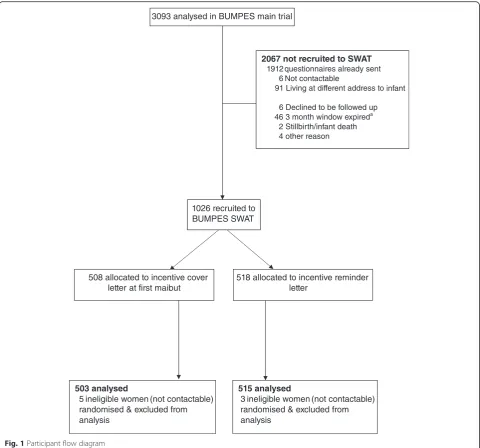
Randomisation to the incentive nested study started on 31st July 2014 and continued until all questionnaires and reminders had been sent (last letter sent 6th March 2015). The total number of women in the SWAT was 1026. Eight women were excluded from all analyses as it was discovered after they had been randomised to the SWAT that they had moved address (see Fig. 1).
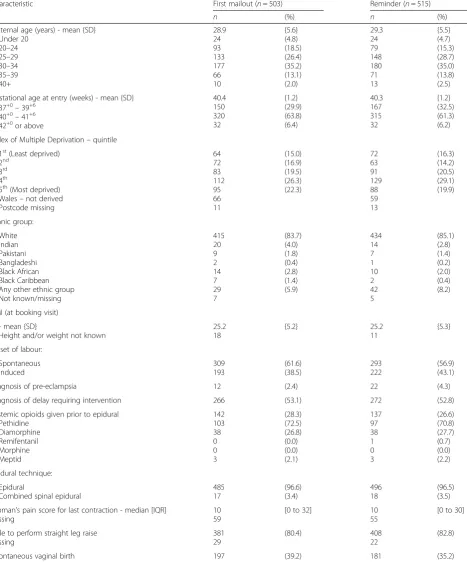
Balance between the SWAT trial arms in baseline characteristics was good. There were only small imbal-ances in onset of labour (spontaneous or induced), diag-nosis of pre-eclampsia, and spontaneous vaginal birth (the BUMPES primary outcome) (see Table 1).
The overall percentage of questionnaires returned before the SWAT started was considerably lower com-pared to that for participants included in the SWAT (1149/2067, 55.6 % vs. 743/1018, 73.0 %). This trend is also seen in the percentage returned without any reminder letters being sent (729/2067, 35.3 % vs. 476/1018, 46.8 %).
1.39). One in five of all questionnaires returned (152/ 743, 20.5 %) were completed online, with slightly fewer being returned online in the first mailout group com-pared to the reminder group (18.0 vs. 23.0 %). The mean difference in the total cost of the vouchers per partici-pant was £4.56 (95 % CI £4.02 to £5.11), with the cost being higher in the group receiving the incentive cover letter at first mailout (see Table 2).
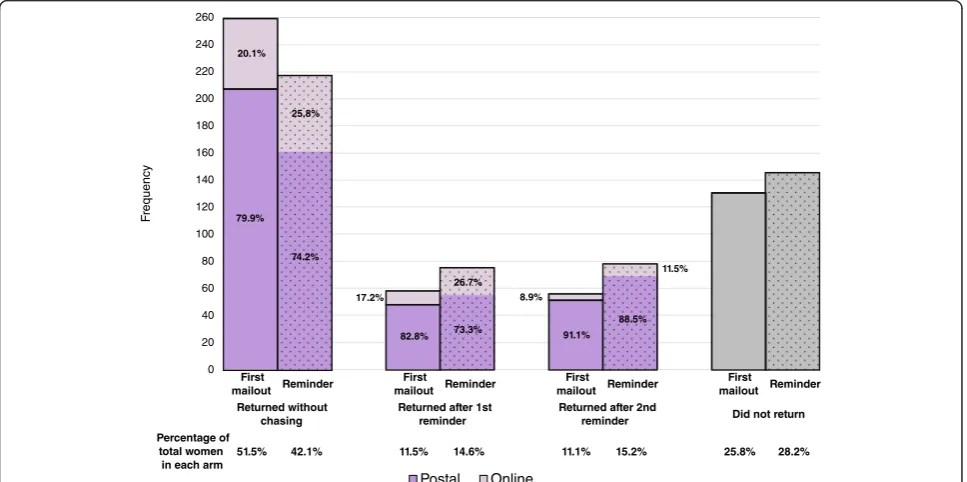
Figure 2 presents the percentage of questionnaires returned according to how many times a reminder letter was sent, and broken down by postal versus on-line completion. If a reminder was sent fewer women returned the questionnaire in the group receiving the promise of an incentive in the first mailout compared to those receiving a promise in the reminder letter
(11.5 vs. 14.6 % for the first reminder, and 8.9 vs 11.5 % for the second reminder), with consistently more women completing the questionnaire online in the reminder group.
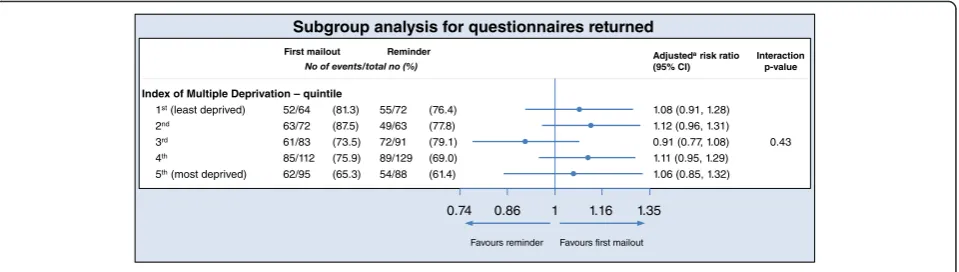
The pre-specified subgroup analysis is presented as a forest plot in Fig. 3. There is no evidence of heterogen-eity for IMD subgroups for the primary outcome of overall response rate (p= 0.43), suggesting no differential intervention effect across deprivation quintiles.
Discussion
In this study within a trial, there is no evidence to suggest that an offer of a monetary incentive at first mailout com-pared to only when a reminder letter is sent makes a sub-stantial difference to the overall return rate of a 1-year
Table 1Characteristics prior to study entry
Characteristic First mailout (n= 503) Reminder (n= 515)
n (%) n (%)
Maternal age (years) - mean {SD} Under 20
20–24 25–29 30–34 35–39 40+ 28.9 24 93 133 177 66 10 {5.6} (4.8) (18.5) (26.4) (35.2) (13.1) (2.0) 29.3 24 79 148 180 71 13 {5.5} (4.7) (15.3) (28.7) (35.0) (13.8) (2.5)
Gestational age at entry (weeks) - mean {SD} 37+0–39+6
40+0–41+6 42+0or above
40.4 150 320 32 {1.2} (29.9) (63.8) (6.4) 40.3 167 315 32 {1.2} (32.5) (61.3) (6.2)
Index of Multiple Deprivation–quintile
1st(Least deprived)
2nd 3rd
4th
5th(Most deprived)
Wales–not derived Postcode missing 64 72 83 112 95 66 11 (15.0) (16.9) (19.5) (26.3) (22.3) 72 63 91 129 88 59 13 (16.3) (14.2) (20.5) (29.1) (19.9) Ethnic group: White Indian Pakistani Bangladeshi Black African Black Caribbean Any other ethnic group Not known/missing 415 20 9 2 14 7 29 7 (83.7) (4.0) (1.8) (0.4) (2.8) (1.4) (5.9) 434 14 7 1 10 2 42 5 (85.1) (2.8) (1.4) (0.2) (2.0) (0.4) (8.2)
BMI (at booking visit)
- mean {SD}
Height and/or weight not known
25.2 18
{5.2} 25.2
11
{5.3}
Onset of labour:
Spontaneous Induced 309 193 (61.6) (38.5) 293 222 (56.9) (43.1)
Diagnosis of pre-eclampsia 12 (2.4) 22 (4.3)
Diagnosis of delay requiring intervention 266 (53.1) 272 (52.8)
Systemic opioids given prior to epidural Pethidine Diamorphine Remifentanil Morphine Meptid 142 103 38 0 0 3 (28.3) (72.5) (26.8) (0.0) (0.0) (2.1) 137 97 38 1 0 3 (26.6) (70.8) (27.7) (0.7) (0.0) (2.2) Epidural technique: Epidural
Combined spinal epidural
485 17 (96.6) (3.4) 496 18 (96.5) (3.5)
Woman’s pain score for last contraction - median [IQR] Missing
10 59
[0 to 32] 10
55
[0 to 30]
Able to perform straight leg raise Missing 381 29 (80.4) 408 22 (82.8)
Spontaneous vaginal birth 197 (39.2) 181 (35.2)
SDstandard deviation,IQRinterquartile range
follow-up questionnaire. Although there were slightly more questionnaires returned in the group receiving the offer at first mailout (an absolute difference of 3.4 %) the corresponding adjusted risk ratio of 1.03 (95 % CI 0.96 to 1.11) was not statistically significant at the 5 % level.
The return rate for women included in the SWAT com-pared to that before the SWAT was introduced demon-strated a marked improvement (absolute difference 17 %). Although this is not a randomised comparison, it is consist-ent with that found by Kenyon et al. [4] in a randomised study within a trial which showed an increase in the return rate of 11.7 % (95 % CI 4.7 % to 18.6 %) with the inclusion of a high-street voucher vs no voucher sent with a reminder let-ter to parents of seven year old children. In addition, a
systematic review [2] including the study by Kenyon et al., showed that the addition of a monetary incentive was more effective than no incentive at increasing response rates to postal questionnaires (RR 1.18, 95 % CI 1.09 to 1.28).
This SWAT used a £10 high-street gift voucher as a monetary incentive. The mean cost of vouchers per par-ticipant was greater in the group receiving the offer at first mailout (£7.50 vs £3.00). Coupled with the lack of evi-dence of a difference in the overall return rate, this would indicate that sending the offer of an incentive with a re-minder letter only is a cost-effective approach to improv-ing return rates. However, there is evidence to suggest that the return rate without requiring reminders is higher in the group for whom the incentive is offered in the first Table 2Outcomes
Outcome First mailout (n= 503) Reminder (n= 515) Effect measure
(95 % CI)
n % n %
Primary outcome
Questionnaire returned Postal
Online
373 306 67
(74.2) (82.0) (18.0)
370 285 85
(71.8) (77.0) (23.0)
RRa1.03 (0.96 to 1.11)
Secondary outcomes
Questionnaire returned without chasing by study team Postal
Online
259 207 52
(51.5) (79.9) (20.1)
217 161 56
(42.1) (74.2) (25.8)
RRa1.22 (1.07 to 1.39)
Total cost of vouchers, £ 3790 1530 MD 4.56 (4.02 to 5.11)
Cost of vouchers per participant, £–mean {SD} 7.53 {4.31} 2.97 {4.57}
a
Adjusted for centre
SDstandard deviation,RRrisk ratio,MDmean difference
Values are numbers (percentages) unless stated otherwise
mailout (absolute difference 9.4 %). The cost of adminis-tering the additional reminder letters was not calculated, but is a serious consideration that would need to be offset against the expected cost of the vouchers and could de-pend on the administration resources available in the trial team as well as the sample size of the study.
There are ethical issues to consider with the approach of only sending an offer of an incentive to those partici-pants who do not return their questionnaire promptly. Consideration should be given to the chance that partici-pants in a study may communicate with each other, and share their experiences regarding whether or not they received an incentive.
Conclusion
This is the first known SWAT to investigate the use of in-centives for improving questionnaire return rates in a population of first time mothers with infants around 1 year old. This study suggests that offering a monetary incentive when a reminder is required could be cost-effective de-pending on the sample size of the study and the resources available to administer the reminder letters.
Abbreviations
CI, confidence interval; IMD, index of multiple deprivation; IQR, interquartile range; RR, risk ratio; SD, standard deviation; SWAT, study within a trial
Acknowledgements
We thank all the women who participated in this study. The Epidural and Position Trial Collaborative Group:
Professor Debra Bick, Professor of Evidence Based Midwifery Practice, Kings College London
Dr Annette Briley, Consultant Midwife, Guys and St Thomas’s NHS Foundation Trust (replaced Geraldine O'Sullivan, Lead Clinician in Obstetric Anaesthesia in 2012)
Associate Professor Edmund Juszczak, Director, National Perinatal Epidemiology Unit, Oxford
Lynn Lynch, Senior Research Midwife
Professor Christine MacArthur, Professor of Maternal and Child Epidemiology, University of Birmingham
Dr Phillip Moore, Consultant Anaesthetist, University Hospital Birmingham NHS Trust
Professor Mary Nolan, Professor of Perinatal Education, University of Worcester
Dr Felicity Plaat, Lead Clinician & Consultant Anaesthetist, Queen Charlotte’s and the Hammersmith Hospital/Senior Lecturer, Imperial College London Dr Julia Sanders, Consultant Midwife/Reader in Midwifery, Cardiff University Professor Andrew Shennan, Professor of Obstetrics, Kings College London Dr Matt Wilson, Consultant in Obstetric Anaesthesia/Senior Lecturer in Anaesthesia, Sheffield Teaching Hospital/University of Sheffield Steve Hibbert, IT Manager, Comprehensive Clinical Trials Unit, University College London
Elizabeth Howden, Trial Manager, Comprehensive Clinical Trials Unit, University College London (until December 2013)
Sawretse Leslie, Trial Manager, Comprehensive Clinical Trials Unit, University College London (December 2013 until September 2015)
Amber Gibney, Data Manager, Comprehensive Clinical Trials Unit, University College London (until October 2013)
Claire Nelis, Statistician, National Perinatal Epidemiology Unit Clinical Trials Unit, University of Oxford (until June 2011)
Funding
The BUMPES Trial was funded by the UK National Institute for Health Research Health Technology Assessment programme (NIHR HTA) (project number 08.22.02). No additional funding was required to carry out this study. The NIHR HTA had no role in the design of the study and collection, analysis, and interpretation of data or in writing this paper.
Availability of data and materials
The dataset supporting the conclusions of this article is available from the last author upon request.
Authors' contributions
PH and PB developed the protocol and managed the trial. JB did the analyses. PH wrote the first draft of the manuscript and revised it with input from PB and JB. All authors read and approved the final manuscript.
Competing interests
The authors declare that they have no competing interests.
Consent for publication
Not applicable.
Ethics approval and consent to participate
Research ethics committee approval for the incentives study was granted by the National Research Ethics Service - Oxfordshire REC B on the 30th July 2014 (reference number 09/H0605/114).
For the BUMPES Trial women were provided with written information during pregnancy and again in labour. Women were able to provide written informed consent during the first stage of labour but were not eligible to be randomised until the second stage of labour had been diagnosed. No consent from participants was sought for the incentive study.
Author details
1Nuffield Department of Population Health, National Perinatal Epidemiology
7LF, UK.2Institute for Women’s Health, University College London, London,
UK.
Received: 31 March 2016 Accepted: 8 June 2016
References
1. Edwards PJ, Roberts I, Clarke MJ, DiGuiseppi C, Wentz R, Kwan I, Cooper R, Felix LM, Pratap S. Methods to increase response to postal and electronic questionnaires (Review). Cochrane Database of Systematic Reviews; 2009. p. 1-527. Issue 3. Art. No.: MR000008.
2. Brueton VC, Tierney J, Stenning S, Harding S, Meredith S, Nazareth I, Rait G. Strategies to improve retention in randomised trials. Cochrane Database Syst Rev; 2013. p. 1-126. Issue 12. Art. No.: MR000032.
3. Khadjesari Z, Murray E, Kalaitzaki E, White IR, McCambridge J, Thompson SG, Wallace P, Godfrey C. Impact and Costs of Incentives to Reduce Attrition in Online Trials: Two Randomized Controlled Trials. J Med Internet Res. 2011;13(1), e26.
4. Kenyon S, Pike K, Jones D, Taylor D, Salt A, Marlow N, Brocklehurst P. The effect of a monetary incentive on return of a postal health and development questionnaire: a randomised trial. BMC Health Serv Res. 2005;5:55. ISRCTN53994660.
5. Kahan BC, Morris TP. Analysis of multicentre trials with continuous outcomes: when and how should we account for centre effects? Stat Med. 2013;32:1136–49.
• We accept pre-submission inquiries
• Our selector tool helps you to find the most relevant journal
• We provide round the clock customer support
• Convenient online submission
• Thorough peer review
• Inclusion in PubMed and all major indexing services
• Maximum visibility for your research
Submit your manuscript at www.biomedcentral.com/submit