R E S E A R C H
Open Access
Effect of
Launaea procumbens
on thyroid
glands lipid peroxidation and hormonal
dysfunction: a randomized control trial
Rahmat Ali Khan
Abstract
Background:Launaea procumbens(Roxb.) Amin is traditionally used in Pakistan for the treatment of hormonal
disorders and oxidative stress. The present study was aimed to evaluate the efficacy ofLaunaea procumbens methanol extract (LPME) against KBrO3-induced oxidative stress and hormonal dysfunction in thyroid.
Methods:To examine the effects of LPME against the oxidative stress of KBrO3in thyroid tissue, 36 male albino rats were used. Protective effects of LPME were observed on thyroid hormonal levels, activities of antioxidant enzymes, lipid peroxidation (TBARS) and DNA damage.
Results:Treatment with KBrO3significantly(P < 0.01)reduced the levels of T3(55.13 ± 1.93) and T4(14.7 ± 1.78) and increased TSH (55.13 ± 1.93) levels. KBrO3exposure in rats reduced the activities of antioxidant enzymes viz.; CAT (1. 16 ± 0.08); SOD (12.0 ± 0.08), GST (17.7 ± 1.1) and GSR (54.3 ± 2.1) but increased lipid peroxidation (20.3 ± 0.71) and DNA (30.4 ± 2.0) damage. Co-administration of LPME significantly (P < 0.01) improved these alterations with respect to hormonal levels, activities of antioxidant enzymes and lipid peroxidation close to those seen in control rats.
Conclusion:These results suggest that LPME can protect thyroid tissue against oxidative damage, possibly through the antioxidant effects of its bioactive compounds.
Keywords:Launaea Procumbens, Oxidative stress, Antioxidant enzymes, T3, T4
Background
Potassium bromate (KBrO3)molecular weight 166 g/mol
is an oxidizing agent. KBrO3has been used is in
indus-tries for the formation of hair solution and cosmetics. Potassium bromate is formed as by product during ozonization of water, causes infections and has been classified as 2B group toxic chemical a probable human carcinogen [9]. KBrO3causes renal cell and thyroid
car-cinomas in rats, hamsters and mice when exposed chronically [15]. It has been investigated that potassium bromate produces free oxygen radicals which causes oxi-dative stress and DNA damages [20]. KBrO3 causes
nephrotoxicity and hepatotoxicity; decreases the tissue soluble proteins, antioxidant enzymes. The decrease of antioxidant enzymes are due to reactive oxygen species (ROS) produced by metabolism of potassium bromate.
Potassium bromate depleted GSH content in various tis-sues which causes decrease in phase II metabolizing en-zymes like GSH-Px and glutathione reductase (GSR). It also increases TBARS contents, causes lipid peroxidation and disrupts liver profile including γ-GT, ALP and pro-tein concentration [4]. Medicinal plants and nutraceuti-cals play important role in improving human health and phytomedicine [24]. These medicinal plants are com-posed of some bioactive phytochemical substances, regu-lates various physiological and molecular action in living organisms. Today many natural products extracted from medicinal plants are being tested for the presence of new drugs with new modes of pharmacological action. Special features of higher plants are their capacity to produce a large number of secondary metabolites [2].
Launaea procumbens (Roxb.)Amin. (Asteraceae) is an annual herb having simple leaves and yellow flowers found in waste places, vacant lots and in cultivated fields throughout Pakistan.Launaea procumbenswas used as a
Correspondence:[email protected]
Department of Biotechnology, Faculty of Biological Sciences, University of Science and Technology, Bannu, KPK, Pakistan
food and washing agent [27] rheumatism, galactogogues, and increases milk production. Eye redness and itchiness are treated with Launaeaprocumbens and also tradition-ally used in kidney (painful urination), liver and sexual dis-eases like gonorrhoea [23]. The antimicrobial activity of ethanolic and aqueous fractions of Launaeaprocumbens was checked against various bacterial and fungal patho-gens and reported that proved that ethanolic extract show maximum activity while theaqueous extract was inactive.
Launaea procumbensis generly classified as, Kingdom (Plantae), Order (Asterales), Family (Asteraceae), Tribe (Cichorieae), Genus (Launaea), and Species (procumbens). Chemical characterization showed that
Launaeaprocum-benscomposed of salicylic acid, vanllic acid, synergic acid, 2-methyl-resercinol, gallic acid and used against plant pathogenic fungi, nematocides and as allelopathic for in-hibition of plant growth [26].
In the present research work we arranged to investi-gate the protective effects of plant extracts against KBrO3induced thyroid dysfunctions in rats.
Methods
Plant collection and extraction
Launaea procumbens whole plant was collected from District Bannu during summer season 2016. After shad drying of plant at room temperature (25 °C), it was ground mechanically to get fine powder. Among powder, 1 kg of fine powder was socked in 70% methanol (1.5 L) and shacked randomly. After a week the extract was fil-tered viaWhatman filter paper No.1. Filtrate was concen-trated using rotary evaporator at 38 °C to get methanol crude extractand was kept at 4 °C in the refrigerator for further in vitro investigation.
Experimental procedure
Sprague-Dawley male rats were divided into sixteen groups (06 rats). Group 1 was control while Group II re-ceived DMSO and saline (0.20% aqueous NaCl solution) orally (Wednesday and Saturday) at a dose of 3 ml/kg b.w. Group III was administered high purity grade KBrO3 (99.9%) 20 mg/kg b.w in 0.20% aqueous NaCl
solution (Monday and Thursday) intragastrictly. Group IV and V were given 100; 200 mg/kg b.w of crude methanol extract (Wednesday and Saturday) of L.
pro-cumbens (LPME) after 48 h of KBrO3 treatment.
How-ever, Group VI was given only (LPME) at a dose of 200 mg/kg b.w (Wednesday and Saturday). All these treatments were given twice a week for 4 weeks. After completion of experiment all the animals were kept on normal feed without any treatment for at least 24 h be-fore the dissection of animals. Animals were given chloroform anesthesia after urine collection and dis-sected from ventral side. Blood was collected in the fal-con tube and centrifuged for serum and stored in refrigerator. Thyroid glandwas removed and washed in ice cold saline, dried with blotting paper and weighted. After weighing the tissues were divided into two por-tions. One part was cut off and stored in fixative sera for histology while the other portion was treated with liquid N2and stored at−70 °C for further biochemical and
mo-lecular studies.
Serum biochemistry
Serum level of various hormones viz.; T3, T4and TSHwere
calculated through 10,227-Czch Republic (IM1447-IM3286) Kit purchased from IMMUNOTECH Company.
Antioxidant oxidant profile
Eighty mg tissue of thyroid tissue was homogenized in phosphatebuffer for 20 min at 4 °C and centrifuged at 10,000 rpm to obtain supernatant. Total tissue protein [16] and antioxidant enzymes like CAT and POD [3], SOD [12],γ-GT [6], GSH [1], TBARS [11], GSH-Px, GSR and GST [19, 21, 22], H2O2,and QR [10] respectively.
Genotoxicity assays
DNA damages were assessed using protocol of Wu et al. [28] qualitatively as well as quantitatively.
Histopathalogical studies
Cellular changes were observed light microscope at 40×.
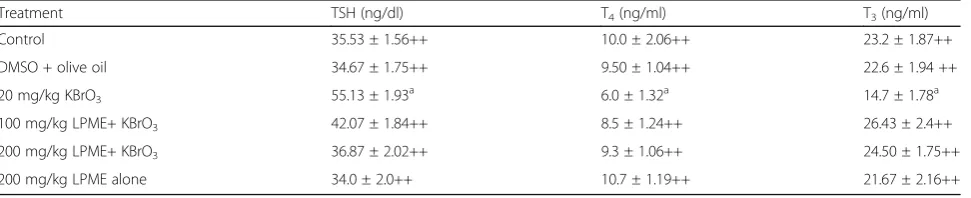
Table 1Serum biochemistry
Treatment TSH (ng/dl) T4(ng/ml) T3(ng/ml)
Control 35.53 ± 1.56++ 10.0 ± 2.06++ 23.2 ± 1.87++ DMSO + olive oil 34.67 ± 1.75++ 9.50 ± 1.04++ 22.6 ± 1.94 ++ 20 mg/kg KBrO3 55.13 ± 1.93a 6.0 ± 1.32a 14.7 ± 1.78a
100 mg/kg LPME+ KBrO3 42.07 ± 1.84++ 8.5 ± 1.24++ 26.43 ± 2.4++
200 mg/kg LPME+ KBrO3 36.87 ± 2.02++ 9.3 ± 1.06++ 24.50 ± 1.75++
200 mg/kg LPME alone 34.0 ± 2.0++ 10.7 ± 1.19++ 21.67 ± 2.16++
Mean ± SE (n= 6 number)
a
Statistical analysis
To determine the treatment effects one way analysis of variance was carried by computer software SPSS 13.0. Level of significance among the various treatments was determined by LSD at 0.05% level of probability.
Results
Serum Biochemistry
Effects of methanol fraction on the serum level of thy-roid hormones like TSH, T3and T4are shown in Table 1.
Treatment of KBrO3 caused reduction in the secretion
of T3, T4and increased the secretion of TSH
compara-tively to non treated rats. Co-administration of LPME significantly decreased the hormonal secretion in a dose dependent way.
Assessment of antioxidant profile
Antioxidant enzymes play a crucial role in detoxification of free radicals. KBrO3 induction in rats significantly
(p> 0.01) decreased the amount of tissue soluble protein and activities of first level antioxidant enzymes viz.; CAT, POD and SOD as compare to control. Post-administration of 100 and 200 mg/kg b.w., LPME mark-edly (p> 0.05) reduced the intoxication and reversed the changes to normal level (Table 2).
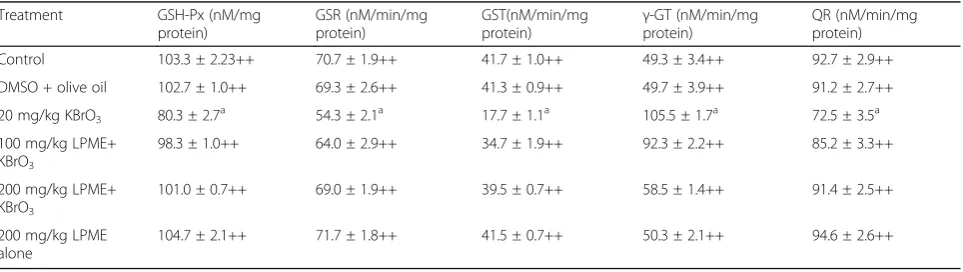
Table 3 revealed the activities of phase II metabolizing enzymes viz.; GST, GSH-Px, GSR, QR, andγ-GT in vari-ous groups. KBrO3-treatment in rats significantly
(p < 0.01) depleted the activity of GST, GSH-Px, GSR and QR, whereas increased the activity of γ-GT com-paratively to control group. The modulation were signifi-cantly (p > 0.01) reversed by the co-treatment of 100 and 200 mg/kg b.w., LPME near to control group.
TBARS, H2O2, GSH and tissue nitrite are key marker of
lipid peroxidation and cellular oxidative stress. KBrO3
ef-fects on the content of TBARS, H2O2, and GSH are shown in Table 4. Administration of 20 mg/kg b.w., of KBrO3
sig-nificantly (p < 0.01) reduced the concentrations of GSH while increased H2O2and TBARS as compare to control.
TBARS, tissue nitrite was significantly reduced (p < 0.01) by LPME decreased the level of TBARS at 100 and 200 mg/kg (p< 0.01) as compared to KBrO3group. Level
of GSH was improved while H2O2was reduced (p< 0.01)
by LPME at 100 mg/kg and 200 mg/kg b.w, respectively.
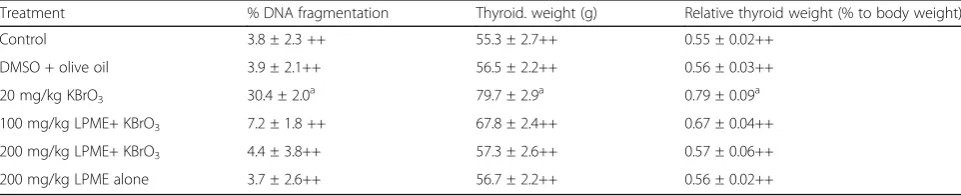
Thyroid weight and genotoxicity
Effects of LPME against KBrO3administration on rats
thyroid weight, relative tissue weight and % DNA fragmentation are shown in Table 5. KBrO3 caused a
significant (p < 0.01) increased in thyroid tissue
Table 3Effect of LPME on thyroid GST, GSR, GSH-Px,γ-GT and QR activity in rat
Treatment GSH-Px (nM/mg protein)
GSR (nM/min/mg protein)
GST(nM/min/mg protein) γ
-GT (nM/min/mg protein)
QR (nM/min/mg protein) Control 103.3 ± 2.23++ 70.7 ± 1.9++ 41.7 ± 1.0++ 49.3 ± 3.4++ 92.7 ± 2.9++ DMSO + olive oil 102.7 ± 1.0++ 69.3 ± 2.6++ 41.3 ± 0.9++ 49.7 ± 3.9++ 91.2 ± 2.7++ 20 mg/kg KBrO3 80.3 ± 2.7
a
54.3 ± 2.1a 17.7 ± 1.1a 105.5 ± 1.7a 72.5 ± 3.5a 100 mg/kg LPME+
KBrO3
98.3 ± 1.0++ 64.0 ± 2.9++ 34.7 ± 1.9++ 92.3 ± 2.2++ 85.2 ± 3.3++ 200 mg/kg LPME+
KBrO3
101.0 ± 0.7++ 69.0 ± 1.9++ 39.5 ± 0.7++ 58.5 ± 1.4++ 91.4 ± 2.5++ 200 mg/kg LPME
alone
104.7 ± 2.1++ 71.7 ± 1.8++ 41.5 ± 0.7++ 50.3 ± 2.1++ 94.6 ± 2.6++
Mean ± SE (n= 6 number)
Table 2Effect of LPME on tissue protein and antioxidant enzymes in thyroid of rat
Treatment Protein (μg/mg tissue) CAT (U/min) POD (U/min) SOD (U/mg protein) Control 0.57 ± 0.01++ 2.88 ± 0.09++ 8.0 ± 0.09++ 26.17 ± 0.77++ DMSO + olive oil 0.53 ± 0.01 ++ 2.90 ± 0.05++ 8.2 ± 0.05++ 25.0 ± 0.92++ 20 mg/kg KBrO3 0.35 ± 0.09a 1.16 ± 0.08a 6.3 ± 0.20a 12.0 ± 0.08a
100 mg/kg LPME+ KBrO3 0.58 ± 0.03++ 2.18 ± 0.04++ 7.0 ± 0.29++ 18.3 ± 0.60++
200 mg/kg LPME+ KBrO3 0.52 ± 0.01++ 2.62 ± 0.03++ 7.8 ± 0.04++ 20.10 ± 1.19++
200 mg/kg LPME alone 0.58 ± 0.01++ 2.93 ± 0.09++ 8.19 ± 0.08++ 28.0 ± 0.82++
Mean ± SE (n= 6 number)
a
weight and relative thyroid tissue weight and %DNA damages as compared to non treated control group. Post-treatment of LPME erased the toxic effect of KBrO3 on rat and reduced the thyroid weight, relative
tissue weight and % DNA fragmentation and signifi-cantly (p < 0.01) reversed towards control group.
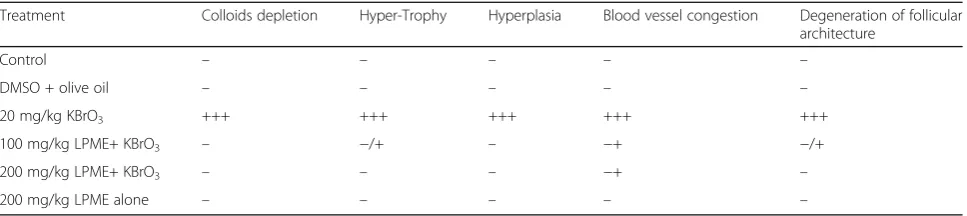
Histopathology of thyroid tissue
Microscopic examinations of various treated groups are shown in Table 6. Administration of KBrO3caused
col-loid depletion and cellular hypertrophy, blood vessels congestion, inflammatory cells infiltrations and follicular shape disruptionand follicular cells hyperplasia. Post-treatment with LPME significantly erased the injuries near to control rats.
Discussion
Thyroid hormones are essential for normal growth of or-gans, development, function and also regulate hepatocytes metabolism while liver in turn metabolizes thyroid hor-mones. It means that liver and thyroid hormones are con-nected with one another, dysfunction of one causes disturbance of other [17]. The hypothalamus releases thyrotrophic-releasing hormone (TRH), which stimulates pituitary gland to release thyroid stimulating hormone (TSH), which in turn promotes thyroid cells to produce thyroid hormones. When level of thyroid hormone is low than TSH and TRH are high, try to increase thyroid
hormone and causes risk of thyroid tumor in rats [5]. Our results showed that administration of KBrO3depleted the
secretion of thyroid hormones i.e., T3and T4and elevated
TSH level in serum of rats which was recovered by LPME. Similar results were reported by Hamidian et al.,[7].
The present study revealed that marked changes were in-duced by KBrO3 in absolute b.w and % increase in body
weight. KBrO3treatment of rats significantly decreased the
b.w, as compare to the non-treated control group. Our re-sults are similar to the findings reported by Farombi et al. [4] that KBrO3treatment to rat decreases the b.w non
sig-nificantly as compare to control group. Other study also de-termined that that low amount of KBrO3 is not toxic as
well as mutagenic (Yamaguchi et al., [29]. Increased lipid peroxidation and/or altered non-enzymatic and enzymatic antioxidant systems contributed oxidative stress. Various reports revealed that various enzymatic and non-enzymatic systems in mammalian cell have the capability to reduced ROS and other free radicals [25]. Toxicity induced with KBrO3results from its metabolism through CYP 450 into
free radicals that in turns leads to oxidative damages. In thyroid presence of cytochrome P450 enzyme system has not been established and injuries induced in thyroid are considered indirectly via the production of metabolites in other organs. In the present study induction of KBrO3 sig-nificantly alter the enzymatic level which was reversed by co-treatment of LPME. Similar reports were obtained by the exposure of KBrO3in rats which has been restored by Table 4Effect of LPME on thyroid GSH, TBARS, H2O2
Treatment TBARS (nM/min/mg protein GSH (μM/g tissue) H2O2(nM/min/mg tissue)
Control 12.8 ± 1.14++ 0.44 ± 0.02++ 0.86 ± 0.02++ DMSO + olive oil 13.0 ± 1.06++ 0.44 ± 0.03++ 0.85 ± 0.02++ 20 mg/kg KBrO3 20.3 ± 0.71a 0.67 ± 0.01a 1.03 ± 0.01a
100 mg/kg LPME+ KBrO3 15.3 ± 1.35++ 0.52 ± 0.04++ 0.94 ± 0.03++
200 mg/kg LPME+ KBrO3 13.3 ± 0.95++ 0.44 ± 0.05++ 0.88 ± 0.03++
200 mg/kg LPME alone 12.0 ± 0.76++ 0.40 ± 0.06++ 0.82 ± 0.02++
Mean ± SE (n = 6 number)
a
Indicate significance from the control group atP <0.01 probability level +, ++ Indicate significance from the KBrO3group atP <0.01 probability level
Table 5Effect of LPME on thyroid weight, relative thyroid weight and % DNA damages
Treatment % DNA fragmentation Thyroid. weight (g) Relative thyroid weight (% to body weight) Control 3.8 ± 2.3 ++ 55.3 ± 2.7++ 0.55 ± 0.02++
DMSO + olive oil 3.9 ± 2.1++ 56.5 ± 2.2++ 0.56 ± 0.03++ 20 mg/kg KBrO3 30.4 ± 2.0a 79.7 ± 2.9a 0.79 ± 0.09a
100 mg/kg LPME+ KBrO3 7.2 ± 1.8 ++ 67.8 ± 2.4++ 0.67 ± 0.04++
200 mg/kg LPME+ KBrO3 4.4 ± 3.8++ 57.3 ± 2.6++ 0.57 ± 0.06++
200 mg/kg LPME alone 3.7 ± 2.6++ 56.7 ± 2.2++ 0.56 ± 0.02++
Mean ± SE (n = 6 number)
a
supplementation of Ficus racemosa and a natural antioxidant kolaviron [14]. Free radicals react with DNA to form a mutagenic pirimedopurinone adduct (M1G) of deoxyguanosine [18] causes genomic instability and dam-ages. The data revealed that the treatment of KBrO3causes
significant oxidative DNA damage in thyroid tissue of rats which are reversed by LPME. Similar investigation was re-ported by Khan et al.,[13] during study of protective effects ofDigeramuricata. These results show that the extract con-tains bioactive phenolic and poly phenolic compounds which play important role in DNA repair. Data of the present study revealed that KBrO3treatment in rats caused
colloids depletion and hypertrophy, blood vessels conges-tion, follicular shape degradation and hyperplasia in thyroid. Treatment with LPME significantly erased the injuries. Similar observation was reported by Hooth et al. [8] during drinking water exposure of sodium chlorate in rats.
Abbreviations
GSR:Glutathione reductase; KBrO3: Potassium bromate; ROS: Reactive oxygen species; TRH: Thyrotrophic-releasing hormone; TSH: Thyroid stimulating hormone
Acknowledgements
We thankful to all my friends and college who guided me.
Funding
No funding is received for conduction of the study.
Availability of data and materials
Data and material will be available as per Journal rule.
Authors’contributions
RAK (ORCID ID: 0000–0003–0453-2090) completed experimentations and analysis of data as well as considerable influence to outset and design, analysis of data and drafting of manuscript.
Ethics approval and consent to participate
The study was conducted according to the protocol approved by ethical committee of the University.
Consent for publication
All the authors are agreeing to submit the paper in your esteemed Journal.
Publisher’s Note
Springer Nature remains neutral with regard to jurisdictional claims in published maps and institutional affiliations.
Received: 16 May 2017 Accepted: 31 August 2017
References
1. Carlberg I, Mannervik EB. Glutathione level in rat brain. J Biol Chem. 1975; 250:4475–80.
2. Castello MC, Phatak A, Chandra N, Sharon M. Antimicrobial activity of crude extracts from plant parts and corresponding calli ofBixaorellanaL. Indian J Exp Biol. 2002:1378–81.
3. Chance B, Maehly AC. Assay of catalase and peroxidases. Methods Enzymol. 1955;11:764–75.
4. Farombi EO, Alabi MC, Akuru TO. Kolaviron modulates cellular redox status and impairment of membrane protein activities induced by potassium bromate (KBrO3) in rats. Pharmacol Res. 2002;45:63–8.
5. Glatt CM, Ouyang M, Welsh W, Green JW, Connor JO, Frame SR, Everds NE, Piondexter G, Snajdr S, Delker DA. Molecular charterization of thyroid toxicity; anchoring gene expression profile to biochemical and pathological end points. Environ Health Perspect. 2005;113:1354–61.
6. Habig WH, Pabst MJ, Jakoby WB. Glutathione-S-transferases: the first enzymatic step in mercapturic acid formation. J Biol Chem. 1974;249:7130–9.
7. Hamidian G, Alboghobeish N, Varzi NH, Esmaeilzadeh S. Unbiased stereological and histological study of silymarin effects on hamster adrenocortical structure in response to an exogenous glucocorticoid. J Cell Anim Biol. 2009;3:107–12.
8. Hooth MJ, Deagelo AB, George MH, Gaillard ET, Travlos GS, Boorman GA, Wolf DC. Subchronic sodium chlorate exposure in drinking water results in concentration dependent increase in rat thyroid follicular cell hyperplasia. J Toxicol Pathol. 2001;29:250–62.
9. IARC/World Health Organisation. IARC Monographs on the evaluation of the carcinogenic risk of chemicals to humans. Some naturally occurring and synthetic food components, furocoumarins and ultraviolet radiation. Lyon, France: IARC publication no. 40; 1986. p. 207–20.
10. Iqbal M, Sharma SD, Zadeh HR, Hasan N, Abdulla M, Athar M. Glutathione metabolizing enzymes and oxidative stress in ferric nitrilotriacetate (Fe-NTA) mediated hepatic injury. Redox Rep. 1996;2:385–91.
11. Jollow DJ, Mitchell JR, Zampaglione N, Gillete JR. Bromobenzene induced liver necrosis. Protective role of glutathione and evidence for 3, 4-bromobenzene oxide as a hepatotoxic metabolite. Pharmacology. 1974;11:151–69.
12. Kakkar P, Das B, Viswanathan PN. A modified spectrophotometric assay of superoxide dimutase. Indian J Biochem Biophys. 1984;21:130–2.
13. Khan MR, Ahmed D. Protective effects ofDigeramuricata(L.)Mart.On testis against oxidative stress of carbon tetrachloride in rat. Food Chem Toxicol. 2009;47:1393–9. 14. Khan N, Sultana S. Chemomodulatory effect ofFicusracemosaextract
against chemically induced renal carcinogenesis and oxidative damage response in Wister rats. Life Sci. 2005;77:1194–210.
15. Kurokawa Y, Maekawa A, Takahashi M, Hayashi Y. Toxicity and carcinogenicity of potassium bromate-a new renal carcinogen. Environ Health Perspect. 1990;87:309–35.
Table 6Effect of LPME on thyroid histopathology
Treatment Colloids depletion Hyper-Trophy Hyperplasia Blood vessel congestion Degeneration of follicular architecture
Control – – – – –
DMSO + olive oil – – – – –
20 mg/kg KBrO3 +++ +++ +++ +++ +++
100 mg/kg LPME+ KBrO3 – −/+ – −+ −/+
200 mg/kg LPME+ KBrO3 – – – −+ –
200 mg/kg LPME alone – – – – –
17. Malik R, Hodgson H. The relationship between thyroid gland and the liver. J Med. 2002;95:559–69.
18. Marnett JL. Oxyridicals and DNA damage. Carcinogenesis. 2000;21:361–70. 19. Mohandas J, Marshal JJ, Duggin GG, Horvath JS, Tiller DJ. Differential distribution
of glutathione and glutathione-related enzymes in rabbit kidney. Possible implications in analgesic nephropathy. Biochem Pharmacol. 1984;33:1801–7. 20. Murata M, Bansho Y, Inoue S, Ito K, Ohnishi S, Midorikawa K, Kawanashi S.
Requirement of glutathione and cysteine in guanine-specific oxidation of DNA by carcinogenic potassium bromate. Chem Res Toxicol. 2001;14:678–85. 21. Orlowaski M, Miester A.γ-Glutamylcyclotransferase distribution, isozymic
forms, and specificity. J Biol Chem. 1973;248:2836–44.
22. Pick A, Keisari Y. Superoxide anion and hydrogen peroxide production by chemically elicited peritoneal macrophages-induction by multiple nonphagocytotic stimuli. Cell Immunol. 1981;59:301–18.
23. Qureshi R, Raza BG. Ethnobotany of plants used by the Thari people of Nara Desert, Pakistan. Fitoterapia. 2008;79:468–73.
24. Scicchitano P, Cameli M, Maiello M, Modesti PA, Muiesan ML, Novo S. Nutraceuticals and dyslipidaemia: beyond the common therapeutics. J Funct Foods. 2014;6:11–32.
25. Sahreen S, Khan MR, Khan RA. Evaluation of antioxidant profile of various solvent extracts ofCarissa opacaleaves: an edible plant. Chem Central J. 2017;(11):83–11.
26. Shaukat SS, Siddiqui IA, Nasim AI. Nematocidal, allelophatic and antifugal potential ofLaunaeaprocumbens. PakistanJ Plant Pathol. 2003;2:181–93. 27. Wazir SM, Saima S, Dasti AA, Subhan S. Ethanobotnical importance of salt
range species of district karak, Pakistan. PakistanJ Plant Sci. 2007;13:29–31. 28. Wu B, Ootani A, Iwakiri R, Sakata Y, Fujise T, Amemori S, Yokoyama F,
Tsunada S, Fujimoto K. T cell deficiency leads to liver carcinogenesis in Azoxymethane-treated rats. Exp Biol Med. 2005;231:91–8.
29. Yamaguchi T, Wei M, Hagihara N, Omori M, Wanibuchi H, Fukushima S. Lack of mutagenic and toxic effects of low dose potassium bromate on kidneys in the big blue rat. Mutat Res. 2008;652:1–11.
• We accept pre-submission inquiries
• Our selector tool helps you to find the most relevant journal • We provide round the clock customer support
• Convenient online submission • Thorough peer review
• Inclusion in PubMed and all major indexing services • Maximum visibility for your research
Submit your manuscript at www.biomedcentral.com/submit