138
Evaluation of hypoglycemic and antihyperglycemic effects of
Luffa
cylindrica
fruit extract in rats
Manjusha Hazra1, Sriparna KunduSen2*, Sanjib Bhattacharya3, Pallab K Haldar2, Malaya Gupta2, Upal K Mazumder2
1. Netaji Subhas Chandra Bose Institute of Pharmacy, Chakdaha, Nadia, India 2. Department of Pharmaceutical Technology, Jadavpur University, Kolkata, India 3. Bengal School of Technology (A College of Pharmacy), Sugandha, Hooghly, India
*Corresponding author: [email protected]
ABSTRACT:
The present study aimed to assess the hypoglycemic and antihyperglycemic activity of fruit methanolic extract of Luffa cylindrica fruits. The effect of methanolic fruit extract on oral glucose tolerance and its effect on normoglycemic rats were studied. The same was tested for antihyperglycemic activity in alloxan induced hyperglycemic rats at the two dose levels 200 and 400 mg/kg body weight p.o. The serum biochemical parameters were also assessed in the alloxin induced experimental animals. The methanolic extract of Luffa cylindrica exhibited remarkable antihyperglycemic activity. The treatment of diabetic rats with methanolic extract of the test plant improved the serum biochemical parameters and the activities were found to be dose dependent. The present study concludes that Luffa cylindrica fruit extract demonstrated promising antidiabetic activity in alloxan-induced diabetic Wistar rats.
Key words: Alloxan, antihyperglycemic, Luffa cylindrica, fruit, diabetes.
INTRODUCTION:
life-139
style, unhealthy dietary-habit, genetic predisposition are the key factor that have conspired to create current worldwide epidemic of type 2 diabetes, an acquired syndrome of elevated blood glucose. The drugs which are available for therapy of diabetes are tolbutamide, chlorpropamide, glipizide, repaglinide, metformin, phenformin, pioglitazone, rosiglitazone etc. [1] But the traditional medicinal plants are used throughout the World for treatment of diabetes mellitus, because the plants drugs are considered to be less toxic and free from side effects than synthetic ones. [2] According to folklore prevalent in the South Bengal region of India, Luffa cylindrica
fruits; locally known as Dhundul, are known for their blood sugar lowering capacity.
Fruits of Luffa cylindrica Linn. belonging to the family Cucurbitaceae are commonly called sponge gourd and its Bengali name is Dhundul. It is found as wild in wasteland especially along the coastal area and also cultivated throughout Indian subcontinent.
Luffa cylindrica has been reported to possess both medicinal and nutritional properties. The seeds have been used in the treatment of asthma, sinusitis, and fever. [3] It has also been reported that an abortificient protein such as luffaculin which has ribosome-inhibiting properties on the replication of HIV infected lymphocyte and phagocyte cells explain its potential as an therapeutic agent for AIDS. [4,5] It has been reported that juice extracted from its stem has been used in the treatment of respiratory disorders and seed has emetic action. [6] The present study was attempted to evaluate the oral hypoglycemic and antihyperglycemic activities of methanol extract of Luffa cylindrica
fruit in alloxan-induced diabetic rats.
MATERIALS AND METHODS: Plant material
The ripe fruits of the plant Luffa cylindrica were collected in the month of September 2010 from Nadia district, West Bengal, India. The plant was taxonomically identified from the Cental National Herbarium, Botanical Survey of India, Shibpur, Howrah, India. The voucher plant specimen was stored in our laboratory for further reference.
Preparation of extracts
140
Preliminary phytochemical screeningThe methanolic extract of Luffa cylindrica was screened for the presence of various phyto- constituents like alkaloids, glycosides, flavonoides, tannins, terpenoids, sterols, saponins, fats and sugars were performed. [7,8]
Animals
Healthy male Wister albino rats of body weight 150-180 g and male Swiss albino mice of 27-30g, with no prior history of drug treatment, were used for the present studies. The animals were fed with commercial pellet diet and water ad libitum. The animals were acclimatized to laboratory hygiene conditions for 10 days before the start of the experiment.
Acute toxicity study
The acute toxicity of the extract was determined according to the OECD guideline No. 421. The mice (27-30 g) were used for this study. After the sighting study, starting dose of 3000 mg/kg i.p. of the test samples was given to various groups containing six animals in each group. The treated animals were under observation for 14 days, for mortality and general behavior. No death was observed till the end of the study. The test extract was found to be safe up to the dose of 3000 mg/kg.
Oral hypoglycemic activity
The rats were classified into four groups (n = 6). Group 1 was kept as control, and was given a single dose of 0.5ml/100g of 0.9% saline solution; group 2 was treated with glibenclamide (0.5 mg/kg) hypoglycemic reference drug. Group 3 and 4 were treated with the methanolic extract in dose levels of 200 and 400 mg/kg p.o as mentioned in Table 1. Blood samples were collected from the tail tip at 0 (before oral administration), 1, 2 and 3 h after administration. The blood sugar level was measured using ‘Accu-chek Active’ Test strip in Accu-chek Active Test meter.
Effect on Luffa cylindrica extract on oral glucose tolerance
141
glucose was determined after 30 minutes, 1, 2, and 3 h of the glucose loading. The blood sugar level was measured using ‘Accu-chek Active’ Test strip in Accu-chek Active Test meter.
Evaluation of antihyperglycemic activity
Diabetes mellitus was induced in male Wistar albino rats (150-180 g) by a single i.p. injection of 160 mg/kg body weight of alloxan monohydrate in 0.9% w/v saline solution to overnight fasted rats. The rats were kept for next 24 h on 10% glucose solution bottle, in their cages, to prevent the hypoglycemia. [9] After 3 days of the injection, the blood sample were drawn from tail vain of fasting animals and fasting glucose levels were determined to confirm the development of diabetes (above 140 mg/dl). [10,11] The diabetic rats were then divided into five groups, each containing six animals. Group 1 served as a control and received vehicle (0.5 ml/100 g normal saline p.o.). Group 2 comprising of alloxan induced diabetic rats served as a negative control. Group 3 was treated with glibenclamide (0.5 mg/kg, p.o.). Groups 4 and 5 consisted of diabetic rats which were treated with the methanol extract at the two dose levels of 200 and 400 mg/kg as mentioned in Table 3. The administration of extract was continued for 15 days, once daily and blood glucose was measured 5th, 8th and 15th days after
administration. After 15 days the serum biochemical parameters were determined.
Collection of blood and estimation of serum biochemical parameters
After 15 days the animals were sacrificed and blood was collected from the retro- orbital plexus of the rats. Then serum was separated by centrifugation (3000 rpm, 2 min) at room temperature. The serum directly used for estimating the ALP, SGOT and SGPT levels by using the estimation kits marketed by Cogent and manufactured by Span Diagnostics, Surat, India. The results are summarized in Table 4.
Statistical analysis
All data were expressed as mean ± standard error of mean (SEM.) and analyzed by ANOVA and Student’s t test. Differences between groups were considered significant at
P< 0.05 levels.
RESULTS:
Preliminary phytochemical screening
142
Acute toxicityAcute toxicity studies revealed the non-toxic nature of the fruit extract of Luffa cylindrica . There was no death or lethal reactions up to a dose of 3000 mg/kg body weight in mice. All the animals were alive, healthy, and active during the entire observation period.
The effect of extract in fasted normal rats
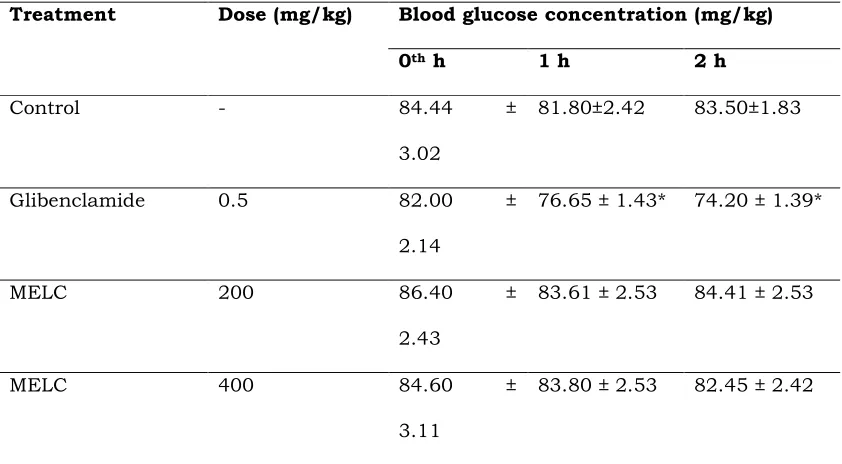
The methanolic extract of Luffa cylindrica (MELC) was subjected to determine the hypoglycemic activity at the dose levels (200 and 400 mg/kg) in normal fasted rats without any prior history of drug treatment and the results are presented in Table 1. The MELC showed the hypoglycemic activity in normal rats.
Table 1: Effects of methanolic extract of Luffa cylindrica (MELC) in fasted normal rats.
Treatment Dose (mg/kg) Blood glucose concentration (mg/kg)
0th h 1 h 2 h
Control - 84.44 ±
3.02
81.80±2.42 83.50±1.83
Glibenclamide 0.5 82.00 ±
2.14
76.65 ± 1.43* 74.20 ± 1.39*
MELC 200 86.40 ±
2.43
83.61 ± 2.53 84.41 ± 2.53
MELC 400 84.60 ±
3.11
83.80 ± 2.53 82.45 ± 2.42
Data are mean ± SEM (n = 6), *p <0.05 when compared against the control group.
The effect of extract in glucose tolerance in rats
143
Table 2: Effect of methanolic extract of Luffa cylindrica (MELC) in glucose loaded rats.
Treatments
Dose (mg/kg)
Blood glucose concentration (mg/dl)
0 h 0.5 h 1 h 2 h
Control - 82.75 ±
1.41
98.50 ± 2.12 108.50 ± 0.70 104.50 ± 0.70
Glibenclamide 0.5 90.20 ±
3.59
105.21 ± 3.49 92.22 ± 4.61* 78.41 ± 4.21*
MELC 200 89.12 ±
5.66
107.63 ± 9.89* 112.50 ± 7.78* 104.12 ± 5.65
MELC 400 89.50 ±
2.12
123.52 ± 26.87* 137.45 ± 31.11* 122.50 ±17.68*
Data are mean ± SEM (n = 6), *p <0.05 when compared against the control group.
The effect of extract in alloxanised hyperglycemic rats
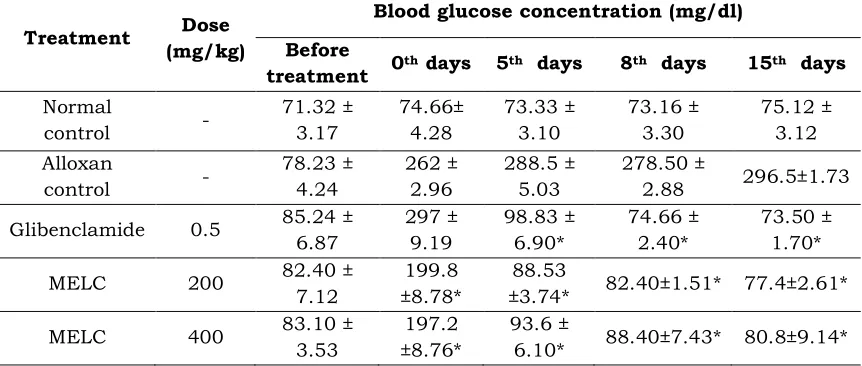
A significant reduction in blood glucose level after administration of methanolic extract (200 and 400 mg/kg body weight) in the diabetic rats after 5th, 8th and 15th days
treatment was observed. The methanolic extract showed a dose dependent reduction in blood glucose levels and this hypoglycemic effect was comparable with that of standard oral hypoglycemic agent, glibenclamide. Therefore 200 mg/kg is more effective than 400 mg/kg in decreasing the blood glucose levels but the analysis of the biochemical parameter data shows that 400 mg/kg is more efficacious than 200 mg/kg (Table 3).
Table 3: Effect of methanolic extract of Luffa cylindrica (MELC) in normal and alloxanised hyperglycemic rats.
Treatment Dose (mg/kg)
Blood glucose concentration (mg/dl) Before
treatment 0
th days 5th days 8th days 15th days
Normal
control -
71.32 ± 3.17 74.66± 4.28 73.33 ± 3.10 73.16 ± 3.30 75.12 ± 3.12 Alloxan
control -
78.23 ± 4.24 262 ± 2.96 288.5 ± 5.03 278.50 ±
2.88 296.5±1.73
Glibenclamide 0.5 85.24 ±
6.87 297 ± 9.19 98.83 ± 6.90* 74.66 ± 2.40* 73.50 ± 1.70*
MELC 200 82.40 ±
7.12
199.8 ±8.78*
88.53
±3.74* 82.40±1.51* 77.4±2.61*
MELC 400 83.10 ±
3.53
197.2 ±8.76*
93.6 ±
144
Data are mean ± SEM (n = 6), *p <0.05 when compared against the alloxan control group.
Serum biochemical parameters
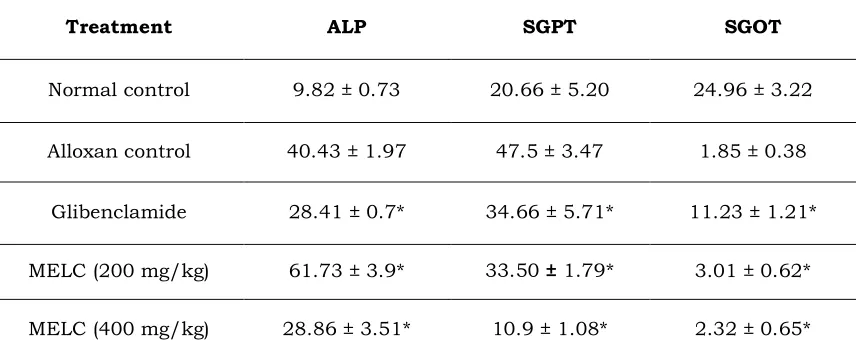
The serum biochemical parameters of alloxan control rats were found to be markedly disrupted as compared to normal control group rats. MELC treatment although could not normalize them but effected some improvement their values towards normal (Table 4).
Table 4: Effect of methanolic extract of Luffa cylindrica (MELC) on serum biochemical parameters of normal and alloxanised hyperglycemic rats.
Treatment ALP SGPT SGOT
Normal control 9.82 ± 0.73 20.66 ± 5.20 24.96 ± 3.22
Alloxan control 40.43 ± 1.97 47.5 ± 3.47 1.85 ± 0.38
Glibenclamide 28.41 ± 0.7* 34.66 ± 5.71* 11.23 ± 1.21*
MELC (200 mg/kg) 61.73 ± 3.9* 33.50 ± 1.79* 3.01 ± 0.62*
MELC (400 mg/kg) 28.86 ± 3.51* 10.9 ± 1.08* 2.32 ± 0.65*
Data are mean ± SEM (n = 6), *p <0.05 when compared against the alloxan control group.
DISCUSSION:
145
The present work was aimed to study the oral hypoglycemic and antihyperglycemic activity of methanol extract of Luffa cylindrica fruit (MELC) in alloxan-induced diabetic rats. The results of this study revealed that MELC at the doses of 200 and 400 mg/kg body weight orally, dose dependently demonstrated effective hypoglycemic and antihyperglycemic activity in normoglycemic, glucose overloaded as well as alloxan induced diabetic rats; and improved the altered serum biochemical parameters towards normal.
Preliminary phytochemical analysis of the methanol extract of Luffa cylindrica showed that the fruit has phytochmicals like steroids, alkaloids, deoxysugars, pentose sugars and saponins. Acute toxicity studies revealed that the plant extract of Luffa cylindrica is not lethal and does not cause death till a dose of 3000 mg/kg in mice, indicating its safety and non toxicity in rodents.
Alloxan is the most commonly employed agent for the induction of experimental diabetic animal models of human insulin dependent diabetes mellitus. In this study, significant hyperglycemia was achieved within 48 hours after alloxan (160 mg/kg body weight i.p.) induction. Alloxan induced diabetic rats with more than 140 mg/dl of blood glucose level were considered to be diabetic and used for the study.
The studies on antidiabetic activity in alloxanised rats show the significant reduction of blood glucose levels. The comparable effect of the extract with glibenclemide may suggest similar mode of action. Since alloxan permanently destroys the β cells the blood sugar level in alloxanised rats is permanently increased. On the basis of the above experimental evidences it is possible that the phytochemicals present in MELC are responsible for the observed antihyperglycemic activity.
CONCLUSION:
146
REFERENCES:
1. Tripathi, K.D. Essentials of Medical Pharmacology. 5th ed. Jaypee Brothers Medical
Publishers Pvt. Ltd.: New Delhi, 2003.
2. Menon V.P., Prince P.S., Pari L. Hypoglycemic activity of Syzigium cumini seeds: effect on lipid peroxidation on alloxan diabetic rats. J. Ethnopharmacol. 1998; 61: 1-7.
3. Stephens J.M. Gourd Luffa: Luffa cylindrica, Luffa aegyptica, Luffa acutangula. J. Hortic. Sci. 2003; 3: 19-21.
4. Ng T.B., Z Feng, Li W.W., Yeung H.W. Improved isolation and further characterization of beta trichosithin: A ribosome inactivating and abortifacient protein from tubers of Trichosanthes cucumeroicles (Cucurbitaceae). Int. J. Biochem. 1991; 23: 561-567.
5. McGrath M.S., Hwang S.E., Caldwell S.E., Liston J.D. GLQ 223: An inhibitor of human immunodeficiency virus replication in acutely and chemically infected cells of lymphocyte and mononuclear phagocyte lineage. Natl. Acad. Sci. 1989; 86: 2844-2848.
6. Bailey, L.H. The Garden of Gourds. 2nd ed. Macmillan: London, 1989.
7. Kokate, C.K., Purohit, A.P., Gokhale, S.B. Text Book of Pharmacognosy. 33rd ed.
Nirali Prakashan: Pune, 2001.
8. Harborne, J.B. Phytochemical Methods. Chapman and Hall: London, 1998.
9. Gupta N.P., Solis, N.G., Avella M.E., Sanchez E. Hypoglycemic activity of Neurollena lobata. J. Ethanopharmacol. 1984; 10: 323-327.
10. Jamal A.A., Issa A.A., Mohammad H.H. Hypoglycaemic and antihyperglycaemic effects of Trigonella foenum-graecum leaf in normal and alloxan induced diabetic rats. J. Ethnopharmacol. 1997; 58: 149-155.
11. Sabu M.C., Subburaju T. Effects of Cassia auriculata Linn. on serum glucose level, glucose utilization by isolated rat hemidiaphragm. J. Ethnopharmacol. 2002; 80: 203-206.