Pavan Kumar Potturi
MSN Laboratories Pvt Ltd, Hyderabad Email: [email protected] Address for correspondence
Access this article online www.japer.in
Solid State Compatibilty Studies between Budesonide with Some
Excipients by using HPLC
1.0 INTRODUCTION
The assessment of possible incompatibilities between an active drug substance and different categories of excipients forms an important role as a part of the preformulation stage to identify product’s stability as well as its reproducibility with ensured therapeutic efficacy [1] . Although these excipients selected for pharmaceutical dosage forms with no pharmacological action [2] . but these may participate in physical and chemical interaction and cause serious degradation of active pharmaceutical ingredients with poor dissolution rate and non- uniformity of doseforms [3] . Over the decade, various methods have been developed to identify drug excipients compatibility as a part of formulation development process [4] . The functional groups within the drug molecule may change the activity of each other, hence alters the therapeutic affectivity [5,6] . The routine drug-excipient interactions can be studied by two methods, i.e. DSC and quantitative assay by HPLC after isothermal stress tests (IST). DSC allows the fast evaluation of possible
incompatibilities; however, the interpretation of DSC results is not always easy. Hence, the DSC results must be interpreted carefully and some complementary techniques, such as Fourier transform infrared (FTIR) spectroscopy, microscopy or powder X-ray powder diffractometry (pXRD), provides data indicating alteration in position of functional groups of drug in physical mixtures and can be useful in avoiding misleading conclusions [7,9-13]. The IST involves storage of drug-excipient blends with or without moisture at high temperature to accelerate drug ageing and interaction with excipients. The normal duration of study could be around 3-4 weeks(8). These analyses can be applied to provide information on physicochemical properties of substances with respect to compatibility by predicting future problems of stability prior to the final solid dosage formulation [14] . Budesonide is a mixture of C-22S (epimer A) and C-22R (epimer B) epimers of 16α, 17-[(1RS)-butylidenebis (oxy)]-11β, 21-dihydroxypregna-1, 4-diene-3, 20-dione used in inflammatory bowel disease. One of the most common uses of Budesonide is in ulcerative colitis and Crohn’s disease.
The aim of this study was to prepare budesonide (BUD) enteric pellets containing capsule formulations and determine the possible interactions between
Compatibility studies are essential for preformulation studies of formulation development. In the present study, HPLC method used for the investigation and to determine the possible interactions between Budesonide and some excipients like sugar spheres , Ethyl cellulose (Aquacoat ECD 30), acetyl tributyl citrate (ATBC), Methacrylic acid copolymer C dispersion (Eudrgit L30D55), triethyl citrate (TEC), polysorbate 80 and talc when stored in elevated temperature conditions. The drug and excipient binary mixtures were evaluated by examining the pure Budesonide or Budesonide-excipient powder mixtures which were stored under different conditions (40°C/75%RH & 25°C/60%RH after 30 days) using High Performance Liquid Chromatography(HPLC). The results demonstrate the suitability of Budesonide with sugar spheres , Ethyl cellulose (Aquacoat ECD 30), acetyl tributyl citrate (ATBC), Methacrylic acid copolymer C dispersion (Eudrgit L30D55), triethyl citrate (TEC), polysorbate 80 and talc when stored in elevated temperature conditions.
Keywords: Budesonide, Compatibility Studies, HPLC, Preformulation Studies
ABSTRACT ABSTRACT ABSTRACT ABSTRACT Pavan Kumar Potturi1#,
Yajamans Sudhakar2 1 Formulation Research and Development, MSN Laboratories Pvt Ltd, Hyderabad. 2 Govt.Womens Polytechnic college, Kadapa.
budesonide and some excipients sugar spheres, Ethyl cellulose (Aquacoat ECD 30), acetyl tributyl citrate (ATBC), Methacrylic acid copolymer C dispersion (Eudrgit L30D55), triethyl citrate (TEC), polysorbate 80 and talc which are commonly used in solid dosage forms by using High performance liquid chromatography(HPLC) quantitative methods.
2.0 MATERIALS AND METHODS:
2.1 Materials:
Budesonide was obtained from aarti industries ltd, Mumbai. Sugar spheres were supplied from JRS pharma, Germany, Ethyl cellulose aqueous dispersion (Aquacoat ECD 30) was procured from FMC BioPolymer,Mumbai, Acetyl tributyl citrate was procured from Vertellus, Mumbai, Talc was procured from Luzenac Val chisone, Hyderabad, Methacrylic acid copolymer dispersion type C
(Eudragit L 30D 55) was procured from Evonik industries, Mumbai, and triethyl citrate and polysorbate 80 were procured from Merck, Mumbai. All other chemicals were obtained commercially as HPLC or analytical grade reagents.
2.2 Methods:
2.2.1 Preparation of Physical mixtures:
The selection of adequate excipients for the formulation was based on the characteristics of the drug and its compatibility with other components. Ethyl cellulose is widely used in pharmaceutical formulations as a polymer(Dissolution rate retardent), Acetyl tributyl citrate and triethyl citrate were widely used in oral pharmaceuticals as a plasticizer in film coating of pellets and tablet formulations. Talc is used as glident and lubricant in the pellets formulation and Methacrylic acid copolymer dispersion type C (Eudragit L 30D 55) is widely used in delayed and modified release dosage froms to retard the release in acidic stage.
The drug: excipient were firstly homogeneously mixed with a pestle in a mortar, and blended in a laboratory powder mixer and then powder mixture was placed in a glass vial and stoppered the vial with rubber
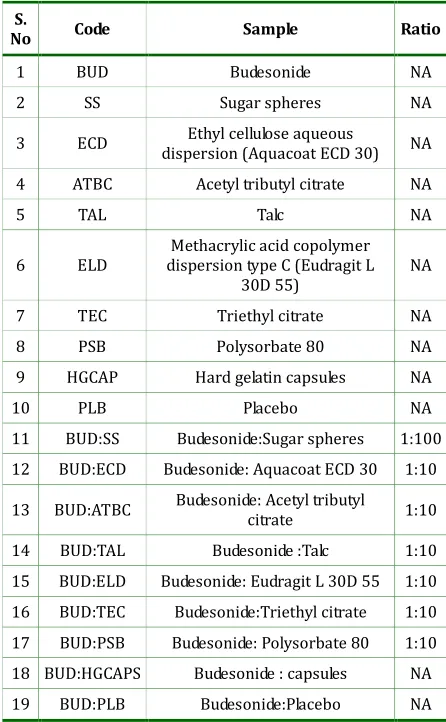
stopper. The composition of the physical mixtures are shown in Table 1. These vials were loaded into 40±2°C/75±5% RH and 25±2°C/60±5% RH storage conditions in open and close conditions of glass vials. All analyses were performed using a sample of Budesonide, single excipients and binary mixtures prepared as it is described above.
S.
No Code Sample Ratio
1 BUD Budesonide NA
2 SS Sugar spheres NA
3 ECD Ethyl cellulose aqueous
dispersion (Aquacoat ECD 30) NA
4 ATBC Acetyl tributyl citrate NA
5 TAL Talc NA
6 ELD
Methacrylic acid copolymer dispersion type C (Eudragit L
30D 55)
NA
7 TEC Triethyl citrate NA
8 PSB Polysorbate 80 NA
9 HGCAP Hard gelatin capsules NA
10 PLB Placebo NA
11 BUD:SS Budesonide:Sugar spheres 1:100
12 BUD:ECD Budesonide: Aquacoat ECD 30 1:10
13 BUD:ATBC Budesonide: Acetyl tributyl
citrate 1:10
14 BUD:TAL Budesonide :Talc 1:10
15 BUD:ELD Budesonide: Eudragit L 30D 55 1:10
16 BUD:TEC Budesonide:Triethyl citrate 1:10
17 BUD:PSB Budesonide: Polysorbate 80 1:10
18 BUD:HGCAPS Budesonide : capsules NA
19 BUD:PLB Budesonide:Placebo NA
Table 1: The composition of the physical mixtures
2.3 Analytical methods:
2.3.1 Assay of Budesonide:
run through the HPLC system at a rate of 1.5 mL/min at room temperature. The peak area used throughout this study and the chromatographic method were validated by linearity, accuracy and precision.
Standard preparation:
An accurately weighed 20 mg of budesonide was transferred to 50 mL volumetric flask. To it 15mL of acetonitrile was added and shaken for 10 min then the volume was made up to 50 mL with buffer.
Sample preparation:
An accurately weighed sample equalent to 20 mg of budesonide was transferred to 50mL volumetric flask, to this 15 mL of acetonitrile was added and sonicated for a period of 15 min and then volume was made up to mark with buffer.
Buffer:
An accurately weighed 317 mg of monobasic sodium phosphate (3.17 mg/mL) and 23 mg of phosphoric acid (0.23 mg/mL) was transferred to 100ml volumetric flask. The pH is 3.2 ± 0.1.
Mobile phase preparation:
320 ml of acetonitrile (HPLC grade) and 680 ml of buffer methanol were mixed then filtered through 0.45μ membrane filters, mobile phase was used as a diluent.
Analytical Method:
Equal volumes of 20 micro liters of samples were injected into the Nucleosil C18 column (4.6 X 15 cm, 5- mm packing L1). The mobile phase flow rate was maintained at 1.5 mL/min with 10 min runtime. The samples were detected at 254nm.The parameters were calculated by using empower 3 software.
Mobile phase: Acetonitrile and Buffer (32:68) Mode: LC
Detector: UV 254 nm
Column: 4.6-mm ´ 15-cm; 5- µm packing L1 Flow rate: 1.5 mL/min
Injection size: 20 µL
2.4 Validation of Analytical Method
2.4.1 Linearity
Appropriate aliquots of Budesonide standard stock solution of 400 μg/mL was transferred to series of 100 ml volumetric flasks and the volume was made up to the mark with mobile phase to get final concentrations of 4 to 32 μg/ml.(Table 2)
S. No Concentration (μg/mL) Peak area
Epimer A Epimer B
1 4.102 584606 710787
2 8.204 1169212 1421573
3 16.408 2338423 2843146
4 24.612 3507635 4264719
5 32.816 4676846 5686292
Correleartion coefficient 1.0 1.0
Slope 142517 173278
Table 2: Linearity table for budesonide epimers 2.4.2 Accuracy studies
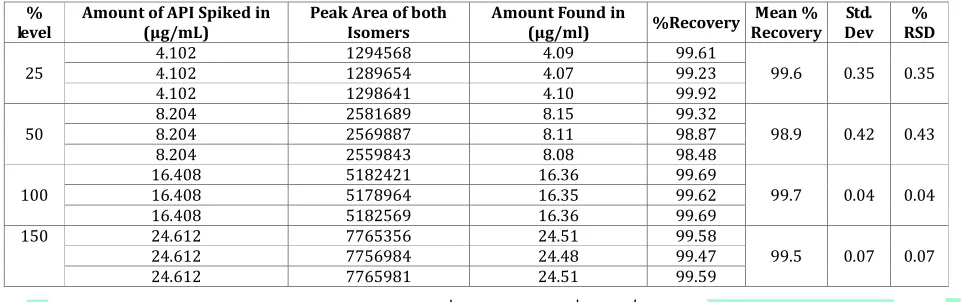
Accuracy of the proposed method was determined by recovery studies using standard addition method. The percentage recovery studies of Budesonide was carried out in triplicate 3 different levels 25%, 50%,100% & 150% by spiking standard drug solution to the placebo. (Table 3)
Table 3: Accuracy studies of the prepared formulation
% level
Amount of API Spiked in (μg/mL)
Peak Area of both Isomers
Amount Found in
(μg/ml) %Recovery
Mean % Recovery Std. Dev % RSD 25
4.102 1294568 4.09 99.61
99.6 0.35 0.35
4.102 1289654 4.07 99.23
4.102 1298641 4.10 99.92
50
8.204 2581689 8.15 99.32
98.9 0.42 0.43
8.204 2569887 8.11 98.87
8.204 2559843 8.08 98.48
100
16.408 5182421 16.36 99.69
99.7 0.04 0.04
16.408 5178964 16.35 99.62
16.408 5182569 16.36 99.69
150 24.612 7765356 24.51 99.58
99.5 0.07 0.07
24.612 7756984 24.48 99.47
24.612 7765981 24.51 99.59
2.4.3 Precision Studies
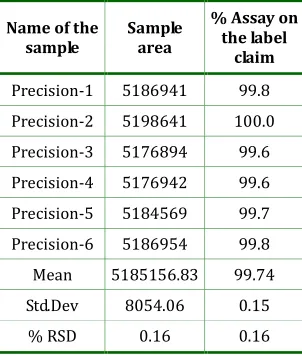
The method precision of the method are ascertained by injecting 6 replicates of test sample % recovery, % RSD was calculated. (Table 4)
Name of the sample
Sample area
% Assay on the label
claim
Precision-1 5186941 99.8
Precision-2 5198641 100.0
Precision-3 5176894 99.6
Precision-4 5176942 99.6
Precision-5 5184569 99.7
Precision-6 5186954 99.8
Mean 5185156.83 99.74
Std.Dev 8054.06 0.15
% RSD 0.16 0.16
Table 4: Precision table
2.5 Related substances(Impurities) of Budesonide:
Buffer: 3.17 mg/mL of monobasic sodium phosphate and 0.23 mg/mL of phosphoric acid. The buffer solution pH is 3.2 ± 0.1.
Mobile phase: Acetonitrile and Buffer(32:68) Standard solution: Dissolve a quantity of Budesonide RS in acetonitrile, and dilute quantitatively with Buffer to obtain a solution having a concentration of 0.5 mg/mL, keeping the proportion of acetonitrile in this solution to NMT 30%.
Sample solution: Dissolve 25 mg of Budesonide in 15 mL of acetonitrile in a 50-mL volumetric flask, and dilute with Bufferto volume.
Mode: LC
Detector: UV 254 nm
Column: 4.6-mm ´ 15-cm; 5- m packing L1 Flow rate: 1.5 mL/min
Injection size: 20 L System suitability
Calculate the percentage of each impurity in the portion of Budesonide taken:
Result = (rU/rT) X100
rU = peak area for each impurity
rT = sum of the areas of all of the peaks
Code Sample Ratio
Total Impurities(%)
Initial 25°C/60% RH-close 25°C/60% RH-open 40°C/75% RH-close 40°C/75% RH-open
BUD Budesonide NA 0.12 0.17 0.17 0.18 0.19
BUD:SS Budesonide:Sugar spheres 1:100 0.12 0.18 0.19 0.23 0.25 BUD:ECD Budesonide: Aquacoat ECD 30 1:10 0.14 0.19 0.19 0.26 0.26 BUD:ATBC Budesonide: Acetyl tributyl citrate 1:10 0.13 0.18 0.19 0.23 0.24 BUD:TAL Budesonide :Talc 1:10 0.13 0.19 0.19 0.25 0.25 BUD:ELD Budesonide: Eudragit L 30D 55 1:10 0.15 0.20 0.21 0.25 0.26 BUD:TEC Budesonide:Triethyl citrate 1:10 0.14 0.19 0.20 0.24 0.25 BUD:PSB Budesonide: Polysorbate 80 1:10 0.15 0.18 0.19 0.23 0.24 BUD:HGCAPS Budesonide : capsules NA 0.14 0.19 0.20 0.26 0.28 BUD:PLB Budesonide:Placebo NA 0.17 0.21 0.22 0.29 0.32
Table 5: Results of Budesonide-Excipient Compatibility Studies
Fig1: Blank Chromatogram
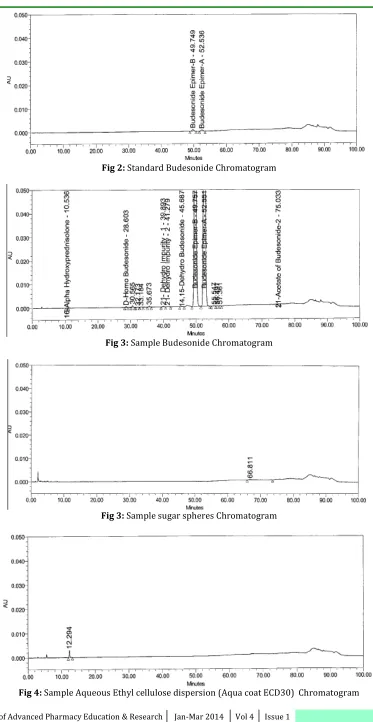
Fig 2: Standard Budesonide Chromatogram
Fig 3: Sample Budesonide Chromatogram
Fig 3: Sample sugar spheres Chromatogram
Fig 4: Sample Aqueous Ethyl cellulose dispersion (Aqua coat ECD30) Chromatogram
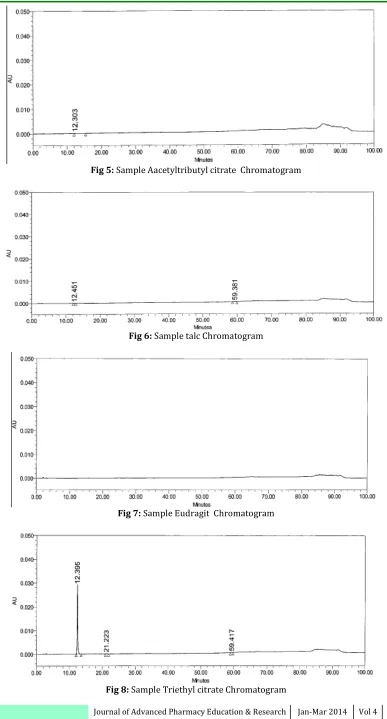
Fig 5: Sample Aacetyltributyl citrate Chromatogram
Fig 6: Sample talc Chromatogram
Fig 7: Sample Eudragit Chromatogram
Fig 8: Sample Triethyl citrate Chromatogram
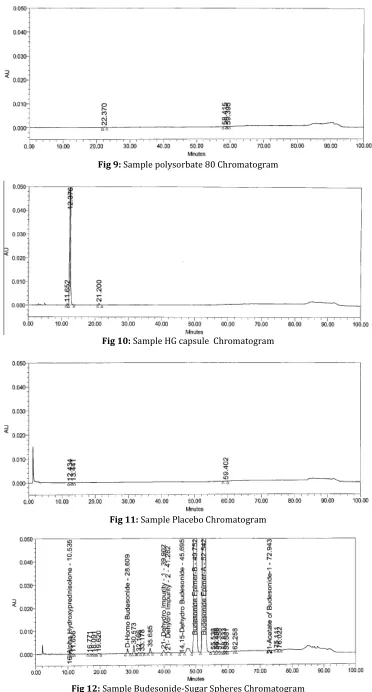
Fig 9: Sample polysorbate 80 Chromatogram
Fig 10: Sample HG capsule Chromatogram
Fig 11: Sample Placebo Chromatogram
Fig 12: Sample Budesonide-Sugar Spheres Chromatogram
Fig 13: Sample Budesonide-Ethyl cellulose Chromatogram
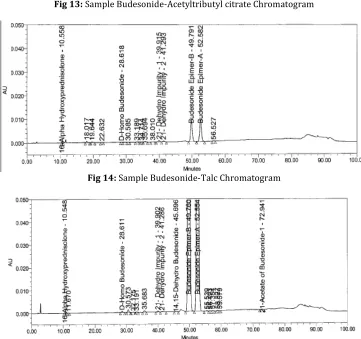
Fig 13: Sample Budesonide-Acetyltributyl citrate Chromatogram
Fig 14: Sample Budesonide-Talc Chromatogram
Fig 15: Sample Budesonide-Eudragit Chromatogram
Fig 16: Sample Budesonide-Triethyl citrate Chromatogram
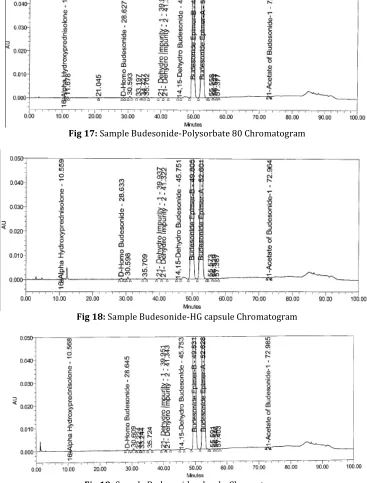
Fig 17: Sample Budesonide-Polysorbate 80 Chromatogram
Fig 18: Sample Budesonide-HG capsule Chromatogram
Fig 19: Sample Budesonide-placeboChromatogram
3.0 RESULTS AND DISCUSSION
In the present investigation the possible interactions between Budesonide and Excipients were evaluated using HPLC method. The HPLC method used in this investigation was Accurate, Precise, and Robust it is validated by using waters system and Nucleosil C18 column (4.6-mm ´ 15-cm; 5-mm packing L1). Linearity was found to be in the range of 4 to 32 µg/ml regression value was 1.0, % recovery was found to be 98.9 to99.7% and %RSD of method precision was found to be 0.07 to 0.43%. This method was suitable for the estimation of Budesonide in bulk and Pharmaceutical formulation. The percentage of the total impurities were found to be not more than 0.4% shown in Table 5 i.e., impurities are within the limit as per ICH guidelines. Pure drug Budesonide or Budesonide in binary mixtures was stable for 30 days at 40±2ºC/75±5.0%RH since there is no change in peak area or change in Rt and the percentage of impurities was within limits as per ICH guidelines. It can be deduced that the drug was stable in pure form or in the presence of excipients tested under these elevated temperature and Humidity conditions. Therefore these excipients were found to be compatible with Budesonide.
4.0 CONCLUSION
Many stability problems encountered during development and post commercialization can be ascribed to inadequate matching of the ingredients in dosage forms, lack of awareness of the complexities of chemical and physical interactions. Hence knowledge of drug–excipient interactions is a necessary prerequisite to the development of dosage forms that are stable and of good quality. The results of HPLC studies showed the method is suitable for the assay of Budesonide in the given modified release formulation and that there were no possible interactions between drug and selected excipients sugar spheres, Ethyl cellulose (Aquacoat ECD 30), acetyl tributyl citrate (ATBC), Methacrylic acid copolymer C dispersion (Eudrgit L30D55), triethyl citrate (TEC), polysorbate
80 and talc during 30 days under 40°C/75%RH storage conditions. This method was useful for the estimation of drug in the formulation and also for the evaluation of relative substances in drug product.
5.0 ACKNOWLEDGMENTS
The author was grateful to Dr.J.Sreekanth, Sr.General Manager, R&D, MSN R&D center; Mr.T.Rajesh, Asst.Manager, AR&D, MSN R&D center; Mr.Amarnath, Sr.Manager, FR&D, Natco Pharma Ltd and Mr.K.Venkateswara rao, Manager, FR&D, Natco Pharma Ltd for encouragement, technical assistance and providing the necessary facilities during the course of investigation.
6.0 REFERENCES
1. K Ashok; MV Chabul. Excipient Development for
Pharmaceutical, Biotechnology, and Drug Delivery
Systems. New York (USA), 2006, 37-50.
2. Center for Drug Evaluation and Research (CDER).
Guidance for Industry: Nonclinical Studies for
Development of Pharmaceutical Excipients. Final
guidance issued by FDA CDER, 2005.
3. S James. Encyclopedia of Pharmaceutical Technology.
3rd Ed. New York (USA) Informa health care, 2007,
Vol-3, 1656-1662.
4. JI Wells, pharmaceutical Preformulation- the
physicochemical properties of drug substances,Ellis
Horwood, Chichester, UK, 1988.
5. M Uchiyama. Drug Inform. J. 1999,33, 27–32.
6. K Dieter; B Heublein; HP Fink; A Bohn. ChemInfor,
2005, 36 (36), 67.
7. Mora PC, Cirri M, Mura P. Differential scanning
calorimetry as a screening technique in compatibility
studies lease of DHEA extended formulations. J Pharm
Biomed Anal 2006;42:3-10.
8. Verma RK, Garg S. Compatibility studies between
isosorbide mononitrate and selected excipients used
in the development of extended release formulations.
J Pharm Biomed Anal 2004;35:449-58.
9. Bruni G., Amici L., Berbenni V., Marini A., Orlandi A.: J.
Therm. Anal. Cal.;2002; 68, 561.
10. Wyttenbach N., Birringer C., Alsenz J., Kuentz M.:
Pharm. Dev. Technol. ; 2005; 10, 499.
11. P Atkins, J De Paula. Physical Chemistry, 8th Edn.
Oxford University Press: Oxford, UK, 2006; 396.
12. S Ahuja. Impurities Evaluation of Pharmaceuticals.
Marcel Dekker, New York, 1998; 142.
13. MAP Rao. Brazilian Journal of Physics, 2010, 40(1):
59-66.
14. Verma R.K., Garg S. : J. Pharm. Biomed. Anal. 2004;35,
449.
How to cite this article: Pavan Kumar Potturi, Yajamans Sudhakar; Solid State Compatibilty Studies between Budesonide with Some Excipients by using HPLC; J. Adv. Pharm. Edu. & Res. 2014: 4(1): 134-144.
Source of Support: Nil, Conflict of Interest: Nil