Development of Sumbawa Dictionary Application
for Multiplatform-Based
A. Rahman
*, Shinta Esabella
1and Umar
21Computer Science Department, Sumbawa University of Technology, Sumbawa, Indonesia. 2English Department, STKIP Paracendekia NW Sumbawa, Sumbawa, Indonesia.
Date of publication (dd/mm/yyyy): 10/09/2019
Abstract – Sumbawa Regency is a regency located on Sumbawa Island. Sumbawa Regency has quite promising potential, especially in the field of tourism. Its diversity makes tourism areas of Sumbawa Regency has high economic value. Then, to be able to support these natural resources requires a touch of technology, such as a dictionary application, a road map application, and so forth. This study aims to: 1) develop a multiplatform based Sumbawa dictionary application, and 2) test the effectiveness of a multiplatform based Sumbawa dictionary application. The result of the study of Development of Multiplatform-Based Sumbawa Language Application Dictionary has been successfully built on the Android and iOS platform systems.
Keywords –Development, Application, Sumbawa Language, and Multiplatform.
I.
I
NTRODUCTIONSumbawa Regency is a regency located on the island of Sumbawa, West Nusa Tenggara Province. Sumbawa Regency has quite promising potential, especially in the tourism sector. The natural beauty that is owned has a positive impact on tourist visits, both domestic tourists and foreign tourists. The results of monitoring in several tourist areas, most of foreign guests confused about how to ask something to the local community, especially for the individual tour.
Based on the phenomenon above, the researcher interested to develop an application that can help foreign tourist to facilitate communication, both cross-regional and international. The application is Multiplatform-based Sumbawa Language Dictionary Application. This application has advantages, namely: (1) providing three languages namely Sumbawa, Indonesian and English, (2) available on the Android and iOS platforms, (3) presenting the feature of translating sounds into words or sentences, (4) presents the feature of translating words or sentences into sound form, and (5) able to translate words and sentences in three languages.
The expected results of this study are able to provide solutions to the phenomena and problems that are being faced by Sumbawa Regency tourism.
II.
M
ETHODOLOGYA.
Research Phases
Fig. 1. Flowchart of Research Phases.
B.
Application Design
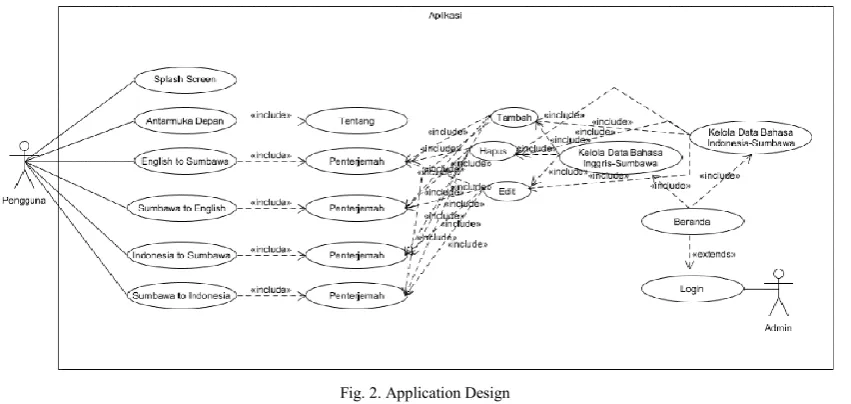
This study uses a Use Case diagram to illustrate the interaction between one or more actors with the system to be created.
Fig. 2. Application Design
In Figure 2 above shows the interaction between users and admins. The user is the general public who uses a smartphone in the form of Android or iOS, while the Admin is someone who is in charge of managing data on the Sumbawa language, Indonesian, and English.
III.
R
ESULT ANDD
ISCUSSIONIn this session, we explain the activities that have been carried out in each phase. We implement the five phases mentioned earlier based on the System Development Life Cycle (SDLC) method as follows [1]:
A.
Analysis Phase
a. Conducting questionnaires and interviews with ten different respondents with the aim of obtaining a number of data to be analyzed and to find problems that exist as research support needs.
b. Conduct library study.
c. Identifying problem boundaries.
d. Identify software specifications and resources.
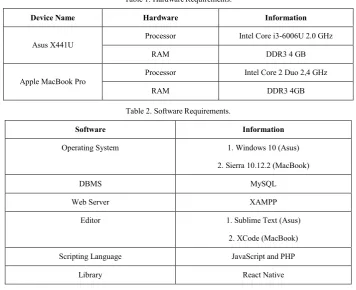
Based on the above stages, obtained several needs for the development and application development as follows: Table 1. Hardware Requirements.
Device Name Hardware Information
Asus X441U
Processor Intel Core i3-6006U 2.0 GHz
RAM DDR3 4 GB
Apple MacBook Pro
Processor Intel Core 2 Duo 2,4 GHz
RAM DDR3 4GB
Table 2. Software Requirements.
Software Information
Operating System 1. Windows 10 (Asus)
2. Sierra 10.12.2 (MacBook)
DBMS MySQL
Web Server XAMPP
Editor 1. Sublime Text (Asus)
2. XCode (MacBook)
Scripting Language JavaScript and PHP
Library React Native
B.
Design Phase
1.
Database Planning
In database design, data files are obtained from Use Case diagrams that produce Class Diagrams. Look at the picture below.
The design of the application database consists of admin data, English and Sumbawa language data, and Indonesian and Sumbawa language data.
2.
User Interface
In the interface design, we present the general user application interface design and admin application. Consider the following picture.
2.1.
General User Application
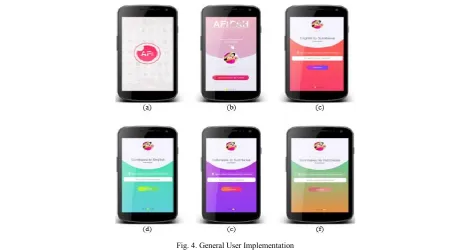
Fig. 4. General User Application.
The user interface design layout consists of (a) splash screen, (b) front interface, (c) interface for English to Sumbawa, (d) interface for Sumbawa to English, (e) interface for Indonesian to language Sumbawa, and (f) interface for the Sumbawa language to Indonesian.
2.2.
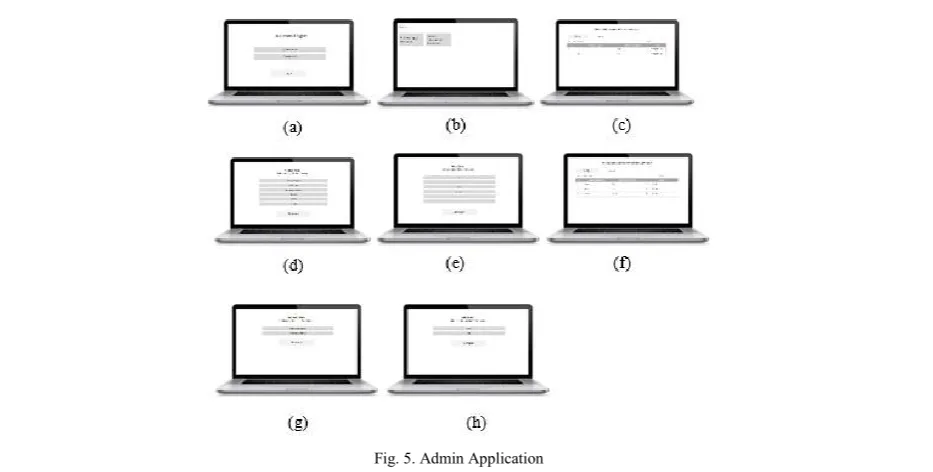
Admin Application
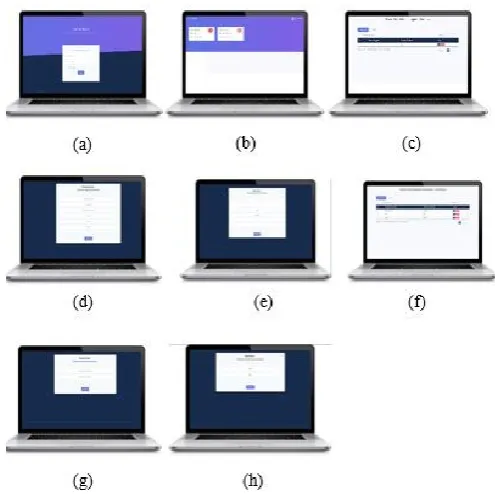
The interface design layout above consists of (a) login page, (b) dashboard page, (c) English and Sumbawa data management pages, (d) English and Sumbawa data added pages, (e) data edit pages English and Sumbawa, (f) Indonesian and Sumbawa data management pages, (g) Indonesian and Sumbawa data added pages, (h) Indonesian and Sumbawa data edit pages.
C. Implementation
At this stage we change the design into a form that can be used by users.
1.
Implementation of Database Design
The implementation of database design in this application uses MySQL DBMS [4]. Figure 6 shows the database design implementation.
Fig. 3. Implementation of Database Design
2
. Implementation of user Interface Design
Implementation of interface design in this application uses the JavaScript programming language with React Native Library to build Android and iOS applications specifically for general users [3] and PHP programming language with Code Igniter Framework to build Web applications specifically Admin data manager [2].
2.1
General user Implementation
2.1.1.
Admin Implementation
Fig. 5. Admin Implementation
D
. Testing
Testing in this study uses two testing methods, namely black box and beta test.
1.
Black Box Method
Black box method is a test that is applied to show the software operating functions that are built by providing a number of inputs and outputs. The test results obtained from using this method are all functions in the application implementation of both general user applications and the admin application fully running without any problems or bugs in the application.
2.
Beta Test Method
Beta test method is a test conducted by users of software or programs that are built.
Testing will be carried out for each of the ten users on the Android platform and the iOS platform. The following are the results of tests we did using beta test.
For more information, we use the following parameters to request ratings from users: 1. VD = Very Dissatisfied.
2. NS = Not Satisfied. 3. LS = Less Satisfied. 4. S = Satisfied. 5. VS = Very Satisfied.
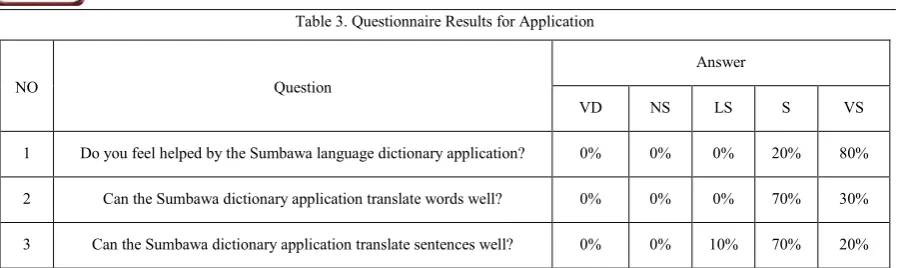
Table 3. Questionnaire Results for Application
NO Question
Answer
VD NS LS S VS
1 Do you feel helped by the Sumbawa language dictionary application? 0% 0% 0% 20% 80%
2 Can the Sumbawa dictionary application translate words well? 0% 0% 0% 70% 30%
3 Can the Sumbawa dictionary application translate sentences well? 0% 0% 10% 70% 20%
Based on the test results obtained that 1) respondents felt helped by the Sumbawa dictionary application, where 20% of respondents were satisfied and 80% of respondents were very satisfied, 2) 70% of respondents were satisfied and 30% of respondents felt very satisfied with the Sumbawa dictionary can translate words well and, 3) 10% of respondents feel less satisfied, 70% of respondents feel satisfied, and 20% of respondents feel very satisfied with the Sumbawa dictionary can translate sentences properly.
2.2.
Testing the Application on the iOS Platform
Table 4. Questionnaire Results for Application.
NO Question
Answer
VD NS LS S VS
1 Do you feel helped by the Sumbawa language dictionary application? 0% 0% 0% 60% 40%
2 Can the Sumbawa dictionary application translate words well? 0% 0% 0% 80% 20%
3 Can the Sumbawa dictionary application translate sentences well? 0% 0% 10% 80% 10%
Based on the test results obtained that 1) respondents felt helped by the Sumbawa dictionary application, where 60% of respondents were satisfied and 40% of respondents were very satisfied, 2) 80% of respondents were satisfied and 20% of respondents were very satisfied with the Sumbawa dictionary can translate words well, and 3) 10% of respondents feel less satisfied, 80% of respondents are satisfied, and 10% of respondents feel very satisfied with the Sumbawa dictionary can translate sentences properly.
E.
Maintenance
Submitting software packages to users by uploading applications on the market.
IV.
C
ONCLUSIONBased on the discussion above, the conclusion can be taken as follows: 1) development of Multiplatform-Based Sumbawa Language Application Dictionary has been successfully on the Android and iOS platform systems, 2) the results of the respondents’ questionnaire showed that from the 10 respondents of Android’s users, 70% stated they satisfied and 3 respondents with 30% stated they very satisfied on translator application development, and 3) the results of the respondent’s questionnaire showed that from the 10 respondents of iOS’ users, 80% stated they satisfied and 20% stated they very satisfied on translator application development.
Thus, it can be concluded that this research can contribute to the people of Sumbawa Regency and the people who visiting Sumbawa Regency, both the local community and the international community.
A
CKNOWLEDGEMENTThis research supported by Sumbawa University of Technology, Faculty of Engineering, Informatics Study Program 2019.
R
EFERENCES[1] Bassil, Y, A Simulation Model for the Waterfall Software Development Life Cycle. International Journal of Engineering & Technology, 2012, (IJET, Vo. 2, No. 5, pp. 742-749).
[2] Firman, A., Wowor, H. F., & Najoan, X., Sistem Informasi Perpustakaan (Library Information System) Online Berbasis (Based on)
Web. E-journal Teknik Elektro dan Komputer (Electrical and Computer Engineering), 2016, Vol. 5, No. 2, pp. 29-36.
[3] Lilipaly, N. K., Rancang Bangun Aplikasi Schoolish Berbasis (Designing a Schoolish Based Application) Mobile Menggunakan (Use)
Framework React Native. Source by zenodo, 2018.
[4] Sitohang, H. T., Sistem Informasi Pengagendaan Surat Berbasis (Mail-based Mail Retention Information System) Web Pada Pengadilan
Tinggi Medan (To the Medan High Court). Journal of Informatic Pelita (Light) Nusantara, 2018, Vol. 3, No. 1, pp. 6-9.
A
UTHORSP
ROFILE’
A. Rahman was born in Bajo Village, Soromandi District, BIma Regency, West Nusa Tenggara Province, on Friday, February 14, 1997. He received his S1 education since 2015 at the Sumbawa University of Technology (UTS), in the Informatics study program, Faculty of Engineering with a scholarship.
Shinta Esabella was born in Sumbawa Besar, July 14th 1986. She finished her Bachelor Degree in Computer Science - STT-PLN Jakarta, 2008. Also, she graduated Master Degree in Computer Science - Bina Nusantara University Jakarta in 2015. She has been a Lecturer at Computer Science Department, Sumbawa University of Technology, Indonesia since 2015. Her research interests are management infrastructure of technology information, develop information system and applications. Now, she is a member of the team for Sumbawa Government Smart City. email id: [email protected]