The Journal of Threatened Taxa (JoTT) is dedicated to building evidence for conservation globally by publishing peer-reviewed articles online every month at a reasonably rapid rate at www.threatenedtaxa.org. All articles published in JoTT are registered under Creative Commons Attribution 4.0 International License unless otherwise mentioned. JoTT allows allows unrestricted use, reproduction, and distribution of articles in any medium by providing adequate credit to the author(s) and the source of publication.
www.threatenedtaxa.org
ISSN 0974-7907 (Online) | ISSN 0974-7893 (Print)
Building evidence for conservation globally
Journal of Threatened Taxa
For Focus, Scope, Aims, Policies, and Guidelines visit https://threatenedtaxa.org/index.php/JoTT/about/editorialPolicies#custom-0 For Article Submission Guidelines, visit https://threatenedtaxa.org/index.php/JoTT/about/submissions#onlineSubmissions For Policies against Scientific Misconduct, visit https://threatenedtaxa.org/index.php/JoTT/about/editorialPolicies#custom-2 For reprints, contact <[email protected]>
Short Communication
First photographic record of the Rusty-spotted Cat
Prionailurus rubiginosus (I. Geoffroy Saint-Hilaire, 1831)
(Mammalia: Carnivora: Felidae) in Horton Plains National
Park, Sri Lanka
Thilina Sudarshana Nimalrathna, Yan Ru Choo, Enoka P. Kudavidanage, Thakshila Ravindra Amarasinghe, Udamulle Gedara Sumith Indika Bandara, Wanninayaka Aarahchilage Charitha Lakmali Wanninayaka, Piyal Ravindrakumar, Marcus Aik Hwee Chua & Edward L. Webb
12 March 2019 | Vol. 11 | No. 4 | Pages: 13506–13510 DOI: 10.11609/jott.4094.11.4.13506-13510
Partner
Member
Threatened Taxa
Publisher & Host
PLATINUMOPEN ACCESS
The opinions expressed by the authors do not reflect the views of the Journal of Threatened Taxa, Wildlife Information Liaison Development Society, Zoo Outreach Organization, or any of the partners. The journal, the publisher, the host, and the part-ners are not responsible for the accuracy of the political boundaries shown in the maps by the authors.
Shor
t C
ommunica
tion
DOI:https://doi.org/10.11609/jott.4094.11.4.13506-13510 | ZooBank: urn:lsid:zoobank.org:pub:1287B562-C3A1-4787-A3FA-CD7239A3A1F4
Editor: Angie Appel, Wild Cat Network, Germany. Date of publication: 12 March 2019 (online & print)
Manuscript details: #4094 | Received 26 February 2018 | Final received 31 August 2018 | Finally accepted 04 December 2018
Citation:Nimalrathna, T.S., Y.R. Choo, E.P. Kudavidanage, T.R. Amarasinghe, U.G.S.I. Bandara, W.A.C.L. Wanninayaka, P. Ravindrakumar, M.A.H. Chua & E.L. Webb (2019). First photographic record of the Rusty-spotted Cat Prionailurus rubiginosus (I. Geoffroy Saint-Hilaire, 1831) (Mammalia: Carnivora: Felidae) in Horton Plains National Park, Sri Lanka. Journal of Threatened Taxa 11(4): 13506–13510; https://doi.org/10.11609/jott.4094.11.4.13506-13510
Copyright: © Nimalrathna et al. 2019. Creative Commons Attribution 4.0 International License. JoTT allows unrestricted use, reproduction, and distribution of this
article in any medium by adequate credit to the author(s) and the source of publication.
Funding: The Singapore Ministry of Education Tier 1 grant to ELW and the Department of Biological Sciences, National University of Singapore.
Competing interests:The authors declare no competing interests.
Acknowledgements: The Leopard Conservation and Ecology Project operated under permit W/L/3/2/67/15 from the Deparatment of Wildlife Conservation, Sri
Lanka. Funding was by a Singapore, Ministry of Education AcRF Tier 1 grant to ELW. The authors acknowledge the assistance of the Deparatment of Wildlife Conservation for this project.
First photographic record of the Rusty-spotted Cat
Prionailurus rubiginosus (I. Geoffroy Saint-Hilaire, 1831)
(Mammalia: Carnivora: Felidae) in Horton Plains National
Park, Sri Lanka
Thilina Sudarshana Nimalrathna 1* , Yan Ru Choo 2* , Enoka P. Kudavidanage 3 , Thakshila Ravindra Amarasinghe 4 , Udamulle Gedara Sumith Indika Bandara 5 , Wanninayaka Aarahchilage Charitha Lakmali Wanninayaka 6 , Piyal Ravindrakumar 7 , Marcus Aik Hwee Chua 8 & Edward L. Webb 91,3,4 Tropical Ecosystem Research Network, 30c, Temple Road, Hadigama, Piliyandala, Sri Lanka. 2,9 Department of Biological Sciences, National University of Singapore, Singapore 117558. 3 Department of Natural Resources, Sabaragamuwa University of Sri Lanka, Belihuloya 70140, Sri Lanka. 5,6,7 Department of Wildlife Conservation, 811A, Jayanthipura, Battaramulla, Sri Lanka. 8 Lee Kong Chian Natural History Museum, National University of Singapore, Singapore 117558. 8 Department of Environmental Science and Policy, George Mason University, 4400 University Dr, Fairfax, VA 22030,
USA.
1,3,4 30c, Temple Road, Hadigama, Piliyandala, Sri Lanka. 2,9 14 Science Drive 4, Department of Biological Sciences, National University of Singapore, Singapore 117558. 5,6,7 Horton Plains National Park, Department of Wildlife Conservation, Ohiya, Sri Lanka. 8 2 Conservatory Drive, Singapore 117377. 1[email protected], 2[email protected], 3[email protected] (corresponding author), 4[email protected], 5[email protected], 6 [email protected], 7[email protected], 8[email protected], 9[email protected] (corresponding author)
* These authors contributed equally to the work.
Abstract: The Rusty-spotted Cat Prionailurus rubiginosus is thought to be present in most forested areas of Sri Lanka. Though it was suggested that the species may occur in montane regions, there was no photographic evidence to date. Here we present the first photographic record of the Rusty-spotted Cat in Horton Plains National Park. Individuals including cubs were photo-captured on 15 separate occasions during a 5,538 camera trap days study. These photo-captures were made both during the day and night, and indicate the presence of a breeding population in this protected area.
Keywords: Camera trap, carnivore, Felidae, montane forest, protected area.
ISSN 0974-7907 (Online) ISSN 0974-7893 (Print)
PLATINUM OPEN ACCESS
The Rusty-spotted Cat Prionailurus rubiginosus (I. Geoffroy Saint-Hilaire, 1831) is native to India, Nepal, and Sri Lanka (Nekaris 2003; Mukherjee et al. 2016). It is currently listed by the IUCN as Near Threatened (Mukherjee et al. 2016) and is considered nationally Endangered in Sri Lanka (Ministry of Environment 2012). Its main threats are habitat loss and fragmentation (Mukherjee et al. 2016).
Rusty-spotted Cat in Horton Plains Nimalrathna et al.
present in most forested areas (Philips 1980 cited in Nekaris 2003). Direct evidence of its presence below 170m in arid scrub forests, dry forests, and monsoon forests was presented by Nekaris (2003) and Kittle & Watson (2004). Indirect or anecdotal evidence suggests its presence in wet forests near montane regions (Nekaris 2003). Photographic evidence, however, is scarce, particularly in the montane region. Here we report the first photographic record of the Rusty-spotted Cat above 2,000m in Horton Plains National Park (HPNP), located in Sri Lanka’s montane zone, from a series of photo-captures made over a 15-month period.
Study area
HPNP is a protected area covering 31.6km2 of grassland and montane forest; it was designated as a national park in 1988 (IUCN 1990) and is part of the Central Highlands of Sri Lanka World Heritage Site (World Heritage Convention 2018). It is located within the wet and cool highlands (Fernanado 1968) between 6.783–6.833 °N and 80.767–80.850 °E at an altitude of 2,100–2,300 m (Fig. 1). It receives an annual rainfall of 2,000–5,000 mm (Werner 1988). The vegetation consists of tropical montane forest interspersed with a mosaic of large grasslands and forest patches; extensive grasslands
Figure 1. The study site in Horton Plains National Park (HPNP; marked in red on the map of Sri Lanka), located within Nuwara Eliya District (orange). The circles on the satellite image of HPNP represent camera trap locations; Rusty-spotted Cat was recorded in locations marked in red. Administrative map of Sri Lanka obtained from GADM v. 2.8 (2015).
and terraces indicate areas of former farmland (Padmalal & Kikuchi 1993). HPNP is surrounded by natural forests, pine and eucalyptus plantations, and tea plantations with an associated village.
Material and Methods
During the initial phase of a camera trapping project focusing on Sri Lankan Leopard Panthera pardus kotiya
in HPNP, we established 18 survey points in the core of the national park, next to and surrounding the grassland (Fig. 1). Survey points were located within each cell of a 1km2 systematic grid. At each survey point, paired ReconyxTM HC500 camera traps were set up facing each other 45cm above the target level. The cameras were deployed from 3 December 2015 to 3 March 2017, for a total of 5,538 camera trap days. Each camera was in operation for 24 hours daily in RapidfireTM mode, with no delay between image sets, taking three images per trigger.
The retrieved images were sorted into incidents; we define an incident as an image or a series of images of a species or individual separated by intervals of less than one hour. The timings of the incidents were analysed using the overlap package (Ridout & Linkie 2009) in R v. 3.5.1 (R Core Team 2018). The Rusty-spotted Cat was
identified by its reddish-grey fur in daytime images, reddish-brown spots that ran longitudinally along its body and head, and by the dark stripes on the inner sides of its front legs (Sunquist & Sunquist 2009). Because of the poor contrast between the cat’s spots and coat in our infrared images, we were not able to distinguish among individuals.
Results
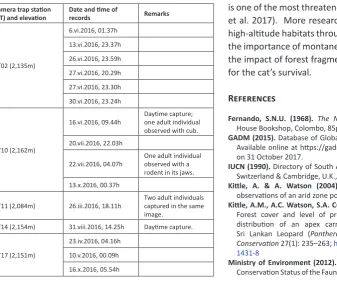
Over the survey period, the Rusty-spotted Cat was captured in 15 incidents at five locations, of which two incidents (13.3%) occurred during the day (Table 1; Image 1). These locations were separated by distances of 0.8–5.1 km. In the first incident on 26 March 2016, two adult individuals were recorded in the same image. The last incident was recorded on 16 October 2016. One notable incident shows an adult female with a kitten during the day on 16 June 2016. On 22 July 2016, an adult individual was photographed with a rodent in its jaws. Overall, most photo-captures occurred between sunset and sunrise (Fig. 2).
Discussion
Our findings make an important extension to the documented range of the species, as previously it was only documented below 2,100m (Nekaris 2003; Kittle &
Figure 2. Patterns in photo-capture timings (n=15) of the Rusty-spotted Cat in Horton Plains National Park, Sri Lanka
Watson 2004). Further, the record of an adult female Rusty-spotted Cat with a kitten indicates the presence of a breeding population in Horton Plains National Park. This also indicates that the Rusty-spotted Cat possibly maintains a reproductive population in montane forest regions.
Given the nationally Endangered status of the species, these findings highlight the conservation value of HPNP and may have implications for managing tourism in the national park. HPNP is one of the most highly visited national parks in Sri Lanka (Sri Lanka Tourist Board 2017) with strict legal protection and enforcement; therefore, the wildlife populations therein are likely adequately protected. Outside HPNP, however, the montane forest is one of the most threatened habitats in Sri Lanka (Kittle et al. 2017). More research needs to be carried out in high-altitude habitats throughout Sri Lanka to determine the importance of montane forest habitats and to assess the impact of forest fragmentation and land use change for the cat’s survival.
References
Fernando, S.N.U. (1968). The Natural Vegetation of Ceylon. Lake
House Bookshop, Colombo, 85pp.
GADM (2015). Database of Global Administrative Areas, Version 2.8.
Available online at https://gadm.org/maps/LKA.html. Downloaded on 31 October 2017.
IUCN (1990). Directory of South Asian Protected Areas. IUCN, Gland,
Switzerland & Cambridge, U.K., xxiv+294pp.
Kittle, A. & A. Watson (2004). Rusty-spotted Cat in Sri Lanka:
observations of an arid zone population. Cat News 40: 17–19.
Kittle, A.M., A.C. Watson, S.A. Cushman & D.W. Macdonald (2017).
Forest cover and level of protection influence the island-wide distribution of an apex carnivore and umbrella species, the Sri Lankan Leopard (Panthera pardus kotiya). Biodiversity and Conservation 27(1): 235–263; https://doi.org/10.1007/s10531-017-1431-8
Ministry of Environment (2012). The National Red List of Sri Lanka:
Table 1. Records of Rusty-spotted Cat in Horton Plains National Park, Sri Lanka, in 2016.
Camera trap station
(CT) and elevation Date and time of records Remarks
CT02 (2,135m) 6.vi.2016, 01.37h 13.vi.2016, 23.37h 26.vi.2016, 23.59h 27.vi.2016, 20.29h 27.vi.2016, 23.30h 30.vi.2016, 23.24h CT10 (2,162m)
16.vi.2016, 09.44h Daytime capture; one adult individual observed with cub. 20.vii.2016, 22.03h
22.vii.2016, 04.07h One adult individual observed with a rodent in its jaws. 13.x.2016, 00.37h
CT11 (2,084m) 26.iii.2016, 18.11h Two adult individuals captured in the same image.
CT14 (2,154m) 31.viii.2016, 14.25h Daytime capture.
CT17 (2,151m)
23.iv.2016, 04.16h
Rusty-spotted Cat in Horton Plains Nimalrathna et al.
Journal of Threatened Taxa | www.threatenedtaxa.org | 12 March 2019 | 11(4): 13506–13510 13509 Image 1. Photographic evidence of the Rusty-spotted Cat Prionailurus rubiginosus in montane forest of Horton Plains National Park, montane forest of Sri Lanka. Yellow boxes indicate the location of the cat in the image if it is not easily observable. Notable features of these images include the presence of a cub, predation behaviour, and up to two individuals in the same image.
Sri Lanka.
Mukherjee, S., J.W. Duckworth, A. Silva, A. Appel & A. Kittle (2016).Prionailurus rubiginosus. In: The IUCN Red List of Threatened Species: e.T18149A50662471. Downloaded on 28 November 2017;
https://doi.org/10.2305/IUCN.UK.2016-1.RLTS.T18149A50662471. en
Nekaris, K.A.I. (2003). Distribution and behaviour of three small wild
cats in Sri Lanka. Cat News 38: 30–32.
Padmalal, U.K.G.K. & T. Kikuchi (1993). A phytosociological survey
on grassland in Horton Plains National Park, Sri Lanka. Ecological Review = Seitaigaku Kenkyu 22(4): 159–174.
Phillips, W.W.A. (1980).Manual of the Mammals of Sri Lanka. Wildlife
and Nature Protection Society of Sri Lanka, Colombo, Sri Lanka, 116pp.
R Core Team (2018). The R Project for Statistical Computing. R
Threatened Taxa online at https://www.R-project.org/. Accessed on 22 July 2018.
Ridout, M. & M. Linkie (2009). Estimating overlap of daily activity
patterns from camera trap data. Journal of Agricultural, Biological, and Environmental Statistics 14(3): 322–337; https://doi. org/10.1198/jabes.2009.08038
Sri Lanka Tourist Board (2017). Annual Statistical Report 2016. Sri
Lanka Tourism Development Authority ASR, 106pp. http://www. sltda.lk/sites/default/files/annual-statical-report-2017.pdf
Sunquist, M.E. & F.C. Sunquist(2009). Family Felidae (cats), pp54–
168. In: Wilson, D.E. & R.A. Mittermeier (eds.) Handbook of the Mammals of the World, Vol. 1. Carnivores. Lynx Edicions, Barcelona, Spain, 728pp.
Werner, W.L. (1988). Canopy dieback in the upper montane rain forests
of Sri Lanka. GeoJournal 17(2): 245–248; https://doi.org/10.1007/ BF02432929
World Heritage Convention (2018). Central Highlands of Sri Lanka.
ISSN 0974-7907 (Online) | ISSN 0974-7893 (Print)
March 2019 | Vol. 11 | No. 4 | Pages: 13419–13510 Date of Publication: 12 March 2019 (Online & Print)
DOI: 10.11609/jott.2019.11.4.13419-13510 www.threatenedtaxa.org
publishing peer-reviewed articles online every month at a reasonably rapid rate at www.threatenedtaxa.org. All articles published in JoTT are registered under Creative Commons Attribution 4.0 International License
unless otherwise mentioned. JoTT allows allows unrestricted use, reproduction, and distribution of articles in any medium by providing adequate credit to the author(s) and the source of publication.
Editorial
Foreword to the small wild cats special issue – Angie Appel & Shomita Mukherjee, 13419–13420
Articles
Using camera traps to study the elusive European Wildcat Felis silvestris silvestris Schreber, 1777 (Carnivora: Felidae) in central Germany: what makes a good camera trapping site? – Harald Wening, Lynne Werner, Matthias Waltert & Markus Port, Pp. 13421–13431
Activity patterns of the small and medium felid (Mammalia: Carnivora: Felidae) guild in northeastern India
– Shomita Mukherjee, Priya Singh, André Pinto Silva, Chandan Ri, Kashmira Kakati, Binod Borah, Tana Tapi, Sandesh Kadur, Prafull Choudhary, Shikha Srikant, Surabhi Nadig, R. Navya, Mats Björklund & Uma Ramakrishnan, Pp. 13432–13447
Estimating Leopard Cat Prionailurus bengalensis Kerr, 1792
(Carnivora: Felidae) density in a degraded tropical forest fragment in northeastern Thailand
– Wyatt Joseph Petersen, Tommaso Savini, Robert Steinmetz & Dusit Ngoprasert, Pp. 13448–13458
An update on the status of Fishing Cat Prionailurus viverrinus Bennett, 1833 (Carnivora: Felidae) in Thailand
– Wanlop Chutipong, Anucha Kamjing, Worata Klinsawat, Dusit Ngoprasert, Kitipat Phosri, Niti Sukumal, Pongnapa Wongtung & Naruemon Tantipisanuh, Pp. 13459–13469
Communications
The Caracal Caracal caracal Schreber, 1776 (Mammalia: Carnivora: Felidae) in Uzbekistan
– Mariya Alexeevna Gritsina, Pp. 13470–13477
Small cat surveys: 10 years of data from Central Kalimantan, Indonesian Borneo
– Karen Anne Jeffers, Adul & Susan Mary Cheyne, Pp. 13478–13491
Short Communications
Insights into the feeding ecology of and threats to Sand Cat Felis margarita Loche, 1858 (Mammalia: Carnivora: Felidae) in the Kyzylkum Desert, Uzbekistan
– Alex Leigh Brighten & Robert John Burnside, Pp. 13492–13496
First photographic evidence of Fishing Cat Prionailurus viverrinus Bennett, 1833 and Clouded Leopard Neofelis nebulosa Griffith, 1821 (Carnivora: Felidae) in Parsa National Park, Nepal
– Shashank Poudel, Babu Ram Lamichhane, Santosh Bhattarai, Dipendra Adhikari, Chiranjibi Prasad Pokheral, Tek Raj Bhatt, Sailendra Raj Giri, Saneer Lamichhane, Amir Sadaula, Ashish Gurung, Laxman Prasad Poudyal, Uba Raj Regmi & Naresh Subedi, Pp. 13497– 13501
First photographic evidence of polymorphic Asiatic Golden Cat Catopuma temminckii Vigors & Horsfield, 1827 (Mammalia: Carnivora: Felidae) in Buxa Tiger Reserve, West Bengal, India – Mayukh Ghose, Deepak Sharma & Nandavaram Subbarao Murali, Pp. 13502–13505
First photographic record of the Rusty-spotted Cat Prionailurus rubiginosus (I. Geoffroy Saint-Hilaire, 1831) (Mammalia: Carnivora: Felidae) in Horton Plains National Park, Sri Lanka
– Thilina Sudarshana Nimalrathna, Yan Ru Choo, Enoka P.
Kudavidanage, Thakshila Ravindra Amarasinghe, Udamulle Gedara Sumith Indika Bandara, Wanninayaka Aarahchilage Charitha Lakmali Wanninayaka, Piyal Ravindrakumar, Marcus Aik Hwee Chua & Edward L. Webb, Pp. 13506–13510
Partner
Member
Publisher & Host
OPEN ACCESS