The Journal of Threatened Taxa is dedicated to building evidence for conservation globally by publishing peer-reviewed articles online every month at a reasonably rapid rate at www.threatenedtaxa.org. All articles published in JoTT are registered under Creative Commons Attribution 4.0 International License unless otherwise mentioned. JoTT allows unrestricted use of articles in any medium, reproduction, and distribution by providing adequate credit to the authors and the source of publication.
OPEN ACCESS
www.threatenedtaxa.org
ISSN 0974-7907 (Online) | ISSN 0974-7893 (Print) Building evidence for conservation globally
Journal of Threatened Taxa
For Focus, Scope, Aims, Policies and Guidelines visit http://threatenedtaxa.org/index.php/JoTT/about/editorialPolicies#custom-0 For Article Submission Guidelines visit http://threatenedtaxa.org/index.php/JoTT/about/submissions#onlineSubmissions For Policies against Scientific Misconduct visit http://threatenedtaxa.org/index.php/JoTT/about/editorialPolicies#custom-2 For reprints contact <[email protected]>
Communication
Status distribution and feeding habit of Wild Boar
Sus scrofa (Mammalia: Artiodactyla: Suidae) in
Pench Tiger Reserve, Madhya Pradesh, India
Shaheer Khan & Orus Ilyas
26 October 2018 | Vol. 10 | No. 11 | Pages: 12459-12463 10.11609/jott.3544.10.11.12459-12463
Threatened Taxa
Member
Partners
DOI:https://doi.org/10.11609/jott.3544.10.11.12459–12463 | ZooBank: urn:lsid:zoobank.org:pub:2253C957-3334-4DEA-A955-3FE2300EAE74
Editor: L.A.K. Singh, Bhubaneswar, Odisha, India. Date of publication: 26 October 2018 (online & print)
Manuscript details: Ms # 3544 | Received 06 June 2017 | Final received 13 September 2018 | Finally accepted 15 October 2018
Citation:Khan, S. & O. Ilyas (2018). Status distribution and feeding habit of Wild Boar Sus scrofa (Mammalia: Artiodactyla: Suidae) in Pench Tiger Reserve, Madhya Pradesh, India. Journal of Threatened Taxa 10(11): 12459–12463; https://doi.org/10.11609/jott.3544.10.11.12459–12463
Copyright: © Khan & Ilyas 2018. Creative Commons Attribution 4.0 International License. JoTT allows unrestricted use of this article in any medium, reproduction and distribution by providing adequate credit to the authors and the source of publication.
Funding: Science and Engineering Research Board, Department of Science and Technology, Govt. of India.
Competing interests:The authors declareno competing interests.
Author Details:Shaheer Khan did his masters in Wildlife Sciences from Aligarh Muslim University, followed by an M.Phil. on the ecology of wild boar in Pench Tiger Reserve, Madhya Pradesh. Presently, he is working as Senior Research Fellow in Wildlife Institute of India, and is pursuing his Ph.D. on “Indian gray wolves in Human Dominated Landscape of Maharashtra: Movement, space use and foraging”. Dr. Orus Ilyas, is working as Assistant Professor in the Department of Wildlife Sciences, Aligarh Muslim University, Aligarh-202202, She is working on different aspects of Ungulates community of Uttaranchal Himalayas as well as Central highlands. She has worked on different projects funded by DST-Fast track, DST-SERB, UGC, CSIR, WWF-India, Wildlife SOS, CAPART etc. She is also an Asia coordinator of Deer Specialist group of SSC/IUCN.
Author Contribution: OI and SK conceived the ideas and designed methodology; SK collected the data and analysed the data; SK and OI led the writing of the manuscript. Both the authors contributed critically to the drafts and gave final approval for publication.
Acknowledgements: We thank DST SERB, Govt of India for providing financial support for the study. We also express our gratitude to CCF, CF, ACF and other forest officials of PTR, Madhya Pradesh for logistics support. We are grateful to Chairman Department of Wildlife Sciences, AMU, Aligarh for encouragement and support. We are sincerely thankful to Dr. Abdul Haleem for helping us during fieldwork and writing. We are grateful to the anonymous reviewers and the Subject Editor for their critical comments and useful inputs.
Communica
tion
Status distribution and feeding habit of Wild Boar Sus scrofa
(Mammalia: Artiodactyla: Suidae) in Pench Tiger Reserve,
Madhya Pradesh, India
Shaheer Khan 1 & Orus Ilyas 2
1,2 Department of Wildlife Sciences, Aligarh Muslim University, Qila Road, Fort Enclave, Firdaus Nagar, Aligarh, Uttar Pradesh 202001, India
1 [email protected], 2 [email protected] (corresponding author)
ISSN 0974-7907 (Online) ISSN 0974-7893 (Print)
OPEN ACCESS
Abstract: The Wild Boar Sus scrofa is omnivorous, serves as the prey base for large carnivores, performs the role of a natural scavenger, and is often involved in crop raiding. The species is included in Schedule V of the Indian Wildlife (Protection) Act, 1972, meaning hunting of the species may be allowed by the Chief Wildlife Warden in instances where individuals of the species are considered dangerous to human life or property. Faecal samples of Wild Boar in Pench Tiger Reserve, Madhya Pradesh, India, were collected from January to June 2013 to assess the distribution of Wild Boar in Karmajhiri range. The density of Wild Boar in Sapath and Tikadi beat was 25.5±0.29 and 23.9±0.33 per hectare, respectively, and was the lowest in Teliya at 1.6±0.05 per hectare. Sixteen different beats were sampled and surveyed to understand the diet of Wild Boar during the winter season. Ingested items included stones, roots, grass, fruits and seeds, hairs, earthworms, flowers, and green plant material. Out of these, the most frequent item was grass, followed by roots and stones.
Journal of Threatened Taxa | www.threatenedtaxa.org | 26 October 2018 | 10(11): 12459–12463
Wild Boar in Pench Tiger Reserve, India Khan & Ilyas
12460
INTRODUCTION
Wild Boar Sus scrofa is one of the eight species of ungulates present in Pench Tiger Reserve (PTR) in Madhya Pradesh in central India. It is an omnivore, is included in Schedule V of Wildlife (Protection) Act, 1972 (WPA), and belongs to the family Suidae. The Wild Boar is widely distributed all across the world, extending from western Europe to southeastern Asia (Bratton 1975; Massei & Genov 1981). In recent years, their numbers have increased globally (Baubet et. al. 2004). Wild Boar is very active and feeds upon almost all kinds of plant material and animal matter. It plays the role of a scavenger in the forest and forms a good prey base for large cats like tiger and leopard, thus balancing the ecosystem (Barwal 2013). The boars habitually group together and mostly feed at night (Stegemen 1938). They are known to impact a variety of ecosystems throughout the world by dispersing seeds, disturbing the soil, feeding upon invertebrates and small vertebrates, contending with large vertebrates and often causing damages due to crop-raiding (Bratton 1975; Genov 1981; Alexiou 1983; Welander 1995). These damages cause retaliation and Wild Boar population come under threats from human beings. Wild Boar is one of the most studied species throughout the world but somehow not many studies have been carried out in India (Srivastava & Khan2009; Barwal 2013).
Study on the feeding habit of Wild Boar is important in perspectives of conservation (Sih 1993) for determining the necessities of the species and for improving its management (Kruuk & Parish1981). The estimations of the population sizes, densities, and home ranges for any species are important aspects that help in guiding better management and conservation of the species (Burnham et al. 1980). Wild Boar populations have high growth rate due to high fecundity and early onset of sexual maturation (Coblentz & Baber 1987) and therefore need to be evaluated from time to time for better management of the species and the habitats.
Several studies have been conducted on the diversity of flora and fauna of PTR (Dwivedi & Shukla1988;Shukla 1990; Karanth & Nichols 1998; Sankar et al. 2000). Most of the faunal studies are concentrated on tigers (Karanth & Nichols 1998; Biswas & Sankar 2002) and on Sambar and Chital (Sankar et al. 2000; Pasha et al. 2002). The present study was carried out to supplement the existing knowledge on Wild Boar of PTR.
STUDY AREA
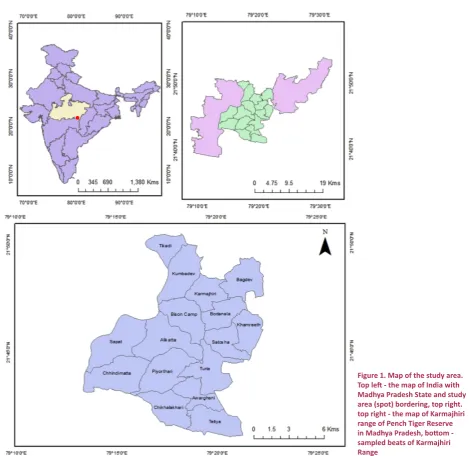
The PTR spans the Seoni and Chhindwara districts of Madhya Pradesh in central India and consists of three forest ranges, namely, Karmajhiri, Gumtara, and Kurai. The reserve gets its name from the river Pench that flows 74km through it from north to south. The river bisects PTR into nearly equal parts: the 147.61km² of the western block in the Gumtara range of the Chhindwara Forest division and the 145.24km² of the eastern block in the Karmajhiri range of the Seoni Forest division. The total area of PTR is 757.89km².
The central Indian highlands have a tropical continental climate, with a distinct monsoon (July– September), winter (November–February), and summer (April–June). The mean annual rainfall is around 1,400mm, with the southwest monsoon accounting for most of the rainfall in the region. For the dry season, (November–May), the mean rainfall is 59.5mm. The temperature in PTR varies from a minimum of 0°C in winter to a maximum of 45°C in summer (Sankar et al. 2000).
PTR belongs to the Indo-Malayan phytogeographical region. Teak Tectona grandis and its associated species such as Madhuca indica, Diospyros melanoxylon,
Terminalia tomentosa, Buchanania lanzan, Lagerstroemia parviflora, Ougeinia dalbergoides, Miliusa velutina,and Lannea coromandalica occur on the flat terrain. The undulating terrain and hill slopes have patches of mixed forest dominated by Boswellia serrata and Anogeissus latifolia. Species like Sterculia urens and Gardenia latifolia are found scattered on rocky slopes. Bamboo forests occur in the hill slopes and along streams. Some of the open patches of PTR are covered with tall grass interspersed with Butea monosperma
and Zizyphus mauritiana. Evergreen tree species like
Terminalia arjuna, Syzygium cumini, and Ixora parviflora are found in riparian vegetation along streams and river banks. Dominant patches of Cleistanthus collinus are also found in some parts of PTR.
METHODS
Faecal matter from the plots was collected from January to June 2013 for feeding analysis.
A total of 83 faecal matter samples, collected from 320 circular plots, were deposited in air-tight bags. The samples were then randomized by dividing these into four equal parts. Out of the four, two diagonal halves were selected for further study (Baubet et al. 2004). After completing the process, a total of 33 faecal samples were taken for feeding analysis. The air-dried faecal matter was washed in flowing water through a fine nylon sieve (Fournier-Chambrillon 1995). Samples were first oven-dried for about 24hr and then placed on filter paper. Five small portions were randomly selected and placed on another piece of paper. Again,
five semi-digested materials were randomly picked up from each portion. Plant and animal fragments found in the samples were separated and identified to the lowest possible taxa using reference collections established prior to the study and were evaluated for the percentage of occurrence.
RESULTS
The overall faecal matter density (FMD) of Wild Boar was found to be 8.2FMD/ha. FMD was assessed in different management beats of Karmajhiri range. The highest FMD of Wild Boar was found in Sapath
Journal of Threatened Taxa | www.threatenedtaxa.org | 26 October 2018 | 10(11): 12459–12463
Wild Boar in Pench Tiger Reserve, India Khan & Ilyas
12462
beat with 25.5±0.29/ha, followed by beats Tikadi with 23.9±0.33/ha, Satosa with 22.3±0.7/ha, and Bison camp with 11.1±0.18/ha. In Bodanala and Avarghani beats no faecal matter of Wild Boar were found during the study period. The lowest FMD was recorded in Khamreeth, Chikhlakhari, and Teliya beats with 1.6±0.05/ha. The FMD of Baghdev beat was recorded at 9.6±0.16/ha, followed by that of beats Chindimatta at 9.6±0.16/ ha, Kumbhadev at 6.4 ±0.15/ha, Turia at 3.2±0.06/ ha, Alikatta at 4.8±0.10/ha, Karmajhiri 4.8±0.10/ha, and Piyorthadi at 3.2 ±0.06)/ha (Fig. 2). Kruskal Wallis One Way ANOVA and post hoc Scheffe’s performed for comparing the nature of different sample sizes showed that the results were not significant (F15 314 = 1.357, P ˃ 0.05), indicating that the samples were not universal or that there is a wide variation in Wild Boar density.
This study provides a general idea of the average dietary spectrum of Wild Boar in PTR. It indicates that 75% of the diet of the species consisted of plant matter and the remaining 25% of animal matter, stones, and earthworm setae. The most commonly detected item was grass, which represented up to 39.37% of the diet (Fig. 3). The second most frequent item was subterranean parts of plants, mainly roots and bulbs, which represented up to 24.5% of the samples (Fig. 3). This was followed by stones (11%), animal hairs (7.8%), and earthworm setae (6.8%). Green plant materials accounted for 5.25%, while fruits & seeds and flowers accounted for 4.25% and 0.8%, respectively.
DISCUSSION
Wild Boar are omnivorous and their depredation on certain forest tree seedlings, saplings, and agricultural crops is known to result in rampant human-animal negative interactions that cause grave concern to
foresters and farmers (Wood & Barrett1979).
The faecal matter of Wild Boar in PTR comprised mainly on plant matter and significant amount of animal matter such as earthworm setae. Among plant matter, the presence of monocots, i.e., grass (39.3%) was the highest, followed by roots and tubers (24.5%). The consumption of earthworm accounted for 6.87% of the total ingested material.
Studies carried out in different geographical regions show that earthworms are the most preferred animal matter for Wild Boar because of its high protein content (Howe et al. 1981; Fournier-Chambrillon et. al. 1995; Massei et al. 1996; Baubet et al. 2004). The consumption of earthworm, however, appears to be very low in this study, which may be due to reduced availability of earthworms during low temperatures of the study period. Earthworms remain inactive when the temperature is very low and probably remain buried deep in the ground (Baubet et. al.2003).
The present study showed that the FMD of Wild Boar in PTR was 8.2/ha, and the densities were high in beats that are situated adjacent to human habitation and are potential sites for human-animal negative interactions. The maximum density was in Sapath beat followed by beats Tikadi and minimum in Turia beat.
The Wild Boar is a Protected species in India under WPA, 1972, however, hunting of the species may be allowed by the Chief Wildlife Warden in instances where individuals of the species are considered dangerous to human life or property. In spite of such a provision in the Act, it is necessary to prevent the persecution of Wild Boar through education and awareness among agriculturists for adopting crop protection measures and avoiding retaliation against depredation by the Wild Boar.
Figure 2. Overall faecal matter density (FMD) of Wild Boar species in different beats of Karmajhiri range of Pench Tiger Reserve, Madhya
Pradesh Figure 3. Percent of occurrence of various ingested items as per
REFERENCES
Alexiou, P.N. (1983). Effect of feral pigs (Sus scrofa) on
subalpine vegetation at Smokers Gap, ACT. Proceedings of the
Ecological Society of Australia12: 135–142.
Barwal, K.S. (2013). Ecology of wild pig (Sus scrofa) and human-wild
pig conflict in and around Ranthambore Tiger Reserve, Rajasthan. PhD Thesis. Wildlife Scinces, Saurashtra University, 396pp
Baubet, E., C. Bonenfant & S. Brandt (2004). Diet of the Wild Boar in
the French Alps. Galemys 16: 99–111.
Baubet, E., Y. Ropert-Coudert & S. Brandt (2003). Seasonal and annual
variations in earthworm consumption by Wild Boar (Sus scrofa
scrofa L.). Wildlife Research 30: 179–186.
Biswas, S. & K. Sankar (2002). Prey abundance and food habit of tigers
(Panthera tigris tigris) in Pench National Park, Madhya Pradesh, India. Journal of Zoology 256: 411–420.
Bratton, P. (1975). The effect of the European Wild Boar, Sus scrofa,
on Grey Beech Forest in the Great Smoky Mountains. Ecology 56(6): 1356–1366.
Burnham, K.P., D.R. Anderson & J.L. Laake (1980). Estimation of
density from line transect sampling of biological populations.
Wildlife Monographs 72: 3-202.
Coblentz, B.E. & D.W. Baber (1987). Biology and control of feral pigs
on Isla Santiago, Galapagos Ecuador. Journal of Applied Ecology 24: 403–418.
Dwivedi, G.D. & R. Shukla (1988). The Pench Bison - an ecological and
behavioural study. Cheetal 29(1): 28–31.
Fournier-Chambrillon, C., D. Maillard & P. Fournier. (1995). Diet of the
wild boar (Sus scofa L.) inhibiting the Montpellier Garrigue. Ibex 3: 174-179
Genov, P. (1981). Food composition of Wild Boar in northeastern and
western Polland. Acta Theriologica 26:185–205.
Howe, T.D., F.J. Singer & B.B. Ackerman (1981). Forage relationships
of European Wild Boar invading northern hardwood forest. Journal
of Wildlife Management 45(3): 748–754.
Karanth, K.U. & J.D. Nichols (1998). Estimation of tiger densities in
India using photographic captures and recaptures. Ecology 79: 2852–2862.
Kruuk, H. & T. Parish (1981). Feeding specialization of European Badger
Meles meles in Scotland. Journal of Animal Ecology 50:773–788.
Massei, G. & P.V. Genov (1981). The Environmental Impact of Wild
Boar. Galemys, 16 (n0 especial): 135–145
Massei, G., P.V. Genov, & B.W. Staines (1996). Diet, food availability
and reproduction of wild boar in a Mediterranean coastal area. Acta
Theriologica 41: 307–320.
Pasha, M.K.S., G. Areendran, K. Sankar & Q. Qureshi (2002). Debarking
of Teak (Tectona grandis)Linn. F.by Gaur Bos gaurus H. Smithduring summer in a tropical dry deciduous habitat of Central India. Journal
of the Bombay Natural History Society 99(2): 238–244.
Sankar, K., Q. Qureshi, M.K.S. Pasha & G. Areendran (2000). Ecology
of Gaur Bos gaurus in Pench Tiger Reserve, Madhya Pradesh. Final Report. Wildlife Institute of India, Dehra Dun, 27pp.
Shukla, R. (1990). An ecological study of interactions between wild
animals and vegetation in Pench Wildlife Sanctuary and its environs. PhD Thesis, Wildlife Sciences, Dr. Harisingh Gour Vishwavidyalaya, Sagar, 249pp.
Sih, A. (1993). Effect of ecological interaction of forager diet:
competition, predation risk, parasitism and prey behavior. In: Hughes, R.N. (ed.). Diet Selection: An Interdisciplinary Approach to
Foraging Behavior. Blackwell Scientist Publication, Oxford 82–211
Srivastava, T. & A. Khan (2009). Population status and habitat use of
wild pigs Sus scrofa in Keoladeo National Park, Bharatpur, Rajasthan, India. Journal of the Bombay Natural History Society 106(3): 298– 304.
Stegeman, L.C. (1938). The European Wild Boar in the Cherokee
National Forest, Tennessee. Journal of Mammalogy 19(3): 279–290.
Welander, J. (1995). Are Wild Boar a future threat to the Swedish
flora? IBEX Journal of Mountain Ecology 3: 165–167.
Wood, G.W. & R.H. Barrett (1979). Status of wild pigs in the United
States. Wildlife Society Bulletin 7(4): 237–246.
ISSN 0974-7907 (Online); ISSN 0974-7893 (Print)
October 2018 | Vol. 10 | No. 11 | Pages: 12443–12618 Date of Publication: 26 October 2018 (Online & Print)
DOI: 10.11609/jott.2018.10.11.12443-12618 www.threatenedtaxa.org
peer-reviewed articles online every month at a reasonably rapid rate at www.threatenedtaxa.org. All articles published in JoTT are registered under Creative Commons Attribution 4.0 International License
unless otherwise mentioned. JoTT allows unrestricted use of articles in any medium, reproduction, and distribution by providing adequate credit to the authors and the source of publication.
Article
The terrestrial life of sea kraits: insights from a long-term study on two Laticauda species (Reptilia: Squamata: Elapidae) in the Andaman Islands, India
-- Zoya Tyabji, Nitya Prakash Mohanty, Erina Young & Tasneem Khan, Pp. 12443– 12450
Communications
Fishing Cat Prionailurus viverrinus Bennett, 1833 (Carnivora: Felidae) distribution and habitat characteristics in Chitwan National Park, Nepal
-- Rama Mishra, Khadga Basnet, Rajan Amin & Babu Ram Lamichhane, Pp. 12451– 12458
Status distribution and feeding habit of Wild Boar Sus scrofa (Mammalia: Artiodactyla: Suidae) in Pench Tiger Reserve, Madhya Pradesh, India
-- Shaheer Khan & Orus Ilyas, Pp. 12459–12463
The composition and status of waterbirds of Perur Lake in Tamil Nadu, India
-- G. Parameswaran & R. Sivashankar, Pp. 12464–12488
The herpetofauna of Jigme Singye Wangchuck National Park in central Bhutan: status, distribution and new records
-- Sangay Tshewang & Letro Letro, Pp. 12489–12498
The Odonata (Insecta) of Dhofar, southern Oman
-- Elaine M. Cowan & Peter J. Cowan, Pp. 12499–12514
New kissing bug (Hemiptera: Reduviidae: Triatominae) records from Napo and Morona-Santiago provinces with distribution updates in Ecuador
-- Ana Soto-Vivas, Sandra Enríquez, Ernesto Villacrés, Jazzmin Arrivillaga, Martín Hinojosa & Jonathan Liria, Pp. 12515–12522
Orchid diversity in two community forests of Makawanpur District, central Nepal
-- Bijaya Pant, Mukti Ram Paudel, Mukesh Babu Chand, Shreeti Pradhan, Bijaya Bahadur Malla & Bhakta Bahadur Raskoti, Pp. 12523–12530
Habitat distribution modeling for reintroduction and conservation of Aristolochia indica L. - a threatened medicinal plant in Assam, India
-- Bhaskar Sarma, Prantik Sharma Baruah & Bhaben Tanti, Pp. 12531–12537
Pollination ecology of Synedrella nodiflora (L.) Gaertn. (Asteraceae)
-- B. Usharani & A.J. Solomon Raju, Pp. 12538–12551
Review
Status of studies on zooplankton fauna of Arunachal Pradesh, India
-- Bikramjit Sinha, Pp. 12552–12560
Short Communications
First record of the endangered Arabian Tahr Arabitragus jayakari (Thomas, 1894) in the Hatta Mountain Conservation Area, Dubai, United Arab Emirates
-- Jeruel Cabadonga Aguhob, Junid N. Shah, Esmat Elfaki Mohammed Elhassan, Aisha Almurr Al Muhery, Mohamed Mustafa Eltayeb Mohamed, Juma Abdulla Saeed Mohammad Al Omairi, Hamad Hashim Mohammed Khalaf Albedwawi,
Obaid Mohammed Salem Mohammed Al Bedwawi, Hassan Zain Alsharif & Afra Mahmood Mohammad Ali Haji, Pp. 12561–12565
A winter roost count of the Short-eared Owl Asio flammeus (Aves: Strigiformes: Strigidae) at Porbandar, Gujarat, India
-- Dhavalkumar Varagiya & Anita Chakraborty, Pp. 12566–12570
Crocodiles of river Krishna: impact on agriculture, economy, and the sociology of human population in Sangli, Maharashtra, India
-- Rajaram Hindurao Atigre, Pp. 12571–12576
A new report on the clasper movements of a captive Sand Tiger Shark Carcharias taurus (Lamniformes: Odontaspididae) and a possible reason for the behaviour
-- Helen Colbachini, Rafael Caprioli Gutierrez, Cristiane Schilbach Pizzutto & Otto Bismarck Fazzano Gadig, Pp. 12577–12581
New species of termite Pericapritermes travancorensis sp. nov. (Isoptera: Termitidae: Termitinae) from India
-- Jobin Mathew & Chinnu Ipe, Pp. 12582–12588
A checklist of vascular epiphytes of El Cometa Lagoon, Pantanos de Centla Biosphere Reserve, Mexico
-- Derio Antonio Jiménez-López, Candelario Peralta-Carreta, Jonathan V. Solórzano, Gerardo Luis Cervantes-Jiménez & Marco Antonio Domínguez-Vázquez,
Pp. 12589–12597
Notes
Two moth species of Lasiocampidae (Lepidoptera: Lasiocampoidea) recorded for the first time in Bhutan
Jatishwor Singh Irungbam & Meenakshi Jatishwor Irungbam, Pp. 12598–12601
New nymphalid butterfly records from Jammu & Kashmir, India
-- Shakha Sharma & Neeraj Sharma, Pp. 12602–12606
Argostemma khasianum C.B. Clarke (Rubiaceae): a new record of a genus and species of flowering plant for the state of Arunachal Pradesh (India) and its lectotypification
-- Umeshkumar L. Tiwari & V.K. Rawat, Pp. 12607–12609
Amorphophallus longiconnectivus and A. margaritifer: additional aroids from Maharashtra with notes on the floral variations
-- Avinash R. Gholave, Ravikiran S. Govekar, Vasanta I. Kahalkar, Milind M. Sardesai & Shrirang R. Yadav, Pp. 12610–12613
Cultivation of the Himalayan seasoning Allium in a remote village of Uttarakhand, India
-- Chandra Prakash Kuniyal & Bir Singh Negi, Pp. 12614–12617
Miscellaneous
National Biodiversity Authority