An Improved Delegation-Based Authentication Protocol for PCSs
Cheng-Chi Lee
1, Rui-Xiang Chang
2, Te-Yu Chen
3, Lung Albert Chen
4,*1 Department of Library and Information Science,Fu Jen Catholic University
510 Jhongjheng Rd., Sinjhuang City, Taipei County 24205, Taiwan, R.O.C. e-mail: [email protected]
2 Department of Photonics & Communication Engineering, Asia University
No. 500, Lioufeng Road, Wufeng Shiang, Taichung, Taiwan, R.O.C. 3 Department of Information Networking Technology,
Hsiuping University of Science and Technology,
No.11 Gongye Rd, Dali Dist., Taichung City 412-80, Taiwan, R.O.C 4 Department of Multimedia Information Science and Applications, Asia University
No. 500, Lioufeng Road, Wufeng Shiang, Taichung, Taiwan, R.O.C. e-mail: [email protected]
http://dx.doi.org/10.5755/j01.itc.41.3.857
Abstract. Portable Communication Systems (PCS) can provide mobile users with an opportunity to enjoy global
roaming services. A lot of researchers have previously proposed their secure protocols for protecting the mobile privacy of the users in PCS. Most protocols pointed out that Lee-Yeh’s protocol and Lee et al.’s protocol are vulnerable to some attacks. Then they proposed their improved protocols to remedy these shortcomings. Unfortunately, we found out that the Lee et al.’s protocol still cannot achieve user anonymity and does not provide perfect forward secrecy. In this paper, we also propose an improved protocol to solve these security problems. Compared with other protocols, our proposed protocol not only achieves all security requirements and functionality requirements but also is more efficient.
Keywords: authentication; delegation-based authentication; portable communication systems; user anonymity;
perfect forward secrecy; roaming; public-key.
* Correcponding author
1. Introduction
Wireless communication systems have become one of the most important applications in our daily life. Generally speaking, mobile users can access the services provided by the home location register (HLR) in a visited location register (VLR). When mobile station (MS) roams into a foreign network, VLR
authenticates the roaming users with the help of s user’s HLR. In recently years, many protocols discussed the user anonymity for wireless environment [4-9, 12, 13, 19, 20]; and theses protocols used the public-key systems to protect the privacy of the MS.
In 2005, Lee and Yeh [10] proposed a new delegation-based authentication protocol for portable communication systems (PCSs). Their protocol also used the public-key cryptosystems to provide user anonymity, non-repudiation, mutual authentication
and communication load. Besides, their protocol used off-line authentication processes to provide communicational efficiency, such as GSM [17]. By this, HLR helps VLR to authenticate with MS in the first authentication processes. Then VLR can authenticate MS without contacting HLR in the later authentication processes. This movement reduces the time of authentication.
However, Lee et al. [11] pointed out that Lee-Yeh’s off-line authentication processes are vulnerable to masquerade user attacks. Any malicious VLR can forge a valid message to login HLR. That is, if a malicious VRL successfully logins into the HLR, the
the on-line and the off-line authentication processes. Unfortunately, we found that both Lee-Yeh’s and Lee et al.’s protocols cannot achieve user anonymity and does not provide perfect forward secrecy [21]. Perfect forward secrecy emphasizes that an adversary obtains a subset of session keys in some ways based on which he/she cannot discover the further session keys. Recently, some related papers about this area have been proposed by some researchers [1, 16, 18, 22]. Tang and Wu pointed out that Lee-Yeh’s protocol is vulnerable to a possible attack [18]. As a result, they proposed an improved scheme for protecting mobile privacy in wireless networks. However, Lu et al. [16] showed that the Tang-Wu’s protocol also cannot provide mobile privacy. In 2010, Youn and Lim [22] showed that Lee et al.’s protocol [11] cannot achieve private roaming service. Youn and Lim then proposed an improved scheme to remedy the weakness. However, Chen et al. [1] pointed out that the Youn-Lim’s protocol is also vulnerable to two drawbacks and presented an improved scheme.
The following security requirements and functionality requirements of the delegation-based authentication protocol for PCSs should be taken into consideration.
Security requirements:
1. Prevent impersonation attacks:
An adversary trying to impersonate as the legitimate user to fool the trust server, or vise versa, to impersonate as the trust server to communicate with the legitimate user, should be prevented.
2. Prevent replay attacks:
An adversary attempting to intercept the messages between two communicating parties and replay these messages in the further processes, should be prevented.
3. Prevent guessing attacks:
An adversary trying to mount a guessing attack by guessing the user’s password [3], should be prevented.
4. Prevent stolen-verifier attacks:
An adversary wanting to steal the password-verifier from the trust server and use it directly to masquerade as a legitimate user in an authentication run, should be prevented.
5. Prevent denial of server attacks
An adversary attempting to disrupt the authentication between a legal mobile user and authentication server, should be prevented. Attacks like this would prevent legal users from gaining access to the authentication server [24].
Functionality requirements: 1. Mutual authentication:
Not only a user can verify the identity of a server, but also a server can authenticate a user.
2. Session key agreement:
Severs and users can establish a session key for protecting their subsequent communications.
3. Non-repudiation:
No user can deny that he/she is the producer of these messages before these messages are verified.
4. User anonymity:
It conceals the identity of the communicating parties. User anonymity prevents an adversary from obtaining sensitive personal information. The identity of the user should not be sent in the public network [4-9, 23].
5. Perfect forward secrecy:
When an adversary obtains a subset of session keys, in any way, he/she cannot discover the further session keys.
In this paper, we propose another improved scheme to overcome these weaknesses. The proposed scheme achieves not only the security requirements, but also the functionality requirements.
This paper is organized as follows: in Section 2, we review Lee et al.’s delegation-based authentication protocol [11]. The security flaws of Lee et al.’s protocol are shown in Section 3. Section 4 describes our improved protocol. In Section 5, we discuss the security and the efficiency of our improved protocol. Finally, we conclude in Section 6.
2. Review of Lee et al.’s protocol
In this section, we will review Lee et al.’s delegation-based authentication protocol [11]. Their scheme is divided into three processes: the setup process, the on-line authentication process, and the off-line authentication process. In the setup process,
MS registers with the HLR and obtains a smart card through a secure channel for some service. In the on-line authentication process, when the MS roams in a new VLR,the VLR authenticates the identity of the MS
2.1. Setup process
The HLR generates a secret random number x to compute his/her public key v = gxmod p, where x is a HLR’s private key. The MS sends a request to the HLR
for registration through a secure channel. Then HLR
generates a random number k to compute the MS’s
public key K = gk mod p and private key σ = x + kK
(mod p). Finally, the key pair (σ, K) is stored in the
MS’s SIM card. Additionally, the MS generates a random number n1 and pre-computes a hash chain h(1)( n1), h(2)( n1),…, h(n+1)(n1), where h(1)( n1) = h( n1) and h(i+1)( n
1) = h(h(i)( n1)) for i = 1, 2, …, n.
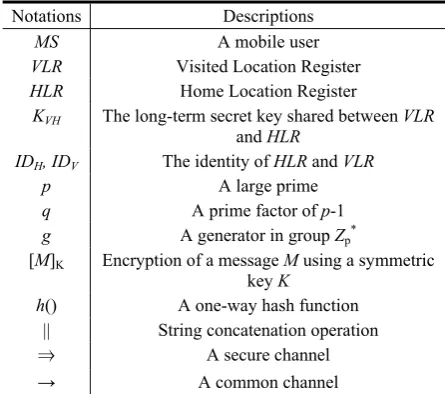
Table 1. The notations used in this paper
Notations Descriptions
MS A mobile user
VLR Visited Location Register HLR Home Location Register
KVH The long-term secret key shared between VLR and HLR
IDH, IDV The identity of HLR and VLR
p A large prime
q A prime factor of p-1 g A generator in group Zp*
[M]K Encryption of a message M using a symmetric
key K
h() A one-way hash function || String concatenation operation ⇒ A secure channel
→ A common channel
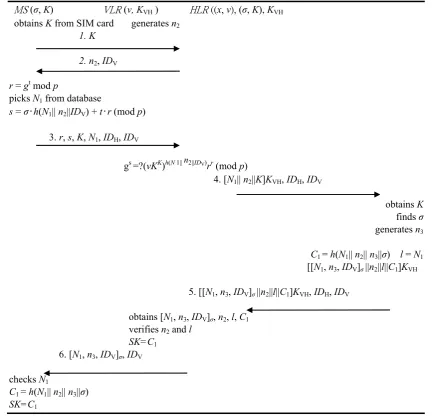
2.2. On-line authentication process Step 1. MS→VLR: K
The MS obtains the public key K from his /her SIM card and sends K to VLR.
Step 2. VLR→MS: n2, IDV
After receiving this message from MS, VLR
generates a random number n2 and responses n2 and IDV to MS.
Step 3. MS→VLR: r, s, K, N1, IDH, IDV
After receiving these messages from VLR, the
MS computes r = gt mod p and picks N 1 from
his/her database to compute s = σ· h(N1|| n2||IDV) + t · r (mod p), where t is a random
number and N1 = h(n+1)(n1). Finally, MS sends
{r, s, K, N1, IDH, IDV} to VLR.
Step 4. VLR→HLR: [N1|| n2||K]KVH, IDH, IDV
After receiving these messages from MS, VLR
computes gs and (vKK)h(N 1||n2||IDV)rr (mod p) and then checks to see if gs is the same as
(vKK)h(N 1||n2||IDV)rr (mod p). If they are the same, the VLR has successfully authenticated
the MS and sends {[N1|| n2|| K]KVH, IDH, IDV}
to HLR’; otherwise, VLR rejects MS’s request.
Step 5. HLR → VLR: [[N1, n3, IDV]σ||n2||l||C1]KVH, IDH, IDV
After receiving these messages from VLR, the
HLR obtains K by decrypting [N1||n2||K]KVH
and further finds the corresponding σ in his/her database according to K. If not found, the HLR rejects this authentication process. Otherwise, the HLR computes C1 = h(N1|| n2|| n3||σ) and l = N1, where n3 is a random
number. Then, the HLR further computes [[N1, n3, IDV]σ ||n2||l||C1]KVH by using the
long-term shared key KVH and the MS’s
private key σ. Finally, the HLR sends {[[N1, n3, IDV]σ||n2||l||C1]KVH, IDH, IDV} to VLR.
Step 6.VLR→MS: [N1, n3, IDV]σ, IDV
After receiving these messages from the HLR, the VLR obtains [N1, n3, IDV]σ, n2, l, C1 by
decrypting [[N1, n3, IDV]σ||n2||l||C1]KVH. Then
the VLR verifies n2 and l and then sets C1 as
the current session key SK. Finally, the VLR
sends {[N1, n3, IDV]σ, IDV} to MS. After
receiving these messages from the VLR, the
MS obtains N1 by using his/her private key
and checks to see if N1 is the same as the
previous sent N1 in Step 3. If they are the
same, MS hassuccessfully authenticated VLR
and computes C1 as the current session key SK. The detailed steps are shown in Fig. 1.
2.3. Off-line authentication process MS→VLR: [h(n-i+1)(n
1)]Ci MS selects h(n-i+1)(n
1) from his/her database and
computes [h(n-i+1)(n
1)]Ci, where n is the limited time of
off-line authentication and i = 1, 2,...,n. Finally, the
MS sends [h(n-i+1)(n
1)]Ci to the VLR. After receiving
these messages from the MS, the VLR obtains
h(n-i+1)(n
1) by using the session key Ci and checks if h(h(n-i+1)(n
1)) is the same as l. If they are the same, the VLR updates l = h(n-i+1)(n
1) and i = i+1, where the
count i ≦ n. Afterwards, the VLR computes the session key Ci+1 = h(l, Ci) .
3. Weaknesses of Lee et al.’s protocol
Figure 1. The on-line authentication process of Lee et al.’s protocol
3.1. Lack of dynamic ID
The most important issue is not only the security problem but also the personal privacy. In the recent years, there are many researches that point out some advantages in the user anonymity for wireless environments [2, 4-9, 11, 12, 14]. In a normal public network, the adversary could intercept the user’s identity and find out who was communicating with VLR and obtain sensitive personal information. Therefore, a user’s identity must be anonymous. Namely, a user’s identity should be encrypted or replaced with a temporal identity. But we found out that Lee et al.’s protocol cannot achieve any dynamic ID. The detail is described in the following paragraph.
In the on-line authentication process, the MS sends
K to the VLR in Step 1. However, the public key K is similar to the identity of the mobile user. Although the public key K is only used in the on-line authentication process, K is both immobile and sent through a public
network. Any user can intercept the user’s public key
K from the public wireless network, including illegal ones. That is, Lee et al.’s protocol fails to achieve anonymity service. When MS communicates with VLR
in an on-line authentication process, any one could figure out who is communicating with VLR and HLR. It triggers the personal privacy problems. Therefore, we think the user’s anonymity should be taken into consideration in PCSs. It’s obvious that Lee et al.’s protocol does not provide user anonymity to protect a user’s privacy.
3.2. Perfect forward secrecy
Perfect forward secrecy is a very important security attribute. However, we found that Lee et al.’s delegation-based authentication protocol for PCSs fails to provide perfect forward secrecy. Perfect forward secrecy means that if an adversary obtains a subset of session key in some ways, he/she cannot MS (σ, K) VLR (v,KVH ) HLR ((x, v), (σ, K), KVH
obtains K from SIM card generates n2 1. K
2. n2, IDV r = gt mod p
picks N1 from database
s = σ‧h(N1|| n2||IDV) + t‧r (mod p)
3. r, s, K, N1, IDH, IDV
gs =?(vKK)h(N 1||n2||IDV)rr (mod p)
4. [N1|| n2||K]KVH, IDH, IDV
obtains K
finds σ
generates n3
C1 = h(N1|| n2|| n3||σ) l = N1
[[N1, n3, IDV]σ||n2||l||C1]KVH
5. [[N1, n3, IDV]σ||n2||l||C1]KVH, IDH, IDV
obtains [N1, n3, IDV]σ, n2, l, C1
verifies n2 and l SK=C1
6. [N1, n3, IDV]σ, IDV
checks N1
extract the past session keys. More details are described in the following paragraphs.
In Lee et al.’s off-line authentication protocol, the
MS sends an authentication request [h(n-i+1)(n
1)]Ci to the VLR, where n is the limited time of off-line authentication and i = 1, 2,...,n. Then the VLR obtains
h(n-i+1)(n
1) by using Ci and checks if h(h(n-i+1)(n1)) is the
same as l. If they are the same, VLR updates l=h(n-i+1)·(n1) and i = i+1, where the count i ≦ n.
Then, the VLR computes the session key
Ci+1 = h(l, Ci) for securing communications with the MS. Finally, the MS and the VLR store the session key
Ci+1 and l for the next communication. Once the session key Ci is disclosed in an off-line authentication, the adversary can obtain h(n-i+1)(n
1) and
compute the session key Ci+1=h(l, Ci). Besides, he/she
also can obtain the next session key by using Ci+1.
As an example, let’s assume that n = 10. Then after the on-line authentication, MS stores h(9)(n
1), h(8)(n1), h(7)(n
1)….. h(1)(n1) in his/her database and the VLR
obtains l = h(10)(n
1) and C1. In the first off-line
authentication, the MS sends an authentication request [h(9)(n
1)]C1 to the VLR, where C1 is the session key
established in the on-line authentication. Then the
VLR obtains h(9)(n
1) by using C1 and checks if h(h(9)(n
1)) is the same as l. If they are the same, the VLR updates l = h(9)(n
1) and computes the current
session key C2 = h(l, C1) for the next communication
with the MS. If the adversary obtains the session key
C1, somehow, he/she can decrypt [h(9)(n1)]C1 and
compute l = h(10)(n
1). Then the adversary can also
compute the current session key C2 = h(l, C1) and store C2 for the second off-line authentication. This means
that if a given session key Ci is disclosed, all the other
session keys Ci+1 will be opened. That is, when the MS
communicates with the VLR, the adversary can decrypt all the massages between the MS and the VLR. Therefore, Lee et al.’s protocol cannot provide perfect forward secrecy.
4. Our improved protocol
In this section, we propose an improvement on Lee et al.’s protocol, which keeps the merits of the original protocol, and at the same time, can provide user anonymity and achieve perfect forward secrecy. To provide user anonymity in Lee et al.’s protocol, we assume that the identity of the user is encrypted or has been replaced with a temporal identity. Our improved protocol consists of three processes: the setup process, the on-line authentication process, and the off-line authentication process. The detailed phases are shown in the following sections.
4.1. Setup process
The HLR computes his/her public key v= gx mod p,
where x is the HLR’s private key. When the MS sends a request to the HLR for registration through a secure channel, the HLR computes the MS’s public key
K = gk mod p and private key σ= x + kK (mod p) and
decides an initialized temporary identity T ID, where k
is a random number generated by HLR. Afterwards,
MS’s SIM card contains the key pair (σ, K) and T ID.
Additionally, MS pre-computes a hash chain h(1)( n 1), h(2)( n
1),…, h(n+1)(n1), where n1 is a random number
generated by MS.
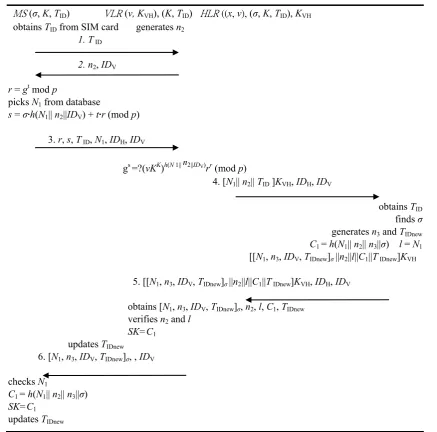
4.2. On-line authentication process Step 1. MS→VLR: T ID
The MS obtains the initialized temporary identity T ID from his/her SIM card and sends T ID to VLR.
Step 2. VLR→MS: n2, IDV
After receiving this message from MS, VLR
generates a random number n2 and responses n2 and IDV to MS.
Step 3. MS→VLR: r, s, T ID, N1, IDH, IDV
After receiving these messages from VLR, MS
computes r = gt mod p and picks N
1 and T ID
from his/her database to compute
s = σ· h(N1|| n2||IDV) + t·r (mod p), where t is
a random number and N1 = h(n+1)(n1). Finally, MS sends {r, s, T ID, N1, IDH, IDV} to VLR. Step 4.VLR→HLR: [N1|| n2|| T ID]KVH, IDH, IDV
After receiving this message from the MS, the
VLR obtains K by checking T ID from his/her
database. We assume that the VLR maintains a table of the mapping between the public key
K and the corresponding initial temporary identity T ID. Then the VLR computes gs and
(vKK)h(N 1||n2||IDV)rr (mod p) and then checks if gs is the same as (vKK)h(N 1||n2||IDV)rr (mod p). If they are the same, the VLR has successfully authenticated the MS and sends {[N1|| n2|| TID]KVH, IDH, IDV} to HLR;
otherwise, the VLR rejects the MS’s request.
Step 5. HLR → VLR: [[N1, n3, IDV, T IDnew]σ ||n2||l||C1||T IDnew]KVH, IDH, IDV
After receiving these messages from the VLR, the HLR obtains TID by decrypting
[N1||n2||TID]KVH and further finds the
corresponding σin his/her database according to TID. If it is not found, HLR rejects this
authentication process. Otherwise, the HLR
computes C1 = h(N1|| n2|| n3||σ) and l = N1,
where n3 is a random number generated by
the HLR. Then, the HLR further generates a new temporary identity T IDnew and computes
[[N1, n3, IDV, T IDnew]σ||n2||l||C1||T IDnew]KVH by
using the long-term shared key KVH and MS’s
private key σ. Finally, HLR sends {[[N1, n3, IDV, T IDnew]σ||n2||l||C1||T IDnew]KVH, IDH, IDV}
Step 6. VLR→MS: [N1, n3, IDV, TIDnew]σ, IDV
After receiving these messages from the HLR, the VLR obtains [N1, n3, IDV, TIDnew]σ, n2, l, C1, TIDnew by decrypting [[N1, n3, IDV, TIDnew]σ ||n2||l||C1||TIDnew]KVH. Then VLR
verifies n2 and l and then sets C1 as the
current session key SK. Finally, the VLR
replaces TID with TIDnew in his/her database.
Then the VLR sends {[N1, n3, IDV, TIDnew]σ,
IDV} to MS. After receiving these messages
from VLR, MS obtains N1 by using his/her
private key and checks if N1 is the same as the
previous sent N1 in Step3. If they are the
same, MS has successfully authenticated the
VLR, and computes C1 as the current session
key SK. Finally, MS obtains TIDnew and
updates the SIM card for the next authentication. The detailed steps are shown in Fig. 2.
Figure 2. The improved on-line authentication process
4.3. Off-line authentication process
MS→VLR: [h(n-i+1)(n
1) ⊕T IDnew]Ci
The MS obtains h(n-i+1)(n
1) and TIDnew from his/her
database and computes [h(n-i+1)(n
1) ⊕TIDnew]Ci, where n
is the limited time of off-line authentication and i = 1, 2,...,n. Finally, the MS sends [h(n-i+1)(n
1)⊕TIDnew]Ci to
the VLR. After receiving these messages from the MS, the VLR obtains h(n-i+1)(n
1) by using the session key Ci
and TIDnew. Then VLR checks if h(h(n-i+1)(n1)) is the
same as l. If they are the same, VLR updates l = h(n-i+1)(n
1) and i = i+1, where the count i≦n. The VLR computes the session key Ci+1 = h(l, Ci) and
decides a new temporary identity TIDnewi and updates
the verification table. Afterwards, the VLR sends [TIDnewi ⊕TIDnew]Ci+1 to the MS and sends [TIDnewi]KVH
MS (σ, K, TID) VLR (v,KVH), (K, TID) HLR ((x, v), (σ, K, TID), KVH
obtains TID from SIM card generates n2 1. T ID
2. n2, IDV r = gt mod p
picks N1 from database
s = σ·h(N1|| n2||IDV) + t·r (mod p)
3. r, s, T ID, N1, IDH, IDV
gs =?(vKK)h(N 1||n2||IDV)rr (mod p)
4. [N1|| n2|| TID ]KVH, IDH, IDV
obtains TID
finds σ
generates n3 and TIDnew C1 = h(N1|| n2|| n3||σ) l = N1
[[N1, n3, IDV, TIDnew]σ||n2||l||C1||T IDnew]KVH
5. [[N1, n3, IDV, TIDnew]σ||n2||l||C1||T IDnew]KVH, IDH, IDV
obtains [N1, n3, IDV, TIDnew]σ, n2, l, C1, TIDnew
verifies n2 and l SK=C1
updates TIDnew
6. [N1, n3, IDV, TIDnew]σ, , IDV
checks N1
C1 = h(N1|| n2|| n3||σ) SK=C1
to the HLR. After receiving these messages, the MS
obtains TIDnewi and updates the SIM card for the next
authentication process. Besides, the HLR obtains
TIDnewi and updates his/her database.
5. Security analysis
In this paper, we propose a modification to the improved Lee et al.’s protocol, to achieve the requirement of user anonymity and perfect forward secrecy. The focus of this section is on security requirements and functional requirements. Therefore, in this section, we will only discuss the essential security requirements and functional requirements that a portable communication system should have.
5.1. Resistance to impersonation attacks
Impersonation attacks are very treacherous when the adversary has the ability to send a valid message to fool another user or the server herself. This attack should be taken into consideration and should be avoided. Assume that the adversary is trying to impersonate a legitimate user to login to the server. Then he/she needs to send a valid message to the VLR
in the off-line authentication processes. However, the adversary cannot impersonate any legitimate users to deceive the VLR, because he/she cannot compute [h(n-i+1)(n
1) ⊕TIDnew]Ci without knowing h(n-i+1)(n1) and TIDnew which are secretly stored in the SIM card and
the session key Ci. It can be assured that the adversary
cannot perform impersonation attacks in our improved protocol.
Besides, the adversary might want to impersonate a legitimate VLR to cheat the MS to obtain some benefits. However, the adversary has no way to perform this attack, because he/she cannot decrypt [h(n-i+1)(n
1) ⊕TIDnew]Ci without the session key Ci.
Therefore, the adversary cannot impersonate a VLR to cheat the legitimate user in our improved protocol.
5.2. Resistance to denial of service attacks
Denial-of-Service attacks can disturb the availability of the authentication between the legitimate user and server. This kind of attack can prevent legitimate users to access the server. We can assume that the adversary wants to perform a denial of service attacks to paralyze the VLR. This DoS will not work in our improved protocol. In off-line authentication processes, the MS can obtain h(n-i+1)(n
1)
and TIDnew from the SIM card and send
[h(n-i+1)(n
1) ⊕TIDnew]Ci to access the VLR. After the VLR receives this message, he/she obtains Ci and TID
from his/her database and verifies the MS by checking if h(h(n-i+1)(n
1)) is the same as l. If it holds, the VLR
updates l = h(n-i+1)(n
1) and TIDnewi and computes the
session key Ci+1 = h(l, Ci). Since the VLR can control
the amount of incoming login messages in the off-line authentication processes, no one can perform the denial of service attack on our improved protocol.
5.3. Resistance to replay attacks
Assuming that the adversary wants to replay the message [h(n-i+1)(n
1)⊕TIDnew]Ci to cheat the VLR, he/she
will fail, because the VLR has the ability to detect this attack. When the adversary intercepts the login message in the off-line authentication processes and retransmits it, the VLR obtains h(n-i+1)(n1) by using the
session key Ci+1 and TIDnewi. Then the VLR checks to
see if h(h(n-i+1)(n
1)) is the same as l. In this case, the
replay message is encrypted by the previous session key Ci. The VLR uses the further session key Ci+1 to decrypt this intercept message. The replayed message cannot pass the equation test h(h(n-i+1)(n
1)) =? l.
Therefore, the VLR will detect and reject this failed message. Our improved protocol can withstand the replay attack.
5.4. User privacy
User anonymity has become an essential functional requirement in mobile communications, because an adversary might intercept the user’s identity from the public network and use it to trace the mobile user. However, in the improved protocol, we substitute a temporary identity TID for the public key K
to protect the privacy of the MS in the on-line authentication processes. Since the user’s public key K is not transmitted over the public network in the on-line authentication processes, the adversary cannot trace the mobile user. Besides, after the on-line authentication processes, as the temporary identity TID
is replaced with a new temporary identity TIDnew, the
adversary cannot use the old one to figure out the trace of the MS. Therefore, user intractability is achieved by the anonymity of a temporary identity and user anonymity is provided in our improved protocol.
5.5. Perfect forward secrecy
Perfect forward secrecy is a form of security requirements in network systems. In general, perfect forward secrecy means that an adversary cannot extract the past session keys, even if, by using some methods, he/she manage to obtain a subset of session keys. If somehow the adversary obtains a subset of session keys Ci , he/she can intercept the login
message [h(n-i+1)(n
1) ⊕TIDnew]Ci of the MS and decrypt
it. However, the adversary cannot compute the further session key Ci+1= h(l, Ci) without the existence of l.
He/she can only obtain h(n-i+1)(n
1) ⊕TIDnew by
decrypting [h(n-i+1)(n
1)⊕TIDnew]Ci. The adversary
therefore can’t compute h(n-i+1)(n
1)⊕TIDnew⊕TIDnew=l,
since he/she doesn’t have the temporary identity TIDnew
of MS. That is, only both MS and VLR have the necessary temporary identity T IDnew to obtain l.
5.6. Mutual authentication
Mutual authentication can be achieved in our improved protocol. In the on-line authentication processes, the MS authenticates the VLR and the HLR
by checking N1 in Step 6. Only a legal HLR can
compute [N1, n3, IDV, T IDnew]σby using a user’s private key. The VLR authenticates the MS and the HLR by checking the proxy signature gs =?(vKK)h(N 1||n2||IDV)rr (mod p) in Step 4 and n2 in Step 6, respectively. Only
a legal MS can compute s=σ·h(N1||n2||IDV)+t·r (mod p)
by using his/her private key, and the HLR then can compute [[N1, n3, IDV, TIDnew]σ||n2||l||C1|| TIDnew]KVH by
using a long-term shared key between the VLR and the
HLR. The HLR authenticates the VLR by checking TID
in Step 5. Besides, the HLR authenticates the MS
through the VLR in Step 4 that checks the equation
gs =?(vKK)h(N 1|| n2||IDV)rr (mod p). In the off-line authentication, the MS sends a login message [h(n-i+1)(n
1) ⊕TIDnew]Ci to the VLR, and the VLR verifies
the MS by checking if h(h(n-i+1)(n
1)) is the same as l. If
they are the same, the VLR has successfully authenticated the MS. The VLR updates l = h(n-i+1)(n
1)
and TIDnewi and computes the further session key Ci+1 = h(l, Ci). Then the VLR sends [TIDnewi ⊕TIDnew]Ci
as a response to the MS, and the MS decrypts it and verifies the VLR by checking TIDnew. If they are the
same, the MS hassuccessfully authenticated the VLR
and updates TIDnewi. That is, both the MS and the VLR
are able to obtain the same TID both to compute the
session key Ci, and to update the further session key Ci+1= h(l, Ci). Therefore, our improved protocol can
provide mutual authentication.
5.7. The security of session key SK
If the adversary tries to obtain the one-time session key C1in the on-line authentication processes, he/she
can intercept all the messages from the public wireless environment. However, the adversary cannot compute
C1 = h(N1|| n2|| n3||σ) without the user’s private key σ.
Only the MS and the HLR can compute the session key C1 = h(N1|| n2|| n3||σ), because both have the user’s
private key σ. Even if the adversary intercepts any messages in the on-line authentication processes, he/she has no way to decrypt [[N1, n3, IDV, TIDnew]σ ||n2||l||C1||TIDnew]KVH to obtain C1 without relying on
the long-term shared key KVH. Besides, the adversary
also cannot obtain the session key in the off-line authentication processes, because he/she cannot compute Ci+1 = h(l, Ci) without h(h(n-i+1)(n1)) and Ci.
Therefore, our improved protocol can provide the session key security.
5.8. Non-repudiation
In the off-line authentication processes, the MS
obtains h(n-i+1)(n
1) and TIDnew from his/her database and
computes [h(n-i+1)(n
1) ⊕TIDnew]Ci, where n is the limited
time of off-line authentication and i = 1, 2,...,n. Then,
the MS sends [h(n-i+1)(n
1)⊕TIDnew]Ci to the VLR. When
the VLR receives these messages from the MS, he/she obtains h(n-i+1)(n
1) by using the session key Ci and TIDnew. Then the VLR checks if h(h(n-i+1)(n1)) is the
same as l. If they are the same, the VLR has successfully authenticated the MS. Only a legal MS
can compute [h(n-i+1)(n
1)⊕TIDnew]Ci and Ci+1 = h(l, Ci)
to login the VLR. No one can masquerade a legal MS
to compute [h(n-i+1)(n
1)⊕TIDnew]Ci to deceive the VLR.
If a mobile user wants to deny the fact that he/she has transmitted a particular message, the VLR can detect this attempt by using the session key Ci. Therefore,
our improved protocol can achieve this essential requirement.
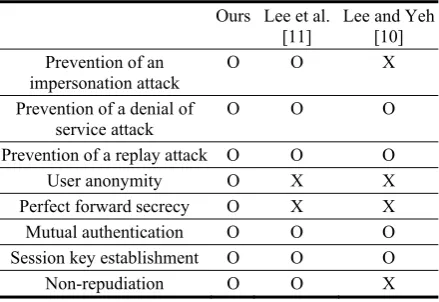
Table 2. Properties of the improved protocol and previously
proposed protocols
Ours Lee et al.
[11] Lee and Yeh [10] Prevention of an
impersonation attack
O O X
Prevention of a denial of service attack
O O O
Prevention of a replay attack O O O User anonymity O X X Perfect forward secrecy O X X Mutual authentication O O O Session key establishment O O O
Non-repudiation O O X
Table 2 lists the properties of the improved protocol and that of the previously proposed protocols. Compared with the previous protocols, our improved protocol can achieve all the security requirements and provide anonymity service for mobile users to roam in portable communication systems.
Since the Chen et al.’s protocol [1] is the newest protocol in this research area, we compare the efficiency of our improvement with this protocol. Table 3 shows the computation costs of both protocols in an on-line authentication process. Since the setup process and the off-line authentication process of both protocols are similar, we only compare the on-line authentication process between both protocols. We can see that our proposed protocol is more efficient than the Chen et al.’s protocol.
Table 3. Comparison of computation costs in an on-line
authentication process
Ours Chen et al. [1] MS VLR HLR MS VLR HLR Modular
exponentiation 1 4 0 1 4 1
Modular multiplication
2 0 0 2 0 1
Symmetric encryption/ decryption
1 2 3 1 2 3
6. Conclusions
In this paper, we have demonstrated that Lee et al.’s protocol fails to provide perfect forward/backward secrecy and is not able to preserve user anonymity. In addition, Lee-Yeh’s protocol suffers from the same problems, since Lee et al.’s protocol inherits from Lee and Yeh’s protocol. Their protocols fail to provide the anonymity service, which is the key to delegation-based authentication. Neither Lee-Yeh’s nor Lee et al.’s protocols can provide perfect forward secrecy, since, if once a subset of session key is revealed, all session keys will be opened. The improved protocol presented in this paper not only retains the advantages from the original research, but also enhances the essential requirements. We therefore believe that our improved protocol will provide a practicable solution in the real world.
Acknowledgment
The authors would like to express their appreciation to the anonymous referees for their valuable suggestions and comments. This research was partially supported by the National Science Council, Taiwan, R.O.C., under contract no.: 100-2221-E-030-015, and 100-2218-E-164-002.
References
[1] H. B. Chen, Y. H. Lai, K. W. Chen, W. B. Lee,
Enhanced delegation based authentication protocol for secure roaming service with synchronization, Journal of Electronic Science and Technology, vol. 9, no. 4, pp. 345-351, Dec. 2011.
[2] M. L. Das, Two-factor user authentication in wireless
sensor networks, IEEE Transactions on Wireless Communications, vol. 8, no. 3, pp. 1086-1090, 2009. http://dx.doi.org/10.1109/TWC.2008.080128.
[3] Y. Ding, P. Horster, Undetectable on-line password
guessing attacks, ACM SIGOPS Operating Systems Review, vol. 29, no. 4, pp. 77-86, 1995. http://dx.doi.org/10.1145/219282.219298.
[4] C. C. Lee, M. S. Hwang, I. E. Liao, Security
enhancement on a new authentication scheme with anonymity for wireless environments, IEEE Transactions on Industrial Electronics, vol. 53, no. 5, pp. 1683-1687, 2006. http://dx.doi.org/10.1109/TIE.20 06.881998.
[5] C. C. Lee, R. X. Chang, T. Williams, On the
anonymity of an enhanced authentication scheme for a roaming service in global mobility networks, accepted to appear in International Journal of Secure digital Information age.
[6] C. C. Lee, C. T. Li, R. X. Chang, A simple and
efficient authentication scheme for mobile satellite communication systems, International Journal of Satellite Communications and Networking, vol. 30, no. 1, pp. 29-38, Jan. 2012. http://dx.doi.org/10.10 02/sat.993.
[7] C. T. Li, C. C. Lee, A novel user authentication and
privacy preserving scheme with smart cards for wireless communications, Mathematical and Computer
Modeling, vol. 55, no. 1-2, pp. 35-44, Jan. 2012. http://dx.doi.org/10.1016/j.mcm.2011.01.010.
[8] C. C. Lee, I. E. Liao, M. S. Hwang, An efficient
authentication protocol for mobile communications, Telecommunication Systems, vol. 46, no. 1, pp. 31-41, Jan. 2011. http://dx.doi.org/10.1007/s11235-009-927 64.
[9] C. C. Lee, T. H. Lin, C. S. Tsai, A new authenticated
group key agreement in a mobile environment, Annals Of Telecommunications - Annales Des Telecommuni-cations, vol. 64, no. 11, pp. 735-744, Dec. 2009.
[10] W. B. Lee, C. K. Yeh, A new delegation-based
authentication protocol for use in portable communication systems, IEEE Transactions on Wireless Communications, vol. 4, no. 1, pp. 57-64, 2005. http://dx.doi.org/10.1109/TWC.2004.840220.
[11] T. F. Lee, S. H. Chang, T. Hwang, S. K. Chong,
Enhanced delegation-based authentication protocol for PCSs, IEEE Transactions on Wireless Communications, vol. 8, no. 5, pp. 2166-2171, 2009. http://dx.doi.org/10.1109/TWC.2009.070032.
[12] M. Long, C. H. Wu, J. D. Irwin, Localized
authentication for internetwork roaming across wireless LANs, Communications IEE Proceedings, vol. 151, no. 5, pp. 496-500, 2004.
[13] T. F. Lee, C. C. Chang, T. Hwang, Private
authentication techniques for the global mobility network, Wireless Personal Communications, vol. 35, no. 4, pp. 329-336, 2005. http://dx.doi.org/10.100 7/s11277-005-6177-z.
[14] H. Y. Lin, L. Harn, Authentication protocols with
non-repudiation services in personnel communication systems, IEEE Communications Letters, vol. 3, no. 8, pp. 236-238, 1999. http://dx.doi.org/10.1109/4234.781 006.
[15] L. Lamport, Password authentication with insecure
communication, Communication of ACM, vol. 24, pp. 770-772, 1981. http://dx.doi.org/10.1145/358790.35 8797.
[16] J. Z. Lu, H. Q. Ren, J. Zhou, Efficient delegation-based authentication protocol with strong mobile privacy, Proceedings of the International Conference on Wireless Information Networks and Systems (WINSYS 2011), Seville, Spain, 18-21 July, pp. 123-127, 2011.
[17] M. Rahnema, Overview of the GSM system and
protocol architecture, IEEE Communications Magazine, vol. 31, no. 4, pp. 92-100, 1993. http://dx.doi.org/10.1109/35.210402.
[18] C. Tang, D. O. Wu, An efficient mobile
authentication scheme for wireless networks, IEEE Transactions on Wireless Communications, vol.7, no. 4, pp. 1408-1416, 2008. http://dx.doi.org/10.11 09/TWC.2008.061080.
[19] C. C. Wu, W.B. Lee, W. J. Tsaur, A secure
authentication scheme with anonymity for wireless communications, IEEE Communications Letters, vol. 12, no. 10, pp. 722-723, 2008. http://dx.doi.org/10 .1109/LCOMM.2008.080283.
[20] S. J. Wang, Anonymous wireless authentication on a
portable cellular mobile system, IEEE Transactions on Computers, vol. 53, no. 10, pp. 1317–1329, 2004. http://dx.doi.org/10.1109/TC.2004.70.
[21] E. J. Yoon, K. Y. Yoo, Cryptanalysis of robust E-mail
Communications Letters, vol. 11, no. 5, pp. 372-374, 2007. http://dx.doi.org/10.1109/LCOMM.2007.061770
[22] T. Y. Youn, J. Lim, Improved delegation-based
authentication protocol for secure roaming service with unlinkability, IEEE Communications Letters, vol. 14, no. 9, pp. 791−793, Sep. 2010. http://dx.doi.org/10.110 9/LCOMM.2010.080210.100353.
[23] J. Zhu, J. Ma, A new authentication scheme with
anonymity for wireless environments, IEEE
Transactions Consumer Electronics, vol. 50, no. 1, pp. 231-235, 2004. http://dx.doi.org/10.1109/TCE.2004.12 77867.
[24] R. Zhang, K. Chen, Improvements on the WTLS
protocol to avoid denial of service attacks, Computers & Security, vol. 24, no. 5, pp. 76-82, 2005. http://dx.doi.org/10.1016/j.cose.2004.10.002.