Published by Central Fisheries Research Institute (SUMAE) Trabzon, Turkey in cooperation with Japan International Cooperation Agency (JICA), Japan
R E S E A R C H P A P E R
Partial Replacement of Plant Sources by Waste Date (
Phoneix
dactylifera
) in the Diet of Fingerling Common Carp (
Cyprinus
carpio
) on Growth Performance, Feed Utilization,
Hematological Parameters and Resistance to Stress
Mehrdad Kamali-Sanzighi
1, Reza Akrami
1,* , Afshin Ghelichi
1, Mahshid
Shamloofar
11Islamic Azad University, Department of Fisheries, Azadshahr Branch, Azadshahr, Iran.
Article History
Received 25 February 2018 Accepted 25 September 2018 Early View 28 September 2018
Corresponding Author
Tel.: +98.9111772071
E-mail: [email protected]
Keywords
Common carp (Cyprinus carpio) Date (Phoneix dactylifera) Growth
Hematology Stress
Abstract
This research was conducted to evaluate the partial replacement of plant sources by date waste meal (DWM) on growth, hematological and resistance of common carp. A
total of 168 common carp fingerling (2.44±0.02 g) were randomly assigned to four groups in triplicate and fed for 12 weeks with substitution of plant sources by 5%, 10% and 15% of DWM and control diet. Some growth and feed utilization parameters including WG, SGR, CF, PER and LER were improved in group fed with 10% DWM; but, there were no significant differences (P>0.05) in growth and feeding parameters between different groups. The results showed that replacement of plant sources by DWM in diets did not affect MCV, MCH and all biochemical parameters while the fish treated with 15% WDM exhibited significantly decrease in RBC, Hb and neutrophil compare to the control and other groups (P<0.05). In addition, there were no significant differences (P>0.05) of Hct, MCV, MCH and all biochemical parameters between treatment groups. Resistance rate to acidy and thermal-salinity stress increased significantly in 5% DWM and control group (P<0.05), respectively. The present study indicates that DWM may be included up to 10% as a substitute for plant sources in common carp diet.
Introduction
Agro-industrial by-products in recent years become one of important feed ingredient in aquaculture, poultry and veterinary diets of some religion of the world manly due to the increased competition for the conventional ingredients by human and the food industries (Masoudi, Bajarpour, Chaji, Eslami & Mirzadeh, 2010). To reach a sustainable aquaculture, new alternative ingredient sources including cheaper plant-derived materials is needed to be introduced for stable aquafeed production (Higgs et al., 1995). In this condition, it is necessary to develop appropriate complete and supplementary diets using locally available material especially, plant by-products
for most of the fish farmers in the world for use in
grow-out facilities due to the prohibitive cost and
limited availability of fishmeal and other rare material
in the world (Obirikorang, Amisah, Fialor & Skov, 2015). In addition, industrial ecology and circular economy are considered the leading principles for eco-innovation
focusing on a “zero waste” society and economy where wastes can be used as raw materials (Kasapidou, Sossidou, & Mitlianga, 2015).
Among different agriculture by-products material, date (Phoneix dactylifera) is one of the world’s oldest
and environmental challenge for country and researchers should be find a new valuable usage of this waste by-product (Gaber, Labib, Omar, Zaki & Nour, 2014). While, according to nutrition value, date fruit consist of high energy, carbohydrate, fiber, ash, protein and fat with different percent, depending on the variety of the date fruit (Habib& Ibrahim, 2009; Abdul Afig, Abdul Rahman, Che Man, Al-Kahtani & Mansor, 2013; Al-Hafedh & Alam, 2013).
Common carp (Cyprinus carpio) is one of the most important cultured fish in the world aquaculture industry. This fish is the third most frequently introduced species worldwide. It is being considered as a potential candidate for commercial aquaculture (Rahman, 2015). In the year of 2014, the world and Iran's common carp production was about ~3.500.000 and ~50.000 tons, respectively (FAO, 2014; Iran's fishery year book, 2016). Carp is an omnivorous species eating plankton, benthos and detritus in the natural
conditions. The carp’s digestive system is adapted to a
diet including more carbohydrates compared with carnivorous species (Mraz, 2011). The economically feasible common carp fish farming can be achieved when it is based on cost effective feed compound of locally available agricultural by-products. Appropriate use of local protein by-products could reduce feed costs and enhance environment and economic sustainability. Therefore, formulation of cheaper diets using locally available ingredients, especially
carbohydrate sources, could have a significant impact
on common carp farming through cost reduction (Azaza, Mensi, Kammoun, Abdelouaheb, Brini & Kraïem, 2009).
Several researches have reported the beneficial of different form of date as a feed ingredient on tilapia
(Yousif, Osman & Alhadrami, 1996; Belal & Al‐Jasser, 1997; Belal & Al‐Owafeir, 2004; El-Sayed, Hamza & Al-Darmaki, 2006; Belal, 2008; Azaza et al., 2009; Gaber et al., 2014), African Catfish (Sotolu, Kigbu & Oshinowo, 2014) and common carp (Hoseinifar, Khalili, Rufchaei, Raeisi, Attar, Cordero, & Esteban, 2015; Hoseinifar, Dadar, Khalili, Cerezuela & Esteban, 2017) but there is no documented evidence about the effect of partial replacement date waste meal (DWM) on common carp. Therefore, the objectives of the present study evaluated the effects of DWM on the common carp fingerlings concerning their growth, blood and biochemical profile as well as on the resistant rate of that fish.
Material and Methods
Fish Culture Condition
Common carp fingerling (2.44±0.02 g) were sourced from private center (Golestan province, Iran). The health of the fish was checked and randomly distributed into 12 glass aquaria (50 L) at 14 fish per
aquaria density (3 aquaria per treatment) and acclimatize for 14 days before experimental feeding regime. The water quality parameters including temperature, dissolved oxygen and pH were monitored daily and maintained at optimum condition. For this reason, water was changed partially to 50% and siphon once a day before start of first feeding time. The experimental diets were fed three times daily (09:00, 12:00 and 15:00 h) at rate of 5% of body weight for 12 weeks (Sotolu et al., 2014).
Diet Preparation and Experiment Design
Date waste meal (DWM with powder form), was purchased from Tabriz's Sepehr Sanat Sahand company (Azarbaijane Sharghi province, Iran). A basal diet was formulated to contain 30% protein and 8% lipid for common carp fingerlings (Table 1). This basal diet served as the control diet and the experimental diets were produced with partial inclusion levels of 5, 10 and 15% DWM respectively (Gaber et al., 2014; Belal, El-Tarabily, Kassab, Abdel-Fattah & Rasheed, 2015). The dietary ingredients were blended with water to form a paste, which passed through a meat grinder and pelleted to produce 0.8 mm diet pellets. The diet was air dried at 60 0C in a vacuum drying oven and was stored in plastic bags at -8 0C until used (Belal et al., 2015). The chemical composition of all experimental diet were determined according to standard methods (AOAC, 2000) (Table 1).
Growth Performance and Feed Efficiency Parameters
Total fish weight in each tank was measured every 15 days at least 12 h after the last feeding to adjust the feeding rate and estimate growth factor. At the end of
feeding trial, specific growth rate (SGR %/day), weight
gain (WG g), percent of body weight gain (WG %), condition factor (CF), feed conversion ratio (FCR), feed intake (FI %/day), protein efficiency rate (PER), lipid efficiency rate (LER), survival rate (SR) and Biomass gain (g) were calculated according to the follow formulas (Imanpoor, Najafim & Kabir, 2012; Abbass, El-Asely & Kandiel, 2012; Ahmed, 2017).
SGR (% day-1) = 100 × (ln (W2) ) – (ln (W1))
t
FCR = FI (g)
weight gain (g)
WG (g) = W2 (g) – W1 (g)***
WG (%) = W2−W1
W1 × 100
FI (%BW/day) = 100 × total dry feed intake per fish ÷(W1×W2)^0.5
t ***
CF = weight (g)
PER = protein intake (g)weight gain (g) ***
LER = weight gain (g)
lipid intake (g)
Biomass gain = final biomass (g) – initial biomass (g)***
SR (%) = N2
N1 × 100
where, W1= Initial body weight (g); W2= Final body weight (g); BW=body weight; t= duration of experiment in days; N1=Number of fish at the start of the experiment and N2= Number of fish at the end of the experiment.
Blood Sample Collection
At the end of the experiment, five fish were
sampled randomly from each tank and were anesthetized with MS222 at 50-75 mg/L, and about 3 mL of blood was drawn from the caudal vein, using a non-heparinized syringe after they were starved for 24 h. Then, blood samples were introduced to both heparinized and non-heparinized tubes in order to perform haematological and immunological studies, respectively. Serum samples were attained after centrifugation (4500 g for 10 min) and stored at -20 °C until analysis for immunological studies (Lewis, Bain & Bates, 2001; Imanpoor & Roohi, 2015; Wu, Zhu, Liu, Chen, Chen & Tan, 2016).
Blood Factors Assays
Red blood cells (RBC) and white blood cells (WBC)
were counted using a Neubaur haemocytometer according to Martins, Tavares-Dias, Fujimoto, Onaka and Nomura (2004). Additional parameters were determined: Haemoglobin (Hb) according to Collier (1944); haematocrit (Hct) according to Goldenfarb, Bowyer, Hall and Brosious (1971); and differential white blood cell counts were obtained by preparing panchromatically-stained smears (Klontz, 1994). Differential leukocyte counts (neutrophil, lymphocyte, monocyte and eosinophil) were determined using Giemsa staining method of blood smears using a light microscope. The smears obtained from heparinized sample were first air-dried, fixed in 96 % ethanol for 30 min and stained in Giemsa to determine differential leukocyte counts (Ghiasi, Mirzargar, Badakhshan, & Shamsi, 2010). Other blood indices such as Mean corpuscular hemoglobin concentration (MCHC), Mean corpuscular hemoglobin (MCH) and Mean corpuscular volume (MCV) were calculated by using the RBC count and Haemoglobin (Hb) concentration methods (Lewis
et al., 2001). Aspartate amino transferase (AST), alanine amino transferase (ALT), alkalin phosphatase (ALP), lactate dehydrogenase (LDH), triglyceride, cholesterol, glucose, total protein and albumin content was determined colorimetrically using kits supplied by ZiestChem diagnostics, Tehran, Iran (Fazlolahzadeh, Keramati, Nazifi, Shirin, & Seifi, 2011). Globulin content was calculated by subtracting albumin content from serum total protein content.
Stress Challenge
At the end of experiment, four fish were randomly
sampled for an environmental stress (high temperature and salinity, high and low pH) trial. The fish were
Table 1. Formulation and proximate composition of experimental diets
Control DWM meal
Ingredients 5% 10% 15%
Fish meal 15 15 15 15
Soybean meal 22 20 19 17
Wheat meal 22 20 19 17
Corn meal 20 19 16 15
Rice bran 10 10 10 10
Date meal - 5 10 15
Fish oil 4 4 4 4
Soybean oil 1 1 1 1
Premix * 3 3 3 3
Salt 0.5 0.5 0.5 0.5
Spaghetti meal 2.5 2.5 2.5 2.5
GE (Kcal/kg) 3.98 3.94 3.90 3.86
Ash (%) 12 12 12 12
NFE 45.19 45.54 45.50 45.86
Pr 30 30 30 30
Fat 8.24 8.28 8.29 8.33
Fiber 0.3 0.6 0.9 1.2
Carbohydrate 45.49 46.14 46.40 47.06
Moisture 4.27 3.58 3.31 2.61
exposed to high temperature (33 ◦C), salinity (40 ppt),
acidity (pH = 2, HCl) and alkalinity (pH = 12, NaOH) according to the methods of Akrami, Rahnama, Chitsaz and Razeghi Mansour (2015). Then mortality time measured in seconds.
Statistical Analysis
Values were expressed as Mean ± standard division (SD). Growth performance, haematological, biochemical parameters and resistant rate were tested using one-way ANOVA and Duncan’s multiple range
test was used for comparison of the mean values at the 5% level of significance using software SPSS (Version 16.0).
Results
Growth Performance and Feed Utilization
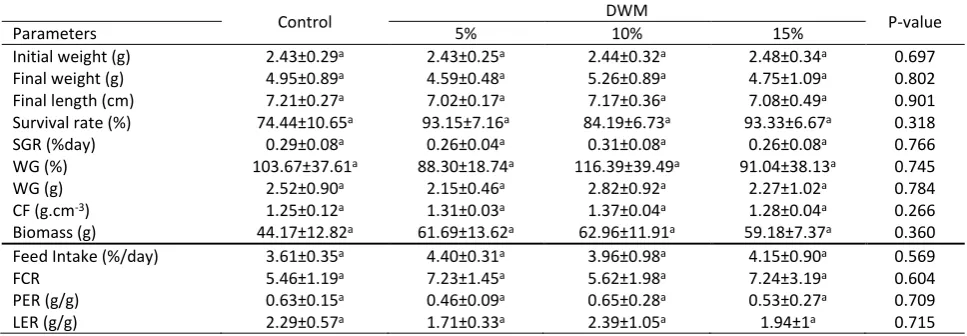
The result of partial replacement of plant sources by DWM on growth performance and feed utilization of common carp is presented in Table 2. There were no significant differences in All of growth and feeding parameters between fingerling fed control and DWM supplementation diet, (P>0.05). All group treated with DWM led to reduction in mortality after 12 weeks.
Haematological and Biochemical Parameters
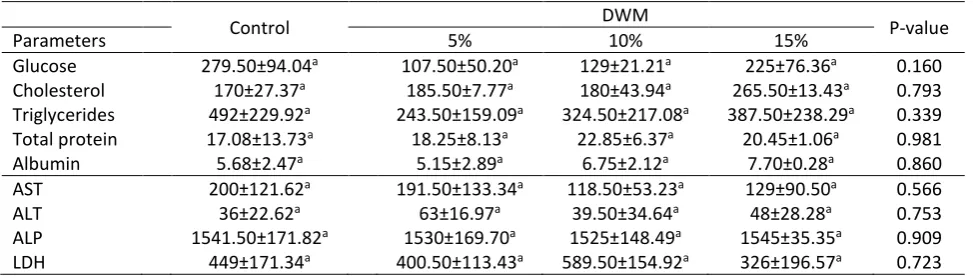
The hematological and biochemical parameters of fingerling carp fed the experimental diets are presented in Table 3 and 4. Statistical analysis of data showed that, there were no significant differences in value of RBC, Hct, MCV and MCH components between the treatment groups (P>0.05), but control group showed a significant increase (P<0.05) in RBC, Hb and
Hct compared with other treatment (Table 3). There were no significant differences in eosinophile, lymphocyte, neutrophil and monocyte count between the DWM treatments and control group (P>0.05). The highest value of lymphocyte and neutrophil were in DWM 15% and control group respectively (P<0.05) (Table 3). Changes in blood biochemical parameters on day 90 are shown in Table 4. Replacement of plant sources by DWM led to negliglibe effect on the glucose, cholesterol, triglycerides, total protein and albumin of plasma of the treatment group (P>0.05) (Table 4). Also, a non-significant differences of AST, ALT, ALP and LDH was found between treatment and control group on week 12 (P>0.05) (Table 4).
Stress Challenge Parameters
Results from the stress test include temperature, salinity, alkalinity and acidicty challenges are presented in Table 5. Resistance rate to thermal-salinity and acidy stress increased significantly in control group and 5% DWM (P<0.05) respectively. Also a non significant elevation of alkalinity stress was observed in the fish fed with different experimental diets (P>0.05).
Discussion
Effective use of locally waste products from agriculture industry in biofloc and other technologies to obtain multi-layers benefit and better fish growth performance as waste minimization and water treatment in aquaculture industry. In this condition, aquaculture industries are suffering from high input cost, low return and environmental pollution threats (Deb, Noori & Rao, 2017). In the present study, the fish readily accepted the experimental diets. The results showed improvement of fish growth and feed
Table 2. Growth and nutritional performance of fingerling common carp fed with different experimental diets (means±SD)
Control DWM P-value
Parameters 5% 10% 15%
Initial weight (g) 2.43±0.29a 2.43±0.25a 2.44±0.32a 2.48±0.34a 0.697
Final weight (g) 4.95±0.89a 4.59±0.48a 5.26±0.89a 4.75±1.09a 0.802
Final length (cm) 7.21±0.27a 7.02±0.17a 7.17±0.36a 7.08±0.49a 0.901
Survival rate (%) 74.44±10.65a 93.15±7.16a 84.19±6.73a 93.33±6.67a 0.318
SGR (%day) 0.29±0.08a 0.26±0.04a 0.31±0.08a 0.26±0.08a 0.766
WG (%) 103.67±37.61a 88.30±18.74a 116.39±39.49a 91.04±38.13a 0.745
WG (g) 2.52±0.90a 2.15±0.46a 2.82±0.92a 2.27±1.02a 0.784
CF (g.cm-3) 1.25±0.12a 1.31±0.03a 1.37±0.04a 1.28±0.04a 0.266
Biomass (g) 44.17±12.82a 61.69±13.62a 62.96±11.91a 59.18±7.37a 0.360
Feed Intake (%/day) 3.61±0.35a 4.40±0.31a 3.96±0.98a 4.15±0.90a 0.569
FCR 5.46±1.19a 7.23±1.45a 5.62±1.98a 7.24±3.19a 0.604
PER (g/g) 0.63±0.15a 0.46±0.09a 0.65±0.28a 0.53±0.27a 0.709
LER (g/g) 2.29±0.57a 1.71±0.33a 2.39±1.05a 1.94±1a 0.715
utilization by replacing 10% DWM, while higher substitution levels could not provide further enhancement. It seems that positive effect may be attributed to the palatability, presence a range of relevant level of fiber and unsaturated fatty acid such as oleic acid (Akbari, Razavizadeh, Mohebbi & Barmak, 2012), digestive enzymes (Pascual, Fernandez, Diaz, Garces & Rubert-Aleman, 2000; Sotolu et al., 2014) and possibly the availability of nutrients especially amino acids (Yeong, 1983; Onwudike, 1986) in waste date seed and bodies meal. The fiber in date pits (DP), according to Babatunde, Fetuga, Odumosu and Oyenuga (1975), has lingocellulosic structure; therefore, it can be reducing digestive enzyme action on DP protein and availability of the protein (Masoudi,
Chaji, Bojarpour, & Mirzadeh, 2011). Also, in our research combination of date pits and flesh cause to improved to this structure without any negative effect of growth performance and feed utilization. Al-Qurawi, Ali, Al-Mougy and Mouse (2003) mentioned that date body structure enzymes such as amylase, protease and
phytase would enhance growth performance
consequent to higher nutrient digestibility and effectiveness of gastrointestinal activities. Yousif et al. (1996) reported that, the inclusion of the wet date did not influence on tilapia fry fish growth. Increasing body protein and decreasing body fat was observed of fish fed on diets supplemented with date pits meal due to estrogenic action of date pits was hypothesized as direct cause of this phenomenon. Different research on Table 3. Haemetalogical parameters of fingerling common carp fed with different experimental diets (means±SD)
Control DWM P-value
Parameters 5% 10% 15%
RBC (106/ml) 1.75±0.07a 1.66±0.11ab 1.56±0.11ab 1.45±0.07b 0.097
WBC (103/ml) 15.30±1.13ab 16.23±0.05a 14.04±0.64b 14.75±0.77ab 0.037
Hb (g/dl) 8.45±0.07a 8.33±0.37a 7.23±0.49b 6.85±0.07b 0.007
Hct (%) 50.45±0.45a 47.66±0.61a 50.20±0.11a 46.35±2.95a 0.140
MCV (10-1.µm3) 288.60±10.80a 286.63±7.46a 321.53±13.13a 320.70±31.40a 0.286
MCH (10-2.pg) 48.30±1.10a 50.26±3.18a 46.20±0.25a 47.30±1.30a 0.546
MCHC (%) 16.75±0.25ab 17.50±0.65a 14.40±0.55c 14.85±1.05bc 0.039
Lymphocytes (%) 80±1b 84±0.57ab 80.66±0.66b 85±3a 0.095
Neutrophils (%) 17±0a 13±1.15ab 16±0.57ab 11.50±2.50b 0.073
Eosinophiles (%) 2±1a 1.66±0.33a 1.33±0.33a 2±1a 0.833
Monocyctes (%) 1±0a 1.33±0.33a 2±0a 1.50±0.50a 0.179
* Same letters are not significant different (P>0.05); Different letters are significant different (P<0.05).
Table 4. Biochemical of blood parameters at fingerling common carp fed with different experimental diets (means±SD)
Control DWM P-value
Parameters 5% 10% 15%
Glucose 279.50±94.04a 107.50±50.20a 129±21.21a 225±76.36a 0.160
Cholesterol 170±27.37a 185.50±7.77a 180±43.94a 265.50±13.43a 0.793
Triglycerides 492±229.92a 243.50±159.09a 324.50±217.08a 387.50±238.29a 0.339
Total protein 17.08±13.73a 18.25±8.13a 22.85±6.37a 20.45±1.06a 0.981
Albumin 5.68±2.47a 5.15±2.89a 6.75±2.12a 7.70±0.28a 0.860
AST 200±121.62a 191.50±133.34a 118.50±53.23a 129±90.50a 0.566
ALT 36±22.62a 63±16.97a 39.50±34.64a 48±28.28a 0.753
ALP 1541.50±171.82a 1530±169.70a 1525±148.49a 1545±35.35a 0.909
LDH 449±171.34a 400.50±113.43a 589.50±154.92a 326±196.57a 0.723
* Same letters are not significant different (P>0.05).
Table 5. Stress challenge value of fingerling common carp fed with different experimental diets (means±SD)
Control DWM P-value
Stress parameters 5% 10% 15%
Temperature 254±11a 89.66±51.85b 133.66±61.61b 95±12b 0.004
Salinity 2215±15a 1292.50±552.50b 1485±205b 1810±40ab 0.023
Acid pH 584±212bc 991±26a 490±169c 791±30ab 0.008
Alkalinity pH 1019.50±153.50a 863.50±250.50ab 625.50±127.50b 1068±155a 0.059
agriculture by product as interesting results, for example Luo, Zhao, Chang, Feng and Tian (2014) found
that gonad flavor of sea urchins (Strongylocentrotus intermedius) fed banana peel was significantly better
than that of individuals fed other specielize diet. Deka, Sahu and Jain (2003), reported that, better growth rate recorded in group fed by pineapple waste may be due to better utilization of pineapple waste diet but, it was not statistically significant from other groups. Though, highest proteolytic activity was found in this group. It may correlate with the presence of a proteolytic
enzyme ‘bromelain’ in pineapple, which might be the
factor for better utilization of protein (Deka et al., 2003). In contrast, Chatzifotis, Esteban and Divanach (2006), who studied different plant meal substitutions, obtained inversely proportional results with statistical differences between treatments and observed that high plant meal substitution resulted in worse FCR values. Common carp similar to tilapia and African catfish is an omnivore that is capable of efficiently digesting and utilizing diverse feeds and ingredients of both plants and animal origin (Sotolu & Faturoti, 2011). For this reason, addition of DWM can help to common carp fish fed diets with more carbohydrates composition. Belal and Al‐Jasser (1997) who noted
improved weight gain, feed conversion, specific growth rate and protein efficiency ratio after feeding tilapia with diets containing date (15, 30 and 45%). Belal and
Al‐Owafeir (2004) observed that fish WG, FCR, SGR and
PER of tilapia did not be affected by different level of date pits as a replacement for corn starch.
But, in another experiment mention that sprouted date pits did not affect on growth and body composition, whereas nonsprouted date pits negatively influenced fish performance. On the other hand, El-Sayed et al. (2006) found that date pits based diets replaced up to 75% wheat bran resulted in reduced growth rates and feed utilization efficiency of Nile tilapia. They reported that, fungi degraded pits (DDP) could replace 300 g/kg dietary corn. This result revealed that, despite the sharp retardation in the performance of Nile tilapia fed raw date pits, the expected reduction in the cost of DP-based diets may justify the use of this by-product in Nile tilapia feed. However, they mention to further work is urgently needed to improve the quality of DP for tilapia, using proper processing and treatment techniques. While, Belal (2008) found that, growth performance of Nile tilapia fed sprouted date pits diets not differ from control diet. All of previous results were confirm of current research. It means that, the addition of DWM to diet compare with control diet had no significant effect on growth performance. Azaza et al. (2009) noted that, no feed-related mortality was observed during the entire experimental period. Final body
weight and specific growth rate in the different treatments were statistically not significantly different
(P>0.05). While, waste date meal could be substitute
with soybean meal up to 300 g/kg-1 without compromising growth of Nile tilapia. Hosseinifar et al. (2015 & 2017) reported that feeding carp fry by date
palm fruit were significantly improved growth
performance, immune efficacy and increase the antioxidant activity (P<0.05) in early stages of common carp culture (Hoseinifar et al., 2015; 2017). This report was contrary with our research. In this research experimental diets prepared by date extract, but in our research we used from waste date meal (Powder form) product.
Blood indices are reflection of dietary treatments effects on the fish health condition and its physiological, biochemical and metabolic necessities. In this research, some haematological parameters were no significant differences in value of RBC, Hct, MCV, MCH and differential leucocyte count (DLC) among different treatment diets (P>0.05). The findings show that these blood cells were not significantly affected by DWM diet. The observed improvement in the values of most haematological parameters assessed (RBC, Hct, MCV, MCH) although, non-significant differences between them, it could serve as indication that it can be included in fish diet to improve and prevent to anaemic condition. But other parameters including WBC, Hb and MCHC were significant between all experimental diets (P<0.05) (Table 3).
The WBC serves as one of the first lines of body defense and their numbers increase sharply when infections arise (Vahedi, Hasanpour, Akrami, & Chitsa, 2017). In our experiment, WBC counts increased significantly in 5% DWM group in comparison with other group. This may explain the efficacy of 5% DWM in terms of the immunestimulatory response and anti-infection properties. The haemoglobin (Hb) content in the blood plays a vital role and serves as transportation element of oxygen to body tissues (Vahedi et al., 2017). In the current study, the Hb and MCHC content was significantly higher in 5% DWM treated groups than the control and other groups, which demonstrates that oxygen supply increases consequently, reflecting beneficial health effect on fish (Vahedi et al., 2017). This is in agreement with Zheng, Wen, Han, Li, and Xie (2012), who reported significant decrease in haemoglobin level in grass carp fed with a high
cottonseed meal (CM) diet (48.94%) were significantly
lower than those of the fish fed with low CM diets. In channel catfish, the dietary free gossypol (FG) of 900
mg/kg decreased the hematocrit (Hct) value, hemoglobin content, plasma protein, and the dietary FG of 1200 mg/kg further reduced the number of RBC (Yildirim, Lim, Wan, & Klesius, 2003). The decreased Hb and Hct resulting from the high level of dietary CM or FG were also reported in rainbow trout (Blom, Lee, Rinchard, Dabrowski, & Ottobre, 2001; Rinchard, Lee, Czesny, Ciereszko, & Dabrowski, 2003) and tilapia (Yue & Zhou, 2008). In another study on channel catfish,
value, Hb content and the number of RBC (Barros, Lim & Klesius, 2002). Wang et al. (2014) found that, increase in dietary cottonseed meal (CM) level from 0% to 45%, the RBC and Hct value increased, but the Hb content showed little change, which indicated that the
Hb and RBC content significantly decreased. In the current study, the decrease in the Hb level of fish
resulting from the 10% DWM may be related to the reaction of date with iron, which further reduced the iron concentration in the body (Al-Orfe et al., 2012). The reason for different results between different values of DWM in diet might be attributed to difference in the effect of active compound of date and immune system reaction (Binaii et al., 2014). Dates are not a rich source of protein, they considered as a reasonable source of vitamins, essential amino acids, mineral elements, dietary fiber, phenolics and polyphenolic (Al-Orfe et al., 2012). Vitamins play role as antioxidants and phenolics can scavenge free radicals help regulate and stimulate the immune function, maintenance of cell function for growth and reduce morbidity of infectious diseases (Masoudi et al., 2011). Minerals are generally important as constituents of hemoglobin, soft tissues, bones, body composition, and nerve cells. Date is also a good source of iron, sodium, potassium, magnesium and calcium. Iron is an
important source for Hb synthesis, and a deficiency in
iron can result in a decrease in Hb level, which has been extensively reported in livestock animals (Wang
et al., 2014).
The results from blood biochemical parameters, showed no significant differences between groups (P>0.05) (Table 4). This is in agreement with the investigation of Al-Maiman (2005) that observed favourable effects of fibers of date palm seed on plasma lipids in rats. Addition of DWM to treatment diets resulted in a linear insignificant increase (P>0.05) of blood glucose concentration (Table 4). However, it agreed with the findings of Onifade (1997) who reported that glucose was accentuated high when fibrous diet was fed to broilers. It seems that this effect of fibrous material contributed to increase in gluconeogenesis activity (Masoudi et al., 2011). Since date pit (DP) has a fibrous structure which supports low glucose than maize, maybe some effect of date pith on blood parameters contributes to its effect on increment of lipid metabolism for supporting the energy requirements of common carp fish (Masoudi et al., 2011). Zhou, Lin, Ji and Yu (2016) reported that the blood serum total protein, albumin, glucose, high and low density of lipoprotein and total antioxidant capacity in green tea waste (GTW) group were significantly higher than control group and GTW supplementation has positive impact on health of fish without affecting the growth of fish. Liver plays an essential role in transforming and clearing metabolites and xenobiotics, and is susceptible to the toxicity from these agents. Liver enzymes include of ALT, AST, ALP
and LDH are important indicators reflecting liver
function. An increase in the activities of serum AST, ALT and ALP might indicate a damage of liver function (Wang et al., 2014). As differences liver enzymes were not observed in the experimental groups, the consumption of DWM did not appear to induce liver toxicity in fish, Also the group tested with 10% DWM decreased liver enzyme activity for 12-week compared to the control. It could be explained that mechanism of hepatoprotective effects of date flesh and pits is possibly related to vitamin C, polyphenolic compounds
(flavonoids and phenolic acids), β-sitosteroland trace elements (selenium, zinc, copper and manganese) (Al-Orfe et al., 2012). Likely that the mechanism of antioxidants in DWM may be related to the ability of its active compounds to detoxify free radicals and to inhibit lipid peroxidation in the liver and protein oxidation (Al-Orfe et al., 2012).
Stress resistance of the fish in different life period is affected by levels of salinity, temperature, environment and nutrition (Jalali, Hosseini & Imanpoor, 2008; Gholami, 2010). The results of present study showed that resistance rate to temperature-salinity stress significantly increased in fish fed control diet (P<0.05) than those fish fed with the DWM groups, but
responses to alkalinity stress was insignificant (P<0.05).
Resistance to acidity stress increased significantly in fish fed diets supplemented with 5% DWM (P<0.05) (Table 5). It seems that greater resistance of control group to stress challenges might also be due to low potential of digestibility of date, higher and lower value of saturated fatty acids (SFA) and polyunsaturated fatty acids (PUFA) and high antiprotease activity, which may increase protective function of body resistance of fish, but studies are required to test this speculative hypothesis. Antiprotease contributes to the innate immunity of fish by its benefit alimentary tract
bactericidal community and antiinflammatory
properties (Guardiola, Porcino, Cerezuela, Cuesta, Faggio & Esteban, 2016).
In this research, addition of DWM alone enhances several of growth and feed utilization parameters, while maybe for enhances the stress resistance or expression of immune-related genes when is administrated in combination with other substance such as probiotic. Therefore, the mixture this diet could potentially be considered of great interest as immunostimulant diet to use as food additive for farmed fish.
concentration in diet and to understand the specific mechanisms involved in stress control by DWM in fish
diets.
Conclusion
To conclude, DWM up to 10% as a substitute for plant sources could improve growth and blood variables in common carp. Further research is needed to clarify the action mechanisms of DWM, as well as the immune response and feeding period in common carp.
Acknowledgments
The authors have special thanks to anonymous reviewers for valuable scientific comments for improvement level of this manuscript.
References
Abbass, A.A., El-Asely, A.M., & Kandiel, M.M.M. (2012). Effect of dietary propolis and pollen on growth performance, fecundity and some haematological parameters of
Oreochromis niloticus. Turkish Journal of Fisheries and
Aquatic Sciences, 12, 851-859.
http://dx.doi.org/10.4194/1303-2712-v12_4_13. Abdul Afiq, M.J., Abdul Rahman, R., Che Man, Y.B., Al-Kahtani,
H.A., & Mansor, T.S.T. (2013). Date seed and date seed oil. International Food Research Journal, 20(5), 2035-2043.
Ahmed, I. (2017). Effects of dietary amino acid l‐lysine on survival, growth and haemato‐biochemical parameters
in Indian catfish, Heteropneustes fossilis (Bloch, 1974), fingerlings. Journal of Applied Ichthyology, 33(5), 1027-1033. http://dx.doi.org/10.1111/jai.13355.
Akbari, M., Razavizadeh, R., Mohebbi, G.H., & Barmak, A. (2012). Oil characteristics and fatty acid profile of seed from three varieties of date palm (Phoenix dactylifera) cultivars in Bushehr-Iran. African Journal of Biotechnology, 11(57), 12088-12093. http://dx.doi.org/10.5897/AJB12.1084.
Akrami, R., Rahnama, B., Chitsaz, H., & Razeghi Mansour, M. (2015). Effects of dietary inulin on growth performance, stress resistance and some hematological parameters of Gibel carp juveniles (Crassius auratus gibelio). Iranian Journal of Fisheries Sciences, 14(4), 1072-1082.
Al-Hafedh, Y.S., & Alam, A. (2013). Replacement of Fishmeal by Single Cell Protein Derived from Yeast Grown on Date (Phoenix dactylifera) Industry Waste in the Diet of Nile Tilapia (Oreochromis niloticus) Fingerlings. Journal of Applied Aquaculture, 25(4), 246-358. https://doi.org/10.1080/10454438.2013.852419 Al-Maiman, S.A. (2005). Effect of date palm (Phoenix
dactylifera) seed fibers on plasma lipids in rats. Journal of King Saudi University Agriculture Science, 17(2), 117-123.
Al-Oref, S.M., Ahmad, M.H.M., Al-Atwai, N., Al-Zaidi, H., Dehwah, A., & Dehwah, S., (2012). Review: Nutritional properties and benefits of the Date fruits (Phoenix dactylifera). Bulletin of the National Nutrition Institute of the Arab Republic of Egypt, 39, 97-129.
Al-Qurawi, A.A., Ali, B.H., Al-Mougy, S.A., & Mouse, H.M. (2003). Gastrointestinal transit in mice treated with various extracts of date (Phoenix dactylifera L.). Food and Chemical Toxicology, 41(1), 37-39. http://dx.doi.org/10.1016/S0278-6915(02)00203-X. AOAC, (2000). Official method of Analysis, Washington, D.C.
Association of Official Analytical Chemists.
Azaza, M.S., Mensi, F., Kammoun, W., Abdelouaheb, A., Brini, B., & Kraïem, M. (2009). Nutritional evaluation of waste date fruit as partial substitute for soybean meal in practical diets of juvenile Nile tilapia, Oreochromis niloticus L. Aquaculture Nutrition, 15(3), 262-
272.http://dx.doi.org/10.1111/j.1365-2095.2008.00591.x.
Babatunde, G.M., Fetuga, B.L., Odumosu, O., & Oyenuga, V.A. (1975). Palm kernel meal as the major protein concentrate in the diets of pigs in the tropics. Journal of the Science of Food and Agriculture, 26(9), 1279-1291. http://dx.doi.org/10.1002/jsfa.2740260906
Barros, M.M., Lim, C., & Klesius, P.H. (2002). Effect of soybean meal replacement by cottonseed meal and iron supplementation on growth, immune response and resistance of Channel Catfish (Ictalurus puctatus) to
Edwarsiella ictaluri challenge. Aquaculture, 207(3-4), 263–279. https://doi.org/10.1016/S0044-8486(01)00740-2.
Belal, I.E.H., & Al‐Jasser, M.S. (1997). Replacing dietary starch
with pitted date fruit in Nile tilapia Oreochromis niloticus (L.) feed. Aquaculture Research, 28(6), 385-
389.http://dx.doi.org/10.1046/j.1365-2109.1997.00872.x.
Belal, I.E., & Al‐Owafeir, M.A. (2004). Incorporating Date Pits
Phoenix dactylifera and their Sprouts in Semi‐purified
Diets for Nile Tilapia Oreochromis niloticus (L.). Journal of the World Aquaculture Society, 35(4),
452- 459.http://dx.doi.org/10.1111/j.1749-7345.2004.tb00110.x
Belal, I.E. (2008). Evaluating fungi‐degraded date pits as a
feed ingredient for Nile tilapia Oreochromis niloticus L.
Aquaculture Nutrition, 14(5), 445-
452.http://dx.doi.org/10.1111/j.1365-2095.2007.00548.x.
Belal, I,E., El-Tarabily, A.K., Kassab, A.A., Abdel-Fattah, M.E., & Rasheed, N.M. (2015). Evaluation of Date Fiber as Feed Ingredient for Nile Tilapia Oreocromis Niloticus
Fingerlings. Journal of Aquaculture Research and Development, 6(3), 1-6.http://dx.doi.org/10.4172/2155-9546.1000320.
Biglar, M., Khanavi, M., Hajimahmoodi, M., Hassani, S., Moghaddam, G., Sadeghi, N., & Oveisi, M.R. (2012). Tocopherol content and fatty acid profile of different Iranian date seed oils. Iranian Journal of Pharmaceutical Research, 11(3), 873-878.
Binaii, M., Ghiasi, M., Farabi, S.M.V., Pourgholam, R., Fazli, H., Safari, R., ... & Bankehsaz, Z. (2014). Biochemical and hemato-immunological parameters in juvenile beluga (Huso huso) following the diet supplemented with nettle (Urtica dioica). Fish and Shellfish Immunology, 36(1), 46-51. https://doi.org/10.1016/j.fsi.2013.10.001 Blom, J. H., Lee, K. J., Rinchard, J., Dabrowski, K., & Ottobre, J.
Collier, H.B. (1944). Standardization of blood haemoglobin determinations. Canadian Medical Association Journal, 50(6), 550.
Chatzifotis, S., Esteban, A.G., & Divanach, P. (2006). Fishmeal replacement by alfalfa protein concentrate in sharp snout sea bream Diplodus puntazzo. Fisheries Science,
72(6), 1313-1315. https://doi.org/10.1111/j.1444-2906.2006.01290.x
Deb, S., Noori, M.T., & Rao P.S. (2017). Experimental study to evaluate the efficacy of locally available waste carbon sources on aquaculture water quality management using biofloc technology. Aquaculture International, 25(6), 2149-2159. http://dx.doi.org/10.1007/s10499-017-0180-8.
Deka, A., Sahu, N.P., & Jain, K.K. (2003). Utilization of Fruit Processing Wastes in the Diet of Labeo rohita
Fingerling. Asian-Australasian Journal of Animal
Sciences, 16(11), 1661-1665.
https://doi.org/10.5713/ajas.2003.1661
El-Sayed, A.F.M., Hamza, W.R., & Al-Darmaki, M. (2006). Evaluation of date pits as a feed ingredient for juvenile and adult Nile tilapia (Oreochromis niloticus) reared in a recirculating system. In Proceeding of 7th International
Symposium on Tilapia aquaculture. Boca Del Rio, Vera Cruz,Mexico, 6-8 September 2006
FAO, (2014). Food and Agriculture Organization, Fishstate plus: Universal software for fishery statistical time series (available at: www.fao.org/fi/statist/fisoft/fishplus.asp).
Fazlolahzadeh, F., Keramati, K., Nazifi, S., Shirin, S., & Seifi, S. (2011). Effect of garlic (Alliumsativum) on hematological parameters and plasma activities of ALT and AST of Rainbow trout in temperature stress. Australian Journal of Basic and Applied Sciences, 5(9), 84-90.
Gaber, M.M., Labib, E.H., Omar, E.A., Zaki, M.A., & Nour, A.M. (2014). Effect of partially replacing corn meal by wet date on growth performance in Nile Tilapia (Oreochromis niloticus) fingerlings, diets supplemented with Digestarom®. Journal of Geosciences and Environment Protection, 2(2), 60-67. http://dx.doi.org/10.4236/gep.2014.22010.
Ghiasi, F., Mirzargar, S.S., Badakhshan, H., & Shamsi, S. (2010). Effects of low concentration of cadmium on the level of lysozyme in serum, leukocyte count and phagocytic index in Cyprinus carpio under the wintering conditions. Journal of Fisheries and Aquatic Science, 5(2), 113–119.
http://dx.doi.org/10.3923/jfas.2010.113.119
Gholami, M. (2010). Effects of n-3 HUFA enrichment Daphnia magna on growth, survival, stress resistance and fatty acid composition of Whitefish fry (Rutilus frisii kutum).
Fisheries and Aquatic Science, 5(1), 49-55. http://dx.doi.org/10.3923/jfas.2010.49.55.
Goldenfarb, P.B., Bowyer, F.P., Hall, E., & Brosious, E. (1971). Reproducibility in the hematology laboratory: the microhematocrit determination. American Journal of Clinical Pathology, 56(1), 35-39. http://dx.doi.org/10.1093/ajcp/56.1.35.
Guardiola, F. A., Porcino, C., Cerezuela, R., Cuesta, A., Faggio, C., & Esteban, M. A. (2016). Impact of date palm fruits extracts and probiotic enriched diet on antioxidant status, innate immune response and immune-related gene expression of European seabass (Dicentrarchus labrax). Fish & Shellfish Immunology, 52: 298-308. https://doi.org/10.1016/j.fsi.2016.03.152
Habib, H.M., & Ibrahim,W.H. (2009). Nutritional quality evaluation of eighteen date pit varieties. International Journal of Food Sciences and Nutrition, 60(S1), 99-111. https://doi.org/10.1080/09637480802314639
Higgs, D.A., Dosanjh, B.S., Prendergast, A.F., Beams, R.M., Hardy, R.W., Riley, W., & Deacon, G. (1995). Use of rapeseed/canola protein products in finfish diets. In C. Lim & D.J. Sessa (Eds.), Nutrition and Utilization of Technology in Aquaculture. AOCS Press, Champaign USA: 130-156.
Hoseinifar, S.H., Khalili, M., Rufchaei, R., Raeisi, M., Attar, M., Cordero, H., & Esteban, M.Á. (2015). Effects of date palm fruit extracts on skin mucosal immunity, immune related genes expression and growth performance of common carp (Cyprinus carpio) fry. Fish and Shellfish
Immunology, 47(2),
706-711.http://dx.doi.org/10.1016/j.fsi.2015.09.046. Hoseinifar, S.H., Dadar, M., Khalili, M., Cerezuela, R., &
Esteban, M.A. (2017). Effect of dietary supplementation of palm fruit extracts on the transcriptomes of growth,
antioxidant enzyme and immune‐related genes in
common carp (Cyprinus carpio) fingerlings. Aquaculture
Research, 48(7), 3684-3692.
http://dx.doi.org/10.1111/are.13192.
Hwang, J.H., Lee, S.W., Rha, S.J., Yoon, H.S., Park, E.S., Han, K.H., & Kim, S.J. (2013). Dietary green tea extract improves growth performance, body composition, and stress recovery in the juvenile black rockfish, Sebastes schlegeli. Aquaculture International, 21(3), 525-538.http://dx.doi.org/10.1007/s10499-012-9586-5. Imanpoor, M.R., Najafim E., & Kabir, M. (2012). Effect of
different salinity and temperature on the growth, survival, haematocrit and blood biochemistry of Goldfish (Crassius auratus). Aquaculture Research, 43(3), 332-338. http://dx.doi.org/10.1111/j.1365-2109.2011.02832.x.
Imanpoor, M.R., & Roohi, Z. (2015). Influence of primalac probiotic on growth performance, blood biochemical parameters, survival and stress resistance in the Caspian Roach (Rutilus rutilus) Fry. Turkish Journal of Fisheries and Aquatic Sciences, 15(4), 917-922. http://dx.doi.org/10.4194/1303-2712-v15_4_15.
Iranʼs Fishery, (2016). Yearbook of Iran's Fishery Production
Statistics (2001-2016). 32p.
Jalali, M.A., Hosseini, S.A., & Imanpoor, M.R. (2008). Effect of vitamin E and highly unsaturated fatty acid enriched
Artemia urmiana on growth performance, survival and stress resistance of Beluga (Huso huso) larvae.
Aquaculture Research, 39(12), 1286-1291. http://dx.doi.org/10.1111/j.1365-2109.2008.01992.x. Klontz, G.W. (1994). Fish hematology. In: Techniques in Fish
Immunology, Vol 3, In J.S., Stolen, Fletcher, T.C., Rowely, A.F., Kelikoff, T.C., Kaattari, S.L. & Smith, S.A. (Eds.), New Jersey, USA, SOS Publications, Fair Haven, pp. 121–132.
Kasapidou, E., Sossidou, E., & Mitlianga, P. (2015). Fruit and vegetable co-products as functional feed ingredients in farm animal nutrition for improved product quality.
Agriculture, 5(4), 1020-1034.
http://dx.doi.org/10.3390/agriculture5041020. Lewis, S.M., Bain, B.J., & Bates, I. (2001). Dacie and Lewis
Practical Haematology. 9th Edn., Churchill Livingston,
London, p 633.
gonad flavor in the sea urchin Strongylocentrotus intermedius. Aquaculture International, 22(2), 833-841. http:dx.doi.org/10.1007/s10499-013-9711-0.
Martins, M.L., Tavares-Dias, M., Fujimoto, R.Y., Onaka, E.M., & Nomura, D.T. (2004). Haematological alterations of
Leporinus macrocephalus (Osteichtyes: Anostomidae) naturally infected by Goezia leporini (Nematoda: Anisakidae) in fish ponds. Arquivo Brasileiro de Medicina Veterinária e Zootecnia, 56(5), 640–646. http://dx.doi.org/10.1590/S0102-09352004000500011. Masoudi, A., Bajarpour, M., Chaji, M., Eslami, M., & Mirzadeh,
K.H. (2010). Economic value of date pits replaced with maize in broiler chicken diet. Journal of Animal and Veterinary Advances, 9(11), 1578-1581. http://dx.doi.org/10.3923/javaa.2010.1578.1581. Masoudi, A., Chaji, M., Bojarpour, M., & Mirzadeh, K.H.
(2011). Effects of different levels of date pits on performance, carcass characteristics and blood parameters of broiler chickens. Journal of Applied
Animal Research, 39(4), 399-405.
https://doi.org/10.1080/09712119.2011.621790 Mraz, J. (2011). Lipid quality of common carp (Cyprinus
carpio) in pond culture. BSc thesis, Department of Food Science, Uppsala, Sweden. p 52.
Obirikorang, K.A., Amisah, S., Fialor, S.C., & Skov, P.V. (2015). Local agro-industrial by-products with potential use in Ghanaian aquaculture: a review. Aquaculture
International, 23(2), 403-425.
http://dx.doi.org/10.1007/s10499-014-9831-1
Onifade, A.A. (1997). Growth performance, carcass characteristics, organs measurement and haematology of broiler chickens fed a high fibre diet supplemented with antibiotics or dried yeast. Molecular Nutrition and
Food Research, 41(6), 370-374.
https://doi.org/10.1002/food.19970410612
Onwudike, O.C. (1986). Palm kernel meal as a feed for poultry. 1. Composition of palm kernel meal and availability of its amino acids to chicks. Animal Feed Science and Technology, 16(3), 179-186. https://doi.org/10.1016/0377-8401(86)90108-2 Pascual, J.J., Fernandez, C., Diaz, J.R., Garces, C., &
Rubert-Aleman, J. (2000). Voluntary intake and In vivo digestibility of different date-palm fractions by murciano-Granadina (Capra hircus). Journal of Arid Environments, 45(2), 183-189.
http://dx.doi.org/10.1006/jare.1999.0622.
Rahman, M.M. (2015). Role of common carp (Cyprinus carpio) in aquaculture production systems. Frontiers in Life Science, 8(4), 399-410.
http://dx.doi.org/10.1080/21553769.2015.1045629. Rinchard, J., Lee, K.J., Czesny, S., Ciereszko, A., & Dabrowski,
K. (2003). Effect of feeding cottonseed meal-containing diets to broodstock rainbow trout and their impact on the growth of their progenies. Aquaculture, 227(1-4), 77-87. https://doi.org/10.1016/S0044-8486(03)00496-4 Sotolu, A.O., & Faturoti, E.O. (2011). Growth performance and hematological effects of varying dietary processed
Leucaena leucocephala seed meal in Clarias gariepinus
(Burchella, 1822) Juveniles. African Journal of Food Agriculture Nutrition Development, 11(1), 4546-4557. http://dx.doi.org/10.4314/ajfand.v11i1.65880.
Sotolu, A.O., Kigbu, A.A., & Oshinowo, A.J. (2014). Supplementation of date palm (Phoenix dactylifera) seed as feed additive in the diets of juvenile African catfish (Burchell, 1822). Journal of Fisheries and Aquatic
Science, 9(5), 259-365.
http://dx.doi.org/10.3923/jfas.2014.359.365.
Vahedi, A.H., Hasanpour, M., Akrami, R., & Chitsaz, H. (2017). Effect of dietary supplementation with ginger (Zingiber officinale) extract on growth, biochemical and hemato-immunological parameters in juvenile beluga (Huso huso). Iranian Journal of Aquatic Animal Health, 3(1), 26-46. 10.18869/acadpub.ijaah.3.1.26
Wang, X. F., Li, X. Q., Leng, X. J., Shan, L. L., Zhao, J. X., & Wang, Y. T. (2014). Effects of dietary cottonseed meal level on the growth, hematological indices, liver and gonad histology of juvenile common carp (Cyprinus carpio). Aquaculture, 428-429, 79-87. https://doi.org/10.1016/j.aquaculture.2014.02.040 Wu, F., Zhu, W., Liu, M., Chen, C., Chen, J., & Tan, Q. (2016).
Effect of dietary vitamin A on growth performance, blood biochemical indices and body composition of juvenile Grass carp (Ctenopharyngodon idellus). Turkish Journal of Fisheries and Aquatic Sciences, 16(2), 339-345. http://dx.doi.org/10.4194/1303-2712-v16_2_14.
Yeong, S.W. (1983). Amino acid availability of palm kernel cake, palm oil sludge and sludge fermented product (Prolima) in studies with chickens. MARDI Research Bulletin, 11(1), 84-88.
Yildirim, M., Lim, C., Wan, P.J., & Klesius, P.H. (2003). Growth performance and immune response of channel catfish (Ictalurus puctatus) fed diets containing graded levels of gossypol–acetic acid. Aquaculture, 219(1-4), 751-768. https://doi.org/10.1016/S0044-8486(03)00062-0 Yousif, O.M., Osman, M.F., & Alhadrami, G.A. (1996).
Evaluation of dates and date pits as dietary ingredients in tilapia (Oreochromis aureus) diets differing in protein sources. Bioresource Technology, 57(1), 81-85. http://dx.doi.org/10.1016/0960-8524(96)00054-5. Yue, Y.R., & Zhou, Q.C. (2008). Effect of replacing soybean
meal with cottonseed meal on growth, feed utilization, and hematological indexes for juvenile hybrid tilapia,
Oreochromis niloticus × O. aureus. Aquaculture, 284(1-4), 185-189.
https://doi.org/10.1016/j.aquaculture.2008.07.030 Zheng, Q., Wen, X., Han, C., Li, H., & Xie, X. (2012). Effect of
replacing soybean meal with cottonseed meal on growth, hematology, antioxidant enzymes activity and expression for juvenile grass carp, Ctenopharyngodon idellus. Fish Physiology and Biochemistry, 38(4), 1059-1069. https://doi.org/10.1007/s10695-011-9590-0 Zhou, J., Lin, Y., Ji, H., & Yu, H. (2016). The effect of green tea