Vol. 1, Spl. Issue 2 (May, 2014) e-ISSN: 1694-2310 | p-ISSN: 1694-2426 GV/ICRTEDC/12
DATA RATE ANALYSIS AND COMPARING
THE EFFECT OF FOG AND SNOW FOR
FREE SPACE OPTICAL
COMMUNICATION SYSTEM
1
Er. Sagar,
2Dr. Rajesh Goel
1,2Department of Electrical & Electronics Engineering, Samalkha Group of Institutions, Samalkha, India 1
[email protected], [email protected]
Abstract— Optical wireless technology or Free Space Optics (FSO) is much more similar to the fiber optic communication except the fiber optic in which atmosphere is used for the data transmission using laser beam from transmitter to receiver. In this aspect possibility of different applications, the performance of such links is extremely dependent on different weather conditions particularly in presence of fog. Snow also affects the free space optics. The weather conditions that reduce visibility affect the FSO performance. In this paper the combined effect of specific attenuation due to Fog and Snow on FSO and RF links is considered. Optical wave attenuation due to low atmospheric visibility conditions causes a performance degradation of freespace optical (FSO) communication systems. Both visibility and attenuation are measured on a long experimental free space optical link. Meteorological conditions causing particular attenuation events are identified. Available models of the relation between atmospheric visibility and optical attenuation are compared with the measured data. It is shown that classical models widely used in the FSO community still underestimate optical attenuation at medium and low visibility conditions.
Keywords—Free space optics, optical communication, RF links.
I. INTRODUCTION
Depending on the environment and range over which an FSO link operates, it is subject to different impairments. Long-range links use directed laser beams to transmit data, and can be used for building-to-building, ground-to-aircraft, or ground-to-satellite communication. Such links may operate over ranges of several kilometers or longer, and often their primary impairment is atmospheric turbulence, which causes phase and intensity fluctuations in the received signal. Short-range links often use infrared or visible light emitting diodes (LEDs) and can be used indoors for data communications or outdoors for vehicular communication. Such links operate over ranges of meters to hundreds of meters and hence are not strongly affected by atmospheric turbulence. Outdoor links may be subject to impairment by atmospheric effects, such as rain, fog and haze. There have been several studies on the impact of these effects on FSO links, but these studies only take
account of the attenuation caused by them. In particular, these studies do not take account of how rain, fog and haze may degrade the performance of an imaging receiver. An imaging receiver employs a lens, telescope or similar optical system to image a received signal onto an image sensor, which is subdivided into multiple pixels. Such an imaging receiver can separate a desired received signal from undesired ambient light and interfering transmissions. Atmospheric effects, such as fog, can degrade the performance of imaging receivers by two mechanisms. First is attenuation of the signal, caused both by absorption and by scattering of light out of the field of view (FOV) of the receiver. The second mechanism is the blooming of the image spot at the receiver focal plane, which causes the spot to spread over a larger area, and thus a larger number of pixels, on the image sensor. When the signal power is spread over a larger number of pixels, each contributing noise, the receiver electrical signal-to-noise ratio (SNR) is reduced.
In this paper, we analyze FSO links with imaging receivers in the presence of atmospheric effects, such as fog or haze, and misalignment. The analysis is based on the radiative transfer equation, and takes into account both attenuation and image blooming. We quantify the relative importance of these two phenomena and study the overall link performance under different weather conditions. To our knowledge, this is the first work that takes account of image blooming caused by atmospheric effects.
II. PROPAGATIONTHROUGHFOG
As light propagates through the atmosphere, it can get scattered multiple times, which results in a glow around the light source in the image. Multiple scattering can be neglected in clear air or light rain, but becomes particularly important in haze or fog. There are different approaches for modeling propagation of light with multiple scattering. One class of methods involves numerical Monte-Carlo ray-tracing simulation. A drawback of such methods is their high computational complexity, which can grow exponentially with the number of scattering events to which a ray is subjected. A. Fog Attenuation Model for FSO
The specific attenuation model is given by
( ) = 13( ) − (550) −
=
1.6 > 50
1.3 6 < > 50
0.585 / < 6
The attenuation of 1550 nm is expected to be less than attenuation of shorter wavelengths. Which is rejected such wavelength dependent attenuation for low visibility in dense fog. The q variable in equation is given by
=
⎩ ⎪ ⎨ ⎪
⎧1.61.3 6 < > 50> 50 0.16 + 0.34 6 < < 1 − 0.5 0.5 < < 1
0 < 0.5
A Telecom model has provided relations to predict fog attenuation. It characterizes advection and radiation fog separately. Al Naboulsi provides the advection fog attenuation coefficients as
=0.11478 + 3.8367
Radiation fog is related to the ground cooling by radiation. Al
Naboulsi provides the radiation fog attenuation coefficients as
=0.18126 + 0.13709 + 3.7502
The specific attenuation for both types of fog is given by
=ln(10) ( )10
The linear wavelength dependence of attenuation in case of advection fog and quadratic wavelength dependence of attenuation in case of radiation fog. This model shows more wavelength dependence of attenuation for radiation fog case.
Fig1 Specific attenuation for different models for 850nm,950nm and 1550nm Wavelength
The kruse model for specific attenuation is more prominent. The Kim model is wavelength independent. It effects for visibility greater than 1km. Al Nabulsi model has more attenuation effect than kruse and kim. The
Fig2 Specific Attenuation for different Fog w.r.t. Wavelength
The Specific attenuation of Fog is also calculated for different visibility using wavelength. The heavy fog has more effect than the other. It means that for less visibility there is greater attenuation.
B. Snow Attenuation for FSO
The FSO attenuation due to snow has been classified into dry and wet snow attenuations. If S is the snow rate in mm/hr then specific attenuation in dB/km is given by asnow=a.Sb dB/km
If λ is the wavelength, a and bare as follows for dry snow a =5.42*10-5λ+5.4958776
b =1.38
The same parameters for wet snow are given as follows a =1.023*104λ+3.7855466
b=0.72
The specific attenuation for FSO is wavelength insensitive. There are very little changes in the attenuation for different wavelengths. The specific attenuation for dry and wet snow is also calculated. The dry snow effects at the low snow rate whereas wet snow effects at high snow rate as in fig 3.
Fig 3 Specific Attenuation of Different FSO Wavelength for Wet Snow Rateup to 100 mm/hr
III. COMMUNICATIONLINKMODAL
We now consider three types of communication links: the receiver signal power, link margin, and data rate. In addition, we performed a signal to noise ratio calculation.
A. Receiver Signal Power
We shall consider the situation of optical propagation between
points underwater. Consider a laser transmitting a total power
Ptrans at the wavelength. The signal power received at the communications detector can be expressed as
= . 10 . /
Where D is the receiver diameter, θ is the divergence angle, γ is the attenuation factor (dB/m), τtrans, τrecare the transmitter and receiver optical efficiency respectively.
B. Data Rate
Given a laser transmitter power Ptrans, with transmitter divergenceof θ, receiver diameter D, transmit and receive optical efficiencyτtrans, τrecthe achievable data rate R can be obtained from
= 10 . /
(2)
Or can be written as
= 4
Where Ep= hc/λ
C. Signal to noise ratio
The SNR for the optical communication system is thus given by
= ( )
2 ( + ) + 2 + 4
IV. SIMULATION RESULT
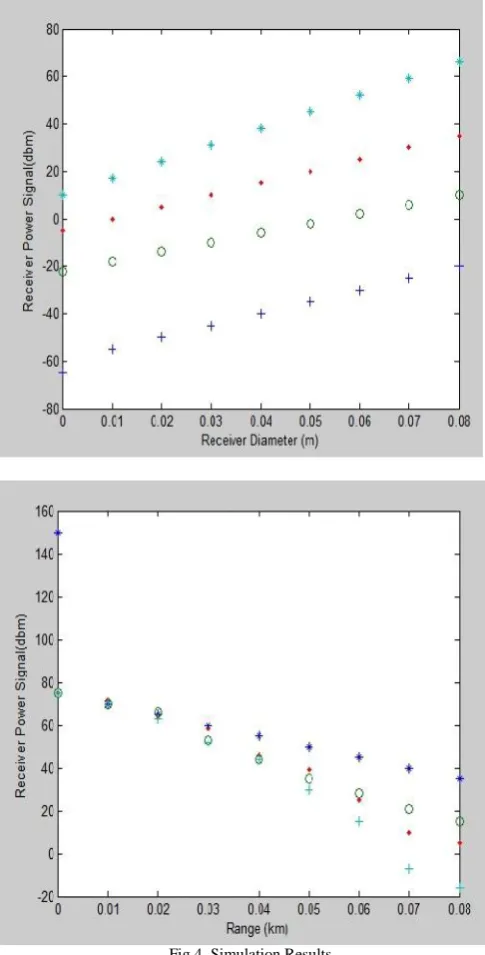
Simulation by matlab carried out to show the weather effect on optical communication System. The performance of optical communication system can be evaluated by the receiver signal power, data rate and signal to noise ratio. We have investigated the high quality and the best performance of optical communication link systems for different weather conditions. The investigating based on the modeling equations analysis and the assumed set of the operating parameters are shown in Table.
TABLE I
S.No Operating Parameter Value
1 Transmitter Power 50MW
2 Transmitter Divergence Angle
1≤θ(mrad)≤3
3 Transmitter Efficiency 0.9
4 Range 1≤ L(m) ≤ 1000
5 Receiver Diameter 1≤ D(cm) ≤10
6 Receiver Efficiency 0.9
7 Receiver sensitivity -20Bm
8 Wavelength 650mn
9 Bulk Dark Current 0.05 nA
10 The APD Gain 100
11 The Excess Noise Factor 0.5
12 Electrical Band 25 MHz
13 Surface Leakage Current 0.001A
14 System Temperature 290K
15 Noise Figure 3dB
16 Equivalent Resistance 50k ohm
17 Weather Condition Clear 0.7(dB/Km) Haze 7.77(dB/Km) Light Fog 10.5(dB/Km) Heavy fog 34.96(dB/Km)
Fig 4. Simulation Results
The data rate 0.1 Gb/s is achieved for different parameters communication system under different weather conditions. The data rate of 0.1 Gb/s is obtained for 650 nm. The data rate decreases with increasing transmitter divergence angle and the range, While for increases receiver diameter the data rate is increasing for the conditions under study. It is also observed that the data rate have very close behavior curves when the transmitter divergence angle is increasing and very different behavior curves for increasing range. To study the signal to noise ratio characteristics under different weather conditions, we analyzed it based on the receiver signal power of the AVD. When the receiver diameter increases the signal to noise ratio is increasing for the wavelength (650) nm under study. Also can be seen the signal to noise ratio have very close behavior curves in small and medium distance but different for high distance. So, the heavy fog has attenuation effect much greater than the other weather conditions.
V.CONCLUSION
In this paper, our main focus on the weather effect that the most important parameter which is affecting the performance of FSO links. Simulation was carried out for the receiver signal, data rate and the signal to noise ratio in the clear, haze and fog conditions. From the simulation results, we concluded that the data rate decreases with increasing divergence angle and link distance for the parameters under study. It is observed that the clear and haze weather condition have low attenuation as compared with the fog attenuation.
REFERENCES
[1] Awan, M. S., Horwath, L. C., Sajid Sh. Muhammad, Leitgeb, E., Farukh Nadeem, Muhammad S.
Khan,“Characterization of Fog and Snow Attenuations for
Free-Space Optical Propagation”, Journal of
Communications, vol. 4, no. 8, 2009
[2] Martin Grabner, Vaclav Kvicera,” Experimental Study of
Atmospheric Visibility and Optical Wave Attenuation for
Free space optics communication”, Czech Science
Foundation project No. 102/08/0851
[3] Kruse, P., McGlauchlin, L., McQuistan, R., “Elements of
Infrared Technology: Generation, transmission and
detection”. John Wiley & Sons, 1962
[4] Kim, I. I., McArthur, B., Korevaar, E., “Comparison of laser
beam propagation at 785 nm and 1550 nm in fog and haze
[5] Majumdar, A. K., “Free-Space Laser Communication
Performance in the Atmospheric Channel”, Journal of
Optical and Fiber Communications Reports, 2(4), pp: 345-396, 2005.
[6] Keiser, G., “Optical Fiber Communications”, McGraw
-Hill, 3rd edition, 2000.
[7] Mazin Ali A. Ali, “Analyzing of Short Range Underwater Optical Wireless Communications Link”, International Jour.
Of Electronics & Communication Technology (IJECT), Vol. 4, iss. 3, 2013.
[8] Yong, H. G., Ying, C. C., Qiang, C. Z., “Free-Space Optical
Wireless Communication Using Visible Light”, Journal of
Zhejiang University Science A, vol. (8), no. (2), 2007.
[9] A. K. Majumdar, “Optical communication between aircraft
in low-visibility atmosphere using diode lasers,”Appl. Opt. 24, 3659-3665 (1985).
[10] B. R. Strickland, M. J. Lavan, E. Woodbridge, and V. Chan,
“Effects of fog on the bit-error rate of a free-space laser
communication system,” Appl. Opt.38, 424-431 (1999).
[11]D. Kedar, and S. Arnon, “Optical wireless communication
through fog in the presenceof pointing errors,” Appl.Opt. 42, 4946-4954 (2003).
[12]X. Zhu, and J. M. Kahn, “Free-space optical communication
through atmospheric turbulence channels,” IEEE Trans. on
Commun. 50, 1293-1300 (2002).
[13] X. Zhu, and J. M. Kahn, “Performance bounds for coded
free-space optical communications through atmospheric
turbulence channels,” IEEE Trans. on Commun. 51,
1233-1239 (2003).
[14]A.A. Farid, and S. Hranilovic, “Outage probability for free
-space optical systems over slow fading channels with
Pointing Errors,” inProceedings of 19th Annual Meeting of
the IEEE Lasers and Electro-Optics Society (Montreal, Quebec, Canada 2006) 82-83.
[15]N. Perlot, “Turbulence-induced fading probability in
coherent optical communication through the
atmosphere,”Appl. Opt.46, 7218-7226 (2007).
[16]T. Komine, and M. Nakagawa, “Fundamental analysis for