INTRODUCTION
The Ti-6Al-4V titanium alloy (UNS R56400
or Grade 5) is a kind of an α/β alloy which is use
-ful in various branches of manufacture, includ
-ing the aerospace industry, for the production of e.g. fan blades and airframes [1, 12]. The main advantages of the Ti-6Al-4V alloy, which deter
-mines its wide application in the industry sector, are a high mechanical strength, high working temperatures as well as a good welding perfor
-mance [9, 47, 48]. These mechanical properties of the Ti-6Al-4V alloy might cause difficulties in forming at room temperature [43]. The super
-plastic forming process is an alternative advanced manufacturing method for the fabrication of com -plex-shape parts made of titanium and other
al-loys which indicate the superplastic state under certain conditions.
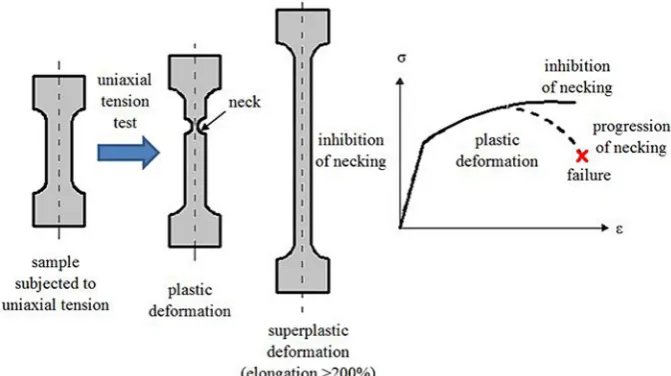
Superplasticity is an ability to undergo large plastic deformation exceeding 200% without necking and failing at relatively low stresses
(Fig. 1) [8]. Typically, the elongations from 200 to 1000% can be achieved in the superplastic state. Superplasticity, as the highly strain-rate dependent, nonlinear viscous behavior of materi
-als, occurs in many met-als, alloys, ceramics and intermetallic materials with fine structure, e.g. in aluminum or titanium alloys [3, 7, 42].
Special conditions are essential to achieve the superplastic elongation in the tensile test. The su
-perplastic forming process occurs in fine-grained materials with an average grain size usually lesser than 10-15 μm for metals and below 1 μm for ceramics in high homologous temperature exceeding 0.5 Tm,where Tm is an absolute
melt-ing point [31]. The superplastic materials are also characterized by the low flow stress <10 MPa and high uniformity of the plastic flow [15].
The superplastic forming process usually oc
-curs in the controlled low strain rate at the range of
10-4 – 10-2 s-1. The superplasticity might also arise in high strain rates even >104 s-1(high strain-rate superplasticity) [16, 28]. The aforementioned 1 Department of Materials Forming and Processing, Rzeszow University of Technology,
Al. Powstańców Warszawy 8, 35-959 Rzeszów, Poland * Corresponding author’s e-mail: [email protected]
ABSTRACT
The numerical results of superplastic punchless deep drawing of the Ti-6Al-4V titanium alloy were presented in this paper. The material behavior subjected to the forming process was characterized by deformation-micro
-structure constitutive equations including the grain growth. Superplastic stress-strain characteristics used in the numerical simulations were computed with the application of authorial program. The explicit integration scheme is used in solving differential equations. The numerical simulations of the super-elastic deep drawing were made with finite element method analysis. The von Mises stress distribution in the blow-forming process was obtained. The possible faults of extrusions caused by the improper load history as well as unsuitable pressure were also presented in this paper. The numerical simulations included in this research allow for the proper choice of material and drawing parameters which can help to optimize the superplastic forming process.
conditions allow the superplastic behavior of a material to be defined [18] as a complex function
of the strain rate
(𝜀𝜀̇)
, strain(𝜀𝜀)
, temperature (𝑇𝑇)
and the grain size(𝑑𝑑)
(Eq. 1)𝜎𝜎 = 𝑓𝑓(𝜀𝜀̇, 𝜀𝜀, 𝑇𝑇, 𝑑𝑑)
(1) The strain rate is inversely proportional to thegrain size [36, 37] in line with Eq. 2
𝜀𝜀̇ = 𝛼𝛼 ∙ 𝑑𝑑
'( (2)where:
𝛼𝛼
is a material constant,𝑑𝑑
is an average grain size and𝑝𝑝
is a grain growth exponent which char-acterizes the deformation micromecha
-nism. Usually, one assumes that p=2 or p=3.
The abovementioned requirements enable to distinguish fine-structure superplasticity (FSS) which occurs in the materials with an average grain size < 15 μm and internal-stress superplas
-ticity (ISS) caused by special external conditions, e.g. pressure or thermal activity [40].
The superplasticity phenomenon has been the subject of research for years. The first laboratory research concerning the superplastic deforma
-tion was carried out by Bengough in 1912 who obtained the elongation of 163% in α/β brass at
427 K [41]. Sherby [39] speculates that the ancient bronzes (2500 BC) and Damascus steel (350 BC) probably indicated the superplastic behavior. In the first half of the 20th century, the superplastic
deformation of different materials was also exam
-ined by Jenkins (1928) and Pearson (1934) [10, 19]. The main aim of their research was to obtain
the highest elongation in uniaxial tensile tests.
After 1945, the papers on the superplasticity phe
-nomenon have appeared occasionally. The ma
-jor increase in the interest of superplasticity was noted from 1962 onwards [13, 28]. In 1967, Lee and Backofen achieved the elongation of >1000% for Ti-6wt%Al-4wt%V (Ti-6/4) [37]. The super
-plasticity phenomenon in a magnesium alloy subjected to isothermal rolling was described in [11]. The 1100% elongation was achieved in this research. The superplastic behavior of the friction stir welded Ti-6Al-4V joint at 454 K and
for
𝜀𝜀̇ = 3 ∙ 10
()− 1 ∙ 10
(+s-1 was examinedin [46]. The microstructure and superplasticity of Al-Cu-Y-Zr alloy within temperature in the
range of 277-307 K and the strain rate range of
10
#$− 10
#& s-1 was also investigated in [32]. Thesuperplasticity of the nano-grained Mg-Gd-Y-Zr
alloy at temperatures of 573-723 K under strain rates in the range of
3.3 ∙ 10
&'− 2.7 ∙ 10
&+ s-1was analyzed in [2].
The superplasticity phenomenon has also been a subject of research carried out on a techni
-cal s-cale. In 1964, Backofen et al. showed that the Zn-Al alloy could be formed into a hemispherical shape by blowing air on one side of a sheet into a die [35]. It was considered as the first investiga
-tion of superplastic forming on a technical scale. The application of superplastic forming for fab
-rication of structural components made from the magnesium alloy is described in [26].
In recent years, the modeling of superplastic forming has been widely used in order to optimize the process on a technical scale. Lin and Dunne [20] modelled the evolution of grain growth and the necking in the superplastic blow-forming
of the Al-6Mg-0.2Sc alloy are contained in [5]. The numerical simulations of superplastic form
-ing of dental and medical prostheses are present
-ed in [4].
The aim of this paper was the numerical anal
-ysis of superplastic behavior of the Ti-6Al-4V titanium alloy subjected to a uniaxial ten -sion test at 655 K for strain rate at the range of
10
#$− 10
#& s-1. Firstly, the superplastic mate-rial response was analyzed and the autho-rial pro -gram simulating the uniaxial tension test for the Ti-6Al-4V titanium alloy based on the
superplas-tic model proposed by Dunne and Petrinic [8] was developed. Then, the stress-strain curves for vari
-ous strain rates were introduced to the commer
-cial ABAQUS program. Finally, the punch less superplastic deep drawing process was analyzed. Different load histories and pressure values were investigated in the numerical simulations. The in
-fluence of process parameters on the shape and quality of an extrusion was examined.
CONSTITUTIVE EQUATIONS
OF SUPERPLASTICITY
During the uniaxial tension test, the material in the superplastic state deformed viscoplastical
-ly. The mechanical properties of the material in the superplastic state were represented by viscous liquid models. Most material viscoplastic models are usually defined by the relationship between the second invariants of the deviator of the Cau
-chy stress tensor and the strain-rate tensor [31]. Numerous phenomenological and physical constitutive equations were proposed to describe the material flow stress response. In the superplas
-tic regime, the relationship between the strain rate and the flow stress for the one dimensional prob
-lem might be simply described with the use of an equation proposed by Backofen et al. (Eq. 3)[33].
𝜀𝜀̇
is the strain rate,𝐾𝐾
and k are material constants depending on testing conditionsand
𝑚𝑚
is the strain-rate sensitivity.In logarithmic coordinates, the relationship
ln(𝜎𝜎) − ln (𝜀𝜀̇)
is approximately a straight linefor a small strain rate interval, with the slope equal to
𝑚𝑚
.The strain-rate sensitivity is described by Eq. 6 [33, 34]:
𝑚𝑚 =
𝜕𝜕ln (𝜎𝜎)
𝜕𝜕ln (𝜀𝜀̇)
(6)The
ln(𝜎𝜎) − ln (𝜀𝜀̇)
as well asm − ln (𝜀𝜀̇)
relationships are shown in Fig. 2. The shapeof
ln(𝜎𝜎) − ln (𝜀𝜀̇)
curve is sigmoidal and them − ln (𝜀𝜀̇)
curve has a dome-like shape for which the maximum𝑚𝑚
value corresponds to the optimal strain rate in a superplastic regime for the given average grain size and the given tem -perature. The optimal strain rate interval isindi-cated from an empirical condition
𝑚𝑚 ≥ 0.3
[33]. For the majority of superplastic materials, m isin the range of 0.4-0.8 [34]. Higher values of the strain-rate sensitivity mean better superplastic elongation without necking and failing.
Eq. 3 does not consider the strain hardening which might occur during superplastic forming. The isothermal, near-constant grain size, stress-strain rate relationship including isotropic hard
-ening in a superplastic state is described by means of Norton-Hoff power law (Eq. 7) [14, 30].
𝜎𝜎 = 𝐾𝐾 𝜀𝜀
&𝜀𝜀̇
( (7)where n is an isotropic exponent.
Equations (3) and (7) are commonly applied to describe the superplasticity phenomenon but they are inadequate for simulating the super
-plastic forming because they do not consider the change of the microstructure. Additionally,
the
ln(𝜎𝜎) − ln (𝜀𝜀̇)
relationship might beRecently, more advanced formulations for describing the superplastic forming have been proposed, including the stress-strain, stress-strain rate behavior and furthermore, the dependence of
the strain rate sensitivity on the strain rate and
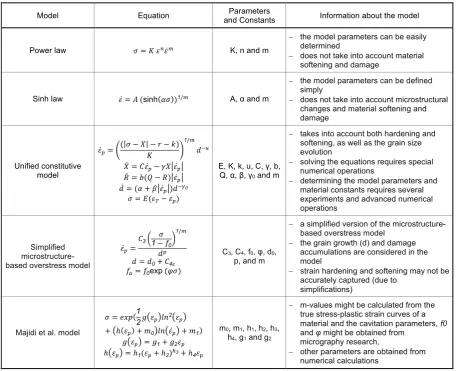
av-erage grain size (Tab. 1). These models can also describe the strain hardening caused by the static and dynamic growth as well as the evolution of an
average grain size. Deformation-microstructure constitutive equations can be found in [6, 17, 21, 22, 24, 25]. The application of complex superplas
-tic models requires the knowledge of the material
data usually designated in the experimental tests.
The superplastic model proposed by Dunne and Petrinic [8, 20] was used in this re
-search. This model was formulated as the set of
Table 1. Constitutive equations for superplastic metals [22, 23]
Table 1. Constitutive equations for superplastic metals [22, 23]
Model Equation and Constants Parameters Information about the model
Power law 𝜎𝜎 = 𝐾𝐾 𝜀𝜀&𝜀𝜀̇( K, n and m
- the model parameters can be easily
determined
- does not take into account material
softening and damage
Sinh law 𝜀𝜀̇ = 𝐴𝐴 (sinh(𝛼𝛼𝜎𝜎))1/( A, α and m
- the model parameters can be defined
simply
- does not take into account microstructural
changes and material softening and damage
Unified constitutive model
𝜀𝜀̇.= /(|𝜎𝜎 − 𝑋𝑋| − 𝑟𝑟 − 𝑘𝑘)𝐾𝐾 5
1/(
𝑑𝑑78
𝑋𝑋̇ = 𝐶𝐶𝜀𝜀̇.− 𝛾𝛾𝑋𝑋;𝜀𝜀̇.;
𝑅𝑅̇ = 𝑏𝑏(𝑄𝑄 − 𝑅𝑅);𝜀𝜀̇.;
𝑑𝑑̇ = (𝛼𝛼 + 𝛽𝛽;𝜀𝜀̇.;)𝑑𝑑7A0
𝜎𝜎 = 𝐸𝐸(𝜀𝜀C− 𝜀𝜀.)
E, K, k, u, C, γ, b, Q, α, β, γ0 and m
- takes into account both hardening and
softening, as well as the grain size evolution
- solving the equations requires special
numerical operations
- determining the model parameters and
material constants requires several experiments and advanced numerical operations
Simplified microstructure- based overstress model
𝜀𝜀̇.=
𝐶𝐶3D 𝜎𝜎1− 𝑓𝑓 0F
1/(
𝑑𝑑.
𝑑𝑑 = 𝑑𝑑0+ 𝐶𝐶4G
𝑓𝑓H= 𝑓𝑓0exp (𝜑𝜑𝜎𝜎)
C3, C4, f0, φ, d0, p, and m
- a simplified version of the
microstructure-based overstress model
- the grain growth (d) and damage
accumulations are considered in the model
- strain hardening and softening may not be
accurately captured (due to simplifications)
Majidi et al. model
𝜎𝜎 = 𝑒𝑒𝑒𝑒𝑒𝑒(12𝑔𝑔N𝜀𝜀.O𝑙𝑙𝑙𝑙2N𝜀𝜀.O
+ Nℎ(𝜀𝜀.) + 𝑚𝑚0O𝑙𝑙𝑙𝑙N𝜀𝜀̇.O + 𝑚𝑚1) 𝑔𝑔N𝜀𝜀.O = 𝑔𝑔1+ 𝑔𝑔2𝜀𝜀.
ℎN𝜀𝜀.O = ℎ1(𝜀𝜀.+ ℎ2)T3+ ℎ4𝜀𝜀.
m0, m1, h1, h2, h3, h4, g1 and g2
- m-values might be calculated from the
true stress-plastic strain curves of a
material and the cavitation parameters, f0
and φ might be obtained from
micrography research,
- other parameters are obtained from
numerical calculations
𝜀𝜀̇
=
𝑙𝑙
'𝑠𝑠𝑠𝑠𝑠𝑠ℎ 𝛽𝛽(𝜎𝜎 − 𝑟𝑟 − 𝜎𝜎
2)
(8) where:𝜀𝜀̇
# is the plastic strain rate,∝ 𝑎𝑎𝑎𝑎𝑎𝑎 𝛽𝛽
arematerial constants,
𝑟𝑟
is an isotropic hard -ening variable and𝜇𝜇
is thedeformation-microstructure coupling constant. − the isotropic hardening
𝑟𝑟̇ = (𝑐𝑐
&− 𝛾𝛾
&𝑟𝑟)𝑝𝑝̇
(9)where:
𝑐𝑐
" and𝛾𝛾
" are material constants and𝑝𝑝̇
isthe effective plastic strain. − the Hooke’s law
𝜎𝜎̇ = 𝐸𝐸(𝜀𝜀̇ − 𝜀𝜀̇
()
(10)The change of microstructure of material is related with an increase of a grain size. The defor
-mation-enhanced grain growth can be written as:
𝑙𝑙̇ =
𝛼𝛼
𝑙𝑙
&%+ 𝛽𝛽
%𝑝𝑝̇
(11)where:
𝑐𝑐
",𝛾𝛾
",𝛽𝛽
" and𝜇𝜇
are material constantsand
𝑙𝑙
is an average grain size.An original numerical program based on the ex
-plicit integration of (8)-(11) equations was devel
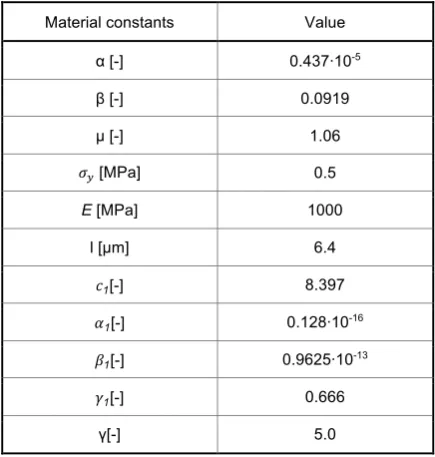
-oped. The material constants appointed by Dunne and Petrinic [8] were used as shown in Table 2.
It is worth noting that the solution of equations (8-11) might be an ill-conditioned problem – see
the magnitudes of
𝛼𝛼
" and𝛽𝛽
" parameters. It is alsovery important for the convergence that param
-eter l must be expressed in μm.
On the basis of the superplastic model pro
-posed in [5], the numerical program was devel
-oped. In the explicit integration of the constitu
-tive equations (8)-(11) the stress-strain curves for
a Ti-6Al-4V titanium alloy for various strain rates
were generated.
The stress vs. strain curves for strain rates of
10
#$− 10
$ s-1 are presented in Figure 3. Onecan see that the yield stress increases along with the strain rate which is an important feature of materials in a superplastic state.
the Ti-6Al-4V titanium alloy at 655 K was carried out using the commercial ABAQUS program. In this research, the superplastic deep-drawing was solved as 3D analysis using the explicit dynamic procedure.
The model of the punchless superplastic deep drawing consists of the die, the blank holder and the flat metal alloy sheet which is subjected to the pressure in order to achieve the die shape. The metal sheet was modeled as a deformable body and all tools were considered as analytical rigid bodies. Such an approach enables to shorten the analysis time, unless the shape of the tools is relatively simple. Analytical rigid bodies do not require generation of finite element mesh, which decreases the size of the problem. The general view of the model is shown in Figure 4.
In this research, the sheet made from Ti-6Al-4V was a flat blank with 5.4∙10-2 m
diam-eter and uniform thickness of 10-3 m. The metal
Table 2. Material constants used in numerical
simulations
Material constants Value
α [-] 0.437∙10-5
β [-] 0.0919
μ [-] 1.06
𝜎𝜎" [MPa] 0.5
E [MPa] 1000
l [μm] 6.4
𝑐𝑐1[-] 8.397
𝛼𝛼1[-] 0.128∙10-16
𝛽𝛽1[-] 0.9625∙10-13
𝛾𝛾1[-] 0.666
sheet was discretized by 11088 C3D8R eight-nodes brick elements with linear shape function. Reduced integration was used to avoid the locking effects. The die and the blank holder were fixed by the applied boundary conditions. The follow -ing material data for the Ti-6Al-4V alloy sheet
were used: density – 4.5 kg/m3, Young’s modu
-lus – 100 MPa, Poisson’s ratio – 0.3. The friction between metal sheet and tools was described by means of Coulomb friction model with a friction coefficient of 0.135.
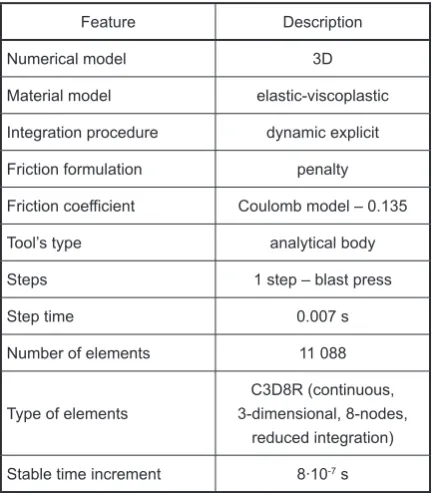
The details of used numerical model are con -tained in Table 3. The pressure applied to the top
of the metal sheet was in the range of 5-10 MPa. The numerical simulations were carried out for
various strain rates of
10
#$− 10
$ s-1. Theprob-lem was solved in the single step consisting of ap
-proximately ten thousand increments. The stable time increment was about
7 ∙ 10
%& (explicit inte-gration is conditionally stable).
Table 3. Details of the numerical model
Feature Description
Numerical model 3D
Material model elastic-viscoplastic
Integration procedure dynamic explicit
Friction formulation penalty
Friction coefficient Coulomb model – 0.135
Tool’s type analytical body
Steps 1 step – blast press
Step time 0.007 s
Number of elements 11 088
Type of elements
C3D8R (continuous, 3-dimensional, 8-nodes,
reduced integration)
Stable time increment 8∙10-7 s
Figure 4. The assembly of superplastic forming process
Figure 3. Numerically generated stress- strain curves for a Ti-6Al-4V
− the springback phenomenon after the super
-plastic forming,
− the type of elements used to model titanium
sheet, i.e. continuous 3D elements vs. shell elements,
− the possibility of the mass scaling on order to decrease the computation time.
The selected results obtained in this research program are presented below.
The value of the pressure applied has
sig-nificant influence on the extrusion shape after the superplastic deep drawing process (see Fig. 5). The overstated pressure results in the presence of folding walls.
The load history influences on the distribution of strain in a metal sheet as well as the quality of the extrusion (Fig. 8). The results presented in Figure 7 show that inappropriate pressure history can cause drawpiece folds.
Figure 6. Effective plastic strains at time t = 0.06 (a), t = 0.1 (b), t = 0.2 (c) and t = 1.0 s (d)
During the deep drawing process, deviations in the dimensions of the final product got spring
-back effect. This elastic recovery of material occurring after the tool is removed or released, depends on the material properties as well as the process parameters, e.g. friction contact condition and punch or blankholder force [44, 45]. Numeri
-cal modeling of the deep drawing process might predict the springback effect in the deformed sheet and enables to obtain the part with a de
-sirable shape. An exemplary springback effect which occurs in a superplastic deep drawing pro
-cess is shown in Figure 8.
CONCLUSIONS
Numerical modeling of punchless deep draw
-ing process in a superplastic regime was present
-ed in this research. The Ti-6Al-4V titanium alloy
material model introduced by Dunne and Petrinic was used in the analysis. Constitutive equations used in this material model included both defor
-mation and the microstructure change related to the grain size growth.
On the basis of the model proposed by Dunne and Petrinic, an original program simulating the
uniaxial tension test for the Ti-6Al-4V titanium
alloy at a temperature of 655 K was developed. The numerically generated stress-strain curves
for strain rates of
10
#$− 10
$ s-1 are obtained bythe explicit integration of the constitutive equa
-tions. Later on, they are applied in the simula
-tions of the superplastic deep drawing process in commercial ABAQUS program. The process was modeled as 3D analysis using explicit dynamic procedure. The metal sheet was discretized by means of 11088 C3D8R eight-nodes brick ele
-ments with linear shape function in order to avoid the locking effects.
Fig. 8. The springback phenomenon for Ti-6Al-4V during the superplastic forming
extrusion’s collar. Numerical analysis also allows the springback effect investigation in the super
-plastic deep drawing process. The precise predic
-tion of springback phenomenon is very important in the sheet metal forming processes and helps in the design of tools as well as provides the correct
shape of the formed parts.
The research contained in this paper shows that it is possible to use the finite element method to design the deep drawing process leads to the reduction of extrusion’s faults or springback ef
-fect. Numerical simulations of superplastic form
-ing enable to optimize the process and select the optimal shape of tools in order to decrease their wearing. This will reduce the cost of development of the deep drawing instrumentation when com -pared to the prototype preparation and experi-mental investigations.
REFERENCES
1. Adamus J., Winowiecka J., Dyner M., Lacki P. Nu
-merical simulation of forming titanium thin-wall panels with stiffeners. Advances in Science and Technology Research Journal, 12(1), 2018, 54-62.
2. Alizadeh R., Mahmudi R., Ngan A.H.W., Huang Y. and Langdon T.G. Superplasticity of a nano-grained Mg-Gd-Y-Zr alloy processed by high-pressure tor
-sion. Materials Science and Engineering A, 651, 2016, 786-794.
3. Berdichevskij E.G. Use of the superplasticity effect of materials in engineering technology. IOP Con
-ference Series: Materials Science and Engineering, 441, 2018, 1-5.
4. Bonet J., Wood R.D., Said R., Curtis R.V. and Gar
-riga-Majo D. Numerical simulation of the super
-plastic forming of dental and medical prostheses. Biomechanics and Modeling in Mechanobiology, 1(3), 2002, 177-196.
5. Chen M. H., Xue Y.H., Rui Y.L., Zhou J.H. and Wang M. Numerical Simulation and Experimen
-tal Investigation of High Strain Rate Superplastic
9. Dziubińska A., Majerski K., Winiarski G. Investi
-gation of the effect of forging temperature on the microstructure of grade 5 titanium ELI. Advances in Science and Technology Research Journal, 11(4), 2017, 147-158.
10. Fan W. Flow behavior and microstructural evolu
-tion during superplastic deforma-tion of AA8090 aluminium-lithium Alloy. PhD thesis, 1998.
11. Galiyev A. and Kaibyshev R. Superplasticity in a magnesium alloy subjected to isothermal rolling. Scripta Materialia, 51, 2004, 89-90.
12. Gomez-Gallegos A., Mandal P., Gonzales D., Zuelli N. and Blackwell P. Studies on Titanium Alloys for Aerospace Applications. Defect and Diffusion Fo
-rum, 385, 2018, 419-423.
13. Henshall C.A., Wadsworth J., Reynolds M.J. and Barnes A.J. Design and manufacture of a superplas
-tic-formed aluminium-lithium component. Materi
-als & Design, 8(6), 1987, 324-330.
14. Hosford W.F. and Caddel R.M. Metal forming: Mechanics and Metallurgy. 4th Edition. Cambridge University Press, 2011.
15. Kawasaki M. and Langdon T.G. Developing Super
-plasticity in Ultrafine-Grained Metals. Acta Physica Polonica a, 128(4), 2015, 470-478.
16. Kharchenko V.V. Viscoplastic models in simulation
of high strain-rate behavior of materials. Strength of
Materials, 34(3), 2002, 219-222.
17. Khraisheh M., Zbib H., Hamilton C. and Bayoumi A. Constitutive modeling of superplastic deforma
-tion. Part I: Theory and experiments. International Journal of Plasticity, 13(1-2), 1997, 143-164. 18. Kotov A.D., Mikhailovskay A.V., Mosleh A.O.,
Pourcelot T.P., Prosviryakov A.S. and Portnoi V.K. Superplasticity of an Ultrafine-Grained Ti-4% Al-1% V-3% Mo Alloy. Physics of Metals and Metal
-lography, 120(1), 2019, 60-68.
19. Langdon T.G. Thirty Years of Superplastic Ultra
-fine-Grained Materials: Examining the Legacy of Oscar Kaibyshev. Defect and Diffusion Forum, 385, 2018, 3-8.
20. Lin J. and Dunne F.P.F. Modelling grain growth evo
21. Lin J. and Yang J. GA-based multiple objective op
-timisation for determining viscoplastic constitutive equations for superplastic alloys. International Jour
-nal of Plasticity, 15(11), 1999, 1181-1196.
22. Majidi O., Jahazi M. and Bombadier N. Finite Ele
-ment Simulation of High-Speed Blow Forming of an Automotive Component. Metals, 8(11), 2018,
1-12.
23. Majidi O., Jahazi M. and Bombardier N. A visco
-plastic model based on a variable strain rate sensitiv
-ity index for superplastic sheet metals. International Journal of Material Forming, 12(4), 2019, 693-702.
24. Mosleh A., Mikhaylovskaya A., Kotov A., Pourcelot T. , Aksenov S., Kwame J. and Portnoy V. Model
-ling of the Superplastic Deformation of the Near-α Titanium Alloy (Ti-2.5Al-1.8Mn) Using Arrhenius-Type Constitutive Model and Artificial Neural Net
-work. Metals, 7(12), 2017, 1-15.
25. Mosleh A.O., Mikhaylovskaya A.V., Kotov A.D. and Kwame J.S. Experimental, modeling and simu
-lation of an approach for optimizing the superplastic forming of Ti-6%Al-4%V titanium alloy. Journal of Manufacturing Processes, 45, 2019, 262-272.
26. Mukai T., Wanatabe H. and Higashi K. Applica
-tion of superplasticity in commercial magnesium alloy for fabrication of structural components. Ma
-terials Science and Technology, 16(11-12), 2013, 1314-1319.
27. Muthusamy B. and Ramanathan K. Numerical simulation and analysis of superplastic forming in Ti-6Al-4V alloy. International Journal of Applied Engineering Research, 55(10), 2015, 3746-3750. 28. Nieh T.G., Wadsworth J. and Sherby O.D. Super
-plasticity in metals and ceramics. Cambridge Uni
-versity Press, 1997.
29. Oh-ishi K., Boydon J. and McNelley T.R. Process
-ing, deformation, and failure in superplastic alumi
-num alloys: Applications of orientation-imaging microscopy. Journal of Materials Engineering and Performance, 13(6), 2004, 710-719.
30. Padmanabhan K.A., Vasin R.A. and Enikeev F.U. Superplastic flow: Phenomonology and Mechanics. Springer-Verlag, 2001.
31. Patel V.V. and Badheka V. Influence of Friction Stir Processed Parameters on Superplasticity of Al-Zn-Mg-Cu Alloy. Materials and Manufacturing Pro
-cesses, 31(12), 2015, 1573-1582.
32. Pozdniakov A.V., Barkov R.Y., Amer S.M., Levchenko V.S., Kotov A.D. and Mikhaylovskaya A.V. Microstructure, mechanical properties and superplasticity of the Al-Cu-Y-Zr Alloy. Materials Science and Engineering A, 758, 2019, 28-35.
33. Prasad N.E. and Wanhill R.J.H. Aerospace Materi
-als and Material Technologies. Volume 2: Aerospace Material Technologies. Springer, 2017.
34. Prasad N.E., Gokhale A.M. and Wanhill R.J.H. Aluminum-Lithium Alloys. Processing, Properties
and Applications. Elsevier, 2014.
35. Rajasekaran A., Sundar Singh Sivam S.P., Rajen
-drakumar S. and Saravanan K. Influence of setting variables in conventional super plastic forming pro
-cess using grey relation analysis in taguchi method. ARPN Journal of Engineering and Applied Science, 12(15), 2017, 4648-4655.
36. Ridley N. Metals for superplastic forming, in: G. Giuliano, (eds.) Superplastic forming of advanced metallic materials. Woodhead Publishing, 2011.
37. Ridley N. Superplastic Forming and Diffusion Bonding of Titanium Alloys, in: R. Blockley, (eds.), Encyclopedia of Aerospace Engineering, John Wil
-ley & Sons, 2010.
38. Sherby O.D. and Burke P.M. Mechanical behavior of crystalline solids at elevated temperature. Prog
-ress in Materials Science, 13, 1968, 323-390. 39. Sherby O.D. and Wadsworth J. Superplasticity –
Recent advances and future directions. Progress in Materials Science, 33(3), 1989, 169-221.
40. Sieniawski J. and Motyka M. Superplasticity in ti
-tanium alloys. Journal of Achievements in Materi
-als and Manufacturing Engineering, 24(1), 2007,
123-130.
41. Tully K. and Monaghan J. Bulk forming of super
-plastic alloys. Journal of Materials Processing Tech
-nology, 26(2), 1991, 159-171.
42. Vasin R. A. and Filippov O.G. On Dependence of the Stress on Strain Rate of Superplastic Materials. Strength of Materials, 32(4), 2000, 311-315.
43. Vasin R. A., Berdin V. K. and Kashaev R.M. On the Universal Curve in Superplasticity Mechanics. Strength of Materials, 33(6), 2001, 509-515.
44. Wang J., Verma S., Alexander R. and Gau J.T. Springback control of sheet metal air bending pro
-cess. Journal of Manufacturing Processes, 10, 2008,
21-27.
45. Winowiecka J. The analysis of springback of titani
-um sheet after bending. Obróbka Plastyczna Metali, 24(3), 2013, 219-232.
46. Wu L.H., Jia C.L., Han S.C., Li N., Ni D.R., Xiao B.L., Ma Z.Y., Fu M.J., Wang Y.Q. and Zeng Y.S. Superplastic deformation behavior of lamellar mi
-crostructure in a hydrogenated friction stir welded Ti-6Al-4V joint. Journal of Alloys and Compounds, 787, 2019, 1320-1326.
47. Yu H., Yan M., Li J., Godbole A., Lu C., Tieu K., Li H. and Kong C. Mechanical properties and mi
-crostructure of a Ti-6Al-4V alloy subjected to cold rolling, asymmetric rolling and asymmetric cry
-orolling. Materials Science and Engineering: A, 710(5), 2018, 10-16.