Individual morningness-eveningness differences explain the rhythmic variations of behavioral and biological patterns. Several studies have corroborated that morningness preference increases over adulthood and aging. Adolescents shift their time of day preferences from morningness to eveningness during puberty. The aims of this study were translate to Spanish the Morningness-Eveningness Scale for Children (MESC)and to analyze age and sex differences. A group of 600 adolescents (aged between 12 and 16 years) participated in the study. Psychometric analysis showed that reliability and factor structure were suitable and similar to previous studies. The results indicated a clear decrease of morningness as of 12 years. Boys were more morningness-oriented than girls in several items of the questionnaire. In view of the results, several educational implications are raised.
Keywords: morningness-eveningness, adolescence, age, sex
La tendencia a la matutinidad-vespertinidad permite explicar gran parte de las variaciones rítmicas de patrones biológicos y conductuales. Se ha constatado que con la edad se produce un incremento paulatino de la matutinidad. En población adolescente se ha detectado una mayor tendencia a la vespertinidad. Los objetivos del estudio fueron la traducción y adaptación del Morningness-Eveningness Scale for Children (MESC) a población adolescente, así como el análisis de las diferencias de edad y sexo. En el estudio participaron 600 adolescentes entre 12 y 16 años. Los resultados indicaron que el MESC es un instrumento fiable en población adolescente, siendo su estructura factorial similar a la obtenida en otros estudios. A partir de los 12 años se producía una disminución progresiva de la matutinidad, siendo esta disminución mayor para las mujeres que para los varones en algunos elementos del cuestionario. Se plantean algunas implicaciones educativas a raíz de los resultados obtenidos.
Palabras clave: matutinidad-vespertinidad, adolescencia, edad, sexo
Morningness-Eveningness in Adolescents
Juan Francisco Díaz-Morales
1and María Gutiérrez Sorroche
2 1Universidad Complutense2I.E.S. Luis García Berlanga
The authors thank Professor Mary A. Carskadon for having provided the MESC questionnaire and authorized its use. We would also like to express our gratitude to Silvia Rojas, Humberto Moreira, Sayli Piamonte, and Virginia Dresh for their help collecting data, as well as the Board of Directors of the educational centers for their availability and support.
Correspondence concerning this article should be addressed to Juan Francisco Díaz-Morales, Departamento Psicología Diferencial y Trabajo, Facultad de Psicología, Universidad Complutense de Madrid, Campus de Somosaguas, 28223, MADRID (Spain). Fax: 91 394 3189. E-mail: [email protected]
Translation: Virginia Navascués Howard.
The physiological processes and the use of psychological resources of an organism vary throughout the day (Carrier & Monk, 2000). Many of these fluctuations follow two clearly differentiated patterns of change that reflect the morningness-eveningness tendency. Basically, the difference consists of the fact that the maximum (acrophase) of some circadian rhythms (i.e., body temperature, cortisol, or melatonin) occurs between 1 and 3 hours earlier for clearly morning-oriented people than for others who are more evening-oriented (Baehr, Revelle, & Eastman, 2000). Considering the interaction between a person’s own rhythms and those of the environment (e.g., light-darkness, social cues), morning and evening types show differences in their behavioral habits (Roenneberg, Wirz-Justice, & Merrow, 2003), as well as characteristic personality differences (DeYoung, Hasher, Djikic, Criger, & Peterson, 2007; Díaz-Morales, 2007). This variable of individual differentiation has received much attention in the work setting, as it is one of the best factors to predict the adaptation to shift work (Pisarski et al., 2006) and, with this purpose, diverse self-reports have been created that, once validated, have led to quicker and simpler assessment of circadian rhythm without having to resort to physiological measures or registers (Adan, Caci, & Prat, 2005; Díaz-Morales & Sánchez-López, 2004, 2005a, 2005b).
A series of studies have shown that morningness increases with age, and therefore, the ease in adapting to shift work is partially reduced (Costa, Sartori, & Åkerstedt, 2006). In this sense, older adults feel better carrying out their activities in the morning and, if possible, always in the morning. In contrast, during adolescence there is a higher tendency to eveningness, a consequence both of the maturation processes typical of puberty and of the many changes in the adolescent’s relational and social sphere (Carskadon & Acebo, 1993). However, compared to the number of works aimed at analyzing the relevance of the circadian rhythms to mitigate the negative effects of adapting to shift work, the implications for health and academic achievement of changing to eveningness during adolescence have received less attention (Cofer et al., 1999; Roenneberg, et al., 2004).
Various studies have found a relation between the progressive reduction of morningness during adolescence and sleeping problems (Bearpark & Michie, 1987), pubertal development (Carskadon, Viera, & Acebo, 1993), decrease in hours of sleep during the school week (Park, Matsumoto, Seo, & Shinkoda, 1999), poorer academic achievement (Kim, Duecker, Hasher, & Goldstein, 2002), depressive tendencies (Caci, Robert, Dossios, & Boyer, 2005), and high family and school demands (Gau & Soong, 2003). The phase delay in circadian rhythmicity (more eveningness) would be a consequence both of the maturation processes during adolescence (Carskadon & Acebo, 1993), and of the different psychosocial factors typical of this developmental stage (Takeuchi et al., 2001).
In contrast, the results of studies of morningness-eveningness as a function of sex differences are still inconclusive. On the one hand, no sex differences have been found in adolescents, which coincides with most of the works carried out in the adult population (Tankova, Adan, & Buela-Casal, 1994). On the other hand, in studies using large samples of university students, women were observed to be more morningness-oriented than men (Adan & Natale, 2002; Natale & Danesi, 2002). In adolescents, morningness-eveningness sex differences are expected due to the earlier pubertal development in adolescent women (Steinberg & Sheffield, 2001) and the relation between pubertal development and eveningness (Carskadon et al., 1993; Roenneberg et al., 2004). According to Gau, Soong, and Merikangas (2004), sex differences can be moderated by personality characteristics, as morningness-oriented men obtained higher anxiety scores and worse mood scores.
Considering these aspects, our investigation had two goals: firstly, to translate and adapt to the Spanish adolescent population the Morningness-Eveningness Scale for Children (MESC) proposed by Carskadon, Vieira, and Acebo (1993) to assess morningness-eveningness in adolescents and, secondly, to obtain normative data about the morningness-eveningness tendency in a large sample of adolescents between 12 and 16 years of age, taking age and sex into account.
Method
Participants
A group of 600 adolescents of ages between 12 and 16 years (M = 14.3, SD = 1.4) participated in this study. Of the sample, 49.9 % were girls. All the adolescents were studying Compulsory Secondary Education in two public schools of the Community of Madrid (Spain). The board of directors authorized the study after obtaining the parents’ permission. Only 10 adolescents did not complete the questionnaire. Participation was voluntary.
Instruments
Morningness-Eveningness Scale for Children(MESC; Carskadon et al., 1993; in Spanish, the “Cuestionario de Matutinidad-Vespertinidad para Niños”). This scale is an adaptation of the Composite Scale of Morningness (Smith, Reilly, & Midkiff, 1989) carried out by Carskadon et al. for the adolescent population. The scale has 10 items drawn up in language that is comprehensible for children and adolescents and it has a response scale with four or five response options for each item. Scores range from 10 (eveningness) to 42 (morningness). The scale was translated to Spanish by the first author (see the Appendix), and subsequently reviewed by a native linguist. Scale validity has been recently contrasted, taking into account sleeping habits, self-assessment of the
DÍAZ-MORALES AND GUTIÉRREZ
Procedure and Data Analysis
The questionnaire was completed during the normal school schedule (8:30-14:20). The assessment sessions lasted approximately 20 minutes and were always carried out in the morning. The study was performed in October.
Data were analyzed using analysis of variance (ANOVA) to contrast the effect of age and sex on morningness, and principal component factor analysis to study the internal structure of the questionnaire, as well as Pearson’s correlation. The SPSS-X (1988) statistical package was used.
Results
The mean of the MESC was 23.93 (SD= 4.86, range = 10-41). The reliability of the scale was .82 (Cronbach’s alpha) and the range of corrected item-scale correlation coefficients was between .25 (item 7) and .66 (item 1). The frequency distribution did not show skewness (value = .08, error = .10) or kurtosis (value = .02, error = .19), although it was significantly different from the normal curve (Kolmogorov-Smirnov’s Z = 1.49, p= .022). The cut-off points of percentiles 10 and 90, which correspond to the MESC values of 18/30, respectively, are usually used to differentiate the prototypical morning, intermediate, and evening types. Assuming less restrictive cut-off points, percentiles 20/80, equivalent to the MESC values of 20/28, no sex differences were detected in the proportion of morning, intermediate, and evening types, χ2(2, N= 600) = 2.44, p = .29, C = .06, p = .29. With regard to age, Pearson’s correlation indicated that morningness decreases with age, r = –.16, p < .01, and the magnitude of this correlation was notably lower than that found by Kim et al. (2000) with North American adolescents, r= –.30.
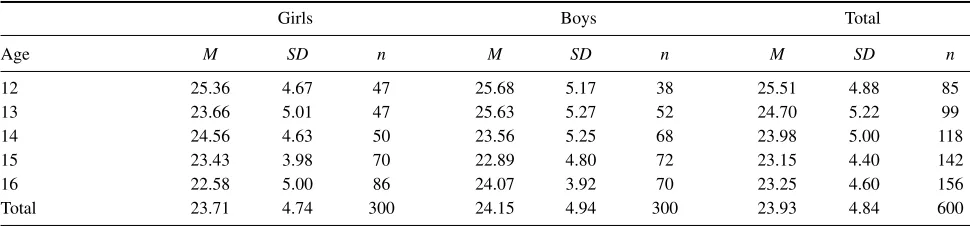
ANOVA was used to analyze the age and sex differences in morningness, considering age (12, 13, 14, 15, and 16 years) and sex (boys and girls) as independent variables. In
590) = 4.47, p < .01, η = 0.03, but there were no sex differences, F(1, 590) = 1.25, p = 0.26. The Sex ×Age interaction was also nonsignificant, F(4, 590) = 2.14, p = .074. The multiple post hoc comparisons among the different age groups (Sheffé test) indicated that the differences were between the 12- and the 15-year-olds (p< .05) and the 12-and the 16-year-olds (p< .05).
In order to study sex differences in more detail, the questionnaire items were analyzed with the Mann-Whitney
U test. In the items in which there were sex differences, boys obtained higher morningness scores. That is, it was easier for boys to get up early (item 2, Z= –2.96, p< .001), they felt more like doing exercise at 7:00 a.m. (item 3, Z= –4.45, p< .001), they needed to go to bed earlier (item 8,
Z= –2.36, p< .001), and they had no trouble getting up at 6:00 a.m. (item 9, Z= –2.44, p< .01).
Table 1
Means, Standard Deviations, and Number of Adolescents in Morningness as a Function of their Age and Sex
Girls Boys Total
Age M SD n M SD n M SD n
12 25.36 4.67 47 25.68 5.17 38 25.51 4.88 85
13 23.66 5.01 47 25.63 5.27 52 24.70 5.22 99
14 24.56 4.63 50 23.56 5.25 68 23.98 5.00 118
15 23.43 3.98 70 22.89 4.80 72 23.15 4.40 142
16 22.58 5.00 86 24.07 3.92 70 23.25 4.60 156
Total 23.71 4.74 300 24.15 4.94 300 23.93 4.84 600
Table 2
Factor Structure of the MESC (Principal Components, Oblique Rotation)
MESC Items Factor 1 Factor 2
2 .77 .14
9 .73 .13
7 .71 .17
3-r .60 .19
1-r .57 .32
10-r .54 .25
8-r .05 .80
6-r .22 .76
4-r .30 .52
5-r .39 .49
% variance explained 30.52 14.66
DÍAZ-MORALES AND GUTIÉRREZ
204
Lastly, principal component factor analysis (oblimin rotation) was performed to study the internal structure of the questionnaire. This analysis yielded a two-factor structure (see Table 2). The first factor accounts for 30.5% of the variance and it is made up of items 1, 2, 3, 7, 9, and 10. The second factor explained 14.6% of the variance and was made up of items 4, 5, 6, and 8. This structure is identical to the one found by Caci et al. (2005) in the French adolescent population. They called the first factor “morningness” and the second factor “planning.” It is also very similar to the one obtained by Natale and Bruni (2000) in the Italian adolescent population (their Factor 2 does not include item 5).
Discussion
During the stage of adolescence studied herein (12-16 years), there is a higher tendency to eveningness. The univariate contrasts indicated differences between the groups of 12-year-olds and the 15- and 16-year-olds. This result is similar to the one found in previous studies (Bearpark & Michie, 1987; Carskadon et al., 1993), and indicates that the MESC can detect the changes in morningness-eveningness during adolescence.
Secondly, we found no sex differences in morningness. However, although the differences between boys and girls in the MESC did not reach the required significance level, the tendency of the means indicates that girls adolescents scored lower in morningness. Item analysis revealed higher morningness in boys in the items that involved more demand or effort as noted above. These results indicate the need to study sex differences in adolescence in more depth. On the one hand, the different speed of pubertal development by boys and girls is a determining factor in the changes that occur in the circadian rhythms (Steinberg & Sheffield, 2001). It must be remembered that there is a positive relation between pubertal development and eveningness detected by Carskadon and colleagues (1993), as well as Park et al.’s (1999) conclusion that adolescence begins with a change toward eveningness. However, the effect of psychological and/or sociological factors in the decrease of morningness at the beginning of adolescence should not be disregarded. Takeuchi et al. (2001) found that parental enforcement of bedtime and rising time can attenuate the change toward eveningness, whereas Gau and Soong (2003) attribute the change toward eveningness both to family and school demands as well as to pubertal development.
This study provides normative data of adolescents’ morningness-eveningness in a Spanish sample that is sufficiently large and heterogeneous. The mean values (compare with Table 1) obtained in the MESC between 12 and 16 years of age are lower than those obtained in the original work of 1993 by Carskadon and colleagues (mean values, 28.5 for boys and 28.7 for girls), and slightly lower than the ones obtained by Kim et al. (2002) in a similar sample of adolescents from the USA (mean values, 27.4,
25.8, 24.3, 24.4, and 23.5). Caci et al. (2005) obtained mean values in the MESC of 27.36 for boys and 26.16 for girls in an adolescent French population between 12 and 15 years of age. In an Italian adolescent population, Natale and Bruni (2000) obtained mean values in the MESC of 27.72 and a negative relation with age of –.15. Lastly, Gau and Soong (2003), in their Taiwanese version of the MESC, obtained a mean value between 10 and 14 years of age of 29.40. As the age ranges used in these studies are somewhat different, it is premature to reach conclusions from a simple comparative analysis of the mean values. Future cross-cultural studies in adolescent population can clarify these differences (Randler & Díaz-Morales, 2007).
Although in this work, the impact of morningness-eveningness on adolescents’ achievement and psychological wellbeing was not examined, the changes in the circadian rhythmicity during adolescence should be taken into account when adapting adolescents to the school schedule. The progressive reduction of morningness (or higher eveningness), together with starting school earlier during Compulsory Secondary Education seems to be a determining factor in adolescents’ adaptation to their school schedule. Adolescents who are more clearly morning types have higher academic achievement (Randler & Frech, 2006). The delay in the circadian phase can affect academic achievement negatively, because of the so-called asynchrony between the preferred time of day and the time when classes take place. According to the synchrony effect(May, 1999), both adolescents and adults will perform certain cognitive tasks better at the optimum time of day, which is different for morning types (the morning) and evening types (the afternoon). Thus, if tasks take place at the optimum time of day, there will be less distraction (May,1999), the new information to be learned is recognized better (May, Hasher & Stoltzfus, 1993), and there is more control of inappropriate responses (May & Hasher, 1998). Recently, Goldstein et al. (Goldstein, Hahn, Hasher, Wiprzycka, & Zelazo, 2006) have observed that higher scores are obtained in fluid intelligence tests when they are performed at the optimum time of day for morning types (in the morning) and evening types (in the afternoon). These aspects should be taken into account in future studies.
References
Adan, A., Caci, H., & Prat, G. (2005). Reliability of the Spanish version of the Composite Scale of Morningness. European Psychiatry, 20, 503-509.
Adan, A., & Natale, V. (2002). Gender differences in morningness-eveningness preference. Chronobiology International, 19, 709-720.
Caci, H., Robert, P., Dossios, C., & Boyer, P. (2005). L’échelle de matinalité pour enfants et adolescents: propriétés psychométriques et effet du mois de naissance. L’Encéphale,
31, 56-64.
Carrier, J., & Monk, T. (2000). Circadian rhythms of performance: New trends. Chronobiology International, 17, 719-732. Carskadon, M.A., & Acebo, C. (1993). A self-administered rating
scale for pubertal development. Journal of Adolescent Health, 14, 190-195.
Carskadon, M.A., Vieira, C., & Acebo, C. (1993). Association between puberty and delayed phase preference. Sleep, 16, 258-262. Cofer, L.F., Grice, J.W., Sethre-Hofstad, L., Radi, C.J.,
Zimmerman, L.K., Palmer-Seal, D., & Santa-Maria, G. (1999). Developmental perspectives on morningness-eveningness and social interactions. Human Development, 42, 169-198.
Costa, G., Sartori, S., & Åkerstedt, T. (2006). Influence of flexibility and variability of working hours on health and well-being.
Chronobiology International, 23, 1125-1137.
DeYoung, C.G., Hasher, L., Djikic, M. Criger, B., & Peterson, J.B. (2007). Morning people are stable people: Circadian rhythm and the higher-order factors of the Big Five. Personality and Individual Differences, 43,267-276.
Díaz-Morales, J.F. (2007). Morning and evening-types: Exploring their personality styles. Personality and Individual Differences, 43, 769-778.
Díaz-Morales, J.F., Dávila de León, C., & Gutiérrez, M. (2007). Validity of the Morningness-Eveningness Scale for Children among Spanish adolescents. Chronobiology International, 24,
435-447.
Díaz-Morales, J.F., & Sánchez-López, M.P. (2004). Composite and Preferences Scales of Morningness: Reliability and factorial invariance in adult and university samples. The Spanish Journal of Psychology, 7, 93-100.
Díaz-Morales, J.F., & Sánchez-López, M.P. (2005a). Composite Scale of Morningness and Preferences: Preliminary validity data in Peruvian undergraduates. Ergonomics, 4, 354-363.
Díaz-Morales, J.F., & Sánchez-López, M.P. (2005b). Propiedades psicométricas de la Escala de Preferencias y la Escala Compuesta de Matutinidad. Psicothema, 17,478-484. Gau, S.F., & Soong, W.T. (2003). The transition of sleep-wake
patterns in early adolescence. Sleep, 26,449-454.
Gau, S.F., Soong, W.T., & Merikangas, K.R. (2004). Correlates of sleep-wake patterns among children and young adolescents in Taiwan. Sleep, 27, 512-519.
Goldstein, D., Hahn, C.S., Hasher, L., Wiprzycka, U.J., & Zelazo, P.D. (2006). Time of day, intellectual performance, and behavioral problems in morning versus evening type adolescents: Is there a synchrony effect? Personality and Individual Differences, 42, 431-440.
May, C.P. (1999). Synchrony effects in cognition: The costs and a benefit. Psychonomic Bulletin & Review, 6, 142-147. May, C.P., & Hasher, L. (1998). Synchrony effects in inhibitory
control over thought and action. Journal of Experimental Psychology: Human Perception and Performance, 24, 363-379. May, C.P., Hasher, L., & Stoltzfus, E.R. (1993). Optimal time of day and the magnitude of age differences in memory.
Psychological Science, 4,326-330.
Natale, V., & Bruni, O. (2000). Confronto fra tre questionari per la valutazione della tipologia circadiana in adolescenza. Testing Psicometria Metodologia, 7, 33-44.
Natale, V., & Danesi, E. (2002). Gender and circadian typology.
Biological Rhythms Research, 33,261-269.
Park, Y.M., Matsumoto, K., Seo, Y.J., & Shinkoda, H. (1999). Sleep and chronotype for children in Japan. Perceptual and Motor Skills, 88, 1315-1329.
Pisarski, A., Brook, C., Bohle, P., Gallois, C., Watson, B., & Winch, S. (2006). Extending a model of shift work tolerance.
Chronobiology International, 23, 1363-1377.
Randler, C., & Díaz-Morales, J.F. (2007). Morningness in German and Spanish students: A comparative study. European Journal of Personality, 21, 419-427.
Randler, C., & Frech, D. (2006). Correlation between morningness-eveningness and final school leaving exams. Biological Rhythm Research, 37, 233–239.
Roenneberg, T., Kuehnle, T., Pramstaller, P.P., Ricken, J., Havel, M., Guth, A., & Merrow, M. (2004). A marker for the end of adolescence. Current Biology, 14,R1038-R1039.
Roenneberg, T., Wirz-Justice, A., & Merrow, M. (2003). Life between the clocks: Daily temporal patterns of human chronotypes. Journal of Biological Rhythms, 18,80-90. Smith, C., Reilly, C., & Midkiff, K. (1989). Evaluation of three
circadian rhythm questionnaires with suggestions for an improved measure of morningness. Journal of Applied Psychology, 74, 728-738.
SPSS, Inc. (1988). SPSS-X user’s guide. New York: McGraw Hill. Steinberg, L., & Sheffield, A. (2001). Adolescent development.
Annual Review of Psychology, 52, 83-110.
Takeuchi, H., Inoue, M., Watanabe, N., Yamashita, Y., Hamada, M., Kadota, G., & Harada, T. (2001). Parental enforcement of bedtime during childhood modulates preference of Japanese junior high school students for eveningness chronotype.
Chronobiology International, 18, 823-829.
Tankova, I., Adan, A., & Buela-Casal, G. (1994). Circadian typology and individual differences: A review. Personality and Individual Differences, 16, 671-684.
DÍAZ-MORALES AND GUTIÉRREZ
206
APPENDIX
Spanish Version of the Morningness-Eveningness Scale for Children (MESC)
Cuestionario de Matutinidad-Vespertinidad para niños
Por favor, rodea con un círculo la respuesta con la que estés de acuerdo.
1. Imagina: ¡El Colegio está cerrado! Te puedes levantar cuando quieras. ¿Cuándo te levantarías? Entre...
a) 5:00 y 6:30 de la mañana b) 6:30 y 7:45 de la mañana c) 7:45 y 9:45 de la mañana d) 9:45 y 11:00 de la mañana e) 11:00 de la mañana y mediodía
2. ¿Es fácil para ti levantarte por la mañana?
a) ¡De ningún modo! b) Algo fácil c) Bastante fácil d) Muy fácil
3. La clase de gimnasia comienza a las 7:00 de la mañana. ¿Cómo crees que lo harías?
a) ¡Muy bien! b) Bien
c) Peor de lo habitual d) Fatal
4. Malas noticias: Tienes que hacer un examen durante dos horas.
Buenas noticias: Puedes hacerlo cuando creas que lo harás mejor, ¿a qué hora sería ?
a) 8:00 a 10:00 de la mañana b) 11:00 a 13:00 del mediodía c) 15:00 a 17:00 de la tarde d) 19:00 a 21:00 de la noche
5. ¿Cuándo tienes más energía para hacer las cosas que te gustan?
a) ¡Por la mañana! Estoy cansado por la tarde b) Por la mañana mas que por la tarde c) Por la tarde mas que por la mañana d) ¡Por la tarde! Estoy cansado por la mañana.
6. ¡Adivinanza! Tus padres han decidido que seas tú el que decidas a qué hora acostarte. ¿Qué hora escogerías? Entre...
a) 20:00 y 21:00 de la noche b) 21:00 y 22:15 de la noche c) 22:15 y 24:30 de la noche d) 24:30 y 1:45 de la madrugada e) 1:45 y 3:00 de la madrugada
7. ¿Cuál es tu nivel de alerta tras levantarte, durante la primera media hora?
a) Nada alerta b) Un poco aturdido c) Bien
d) Preparado para enfrentarme al mundo
8. ¿Cuándo empieza tu cuerpo a decirte que es hora de irse a la cama (incluso si tú no le haces caso)? Entre...
a) 20:00 y 21:00 de la tarde/noche b) 21:00 y 22:15 de la noche c) 22:15 y 24:30 de la noche d) 24:30 y 1:45 de la madrugada e) 1:45 y 3:00 de la madrugada
9. Si te dicen que tienes que levantarte a las 6:00 de la mañana, ¿cómo te sentaría?
a) Fatal b) No tan mal
c) Bien, si tengo que hacerlo d) Bien, no hay problema
10. Cuando te levantas por la mañana, ¿cuánto tiempo te lleva estar totalmente despierto?
a) 0 a 10 minutos b) 11 a 20 minutos c) 21 a 40 minutos d) más de 40 minutos