R E S E A R C H
Open Access
Brain-Computer Interface application:
auditory serial interface to control a
two-class motor-imagery-based wheelchair
Ricardo Ron-Angevin
1*, Francisco Velasco-Álvarez
1, Álvaro Fernández-Rodríguez
1, Antonio Díaz-Estrella
1,
María José Blanca-Mena
2and Francisco Javier Vizcaíno-Martín
1Abstract
Background:Certain diseases affect brain areas that control the movements of the patients’body, thereby limiting
their autonomy and communication capacity. Research in the field of Brain-Computer Interfaces aims to provide patients with an alternative communication channel not based on muscular activity, but on the processing of brain signals. Through these systems, subjects can control external devices such as spellers to communicate, robotic prostheses to restore limb movements, or domotic systems. The present work focus on the non-muscular control of a robotic wheelchair.
Method:A proposal to control a wheelchair through a Brain–Computer Interface based on the discrimination of
only two mental tasks is presented in this study. The wheelchair displacement is performed with discrete movements. The control signals used are sensorimotor rhythms modulated through a right-hand motor imagery task or mental idle state. The peculiarity of the control system is that it is based on a serial auditory interface that provides the user with four navigation commands. The use of two mental tasks to select commands may facilitate control and reduce error rates compared to other endogenous control systems for wheelchairs.
Results:Seventeen subjects initially participated in the study; nine of them completed the three sessions of the
proposed protocol. After the first calibration session, seven subjects were discarded due to a low control of their electroencephalographic signals; nine out of ten subjects controlled a virtual wheelchair during the second session; these same nine subjects achieved a medium accuracy level above 0.83 on the real wheelchair control session.
Conclusion:The results suggest that more extensive training with the proposed control system can be an effective
and safe option that will allow the displacement of a wheelchair in a controlled environment for potential users suffering from some types of motor neuron diseases.
Keywords:Brain–Computer Interface (BCI), Brain-Controlled Wheelchair (BCW), Two-class, Motor imagery (MI) task,
Serial, Auditory interface
Background
There are certain diseases that could prevent the patient’s communication with his or her surroundings to the point of not even having control over such seemingly simple actions as precise control of the eyes or breathing (e.g. advanced states of locked-in syndrome [1]). How-ever, researchers have developed systems that are able to
establish an additional communication channel between the brain activity of the patient and a particular device. These systems are named Brain–Computer Interfaces (BCIs) [2]. Such devices can be used for many different applications such as writing through a speller matrix [3] or even controlling a robotic arm [4], domotic system [5], or telepresence robot [6]. A wheelchair can be another example of the application of a BCI system, as Millán et al. explained in their review about combining assistive technologies and BCIs [7]. The development of a brain-controlled wheelchair (BCW) that can be
* Correspondence:[email protected]
1Department of Electronic Technology, University of Málaga, 29071 Málaga,
Spain
Full list of author information is available at the end of the article
handled by such patients would grant them autonomy to move through a controlled environment.
The interest in controlling a mobile device through a BCI system has been growing since the publication of Millán et al., wherein the control of a mobile robot was presented [8]. Tanaka et al. presented the first BCW afterwards [9]. Despite this interest and due to the com-plexity of developing a BCW, it should be mentioned that the number of scientific contributions in the field is not very high. All these contributions use electroenceph-alographic (EEG) signals to control the system but differ from each other depending on the type of navigation, the specific signal used for handling the BCI system, the type of participant, the way in which the interface is pre-sented, the tasks to be performed by users, or the num-ber of commands available on the device.
Although there are some BCWs that are controlled by potential P300 (e.g. [10, 11]) or SSVEP (e.g. [12, 13]), most systems make use of endogenous signals and espe-cially sensorimotor rhythm (SMR), which are usually based on the discrimination of different mental tasks [14]. While endogenous signals may require more exten-sive training to acquire a precise modulation [15] com-pared to exogenous signals (P300, SSVEP), they have the great advantage of not requiring external visual stimula-tion [16]. This advantage allows the visual channel to remain dedicated to the maintenance of visual attention on the environment, an important factor when control-ling a wheelchair.
We can divide the systems most commonly used in BCW navigation to date into two groups: i) those with high-level navigation, in which the user just needs to select the destination and the BCW performs the naviga-tion of the path, choosing the necessary commands (e.g. [10, 17]) and ii) those with low-level navigation, in which the wheelchair moves through simple navigation com-mands (e.g. move forward, move backward, turn left, and turn right) selected by the subject (e.g. [9, 18]).
Another important feature is the type of movement that the BCW makes. The control can be performed through continuous movements (e.g. [19, 20]) or discrete ones (e.g.[9, 11, 21]). In the first case, the user controls the extension of the movements. In the second case, the movements are predefined in specific extensions that usually correspond to 90° turns and advances of a cer-tain fixed distance.
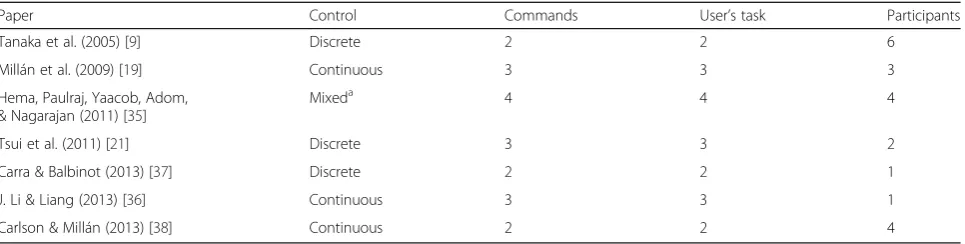
To summarize, the research carried out in relation to the control of a wheelchair through brain activity is lim-ited. From existing systems, those based on the discrim-ination of mental tasks offer more autonomy to subjects. All the studies related to those systems are included in Table 1. As we can see, these systems often associate a navigation command with a specific mental task, result-ing in systems that offer few navigation commands or
that require a high number of mental tasks to increase the number of commands. However, as suggested by several studies, increasing the number of mental tasks to be discriminated worsens the performance of a BCI sys-tem, as it is necessary to discriminate between only two mental tasks to minimize misclassification [22, 23], with the consequent problem that the number of navigation commands is reduced.
In order to provide several navigation commands with-out worsening the performance of the BCI system, the BCI group of the University of Málaga (UMA-BCI) has been working on a paradigm based on the discrimin-ation of only two mental tasks (a mental activdiscrimin-ation task versus another mental task), allowing the selection of four different navigation commands. This paradigm uses a serial auditory interface, so that subjects hear the avail-able commands and they use one task to select the com-mand, or the other task to let it go. The paradigm has been validated to navigate in virtual environments (VEs) [24, 25] and to control a real robot with continuous movement by providing four different navigation com-mands: move forward (F), move backward (B), turn right (R), and turn left (L), as well as providing the option of stopping [26].
The main objective of this work is to study whether the proposed paradigm is an effective option to control a BCW in all directions (very preliminary results have already been suggested [27]). The control of the wheel-chair will be carried out through the discrimination of the minimum number of mental tasks (i.e., two), helping the learning process and the interaction control. Both of these features are very important if we want to ensure the usability of the system and user safety. To achieve this objective, the subjects will undergo only three train-ing sessions. In this first phase of the study, the move-ments of the wheelchair will be discrete.
Method
Participants and data acquisition
consent before entering the study. All these subjects participated in an initial calibration session. In this session, a first test regarding the ability of subjects to control two mental tasks was performed. As a design criterion, a conventional limit of 30% in the classifica-tion error rate was considered to be the maximum that could allow efficient control of the paradigm; the same limit was used in [28] for efficient communica-tion using a two-class BCI for spelling. In a similar way, this study needed users to have acceptable trol of their SMRs, which would enable them to con-trol the BCW. Ten subjects were able to fulfill this criterion and continued with the experiment. As men-tioned, an error rate higher than 30% made the con-trol of the BCW very difficult, leading to a sensation of random behavior. Even when users could have im-proved their performance through training, the aim of our study was not to train subjects to control their SMR, but to test the use of the BCW with users already showing control of their EEG.
The EEG was recorded at a sample rate of 200Hz from two large Laplacian channels (for details see [29]) placed over the right and left sensorimotor areas using the elec-trode positions: C3, F3, P3, T7 and Cz for one Laplacian channel; and C4, F4, P4, T8 and Cz for the other, ac-cording to the 10/20 international system. The ground and reference electrodes were placed at positions AFz and Fz, respectively. Signals were amplified by an acti-CHamp amplifier (Brain Products GmbH, Munich, Germany). Neither online nor offline artifact detection techniques were employed.
Signal processing
As mentioned above, subjects participated in an initial training session (see Calibration Session) for calibration purposes. In this session, we recorded the EEG of each subject performing two mental tasks (80 trials for each task). With this data, an automatic process calculated, for each subject, a reactive frequency band and a classifi-cation error rate (detailed below). After processing it, we selected those subjects with classification error rates
under 30% and obtained the subject-dependent parameters for the next sessions with feedback. Data processing and feedback generation were based on the procedure detailed in [30]:
a) The reactive frequency band of each participant was automatically selected from all possible frequency intervals between 5 and 17 Hz (with a minimum bandwidth of 2 Hz). The search for the optimal frequency band was limited to theμband. Although in some cases it is possible to find subjects whose reactive band belongs to theβband, for simplicity we finally selected the 5–17 Hz band. For each tested frequency interval, feature extraction and classification were carried out, giving a frequency band-dependant error rate as a result. The band that led to the lowest classification error rate was regarded as the subject’s reactive frequency band.
b) The feature extraction consisted of estimating the average power of the signal from the two EEG channels in the specific frequency interval for each trial. This average was calculated by i) digitally band-pass filtering the EEG using a fifth-order Butterworth filter, ii) squaring each sample, and iii) averaging over several consecutive past samples. A total of 100 samples were averaged, giving an estimation of the band power for several intervals of 500 ms. c) The features from both channels for all trials were used to compute the error rate time course of a linear discriminant analysis (LDA) classifier [31] by means of a ten-times ten-fold cross-validation scheme. In this way we obtained the estimated minimum error rate of the classifier for power features from the given frequency band. d) Feedback generation: the previously selected frequency band and the obtained features were used to set up the LDA whose classification results determined the feedback ‘L’, which was used in the next sessions. This feedback was computed online every 31.25 ms. All data processing was carried out in MATLAB.
Table 1Endogenous brain-controlled wheelchair
Paper Control Commands User’s task Participants
Tanaka et al. (2005) [9] Discrete 2 2 6
Millán et al. (2009) [19] Continuous 3 3 3
Hema, Paulraj, Yaacob, Adom,
& Nagarajan (2011) [35]
Mixeda 4 4 4
Tsui et al. (2011) [21] Discrete 3 3 2
Carra & Balbinot (2013) [37] Discrete 2 2 1
J. Li & Liang (2013) [36] Continuous 3 3 1
Carlson & Millán (2013) [38] Continuous 2 2 4
a
Navigation application
As mentioned in the Introduction, the navigation para-digm was similar to the one used in our group’s previous publications [24–26]. In this study, one experimental session was carried out in a VE (control of a virtual wheelchair) and another in a real environment (control of a real wheelchair). The same paradigm was used for both virtual and real experimental sessions. In order to provide subjects with an asynchronous (or self-paced) system, the paradigm must produce outputs in response to intentional control as well as support periods of no control [32]; these are the so-called intentional control (IC) and non-control (NC) states, respectively. Both states are supported in the study presented in this paper: the system waits in an NC state in which an NC inter-face is shown (Fig. 1-left), which enables the subject to remain in the NC state (not generating any command) until he or she decides to change to the IC state, where the control is achieved through the IC interface (Fig. 1-right). The NC interface consists of a semi-transparent vertical blue bar placed in the center of the screen. The bar length is computed every 31.25 ms as a re-sult of the LDA classification: if the classifier determines that the mental task is right-hand MI, the bar extends; otherwise (the other class is idle or rest state) the bar length remains at its minimum size. In order to change from the NC to the IC state, the user must perform the MI task, and so extend the bar, for a certain subject-dependent“selection time”(around 1 s); during this time, the extension of the bar must be kept above a predefined “selection threshold”(70% of the maximum extension). If the length is temporarily (less than a“reset time”) lower than the selection threshold, the accumulated selection time is not reset, but otherwise it is set to zero. This tim-ing is similar for the IC state, but whereas in the NC state the consequence of a selection is a change of state, in the IC the consequence is a navigation action. The IC inter-face consists of a circle divided into four parts (named command sector onwards), which correspond to the pos-sible navigation commands (F, R, B, L), with a blue bar placed in the center of the circle, which is continuously rotating clockwise. The rotation speed was configurable, but most users fixed it so the bar took 15 s to complete a turn. The subject can extend the bar when carrying out
the MI task to select a command when the bar is pointing at it. Once a command is selected, the BCW (virtual or real depending on the experiment) performs a discrete movement: 1 m forward/backward displacement or 90° right/left turn.
The final aim is to control the BCW without visual cues; for this reason, subjects receive audio cues (in Spanish) that represent the situation of the bar in the interface while they interact with the system. One cue indicates the state change from IC to NC: they hear “waiting”. The reverse change is indicated by “forward”, since the forward command is the first available com-mand in the IC state. As mentioned above, once the subject reaches the IC, the bar starts rotating; every time the bar points to a different command, subjects can hear the corresponding word: “forward”, “right”, “backward”, or “left”. Additionally, we included beep sounds that were played when the bar had completed one third and two thirds of each quadrant, in order to inform the par-ticipant of the approximate situation of the selecting bar in the quadrant.
In the VE session, two simultaneous control interfaces were provided: visual and auditory. As mentioned before, the objective was to control a real BCW without using a GUI. So in this way, during the first run, users first trained with both interfaces in order to make the learn-ing process of the proposed paradigm easier. Then, in a second run, only the auditory interface was provided. After finishing both runs in the VE session, subjects par-ticipated in a second session to control the real BCW using only the auditory control interface.
Robotic wheelchair
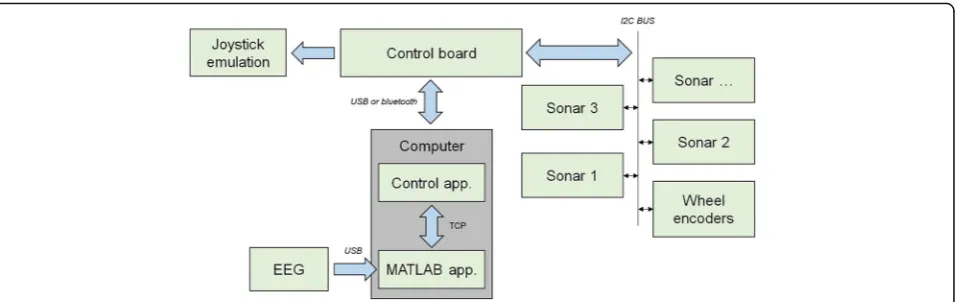
The BCW used consisted of a customized Invacare Mistral3 electric wheelchair (see Fig. 2) equipped with a custom-built control board (Control board) that emu-lated its analog two-axis joystick in real time and re-ceived multiple sensor information (Sonars, Wheel encoder) through an I2C bus (I2C BUS). This board was connected through a USB port to a control application (Control app.) written in C that ran on a laptop (Computer). This application received, via a TCP con-nection, the commands (e.g., move forward) issued by the navigation application running in a MATLAB
session, and then transformed them in real time into low-level commands that were fed back to the control board. A set of 11 SRF08 ultrasonic rangefinders (i.e., so-nars) allowed the creation of a real-time discrete grid map of the area surrounding the wheelchair, based on the likelihood that a small area near it was occupied. Specifically, when one of the sonars detected an obstacle at a given distance, all the grid cells within its detection cone were updated according to a sonar model, and, in turn, the grid map was also updated in real time. This made it possible to implement different low-level naviga-tion strategies for preventing collisions or for avoiding obstacles by moving along their edges. In this case, only obstacle detection was carried out: When the sensors detected that the center of the BCW was at a distance of 1 m from an obstacle, the system stopped the advance movement. Two AS5048 magnetic rotary encoders were attached to the wheelchair’s driving wheels in order to carry out the odometry and thus compute the wheel-chair’s heading at every moment. The application control made use of this information to correct small drifts both online and right after having performed a displacement. As in the case of the virtual BCW, a command selection involved a discrete movement: forward/backward dis-placement of 1 m or a 90° right/left turn. The BCW took around 10 s to advance 1 m and 15 s to complete a 90° turn (these values could vary slightly because of the mentioned drift corrections).
Procedure
The study involved a total of three sessions: i) an initial calibration session, ii) a navigation session in a VE, and finally iii) a navigation session in a real environment with the BCW (see Fig. 3). Both the calibration session and the virtual navigation were carried out in a room where the participant performed the experimental task alone, so that he or she would not be disturbed by exter-nal elements, sitting in an armchair in front of a
15.6-inch laptop screen. It should be added that to continue with the next session, subjects had to properly complete the required task in the current session.
Session 1: Calibration session
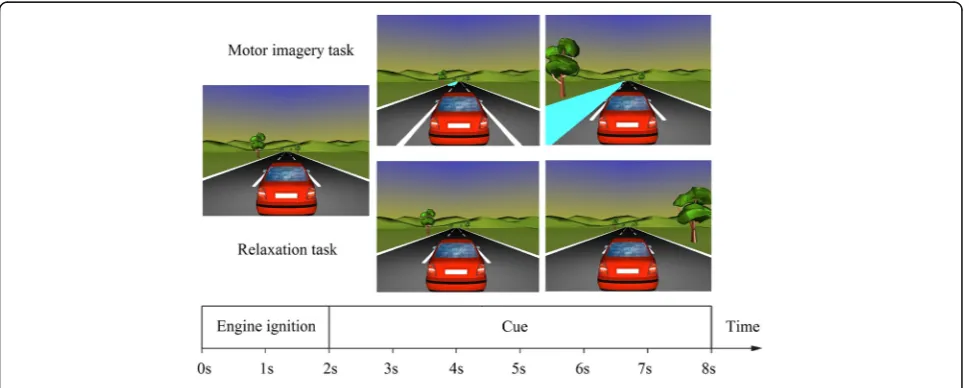
of the LDA classifier. We excluded those participants whose EEG data at this point could not be classified with an error rate of less than 30%. The virtual car environment was developed with VRML 2.0.
Session 2: Virtual navigation
In this session, after preparing the system and explaining to subjects what tasks they should carry out, a short re-calibration was performed with only two blocks of data from 40 trials. Differently from the calibration session, subjects received visual feedback on their MI or mental relaxation tasks through the movement of the car. With these data, subjects’ parameters were updated (keeping the same frequency band obtained in the previous ses-sion). In this feedback session, the trial paradigm was the same as the one used during the calibration session, except for the fact that now the water puddle occupied part of the middle lane. If the car did not avoid the pud-dle, a splash sound was heard. In this way we aimed to make this training phase more engaging.
After the recalibration and before starting the experi-mental task, subjects trained in controlling the virtual BCW freely for 5 to 10 min in order to adjust some subject-dependent paradigm parameters (such as the bar rotation speed, the selection time, or the ease of bar ex-tension) and thus adapt the interface to each user. As in
[26], the experimental trials consisted of two navigation tasks (also called runs) in a VE. Both tasks were the same, with the only difference being that the first had a visual and auditory interface while the second had only an auditory one. The participant saw a plane from a first-person perspective as though he or she were sitting in a virtual wheelchair (see Fig. 1). This wheelchair was at the beginning of a path that was demarcated by flower beds (see Fig. 5). Always using discrete commands (1 m advances and 90° turns), the first task consisted of driv-ing the virtual wheelchair from the startdriv-ing point to the goal (the end of the path shown in Fig. 5) using the au-diovisual interface. Using a red arrow on the ground, the system indicated which command the subject should se-lect. After the selection of a command, the IC interface always presented the bar pointing to the F command. As this training phase was not aimed at assessing user per-formance, incorrect commands were actually not issued to the virtual wheelchair. In those cases, only an buzzing sound indicating an error was heard and the IC interface was shown, allowing the subject to try again to select the correct command. Completion of the path needed a total of 17 commands: 13 advances, two left turns, and two right turns. This first task with the audiovisual inter-face was intended to train subjects in the use of the con-trol paradigm. In the second task, they could use only
the audio-cued interface, just as would be the case when controlling the real BCW later. The tasks were separated by a short break. At the end of the session, subjects an-swered a short usability test to evaluate their experiences of using the interface.
Session 3: Real navigation
Those participants who had completed the training schedule (sessions 1 and 2) attended on a third day to carry out two navigation tasks with the robotic wheel-chair. As in the virtual navigation session, a short recali-bration was performed before the navigation tasks. This session took place in a private and spacious room in our faculty. Using folding chairs, we demarcated a 2 m wide path that was similar to the one used in the VE, except that this path was 2 m shorter so it could be completed with 11 advances and four turns (see Fig. 6). Its dimen-sions were adapted to the fixed-magnitude displacements that the wheelchair could perform, that is, 1-m forward/ backward movements and 90° turns. If a collision was de-tected, the control application played the mentioned buzz-ing sound and if the command issued had been a turn, the system moved the wheelchair back to its previous pos-ition. As in the virtual navigation session, subjects could train for around 5 min in controlling the real BCW so that their interface parameters could be adjusted. As in session 2, the experimental trial consisted of two navigation tasks. In the first task, subjects were asked to drive the real wheelchair from the starting point to the goal. Obviously, only the audio-cued interface was used. The second task consisted of returning along the same path to the starting point. As the participant ended the first task by returning to that point, in order to perform the second task it was necessary to make a U-turn at the beginning of it. Differ-ently from the previous virtual session, in this case there were no indications of the proposed commands, and in-correct selections involved a movement of the BCW that
users had to amend afterwards. Another difference from the virtual session lay in the fact that after the selection of a command, the bar did not restart from the first com-mand but continued its rotation from the same point at which it had stopped when the command was selected.
Evaluation metrics and usability tests
Referring to the performance metrics in navigation, in order to accurately assess the performance of users in the management of the BCW, confusion matrix metrics are used (see Eqs. 1–5) as proposed in Mason et al. for self-paced BCIs [33]. In our interface, these parameters Fig. 5Path to be followed in the virtual environment. Each dot represents one different position where the BCW passes by. Every time the user reaches a new spot, he/she would have to select a new command to continue the path
are related to when the bar passes through a command sector: it will be categorized as one of the possibilities of the confusion matrix (i.e. true selection, false selection, true non-selection, or false non-selection), depending on the user's intent and what actually happens. The following metrics are used:
i) Recall (see Eq.1) indicates the user’s ability to select the desired command.
ii) Specificity (see Eq.2) indicates the user’s ability to avoid unwanted commands.
iii) Precision (see Eq.3) indicates which of the user’s selections are correct.
iv) Negative Predictive Value (NPV) (see Eq.4) indicates which of the users’non-selections are correct. v) Accuracy (see Eq.5) shows the level of overall
performance.
Recall¼ X
True selection X
Selection desired ð1Þ
Specificity¼ X
True non−selection X
Non−selection desired ð2Þ
Precision¼ X
True selection X
Actual selection ð3Þ
Negative Predictive Value¼ X
True non−selection X
Actual non−selection ð4Þ
Accuracy¼
X
True selectionþXTrue non−selection
X
All conditions ð5Þ
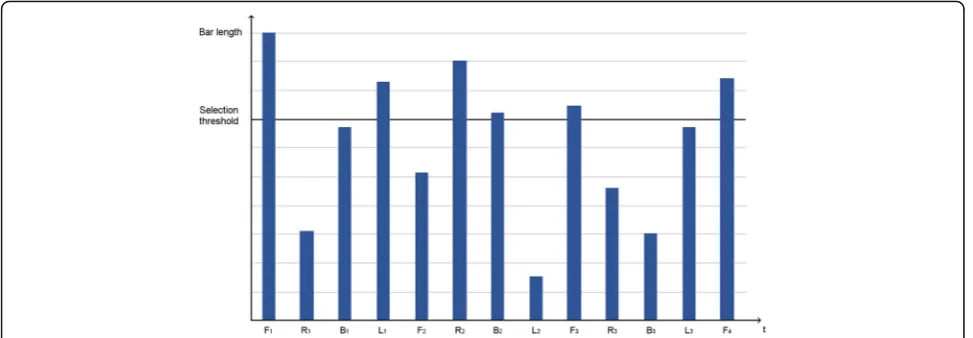
An illustrative example of a sequence of selections is shown in Fig. 7. The x-axis indicates the time elapsed,
which in our interface means the rotation of the bar passing through each of the command sectors (F, R, B, L). The y-axis indicates the maximum length of the bar during its passage through the corresponding command sector. In this figure, a bar length over the selection threshold indicates a command selection. In this ex-ample, the user wants to follow a straight path, which would need two F commands. The first forward com-mand is F1 and the second is F4. Between these two commands, other commands are selected. In fact, this user made two mistakes (L1 and B2) and then corrected them (R2 and F3 for L1 and B2 respectively). In this se-quence of commands, the number of true selections was four (F1, R2, F3, and F4), while we found two false selec-tions (L1 and B2), zero false non-selecselec-tions, and seven true non-selections. This evaluation would lead to the following results: i) Recall equal to 1 (4/4) since the user was able to select all commands that he or she wanted; ii) Specificity equal to .78 (7/9), as out of nine commands that the user did not want to select, he or she did not select seven; iii) Precision equal to .67 (4/6), as four of the six selected commands were desired; and iv) NPV equal to 1 (7/7), since all seven non-selections were desired.
In the virtual navigation task, where the first available command is always Forward command, the percentage of failure for each command and user has been calcu-lated as follow (Eq.6):
Failureð Þ ¼% Fx Rx
100 ð6Þ
where Fx is the number of failures for a specific x
com-mand, and Rx the total number of times that the
men-tionedxcommand was required.
Regarding the usability tests, two ad hoc usability tests were designed to evaluate the user experience after
navigation sessions (virtual and real). Subjects were asked to evaluate, on a Likert scale of 1 to 5, the follow-ing different factors: i) how useful they found the control interface; ii) whether they managed to remain relaxed; iii) whether they felt frustration during the navigation; and iv) how tired they felt at the end of the session. Fur-thermore, they evaluated the overall interface and the use of the beep sounds. These latter metric was evalu-ated from 1 in the case of being very detrimental to the performance up to 5 in the case of being very useful. It should be noted that only participants A1–A12 took part in these tests.
Results
Calibration session
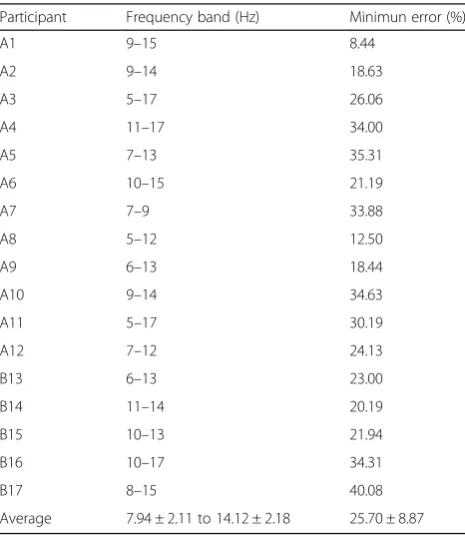
The most reactive band power features and the mini-mum error rate obtained for each subject are presented in Table 2. On average, the minimum error rate was 25.70% (±8.87). Of the seventeen subjects, seven (A4, A5, A7, A10, A11, B16, and B17) had error rates above the cutoff point of 30% and were removed.
Virtual navigation
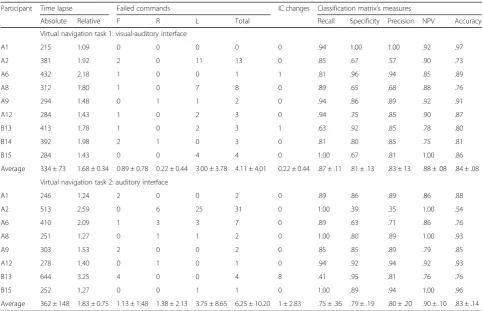
In Table 3, the values of different parameters obtained in the virtual navigation session for each subject are shown. The analyzed parameters are: the absolute and relative time taken to complete the path, the total number of fails to select the desired command and divided for each type (F, R, L), the number of times that the NC interface was activated (IC changes), and the different measures
obtained for each parameter of the confusion matrix (Recall, Specificity, Precision, NPV, and Accuracy). Participant A3 could not complete any of the tasks, and participant B14 could not complete the second task. Fur-thermore, thanks to equation 6 referring to the difficulty of the users to select each command, the following aver-age values for failure command (Failure (%)) have been obtained: F: 6.58 ± 4.37; R: 20.32 ± 20.38; L: 37.97 ± 29.82. According to these values repeated measures ana-lysis of variance shown significant differences between commands (F (2, 16) = 6.538;p= .008), where the L com-mand was the most difficult for the users to select.
A bivariate correlation analysis through Pearson’s coef-ficient makes it possible to determine which parameter of the confusion matrix is related to the time required (Relative time) to complete the path. Significant correla-tions were obtained for the parameters Recall (r=−.727;
p= .026) and Accuracy (r=−.81;p= .008) but not for the other parameters, that is, Precision (r=−.561; p= .116), NPV (r=−.513; p= .158), and Specificity (r=−.237;
p= .539).
Real navigation
All the obtained parameters in the real navigation ses-sion are shown in Table 4. This table is similar to Table 3, except for the command parameters. Table 3 shows the number of fails to select the desired commands for each type, whereas Table 4 shows the total number of times that a specific command was selected, and how many of these commands were correctly selected by the user (Correct) or incorrectly selected (Incorrect). In this session, all the participants completed the first task. Because the duration of the session was limited, subjects A8 and A9 did not participate in the second task, mainly due to the excessive time they took to complete the first task (1111 and 1094 s respectively).
As in the virtual navigation session, we proceeded to analyze the relationship between the Relative time and the different metrics obtained from the confusion matrix. In this case, significant correlations were obtained for Recall (r=−.829; p= .006), Precision (r=
−.685; p= .042), NPV (r=−.926; p< .001), and Accur-acy (r=−.826; p= .006) but not Specificity (r=−.278;
p= .469).
Usability tests
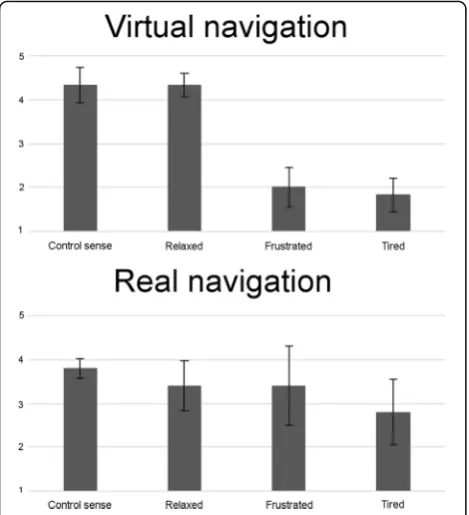
The different mean values obtained in the usability tests are shown in Fig. 8. Besides, mean scores of 4.57 ± 0.53 and 4.5 ± 0.55 in the overall assessment of the interface were obtained for virtual and real sessions respectively. Regarding the utility of beep sounds presented at the command interval, the mean scores were 4.57 ± 0.79 and 4.4 ± 0.89 for the virtual and real sessions respectively. Finally, subjects were also asked for the need to display Table 2Results of the calibration session
Participant Frequency band (Hz) Minimun error (%)
A1 9–15 8.44
A2 9–14 18.63
A3 5–17 26.06
A4 11–17 34.00
A5 7–13 35.31
A6 10–15 21.19
A7 7–9 33.88
A8 5–12 12.50
A9 6–13 18.44
A10 9–14 34.63
A11 5–17 30.19
A12 7–12 24.13
B13 6–13 23.00
B14 11–14 20.19
B15 10–13 21.94
B16 10–17 34.31
B17 8–15 40.08
the bar extension in the virtual session, and the mean value obtained was 3.57 ± 0.79.
An interesting analysis is to determine a possible rela-tionship between these usability metrics and the different parameters of the confusion matrix. To this end, a correl-ation analysis through the Spearman correlcorrel-ation coeffi-cient was performed. In the virtual navigation session, a significant correlation between the sense of control and different parameters of the confusion matrix was obtained: Specificity (ρ=−.878; p= .021), Precision (ρ=−.878; p
= .021), and Accuracy (ρ=−.878;p= .021). Regarding the real navigation session, a correlation was found only be-tween the feeling of tiredness (tired) and the Recall par-ameter (ρ=−.82; p = .046). It is noteworthy that these tests were only carried out by participants who success-fully completed at least one task of the corresponding navigation session, that is, those shown in Tables 3 and 4.
Discussion
Due to the specific paradigms presented by the BCWs shown in Table 1, it is difficult to make an accurate comparison between them and the results obtained in the present work. In addition, these studies should have the same participant experience level, tasks and metrics
to allow a direct comparison between them as it has been manifested in previous reviews [14, 34].
In spite of this difficulty to compare the obtained re-sults with those obtained in previous works, it is import-ant to mention some differences. From those studies based on the discrimination of mental tasks for controlling a wheelchair, only one provides 4 navigation commands [35] (move forward, turn left, turn right and stop) however, each command is associated to a specific motor imagery task, being necessary to discriminate between four different mental tasks. In [19, 21, 36] three mental tasks are discrimi-nated in order to execute three different commands (move forward, turn left and turn right [19, 36] or turn left, turn right and stop [21]). Finally, in [9, 37, 38], the discrimin-ation between two mental tasks provide only two different commands (turn left and turn right [9, 38] or turn right and move forward [37]). Our proposed BCI is the only one which offers the command move backward in addition to the commands move forward, turn left, turn right and stop. As we can check in Table 1, the number of partici-pants for controlling the different BCWs is very reduced (6 [9], 4 [35, 38], 3 [19], 2 [21] and 1 [36, 37]), being the vast majority of them participants with previous experi-ence in BCI (only one participant had no previous Table 3Results of the users’performance in the virtual navigation session
Participant Time lapse Failed commands IC changes Classification matrix’s measures
Absolute Relative F R L Total Recall Specificity Precision NPV Accuracy
Virtual navigation task 1: visual-auditory interface
A1 215 1.09 0 0 0 0 0 .94 1.00 1.00 .92 .97
A2 381 1.92 2 0 11 13 0 .85 .67 .57 .90 .73
A6 432 2.18 1 0 0 1 1 .81 .96 .94 .85 .89
A8 312 1.80 1 0 7 8 0 .89 .65 .68 .88 .76
A9 294 1.48 0 1 1 2 0 .94 .86 .89 .92 .91
A12 284 1.43 1 0 2 3 0 .94 .75 .85 .90 .87
B13 413 1.78 1 0 2 3 1 .63 .92 .85 .78 .80
B14 392 1.98 2 1 0 3 0 .81 .80 .85 .75 .81
B15 284 1.43 0 0 4 4 0 1.00 .67 .81 1.00 .86
Average 334 ± 73 1.68 ± 0.34 0.89 ± 0.78 0.22 ± 0.44 3.00 ± 3.78 4.11 ± 4.01 0.22 ± 0.44 .87 ± .11 .81 ± .13 .83 ± 13 .88 ± .08 .84 ± .08
Virtual navigation task 2: auditory interface
A1 246 1.24 2 0 0 2 0 .89 .86 .89 .86 .88
A2 513 2.59 0 6 25 31 0 1.00 .39 .35 1.00 .54
A6 410 2.09 1 3 3 7 0 .89 .63 .71 .86 .76
A8 251 1.27 0 1 1 2 0 1.00 .80 .89 1.00 .93
A9 303 1.53 2 0 0 2 0 .85 .85 .89 .79 .85
A12 278 1.40 0 1 0 1 0 .94 .92 .94 .92 .93
B13 644 3.25 4 0 0 4 8 .41 .95 .81 .76 .76
B15 252 1.27 0 0 1 1 0 1.00 .89 .94 1.00 .96
Average 362 ± 148 1.83 ± 0.75 1.13 ± 1.48 1.38 ± 2.13 3.75 ± 8.65 6.25 ± 10.20 1 ± 2.83 .75 ± .36 .79 ± .19 .80 ± .20 .90 ± .10 .83 ± .14
experience in BCI [19], and no information is provided regarding the subjects’ experience in [9]). In our study, 17 subjects were initially involved and only one had pre-vious experience in BCI. Out of the 17 users who partic-ipated, 10 passed the first training session, obtaining a classification error under the established criterion of 30%. As we can see in Table 2, for these 10 subjects, the minimum error rate ranged from 8.44% (A1) to 26.06% (A3). All these subjects, except for subject A3, were able to control the proposed BCW, being this number of par-ticipants much higher than other studies. The fact that subject A3 could not complete any task in the virtual session could suggest that, in order to guarantee the ability to control the BCW, the criterion of achieving a classification error rate of 30% during the calibration session should be reduced to 25%. Once this error rate is obtained, a subject will have high probability of con-trolling the proposed BCW. Next, the obtained results shown in the previous section will be discussed.
Virtual navigation
As can be observed in Table 3, the obtained results are very positive, with an average Accuracy of above .80 in both tasks (.84 ± .08 and .83 ± .14 for tasks 1 and 2 re-spectively). The success in the execution of the path in both tasks shows the effectiveness of the proposed train-ing paradigm: not only did the paradigm seem a good option for helping subjects learn to control the interface
but also they seemed to be able to manage the system using only the audio interface.
Regarding the time needed to carry out the task, only some users required a Relative time close to or above 2 to complete the path: A2 (1.92), A6 (2.18), A8 (1.80), B13 (1.78), and B14 (1.98) in task1 and A2 (2.59), A6 (2.09), and B13 (3.25) in task 2. Except for subject B14, subjects with these values of Relative time were those who had to select the interface control more than once (IC > 1) or made many incorrect command selections (Total > 5). In some ways, these results (i.e., the ability to execute the task) are closely related to the different con-fusion matrix measures.
It might be considered that a high ability in selecting the desired command (i.e., Recall = 1) would be sufficient to assure a good ability to execute the task; however, to achieve good control, the Precision parameter must be high too. In Table 3, those subjects with Recall = 1 are B15 in task 1 and A2, A8, and B15 in task 2. Of these subjects, only the one with low Precision had a high Relative time value (i.e., subject A2 with Precision = .35). Indeed, a low value of Precision is obtained when the system (i.e., the user) sensitivity to select commands is too high (when it is easier to select a command) and therefore the number of unwanted selections is in-creased (31 for subject A2). On the other hand, a low value of Recall is obtained when a subject has great diffi-culty in selecting a desired command. In this case, the bar might make a complete turn without any command being selected and causing an IC change. In Table 3, subjects with IC > 1 are those with the lowest Recall values: A6 (Recall = .81, IC = 1) and B13 (Recall = .63, IC = 1) in task 1 and B13 (Recall = .41, IC = 8) in task 2.
While the Recall and Precision parameters are related to the desired command selections, the NPV and Speci-ficity parameters are related to the desired command non-selections. A value of NPV = 1 means that the total number of non-selected commands was equal to the number of desired non-selections. Therefore, a high value of NPV could be considered as a good control; however, to this end, a high value of Specificity is also required. A small value of Specificity, that is, less than .5, indicates that from the total number of commands that should not be selected, less than half were finally not selected and thus more than half produced failed commands (incorrect selections). These small values of Specificity are obtained when a command is easily selected by the system (i.e., when the bar is easily ex-tended). To avoid this, it is very important to correctly adjust all the parameters related to the bar extension. However, this is not always an easy task, being closely related to the control capacity of the subject. In Table 3, those subjects with NPV = 1 were B15 in task 1 and A2, A8, and B15 in task 2. Of these subjects, only A2 Fig. 8Results in the usability tests. Average values obtained for each
obtained a Relative time close to 2 (2.59), which is ex-plained by his or her low value of Specificity (.39). Although this subject did not fail to select any F mands, he or she failed to select 6 R and 25 L com-mands. It should be noted that in the virtual session the bar always started in the F command position so the user could select it easily. However, taking into account the distribution of commands, to select the L command, three previous commands had to be avoided (F, R, and B), and this task was difficult for subjects with low values of Specificity. As can be observed in Table 3, those subjects with smaller values of Specificity were those with higher rates of failure to select desired commands (total): A2 (Specificity = .67, total = 13), A8 (Specificity = .65, total = 8), and B15 (Specificity = .67, total = 4) in task 1 and A2 (Specificity = .39, total = 31) and A6 (Specificity = .63, total = 7) in task 2. On the contrary, the only subject with Specificity = 1 was the only one who did not fail to select any desired com-mand (A1 in task 1).
These facts about the time taken to complete the path are confirmed by the observed correlations between the Relative time and the metrics of the confusion matrix, where greater negative significant correlations of Accur-acy (r=−.81; p= .008) and Recall (r=−.727; p= .026) were found. With regard to Accuracy, this was expect-able as it is the general metric of the performance classi-fication. However, thanks to the strong relationship between Recall and time, and not between time and other measures used, it seems that for a faster execution of the path, it is suitable that the interface has a good detection of the desired commands, although this could involve some wrong selections.
Real navigation
It must be mentioned that, as explained in Procedure, the experiments carried out in session 2 (virtual naviga-tion) and session 3 (real naviganaviga-tion) had significant dif-ferences, so the results obtained are not comparable. Not only the length of paths but also the interface para-digms were different. For example, in the virtual session, once a command was selected, the bar position was automatically situated at the F command; however, in the real session, it continued its rotation from the same position. Another important difference is the fact that in the virtual session wrong commands did not execute any movement. Anyway, the purpose of the virtual ses-sion was always to act as a training sesses-sion. As can be observed in Table 4, the results show the good perform-ance obtained by the subjects, with the average values of Accuracy being .84 ± .09 and .85 ± .07 for tasks 1 and 2, respectively. In fact, these average values of accuracy was higher than those obtained in other BCW studies which use discrete commands (80% in [9] and 65.7% in
[37]). Although all the subjects achieved high perfor-mances on Accuracy (between .72 and 1), regarding the times needed to complete the task, the results were more heterogeneous. Indeed, while some users needed less than 4 min to complete the task, others spent more than 15 min, depending on their initial ability to control their mental activity.
In this real session, subjects with Relative time values close to or above 2 were those with IC > 1: A2 (Relative time = 1.77, IC = 2), A8 (Relative time = 2.88, IC = 5), A9 (Relative time = 2.8, IC = 1), and B15 (Relative time = 1.94, IC = 3) in task 1 and A2 (Relative time = 1.96, IC = 2) and A12 (Relative time = 2.0, IC = 2) in task 2. Once again, IC values >1 are closely related to low Recall values (subjects A2, A8, A9, and B15 are those with the lowest Recall values in task 1 while subjects A2 and A12 are those with the lowest Recall values in task 2). Like-wise, subjects with the lowest Precision values are those with the highest number of incorrect commands (Incorrect > 6): A6 (Incorrect = 8, Precision = .71), A9 (Incorrect = 15, Precision = .64), and B15 (Incorrect = 9, Precision = .73) in task 1 and A2 (Incorrect = 13, Precision = .55) and A12 (Incorrect = 9, Precision = .74) in task 2. As mentioned in the previous sub-section (Virtual navigation), incorrect selection of commands is also in concordance with the Specificity parameter. It can be observed in Table 4 that the subjects with the lowest number of Incorrect commands Specificity are those with the highest Specificity values: A1 (Incorrect = 0, Specificity = 1), A8 (Incorrect = 4, Speci-ficity = .95), B13 (Incorrect = 1, SpeciSpeci-ficity = .95), and B14 (Incorrect = 1, Specificity = .95) in task 1 and B13 (Incorrect = 2, Specificity = .95) and B14 (Incorrect = 1, Specificity = .95) in task 2.
selecting the desired command, which caused many IC changes (five) and increased the time taken. On the other hand, his or her high value of Specificity (.95) shows his or her ability to avoid selecting un-desired commands. In fact, these values correspond to an unbalanced system whose selection parameters were difficult to adjust.
Regarding the correlations observed between the Rela-tive time taken to complete the path and the metrics of the confusion matrix, larger negative correlations was found for NPV (r=−.926;p< .001) and Recall (r=−.829;
p= .006). These metrics take into account the number of false non-selections, that is, those cases where the user wants to select a command and does not and therefore has to wait for the bar to complete another turn before selecting it, increasing the time taken considerably. On the other hand, it is remarkable to note the low non-significant correlation between the Relative time and Specificity, which, as in the virtual navigation session, could indicate that it would be more efficient to sacrifice part of the Specificity in order to improve the Recall and thus the time taken to complete the path. As a conse-quence, the user would lose the ability to avoid selecting unwanted commands but could select the desired commands easily, including both the initially desired command and the corrective command if necessary. Despite being more efficient in terms of time, it is noteworthy that this configuration is not the best tak-ing into account the movements made by the BCW or the user experience.
Usability tests
In the virtual navigation session, most users expressed a good control sense, and low levels of frustration and tiredness (see Fig. 8). In the real navigation session, simi-lar scores were obtained excepted for the parameters “frustrated” and “tired”. For these factors, a larger vari-ability was obtained, with subjects A6 and A9 reporting the maximum frustration scores. These results are in ac-cordance with the fact that the virtual and real naviga-tion tasks were different. Indeed, in the virtual session, wrong commands were not executed by the system and thus subjects did not have to correct them, making it easier to use compared to the real navigation session.
By analyzing the correlations, it can be seen that the users’Control Sense levels in the virtual navigation session are related to the general performance of the classification through the significant correlation with the Accuracy and the amount of unwanted commands selected, that is, the number of errors made in the selection of incorrect commands, through the significant correlations with the Specificity and Precision. However, in the real navigation tasks, it was possible to observe a significant relation be-tween the feeling of tiredness and the percentage of
incorrect command selections, through the negative sig-nificant correlation with the Recall.
Conclusions
A brain-controlled wheelchair has been developed. In order to provide several navigation commands without worsening the performance, a paradigm based on the discrimination of only two mental tasks has been proposed. The obtained results with healthy subjects demonstrate that this BCW al-lows them to freely control the wheelchair in four direc-tions and to do so efficiently with only three training sessions. Although the times needed to complete the task were heterogeneous, all the subjects achieved high per-formance in terms of Accuracy (between .72 and 1).
We observed that subjects who finally successfully controlled the wheelchair were those who initially had adequate initial control of their SMRs in the calibration session (minimum error rate < 25%). However, it is men-tioned in some studies that the ability to modulate the SMR can be acquired by users through training (e.g. [15, 39]). In this sense, with more training sessions, not only would better BCW performance be achieved, but also the number of subjects who could control the wheelchair would increase.
Compared with other BCWs, the control strategy pro-posed in this study seems to allow efficient control of the wheelchair without requiring long training or large mental effort. Besides, because the system is achieved by discriminating only two mental tasks, misclassification is minimized, which is very important in order to guaran-tee the usability of the system and the user’s safety.
Future work will focus on training users with low ini-tial performance over several sessions until they achieve good control of the wheelchair. Another important ob-jective will be to evaluate the performance of the system with continuous movement.
Thanks to the metrics displayed in the confusion matrix about the performance of the user controlling a BCW, new ways of adjusting the user parameters of our control interface (i.e. the facility to extend the bar or the time needed to maintain the bar above the selection threshold) have been identified in order to make the BCW an efficient proposal with dynamic and efficient management.
Abbreviations
BCI:Brain-computer interface; BCW: Brain-controlled wheelchair;
EEG: Electroencephalogram; IC: Intentional control; LDA: Linear discriminant analysis; MI: Motor imagery; NC: Non-control; NPV: Negative Predictive Value; SMR: Sensorimotor rhythm; VE: Virtual environment
Funding
Availability of data and materials
The datasets used and/or analysed during the current study are available from the corresponding author on reasonable request.
Authors’contributions
RRA led the research, participated in the design of the BCW prototype and the virtual environments, and contributed in the experimental design and in the critical revision of the manuscript. FVA developed the BCW prototype and the virtual environments, participated in the experimental sessions and was a major contributor in drafting the work. AFR carried out the experimental sessions, collaborated in the experimental design, performed the statistical analysis and was a major contributor in writing the manuscript. ADE was a major contributor in the experimental design. MJBM was responsible for the experimental design and collaborated in the statistical analysis. FJVM collaborated in the development of the BCW prototype. All authors contributed in the research design and read and approved the final manuscript.
Competing interests
The authors declare that they have no competing interests.
Ethics approval and consent to participate
The study was approved by the Ethics Committee of the University of Malaga (CEUMA: 41-2016-H). All participants provided written informed consent.
Publisher’s Note
Springer Nature remains neutral with regard to jurisdictional claims in published maps and institutional affiliations.
Author details 1
Department of Electronic Technology, University of Málaga, 29071 Málaga,
Spain.2Department of Psychobiology and Methodology of Behavioral
Sciences, University of Málaga, 29071 Málaga, Spain.
Received: 9 August 2016 Accepted: 22 May 2017
References
1. Patterson JR, Grabois M. Locked-in syndrome: a review of 139 cases. Stroke. 1986;17(4):758.
2. Wolpaw J, Birbaumer N, McFarland DJ, Pfurtscheller G, Vaughan TM. Brain Computer Interfaces for communication and control. Clin Neurophysiol. 2002;113:767–91.
3. Farwell LA, Donchin E. Talking off the top of your head: toward a mental prosthesis utilizing event-related brain potentials. Electroencephalogr Clin Neurophysiol. 1988;70(6):510–23.
4. Hochberg LR, Bacher D, Jarosiewicz B, Masse NY, Simeral JD, Vogel J, et al. Reach and grasp by people with tetraplegia using a neurally controlled robotic arm. Nature. 2012;485(7398):372–5. Available from: http://www. nature.com/nature/journal/v485/n7398/full/nature11076.html. 5. Corralejo R, Hornero R, Álvarez D. A domotic control system using
Brain-Computer Interface (BCI). 2011. 345–352 p. (Lecture Notes in Computer Science (including subseries Lecture Notes in Artificial Intelligence and Lecture Notes in Bioinformatics); vol. 6691 LNCS).
6. Leeb R, Tonin L, Rohm M, Desideri L, Carlson T, Millán JDR. Towards Independence: A BCI Telepresence Robot for People With Severe Motor Disabilities. Vol. 103, Proceedings of the IEEE. 2015. p. 1–14.
7. Millán JDR, Rupp R, Müller-Putz GR, Murray-Smith R, Giugliemma C, Tangermann M, et al. Combining brain-computer interfaces and assistive technologies: State-of-the-art and challenges. Front Neurosci. 2010;4(SEP):1– 15. Available from: http://journal.frontiersin.org/article/10.3389/fnins.2010. 00161/abstract.
8. Millán JDR, Renkens F, Mouriño J, Gerstner W. Noninvasive brain-actuated control of a mobile robot by human EEG. IEEE Trans Biomed Eng. 2004;51(6): 1026–33. Available from: http://www.ncbi.nlm.nih.gov/pubmed/15188874 9. Tanaka K, Matsunaga K, Wang HO. Electroencephalogram-based control of
an electric wheelchair. IEEE Trans Robot. 2005;21(4):762–6.
10. Rebsamen B, Guan C, Zhang H, Wang C, Teo Jr C, Ang MH, et al. A brain controlled wheelchair to navigate in familiar environments. IEEE Trans Neural Syst Rehabil Eng. 2010;18(6):590–8.
11. Iturrate I, Antelis J, Minguez J. Synchronous EEG brain-actuated wheelchair with automated navigation. In: Robotics and Automation, 2009 ICRA‘09 IEEE International Conference on. 2009. p. 2318–25.
12. Müller SMT, Bastos TF, Filho MS. Using a SSVEP-BCI to command a robotic wheelchair. J Control Autom Electr Syst. 2011;24(1–2):97–105. Available from: http://ieeexplore.ieee.org/xpls/abs_all.jsp?arnumber=5984288.
13. Xu Z, Li J, Gu R, Xia B. Steady-State Visually Evoked Potential (SSVEP)-Based Brain-Computer Interface (BCI): a low-delayed asynchronous wheelchair control system. In: Neural Information Processing 2012, Pt I, vol. 7663. 2012. p. 305–14. doi:10.1007/978-3-642-34475-6_37.
14. Bi L, Fan X-A, Liu Y. EEG-Based Brain-Controlled mobile robots: a survey. IEEE Trans Human-Machine Syst. 2013;43(2):161–76. Available from: http:// ieeexplore.ieee.org/lpdocs/epic03/wrapper.htm?arnumber=6461528. 15. Pfurtscheller G, Neuper C. Motor imagery and direct brain-computer
communication. Proc IEEE. 2001;89(7):1123–34.
16. Nicolas-Alonso LF, Gomez-Gil J. Brain Computer Interfaces, a review. Sensors. 2012; 12(12):1211–79. Available from: http://www.mdpi.com/1424-8220/12/2/1211/. 17. Choi K. Control of a vehicle with EEG signals in real-time and system
evaluation. Eur J Appl Physiol. 2012;112(2):755–66. Available from: http:// www.ncbi.nlm.nih.gov/pubmed/21667185
18. Long J, Li Y, Wang H, Yu T, Pan J, Li F. A hybrid Brain Computer Interface to control the direction and speed of a simulated or real wheelchair. Neural Syst Rehabil Eng IEEE Trans. 2012;20(5):720–9.
19. Millán JDR, Galán F, Vanhooydonck D, Lew E, Philips J, Nuttin M. Asynchronous non-invasive brain-actuated control of an intelligent wheelchair. Proc 31st Annu Int Conf IEEE Eng Med Biol Soc Eng Futur Biomed EMBC 2009. 2009; 2009:3361–4. Available from: http://www.ncbi.nlm.nih.gov/pubmed/19963794 20. Li Y, Pan J, Wang F, Yu Z. A hybrid BCI system combining P300 and SSVEP
and its application to wheelchair control. IEEE Trans Biomed Eng. 2013; 60(11):3156–66.
21. Tsui CSL, Gan JQ, Hu H. A self-paced motor imagery based Brain-Computer Interface for robotic wheelchair control. Clin EEG Neurosci. 2011;42(4):225–9. 22. Kronegg J, Chanel G, Voloshynovskiy S, Pun T. Eeg-based synchronized
brain-computer interfaces: a model for optimizing the number of mental tasks. IEEE Trans Neural Syst Rehabil Eng. 2007;15(1):50–8.
23. Obermaier B, Neuper C, Guger C, Pfurtscheller G. Information Transfer Rate in a Five-Classes Brain–Computer Interface. IEEE Trans Neural Syst Rehabil Eng. 2001;9(3):283–8.
24. Ron-Angevin R, Díaz-Estrella A, Velasco-Álvarez F. A two-class brain computer interface to freely navigate through virtual worlds. Biomed Tech. 2009;54(3):126–33. 25. Velasco-Álvarez F, Ron-Angevin R, Blanca-Mena MJ. Free virtual navigation
using motor imagery through an asynchronous Brain–Computer Interface. Presence Teleoperators Virtual Environ. 2010;19(1):71–81.
26. Velasco-Álvarez F, Ron-Angevin R, da Silva-Sauer L, Sancha-Ros S. Audio-cued motor imagery-based brain-computer interface: navigation through virtual and real environments. Neurocomputing. 2013;121:89–98.
27. Varona-Moya S, Velasco-Álvarez F, Sancha-Ros S, Fernández-Rodríguez Á, Blanca MJ, Ron-Angevin R. Wheelchair navigation with an audio-cued, two-class motor imagery-based Brain–Computer Interface system. In: 2015 7th International IEEE/EMBS Conference on Neural Engineering (NER). IEEE. 2015. p. 174–7.
28. Kübler A, Neumann N, Kaiser J, Kotchoubey B, Hinterberger T, Birbaumer NP. Brain-computer communication: self-regulation of slow cortical potentials for verbal communication. Arch Phys Med Rehabil. 2001;82(11):1533–9. 29. McFarland DJ, McCane LM, David SV, Wolpaw JR. Spatial filter selection for
EEG-based communication. Electroencephalogr Clin Neurophysiol. 1997; 103(3):386–94. Available from: http://linkinghub.elsevier.com/retrieve/pii/ S0013469497000222.
30. Ron-Angevin R, Díaz-Estrella A. Brain-computer interface: changes in performance using virtual reality techniques. Neurosci Lett. 2009;449(2):123–7.
31. Bishop CM. Neural networks for pattern recognition. New York: Oxford University Press; 1995. p. 482.
32. Schögl A, Kronegg J, Huggins JE, Mason SG. Evaluation criteria for BCI research. Towar Brain-Computer Interfacing. 2007. p. 327–42.
33. Mason S, Kronegg J, Huggins J, Fatourechi M, Schlögl A. Evaluating the performance of self-paced brain-computer interface technology. Tech Rep. 2006;0:1–60. Available from: http://ipl.ece.ubc.ca/bci_files/self_paced_tech_ report-2006-05-19.pdf.
35. Hema CR, Paulraj MP, Yaacob S, Adom AH, Nagarajan R. Asynchronous Brain Machine Interface-Based Control of a Wheelchair. In: Arabnia HR, Tran Q-N, editors. Software Tools and Algorithms for Biological Systems. Springer; 2011. p. 565–72. Available from: http://link.springer.com/chapter/10.1007/ 978-1-4419-7046-6_57/fulltext.html.
36. Li J, Liang J. Design of assistive wheelchair system directly steered by human thoughts. Int J Neural Syst. 2013;23(3):1–12.
37. Carra M, Balbinot A. Evaluation of sensorimotor rhythms to control a wheelchair. In: Biosignals and Biorobotics Conference (BRC), 2013 ISSNIP. 2013. p. 1–4. 38. Carlson T, Millán JDR. Brain-controlled wheelchairs: a robotic architecture.
IEEE Robot Autom Mag. 2013;20(1):65–73.
39. Vidaurre C, Blankertz B. Towards a cure for BCI illiteracy. Brain Topogr. 2010; 23(2):194–8.
• We accept pre-submission inquiries
• Our selector tool helps you to find the most relevant journal • We provide round the clock customer support
• Convenient online submission • Thorough peer review
• Inclusion in PubMed and all major indexing services • Maximum visibility for your research
Submit your manuscript at www.biomedcentral.com/submit