i/.
SELENIUM CONCENTRATIONS IN FORAGE ON
SOME HIGH NORTHWESTERN RANGES
D. L. CARTER, C. W. ROBBINS, AND M. J. BROWN
Made in United Stales of America
Reprinted from JOURNAL OF RANGE MANAGEMENT, VOL 23, No. 4, July 1970
Selenium Concentrations in Forage
on Some High Northwestern
Ranges 1
D. L. CARTER, C. W. ROBBINS, AND M. J. BROWN
Research Soil Scientist and Soil Scientists, Snake River Conservation Research Center, Northwest Branch, Soil
and Water Conservation Research Division, Agricultural Research Service, U.S.
Department of Agriculture,
Kimberly, Idaho.
Highlight
Forages produced on some high northwestern ranges were analyzed for selenium concentration to determine the hazard of white muscle disease (WMD) in calves and lambs. The selenium concentration in 94 forage samples ranged from 0.01 to 0.78 ppm, of which 20 samples con-tained more than 0.10 ppm. The remaining 74 samples contained less than 0.10 ppm and 59 of those contained Less than 0.05 ppm. Approximately 90% of the summer ranges studied produce forage containing less than 0.10 ppm selenium. Thus, the hazard of WMD on these north-western ranges may be high. Ranchers should work in-dividually and in groups to ascertain losses from the disease and minimize them by injecting the animals with selenium.
Livestock losses from selenium responsive diseases are common in the northwestern United States. White muscle disease (WMD), the most common of these diseases, afflicts calves and lambs, causing serious economic losses. WMD occurs when animal feeds contain insufficient selenium for normal ani-mal nutrition (Muth, 1963). The miniani-mal diet level of selenium required to prevent WMD is from 0.03 to 0.10 parts per million (ppm), depend-ing upon the level of vitamin E and possibly other substances (Allaway et al., 1967; and Underwood, 1966). While range forage is still green, it contains a good supply of vitamin E and the required selenium content to prevent WMD is below 0.10 ppm and may be as low as 0.03 ppm. As the range forage dries, the selenium content required to pre-vent WMD increases to about 0.10 ppm. WMD is
'Received July 16, 1969; accepted for publication September 15, 1969.
common in animals being fed hay that contains less than this amount.
Animals on high selenium diets for a few months build up selenium reserves that may protect them and their offspring from WMD for a full year. Thus, the selenium content of feed being consumed by livestock during all seasons should be known. Low selenium diets at a certain time may not repre-sent a WMD hazard if animals have built-up pro-tective reserves from a previous diet. The duration of these selenium reserves depends on the concen-tration in the diet and how long the animals are on that diet.
Generally, only animals less than six months old are afflicted by WMD. The disease is characterized by muscle tissue degeneration, and the animal may or may not exhibit visible symptoms, depending on the muscles that are affected. Heart muscles are most commonly affected, and animals may exhibit no symptoms until death. Other muscles com-monly affected are hindquarter, forequarter, and throat muscles. When these muscles degenerate, the animals have difficulty walking, standing, or swallowing. Often the degenerating muscle tissue contains white deposits of calcium compounds. Hence the name—white muscle disease.
Plants may contain from none to several thou-sand parts per million of selenium, depending upon the plant species and the soil. On alkaline soils, certain plants may accumulate concentrations toxic to livestock. Toxicity usually results from eating plants containing from four to several thou-sand parts per million selenium (Rosenfeld and Beath, 1964). Extensive information is available about selenium toxicity to animals and the geo-graphic regions where selenium toxicity is likely are also well characterized.
Oregon Idaho Nevada
0
Salina
1);A-1
SELENIUM IN FORAGE 235
that forage on some high northwestern ranges may be low in selenium content.
Methods
Sampling locations were selected on high northwestern rangelands used for summer and early fall grazing. The locations selected represent large areas typical of the particu-lar high range. These ranges are generally conifer-aspen-grass or conifer-conifer-aspen-grass complexes. Mixed forage being con-sumed by livestock was sampled at each location. At most sites the samples were composed of 4 to 8 different plant species. The relative proportions of the various species were not determined because the primary objective was to sample the forage being consumed by the livestock. Each sample was composed of clippings of mixed forage from at least 20 different plants or plant clusters. Generally, the samples were composited from plants sampled over more than one acre. Care was taken to avoid sampling plants and areas that might have been contaminated by construction ac-tivities or excessive animal. activity.
The samples were placed in cloth bags, taken to the lab-oratory, dried at 50 C for at least 48 to 72 hours, and ground to pass through a 1-mm sieve. The selenium content was determined fluorometrically by the method of Allaway and Cary (1964).
No selenium accumulator plants grow in any of the high elevation areas sampled. However, to assure that mixed species samples represented the true selenium content of all forage in the area, samples of several individual species were collected at some sampling sites. The selenium con-tents of different species at the same site were very nearly the same. Differences were generally within the margin of experimental error of the analysis procedure. These results agree with a report that the selenium concentration of non-accumulator species will be nearly the same on low selenium soils (Ehlig et al., 1968). Thus, even if animals selectively grazed, they would obtain about the same quantity of selenium as they would from random grazing.
Results and Discussion
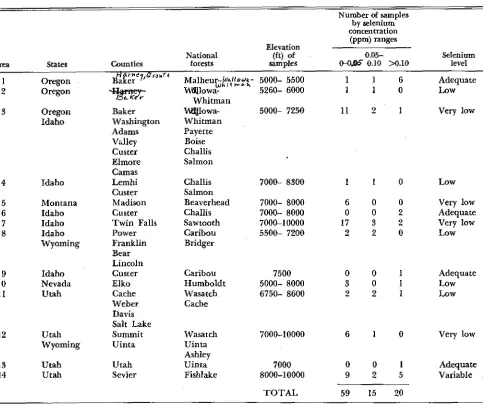
The selenium content of 94 forage samples from high northwestern ranges varied from 0.01 to 0.78 ppm, but only 20 samples contained more than 0.10 ppm. The remaining 74 samples contained less than 0.10 ppm selenium. Of these 74 samples, 59 contained less than 0.05 ppm. Thus, forage produced on many high summer ranges in the northwestern U.S. is low in selenium concentra-tion, and livestock losses from WMD and other selenium-responsive diseases may occur on these rangelands.
The high rangelands sampled were grouped into 14 areas according to geographic location (Fig. 1). Each range area was then classified according to the selenium level found in the forage sample (Table 1). Where 75% or more of the samples con-tained more than 0.10 ppm selenium, the area was classified as adequate in selenium, even though it is realized that some ranges in this group may have localized areas of inadequate selenium in the for-age. Where 75% or more of the samples contained
Fm. 1. Geographic location of high northwestern ranges where forage was sampled for determining selenium content.
less than 0.10 ppm selenium, the area was classified
low or very low in selenium level depending upon the proportion containing less than 0.05 ppm selenium. Areas not falling in the described group-ings were classified as variable in selenium level. Some information on the geologic materials and the soil associations present in each area is also given in Table I (Ross and Forester, 1947, and Western Land Grant Universities and Colleges and the Soil Conservation Service, 1964).
Areas 1, 6, 9 and 13 produce forage that generally contains adequate selenium for animals. Area I
au-236 CARTER, ROBBINS, AND BROWN
Table 1. Selenium concentration in forage from high summer ranges. Area locations are shown in Fig. 1.
Area States Counties Nationalforests
Elevation (ft) of samples
Number of samples by selenium concentration
(PP* ranges
Selenium level 0-0.0s0.05-0.10 >0.10
1 Oregon BakerNArne i,,Crahr# Malheur- AL /gip - 5000- 5500 1 6 Adequate
2 Oregon
kker Wllowa-Whitman 5260- 6000 1 0 Low
3 Oregon Baker NUIowa- 5000- 7250 11 1 Very low
Idaho Washington Whitman
Adams Payette
Valley Boise
Custer Challis
Elmore Salmon
Camas
4 Idaho Lemhi Challis 7000- 8300 1 1 0 Low
Custer Salmon
5 Montana Madison Beaverhead 7000- 8000 6 0 0 Very low
6 Idaho Custer Challis 7000- 8000 0 0 2 Adequate
7 Idaho Twin Falls Sawtooth 7000-10000 17 3 2 Very low
8 Idaho Power Caribou 5500- 7200 2 2 0 Low
Wyoming Franklin Bridger
Bear Lincoln
9 Idaho Custer Caribou 7500 0 0 1 Adequate
I0 Nevada Elko Humboldt 5000- 8000 3 0 1 Low
1I Utah Cache Wasatch 6750- 8600 2 2 1 Low
Weber Cache
Davis Salt Lake
12 Utah Summit Wasatch 7000-40000 6 1 0 Very low
Wyoming Uinta Uinta
Ashley
13 Utah Utah Uinta 7000 0 0 1 Adequate
14 Utah Sevier Fishlake 8000-10000 9 2 5 Variable
TOTAL 59 15 20
thors). The sample from area 9 contained 0.78 ppm selenium, the highest found in the study. Area 13 is part of the Uinta National Forest south of Payson, Utah. Areas 9 and 13 lie within areas mapped variable by Carter et al. (1968). Thus live-stock grazing summer ranges may or may not obtain adequate diet selenium for part of the year on these areas, depending upon the selenium content of winter feed.
Area 14 was the only range classified as variable. On this range, 69% of the samples contained less than 0.10 ppm selenium. Livestock losses from WMD in that area depend upon where the stock graze, supplement feeding programs and the sele-nium content of hay feed on home ranches. The WMD hazard is fairly high in area 14.
Five range areas produce forage classified as low in selenium level. These are areas 2, 4, 8, 10, and
11. Area 2 is south of Baker, Oregon in the Wil-lowa-Whitman National Forest. Area 4 represents
two ranges east of Challis, Idaho. Area 8 includes most of the high range in the southeastern corner of Idaho. Area 10 is the high range in northeastern Nevada, and area 11 is the Wasatch Mountain range in Utah. Livestock grazing forage on these ranges may not obtain adequate selenium to pro-tect young animals from WMD.
The remaining four range areas produce forage very low in selenium content. Area 3 includes a vast area north of Boise, Idaho which extends into Oregon. Area 5 is in southern Montana, and it lies within a region where alfalfa grown at lower elevations is also low in selenium (Carter et al., 1968). Area 7 includes portions of the Sawtooth National Forest in southern Idaho and Northern Utah. Area 12 is the Uinta Mountains in Utah with one sample from Wyoming.
SELENIUM IN FORAGE 237
Table 2. Geologic materials and soil associations for the sampling areas.
Area Geological materials present
1 Jurassic and Triassic rocks. Columbia River basalt.
2 Columbia River basalt. Jurassic and Triassic rocks. Carboniferous rocks.
3 Columbia River basalt. Jurassic and Triassic rocks. Granitic rock of the Idaho Batholith. Permian sedimentary rocks.
4 Belt age argillites and quartzites. Paleozoic sedi-mentary rocks.
5 Permian, undifferentiated, chert sandstone, lime-stone, quartzite and shale. Pre-Belt gneiss, schist and related rock.
6 Paleozoic sedimentary rocks, undifferentiated. Chal-lis volcanics.
7 Snake River basalt, Idavada volcanics. Belt series argillites and quartzites. Some granitic rocks.
8 Mesozoic sedimentary rocks. Paleozoic sedimentary rocks. Alluvial and glacial deposits.
9 Mesozoic sedimentary rocks.
10 Idavada volcanics and silicic rocks of volcanic origin,
1I Knight Conglomerate, chiefly fluvial Ordovician rock. Nounan formation limestone and dolomite. Brigham Quartzite formation.
12 Mississippian rocks, undivided Early Tertiary, ande-sitic and pyroclastic rocks. Alluvial deposits. Mutual Formation, chiefly quartzite.
13 Early tertiary andesitic and pyroclastic rocks.
14 Late Tertiary basalt and basaltic andesite flows, Tertiary volcanic rocks, undifferentiated. Glacial ou tw ash.
Soil associations present
Soils of the cool to cold subhumid and humid forested regions (F). Western Brown Forest, Regosol and Lithosol
(F 14).
Soils of the cool to cold, subhumid and humid forested regions (F). Western Brown Forest, Regosol and Lithosol (F 14).
Soils of the cool to cold, subhumid and humid forested regions (F). Brown Podzolic, Lithosol and Regosol (F 2) and Western Brown Forest.
Dark colored soils of the subhumid regions (D). Prairie, Gray Brown Podzolic and Western Brown Forest (D 8). Dark colored soils of the subhumid regions (D). Cherno-zem, Prairie and Lithosol (D 4).
Dark colored soils of the subhumid regions (D). Prairie, Gray Brown Podzolic and Western Brown Forest (D 8). Dark colored soils of the subhumid regions (D). Prairie, Gray Brown Podzolic and Western Brown Forest (D 8). Prairie, Gray Wooded, Chestnut and Lithosol (D 10). Dark colored soils of the subhumid regions (D). Cheno-zem, Chestnut and Prairie (D 2). Prairie, Gray Brown Podzolic and Western Brown Forest (D 8).
Soils of the cool to cold, subhumid and humid forested regions (F). Gray Wooded, Gray Brown Podzolic, and Western Brown Forest (D 9).
Dark colored soils of the subhumid regions (0). Prairie and Lithosols (D 11).
Dark colored soils of the subhumid regions (ID). Prairie, Gray Wooded, Chestnut and Lithosol (0 10).
Soils of the cool to cold, subhumid and humid forested regions (F). Gray Wooded, Podzol, and Lithosol (F 10).
Dark colored soils of the subhumid regions (D). Prairie, Gray Wooded, Chestnut and Lithosol (0 10).
Dark colored soils of the subhumid regions (D). Prairie, Gray Wooded, Chestnut and Lithosols (D I0).
produces forage with adequate selenium to assure protecting livestock from WMD. Therefore, the hazard for livestock losses from WMD on these western ranges may be high. However, actual losses may not be great on all these ranges because of high vitamin E content of green forage, and other factors.
Incidence of WMD in calves and lambs is re-lated to the supply of selenium to the mother before the calves and lambs are born. There is some lasting protection against WMD when mother ani-mals have been supplied adequate selenium. How long the protection lasts depends upon many fac-tors such as the length of the adequate supply period and the selenium concentration in the sup-plying source relative to the critical protective level. Thus calves and lambs born on high summer ranges may not suffer WMD even though the
forage contains insufficient selenium. Protection of young animals can also be assured by injecting the mothers with selenium during gestation (Hidiroglou et al., 1965; and Mace et al., 1962). Another way to provide protective selenium on high ranges would be by supplying selenium-forti-fied salt, if it were approved for use (Paulson et al., 1968).
238 CARTER, ROBBINS, AND BROWN
range forage. Often supplements are fed during certain times of the year. The selenium content of all these sources is important. When all feed sources are low in selenium, the incidence of WMD will likely be higher than when one or more feed source contains adequate selenium. For example, area 5 is located where all local sources of animal feed contain insufficient selenium. Losses from WMD in this area are high and ranchers inject most young animals with selenium to minimize losses. In contrast, areas 10 and 12 are within regions where lower elevation range forage and hay produced contain adequate selenium. There-fore, losses from WMD may be few, although the actual losses are not known.
The data presented in this paper indicate that most of the high northwestern ranges produce forage low in selenium content. On these ranges, calves and lambs are not assured protection against WMD and possibly other selenium-responsive dis-eases. Even if animals are not lost to WMD, they are not building selenium reserves to protect them or their offspring at a later time. Thus, many ranchers in the region may lose young livestock on the high summer ranges or at a later time from WMD. These losses may have occurred for many years and may be considered as part of the "nat-ural"range losses. Where actual losses are verified, practices to minimize them will be of economic value to ranchers. The best known approved prac-tices are to inject young calves and lambs with selenium soon after birth, or to inject pregnant animals. For cattle, the latter practice would be more expensive because selenium must be adminis-tered in relation to animal weight, but it would be more convenient than finding, catching, and injecting the young calves on the range. The most convenient and economic practice will depend upon the particular situation. Ranchers should
determine the best practice for their operation and minimize losses from WMD where they occur.
Literature Cited
ALLAWAY, W. H., E. E. CARY, AND C. F. EHLIG. 1967. The cycling of low levels of selenium in soils, plants, and animals. In Selenium in Biomedicine. A.V.I. Pub. Co., Inc., Westport, Conn. p. 273-296.
ALLAWAY, W. H., AND EARLE E. CARY. 1964. Determina-tions of submicrogram amounts of selenium in biological materials. Anal. Chem. 36:1359-1362.
CARTER, D. L., M. J. BROWN, W. H. ALLAWAY, AND E. E.
CARY. 1968. Selenium content of forage and hay crops in the Pacific Northwest. Agron. J. 60:532-534.
EHLIG, C. F., W. H. ALLAWAY, E. E. CARY, AND J. KunoTA.
1968. Differences among plant species in selenium ac-cumulation from soils low in available selenium. Agron. J. 60:43-47.
Ku ROTA, J., W. H. ALLAWAY, D. L. CARTER, E. E. CARY, AND V. A. LAZAR. 1967. Selenium in crops in the United States in relation to selenium responsive diseases of ani-mals. Agr. Food Chem. 15:448-453.
MOTH, O. H. 1963. White muscle disease, a selenium-responsive myopathy. J. Am. Vet. Med. Assoc. 142:
272-277-PAULSON, G. D., G. A. BRODERICK, C. A. BAUMANN, AND A. L.
POPE. 1968. Effect of feeding sheep selenium fortified trace mineralized salt: Effect of tocopherol. J. Animal Sci. 195-202.
ROSENFELD, IRENE, AND 0. A. BEATH. 1964. Selenium: geobotany, biochemistry, toxicity and nutrition. Academic Press, New York, 411 p., Illus.
Ross, CLYDE P., AND J. DONALD FORESTER, COMPILERS. 1947.
Geologic map of the State of Idaho. U.S. Dept. Interior and Idaho Bur. of Mines and Geology.
UNDERWOOD, E. J. 1966. The mineral nutrition of live-stock. F.A.O., United Nations, and Commonwealth Agric. Bureaux. p. 291-320.
WESTERN LAND GRANT UNIVERSITIES AND COLLEGES AND THE SOIL CONSERVATION SERVICE. 1964. Soils of the Western