The Thirty-Third AAAI Conference on Artificial Intelligence (AAAI-19)
RepeatNet: A Repeat Aware Neural
Recommendation Machine for Session-Based Recommendation
Pengjie Ren,
1,2Zhumin Chen,
1Jing Li,
1Zhaochun Ren,
3Jun Ma,
1Maarten de Rijke
2 1Shandong University, Jinan, China2University of Amsterdam, Amsterdam, The Netherlands 3Data Science Lab, JD.com, Beijing, China
Abstract
Recurrent neural networks for session-based recommenda-tion have attracted a lot of attenrecommenda-tion recently because of their promising performance.repeat consumptionis a com-mon phenomenon in many recommendation scenarios (e.g., e-commerce, music, and TV program recommendations), where the same item is re-consumed repeatedly over time. However, no previous studies have emphasizedrepeat con-sumptionwith neural networks. An effective neural approach is needed to decide when to perform repeat recommenda-tion. In this paper, we incorporate a repeat-explore mecha-nism into neural networks and propose a new model, called RepeatNet, with an encoder-decoder structure. RepeatNet in-tegrates a regular neural recommendation approach in the de-coder with a new repeat recommendation mechanism that can choose items from a user’s history and recommends them at the right time. We report on extensive experiments on three benchmark datasets. RepeatNet outperforms state-of-the-art baselines on all three datasets in terms of MRR and Recall. Furthermore, as the dataset size and the repeat ratio increase, the improvements of RepeatNet over the baselines also in-crease, which demonstrates its advantage in handling repeat recommendation scenarios.
Introduction
Session-based recommendations have received increasing interest recently, due to their broad applicability in many on-line services (e.g., e-commerce, video watching, music lis-tening) (Cheng et al. 2017). Here, a session is a group of interactions that take place within a given time frame. Ses-sions from a user can occur on the same day, or over several days, weeks, or even months (Quadrana et al. 2017).
Conventional recommendation methods tackle session-based recommendations session-based on either the last interaction or the last session. Zimdars, Chickering, and Meek (2001) and Shani, Heckerman, and Brafman (2005) investigate how to extract sequential patterns to predict the next item us-ing Markov models. Then, Chen et al. (2012) propose lo-gistic Markov embeddings to learn the representations of songs for playlist prediction. A major issue for these mod-els is that the state space quickly becomes unmanageable when trying to include all possible sequences of potential
Copyright c2019, Association for the Advancement of Artificial Intelligence (www.aaai.org). All rights reserved.
user selections over all items. Recurrent neural networks (RNNs) have recently been used for the purpose of session-based recommendations and attracted significant attention. Hidasi et al. (2016a) introduce RNNs with gated recurrent units (GRUs) for session-based recommendation. They in-troduce a number of parallel RNN (p-RNN) architectures to model sessions based on both clicks and features (images and text) of clicked items (Hidasi et al. 2016b). Quadrana et al. (2017) personalize RNN models with cross-session in-formation transfer and devise a Hierarchical RNN model that relays and evolves latent hidden states of the RNNs across user sessions. Li et al. (2017b) introduce an atten-tion mechanism into session-based recommendaatten-tions and outperform (Hidasi et al. 2016a). Though the number of studies that apply deep learning to session-based recommen-dation is increasing, none has emphasized so-calledrepeat consumptions, which are a common phenomenon in many recommendation scenarios (e.g., e-commerce, music, and TV program recommendations), where the same item is re-consumed repeatedly over time.
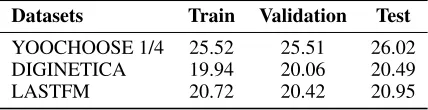
Repeat consumptionexists because people have regular habits. For example, we all buy the same things repeatedly, we eat at the same restaurants regularly, we listen to the same songs and artists frequently (Anderson et al. 2014). Table 1 shows the repeat consumption ratio for three benchmark datasets that are commonly used in related studies (Hidasi et al. 2016a; Li et al. 2017b). Repeat consumption not only
Table 1: Repeat ratio (%) on three benchmark datasets.
Datasets Train Validation Test
YOOCHOOSE 1/4 25.52 25.51 26.02
DIGINETICA 19.94 20.06 20.49
LASTFM 20.72 20.42 20.95
exists but also accounts for a large proportion of the inter-actions in some applications. In this paper, we investigate
explore mode, respectively. In therepeat mode we recom-mend an old item from the user’s history while in the ex-plore modewe recommend a new item. Specifically, we first encode each session into a representation. Then, we use a repeat-explore mechanism to learn the switch probabilities between repeat and explore modes. After that, we propose a
repeat recommendation decoderto learn the probabilities of recommending old items in therepeat modeand anexplore recommendation decoder to learn the probabilities of rec-ommending new items under theexplore mode. Finally, we determine the recommendation score for an item by combin-ing the mode switch probabilities and the recommendation probabilities of each item under the two modes in a proba-bilistic way. The mode prediction and item recommendation are jointly learned in an end-to-end back-propagation train-ing paradigm within a unified framework.
We carry out extensive experiments on three benchmark datasets. The results show that RepeatNet outperforms state-of-the-art baselines on all three datasets in terms of MRR and Recall. Furthermore, we find that as the dataset size and the repeat ratio increase, the improvements of Repeat-Net over the baselines also increase, which demonstrates its advantages in handling repeat recommendation scenarios.
To sum up, the main contributions in this paper are: • We propose a novel deep learning-based model named
RepeatNet that takes into account therepeat consumption
phenomenon. To the best of our knowledge, we are the first to consider this in the context of session-based rec-ommendation with a neural model.
• We introduce a repeat-explore mechanism for session-based recommendation to automatically learn the switch probabilities between repeat and explore modes. Unlike existing works that use a single decoder, we propose two decoders to learn the recommendation probability for each item in the two modes.
• We carry out extensive experiments and analyses on three benchmark datasets. The results show that RepeatNet can improve the performance of session-based recommenda-tion over state-of-the-art methods by explicitly modeling
repeat consumption.
Related Work
We survey related work in two areas: session-based recom-mendations and repeat recomrecom-mendations.
Session-based recommendation
Conventional methods for session-based recommendation are usually based on Markov chains that predict the next action given the last action. Zimdars, Chickering, and Meek (2001) propose a sequential recommender based on Markov chains and investigate how to extract sequential pat-terns to learn the next state using probabilistic decision-tree models. Mobasher et al. (2002) study different sequential patterns for recommendation and find that contiguous se-quential patterns are more suitable for sese-quential prediction task than general sequential patterns. Shani, Heckerman, and Brafman (2005) present a Markov decision process (MDP) to provide recommendations in a session-based manner and
the simplest MDP boils down to first-order Markov chains where the next recommendation can simply be computed through the transition probabilities between items. Yap, Li, and Yu (2012) introduce a competence score measure in personalized sequential pattern mining for next-item recom-mendations. Chen et al. (2012) model playlists as Markov chains, and propose logistic Markov embeddings to learn the representations of songs for playlists prediction. A ma-jor issue with applying Markov chains to the session-based recommendation task is that the state space quickly becomes unmanageable when trying to include all possible sequences of potential user selections over all items.
RNNs have proved useful for sequential click predic-tion (Zhang et al. 2014). Hidasi et al. (2016a) apply RNNs to session-based recommendation and achieve signif-icant improvements over conventional methods. They utilize session-parallel mini-batch training and employ ranking-based loss functions for learning the model. Later, they in-troduce a number of parallel RNN (p-RNN) architectures to model sessions based on clicks and features (images and text) of clicked items (Hidasi et al. 2016b); they propose al-ternative training strategies for p-RNNs that suit them bet-ter than standard training. Tan, Xu, and Liu (2016) pro-pose two techniques to improve the performance of their models, namely data augmentation and a method to ac-count for shifts in the input data distribution. Jannach and Ludewig (2017) show that a heuristics-based nearest neigh-bor scheme for sessions outperforms the model proposed by Hidasi et al. (2016a) in the large majority of the tested con-figurations and datasets. Quadrana et al. (2017) propose a way to personalize RNN models with cross-session infor-mation transfer and devise a Hierarchical RNN model that relays end evolves latent hidden states of the RNNs across user sessions. Li et al. (2017b) explore a hybrid encoder with an attention mechanism to model the user’s sequential be-havior and intent to capture the user’s main purpose in the current session.
Unlike the studies listed above, we emphasize therepeat consumptionphenomenon in our models.
Repeat recommendation
Anderson et al. (2014) study the patterns by which a user consumes the same item repeatedly over time, in a wide va-riety of domains, ranging from check-ins at the same busi-ness location to re-watches of the same video. They find that recency of consumption is the strongest predictor of repeat consumption. Chen, Wang, and Wang (2015) derive four generic features that influence people’s short-term re-peat consumptionbehavior. Then, they present two fast algo-rithms with linear and quadratic kernels to predict whether a user will perform a short-termrepeat consumptionat a spe-cific time given the context.
݅
ଵ݅
ଶ݅
ଷ݅
௧݄
ଵ݄
ଶ݄
ଷ݄
௧݄
ଵ݄
ଶ݄
ଷ...
݄
௧...
Repeat-Explore Mechanism
Attentive Encoder Repeat Rec Decoder
Explore Rec Decoder Explore Rec pl
Repeat Mode
Explore Mode
ܲ ݅ ܫ
ௌ
=
ܲ ݎ ܫ
ௌ
ܲ ݅ ݎ
,
ܫ
ௌ
+
ܲ ݁ ܫ
ௌ
ܲ
(
݅
|
݁
,
ܫ
ௌ
)
RepeatNet
...
...
...
...
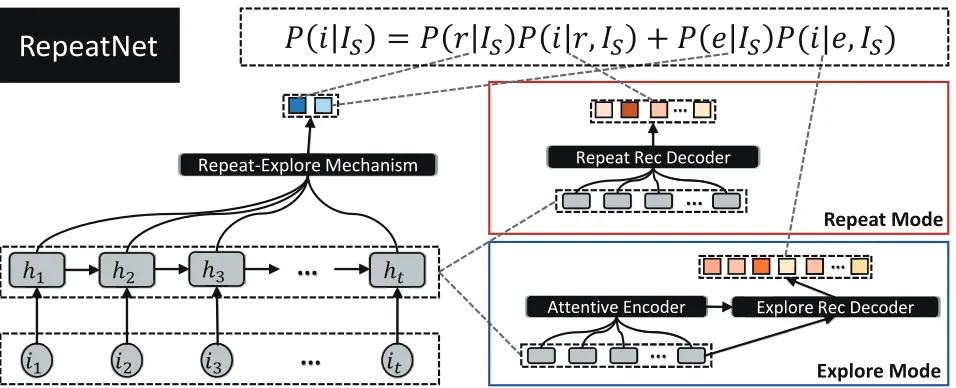
Figure 1: Overview of RepeatNet.
Benson, Kumar, and Tomkins (2016) identify two macro-scopic behavior patterns of repeated consumptions. First, in a given user’s lifetime, very few items live for a long time. Second, the last consumptions of an item exhibit growing inter-arrival gaps consistent with the notion of increasing boredom leading up to eventual abandonment. The main difference between our work and previous work on repeat recommendations is that we are the first to propose a neu-ral recommendation model to explicitly emphasize repeat consumptionin both conventional and session-based recom-mendation tasks.
RepeatNet
Given an action (e.g., clicking, shopping) session IS =
{i1, i2, . . . , iτ, . . . , it}, whereiτ refers to an item,
session-based recommendation tries to predict what the next event would be, as shown in Eq. 1. Without loss of generality, we takeclick actionsas our running example in the paper:
P(it+1|IS)∼f(IS), (1)
whereP(it+1 |IS)denotes the probability of
recommend-ing it+1 given IS. Conventional methods usually model
f(IS)directly as a discriminant or probability function.
Framework
We propose RepeatNet to modelP(it+1|IS)from a
prob-abilistic perspective by explicitly takingrepeat consumption
into consideration, as shown in Eq. 2:
P(it+1|IS) =P(r|IS)P(it+1|r, IS) +
P(e|IS)P(it+1|e, IS),
(2)
wherer ande denote repeat modeand explore mode, re-spectively. Here, P(r | IS)and P(e | IS) represent the
probabilities of executing inrepeat modeandexplore mode, respectively.P(it+1 |r, IS)andP(it+1|e, IS)refer to the
probabilities of recommendingit+1 inrepeat modeand in
explore mode, respectively, givenIS.
As illustrated in Fig. 1, RepeatNet consists of four main components, a session encoder, a repeat-explore mecha-nism, a repeat recommendation decoder, and an explore recommendation decoder. Thesession encoderencodes the given session IS into latent representationsH = {h1, h2,
. . . , hτ, . . . , ht}, wherehtrepresents the session
represen-tation at timestampt. Therepeat-explore mechanismtakes H as input and predicts the probabilities of executing re-peat mode or explore mode, corresponding to P(r | IS)
and P(e | IS) in Eq. 2. The repeat recommendation
de-coder takesH as input and predicts the repeat recommen-dation probabilities over clicked items inIS, corresponding
toP(it+1|r, IS)in Eq. 2. Theexplore recommendation
de-codertakesH as input and predicts the explore recommen-dation probabilities over unclicked items inI−IS, whereI
refers to all items, corresponding toP(it+1|e, IS)in Eq. 2.
Session encoder
Like previous studies (Hidasi et al. 2016a; Li et al. 2017b), we use a GRU to encodeIS, where the GRU is defined as:
zτ=σ(Wz[emb(iτ), hτ−1])
rτ =σ(Wr[emb(iτ), hτ−1])
f
hτ = tanh(Wh[emb(iτ), rτhτ−1])
hτ = (1−zτ)hτ−1+zτhfτ,
(3)
whereWz,Wr, andWhare weight matrices;emb(iτ)is the
item embedding ofiτ;σdenotes the sigmoid function. The
initial state of the GRU is set to zero vectors, i.e.,h0 = 0.
After thesession encoder, each sessionIS is encoded into
H ={h1, h2, . . . , hτ, . . . , ht}.
Repeat-explore mechanism
Therepeat-explore mechanismcan be seen as a binary clas-sifier that predicts the recommendation mode based onH=
{h1, h2, . . . , hτ, . . . , ht}. To this end, we first apply an
H to get a fixed-length vector representation ofIS.
Specifi-cally, we first use the last hidden statehtto match with each
encoder hidden statehτ ∈Hto get an importance score:
ereτ =vre>tanh(Wreht+Urehτ), (4)
wherevre,Wre, andUre are parameters. The importance
scores are then normalized to get the context vector forIS
as a weighted sum in Eq. 5:
ατre=
exp(ereτ )
Pt
τ=1exp(ereτ )
creIS =
t
X
τ=1
αreτ hτ.
(5)
We then employ a softmax regression to transformcreIS into a mode probability distribution, corresponding toP(r|IS)
andP(e|IS)respectively, as shown in Eq. 6:
[P(r|IS), P(e|IS)] = softmax(WreccreIS), (6) whereWc
reis the weight matrix.
Repeat recommendation decoder
Therepeat recommendation decoderevaluates the probabil-ity of re-clicking an item inIS. Inspired by CopyNet (Gu
et al. 2016), we use a modification of the attention model to achieve this. The probability of re-clicking itemiτ ∈IS is
computed as follows:
erτ=vr>tanh(Wrht+Urhτ) (7)
P(i|r, IS) =
( P
iexp(e r τ)
Pt
τ=1exp(erτ)
ifi∈IS
0 ifi∈I−IS,
(8)
wherevr,Wr, andUrare parameters;Piexp(erτ)denotes
the sum of all occurrences of itemi∈IS, because the same
item might occur multiple times in different positions ofIS.
Explore recommendation decoder
Theexplore recommendation decoder evaluates the proba-bility of clicking a new item that does not exist inIS. To
better capture the user’s interest in sessionIS, we employ
an item-level attention mechanism that allows the decoder to dynamically select and linearly combine different parts of the input sequence (Li et al. 2017b):
eeτ=ve>tanh(Weht+Uehτ)
αeτ=
exp(ee τ)
Pt
τ=1exp(eeτ)
ceIS =
t
X
τ=1
αeτhτ,
(9)
whereve,We, andUeare parameters. The factorsαeh
deter-mine which part of the input sequence should be emphasized or ignored when making predictions. We then combine the last hidden state and the attentive state into a hybrid repre-sentationcIS forIS, which is the concatenation of vectors htandceIS:cIS = [ht, c
e IS].
Finally, the probability of clicking item iτ ∈ I−IS is
computed as follows:
fi=
−∞ ifi∈I
S
Wc
ecIS ifi∈I−IS
(10)
P(i|e, IS) =
exp(fi)
Pt
τ=1exp(fτ)
, (11)
whereWc
e is the weight matrix and−∞means negative
in-finity. Sinceexp(−∞) = 0, we assume that if an item exists inIS, then the probability of recommending it in theexplore
modeis zero.
Objective function
Our goal is to maximize the output prediction probability given the input session. Therefore, we optimize the negative log-likelihood loss function as follows:
Lrec(θ) =−
1
|IS|
X
IS∈IS
|IS| X
τ=1
logP(iτ|IS), (12)
whereθare all the parameters of RepeatNet,ISis the set of
all sessions in the training set, and P(iτ | IS)is the item
prediction probability as defined in Eq. 2.
RepeatNet incorporates an extra repeat-explore mecha-nism to softly switch between repeat mode and explore mode. We assume that if the next item exists inIS, then it is
generated under therepeat mode, otherwiseexplore mode. Here, we can jointly train another mode prediction loss as follows, which is also the negative log-likelihood loss:
Lmode(θ)
= − 1
|IS|
X
IS∈IS
|IS| X
τ=1
1(iτ∈IS) logP(r|IS) +
(1−1(iτ ∈IS)) logP(e|IS),
(13)
where1(iτ ∈ IS)is an indicator function that equals 1 if
iτ ∈ISand 0 otherwise.
In the case of joint training, the final loss is a linear com-bination of both losses:
L(θ) =Lrec(θ) +Lmode(θ). (14)
All parameters of RepeatNet as well as the item embed-dings are learned in an end-to-end back-propagation training paradigm. Due to the full probability term in Eq. 2, the two modes probabilitiesP(r| IS),P(e|IS)and the item
pre-diction probabilitiesP(i |r, IS),P(i| e, IS)are basically
competing through a unified function.
Experiments
Datasets and evaluation metrics
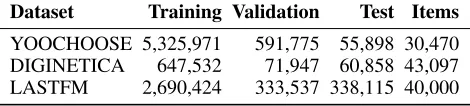
2017). Since they are both for e-commerce, we choose a third dataset in a different domain, music, Last.fm.1See
Ta-ble 2. The splitting of the datasets are the same as (Li et al. 2017b).
• YOOCHOOSE2 is a public dataset released by the
Rec-Sys Challenge 2015. We follow (Hidasi et al. 2016a; Li et al. 2017b) and filter out sessions of length 1 and items that appear less than 5 times. They note that the 1/4 version of the dataset is enough for the task and in-creasing the amount of data will not further improve the performance.
• DIGINETICA3 is released by the CIKM Cup 2016. We
again follow (Li et al. 2017b) and filter out sessions of length 1 and items that appear less than 5 times.
• LASTFM4is released by (Celma 2010) and widely used
in recommendation tasks (Cheng et al. 2017). We use the dataset for music artist recommendation; we keep the top 40,000 most popular artists and filter out sessions that are longer than 50 or shorter than 2 items.
Recommender systems can only recommend a few items at a time, the actual item a user might pick should be amongst the first few items of the list (He et al. 2018b; Cheng et al. 2018). Therefore, commonly used metrics are MRR@20 and Recall@20 (He et al. 2018a; Mei et al. 2018). In this paper, we also report MRR@10 and Recall@10. • Recall@k: The primary evaluation metric is Recall@k,
which is the proportion of cases when the desired item is amongst the top-k items in all test cases.
• MRR@k: Another used metric is MRR@k (Mean Recip-rocal Rank), which is the average of recipRecip-rocal ranks of the desire items. The reciprocal rank is set to zero if the rank is larger than k.
Table 2: Statistics of three datasets (number of sessions and items).
Dataset Training Validation Test Items
YOOCHOOSE 5,325,971 591,775 55,898 30,470 DIGINETICA 647,532 71,947 60,858 43,097 LASTFM 2,690,424 333,537 338,115 40,000
Implementation details
We set the item embedding size and GRU hidden state sizes to 100. We use dropout (Srivastava et al. 2014) with drop ra-tiop= 0.5. We initialize model parameters randomly using the Xavier method (Glorot and Bengio 2010). We use Adam as our optimizing algorithm. For the hyper-parameters of the Adam optimizer, we set the learning rate α = 0.001, two momentum parameters β1 = 0.9 and β2 = 0.999, respectively, and = 10−8. We halve the learning rate α
every 3 rounds. We also apply gradient clipping (Pascanu,
1
https://www.last.fm
2http://2015.recsyschallenge.com/challenge.html 3
http://cikm2016.cs.iupui.edu/cikm-cup
4
http://www.dtic.upf.edu/ ocelma
/MusicRecommendationDataset/lastfm-1K.html
Mikolov, and Bengio 2013) with range[−5,5]during train-ing. To speed up the training and converge quickly, we use mini-batch size 1024 by grid search. We test the model per-formance on the validation set for every epoch. The model is written in Chainer (Tokui et al. 2015) and trained on a GeForce GTX TitanX GPU.
Methods used for comparison
Conventional methods We select the following conven-tional methods which are commonly used as baselines in session based recommendations (Hidasi et al. 2016a; Tan, Xu, and Liu 2016; Li et al. 2017b).
• POP: POP always recommends the most popular items in the training set. It is frequently used as baselines in recommender system domains (He et al. 2017).
• S-POP: S-POP recommends the most popular items of the current session. Ties are broken using global popularity values (Hidasi et al. 2016a).
• Item-KNN: Items similar to the actual item are recom-mended by this baseline. Similarity is defined as the co-occurrence number of two items in sessions divided by the square root of the product of the number of sessions in which either item occurs. Regularization is also included to avoid coincidental high similarities between rarely vis-ited items (Davidson et al. 2010).
• BPR-MF: BPR-MF (Rendle et al. 2009) is a commonly used matrix factorization method. We apply it to session-based recommendation by representing a new session with the average latent factors of items that occurred in the session so far.
• FPMC: FPMC (Rendle, Freudenthaler, and Schmidt-Thieme 2010) is a state-of-the-art hybrid model for next-basket recommendation. To adapt it to session-based rec-ommendation, we ignore the user latent representations when computing recommendation scores.
• PDP: Benson, Kumar, and Tomkins (2016) propose PDP and claim that they are the first to model sequential repeat consumption. This is the only recommendation model that considers sequential repeat consumption, to the best of our knowledge.
Deep learning methods No previous studies propose neu-ral models that consider sequential repeat consumption. We select recent state-of-the-art neural session based recom-mendation models as baselines.
• GRU4REC: GRU4REC (Hidasi et al. 2016a) uses session-parallel mini-batch training process and also em-ploys ranking-based loss functions for learning the model. • Improved-GRU4REC: Improved GRU4REC (Tan, Xu, and Liu 2016) improves GRU4REC with two techniques, data augmentation and a method to account for shifts in the input data distribution.
Table 3: Experimental results (%) on the three datasets.
Methods
YOOCHOOSE DIGINETICA LASTFM
MRR Recall MRR Recall MRR Recall
@10 @20 @10 @20 @10 @20 @10 @20 @10 @20 @10 @20
POP 0.26 0.30 0.81 1.33 0.18 0.20 0.53 0.89 1.09 1.26 2.90 5.26
S-POP 17.70 17.79 25.96 27.11 13.64 13.68 20.56 21.06 8.36 8.71 18.08 22.59
Item-KNN 20.89 21.72 41.56 52.35 10.77 11.57 25.04 35.75 4.48 4.85 9.77 14.84
BPR-MF 1.90 1.97 3.07 4.05 1.86 1.98 3.60 5.24 4.88 5.19 9.87 14.05
FPMC 16.59 17.50 38.87 51.86 6.30 6.95 17.07 26.53 4.58 4.99 11.67 17.68
PDP 18.44 19.15 40.03 52.98 6.75 7.24 19.57 28.77 4.86 5.05 12.11 18.09
GRU4REC 21.64 22.60 46.67 59.56 7.59 8.33 19.09 29.45 4.92 5.39 11.56 17.90
Improved-GRU4REC 28.36 29.15 57.91 69.20 13.63 14.69 33.48 46.16 9.60 10.15 20.98 29.04 GRU4REC-TOPK 29.76 30.69 58.15 70.30 13.14 14.16 31.54 45.23 7.44 7.95 15.73 22.61
NARM 28.52 29.23 58.70 69.73 15.25 16.17 33.62 49.70 10.31 10.85 22.04 29.94
RepeatNet (no repeat) 30.02 30.76 59.62 70.21 12.71 13.52 30.96 42.56 9.92 10.47 21.81 29.96 RepeatNet 30.50† 31.03† 59.76† 70.71 16.90† 17.66† 36.86† 47.79 11.46† 12.03† 24.18† 32.38† Bold face indicates the best result in terms of the corresponding metric. Significant improvements over the best base-line results are marked with † (t-test, p < .05). The scores reported in (Li et al. 2017b) on the DIGINETICA dataset differ because they did not sort the session items according to the “timeframe” field, which ignores the sequential in-formation. We run the code released by (Hidasi et al. 2016a; Tan, Xu, and Liu 2016; Hidasi and Karatzoglou 2017; Li et al. 2017b) to obtain the results of GRU4REC, Improved-GRU4REC, GRU4REC-TOPK, and NARM.
Results and Analysis
Results
The results of all methods are shown in Table 3. We run the code released by (Hidasi et al. 2016a; Li et al. 2017b) to report the results of GRU4REC and NARM. We can get several insights from Table 3. First, RepeatNet outperforms both conventional methods and recent neural methods, in-cluding the strong baselines, GRU4REC-TOPK and NARM. The improvement of RepeatNet over NARM is even larger than the improvement of NARM over Improved-GRU4REC. The improvements mean that explicitly modeling repeat consumptionis helpful, which gives RepeatNet more capa-bilities to model complex situations in session-based recom-mendations.
Second, as the repeat ratio increases, the performance of RepeatNet increases generally. We reach this conclusion based on the different improvements on YOOCHOOSE and DIGINETICA. Both datasets are from the e-commerce do-main but YOOCHOOSE has a higher repeat ratio.
Third, the performance of RepeatNet varies with differ-ent domains. Table 3 shows that RepeatNet has a bigger ad-vantage in the music domain than in the e-commerce do-main; we believe this is due to different characteristics of the different domains. S-POP performs much better than Item-KNN on LASTFM, which means that popularity is very im-portant on LASTFM. However, Item-KNN performs much better than S-POP on YOOCHOOSE, which means that col-laborative filtering is more important on YOOCHOOSE. Be-sides, the neural models have substantial gains over the con-ventional methods in all evaluation metrics on all datasets generally. Similar conclusions have been formulated in other recent studies (Hidasi et al. 2016a; Tan, Xu, and Liu 2016;
Li et al. 2017b).
Analysis of the repeat mechanism
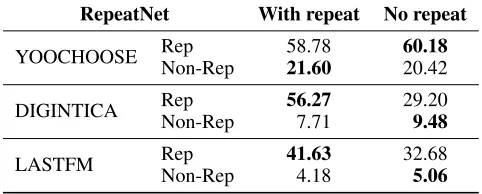
Table 4: MRR@20 (%) of RepeatNet (with and without re-peat mechanism) on rere-peat and non-rere-peat sessions.
RepeatNet With repeat No repeat
YOOCHOOSE Rep 58.78 60.18
Non-Rep 21.60 20.42
DIGINTICA Rep 56.27 29.20
Non-Rep 7.71 9.48
LASTFM Rep 41.63 32.68
Non-Rep 4.18 5.06
Rep: repeat sessions;Non-Rep: non-repeat sessions.
Table 5: Recall@20 (%) of RepeatNet (with and without re-peat mechanism) on rere-peat and non-rere-peat sessions.
RepeatNet With repeat No repeat
YOOCHOOSE Rep 97.41 93.70
Non-Rep 61.32 61.95
DIGINTICA Rep 99.09 65.18
Non-Rep 34.58 36.73
LASTFM Rep 91.22 67.06
Non-Rep 16.79 20.10
Analysis of the attention vs repeat mechanism
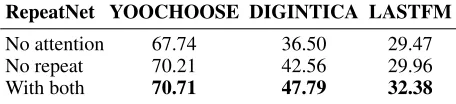
Neural attention has shown its potential on many tasks (Bah-danau, Cho, and Bengio 2015; Ren et al. 2017; Li et al. 2017a) and also on recommender systems recently (Li et al. 2017b; Xiao et al. 2017; Chen et al. 2017). We compare the results of RepeatNet with and without attention, with and without repeat in Table 6 and 7. The results show that both repeat and attention mechanisms can improve the re-sults over Improved-GRU4REC. Importantly, the contribu-tions of attention and repeat mechanisms are complementary as the combination brings further improvements, on all met-rics and datasets, demonstrating the need for both. Besides, we can see that the attention mechanism helps to improve Recall while the repeat mechanism helps to improve MRR.Table 6: MRR@20 (%) of RepeatNet with attention vs with repeat.
RepeatNet YOOCHOOSE DIGINTICA LASTFM
No attention 28.65 16.03 11.10
No repeat 30.76 13.52 10.47
With both 31.03 17.66 12.03
Table 7: Recall@20 (%) of RepeatNet with attention vs with repeat.
RepeatNet YOOCHOOSE DIGINTICA LASTFM
No attention 67.74 36.50 29.47
No repeat 70.21 42.56 29.96
With both 70.71 47.79 32.38
Analysis of joint learning
Interestingly, if we jointly train the recommendation loss Lrec and the mode prediction probabilityLmode, the
over-all performance drops a little, as shown in Table 8. We be-lieve that this is due to the following. First,Lrecis already a
good supervisor for learning the mode prediction. This con-clusion can be drawn from Table 4 and 5 where it shows that RepeatNet (withLreconly) achieves large improvements on
repeated sessions. And the room left for improvement on re-peated sessions is relatively small. Second, RepeatNet (with
Lrec only) is inclined to repeat recommendation. Adding
Lmode further exacerbates the situation. Besides,Lmode
as-sumes that if the next item exists inIS, then it is generated
inrepeat mode, which is not always reasonable.
Table 8: MRR@20 and Recall@20 (%) of RepeatNet with and without joint learning.
Loss YOOCHOOSE LASTFM
MRR Recall MRR Recall
Lrec 31.03 70.71 12.03 32.38
Lrec+Lmode 28.99 69.64 11.58 31.94
Conclusion and Future Work
We propose RepeatNet with an encoder-decoder architecture to addressrepeat consumptionin the session-based recom-mendation task. By incorporating arepeat-explore mecha-nism into RNNs, RepeatNet can better capture the repeat-or-explore recommendation intent in a session. We con-duct extensive experiments and analyses on three datasets and demonstrate that RepeatNet outperforms state-of-the-art methods in terms of MRR and Recall.
RepeatNet can be advanced and extended in several direc-tions. First, prior knowledge of people can be incorporated to influencerepeat-explore mechanism. Second, more infor-mation (e.g., metadata, text) and more factors (e.g., collab-orative filtering) can be considered to further improve the performance. Besides, variants of RepeatNet can be applied to other recommendation tasks, such as content based rec-ommendations.
Acknowledgments
This work is supported by the Natural Science Foundation of China (61672324, 61672322), the Natural Science Foun-dation of Shandong province (2016ZRE27468), the Funda-mental Research Funds of Shandong University, Ahold Del-haize, Amsterdam Data Science, the Bloomberg Research Grant program, Elsevier, the European Community’s Sev-enth Framework Programme (FP7/2007-2013) under grant agreement nr 312827 (VOX-Pol), the Google Faculty Re-search Awards program, the Microsoft ReRe-search Ph.D. pro-gram, the Netherlands Institute for Sound and Vision, the Netherlands Organisation for Scientific Research (NWO) under project nrs CI-14-25, 652.002.001, 612.001.551, 652.-001.003, and Yandex. All content represents the opinion of the authors, which is not necessarily shared or endorsed by their respective employers and/or sponsors.
Code
To facilitate reproducibility of the results in this paper, we are sharing the code used to run the experiments in this paper at https://github.com/PengjieRen/RepeatNet.
References
Bahdanau, D.; Cho, K.; and Bengio, Y. 2015. Neural ma-chine translation by jointly learning to align and translate. In
ICLR ’15.
Benson, A. R.; Kumar, R.; and Tomkins, A. 2016. Modeling user consumption sequences. InWWW ’16.
Celma, `O. 2010. Music Recommendation and Discovery in the Long Tail. Springer.
Chen, S.; Moore, J. L.; Turnbull, D.; and Joachims, T. 2012. Playlist prediction via metric embedding. InKDD ’12. Chen, J.; Zhang, H.; He, X.; Nie, L.; Liu, W.; and Chua, T.-S. 2017. Attentive collaborative filtering: Multimedia recommendation with item- and component-level attention. InSIGIR ’17.
Chen, J.; Wang, C.; and Wang, J. 2015. Will you “sume” the near past? Fast prediction on short-term recon-sumption behaviors. InAAAI ’15.
Cheng, Z.; Shen, J.; Zhu, L.; Kankanhalli, M.; and Nie, L. 2017. Exploiting music play sequence for music recommen-dation. InIJCAI ’17, 3654–3660.
Cheng, Z.; Ding, Y.; Zhu, L.; and Kankanhalli, M. 2018. Aspect-aware latent factor model: Rating prediction with ratings and reviews. InWWW ’18, 639–648.
Davidson, J.; Liebald, B.; Liu, J.; Nandy, P.; Van Vleet, T.; Gargi, U.; Gupta, S.; He, Y.; Lambert, M.; Livingston, B.; and Sampath, D. 2010. The YouTube video recommenda-tion system. InRecSys ’10.
Glorot, X., and Bengio, Y. 2010. Understanding the diffi-culty of training deep feedforward neural networks. JMLR
9:249–256.
Gu, J.; Lu, Z.; Li, H.; and Li, V. O. 2016. Incorporating copying mechanism in sequence-to-sequence learning. In
ACL ’16.
He, X.; Liao, L.; Zhang, H.; Nie, L.; Hu, X.; and Chua, T.-S. 2017. Neural collaborative filtering. InWWW ’17.
He, X.; He, Z.; Du, X.; and Chua, T.-S. 2018a. Adversarial personalized ranking for recommendation. In SIGIR ’18, 355–364.
He, X.; He, Z.; Song, J.; Liu, Z.; Jiang, Y.-G.; and Chua, T.-S. 2018b. Nais: Neural attentive item similarity model for recommendation. TKDE30(12):2354–2366.
Hidasi, B., and Karatzoglou, A. 2017. Recurrent neural net-works with top-k gains for session-based recommendations.
CoRRabs/1706.03847.
Hidasi, B.; Karatzoglou, A.; Baltrunas, L.; and Tikk, D. 2016a. Session-based recommendations with recurrent neu-ral networks. InICLR ’16.
Hidasi, B.; Quadrana, M.; Karatzoglou, A.; and Tikk, D. 2016b. Parallel recurrent neural network architectures for feature-rich session-based recommendations. InRecSys ’16. Jannach, D., and Ludewig, M. 2017. When recurrent neural networks meet the neighborhood for session-based recom-mendation. InRecSys ’17.
Lerche, L.; Jannach, D.; and Ludewig, M. 2016. On the value of reminders within e-commerce recommendations. In
UMAP ’16.
Li, H.; Min, M. R.; Ge, Y.; and Kadav, A. 2017a. A context-aware attention network for interactive question answering. InKDD ’17.
Li, J.; Ren, P.; Chen, Z.; Ren, Z.; Lian, T.; and Ma, J. 2017b. Neural attentive session-based recommendation. In CIKM ’17.
Mei, L.; Ren, P.; Chen, Z.; Nie, L.; Ma, J.; and Nie, J.-Y. 2018. An attentive interaction network for context-aware recommendations. InCIKM ’18, 157–166.
Mobasher, B.; Dai, H.; Luo, T.; and Nakagawa, M. 2002. Using sequential and non-sequential patterns in predictive web usage mining tasks. InICDM ’02.
Pascanu, R.; Mikolov, T.; and Bengio, Y. 2013. On the difficulty of training recurrent neural networks. In ICML ’13.
Quadrana, M.; Karatzoglou, A.; Hidasi, B.; and Cremonesi, P. 2017. Personalizing session-based recommendations with hierarchical recurrent neural networks. InRecSys ’17. Ren, P.; Chen, Z.; Ren, Z.; Wei, F.; Ma, J.; and de Rijke, M. 2017. Leveraging contextual sentence relations for extrac-tive summarization using a neural attention model. InSIGIR ’17.
Rendle, S.; Freudenthaler, C.; Gantner, Z.; and Schmidt-Thieme, L. 2009. BPR: Bayesian personalized ranking from implicit feedback. InUAI ’09.
Rendle, S.; Freudenthaler, C.; and Schmidt-Thieme, L. 2010. Factorizing personalized markov chains for next-basket recommendation. InWWW ’10.
Shani, G.; Heckerman, D.; and Brafman, R. I. 2005. An MDP-based recommender system. JMLR6:1265–1295. Srivastava, N.; Hinton, G.; Krizhevsky, A.; Sutskever, I.; and Salakhutdinov, R. 2014. Dropout: A simple way to prevent neural networks from overfitting.JMLR15(1):1929–1958. Tan, Y. K.; Xu, X.; and Liu, Y. 2016. Improved recur-rent neural networks for session-based recommendations. In
DLRS ’16.
Tokui, S.; Oono, K.; Hido, S.; and Clayton, J. 2015. Chainer: a next-generation open source framework for deep learning. InNIPS ’15.
Xiao, J.; Ye, H.; He, X.; Zhang, H.; Wu, F.; and Chua, T. 2017. Attentional factorization machines: Learning the weight of feature interactions via attention networks. In IJ-CAI ’17.
Yap, G.-E.; Li, X.-L.; and Yu, P. S. 2012. Effective next-items recommendation via personalized sequential pattern mining. InDASFAA ’12.
Zhang, Y.; Dai, H.; Xu, C.; Feng, J.; Wang, T.; Bian, J.; Wang, B.; and Liu, T.-Y. 2014. Sequential click predic-tion for sponsored search with recurrent neural networks. In
AAAI ’14.