Volume 3, Issue 4, April 2014
Page 123
Abstract
A virtual classroom is an online learning environment that contains all course materials. The conception of the virtual classroom has made it possible for learners to tackle the features of the Internet to create meaningful and constructivist learning environments Information and Communication Technology (ICT) is playing a vital role in teaching and learning to meet the needs and anticipation of the learners’ in large scale. The main purpose of ICT in education means implementing of ICT equipment and tools in teaching and learning process as a media and methodology. The purpose of ICT in education is generally to make students familiar with the use and workings of computers, and related social and ethical issues. Due to miscellaneous requirements in teaching and learning for a Virtual Classroom, there are opportunities and challenges that are to be addressed in usage of the technology and the service(s) being provided through ICT. The paper emphasizes on the concept, role of teaching and learning and to promote easily manageable, affordable eminence higher education in terms of its availability, authenticity, confidentiality and access control so that one can ensure a service to the outmost satisfaction of a learner.
Keywords: Pedagogical, Vocational, Catalytic, Integration
1.
I
NTRODUCTIONICTs stand for information and communication technologies and are defined, for the purposes of this primer, as a diverse set of technological tools and resources used to communicate, and to create, disseminate, store, and manage information [1]. These technologies include computers, the Internet, broadcasting technologies and telephony that have been boosted as potentially powerful enabling tools for educational change and reform. When used appropriately, different ICTs are said to help expand access to education, strengthen the relevance of education to the increasingly digital workplace, and raise educational quality by, among others, helping make teaching and learning into an engaging, active process connected to real life.
ICT not only helps to avail the in depth knowledge of basic courses but also increases the flexibility of delivery of education so that learners can access knowledge anytime and from anywhere. ICT can influence the way students are taught and how they learn as now the processes are learner driven and not by teachers. Teachers will play an effective role in the overall use of ICT whose main task will not be to transmit information and culture but rather act as expert to motivate learning. This paper explores the various factors affecting the use of computers in school. ICT encourage students to take responsibility for their own learning and offers problem centered and inquiry based learning which provides easy access and information based resources. Especially in developing countries like India, effective use of ICT leads to development of the educational sector resulting in educational competitiveness and increased employment. This paper explores the different impacts ICT has on teaching and learning including the impact on pupils and learners. Education is the driving force of economic and social development in any country [2]. Considering this, it is necessary to find ways to make education of good quality, accessible and affordable to all, using the latest technology available. ICT has the potential to remove the barriers that are causing the problems of low rate of education in any country .It can be used as a tool that helps to overcome the issues of cost, less number of teachers, and poor quality of education as well as to overcome time and distance barriers which are the major hurdles in the field of development.
Educational system is dynamic and changes with time. It responds to the demands of the society, by assimilating the advances in technology. The various kinds of ICT products available and having relevance to education, such as teleconferencing, email, audio conferencing, television lessons, radio broadcasts, interactive radio counseling, interactive voice response system, audiocassettes and CD ROMs etc have been used in education for different purposes. A critical factor in the effective use of ICT is the role played by the school management that addresses future development and consistency and includes some means of monitoring progress against identified milestones. This assimilation of technology leads to a new mode of education. It is diagrammatically represented in a spiral model as follows.
The Virtual Classroom redefines by ICT:
Enhancing eminence education through
successful implementation of ICT with special
reference to Rajasthan schools
Megha Gupta1, V.K.Gupta2
1
Research Scholar at Jagannath University, Jaipur , Rajasthan 2
Volume 3, Issue 4, April 2014
Page 124
Figure 1 Technology based growth of education system
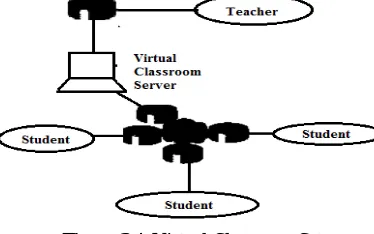
Virtual learning environments are the basic component of open and distance learning and a virtual classroom is a teaching and learning environment located within a computer-mediated communication. Just like in a real-world classroom, a student in a virtual classroom participates in synchronous instruction, which means that the teacher and students are logged into the virtual learning environment at the same time.
2.
O
PPORTUNITIES ANDC
HALLENGES OFICT
SThe rapid development of information and communication technologies (ICTs) and the move towards more knowledge-intensive, interdependent and internationalized societies create new opportunities and challenges for the design and delivery of education.
For the student/learner learning means increased access and flexibility along with the combination of work and education. It may also mean a more learner-centered approach, enrichment, higher quality and new ways of interaction.
Figure 2 A Virtual Classroom Setup
For employers it offers high quality and usually cost effective professional development in the workplace. It allows upgrading of skills, increased productivity and development of a new learning culture. In addition, it means sharing of costs, of training time, and increased portability of training.
For governments the main aim is to increase the capacity and cost effectiveness of education and training systems, to reach target groups with limited access to conventional education and training, to support and enhance the quality and relevance of existing educational structures, to ensure the connection of educational institutions and curricula to the emerging networks and information resources, and to promote innovation and opportunities for lifelong learning.
Besides the opportunities, ICTs also bring challenges. First is the high cost of acquiring, installing, operating, maintaining and replacing ICTs. While potentially of great importance, the integration of ICTs into teaching is still in its inception. Introducing ICT systems for teaching has a particularly high opportunity cost because installing them is usually very expensive.
Inexperience in acquiring institution, wide requirement of hardware and software and attendant services may cost institutions very high as they may end up with wares that are outdated and subject to unworkable but binding supplier contracts.
Use of unlicensed software can be very problematic, not only legally but in the costs of maintenance, particularly if the pirated software varies in standard formats. Even under ideal circumstances of licensed hardware and software acquisition, lack of capacity in equipment maintenance can pose serious implementation problems. Clear policies and procedures for buying computer hardware and software are necessary to prevent such problems.
3.
I
MPACT OFICT
IN TEACHING AND LEARNING IN SCHOOLVolume 3, Issue 4, April 2014
Page 125
exercises, in simulations and educational networks. The complete process has four dimensions input, output, result and finally the impact. Input consists of funding for schools to buy computers and to establish computer labs in different schools at different locations and funds to pay to teachers. Output is the percentage of schools with computer connections or improved student to computer ratio. Outcome is the broader result achieved by ICT investment such as greater use of ICT in teaching .Impact is the overall achievement of the intervention on the educational system or improvement in learning in school.High investments in education can have a very direct effect on the economic growth and developments of the country. ICT capital is superior to Non-ICT capital in enhancing economic growth: a higher level of ICT capital stock per capita allows a typical economy to achieve a higher growth rate for given levels of growth in labor and capital inputs [3].It is also possible to say that sometimes it may not be how much capital you invest, that makes a difference, but rather how you invest it[3]. ICT in education act as a catalyst for the growth and development of country.
3.1 Impact of ICT on pupil
With ICT, direct causal impacts are not very easily identifiable. Furthermore, drawing clear conclusions on the impact of ICT from the range of research evidence is difficult. There are a number of factors that limit effective comparisons, such as differences in sample sizes, methodologies and effects, and education systems. When the impact of ICT in education is considered there tends to be a focus on whether and to what extent, ICT can raise pupil attainment. A, positive relationships has been found between ICT use and improvement in subject-related learning in several subject areas. The fact was seen that the longer the pupils have used computers the better they performed. An interview was conducted to analyze the present teachers and pupils views about the consequences of using ICT in schools. After looking at the views it was concluded that pupils, teachers and parents consider that ICT has a positive impact on pupils’ learning. In the question ‘does ICT improve pupil performance’, eight out of ten teachers reported that there has been an improvement in their pupils ‘achievement of subject-related performance and their basic skills like calculation, reading and writing. In addition, teachers consider that academically strong students benefit more from ICT use. The above facts were also confirmed by the pupils themselves as well as their parents.
Important factors at the school level that can foster the use of ICT by teachers are school Policy, access to hardware, the availability of adequate software, teacher time, internal support, and communication about ICT use.
3.2 Factors affecting the implementation of computers in school- 3.2.1 Enthusiasm of a teacher to learn and teach
Time to learn, time to practice, time to reflect. Time is a crucial factor with regard to the implementation of ICT in education. The amount of time a teacher devotes to attend training or workshops, to experiment with machines, to discuss with other teachers about the effective use of computer in education are all the factors that affect the implementation of ICT in education. Short-term training, even when conducted intensely during summer months or intersession, cannot, by itself, produce change. Training must be accompanied by a well-designed maintenance plan that provides opportunities for teachers to talk about their issues, ask questions, and get feedback. By viewing the adoption of technology as a process that takes place gradually, schools can provide both the time and the resources to help teachers implement technology effectively’. How much time there is for teachers to familiarize themselves with ICT depends on decisions made at the community level, choices made at the school level and choices made by the teachers themselves.
3.2.2 Support from the school principal: may accelerate the implementation of ICT in education
Concerns about the slow adoption of new technology by teachers are not new. Many researchers have from various angles studied the phenomenon through different approaches from case studies[4], to historical analysis[5], to large surveys[6]. They offer various accounts of why teachers do not frequently use technology to its full potential or in revolutionary ways that could truly lead to qualitatively different teaching and learning experiences. One of the findings has shown that school principals generally have favorable attitudes towards the use of computers in education.
3.2.3 School’s policy and management’s attitude towards the use of ICT in school Some important parameters can be seen
Whether the school will give priority to the use of computers for instruction
Whether the school will prescribe which hardware and software to use
Whether all students have to compulsorily have to acquire knowledge about computers.
Selection and provision of teacher training
Allocation of budget
Provision of internal support
Volume 3, Issue 4, April 2014
Page 126
3.2.4 Availability of sufficient hardware
Obviously, the availability of hardware is an important issue for the use of ICT in education. However, just the availability is not enough. Implementing technology in education calls for extra space in classrooms, individual places for study and/or computer rooms. There has to be dedicated computer rooms available in the school. In this way, all pupils have access to the technology, and full-group instruction is possible.
3.2.5 The availability of adequate software
The availability of software which fits into the curriculum is to a large part determined by factors at the community level. However, the purchase of suitable software that is available on the market depends on school policy with regard to the acquisition of software and to the attribution of financial resources for the purchase of courseware.
4.
B
ENEFITS OFICT
I
NTEGRATIONI
N EDUCATIONEducation is the driving force of economic and social development in any country. Hence, it is necessary to find ways to make education of good quality, accessible and affordable to all, using the latest technology available. From last two decades ICT has been used and its usage has caused a revolutionary change in the development of society. It can be used as a tool to overcome the issues of cost, less number of teachers, and poor quality of education as well as to overcome time and distance barriers. India has a billion-plus population and a high proportion of the young and hence it has a large formal education system. Parents and pupils believed that ICT improved motivation and confidence, made schoolwork more enjoyable and improved achievement [7]. They reported a statistically small improvement in attainment in mathematics and English linked to the home use of ICT for educational purposes at particular key stages, and concluded that home use brings advantages in terms of new sources of information, enhanced presentation and raised self-esteem which, in turn, affects attainment.
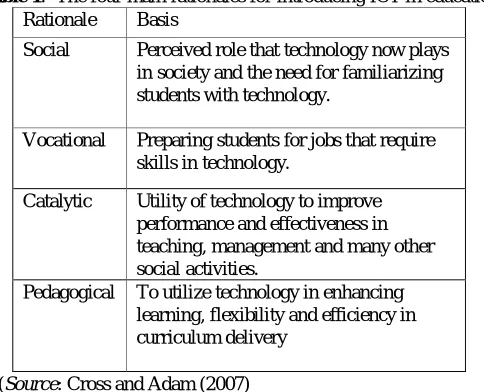
Table 1: The four main rationales for introducing ICT in education Rationale Basis
Social Perceived role that technology now plays in society and the need for familiarizing students with technology.
Vocational Preparing students for jobs that require skills in technology.
Catalytic Utility of technology to improve performance and effectiveness in teaching, management and many other social activities.
Pedagogical To utilize technology in enhancing learning, flexibility and efficiency in curriculum delivery
(Source: Cross and Adam (2007)
ICT enables a student, teachers and professionals to communicate among each other and share their views at any place and at any time. Usage of ICT allows the networking of academics and researchers and hence sharing of scholarly material. Usage of ICT enables to communicate efficiently and hence to solve the real world problems. It improves the perception and understanding of the world of the student. Thus, ICT can be used to prepare the workforce for the information society and the new global economy.
5.
R
ESULTA
NDC
ONCLUSION5.1 Comparative Analysis of performance of students/learners by conducting test in various private and government
school of Rajasthan
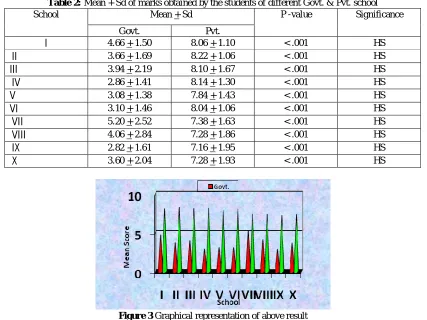
Different technical test based on computer education were conducted at 10 different districts of Rajasthan. Various private and government schools students participated in the questionnaire conducted and the results found were:
Volume 3, Issue 4, April 2014
Page 127
Table 2: Mean + Sd of marks obtained by the students of different Govt. & Pvt. school
School Mean + Sd P -value Significance
Govt. Pvt.
I 4.66 + 1.50 8.06 + 1.10 < .001 HS
II 3.66 + 1.69 8.22 + 1.06 < .001 HS
III 3.94 + 2.19 8.10 + 1.67 < .001 HS
IV 2.86 + 1.41 8.14 + 1.30 < .001 HS
V 3.08 + 1.38 7.84 + 1.43 < .001 HS
VI 3.10 + 1.46 8.04 + 1.06 < .001 HS
VII 5.20 + 2.52 7.38 + 1.63 < .001 HS
VIII 4.06 + 2.84 7.28 + 1.86 < .001 HS
IX 2.82 + 1.61 7.16 + 1.95 < .001 HS
X 3.60 + 2.04 7.28 + 1.93 < .001 HS
Figure 3 Graphical representation of above result
5.2 Vision of teachers of various private and government schools of Rajasthan towards the impact of educational use of
ICT in schools.
This study surveyed 1,000 pupils through questionnaires and drew data from 33 interviews with teachers (from 20 schools). The study found that:
All teachers had fundamental ICT skills. But the technical infrastructure between schools varied significantly and, therefore, the opportunities to develop these skills also varied to put into practice;
The enormous majority of teachers used ICT to help with their planning but few used it in their teaching;
Teachers realized the possibilities of ICT but most of them lacked the pedagogical visualization to integrate ICT successfully within their teaching;
Pupils ostracized, and were not motivated by, highly structured, ready-made learning tasks. They preferred open, enquiry-based tasks but these were seldom evidenced in the research;
Those pupils with a positive approach towards ICT had a more positive attitude about their school and themselves in general. They were able to use their knowledge in more significant and resourceful ways.
6.
C
ONCLUSIONIt is true that ICT is playing a vital role in teaching and learning but at same time there are many opportunities and challenges that are to be addressed for smooth functioning of various services that are to be implemented for its learners and other public provided through ICT. In this paper, the concept, components and role of teaching and learning of a virtual classroom are addressed through various test and analysis to make one understand the need and the use of ICT in education in the era of this growing and competitive world.
R
EFERENCES[1] Blurton, C.,“New Directions of ICT-Use in Education” http://www.unesco.org/education/educprog/lwf/dl/edict.pdf; accessed 7 August 2002.
[2] Cholin, V. S. (2005), 'Study of the application of information technology for effective access to resources in Indian university libraries', The International Information & Library Review 37(3),
[3] Vu, K. ” ICT and Global Economic Growth”
Volume 3, Issue 4, April 2014
Page 128
[4] Cuban, L. (1986). Teachers and machines: The classroom uses of technology since 1920. New York: Teachers College Press.
[5] Cuban, L. (2001). Oversold and underused: Computers in schools, 1980–2000. Cambridge, MA: Harvard University [6] Press. Becker, H. J. (2000a). Findings from the teaching, learning, and computing survey: Is Larry Cuban right?
Education Policy Analysis Archives, 8(51). Available at http://epaa.asu.edu/epaa/v8n51/
[7] Valentine, G, Marsh, J and Pattie, C (2005), Children and Young People’s Home Use of ICT for Educational Purposes.London:DfES http://www.dfes.gov.uk/research/data/uploadfiles/RR672.pdf