Customer Knowledge Management in
organisations: Developing a practice
framework to achieve 360
O
view of
customer
Pavan Vasireddy
A thesis submitted in partial fulfilment of the requirements of the
University of Bolton for the degree of Doctor of Philosophy
***
I dedicate this work to Almighty Creator, the original source of all thoughts ***
“Isvarah sarva-bhutanam hrid-dese’arjuna thishtathi, bhramayan srava-bhuthani yantrarudhani mayaya”
i
Abstract
With emergence of knowledge economy and shift in power towards customers, the way of performing business and managing customer markets in organisations has changed significantly. Organisations which are typically reliant on internal knowledge have been setting their sight on customers as a valuable new source of external knowledge. This led to the wide acknowledgement of Customer Knowledge Management (CKM) in both business and academic fields within the last decade. Extant CKM literature has highlighted the need for 360O view of customer but there is significant gap regarding how to achieve this in organisations. Thus, the main motivation for this research is to develop theory in terms of practise framework to enable organisations to achieve 360O view of customer while taking into consideration the challenges identified in practising CKM. This thesis attempts to address the complex research problem – ‘how to manage customer knowledge to achieve 360O view of customer in organisations’.
The research problem developed for the study led towards interpretivist paradigm to interpret and understand various relevant organisational phenomena and research is carried out using qualitative approach. The empirical data is collected using case study research method from five large organisations from India, Germany, and the United Kingdom. In-depth case studies were conducted in Biocon, Daimler, Genpact, Honeywell-ADI, and University of Bolton. The empirical data collected was analysed using techniques from grounded theory approach.
ii
Acknowledgment
This research has been one of the life-time memorable things in the journey of my life. This research work has been accomplished with the support and assistance of several individuals and some organisations. Firstly, my foremost thanks go to my director of studies, Dr. Kondal Reddy Kandadi, for his invaluable guidance and inspirational mentorship. I am grateful to the University of Bolton for supporting me through studentship and bursary. I would like to thank my second supervisor, Dr.Zahra Salimi, for extending her timely support as and when requested. I would also like to thank other staff at Bolton Business School (especially Prof. Danny Morton) and my PhD examiners (Prof. David Newton and Dr. Easton Simenti-Phiri) who contributed through interesting discussions and scholarly conversations.
Special thanks to executives and senior managers for sparing their valuable time and supporting me in conducting case studies at their respective organisations which include Biocon, Daimler, Genpact, Honeywell-ADI, and University of Bolton. I would also like to thank my research colleagues and friends at the University of Bolton, for their support and thought-provoking discussions. I am thankful to all my friends and others for giving me support and comfort. Among friends and colleagues, I would like to convey my thanks to Dr. Alfred Chinta, Anik Fouzdar, Krishna Chaitanya, Narender, Dr. Chari, Dr. Subhash Chandra Bose and Sri. Ramachandar Raav for their support in facilitating some parts of this empirical research and thesis refinement. I would like to convey my gratitude to Dr. Pratap Sriram Sundar for his invaluable moral support and guidance during the last phase of this thesis writing.
iii
Table of Contents
List of Figures ... vii
List of Tables ... viii
List of Abbreviations ... ix
1. INTRODUCTION ...1
1.1 SETTING THE SCENE ... 1
1.2 MOTIVATION FOR THE RESEARCH ... 2
1.3 RESEARCH PROBLEM ... 3
1.4 RESEARCH GOAL AND OBJECTIVES ... 4
1.5 RESEARCH PARADIGM, METHODOLOGY AND DESIGN ... 5
1.6 RESEARCH OVERVIEW ... 6
1.7 RESEARCH FOCUS AND BOUNDARIES ... 8
1.7.1 Positioning of the thesis ... 8
1.7.2 Associated subject areas ... 8
1.7.3 Applicability of the framework... 9
1.8 THESIS STRUCTURE ... 9
1.8.1 Chapter 2: Literature review ... 9
1.8.2 Chapter 3: Research paradigm, methodology, and design... 10
1.8.3 Chapter 4: Findings, analysis and developing a CKM framework ... 10
1.8.4 Chapter 5: Conclusion and further work ... 11
1.8.5 Appendix A: Research Questionnaire ... 11
SUMMARY ... 11
2. LITERATURE REVIEW... 12
INTRODUCTION ... 12
2.1 BASIC CONCEPTS: CUSTOMER, KNOWLEDGE, AND MANAGEMENT ... 12
2.2 CUSTOMER KNOWLEDGE (CK) ... 19
2.2.1 Knowledge for customers ... 19
2.2.2 Knowledge about customers ... 20
2.2.3 Knowledge from customers... 20
2.3 KNOWLEDGE MANAGEMENT (KM) ... 23
iv
2.5 CUSTOMER KNOWLEDGE MANAGEMENT (CKM) ... 28
2.5.1 Evolution of CKM ... 28
2.5.2 Customer Knowledge Management Definition ... 30
2.5.2.1 Customer (knowledge management) ... 30
2.5.2.2 (Customer knowledge) management ... 32
2.5.2.3 (Customer knowledge management) ... 33
2.5.3 CKM versus KM and CRM ... 33
2.5.4 Benefits of CKM... 34
2.6 REVIEW OF CKM THEORIES AND RELEVANT FRAMEWORKS ... 35
2.6.1. Lead User Model ... 36
2.6.2. Customer/User Toolkits for Innovation ... 38
2.6.3. Five Styles of CKM ... 42
2.6.4. CKM Cycle ... 45
2.6.5. University of St. Gallen Model of CKM ... 47
2.6.6. Kano-CKM and E-CKM Models ... 49
2.6.7. CKM Model for customer life cycle and Schematic CKM framework ... 52
2.6.8. Customer Interaction Management across Lifecycle ... 55
2.6.9. Other Theories and Contemporary Research ... 56
2.7 360O VIEW OF CUSTOMER ... 56
2.8 NEED TO ACHIEVE 360O VIEW OF CUSTOMER ... 58
2.9 RESEARCH QUESTIONS ... 62
SUMMARY ... 63
3. RESEARCH PARADIGM, METHODOLOGY AND DESIGN ... 64
INTRODUCTION ... 64
3.1 CKM RESEARCH: PROBLEM, GOAL AND QUESTIONS ... 64
3.2 RESEARCH PARADIGMS ... 66
3.2.1. Determination of Research Paradigm... 69
3.2.1.1 Positivism ... 69
3.2.1.2 Interpretivism ... 70
3.3 RESEARCH APPROACH (Quantitative & Qualitative continuum) ... 70
3.4 DETERMINATION OF RESEARCH APPROACH ... 71
3.5 DETERMINATION OF RESEARCH METHODOLOGY ... 72
v
3.5.2 Case-Study... 78
3.6 RESEARCH DESIGN ... 80
3.6.1 Sample selection ... 82
3.6.1.1 Genpact ... 85
3.6.1.2 Biocon ... 86
3.6.1.3 Honeywell-ADI ... 87
3.6.1.4 Daimler ... 88
3.6.1.5 University of Bolton ... 89
3.6.2 Data Collection ... 90
3.6.3 Data Analysis: Grounded Theory Tools and Techniques ... 94
3.6.3.1 Open Coding ... 96
3.6.3.2 Axial Coding ... 96
3.6.3.3 Selective Coding ... 97
3.6.4 Data Analysis Protocols: Data Accuracy and Triangulation ... 98
3.7 RESEARCH ETHICS ... 98
SUMMARY ... 99
4. FINDINGS AND ANALYSIS ... 100
INTRODUCTION ... 100
4.1 FINDINGS, ANALYSIS, AND DISCUSSION ... 101
4.1.1 Components of Customer Knowledge (C1) ... 105
4.1.1.1 Knowledge for customers (F1)... 108
4.1.1.2 Knowledge from Customers (F2) ... 111
4.1.1.3 Knowledge about customers (F3) ... 113
4.1.2 Drivers of CKM (C2) ... 116
4.1.2.1 Market Environment (F4) ... 117
4.1.2.2 Innovation (F5) ... 119
4.1.2.3 Regulatory Environment (F6) ... 124
4.1.3 Culture (C3) ... 127
4.1.3.1 Training (F7) ... 129
4.1.3.2 Reward Mechanisms (F8) ... 133
4.1.3.3 Alert Raising (F9) ... 136
4.1.3.4 CKM Devoted Capabilities and Resources (F10) ... 138
vi
4.1.4 Processes (C4) ... 142
4.1.4.1 Frequent problems and common solutions (F12) ... 144
4.1.4.2 Knowledge of people and their capabilities (F13) ... 145
4.1.4.3 Holistic Awareness and Group Decision Making (F14) ... 146
4.1.4.4 Risk Register (F15) ... 148
4.1.4.5 Domain Experts (F16) ... 150
4.1.4.6 Outsourcing (F17) ... 153
4.1.4.7 Customer Knowledge Creation and Acquisition (F18) ... 155
4.1.4.8 Customer knowledge Sharing and Usage (F19) ... 158
4.1.4.9 Contact with Customer (F20) ... 161
4.1.4.10 Collaboration with Business Partners (F21) ... 164
4.1.4.11 Quality Assurance (F22) ... 167
4.1.4.12 Return on Investment (F23) ... 170
4.1.5 Technology / IT Infrastructure (C5) ... 173
4.1.5.1 IT Tools (F24) ... 175
4.1.5.2 Knowledge-base or Centralised Database (F25)... 179
4.1.5.3 Web-accessibility and Access Levels (F26) ... 182
4.1.5.4 Technology provisions for customer (F27) ... 185
4.2 COMPREHENSIVE CKM FRAMEWORK ... 188
SUMMARY ... 194
5. CONCLUSION AND FURTHER RESEARCH ... 195
INTRODUCTION ... 195
5.1 RESEARCH OBJECTIVES ACCOMPLISHMENT ... 195
5.2 THEORETICAL AND PRACTICAL CONTRIBUTIONS ... 199
5.3 VALIDITY OF FINDINGS ... 204
5.4 LIMITATIONS OF THIS STUDY ... 205
5.5 IMPLICATIONS FOR FURTHER RESEARCH ... 207
SUMMARY ... 208
References ... 209
vii List of Figures
Figure 1.1: Research Process overview ... 7
Figure 2.1: Four modes of knowledge conversion ... 16
Figure 2.2: Conceptual Model with three elements of Customer Knowledge ... 21
Figure 2.3: Components of Knowledge Management Cycle... 25
Figure 2.4: Stages of CRM development ... 27
Figure 2.5: C[KM], [CK]M and [CKM] ... 30
Figure 2.6: Lear Users’ position in New Product Lifecycle ... 37
Figure 2.7: Approaches to develop custom products ... 40
Figure 2.8: CKM Cycle ... 46
Figure 2.9: CKM Process Model ... 48
Figure 2.10: The Kano-CKM Model for attractive quality creation ... 50
Figure 2.11: The E-CKM Model... 51
Figure 2.12: Schematic Diagram of CKM framework ... 54
Figure 2.13: Planning customer interaction across the lifecycle ... 55
Figure 2.14: Four dimensions of single customer view ... 57
Figure 3.1: Four types of Case-Study designs ... 83
viii List of Tables
Table 2.1: Types of customer knowledge ... 22
Table 2.2: Characteristics of customer-oriented knowledge ... 22
Table 2.3: KM and CRM versus CKM... 34
Table 2.4: Five Styles of CKM ... 44
Table 2.5: CKM model for customer life cycle... 52
Table 3.1: Philosophical differences between Positivism and Interpretivism ... 68
Table 3.2: Comparison of quantitative, mixed methods, and qualitative research approaches... 71
Table 3.3: Overview of Case organisations ... 85
Table 3.4: Review of Various Sources of Evidence within Case Study Methodology ... 92
Table 4.1: CKM Core categories and constituent factors ... 104
Table 4.2: Customer Knowledge Components (Core Category C1): Substantiating concepts and codes ... 106
Table 4.3: Knowledge for customers (F1): Substantiating concepts and codes ... 109
Table 4.4: Knowledge from customers (F2): Substantiating concepts and codes ... 112
Table 4.5: Knowledge about customers (F3): Substantiating concepts and codes ... 115
Table 4.6: Drivers of CKM (Core Category C2): Substantiating concepts and codes ... 116
Table 4.7: Market Environment (F4): Substantiating concepts and codes ... 118
Table 4.8: Innovation (F5): Substantiating concepts and codes ... 122
Table 4.9: Regulatory Environment (F6): Substantiating concepts and codes ... 125
Table 4.10: Culture (Core Category C3): Substantiating concepts and live codes ... 128
Table 4.11: Training (F7): Substantiating concepts and codes ... 131
Table 4.12: Reward Mechanisms (F8): Substantiating concepts and codes ... 134
Table 4.13: Alert Raising (F9): Substantiating concepts and codes... 137
Table 4.14: CKM devoted capabilities and resources (F10): Substantiating concepts and codes .... 139
Table 4.15: Hybrid roles with matrix reporting (F11): Substantiating concepts and live codes ... 141
Table 4.16: Processes (Core Category C4): Substantiating concepts and codes ... 143
Table 4.17: Frequent problems and common solutions (F12): Substantiating concepts and codes . 144 Table 4.18: Knowledge of people and their capabilities (F13): Substantiating concepts and codes . 146 Table 4.19: Holistic Awareness and Group Decision Making (F14): Substantiating concepts and codes ... 147
Table 4.20: Risk Register (F15): Substantiating concepts and codes ... 149
Table 4.21: Domain Experts (F16): Substantiating concepts and codes... 151
Table 4.22: Outsourcing (F17): Substantiating concepts and codes... 154
Table 4.23: Customer knowledge creation and acquisition (F18): Substantiating concepts and codes ... 156
Table 4.24: Customer knowledge Sharing and Usage (F19): Substantiating concepts and codes ... 160
Table 4.25: Contact with Customer (F20): Substantiating concepts and codes ... 162
Table 4.26: Collaboration with Business Partners (F21): Substantiating concepts and codes... 165
Table 4.27: Quality Assurance (F22): Substantiating concepts and codes ... 169
Table 4.28: Return on Investment (F23): Substantiating concepts and codes ... 171
Table 4.29: Technology (Core Category C5): Substantiating concepts and codes ... 174
Table 4.30: IT Tools (F24): Substantiating concepts and codes ... 176
Table 4.31: Knowledge base or Centralised database (F25): Substantiating concepts and codes ... 180
Table 4.32: Web-Accessibility and Access Levels (F26): Substantiating concepts and codes ... 184
ix List of Abbreviations
BCPI – Business focus, Culture, Processes, and Infrastructure BI – Business Intelligence
CAS – Computer Aided Selling
CDCPT – Components, Drivers, Culture, Processes, and Technology CGIP – Consumer Generated Intellectual Property
CK – Customer Knowledge
CKEI – Customer Knowledge Enabled Innovation CKM – Customer Knowledge Management CLC – Customer Life Cycle
CRM – Customer Relationship Management CSR – Corporate Social Responsibility FAQs – Frequently Asked Questions GRMs – Global Relationship Managers GROs – Global Relationship Officers HR – Human Resource
KF – Kooperativa Forbundet KM – Knowledge Management i-CRM – Integrated-CRM
IT – Information Technology
MIS – Management Information System MNCs – Multi National Companies
NPD – New Product Development PKT – Process Knowledge Test PR – Public Relations
QA – Quality Assurance
R&D – Research and Development ROI – Return on Investment SCV – Single Customer View
SECI – Socialisation, Externalisation, Combination, and Internalisation SFA – Sales Force Automation
1
1.
INTRODUCTION
“A customer is the most important visitor on our premises. He is not dependent on us. We are dependent on him. He is not an interruption in our work. He is the purpose of it. He is not an outsider in our business. He is part of it. We are not doing him a favour by serving him. He is doing us a favour by giving us an opportunity to do so.” – M.K. Gandhi
1.1 SETTING THE SCENE
With increase in bargaining power of customers and emergence of knowledge economy, the way of performing business and managing customer markets in organisations has changed significantly. Organisations which are conventionally reliant on internal knowledge have been setting their sight on customers as an invaluable new source of external knowledge. Customer knowledge has potential to provide innovative ideas and new insights that may not be possible with internal sources alone. Customer knowledge and its management in organisations are becoming critical for sustainability of business in long term. Al-Shammari (2009) emphasises that Customer Knowledge Management (CKM) enables organisations to build distinctive core competencies by acquiring and utilizing knowledge residing with customers in order to achieve sustainable competitive advantage.
2
Greenberg, 2009; Pockard, 2009; Smalley, 2000). However, there is significant gap in literature regarding how to achieve 360O customer view (Liautaud, 2010; Pockard, 2009; Zanjani et al, 2008; Salomann et al, 2005). The research topic of the thesis, “Customer Knowledge Management in Organisations: Developing a framework for 360O view of customer” addresses that gap and intends to contribute through practice framework to the body of knowledge.
1.2 MOTIVATION FOR THE RESEARCH
3
systems, and 5) organisational culture that support learning and customer orientation.
Implementing and practising CKM incorporates significant organisational challenges. For example, Smith and McKenn (2005) identified challenges in terms of structural, cultural, competency and privacy concerns. Desouza and Awazu (2005) viewed challenges of CKM in terms of segmentation, integration, distribution and application. There is also recognition and acknowledgement of need for 360O view of customer in terms of the following aspects: a) creating consistent experience of the customer throughout the organisation, b) improving the quality of customer information, c) communicating with customer in a fully informed way, and d) enabling new channels of innovation and growth (Greenberg, 2009; Liautaud, 2010; Smalley, 2000; Gibbert et al, 2002). There is considerable published work emphasising CKM theories and frameworks (Zanjani et al, 2008; Liautaud, 2010; Salomann et al, 2005; Pockard, 2009). However, there is a lack of literature regarding ‘how to achieve 360O view of customer in organisations’.
The motivation for this research is to contribute towards customer-centricity in organisations and to address the need to achieve 360O view of customer while taking into consideration the challenges identified in practising CKM.
1.3 RESEARCH PROBLEM
4
and from customer. This will require reviewing various organisational elements such as culture, processes, systems, and restructuring relevant functional areas like CRM and marketing to orient towards CKM. Therefore, the following core research problem has been defined for this study.
“How to manage customer knowledge to achieve 360O view of customer in organisations?”
1.4 RESEARCH GOAL AND OBJECTIVES
A review of literature has revealed that current concepts and theories to adopt and improve CKM in organisations are inadequate to address the research problem (Gibbert et al, 2002; Salomann et al, 2005; Al-Shammari, 2009; Zanjani et al, 2008; Liautaud, 2010). Therefore, the goal of this research is:
“To develop a holistic framework for practicing customer knowledge management to achieve 360O view of customer in organisations”
To achieve the above goal, the following research objectives have been derived for this research study:
5
From the literature review, identify elements which influence CKM and assist in attainment of 360O view of customer.
Conduct empirical studies to determine significant factors that affect CKM for attaining 360O view of customer.
Through the empirical studies, determine how these factors and associated organisational dimensions can be managed for effective Customer Knowledge Management in organisations.
Evaluate the findings of the empirical studies against current literature and provide critical discussion on each of the organisational elements.
Develop a CKM practice framework for 360O view of customer based on empirical studies and knowledge from extant CKM literature.
1.5 RESEARCH PARADIGM, METHODOLOGY AND DESIGN
6
critical theory (Gephart, 1999). Generally, Interpretivist paradigm proposes using qualitative methodologies. In addition, the research goal of this study and the derived research questions seek answers that stress ‘how organisational elements influence CKM’, and this illustrates the qualitative nature of this inquiry. A review of different approaches including quantitative, qualitative and mixed methodologies indicates that qualitative research is appropriate to address the research problem of this study as it focuses on many complex organisational elements which are qualitative in nature. The proposed research intends to collect empirical data from organisations within their real-life context through case study method. The sample selection uses purposive sampling encompassing multiple case organisations from varied industry sectors to attain variety and intensity. Primary data would be collected from these case organisations through semi-structured interviews with draft questionnaire. Data collection will also encompass documents, white papers, conversations, notes, observations, and reports about the case organisation. Data analysis includes codification using grounded theory techniques along with reflection to uncover findings which facilitates towards development of CKM framework.
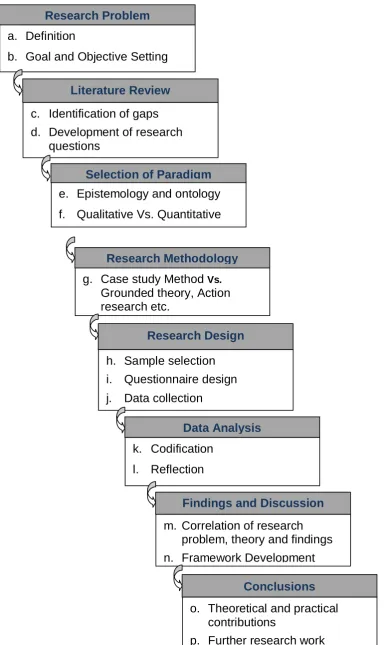
1.6 RESEARCH OVERVIEW
7
Figure 1.1: Research Process overview(source: Author)
Research Problem
a. Definition
b. Goal and Objective Setting
Literature Review
c. Identification of gaps d. Development of research
questions
Selection of Paradigm
e. Epistemology and ontology f. Qualitative Vs. Quantitative
Research Methodology
g. Case study Method Vs. Grounded theory, Action research etc.
Research Design
h. Sample selection i. Questionnaire design j. Data collection
Data Analysis
k. Codification l. Reflection
Findings and Discussion
m. Correlation of research problem, theory and findings n. Framework Development
Conclusions
o. Theoretical and practical contributions
8 1.7 RESEARCH FOCUS AND BOUNDARIES
The following sub-sections provide a brief overview of research focus, scope and boundaries in terms of related subject areas, and viewpoint adopted in positioning this thesis.
1.7.1 Positioning of the thesis
This research study focuses on developing a set of critical factors and a comprehensive framework for practicing customer knowledge management in order to enable organisations to achieve customer centricity and 360O view of customer. The proposed framework is intended to serve as a multi-dimensional guiding theory for practicing CKM in organisations with customer orientation and vision. However, it would not prescribe a definitive way or provide exhaustive steps on trivial aspects of CKM practice, intentionally leaving room for customised usage of framework depending on the organisational specificities.
1.7.2 Associated subject areas
9
1.7.3 Applicability of the framework
The customer knowledge management framework to be developed through this research study will apply to organisations with customer related departments. The framework will have direct implications for customer facing departments and some indirect inferences for other support functions like Information Technology (IT), Research and Development (R&D) etc within organisations. This CKM framework might not be relevant for micro or small organisations catering few customers. However, some aspects of the framework might be applicable for small organisations with vision for customer orientation and growth.
1.8 THESIS STRUCTURE
The thesis is broadly structured into following five chapters: a) Introduction, b) Literature review, c) Research methodology and design, d) Findings and analysis, and e) Conclusion and further work. In addition to these chapters, thesis includes references as a separate section and appendices. The following sub-sections provide a brief overview of content within chapters and appendix.
1.8.1 Chapter 2: Literature review
10
case studies and white papers, etc. This chapter provides a review of simple concepts and complex elements which lays the foundation for Customer Knowledge Management. This chapter highlights recent developments within CKM landscape through critical review of relevant theories and frameworks. In addition, literature review identifies gaps in CKM research and presents practical challenges in achieving 360o customer view among organisations. This chapter concludes with formulation of research questions to address these gaps and challenges.
1.8.2 Chapter 3: Research paradigm, methodology, and design
This chapter provides a review of various philosophical foundations and multiple research components within business and management domain. It presents rationale for selection of specific research tools based on comprehensive analysis of research problem in association with multiple methodological choices. This chapter presents a variety of criteria considered while selecting five case-organisations for empirical data collection. In addition, it provides a brief description of each of the case-organisations along with limitations and challenges encountered.
1.8.3 Chapter 4: Findings, analysis and developing a CKM framework
11
1.8.4 Chapter 5: Conclusion and further work
This chapter presents conclusions and implications of this research study. This final chapter begins with discussion regarding research objectives accomplishment, followed by theoretical and practical contributions to knowledge. Subsequently, it provides discussion on validity of findings and limitations of this study. Finally, the chapter concludes with some directions and potential opportunities for further research work.
1.8.5 Appendix A: Research Questionnaire
A copy of research questionnaire that has been used in semi-structured interviews during empirical research is provided as Appendix-A at the end of the thesis.
SUMMARY
12
2. LITERATURE REVIEW
“Intensive research is like drinking salt water. No matter how much you learn about a person, topic or event, you are left with an unquenchable thirst to find out more. The only solution is to keep researching and learning. Slaking your thirst is not the objective, because you can never learn enough and you will never know everything.” – Karl Pippart
INTRODUCTION
This chapter presents critical review of extant theories and concepts from Knowledge Management, Customer Relationship Management, and Customer Knowledge Management literature. Firstly, it provides an explanation of research scope of relevant theories and concepts such as customer, knowledge, management, customer knowledge (CK), knowledge management (KM), customer relationship management (CRM), and lead towards Customer Knowledge Management (CKM). This includes a comparison of KM, CRM and CKM based on literature review in order to stress the significance of CKM. This chapter highlights current research developments within CKM and imminent need for 360O view of customer in organisations along with some significant challenges. This chapter concludes with formulation of research questions to address the identified challenges as well as fill the gap in literature.
2.1 BASIC CONCEPTS: CUSTOMER, KNOWLEDGE, AND MANAGEMENT
13 Customer
The word customer originated from ‘custom’, meaning ‘habitual practice’. In this traditional view, organisation’s rigid definition of customer is someone who habitually purchases goods or services from that organisation. Even within this rigidity, sensible view from an organisation’s perspective would be, customer is someone with whom organisation had to maintain a relationship to sustain the ‘custom’ i.e., habitual buying. Review of literature indicates that this rigid view of customer and its definition is very narrow for practical and academic purposes (Al-shammari 2009, Imnoff et al., 2001). In contrast some authors define customer too broadly to include every entity that interacts with organisation in a significant manner (Shuman et al 2002; Massnick, 1997). Some of the views of these authors indicate that the term customer encompasses all stakeholders like employees, consumers, suppliers, tax authorities, environmental agencies, etc. Simons (2005) opposes this view and notes that “If everyone is a customer then no one is – and the focus on real customer is lost.” Accordingly, this research adopts the following definition which is neither too narrow nor too broad but at the same time directs organisations to focus their efforts. A customer is an individual or an entity that acquires or uses an offering, be it product and/or service, of an organisation. Customer as an entity includes any of the following: buyer, intermediate user, end user/consumer and prospect of an organisation’s offering (Al-Shammari 2009).
14
Set A – loyal customers, discount customers, impulsive customers, need based customers, and wandering customers
Set B – previous customers, existing customers, and prospective customers Set C – individual customers and organisational customers
Set D – lead users, early adopters, routine users, and laggards
Set E – accessible customers, exclusive customers, supportive customers, close minded customers, one man show, unqualified customers
Set F – innovators, early adopters, early majority, late majority, and laggards Set G – meek customers, aggressive customers, high-profile customers, rip-off customers, chronic complainer customers
These are some of the customer segments based on varied dimensions. For instance, customer segmentation in Set G is based on complaining behaviour. Depending on the context, some of these dimensions and sets are useful in trying to achieve customer focus within organisations. In addition to above sets, customer segmentation can be based on generic profilers like geographic, demographic, psychographic, and behavioural (Kotler and Armstrong, 2012; Brassington and Pettitt, 2006). Within each of these generic profilers there are multiple dimensions as follows:
Geographic: region; urban or rural
Demographic: age, sex, family size; income occupation, education; religion, race, nationality
Psychographic: social class, life style type, personality type Behavioural: product usage, brand loyalty, type of user
15
customers. This subsection dealt with the definition of customer and various types of customers within the context of this research and lead towards the concept of knowledge.
Knowledge
The term knowledge has gained wide attention and recognition from philosophical perspective, centuries back which is reflected in writings of famous philosophers like Plato, Aristotle and Socrates. Based on epistemological traditions of Rationalism and Empiricism, knowledge is perceived in two distinct ways. Rationalists argue that knowledge is attained deductively through reasoning while empiricists contend that knowledge is obtained inductively through sensory experience. Immanuel Kant synthesised these two schools of epistemology and notes that “though all our knowledge begins with experience, it does not follow that it all arises from experience” (Russell, 1961). Despite the arguments between these two schools of thought, initial description provided by Plato is highly regarded within contemporary KM domain (Nonaka & Takeuchi 1995; Kandadi, 2006). Plato describes knowledge in his writings Meno, Phaedo, and Theaetetus as “Justified true belief” back in 4th century BC while Kirkpatrick (1983) defines knowledge on similar grounds with slight variation as “assured belief: that which is known”. These two definitions are based on general philosophical perspective with no inclination to any of the modern management disciplines.
16
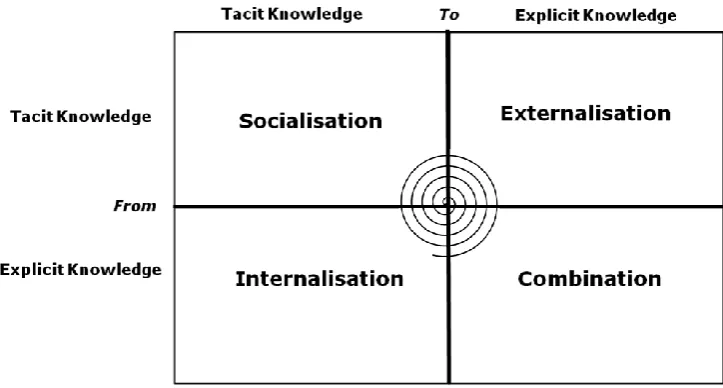
“knowledge is our most powerful engine of production”. Pioneers in organisational Knowledge management domain, Nonaka and Takeuchi (1995) within their phenomenal book ‘the knowledge-creating company’ propose that knowledge is created through a spiralling process of interactions between explicit and tacit knowledge. Tacit knowledge is personal, context specific and therefore hard to formalise and communicate. Polanyi (1966), in his famous aphorism about tacit knowledge says that “we know much more than we can tell”. Conversely, explicit knowledge can be expressed in words and numbers and shared in the form of data, scientific formulae, specifications, manuals and the like. It can be easily transferred across individuals formally and systematically (Nonaka and Takeuchi, 1995; Kandadi and Vasireddy 2009; Polanyi, 1966).
In contrast to Polanyi’s distinction between explicit and tacit knowledge, Nonaka and Takeuchi view that these two types of knowledge are not totally separate. They suggest that these two forms of knowledge are complementary entities, which “interact with and interchange into each other”. Based on the assumption that knowledge is created through the interactions between explicit and tacit knowledge,
17
the framework proposes four different modes of knowledge conversion: Socialisation, Externalisation, Combination and Internalisation (SECI). Socialisation is a process of sharing experiences and thereby creating tacit knowledge such as mental models and technical skills. Externalisation process involves articulation of tacit knowledge into explicit concepts. Through this process tacit knowledge is converted into explicit knowledge. Combination process involves conversion of explicit knowledge into more complex and systematic explicit knowledge. Internalisation is a process of learning whereby explicit knowledge becomes embodied into tacit knowledge. Figure 2.1 (on page 16) depicts the knowledge spiral of these four different modes of conversion (Nonaka & Takeuchi, 1995; Nonaka and Nishiguchi, 2001; Polanyi, 1966; Kandadi and Vasireddy, 2009).
18
along with its customers, and confines the definition of knowledge to ‘fluid mix of interpretations, ideas, values, experiences, views and/or hypothesis that is based on rational imagination, which can bring positive change to organisation and its customers’.
Management
19
organisation on track towards effective CKM with 360O view of customer, and making corrections as required (Daft, 2010; Schermerhorn, 2005).
This section addressed three basic concepts (customer; knowledge; management) and leads to successive concepts ‘customer knowledge’, ‘knowledge management’, and ‘customer relationship management’ which are crucial elements of CKM. The following sections provide critical review of these two crucial elements and some important CKM theories.
2.2 CUSTOMER KNOWLEDGE (CK)
The scope of customer knowledge includes not only ‘knowledge about customers’ and ‘knowledge for customers’ but also ‘knowledge from customers’ (Salomann, et al., 2005; Zanjani et al, 2008; Akhavan & Heidari, 2008). Al-Shammari (2009) highlighted another split which is ‘knowledge co-creation with customers’. However for the purpose of this research it is encompassed with in ‘knowledge from customers’. The following subsections provide a detailed description of the three elements of customer knowledge mentioned earlier.
2.2.1 Knowledge for customers
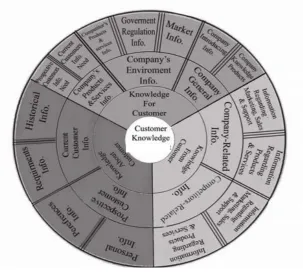
20
products and services info, organisation’s environment and general info with detailed information regarding each of them in second layer as shown in figure 2.2 (on page 21).Knowledge for customers within CKM addresses knowledge needs of customers by providing relevant information (i.e., knowledge on products, markets and suppliers) to take action in terms of purchasing or using products and services.
2.2.2 Knowledge about customers
This includes data about a customer like their name, contact information, connections, records of their historical transactions, requirements, expectations, post purchase issues and complaints, and their personal preferences. This accumulation of knowledge about customers is useful to understand Customers’ motivations and enable organisations to deal with them in a personalised way. Along with data about existing customers, this includes knowledge about prospective customers and target customer segments. This can be captured through other sources like collaborating with market research organisations. Organisations even utilise business intelligence (BI) and KM tools that attempt to determine overall customer profitability to the organisation (Cody et al., 2002).
2.2.3 Knowledge from customers
21
source for development of innovative products and they even highlighted the term ‘prosumer’ to emphasise the role of customer as both producer and consumer. Zanjani et al, (2002) notes that organisations needs to capture organisation-related information as well as competitor-related information from customers (Figure 2.2). Gebert et al, (2003) further emphasises that customers’ knowledge of products, suppliers and markets needs to be captured as well. These knowledge elements helps organisations to consistently innovate new products and services; segment their markets more effectively; develop successful business strategies and improve existing products and services (Davenport et al, 2001; Akhavan & Heidari, 2008).
Figure 2.2 below represents the conceptual model highlighting the above three elements of customer knowledge. Salomann, et al., (2005) reinforces the importance of knowledge for, from and about customers through empirical research in Union Investment, Siemens and Credit Suisse respectively.
22
Wilde (2011) explores each of these three types of customer knowledge based on four different dimensions as shown in the Table 2.1 below. He further explores characteristics of customer-oriented knowledge and cross tabulates them in a two by two matrix as shown in the Table 2.2 below.
Knowledge about the customer
Knowledge from the customer
Knowledge for the customer
Company/person B2B: industry,
creditworthiness
B2C: age, sex, income...
Own objective, strategies, own expectations, interests...
Specify problems and ascertain the demand
Product/service Product portfolio,
purchase history, contract duration...
Strengths/weakness
es of quality compared to the competitor
Scope of offer, quality features, prices...
Actions of the company
Type, intensity, frequency of customised activities
Strengths/weakness
es of activities compared to the competitor
Special offers, individual talks, special conditions..
Reactions of the customer
Turnover, gross margin, customer life time value, customer satisfaction, complaints
Insights and
intentions concerning products and
services
Achieved customer
status (e.g. in customer binding programs) or discount stages
Table 2.1: Types of customer knowledge (Source: Wilde 2011)
Explicit knowledge Tacit Knowledge
Individual knowledge Customer data in a specially managed customer file
Contact person with function
Customer’s assessment of the market development
Innovative ideas of the customer
Personal preferences of the customer
Detailed procedures at the customer
Customer’s reaction to complaints
Collective knowledge Customer’s disclosed assessment of the market development
Clearly articulated customer demands or collected through market research
Terms and invoicing practice
Transaction data
Customer master data
Contact person with his/her power position
Future behaviour of single customers
Requirements to be met by the market service
Rough future development of turnover
Jointly developed perceptions of the customer behaviour
23
Many studies in KM arena have emphasised the importance of customer knowledge in creating organisational value. (Al-Shammari, 2009; Paquette, 2008; Gibbert et al., 2002; Stefanou et al., 2003; Gebert et al., 2003; Liew, 2008). For example, Al-Shammari (2009) viewed customer knowledge as a source of sustainable competitive advantage while Stefanou et al (2003) notes customer knowledge as the most important asset in maintaining competitiveness. However, managing these knowledge flows between organisations and customers is the most important challenge. Davenport et al, (2002) also emphasises that the most important issue is how to concentrate efforts on managing only useful knowledge while not wasting time and resources on generating non-value adding information which falls in to the domain of knowledge management. The following section provides an overview of knowledge management and contextualises it to this research study.
2.3 KNOWLEDGE MANAGEMENT (KM)
24
Knowledge Management as an academic discipline has gained wide popularity for the past two decades and many authors came up with definitions for knowledge management within the context of their research. Following are some of the definitions of knowledge management (KM):
a) KM is a set of strategies, systems and processes that enable and simplify creation,
capture, sharing, distribution and utilization of organisation’s knowledge (Kandadi, 2006)
b) KM is the process of identifying, capturing, sharing, applying, disseminating, and creating
knowledge in organisation’s context (Liebowitz, 2006)
c) KM enables the creation, distribution, and exploitation of knowledge to create and retain
greater value from core business competencies. The primary goal of KM in business
context is to facilitate opportunistic application of fragmented knowledge through
integration (Tiwana, 2002)
d) KM is the discipline of creating a thriving work and learning environment that fosters the
continuous creation, aggregation, use and re-use of both organisational and personal
knowledge in the pursuit of new business value (Cross 1998 quoted in Little et al., 2002)
Within the context of this research, a broader view of Knowledge Management is taken and is viewed as a building block of CKM. This research adopts a comprehensive definition provided by Kandadi (2006) which states that “KM is a set of strategies, systems and processes that enable and simplify creation, capture,
25
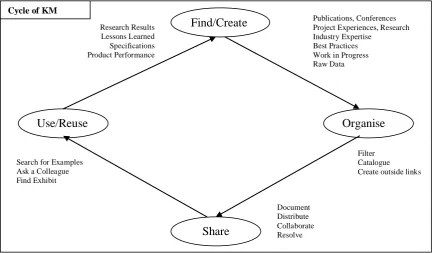
The main aim of KM is to build core competencies based on strategic business knowledge. Hence, the related knowledge processes within organisation needs to be focussed towards market oriented factors like customer needs, preferences and other external elements, along with managing internal knowledge of employees. Burk (1999) explains that knowledge management cycles enable information flow across organisation lines, making knowledge available in a timely fashion and where it is needed the most. Burk (1999) illustrates various components of knowledge management cycle in figure 2.3 below.
These four basic elements of knowledge management cycle (find/create, organise, share and use/reuse) are highly relevant for managing customer knowledge within organisations. Maier and Remus (2002) emphasises that knowledge management should consider and integrate both strategic business areas (market oriented view) and organisational resources and competencies (resource based view).
Find/Create
Organise Use/Reuse
Share
Cycle ofKM
Publications, Conferences Project Experiences, Research Industry Expertise
Best Practices Work in Progress Raw Data
Filter Catalogue Create outside links
Document Distribute Collaborate Resolve Search for Examples
Ask a Colleague Find Exhibit
Research Results Lessons Learned Specifications Product Performance
26
Within knowledge management context, focus of this CKM research is on specific parts of organisation’s knowledge i.e. customer knowledge. Further to the scope of customer knowledge and knowledge management within this research study, following section provides an overview of CRM along with its origins, definitions, and a review of conceptual model.
2.4 CUSTOMER RELATIONSHIP MANAGEMENT
Gebert et al (2003) notes that CRM emerged through amalgamation of management approaches like relationship marketing and IT oriented approaches like computer aided selling (CAS) and Sales Force Automation (SFA). CRM as a concept which focuses on nurturing customer relationships came into sight in the light of increasing competition and decreasing customer loyalty. Dyche (2001) defines CRM as “the Infrastructure that enables the delineation of and increase in customer value, and the
correct means by which to motivate valuable customers to remain loyal – indeed, to
buy again”. The main objective of CRM is customer retention through customer loyalty schemes. However, CKM is about innovation and growth through co-creation of organisational value with customers. Different types of CRM include the following (Xu and Walton, 2005; Dyche, 2001):
27
Analytical CRM : Use of data originating through operational CRM to enhance customer relationships.
Enterprise CRM : Cross-functional CRM system used across various organisations and departments.
Collaborative CRM : Specific functionality that enables a two-way dialogue between a company and its customers, through a variety of channels, to facilitate and improve the quality of customer interactions.
A review of a conceptual model of CRM proposed by Stefanou et al (2003) illustrates CRM development within organisations in stages leading towards an integrated CRM (i-CRM) as shown in figure 2.4 below.
28
The first stage is non IT assisted stage in which companies rely on cumbersome manual recording. The second stage is IT-assisted CRM which uses technology to enhance the customer relationship but it is largely a manual process. The third stage is IT automated CRM which uses technology for interaction with customers. The fourth stage of development is integrated CRM which leads to high level of service and customer personalization. Even with integrated CRM (i-CRM) the role of customer is limited to that of a loyal recipient of products and services. Where as, with CKM the role of customer is enhanced to that of an active partner in co-creation of organisational value. Following section provides an overview of CKM including its evolution, definition, and comparison with KM and CRM.
2.5 CUSTOMER KNOWLEDGE MANAGEMENT (CKM)
2.5.1 Evolution of CKM
29
efficiency (Newell, 2003; p9). CRM efforts have been focussed on these fundamental needs to organisation’s benefit and overlooked some aspects which are crucial for customer empowerment and success. Over decades, competitive landscape changed and nurturing customer relationships alone is not sufficient to sustain organisations. CRM efforts have failed to capture knowledge from customers that will enable organisations to innovate products and services to meet customer needs.
Managing customer knowledge effectively within an organisation, and between organisation and its customers is becoming important than ever before. Consequently knowledge intensity has increased and managing knowledge flows within customer relationships posed a challenge for CRM (Gebert et al 2002). With in this context of managing customer knowledge effectively, KM with its set of strategies, systems and processes to manage knowledge adds a significant value by facilitating knowledge flows between customers and organisation. Liew, (2008) argues that various KM sub-systems must be evaluated and relevant ones to be applied to CRM to achieve knowledge-based customer and value driven relationship management. He emphasises that KM needs to be integrated with CRM strategically in order to achieve this level of relationship and further ascertains that amalgamation of KM and CRM is undeniably a strategic move.
30
2.5.2 Customer Knowledge Management Definition
The following sub-section provides some insights into management of ‘customer knowledge’ in organisations and ‘knowledge management’ processes that are specifically tailored for customers, and intersection of these two i.e., particular KM processes for customer knowledge. Customer knowledge management is viewed as a combination of three elements and it is represented in Venn diagram in figure 2.5 below. Within this notation, CKM can be represented as union of two sets C[KM] and [CK]M that is CKM = C[KM] U [CK]M
Figure 2.5: C[KM], [CK]M and [CKM] (source: Zhang 2011)
These three elements of customer knowledge management i.e. C[KM], [CK]M, and [CKM] are explained in detail in following sub-sections.
2.5.2.1 Customer (knowledge management)
Zhang (2011) proposes that customer ‘knowledge management’ represented here as C[KM] denotes the KM processes and practices that are specifically tailored for customers. The KM processes related to customers include not
OKM
[CK]M [CKM]
31
only those between customers and organisations but also processes that facilitate knowledge sharing among customers themselves.
One category of processes enables customers to share and exchange experiences and knowledge among themselves so that they can utilise the knowledge obtained from other customers in purchasing goods or acquiring services. Krishnamurthy (2006) emphasises the importance of these processes in e-marketing context and highlights the following benefits for organisations: a) identifying major problems that are being faced by customers; b) benchmarking against competitive products and services stressing areas that need to be improved; and c) reducing customer service load as customers share and exchange knowledge and solutions among themselves.
Other category of processes facilitates knowledge flows between customers and organisations which include following two aspects:
1. Knowledge flow from organisations to customers that is imparting ‘knowledge for customers’ to assist with decision making process to buy organisation’s products and services; and
2. Knowledge flow from customers to organisations that is acquiring ‘knowledge from customers’ to improve product innovation and engage in new service development.
32
and technology infrastructure of an organisation have significant influence on the performance of above two categories of processes even though they need not deal with customers directly.
2.5.2.2 (Customer knowledge) management
‘Customer knowledge’ management represented here as [CK]M denotes special type of KM focusing on customer knowledge. Customer knowledge has some distinctive features when compared with general organisational knowledge. For example, customer knowledge is widely spread throughout organisation usually in fragmented form with diverse formats across different functional divisions and has significant direct impact on business performance. Davenport (2007) notes that customer knowledge can be derived from following three major channels:
1) Analysis of customer data 2) Interactions with customers 3) Observation of customers
33
Zhang (2011) proposes that [CK]M denotes a set of processes, methods, and styles of managing customer knowledge. For instance, the sharing of customer knowledge between two functional departments also belong to the category of [CK]M.
2.5.2.3 (Customer knowledge management)
‘[Customer knowledge management]’ represented here as [CKM] denotes the
particular KM processes for customer knowledge, which represents the intersection of C[KM] and [CK]M. Particularly, [CKM] includes multiple processes and methods of interacting with customers, extracting customer knowledge, and utilization of customer knowledge.
Customer Knowledge Management is a combination of above three elements. The main objective of CKM is to gain, expand, share and utilise the customers’ knowledge which in turn helps both customers and organisations. KM and CRM have significant roles to play as they are building blocks for CKM.
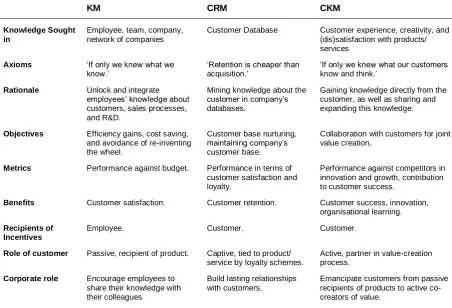
2.5.3 CKM versus KM and CRM
34
KM CRM CKM
Knowledge Sought in
Employee, team, company, network of companies
Customer Database Customer experience, creativity, and (dis)satisfaction with products/ services
Axioms ‘If only we knew what we know.’
‘Retention is cheaper than acquisition.’
‘If only we knew what our customers know and think.’
Rationale Unlock and integrate employees’ knowledge about customers, sales processes, and R&D.
Mining knowledge about the customer in company’s databases.
Gaining knowledge directly from the customer, as well as sharing and expanding this knowledge.
Objectives Efficiency gains, cost saving, and avoidance of re-inventing the wheel.
Customer base nurturing, maintaining company’s customer base.
Collaboration with customers for joint value creation.
Metrics Performance against budget. Performance in terms of customer satisfaction and loyalty.
Performance against competitors in innovation and growth, contribution to customer success.
Benefits Customer satisfaction. Customer retention. Customer success, innovation, organisational learning.
Recipients of Incentives
Employee. Customer. Customer.
Role of customer Passive, recipient of product. Captive, tied to product/ service by loyalty schemes.
Active, partner in value-creation process.
Corporate role Encourage employees to share their knowledge with their colleagues
Build lasting relationships with customers.
Emancipate customers from passive recipients of products to active co-creators of value.
Table 2.3: KM and CRM versus CKM (Source: adapted from Gibbert et al,2002)
2.5.4 Benefits of CKM
Several authors emphasise that an effective CKM is beneficial to both organisations and customers (Davenport et al, 2001; Garcia-Murillo and Annabi, 2002; Gibbert et al, 2002). An effective CKM would enable organisations to achieve following outcomes:
Innovate existing products: Knowledge about usage of products and services by
35
Extend products or services: Value-adding knowledge based services can be added
along with existing products and services and it will add value to offering in competitive environment.
Improve success in cross-selling: Customer knowledge provides opportunities for cross
selling. Many banks successfully use customer knowledge to sell varied financial products.
Know what your customers want to know: Effective CKM would enable to capture
customer buying behaviour and reveal aspects that play a crucial role in customer decision making.
Segment the customer base: Based on past transaction history and buying behaviour,
CKM enables segmentation of target customers based on offering.
Prioritise customers: CKM enables organisations to determine valuable customers
and prioritize resources to cater them in better way
Understand your customers’ internet behaviour: With exception of some cases, CKM
enables organisations to provide customized knowledge or send customized promotional offers to target customers.
Engender customer loyalty: CKM with its focus on customer success and customer
satisfaction engenders customer loyalty
2.6 REVIEW OF CKM THEORIES AND RELEVANT FRAMEWORKS
36
in academic literature much earlier and some insightful theories have been proposed since then (von Hippel, 1986; Herstatt and von Hippel 1992; von Hippel, 2001; Thomke and von Hippel, 2002; Gibbert et al, 2002). Academia has contributed to CKM domain through development of conceptual knowledge and relevant theories based on empirical research even before the term ‘customer knowledge management’ was coined. This section throws light on some old theories which focus on customer led innovation in organisations followed by more broad contemporary CKM theories.
2.6.1. Lead User Model
37
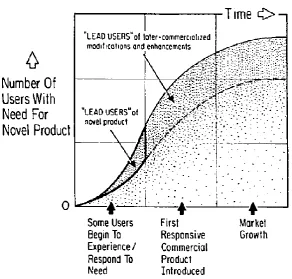
Figure 2.6 below schematically illustrates lead users’ position in the life cycle of a novel product, process, or service. Von Hippel (1986) describes two characteristics of ‘lead users’ of a novel product, process, or service as follows:
a) “They face needs that will be general in the marketplace - but face them months or years before the bulk of that marketplace encounters them, and b) They are positioned to benefit significantly by obtaining a solution to those
needs.”
Figure 2.6: Lear Users’ position in New Product Lifecycle (Source: von Hippel, 1986)
He proposed the following four-step process to integrate lead users into marketing research:
1. “Identify an important market or technical trend;
38 3. Analyse lead user need data;
4. Project lead user data onto the general market of interest.”
However, identifying a major trend along with relevant lead users is not an easy task and von Hippel himself concedes that organisations might face varied challenges while applying this model. Firstly, it is difficult to ascertain that the novel product needs faced by lead users are representative of wider marketplace. Secondly, these new product needs of lead users may be too novel for ordinary users and may not appeal to them in the near future.
In spite of these challenges, lead user model has huge potential to contribute towards developing valuable customer knowledge. Lead user model with its concentrated efforts and intensive personal interaction is capable of imbibing tacit knowledge into organisation through socialisation with customers. This ‘knowledge from customer’ is very precious and has high potential to lead towards innovation. The following theory of customer/user toolkits for innovation has synergy potential when used in combination with lead user model. This lead user model has high synergy potential when used in combination with customer/user toolkits for innovation. Customer/User toolkit solution is discussed in detail along with customers-as-innovators approach in the following sub-section.
2.6.2. Customer/User Toolkits for Innovation
39
with tools to design and develop their own products, and emphasise that understanding customers’ needs thoroughly is a costly and inexact process. In the traditional product development approach, manufacturers first find out customer/consumer needs and then produce products that meet them. Gaining a full understanding of user needs is difficult and consumes significant resources which make this approach very costly. Apart from cost, additional complexity often connected with understanding customers’ needs completely is customers’ inability to externalise tacit dimensions of their needs clearly.
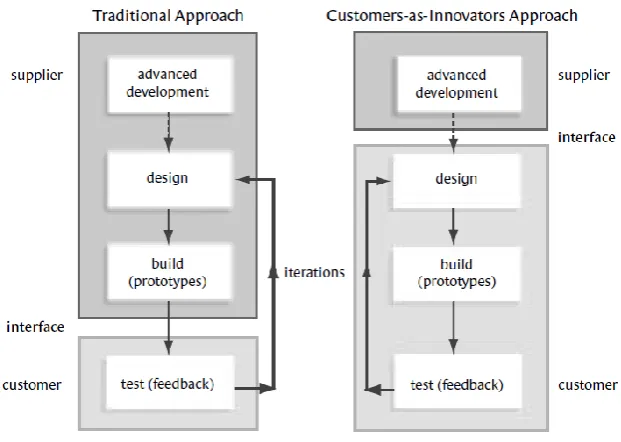
In order to address these complexities, Thomke and von Hippel (2002) proposed customers-as-Innovators approach in contrast to traditional approach as shown in figure 2.7 (on page 40). This approach enables customers/users to freely innovate, enabling them to design custom products in an iterative process through trial and error. Key to this approach is development of customer/user toolkit.
40
that user toolkits for innovation as a strong form of consumer involvement when compared with listening to customers and interaction with advanced users.
Figure 2.7: Approaches to develop custom products (Source: Thomke and von Hippel, 2002)
From manufacturer’s perspective, Katz & von Hippel (2002) argue that toolkits have potential to create competitive advantages. The major advantage for manufacturers from right toolkit solution can be “to allow easy, error-free translations of designs made by users into their own production capabilities”. They also note that “first-movers” have an opportunity to develop a design language that tends to be easily accepted and has high probability to become standard in that particular market. However, Thomke and von Hippel (2002) concede that “developing the right toolkit for a customer is hardly a simple matter”. They emphasise that toolkits need to provide following capabilities.
41
Toolkits need to be easily manageable for users, that is familiarising customers with them should not involve learning a new design language.
Toolkits need to contain libraries of useful components and modules which have been pre-tested and debugged.
Toolkits need to contain information about the capabilities and limitations of production process
In addition, Jeppesen and Molin (2003) determined a set of three important and interrelated dimensions influencing toolkit approach based on empirical research: solution space, consumer design capabilities, and support.
Solution space – Size of solution space determines the freedom of user that is a set of functions over which consumers have control. However if the solution space is too large, it complicates decision making as toolkit tends to be more complex and requires user to master more functions. Users need to have flexibility to choose the level of complexity based on their level of mastery over functions.
42
Support – Support in this context can be viewed as training and resources to enhance consumer design capabilities. Support from toolkit providers can be of immense use to consumers when they are not capable of dealing with tools on their own.
These three dimensions of the toolkit solution are very much interrelated. Size of solution space needs to consider customer design capabilities while shortcoming within customer design capabilities can be improved through support provision. This toolkit for customer innovation approach has synergy potential with lead user approach as ‘lead users’ are typically interested in designing custom products to fulfil their needs. These toolkits enable ‘lead users’ to design custom products that address their needs and at the same time allow manufacturers to outsource innovation of futuristic products to lead users as their current needs tend to uncover future standard needs. These Customer/user toolkits enable organisations to gain ‘knowledge from customer’ which not only adds value to customer knowledge but also lead organisations towards innovation. While these two theories (i.e. lead user model and customer/user toolkit solution) illustrate two ways to achieve novel product innovation, the following theory uncovers five styles of customer knowledge management to enable knowledge co-creation with customers.
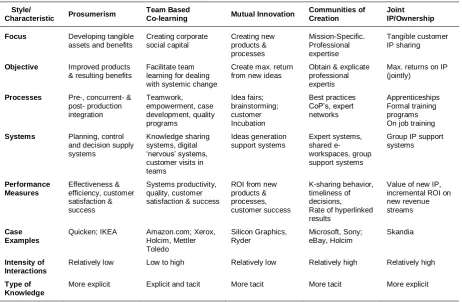
2.6.3. Five Styles of CKM
43
knowledge among organisations. They proposed five styles of CKM based on empirical research as follows:
Prosumerism: It means customer should handle the roles of producer and consumer. Prosumerism deals with co-production of products and services. For example IKEA, the furniture retailer, provides customers with planning tools (kitchen planner, bathroom planner, etc) to design the furniture that fits the specifications of their living environment there by making them co-producers.
Team based co-learning: It utilizes the knowledge of customers and focuses on reconfiguring entire organisation’s systems of value. For example, Amazon.com through interactive joint learning and inter-linkages with customer base reconfigured itself as a generalised access channel for various products and services.
Mutual innovation: Product innovations come from the end users of the product rather than organisation. For example Ryder Systems, a trucking company, transformed into extensive logistics solutions organisation by utilising knowledge from customers in operations, manufacturing and supply chain strategy through mutual innovation.

![Figure 2.5: C[KM], [CK]M and [CKM] (source: Zhang 2011)](https://thumb-us.123doks.com/thumbv2/123dok_us/9700607.1953234/41.595.190.406.331.438/figure-c-km-ck-m-ckm-source-zhang.webp)