F O R U M
Navigating the Perfect Storm: Research Strategies
for Socialecological Systems in a Rapidly Evolving World
John A. Dearing•Seth Bullock •Robert Costanza• Terry P. Dawson•Mary E. Edwards•
Guy M. Poppy•Graham M. Smith
Received: 9 August 2011 / Accepted: 19 February 2012 / Published online: 15 March 2012 Springer Science+Business Media, LLC 2012
Abstract The ‘Perfect Storm’ metaphor describes a combination of events that causes a surprising or dramatic impact. It lends an evolutionary perspective to how social-ecological interactions change. Thus, we argue that an improved understanding of how social-ecological systems have evolved up to the present is necessary for the mod-elling, understanding and anticipation of current and future social-ecological systems. Here we consider the implica-tions of an evolutionary perspective for designing research approaches. One desirable approach is the creation of multi-decadal records produced by integrating palaeoen-vironmental, instrument and documentary sources at mul-tiple spatial scales. We also consider the potential for improved analytical and modelling approaches by devel-oping system dynamical, cellular and agent-based models,
observing complex behaviour in social-ecological systems against which to test systems dynamical theory, and drawing better lessons from history. Alongside these is the need to find more appropriate ways to communicate com-plex systems, risk and uncertainty to the public and to policy-makers.
Keywords Social-ecological systemEvolutionary perspectivesManagement strategyEcosystem service
Multi-decadal Paleoenvironmental recordsDynamic modeling
Introduction
No matter how the political deliberations at recent global summits (UN Climate Change Conference 2009; UN Convention on Biodiversity 2010; UN Conference on Sustainable Development 2010) play out, the sustainable management of the world’s social-ecological systems will continue to remain a standing item on the global change agenda. While it is generally accepted that all nations implement appropriate environmental management strate-gies (e.g., UNEP Medium Term Strategy2010–2013) their formulation for specific nations and regions poses a sig-nificant challenge to scientists and policy-makers alike. At their heart exist frameworks that bring together the con-cepts of ecosystem services and social wellbeing via a flow of benefit (Millennium Ecosystem Assessment 2005; UK National Ecosystem Assessment 2010). While there is evidence of the interdependent roles played by frame-works, scenario generation, heuristics, qualitative rela-tionships and computational models in the policy process (Carpenter and others2009), the last two years have seen a rise in publications in sustainability and adaptation science J. A. Dearing (&)M. E. Edwards
Department of Geography and Environment, University of Southampton, Highfield Campus, Southampton SO17 1BJ, UK e-mail: [email protected]
S. Bullock
Department of Electronics and Computer Science, University of Southampton, Southampton, UK
R. Costanza
Institute for Sustainable Solutions, Portland State University, Portland, Oregon, USA
T. P. Dawson
Department of Geography, University of Dundee, Dundee, UK
G. M. Poppy
Department of Biological Sciences, University of Southhampton, Southampton, UK
G. M. Smith
Department of Social Sciences, University of Southampton, Southampton, UK
arguing that in many cases these tools fail to capture rel-evant complexities of the real world. In this paper, we consider the background to this perceived failure before assessing alternative approaches to observing, modelling, and communicating the complexities of the real world.
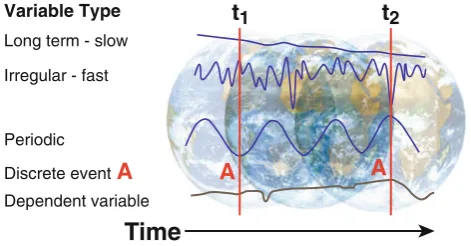
Two sets of arguments define the background to this problem. First, a greater level of understanding of inter-actions between social and ecological systems can be achieved by using complex systems theory (Nicholson and others 2009), a view strengthened by the empirical evi-dence for the rapidity of global environmental change (Steffen and others 2004). Boundary conditions may be changing so quickly as to negate the usefulness of equi-librium models, for example, with regards to water resources (Milly and others 2008), even though such models were previously considered fit for purpose. The problem is vividly expressed in John Beddington’s (2009) use of a Perfect Storm image to describe the multi-decadal interactions of several drivers culminating in dramatic, and often unanticipated, responses. As more information about past global trends (Steffen and others 2004) and future projections (Millennium Ecosystem Assessment 2005; Intergovernmental Panel on Climate Change2007) become available for an array of social, economic and environ-mental phenomena it is clear that management policies have to recognize and incorporate the impacts on ecosys-tem services of multiple interacting drivers and pressures (Fig.1). Beddington (2009) drew on projections of popu-lation growth, food security and water demands, in addition to the direct impacts of climate change, to speculate about abrupt change in the future. But it is a metaphor that can just as well be applied to crises that we have already observed in quite different domains: from regional fire risk to global financial collapse (Fig.1). Building on earlier arguments for an evolutionary understanding of people and nature (Costanza and others 1993), the metaphor empha-sizes the need for new approaches that canexplicitlyhandle emergent behaviour, ‘fast’ and ‘slow’ processes, feedback loops, critical transitions, thresholds and tipping points, and network interactions—in the real world.
Second, the management of ecosystem services demands place-based and comparative research, with the emphasis on constructing modelling tools that address policy-making at local and regional scales (e.g., Grimm and others2008; Carpenter and others 2009). At regional scales, impact assessment models (IAMs) are the main tools for agencies to engage with impacts, vulnerability, adaptation and sustainable management. Abundant com-puting power enables modeling that is cheap and fast (by comparison with empirical studies), but the question remains: will these models deliver what is required? Underlining the connection with complex systems, the argument has been made (e.g., Tallis and Kareiva 2006)
that IAMs frequently lack key feedbacks, are unable to predict critical thresholds and tipping points, and may fail to couple ecosystems and their associated services to societal wellbeing. Nicholson and others (2009) take a stronger line, arguing that modeling approaches that do not consider feedbacks have the potential to produce
danger-ous policy recommendations: they should not be used to
predict causality. IAMs may also be compromised as regards their spatial scale. For example, modeled future species distributions using bioclimatic envelopes often use the wrong spatial scale to define species niches (Trivedi and others 2008). Ignoring fine-scale environmental het-erogeneity (Willis and Bhagwat 2009) and failing to account for adaptive phenotypic plasticity, IAMs may exaggerate the loss of ecological niches and extinction rates (Dawson and others 2011). Each ecosystem process or service operates over a specific range of spatial and temporal scales (Costanza 2008). Without knowing what these scales are and how the services interact within a social-ecological network the high likelihood of being misled by non-causative correlations make valid assess-ments difficult. This is because in complex unbounded systems, such as social-ecological systems, equifinality
Long term - slow
Variable Type
t
1t
2Irregular - fast
Periodic
Discrete event
A
A
A
Dependent variable
Time
results in a system state (or set of states) that can be reached through many different pathways, processes and initial conditions of individual system components (von Bertalanffy1969). In this sense, Oldfield (2005) notes the lack of rigorous testing of IAM outputs against past data. Despite the problematic notions of validity and verification in complex domains (Oreskes and others 1994) the close correlation of past global and regional temperature simu-lations with long-term instrument records (IPCC2007) has perhaps made the most compelling argument for the acceptance of future climate-model projections. Oldfield (2005) speculates that some modellers prefer not to attempt such model validation against the past because failure may constrain the development of engaging scenarios of the future, which allow for a wide variation in the set of coherent, internally consistent and plausible descriptions of a possible future state of the world.
Arguments for new and improved conceptual insights and associated modeling tools that capture complexity belie the difficulty in creating them, but some recent developments are promising. Improvements to conven-tional impact assessments, such as Driver-Pressure-Stress-Impact-Response frameworks (Spangenberg and others 2009), offer new means for dealing explicitly with resil-ience and other dynamic properties of social-ecological systems (Dawson and others2010) by the incorporation of both autonomous and top-down (command-and-control) feedback processes (Rounsevell and others 2010). Press-Pulse Dynamic frameworks (Collins and others 2011) would seem to accommodate the interaction of slow and fast processes over the long term, and self-organizational processes are at the heart of Ostrom’s (2009) framework for analyzing human-environment interactions in social-ecological systems. Stakeholder participation is an essen-tial component in developing these frameworks and models (Walker and others2009). Typically a risk-assessment is involved. While it has been argued that any risk determi-nation—essentially a trade-off between costs and bene-fits—may be viewed as a non-scientific threshold decision (NRC 1983), Johnson and others (2007) argue that in regulatory decision-making the roles of scientists and of wider society are commonly confused. Their view is that scientists engaged in risk assessment should ensure they test well-defined hypotheses and that greater efforts are then made to integrate scientific risk assessment and risk analysis so thatnon-scientificquestions, such as economic and social acceptance, can be considered within the deci-sion-making process (Graham 1991; Sexton1995). Thus, as the interactions between major drivers of global change create increasingly complex effects it is now becoming recognized (e.g. Beddoe and others 2009; Walker and others2009) that co-evolving regulatory and institutional reform is a major international priority.
New methods that provide insight into how governance systems, users and resources interact will be increasingly useful to policy makers (McNie2007). But inevitably, the extent to which impact assessments are able to inform policy-makers about future thresholds and extreme events, and the basis on whether we can judge them to be ‘realistic’ outcomes, are questions that society will ask more fre-quently. So what are the ways forward? Here we consider three areas of study that we believe can contribute to an improved understanding of complex social-ecological changes: observing long-term system dynamics, modeling complex systems, and testing complexity theory against historical reconstructions. The common thread is a greater utilisation of long, multi-decadal records.
Observing Long-Term System Dynamics
Carpenter and others (2009) contend that management of ecosystem services demands not only place-based but long-term research. Monitored records from instruments and repeat surveys can provide long ecological and social-ecological perspectives (e.g., ILTEN 1993; Singh and others2010) but, unlike climate records, datasets are sparse and often cover a relatively short period of a few years. Increasingly, short records are supplemented with envi-ronmental reconstructions from historical (e.g., Stafford Smith and others2007) and paleoecological investigations (e.g., Dearing and others2006a). Indeed, there is growing evidence that multi-decadal perspectives are not only useful in providing context. Rather, they may actually represent the true timescales within which a contemporary system operates (Dearing and others 2010) helping to observe the nature of legacies and contingencies: the changing pattern of magnitude-frequency relationships; ‘slow’ and ‘fast’ processes; the existence of thresholds; and the convergence and divergence of system and variable trajectories over these timescales (cf. Fig.1). As such, these system properties all give crucial insight into the functioning of contemporary social-ecological systems (Foster and others 2003; Costanza and others 2007a; Dearing and others2008; Froyd and Willis2008) and their resilience properties (Walker and others 2002; Dearing 2008). Without knowing the paths and drivers of social and ecological processes, and their interactions, across all rel-evant timescales it is doubtful whether ‘predictive’ simu-lation models (including agent-based, impact analysis, reduced complexity, and numerical process models) can be accurately created.
This means that evolutionary perspectives for many real world social-ecological systems are plausible. Whether the current trajectories for social and ecological states are diverging, converging or in coincidental states determines to a large extent the likelihood of abrupt system change in the future. Similar arguments have recently been put for-ward in explaining the development of modern urban and regional economies (Martin and Sunley2006; Simmie and Martin2010). For sustainable management of landscapes and resources over annual-decadal timescales it is desirable to identify the range of potential paths that push the system towards relative stability, threshold-dependent responses, gradual but irreversible changes, lower levels of resilience, or path-dependent ‘poverty’ traps characterised by low efficiency (e.g., Stafford Smith and others2007).
Thus, temporally extended databases of social-ecologi-cal systems will make it easier to answer pragmatic ques-tions about regional condiques-tions, for example:
• How rapidly is the whole landscape changing and which social and ecological processes are changing most rapidly? Answers to this question allow policy-makers to prioritize action across the range of ecosys-tem services and to create simple aggregated, indices of change for communication (cf. IGBP Climate Change Index 2009).
• What are the appropriate pre-impact target conditions for management or restoration of key ecological processes and services that would give long-term sustainable use? In some policy arenas (e.g., EU Water Framework Directive 2002) target conditions for restoration are already based on analyses of past conditions. For other ecosystem processes/services, like soil erosion and biodiversity, policy now lags behind the knowledge base in many regions (Willis and others2010).
• How have the various parts of the social-ecological system interacted through time? Long records of ecological services and their drivers allow partial reconstruction of energy, material and information networks through time. (e.g., Dai and others 2009). Conceptualising how these interactions have changed up to the present enhances our study of the evolutionary processes at work within the system: the mechanisms that drive conditions towards or away from Perfect Storm scenarios; the important feedbacks; the presence of thresholds. But such conceptual models also repre-sent an esrepre-sential preliminary stage in developing simulation models.
• Which parts of the landscape are particularly resilient to current social and biophysical (e.g., climate) drivers, and which are particularly sensitive? Here, there is the scope to analyse the long-term records in terms of evolutionary conceptual models of change, like the
adaptive cycle (Gunderson and Holling 2002; Dearing 2008). For example, knowing where the system lies on the adaptive cycle may give insight into its resilience (Holling2001). But long-term records might also allow a critical reappraisal of the conditions under which we do and do not see the dynamics described by such conceptual models. Recent suggestions that abrupt changes in climate and ecological systems can be anticipated by observing early warning signals is an exciting development (Biggs and others2009; Scheffer and others2009). But detection of these signals in real world social-ecological systems is difficult with limited observations, underlining the need for multi-decadal records.
Modeling Complex Systems
Macro-scale dynamical modeling of global social-ecological system started in the 1970 s with the Limits to Growth pro-gramme, using World3 (Meadows and others 1972;2005). More recent integrated global models, like IMAGE, IFS, DICE, TARGETS and GUMBO (see review in Costanza and others2007b) attempt to capture complex behaviour that arise through the interaction of social and biophysical processes. In systems’ modeling, success is measured by an improved ability to understand the fundamental organisation of a sys-tem’s dynamical behaviour (e.g., Costanza and Voinov2003; Low and others1999), rather than an apparent ability to pre-dict one particular outcome at one particular time in the future. Turner’s (2008) comparison of the Limits to Growth outputs from the 1970s with data sets for key variables measured over the past 30 years shows striking similarities, especially with the ‘business-as-usual’ scenario. Not only do the findings suggest that World3 captures realistic interaction of feedback mechanisms, but that the modelled trends and interactions into the 21st century resonate with the perceived effects of multiple stressors (Turner 2008p. 409) as visualised in the Perfect Storm image. Indeed, both World3 and GUMBO (Boumans and others2002) indicate declining trends in ‘food per capita’ before 2050 using ‘business-as-usual’ scenarios. Given these insights at aggregated, global scales, it is surprising that there have not been more attempts to develop integrated regional dynamic models. One major obstacle may be the perceived lack of data needed for model calibration and testing. World3 and GUMBO outputs were calibrated against global datasets for key variables (e.g., total population) available from 1900 onwards, but multi-decadal data sets (especially for ecological services) are often perceived as unavailable at sub-global scales.
history, palaeoenvironmental and archaeological sources show that this perception may be misguided for many regions (Past Global Changes2010; Dearing and others2011). Ana-lytical developments in the paleoenvironmental sciences means that proxy records for regional fire, flooding, soil ero-sion, carbon flux, nutrient export, water quality, atmospheric pollution, sediment transport, algal levels, fish stocks, terres-trial biodiversity, land cover, land use, climate variables and other variables linked explicitly to ecosystem services can now be routinely obtained from sedimentary archives (Dear-ing2006; Dearing and others in review). There are caveats to note, especially with regards the calibration of paleoecologi-cal proxies, their dating and the geographipaleoecologi-cal coverage (Dearing and others in review). But for many regions, quan-titative and high resolution reconstructed time-series, which can replace instrument and document records where none exists and extend the timescale of existing time-series, now provide the means for testing model skill (Anderson and others2006; Dearing and others2006b).
Top-down, aggregated, macroscale system dynamical models may capture feedback mechanisms among major system components and processes, but as generally con-stituted do not simulate changes in the spatial distribution of phenomena: essentially giving a 2D rather than a 4D representation of change. In contrast, so-called ‘bottom-up’ approaches simulate autonomous change through continu-ous interaction and feedback within space as well as time, and include reduced complexity cellular automata and agent-based models based on local rules and behaviour (Costanza and others1990; Costanza and Voinov 2003; Anderson and others 2006). Application of ‘bottom-up’ models to social-ecological systems so far has included testing hypotheses about past cultural shifts (e.g., Dean and others2000), simulating land use change and urbanisation (e.g., Fontaine and Rounsevell 2009), and experimenting with the effects of different weightings of climate and land use on landscape processes (Coulthard and Macklin2001). A major challenge for these new modelling tools is the creation of frameworks that are able to accommodate both social and physical processes with their very different levels of fundamental laws (Dearing2007), though recent attempts to do this look promising (Wainwright 2008). Validation against past records is key, and possible (e.g., Welsh and others2009), indicating that full compilations of historical data should be central to the design of forward modelling programmes (e.g., Butler and others2007).
Testing Complexity Theory Against Historical Reconstructions
We usually learn from history by drawing generalizations from historical events that represent credible analogues
with the present (Dearing and others2010). For example, it seems that monetary policy for handling the recent global financial crisis drew as much on analyses of the socio-economic interactions in the early 1930s as from contem-porary economic models. The literature is replete with historical case studies of social-ecological change that potentially provide lessons for the future (see Dearing 2006). But criticisms of an analogue approach are long-standing and many. They include the difficulty of matching modern political and technological conditions with those in the past, and the possible bias towards the examination of disasters and social collapses, as in the history of Easter Island. However, new, imaginative developments suggest that far from being simplistic analogues for the present, historical case studies can provide important heuristic ty-pologies of social-ecological system behaviour (Costanza and others2007a; Tainter and Crumley2007; Dearing and others 2010) and decision-making (Diamond 2005). For example, historical reconstructions of repeated drought-led agricultural collapse in Australia show that the phenome-non was characterized by a distinct set of social and eco-logical interactions that varied in local detail but had a common pattern (Stafford Smith and others 2007). Other global zones vulnerable to drought may also have their own unique properties that, through the historical record, are amenable to description and analysis at a level of general system behavior. Such a typological approach that com-presses system complexity into an easily understood nar-rative of system behaviour adds important qualitative details to classifications of modern social-ecological sys-tems (Lu¨deke and others 2004) and provides an attractive option for communicating findings to policy makers.
systems science uses information theory. Ulanowicz and others’ (2009) mathematical studies of ecological food webs allow quantification of the size, efficiency and resil-ience of networks. Their results show that natural ecosys-tems have a small space of stability, awindow of vitality, which they extend to a general model for the sustainability of all networks in terms of diversity and connectivity. Networks that are too efficient, with too little diversity become ‘brittle’ and lack resilience, whereas those with insufficient efficiency create stagnation. These findings not only resonate strongly with current resilience theory and the adaptive cycle (Gunderson and Holling2002), but also with observations of modern socio-economic systems (Goerner and others2009) and cascading social and eco-logical crises (e.g., Adger and others 2009; Galaz and others 2010), and the detailed analysis of past societal collapses, such as the Roman Empire (Tainter and Crumley 2007). But systematic analysis of these potential connec-tions between mathematical theory, heuristics and obser-vations remains undone.
Thus, there is the exciting possibility that historical case studies can play a key role in testing current complexity theory in order to help develop new social-ecological the-ory. The approach would be to compare mathematical system behaviour drawn from ecology and complexity science against historical, empirical records from the real world. Past records not only provide longer timescales than are conventionally available for modern observations but provide a larger array of social-ecological systems than currently exist. A strong theoretical basis would help sharpen the design focus for adaptation strategies and give an enhanced level of confidence in their deployment.
Navigating the Storm
There is then reason to be optimistic about our ability to improve our understanding of social-ecological systems. However, this in itself does not ensure better policy because there are numerous barriers to effective policy making. Here we confine discussion to the way in which scientists communicate their findings to policy-makers and the general public, and the expectations of scientists on the part of policy-makers and the public. As scientists develop a more refined approach to dealing with complex systems, how should they communicate complex and alternative views of the future? Scientists are under pressure to pre-dict, but at some stage the semantics need to change. Policy-makers need to know that large-scale simulations, ‘in silico’ science, ‘virtual labs’ and synthetic experiments are not sources of facts about the world that can be acted upon but must be viewed as ways of exploring system sensitivities and the ramifications of theories (Peck 2004;
Di Paolo and others2000). Policy-makers need to accept and accommodate the fact that the best available scientific understanding may not enable usto reduce uncertainty or
evento define uncertaintybut only to definewhat we may
never know(Costanza and Cornwell1992; Makridakis and
Taleb2009), and to reach consensus on what we currently understand. Easily communicated results may be attractive but have little value to policy makers and society in the long run if they are based on methods that do not adhere to the new complexity paradigm. Scenarios seldom account for emergent properties and behaviours arising from com-plex system dynamics, which are largely unpredictable. At some point, scenario-driven models alone will be unable to provide the essential depth of understanding or range of realistic options needed to support effective policy-making. Successful policy decision-making to address the mul-tilevel and multiscale character of today’s complex social, political and environmental challenges requires both access to clear accurate scientific information and an effective adaptive governance context to navigate the research-pol-icy linkages effectively (Court and Cotterell2004). Whilst the arrangement of the appropriate institutional factors for governing complex systems remain poorly understood (Folke and others 2007; Termeer and others 2010), the scientific knowledge needs to be communicated through multiple pathways and scales depending on needs of the various stakeholders: government, non-governmental organizations, lobby-groups, epistemic communities, international organizations and others. A major research challenge is to know when to discard simplistic explana-tions in favour of complex realism, and how this should be communicated. We have to recognize that the credibility of models derives from two distinct sources: (1) the ability of the model to simulate complex reality and (2) the degree of consensus about the model and its assumptions among the stakeholders who might use the model (van den Belt2004). This ‘social capital’ component is often overlooked but is essential for creating models that are actually used in policy-making (Brondizio and others2009).
approaching a time when untested IAM assessments of future impacts may have less influence on discussions about policy than hitherto because the realism of projec-tions are unacceptably low given the insightsfrom com-plexity science. However, the expectations of science on the part of society and policy makers are still not yet compatible with the existing modeling abilities of the sci-entific community to capture and relay the complexity of future worlds. Concerted efforts in these methodologies therefore need to develop in parallel with debate and education about the real meanings of complex systems, risk and uncertainty. In addition, new forms of multi-level, polycentric, adaptive, participatory governance institutions will need to be developed that can better incorporate complexity modeling into decision-making.
Model development for adaptation policies and sus-tainable management is at a crossroads. We are seeing the birth of evolutionary approaches that have the potential to lift us out of an outmoded over-commitment to impact assessment models at the expense of nuanced understand-ing of system complexity. If we fail to embrace this potential, the prospects for designing meaningful and effective adaptation strategies are low.
Acknowledgments This paper represents the outcome of discus-sions held within the Sustainability Science research group at Southampton (previously Living with Environmental Change) during 2009. Figure1 was produced following a workshop held at the National Center for Ecological Analysis and Synthesis (NCEAS), Santa Barbara, within the IHDP-IGBP initiative ‘Integrating the History and Future of People on Earth’ in November 2008. The IHOPE initiative (http://www.aimes.ucar.edu/ihope/) aims to better understand the social-ecological dynamics of human history by test-ing human-environment system models against historical changes.
References
Adger WN, Eakin H, Winkels A (2009) Nested and teleconnected vulnerabilities to environmental change. Frontiers in Ecology and the Environment 7:150–157
Anderson NJH, Bugmann H, Dearing JA, Gaillard-Lemdahl M-J (2006) Linking palaeoenvironmental data and models to under-stand the past and to predict the future. Trends in Ecology & Evolution 21:696–704
Bak P (1996) How nature works: the science of self-organized criticality. Copernicus, New York
Baraba´si AB, Albert R (1999) Emergence of scaling in random networks. Science 286:509–512
Beddington J (2009) Presentation given to the Sustainable Development UK Annual Conference, London, 19 March 2009 http:// webarchive.nationalarchives.gov.uk/?/http://www.dius.gov.uk/ news_and_speeches/speeches/john_beddington/perfect-storm. Accessed 30 January 2012
Beddoe R, Costanza R, Farley J, Garza E, Kent J, Kubiszewski I, Martines J, McCowen T, Murphy K, Myers N, Ogden Z, Stapleton K, Woodward J (2009) Overcoming systemic road-blocks to sustainability: the evolutionary redesign of world-views, institutions and technologies. Proceedings of the National Academy of Sciences 106:2483–2489
Biggs R, Carpenter SR, Brock WA (2009) Turning back from the brink: detecting an impending regime shift in time to avert it. Proceedings of the National Academy of Sciences. doi: 10.1073/pnas.0811729106
Boumans R, Costanza R, Farley J et al (2002) Modeling the dynamics of the integrated earth system and the value of global ecosystem services using the GUMBO model. Ecological Economics 41:529–560
Brondizio ES, Ostrom E, Young OR (2009) Connectivity and the governance of multilevel social-ecological systems: the role of social capital. Annual Review of Environment and Resources 34:253–278
Butler SJ, Vickery JA, Norris K (2007) Farmland biodiversity and the footprint of agriculture. Science 315:381–384
Carpenter SR, Mooney HA, Agard J et al (2009) Science for managing ecosystem services: beyond the Millennium Ecosys-tem Assessment. Proceedings of the National Academy of Sciences 106:1305–1312
Collins SL, Carpenter SR, Swinton SM et al (2011) An integrated conceptual framework for long-term social–ecological research. Frontiers in Ecology and the Environment 9:351–357
Costanza R (2008) Ecosystem Services: multiple classification systems are needed. Biological Conservation 141:350–352 Costanza R, Cornwell L (1992) The 4P approach to dealing with
scientific uncertainty. Environment 34:12–20
Costanza R, Voinov A (eds) (2003) Landscape simulation modeling: a spatially explicit, dynamic approach. Springer, New York Costanza R, Sklar FH, White ML (1990) Modeling coastal landscape
dynamics. Bioscience 40:91–107
Costanza R, Wainger RL, Folke C, Maler K-G (1993) Modeling complex ecological economic systems: toward an evolutionary, dynamic understanding of people and nature. Bioscience 43:545–555
Costanza R, Graumlich LJ, Steffen W et al (2007a) Sustainability or collapse: what can we learn from integrating the history of humans and the rest of nature. Ambio 36:522–527
Costanza R, Leemans R, Boumans, Gaddis E (2007b) Integrated global models. In: Costanza R, Graumlich L, Steffen W (eds), Integrated history and future of people on earth. Dahlem Workshop Report 96. The MIT Press, Cambridge
Coulthard TJ, Macklin MG (2001) How sensitive are river systems to climate and land-use changes? A model-based evaluation. Journal of Quaternary Science 16:347–351
Court J, Cotterrell L (2004) What political and institutional context issues matter for bridging research and policy? A literature review and discussion of data collection approaches. Overseas Development Institute, London
Crumley CL (1995) Heterarchy and the analysis of complex societies. Archeological Papers of the American Anthropological Associ-ation 6:1–5
Dai X, Yu L, Dearing JA et al (2009) The recent history of hydro-geomorphic processes in the upper Hangbu river system, Anhui Province, China. Geomorphology 106:363–375
Dawson TP, Rounsevell MDA, Kluva´nkova´-Oravska´ T, Chobotova´ V, Stirling A (2010) Dynamic properties of complex adaptive ecosystems: implications for the sustainability of service provi-sion. Biodiversity and Conservation 19:2843–2853
Dawson TP, Jackson ST, House JI, Prentice IC, Mace GM (2011) Beyond predictions: biodiversity conservation in a changing climate. Science 332:53–58
Dean JS, Gummerman GJ, Epstein JM et al (2000) Understanding Anasazi culture change through agent-based modelling. In: Kohler T, Gumerman GJ (eds) Dynamics in human and primate societies. Oxford University Press, Oxford, pp 179–206 Dearing JA (2006) Climate-human-environment interactions:
Dearing JA (2007) Integration of world and earth systems: heritage and foresight. In: Hornborg A, Crumley CL (eds) The world system and the earth system. Left Coast Press, Santa Barbara, pp 38–57
Dearing JA (2008) Landscape change and resilience theory: a palaeoenvironmental assessment from Yunnan, SW China. The Holocene 18:117–127
Dearing JA, Battarbee RW, Dikau R, Larocque I, Oldfield F (2006a) Human-environment interactions: learning from the past. Regional Environmental Change 6:1–16
Dearing JA, Battarbee RW, Dikau R, Larocque I, Oldfield F (2006b) Human-environment interactions: towards synthesis and simu-lation. Regional Environmental Change 6:115–123
Dearing JA, Jones RT, Shen J et al (2008) Using multiple archives to understand past and present climate–human–environment inter-actions: the lake Erhai catchment, Yunnan Province, China. Journal of Paleolimnology 40:3–31
Dearing JA, Braimoh AK, Reenberg A, Turner BL II, van der Leeuw SE (2010) Complex land systems: the need for long time perspectives in order to assess their future. Ecology and Society 15:21
Dearing JA, Dotterweich M, Foster T, Newman L, von Gunten L (2011) Integrative Paleoscience for Sustainable Management. PAGES News 19 (2) http://www.pages.unibe.ch/products/2011-03-28-16-23-06/370-pages-news-vol-19-no2. Accessed 30 January 2012
Dearing JA, Yang X, Dong X et al (in review) Extending the timescale and range of ecosystem services through paleoenvi-ronmental analyses: the example of the lower Yangtze basin. Proceedings of the National Academy of Sciences
Di Paolo EA, Noble J, Bullock S (2000) Simulation models as opaque thought experiments. In: Bedau MA, McCaskill JS, Packard N, Rasmussen S (eds) Proceedings of the seventh international conference on artificial life. MIT Press, Cambridge, pp 497–506 Diamond J (2005) Collapse: how societies choose to fall or succeed.
Viking, New York
European Union Water Framework Directive (2002)http://ec.europa. eu/environment/water/water-framework/info/intro_en.htm. Acces-sed 30 January 2012
Folke C, Pritchard L, Berkes F, Colding J, Svedin U (2007) The problem of fit between ecosystems and institutions: ten years later. Ecology and Society 12:30.http://www.ecologyandsociety. org/vol12/iss1/art30/
Fontaine CM, Rounsevell MDA (2009) An agent-based approach to model future residential pressure on a regional landscape. Landscape ecology 24:1237–1254
Foster DRF, Swanson J, Aber I et al (2003) The importance of land-use legacies to ecology and conservation. Bioscience 53:77–88 Froyd CA, Willis KJ (2008) Emerging issues in biodiversity and
conservation management: the need for a palaeoecological perspective. Quaternary Science Reviews 27:1723–1732 Galaz V, Moberg F, Olsson E-K, Paglia E, Parker C (2010)
Institutional and political leadership dimensions of cascading ecological crises. Public Administration 89:361–380
Goerner SJ, Lietaer B, Ulanowicz RE (2009) Quantifying economic sustainability: implications for free-enterprise theory, policy and practice. Ecological Economics 69:76–81
Graham JD (1991) Science and environmental regulation. In: Graham JD (ed) Harnessing science for environmental regulation. Praeger Publishers, New York, pp 1–9
Grimm NB, Faeth SH, Golubiewski NE et al (2008) Global change and the ecology of cities. Science 319:756–760
Gunderson LH, Holling CS (eds) (2002) Panarchy: understanding transformations in systems of humans and nature. Island Press, Washington
Hardin G (1968) The tragedy of the commons. Science 162: 1243–1248
Holling CS (2001) Understanding the complexity of economic, ecological and social systems. Ecosystems 4:390–405
Intergovernmental Panel on Climate Change (2007) 4th Assessment Report. Synthesis Report Summary for Policymakers and Working Group II Report Impacts, Adaptation and Vulnerability Summary for Policymakers http://www.ipcc.ch/. Accessed 30 January 2012
International Geosphere-Biosphere Programme Climate Change Index (2009) http://www.igbp.net/5.1b8ae20512db692f2a68000 8616.html. Accessed 30 January 2012
International Long Term Ecological Network (1993) http://www. ilternet.edu/. Accessed 30 January 2012
Janssen MA, Bodin O¨ , Anderies JM et al (2006) A network perspective on the resilience of social-ecological systems. Ecology and Society 11:15.http://www.ecologyandsociety.org/vol11/iss1/art15/ Johnson KL, Raybould AF, Hudson MD, Poppy GM (2007) How
does scientific risk assessment of GM crops fit within the wider risk analysis? Trends in Plant Science 12:1–5
Low B, Costanza R, Ostrom E, Wilson J (1999) Human: ecosystem interactions: a dynamic integrated model. Ecological Economics 31:227–242
Lu¨deke MKB, Petschel-Held G, Schellnhuber H-J (2004) Syndromes of global change: the first panoramic view. Gaia 13:42–49 MacArthur R (1955) Fluctuations of animal populations and a
measure of community stability. Ecology 36:533–536
Makridakis S, Taleb NN (2009) Living in a world of low levels of predictability. International Journal of Forecasting 25:840–844 Martin R, Sunley P (2006) Path dependence and regional economic
evolution. Journal of Economic Geography 6:395–437 May RM (1974) Stability and complexity in model ecosystems, 2nd
edn. Princeton University Press, Princeton
McNie EC (2007) Reconciling the supply of scientific information with user demands: an analysis of the problem and review of the literature. Environmental Science and Policy 10:17–38 Meadows DH, Meadows DL, Randers J, Behrens WW (1972) The
limits to growth. Universe, New York
Meadows DH, Randers J, Meadows DL (2005) Limits to growth: the 30-year update. Earthscan, London
Millennium Ecosystem Assessment (2005) Ecosystems and human well-being: synthesis. Island Press, Washington.http://www.millennium assessment.org/en/synthesis.aspx. Accessed 30 January 2012 Milly PCD, Betancourt J, Falkenmark M et al (2008) Stationarity is
dead: whither water management? Science 319:573–574 National Research Council (1983) Risk assessment in the federal
government: managing the process. The National Academy Press, Washington
Nicholson E, Mace GM, Armsworth PR et al (2009) Priority research areas for ecosystem services in a changing world. Journal of Applied Ecology. doi:10.1111/j.1365-2664.2009.01716.x Oldfield F (2005) Environmental change. Cambridge University
Press, Cambridge
Oreskes N, Shrader-Frechette K, Belitz N (1994) Verification, validation, and confirmation of numerical models in the Earth Sciences. Science 263:641–646
Ostrom E (2001) Reformulating the commons. In: Burger J, Ostrom E, Norgaard RB et al (eds) Protecting the commons: a framework for resource management in the Americas. Island Press, Washington, pp 17–41
Ostrom E (2009) A general framework for analyzing sustainability of social-ecological systems. Science 325:419–422
Peck SL (2004) Simulation as experiment: a philosophical reassess-ment for biological modeling. Trends in Ecology & Evolution 19:530–534
Rosling H (2009) Asia’s rise: how and when.http://www.ted.com/ talks/hans_rosling_asia_s_rise_how_and_when.html. Accessed 30 January 2012
Rounsevell MDA, Dawson TP, Harrison PA (2010) A conceptual framework to assess the effects of environmental change on ecosystem services. Biodiversity and Conservation 19:2823–2842
Scheffer M, Bascompte J, Brock WA et al (2009) Early-warning signals for critical transitions. Nature 461:53–59
Sexton K (1995) Science and policy in regulatory decision making: getting the facts right about hazardous air pollutants. Environ-mental Health Perspectives 103(Suppl 6):213–222
Simmie J, Martin R (2010) The economic resilience of regions: towards an evolutionary approach. Cambridge Journal of Regional Studies 3:27–43
Singh SJ, Haberl H, Gaube V et al (2010) Conceptualising long-term social-ecological research (LTSER): Integrating socioeconomic dimensions into long-term ecological research. In: Mu¨ller, F. et al. (eds) Long-term ecological research, between theory and application. Springer, Berlin
Spangenberg JH, Martinez-Alier J, Omann I, Monterroso I, Binimelis R (2009) The DPSIR scheme for analysing biodiversity loss and developing preservation strategies. Ecological Economics 69:9–11
Stafford Smith DM, McKeon GM, Watson IW et al (2007) Learning from episodes of degradation and recovery in variable Australian rangelands. Proceedings of the National Academy of Sciences 104:20690–20695
Steffen W, Sanderson A, Tyson P et al (2004) Global change and the earth system: a planet under pressure. Springer, Berlin Tainter JA, Crumley C.L. (2007) Climate, complexity, and problem
solving in the Roman Empire. In: Costanza R, Graumlich LJ, Steffen W (eds) Sustainability or collapse? An integrated history and future of people on earth. Dahlem Workshop Report 96. The MIT Press, Cambridge
Tallis HM, Kareiva P (2006) Shaping global environmental decisions using social-ecological models. Trends in Ecology & Evolution 21:562–568
Termeer CJAM, Dewulf A, van Lieshout M (2010) Disentangling scale approaches in governance research: comparing monocen-tric, multilevel, and adaptive governance. Ecology and Society 15: 29.http://www.ecologyandsociety.org/vol15/iss4/art29/ Trivedi MR, Berry PM, Morecroft MD, Dawson TP (2008) Spatial
scale affects bioclimate model projections of climate change
impacts on mountain plants. Global Change Biology 14:1089–1103
Turner GM (2008) A comparison of the limits to growth with 30 years of reality. Global Environmental Change 18:397–411 Ulanowicz RE, Goerner SJ, Lietaer B, Gomez R (2009) Quantifying
sustainability: resilience, efficiency and the return of information theory. Ecological Complex 6:27–36
United Kingdom National Ecosystem Assessment (2010) http://uknea.unep-wcmc.org/. Accessed 30 January 2012 United Nations Climate Change Change Conference (2009)http://unfccc.
int/meetings/copenhagen_dec_2009/meeting/6295.php. Accessed 30 January 2012
United Nations Conference on Sustainable Development (2010) http://www.uncsd2012.org/rio20/. Accessed 30 January 2012 United Nations Convention on Biodiversity (2010) http://www.
cbd.int/cop10/. Accessed 30 January 2012
United Nations Environment Program, Medium Term Strategy 2010-2013 www.unep.org/pdf/finalmtsgcss-x-8.pdf. Accessed 30 January 2012
van den Belt M (2004) Mediated modeling: a system dynamics approach to environmental consensus building. Island Press, Washington
von Bertalanffy L (1969) General system theory: foundations, development, applications (Revised Edition). George Braziller Inc., New York
Wainwright J (2008) Can modelling enable us to understand the role of humans in landscape evolution? Geoforum 39:659–674 Walker B, Carpenter SR, Anderies J et al (2002) Resilience management
in social-ecological systems: a working hypothesis for a participa-tory approach. Conservation Ecology 6: 14. http://www. consecol.org/vol6/iss1/art14
Walker B, Barrett S, Polasky S et al (2009) Looming global-scale failures and missing institutions coevolving set of collaborative, global institutions. Science 325:1345–1346
Welsh KE, Dearing JA, Chiverrell RC, Coulthard TJ (2009) Testing a cellular modelling approach to simulating late Holocene sedi-ment and water transfer from catchsedi-ment to lake in the French Alps since 1826. The Holocene 19:785–798
Willis KJ, Bhagwat SA (2009) Biodiversity and climate change. Science 326:806–807