A Compact Scheme for a Partial Integro-Differential
Equation with Weakly Singular Kernel
J. Biazar, A. Aasaraai, and M. B. Mehrlatifan
*Department of Applied Mathematics, Faculty of Mathematical Sciences, University of Guilan, P. O. Box 41335-19141, Rasht, Islamic Republic of Iran
Received: 28 July 2016 / Revised: 15 March 2017 / Accepted: 13 June 2017
Abstract
Compact finite difference scheme is applied for a partial integro-differential equation
with a weakly singular kernel. The product trapezoidal method is applied for
discretization of the integral term. The order of accuracy in space and time is
4 2
O(h , k −α)
, where 0
< α <
1
. Stability and convergence in
2
L norm are discussed
through energy method. Numerical
examples are provided to confirm the theoretical
prediction and to show that the combination of the compact finite difference
approximation and product trapezoidal method give an efficient method for solving a
partial integro-differential equation.
Keywords: Compact finite difference; Partial integro-differential equation; Product trapezoidal method; Stability; Convergence.
* Corresponding author: Tel: +981333664408; Fax: +981333666427; Email: [email protected]
Introduction
This study is focused on the investigation of a compact difference method for the following partial integro-differential equation
t
t xx x 0 xx x
u = μ(u + βu )+
(s t) (u− −α +βu )ds, 0 x 1, t 0,< < ≥(1) whereμ ≥0, 0< α <1, and
β
are real constants, with initial and boundary conditions0
u(x,0) u (x), 0 x 1, u(0, t) u(1, t) 0, t 0.
= ≤ ≤
= = ≥ (2)
The partial integro-differential equations arise in a wide range of disciplines including physics, chemistry, and engineering. Specific examples of our interest here include modeling of wave propagation which involves viscoelastic forces, heat conduction in materials with
equation and shall result in the formation of tridiagonal matrix. Therefore, the combination of the compact finite difference approximation and product trapezoidal method gives an efficient method for solving the partial integro-differential equation (1), and would help us accomplish our goal.
A number of people have studied the integro-differential equations [5, 6], however, considerable works on numerical solutions of partial integro-differential equations have not been carried out. Lopez-Marcos studied the nonlinear partial integro-differential equation; he used one order full discrete difference scheme and a convolution quadrature for approximating the integral term [7]. Xu considered backward Euler method in time direction for a parabolic integro-differential equation and proved the stability and convergent properties of time discretizations [8, 9], Singh, et al. analyzed an efficient matrix method based on shifted Legendre polynomials for the solution of non-linear volterra singular partial integro-differential equations [10]. Fakhar-Izadi and Dehghan applied the spectral method for the partial integro-differential equations with a weakly singular kernel on irregular domains [11].
Tang presented finite difference scheme for Eq. (1) with β =0, and 1
2
α = [12], Chen and Xu worked on theoretical analysis of compact difference scheme for an evolution equation with a weakly singular kernel with the truncation error of order 32 in time and 4 in space, and the convergence and stability of their method was proved [13], and Luo, et al. considered compact finite difference scheme for Eq. (1) with β =0 and 1
2 α =
[14]. In the present study, the researchers attempt to give a compact difference scheme for Eq. (1) and prove that the compact difference scheme is stable and convergent in L2 norm; moreover, the order of
convergence will be proved to beO(h , k4 2−α).
This study is presented in the following sections: in Section 1, the product trapezoidal method and a fourth-order compact finite difference scheme for discretization of spatial derivatives are introduced. Results of section 1 are applied for discretization of Eq. (1) and product trapezoidal method to approximate the integral term of Eq. (1). Stability analysis and convergence of the suggested method are addressed in section 2. In Section 3, the numerical results obtained from applying new scheme to an illustrative example are presented. Finally, the conclusion is stated in Section 4.
Description of the Method
Let h 1 M= be the step size in x direction, M and N be positive integers, and k explain the step size of time. Consider the following nodes
i
x =ih, i 0,1,..., M,= and tj=jk, j 0,1,2, , N.=
Moreover, let tj 1 2+ = +( j 1 2)k andui, j=u(x , t ),i j where0 i M,≤ ≤ 0 j N≤ ≤ .
In the following, product trapezoidal method explained approximation of t
0
I(u, t)=
(t s) u(s) ds− −α .This method was presented forα =1 2, by Tang [11]. To start, for any u (C [0,1] C (0,1])∈ 1 ∩ 3 satisfying
u (t) O(t )′′ = −α and 1
u (t) O(t′′′ = − −α), as t→0+,
I(u, t)
will be approximated numerically. Obviously,2 1
j 1 2 j j 1 j
1
I(u, t ) I(u, t ) I(u, t ) O(k t ), j 0. 2
− −α
+ = + + + ≥ (3)
Now, the product trapezoidal method is applied to approximateI(u, t ), 1 j Nj ≤ ≤ . For u(tj−θ) with
n n 1
[t , t ], 0 n j 2+
θ∈ ≤ ≤ − , the following can be written:
n 1 n
j j n j n 1 j1
t t
u(t ) u(t ) u(t ) E
k k
+
− − −
− θ θ −
− θ = + + , (4)
for
θ∈
[t , t ]
j 1− j , the following will be given:2
n n 1
j 1 0
t t
u(t ) u(t ) u(t ) O(k )
k k
−α −
− θ θ −
− θ = + + . (5)
The remainder term,
E
j1, in (4) can be bounded by2 2
j n 1
O(k t−α ) O(k−α)
− − = . Using (4), (5) and transformation
θ = −
t
js
, the following will be resulted:j n 1
n n 1
n
j 1
t t
j 0 j t j
n 0 j 1 t
n 1 n
j n j n 1 j2
t n 0
I(u, t ) u(t ) d u(t ) d
t t
u(t ) u(t ) d E ,
k k
+
+
−
−α −α
= −
−α +
− − −
=
= θ − θ θ = θ − θ θ − θ θ −
= θ + θ +
(6)
where
n 1 n
j 1 t
2 2
j2 t
n 0
E − + −αO(k −α) d O(k −α).
=
≤
θ θ = (7)n 1 n
n 1 n
j 1 t
n 1 n j n j n 1 t
n 0
j 1 j 1 t
j n j n 1
1 1 1
n 1 j n 1 n j n t
n 0 n 0
j 1
2 j 0 0 j n j n
n 1
t t
u(t ) u(t ) d
k k
u(t ) u(t )
1 [t u(t ) t u(t )] 1 d ,
1 1 k
u(t ) u(t ) u(t ) O(k ), +
+
−
−α +
− − −
=
− −
− − −
−α −α −α
+ − − −
= =
−
−α −
=
− θ θ −
θ + θ
−
= − + θ θ
− α − α
= λ + γ + γ +
(8) where
j j 1
1 0 n 1 n n n 1
t
1 1
j j t
t
1 1
0 0 t
t 1 t 1
n t t
1 1
[t d ],
1 k
1 1
[t d ],
1 k
1
[ d d ].
k(1 ) −
+
−
−α −α
−α −α
−α −α
λ = − θ θ
− α
γ = − − θ θ
− α
γ = θ θ − θ θ
− α
(9)
The following lemma will be used in the derivation of the compact difference scheme.
Lemma1.1. Suppose that 6
i 1 i 1
u(x) C [x , x ]∈ − + , then a compact finite difference form of the following differential equation
u u f (x), x (0,1), u(0) = u(1) = 0.
′′+β =′ ∈
(10)
Is
1 2 i 1 1 i 1 2 i 1 3 4 i 1 3 i 3 4 i 1
(r r )u+ + −2r u (r r )u+ − − = +(r r )f+ +10r f (r r )f+ − −
(11) Where
2
1 2 2 3 4
1 1 h
r , r , r , r
h 12 2h 12 24
β β β
= + = = = .
Proof: The well-known central difference approximation for the first and the second derivatives of u(x) are applied which result in the following discrete form of equation (10), at the
x
ipoint:2
x
u
i xu
i if ,
iδ
+ βδ
− τ =
(12) where
2
2 i 1 i i 1 (4)
x i 2
2 i 1 i 1 x i
2 4 3
4
i 4 3
u 2u u h
u u ,
h 12
u u h
u u ,
2h 6
h d u d u
( + 2 ) O(h ).
12 dx dx
+ −
+ −
− +
δ = +
− ′′′
δ = +
τ = β +
(13)
In order to take a fourth-order compact difference scheme for Eq. (10), the third and fourth derivatives of
u(x), in (13) should be approximated [15]. Considering (10), one has:
3 2
2 2
i i x i x i
3 2
4 2 3
2 2 2 2
i i x i x i x i
4 2 3
d u df d u
( ) ( ) ( f u ) O(h ),
dx dx dx
d u d f d u
( ) ( ) ( f f u ) O(h ).
dx dx dx
= −β = δ −βδ +
= −β = δ −βδ + β δ +
(14)
By substituting (14) into the third equation of (13), truncation error can be written as the following:
2
2 2 2 4
i x i x i x i
h
f f u O(h ).
12
τ = δ + βδ −β δ + (15)
By substituting (15) in (12), a fourth-order compact finite difference form of Eq. (10) can be obtained.
1-1. Implementation of the product trapezoidal method
Equation (1) can be introduced as follows
t xx x xx x
u
= μ
(u
+ β
u ) I(u
+
+ β
u , t).
(16)According to lemma1.1, one has:
2
x x i, j 1 2 i 1, j 1 i, j 1 2 i 1, j
(δ + βδ )u =(r +r )u+ −2r u + −(r r )u− . (17)
By using (17), an application of the standard Crank-Nicolson method for (16) gives:
5 i 1, j 1 i, j 1 5 i 1, j 1 5 i 1, j i, j 5 i 1, j j
j j 1 j 1
2 2 2
x x i, j x x i,0 n x x i, j n n 0
1
[(1 r )u 10u (1 r )u ] [(1 r )u 10u (1 r )u 12k
1
( )u ( )u ( )u E,
2 2
+ + + − + + −
+ +
− =
+ + + − − + + + − =
λ + λ + γ
μ δ + βδ + δ + βδ +
γ δ + βδ + (18)where
λ λ
j,
j 1+ andγ
j 1+ are presented in (9),5
r = βh 2, and i, j i, j i, j 1 i, j n i, j n i, j n 1
u u u ,
u u u .
+
− − − +
= +
= +
There exists a constant
c,
such that the remainder term (E) in (18)can be predicted as follows:2 4 2 2 1
j
E ≤c(k +h +k −α+k t− −α).
0, j M, j
i,0 i
u u 0, 0 j N,
u u(x ,0), 1 i M 1.
= = ≤ ≤
= ≤ ≤ − (19)
In what follows the operator
Δ
,
will be used,5 i 1, j 1 i, j 1 5 i 1, j 1
5 i 1, j i, j 5 i 1, j 5 t i 1, j t i, j 5 t i 1, i j
j ,
1
[(1 r )u 10u (1 r )u ] 12k
1
[(1 r )u 10u (1 r )u ] [(1 r ) u 10 u (1 r ) u ]. 12
+ + + − +
+ − + −
+ + + −
− + +
Δ
+ − = + δ + δ + −
=
δ
u
(20)
Eliminating E in (18) and replacing
u
i, j byU
i, j, the proposed compact scheme is constructed as follows:j
2 2 2
i, j x x i, j j x x i,0 n x x i, j n n 0
U ( )U ( )U ( )U − ,
=
Δ = μ δ + βδ + λ δ + βδ +
γ δ + βδ(21) where j j 1 j 1
j 2 .
+ +
λ + λ + γ λ =
Furthermore,
0, j M, j
i,0 i
U U 0, j 0,1,..., N, U U(x ,0), i 0,1,..., M.
= = =
= = (22)
Analysis of the compact difference scheme
In this section, it will be shown that the proposed method is convergent with the order
O(h , k
4 2−α)
. In the special case of (1), when1 2
α = andβ =0, Luo et.al [13] proved that convergence orderisO(h , k )4 3 2 . Suppose
h
U
be the space of grid functions as follows:{
}
h 0 1 M 1 M 0 M
U = U U (U , U ,..., U= − , U ), U =U =0 .
Defining the grid function
i, j i j
U =u(x , t ), 0 i M, 0 j N≤ ≤ ≤ ≤ , for any two grid functions
U, W U
∈
h, one gets the followings;2
t i, j i, j 1 i, j x i i 1 i 1 x i 2 i 1 i i 1 i, j i, j 1 i, j
M 1
2 i i i 1 i M 1 i i i
i 1
1 1 1
U (U U ), U (U U ), U (U 2U U ),
k 2h h
1
U (U U ), 2
(UW) U W , U max U , U, W h U W , U U, U .
+ + − + −
+
−
∞ ≤ ≤ − =
δ = − δ = − δ = − +
= +
= = =
=(23)
Lemma2.1.
I) Suppose that
U, W U
∈
h, thenM 1 2
x x x
i 0
U, W h − ( U)( W).
=
δ = −
δ δ (24)II) If
U , U
.,k .,l∈
U
h, then2
x x .,k .,l 2 .,k .,l
4
( )U , U U U .
h
+β
δ +βδ ≤
Proof: For proving I, see [7]. (II): When
N 1
≥
,one has:2 2
x x .,k .,l x .,k .,l x .,k .,l
M 1 M 1
2
x i,k i,l x i,k i,l
i 1 i 1
( )U , U U , U U , U
h U U h U U ,
− −
= =
δ +βδ ≤ δ +β δ
=
δ +β
δ(25)
each term in (25) can be estimated. First, it can be written as the following:
M 1 M 1 M 1 M 1
2 2 2 2
i 1,k i,l i 1,k i,l i 1,k i,l
i 1 i 1 i 1 i 1
2 2
.,k .,l
( hU U ) ( h U U ) ( h(U ) )( h(U ) )
U U ,
− − − −
+ + +
= ≤ = ≤ = =
≤
(26)
by using Cauchy-Schwarz inequality, one gets:
M 1 M 1
2 2 i 1,k i 1,k 2
x .,k x i,k
i 0 i 1
M 1 M 1 M 1
2 2 2
i 1,k i 1,k i 1,k i 1,k
i 0 i 1 i 0
2 .,k 2
U U
U h | U | h | |
2h 1
[ | U | 2 | U U | | U | ]
4h 1
U .
h
− −
+ −
= =
− − −
+ + − −
= = =
−
δ = δ =
≤ + +
≤
(27)
Consequently, inequality (25) can be written as the following:
M 1 M 1
2 2
x x .,k .,l x i,k i,l x i,k i,l i 1 i 1
M 1 M 1
i 1,k i,k i 1,k i,l i 1,k i 1,k i,l
i 1 i 1
( )U , U h U U h U U
1 (U 2U U )U (U U )U ,
h 2
− −
= =
− −
+ − + −
= =
δ + βδ ≤ δ + β δ
β
= − + + −
Using (26) and (27),yields to:
2
x x .,k .,l 2 .,k .,l
4
(
)U , U
U
U .
h
+β
δ +βδ
≤
(28)Which completes the proof.
N 1 2 2 ., j ., j .,N .,0 j 0
11 1
k U , U U U .
24 2
−
= Δ ≥ −
Proof: By using (20), the general term of this sequence can be written as the following:
M 1
., j ., j 5 t i 1, j t i, j 5 t i 1, j i, j i 1
2 M 1
2 5
t i, j x t i, j x t i, j i, j i 1
2
2 5
t ., j ., j x t ., j ., j x t ., j ., j 2
2 2
., j 1 ., j x ., j
h
U , U ([(1 r ) U 10 U (1 r ) U ])(U ) 12
r h h
h ( U U U )(U )
12 6
r h h
U , U U , U U , U
12 6
1 h
( U U ) ( U
2k 24k
−
+ −
= − =
+
Δ = + δ + δ + − δ
= δ + δ δ + δ δ
= δ + δ δ + δ δ
= − − δ
2 2 5 2 2 1 x ., j x ., j t ., j
2 2
2 2 2 2
., j 1 x ., j 1 ., j x ., j
r h
U ) U U
6
1 h h
( U U ) ( U U ) ,
2k 12 12
+
+ +
− δ − δ δ
≥ − δ − − δ
(29)
and by considering (27)
2
2 2 2 2 2 2
., j ., j x ., j ., j ., j ., j
h 1 11
U U U U U U .
12 12 12
≥ − δ ≥ − ≥
(30)
Using (29) and (30), leads to:
2 2
N 1 2 2 2 2
., j ., j .,N x .,N .,0 x .,0
j 0
2 2
.,N .,0
1 h h
k U , U ( U U ) ( U U )
2 12k 12k
11 U 1 U .
24 2
−
=
Δ ≥ − δ − − δ
≥ −
(31)
Now, the stability and the convergence of the proposed approach will be proved.
2.1. Stability
The stability of the scheme by means of the energy method should be established as the following:
Theorem2.1. Let
U
., j=
( U ,..., U
1, j M 1, j−)
fori 1,..., M 1, j 1,..., N
=
−
=
be the solution of thefollowing equation
j
2 2 2
i, j x x i, j j x x i,0 n x x i, j n n 0
U ( )U ( )U ( )U − ,
=
Δ = μ δ + βδ + λ δ + βδ +
γ δ + βδ(32)
with initial and boundary conditions (22). Then for
N 1≥ ,
2
.,N 2 .,0 .,0
Ck T 12
U U U .
11h 11
−α α
≤ + (33)
Proof: Multiplying both sides of (32) by
hU
i, j and summingi
from1
up toM 1
−
, andj
from0
up toN
, the following can be written:N 1 N 1
2
., j ., j x x ., j ., j
j 0 j 0
j
N 1 N 1
2 2
j x x .,0 ., j n x x ., j n ., j
j 0 j 0 n 0
U , U ( )U , U
( )U , U ( )U , U .
− −
= =
− −
−
= = =
Δ = μ δ + βδ
+ λ δ + βδ + γ δ + βδ
(34)
The first term in the right side of equation (34), when using (26), will be estimated as follows:
M 1
2 2
x x ., j ., j x x i, j i, j i 1
M 1 M 1
2
x i, j i, j x i, j i, j
i 1 i 1
M 1 M 1
x i, j x i, j x i, j i, j
i 1 i 1
2 2 2
., j ., j ., j
k ( )U , U k h (( )U )(U )
k h ( U )(U ) k h ( U )(U )
k h ( U )( U ) k h ( U )(U )
k
k U U k (1 ) U 0.
h h
−
=
− −
= =
− −
= =
μ δ + βδ = μ δ + βδ
= μ δ + μ βδ
= − μ δ δ + μβ δ
μβ β
= − μ − = − μ + ≤
(35)
In the third equality of (35), Lemma 2.1(1) is used. For estimation of the second term on the right hand side of equality (34), using Cauchy–Schwarz inequality and (28), result in:
N 1 N 1 M 1
2 2
j x x .,0 ., j j x x i,0 i, j
j 0 j 0 i 1
N 1 2
j x x .,0 ., j j 0
N 1
j .,0 ., j 2
j 0
k ( )U , U kh (( )U )U
k | | ( )U , U
4 k | | U U .
h
− − −
= = =
−
= −
=
λ δ + βδ = λ δ + βδ
≤ λ δ + βδ
+ β
≤ λ
(36)
According to (9), and using the mean value theorem of integrals, the sum of
λ
j can be written as the following:j j 1
N 1 N 1 t N 1 N 1
1 1 1 1 1
j j t j 1 j
j 0 j 0 j 0 j 0
T
2 2 2
1 1 1 0 1
1 1 k
k k [t d ] (t ) k kt
1 k 1
k 1 1 1 1 1
k k dx k T ,
k (k) (2k) (mk) x
−
− − − −
−α −α −α −α α−
= = = =
−α −α α
α −α −α −α −α
λ = − θ θ = − η ≤
− α − α
= + + + ≤ ≤α
j 1 j
j j 1
N 1 N 1 t t N 1
1 1 1 1
j 1 t t 2 3
j 0 j 0 j 0
N 1 N 1 T
1 1 2 1 2 2
j 2 j j 0 1
j 0 j 0
1 k
k k [ d d ] ( )
k(1 ) 1
1
k (t t ) 2k t 2k dx Ck T ,
x +
−
− − −
−α −α −α −α
+
= = =
− −
α− α− α− −α −α α
+ −α
= =
γ = θ θ − θ θ = η − η
− α − α
≤ − ≤ ≤ ≤
(38)
where
η ∈
2(t , t ),
j j 1+ andη ∈
3(t , t )
j 1− j .The last term on the right hand side of equality (34), will be estimated as follows:
j j
N 1 N 1
2 2
n x x ., j n ., j n x x ., j n ., j
j 0 n 0 j 0 n 0
2
., j n ., j 2
k ( )U , U kh | |(( )U )(U )
4
C Nk T U U 0.
h
− −
− −
= = = =
−α α −
γ δ + βδ ≤ − γ δ + βδ
+ β
≤ − ≤
(39)
Since
λ = λ +λ + γ
j 12(
j j 1+ j 1+)
and substituting (31) and (35)–(39) into (34), this inequality can be obtained as follows:N 1 N 1
2 2 2
.,N .,0 ., j ., j j x x .,0 ., j
j 0 j 0
N 1
j .,0 ., j 2
j 0
2 2 2
.,0 ., j 2
11 1
U U k U , U k ( )U , U
24 2
4
| | U U h
4 1 1
( k T k T Ck T ) U U , 2h
− −
= =
−
=
−α α −α α −α α
− ≤ Δ ≤ λ δ + βδ + β
≤ λ
+ β
≤ + +
α α
so
2 2 2 2
.,N 2 .,0 ., j .,0
12(4 ) 2 12
U ( k T Ck T ) U U U ,
11h 11
−α α −α α
+ β
≤ + +
α
choosing J, so that .,J ., j
0 j N
U
max U
≤ ≤
=
, results in;2 2 2 2
.,J 2 .,0 .,J .,0
2
.,0 .,J .,0 .,J 2
12(4 ) 2 12
U ( k T Ck T ) U U U
11h 11
Ck T U U 12 U U ,
11h 11
−α α −α α
−α α
+ β
≤ + +
α
≤ +
Therefore, for
N 1
≥
, above inequality can be written as the following:2
.,N .,J 2 .,0 .,0
Ck T 12
U U U U ,
11h 11
−α α
≤ ≤ +
which completes the proof.
2.2. Convergence
The convergence of the numerical method (21), with
initial and boundary conditions (22), is proved similar to Theorem 2.1. Denote
i, j i, j i, j
e =u −U , 0 i M, 0 j N.≤ ≤ ≤ ≤
Theorem2.2. Assume that
i, j
{u : 0 i M, 0≤ ≤ ≤ ≤j N} is a solution of the problem (1), subjected to initial and boundary conditions (2). Let
(U , U ,..., U )
.,0 .,1 .,N be the solution of compact difference scheme (21) with initial and boundary conditions (22). Whenh
andk
tend to zero independently, leads to:4 2 ., j
1 j N
max || e || O(h , k −α).
≤ ≤ =
(40)
Proof: Subtracting (18) and (19) from (21) and (22), respectively, the error operator can be obtained as the following:
j
2 2
i, j x x i, j n x x i, j n n 0
e ( )e ( )e − E, 1 i M 1,1 j N 1,
=
Δ = μ δ + βδ +
γ δ + βδ + ≤ ≤ − ≤ ≤ −(41)
and 0, j M, j i,0
e e 0, j 0,1,..., N. e 0, i 1,..., M 1.
= = =
= = −
Multiplying (41) by
khe
i, j and summing oni
from1
up toM 1
−
, andj
from0
toN
, can be obtained as follows:N 1 N 1
2
., j ., j x x ., j ., j
j 0 j 0
j
N 1 N 1
2
n x x ., j n ., j ., j
j 0 n 0 j 0
k e , e k ( )e , e
k ( )e , e k E, e .
− −
= =
− −
−
= = =
Δ = μ δ + βδ
+ γ δ + βδ +
(42)
As in the proof of Theorem 2.1, choosing
.,J 0 j N ., j
|| e || max || e ||
≤ ≤
=
results in;N 1 N 1 N 1
2 2 3 4 3 1
.,J .,0 ., j .,J j 1 .,J j 0 j 0 j 0
N 1
2 1 4 2 4 2 .,J j 0
11 e 1 e k E, e Ck E . e [C (k kh k t )] e
24 2
[Ck ( j 1) Ch Ck O(h k )] e ,
− − −
−α − −α
+ ∞
= = =
−
−α − −α −α −α
=
− ≤ ≤ ≤ + +
≤ + + + + +
(43) therefore,
e
.,J 2≤
3C(h
4+
k
2−α) e .
.,JIn order examples are
Example
The effect the followin differential e
t
t xx 0
u u u(0, t) u(1, u(x,0) sin
= +
= =
Letβ =0,
k 1 N= and
u(x, t)
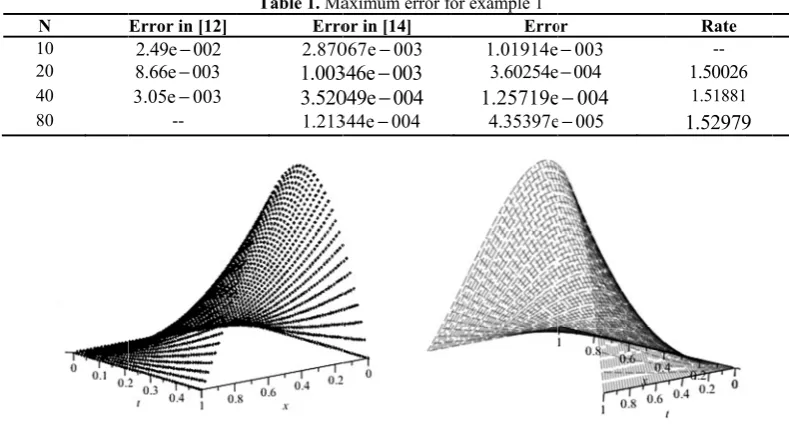
corrthe exact sol with differen The nume convergence to the nume method can b in Table 1 w obtained in t considerN=
R to illustrate e computed.
1.
tiveness of sc ng example. equation
1 t
2 xx 0(s t) u d
, t) 0, 0 t n( x), 0 x
− −
= ≤
π ≤
1,
μ =
α =1d M 10= . T responding to lution. The re nt step-sizes.
erical results rate in time i erical solutio be applied to with those of this paper are
20
= , the erro
N
10 20 40 80
Figure 1. C
Results our schemes
cheme (21) is Consider the
ds, T. x 1.
≤ ≤
2, and T 0.5=
The numeric o M N 10× =
esults are pres
from Table 1 is
3 2
. Our r on reported i anyα
. Comp f table 4, in e more accura r in [14], isError in [12]
2.49e 002−
8.66e 003−
3.05e 003−
--
omputational so
s, the follow
demonstrated partial integ
5. Takeh 1=
cal solution
640
× is used sented in Tabl
1 reflect that results are sim n [14], but paring the res
[14], the res ate. For examp
1.00346e 0−
Table 1. Ma
Erro
2.870
1.003 3.520
1.213
olution of probl wing
d by
gro-M, of d as
le 1 the milar our sults sults mple, 03, but the Ψ obt use wh tim thi pre res bec res par sin sta me
aximum error f
or in [14]
067e 003−
346e 003−
049e 004−
344e 004−
lem 2 Figu
t the error in t Example 2. Consider Eq. e following ex where
Ψ
, dei i 0
(z) ∞ ( 1)
=
=
−The initial
tained from t ed in [14]. T hich has four me. The accur s problem w esents rates o sults are simi cause we us sults are prese
In this articl rtial integro-ngular kernel ability and L2 ethod. In this
for example 1
Erro
1.01914e 3.60254e
1.25719e
4.35397e
ure 2. Computa
this paper is 3
. (1) when α xact solution u
enotes the enti
1 i
3 ( i 1) z
2
−
Γ +
and bound the exact solu he authors of th-order accu racy of our m with several v
f convergenc ilar to the nu
ed the same nted in Table
Discu
e, a compact differential e
for any0< α
norm converg study, Crank– or 003 − 004 − 004 −
e 005−
tional solution
3.60254e 004−
1 2
α = and μ
5
u(x, t)= Ψ π
ire function
.
dary conditi ution. This te f [14] propos uracy in spac method is teste values of ste ce in time for numerical solu
e method. Th 2.
ussion
t difference s equation wit
1
α < , is con rgence is prov –Nicolson tim Rate -- 1.50026 1.51881 1.52979
of problem 2
4 .
0
= β = , with
5 3t sin( x).π
(44)
ions can be st problem is sed a scheme ce and 32 in ed by solving eps size and rT 0.5= . Our ution in [14] he numerical
used to appro trapezoidal m term. The co space. The m solutions of
1
μ =
, and theoretical re rates in timeoximate the d method is use onvergence ord
method was t two different
,
0
β μ =
, besults. What’ e will increase
N
20
8.
40
3.
80
1.
160
4.
320
1.5
640
5.
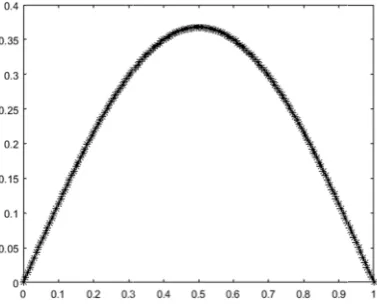
Figure 3. Num
Figure 4. Num
differential ter ed to approxim
der is
2
− α
,
tested against t examples, w both example s more by in e at a steadyError in [14]
.93117e 002
−
.21568e 002
−
15715e 002
−
.16970e 00
−
50417e 00
−
.46742e 004
−
merical approx
merical approxi
rm and a prod mate the integ
in time and 4 t exact refere where
β =
0
es supported ncreasing
N
,rate. In additi
Table 2. Ma
Rat
2
2
1.
2
1.4
3
1.03
1.4
1.imations are co
imations are com
duct gral 4 in ence and our
the ion,
num mo wo by
val
aximum error f
te in [14]
--
47372
47455
47256 47098 46004ompared with ex
mpared with ex
merical resul ore accurate t orth mentionin
Matlab.
We would l luable comme
for example 2
Erro
9.05317e
3.19954e
1.13096e
3.99814e
1.41360e
5.00614e
xact solution (4
xact solution (44
ts presented than those re ng that our co
Acknowl
like to thank ents and helpf
or
e 003
−
e 003
−
e 003
−
e 004
−
e 004
−
e 005
−
44) of problem 2
4) of problem 2
in the prese eported in [1 omputations a
ledgment
k both refere ful suggestion
Rate
--
1.50055
1.500311.50014
1.49995
1.49760
2 forN 80= .
2 forN 160= .
ent study are 2, 14]. It is are performed
ees for their ns which have e s d
improved the paper.
References
1. Jangveladze T., Kiguradze Z. and Neta B. Numerical Solutions of Three Classes of Nonlinear Parabolic Integro-Differential Equations, Academic Press, New York., (2016).
2. Dumitru B., Darzi R. and Agheli B. New study of weakly singular kernel fractional fourth- order partial integro-differential equations based on the optimum q-homotopic analysis method, J. Comput & Appl. Math.,320: 193-201 (2017).
3. Babaaghaie A. and Maleknejad K. Numerical solutions of nonlinear two-dimensional partial Volterra integro-differential equations by Haar wavelet, J. Comput & Appl. Math., 317: 643-651 (2017).
4. Canuto C. and Quarteroni A. Approximation results for orthogonal polynomials in Sobolev spaces, Math. Comp.,
38: 67-86 (1982).
5. Lakestani M., Nemati Saray B. and Dehghan M. Numerical solution for the weakly singular Fredholm integro-differential equations using Legendre multiwavelets, J. Comput. & Appl. Math., 235(11): 3291-3303 (2011). 6. Tahami M., Hemmat A. A. and Yousefi SA. Numerical
solution of two-dimensional first kind Fredholm integral equations by using linear Legendre wavelet, Int. J. Wavel. Multi. Resolu.& Inf. Proce.,14(01): 1-20 (2016).
7. Lopez-Marcos J.C. A difference scheme for a nonlinear
partial integro-differential equation, SIAM J. Numer. Anal.,
27: 20–31(1990).
8. Xu D. On the discretization in time for a partial integro-differential equations with a weakly singular kernel I: smooth initial data, Appl. Math. Comput. 58: 1–27 (1993). 9. Xu D. On the discretization in time for a partial
integro-differential equations with a weakly singular kernel II: nonsmooth initial data, Appl. Math. Comput., 58: 29–60 (1993).
10. Singh S., Patel V. K., Singh V. K. and Tohidi E. Numerical solution of nonlinear weakly singular partial integro-differential equation via operational matrices, Appl. Math. & Comput., 298: 310-321 (2017).
11. Fakhar-Izadi F. and Dehghan M. Space–time spectral method for a weakly singular parabolic partial integro-differential equation on irregular domains, Comput. &
Math. with Appl., 67(10): 1884–1904 (2014).
12. Tang T. A finite difference scheme for a partial integro-differential equations with a weakly singular kernel, Appl.
Numer. Math., 11: 309–319 (1993).
13. Chen H. and Xu D. A compact difference scheme for an evolution equation with a weakly singular kernel, Numer.
Math. Theory Methods Appl., 4: 559–572(2012).
14. Luo M., Xu D. and Limei L. A compact difference scheme for a partial integro- differential equation with a weakly singular kernel, Appl. Math. Modelling., 39(2): 947-954 (2015).