٭
Corresponding Author, Email: [email protected]
Vol. 45, No. 1, spring 2013 35
Analysis and Design of High Gain, and Low Power
CMOS Distributed Amplifier Utilizing a Novel Gain-cell
based on Combining Inductively Peaking and Regulated
Cascode Concepts
Z. Baharvand
1, A. Hakimi
21- MSc Student, Department of Electrical and Computer Engineering, Graduate University of Advanced Technology, Kerman, Iran. 2- Assistant Professor, Department of Electrical Engineering, Shahid Bahonar University of Kerman, Kerman, Iran.
ABSTRACT
In this study an ultra-broad band, low-power, and high-gain CMOS Distributed Amplifier (CMOS-DA)
utilizing a new gain-cell based on the inductively peaking cascaded structure is presented. It is created by
cascading of inductively coupled common-source (CS) stage and Regulated Cascode Configuration (RGC).
The proposed three-stage DA is simulated in 0.13 μm CMOS process. It achieves flat and high
of 26.5
±
0.4 dB over the frequencies range from DC up to 13 GHz 3-dB bandwidth, and it dissipates only 9.95 mW.
The IIP3 is simulated and achieved -10 dBm at 6 GHz. Also, simulated input referred 1-dB compression
point at 6 GHz achieves the value of -20 dBm. Both input and output matches are better than -11 dB. To
obtain the low power and high gain requirements, the advantages of the bulk terminal are
exploited in the
proposed CMOS-DA. It adopts the method of forward body biasing in output MOS transistor to achieve
higher transconductance and lower power consumption.
Additionally, the Monte Carlo (MC) simulation is
performed to take into account the risks associated with various input parameters which they receive little or
no consideration in simulating of designs utilizing ideal components. MC simulation predicts an estimate of
the good accuracy performance of the proposed design under various conditions.
KEYWORDS
1- INTRODUCTION
The low-cost, easy integration and the latest performance developments driven by forceful scaling of nanometer complementary-metal-oxide-semiconductor (CMOS) technology have made it feasible to realize the radio frequency (RF) systems [1]. The high-rate requirement for broadband communication systems demands the wideband amplifiers as essential building blocks. Distributed amplifier (DA) is appeared as one of the most prevalently candidates for broadband amplification applications. The reason of choosing DAs, as a prime solution for extremely wideband amplification applications is their high gain-bandwidth product and excellent linearity in nature [1, 2].
The existing trade-offs in CMOS-DA designing introduce significant design considerations with regards to gain, bandwidth, and power consumption. The conventional CMOS-DAs have the additive gain mechanism, and their gain is not significantly high. Besides, the low gain drawback in CMOS process is further critical as a result of the low transconductance and high substrate loss in a silicon-based process [3]. In addition, one of the main issues of DAs design is their large DC power dissipation. The high power dissipation of the DAs critically restricts their usage in wireless portable devices [4]. In general, there are two choices in implementing the high gain and broad bandwidth CMOS-DAs. One isbased on the cascaded gain-cells topology, and the other is two-dimensional DAs which are discussed as follows:
Ref. [4] introduces a 0.18 μm CMOS-DA utilizing cascade of inductively coupled common source (CS) gain-cells for gain improvement at high frequencies. The DA is attained extraordinary flat and high gain of 10 ± 1.5 dB at low-gain (LG) mode and 16 ± 1.5 dB at high-gain (HG) mode. But, the corresponding of 19.6 mW
at LG mode and 100 mW at HG mode are not desire. Ref. [5] demonstrates a 0.13 μm two-stage CMOS-DA with cascaded gain-cell, which comprises two enhanced CMOS inverters. This work achieved high power gain of 11.4 ± 1.4 dB at LG mode and 17.1 ± 1.5 dB at HG mode, respectively. The design at HG mode consumes
of 30 mW isn’t decent. The design of Ref. [6]
illustrates a CMOS-DA in 0.13 μm by utilizing cascaded gain-cell that constitutes by an inductively parallel-peaking cascode stage with a low-Q RLC load and an inductively series peaking CS stage. The flat and high gain of 11.03 ± 0.98 dB at the LG mode and 20.47 ± 0.72 dB at the HG mode are achieved. However, this DA achieves an excellent average noise figure (NF) of 4.25 dB at LG mode and 3.29 dB at HG mode, but the corresponding of 37.8 mW is at the medium range
and hasn’t very low value. Finally, in Ref. [7] with modified cascade gain-cell is demonstrated that it is possible to achieve a high gain and low power consumption, concurrently. However, the corresponding average NF of 6.6 dB at LG mode and 6.5 dB at HG mode aren’t satisfactory. As a general result, the mentioned designs are based on the cascade gain-cell
topology which can’t provide enough gain and bandwidth at very low power consumption or low power dissipation at the high gain levels.
Two-dimensional DAs have been suggested to take the benefits of multiplicative gain mechanism, such as cascaded single-stage distributed amplifiers (CSSDAs) [3], cascaded multi-stage distributed amplifier (CMSDA) [2, 8], and matrix DA [8], composition of the conventional DA and the cascaded single stage DA [3], DA with cascaded gain stages [9] and DA with internal feedback [10].
Even though the two-dimensional DAs have potential of higher gain-bandwidth performance than other DA configurations, their high power consumption and big chip-area aren’t satisfactory. These drawbacks of two-dimensional DAsseriously restrict their usage in wireless portable devices. As it can be seen, in reported various types of DAs, gain, bandwidth, and power dissipation are significant criteria in the design of DAs.
Biasing the active devices of DA at a very low overdrive voltage improves the power consumption at the expense of insufficient gain. Also, raising the gain of CMOS-DAs generally comes at the deep trade-off in bandwidth.Therefore, as a research motivation one can try to optimize the performance of CMOS-DA regarding the gain, bandwidth, power dissipation and noise figure. Here, a novel gain-cell is presented to pick the optimal performance and topology which it meets these targets. This paper discusses the design of a high gain, ultra-broad bandwidth, and low power CMOS-DA.
Vol. 45, No. 1, spring 2013 37
Figure 1: Circuit schematics of the conventional DA
comparative results are discussed in Section 3. Finally, Section 4 presents the conclusion of the wor k.
2- BASIC PRINCIPLE OF PROPOSED DA
The main idea behind of a DA relies on the operation of a pair synthesized transmission line (TL). TLs constitutes by series on-chip inductors in conjunction with the shunt parasitic capacitances from active devices, which are the input gate-line and the output drain-line.
The input and output TLs are terminated in their characteristic impedance at the end of the lines. This is because of the reflections won’t occur. The parasitic capacitances of the active devices which are the major reason of bandwidth restriction absorb into TLs, and the extensive bandwidth response is attained. The active devices are coupled into the drain line through the transconductance of them. The input signal is sent at the input-gate line while it travels down on the gate line, each of the active devices is triggered by the propagating input signal.
Finally, the traveling input signal is absorbed at the termination end of the gate line.The active devices feed a current into the output-drain line. Fig. 1 shows the simplified schematic of an original DA with CS stages as active devices [11-13].
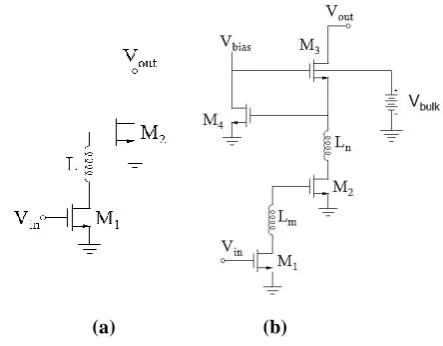
Fig. 2 shows theschematic of the proposed CMOS-DA based on the new gain-cell note that,biasing not shown for simplicity. The proposed gain-cell construction illustrates that it is practicable to achieve flat and high gain, and low-power dissipation for a CMOS-DA, concurrently. The new gain-cell uses the inductively coupled cascaded structure, which isshaped by acascade of inductively coupled CS stage and a Regulated Cascode Configuration (RGC).
In the next sub-sections the effects of inductively coupled cascaded structure and the effect of the RGC, define in details. They aimto realize the balanced trade-off between critical challenges in high gain and broad bandwidth DAs designing. For stability consideration, the gates of (i = 2, 3) devices at each gain-cell are bypassed through (i= 1, 2) resistors in series with
DC-BLOCK capacitors. Note that, this section of thecircuit is omitted in the Fig. 2 for simplicity.
A- INDUCTIVELY COUPLED CASCADED
STRUCTURE
The cascaded gain-cells increase the amplifier’s gain while operating in low voltage and low power conditions. However, the lack of an ultra-broad band response arises from imposing multiple poles is main issue that they face with it. Inductively coupled cascaded structure that shaped based on inductive peaking concept has been addressed in Ref. [4] to circumvent the influence of the traditional cascaded gain-cell’s restricted bandwidth. It creates a zero that can be used to cancel the effect of dominate pole and to increase the amplifier’s bandwidth to farther pole. It is a helpful approach to alleviate the effects of imposing multiple poles that associated with the inter-stage parasitic capacitances due to increase cascaded stages. This method is employed in this design that makes it possible to meet the high gain performance of the proposed cascaded gain-cell, without sacrificing the bandwidth.
Moreover, to avoid of limiting the total bandwidth by the pole associated with the RGC cell’s internal node, inductive peaking embedded in the source of device in each gain-cell. Another benefit of is the
transconductance improvement. As a result, more gain can be achieved without make larger the power dissipation. This effect arises from the fact that employing enables us to raise the transistor aspect ratio
and to earn the objective transconductance with lower power dissipation while the similar bandwidth is obtained at the same time [9, 14, 15].
The inductive peaking inductors including and not only extends the bandwidth, but also substantially maintain pass-band gain flatness. This sub-section investigated the effects of inductively coupled cascaded structure on extending bandwidth. The next sub-section elaboratesthe effect of RGC upon increasing the output impedance as a result increasing the gain.It shows how large effect is obtained by utilizing of RGC.
B- REGULATED CASCODE CONFIGURATION
In order to avoid the utilizing of stacked structure that is unsuited to boost the gain in low supply voltage applications the RGC can be used[16, 17]. RGC not only substantially increases the output impedance and the gain, but also remove the voltage headroom’s obstacle of conventional cascode architecture. To highlight the more favorable aspects of the RGC than conventional cascode cell, these structures are compared against each other as follows:
Fig. 3 illustrates the conventional cascode configuration versus RGC structure. The output impedance of conventional cascode cell (see Fig. 3 (a)) can be calculated as (1), that device plays
degeneration resistor’s role:
(a) (b)
Vol. 45, No. 1, spring 2013 39
(1)
Where and for (i = 1, 2) are thetransconductance and the output resistances of the MOS devices, respectively. Fig. 3(b) shows the RGC cell.As long as, output impedance is concerned, plays the role
of degeneration resistor, which makes sense the output current and changes it to voltage.The observation that the small-signal voltage presented is proportional to the
output current proposes this voltage can be deducted from gate voltage of transistor in a manner to place in
the current-voltage negative feedback.
The negative feedback loop perfects by device. It forces the small-signal voltage presented to be equal
to gate voltage of transistor. Thus, the voltage deviations at the drain of transistor now affect the small-signal voltage presented to a lower extent,
because the gain of the device “Regulates” this voltage. In other words, a negative feedback loop sensing the output current increases the output impedance, significantly. This arises due to the fact that negative feedback tends to adjust the output quantity which it senses. This effect is formulated meticulously as follow [16, 18]:
The current-voltage negative feedback in RGC cell enhances the output impedance of simple cascode by factor of device’s small signal voltage gain, so we will have:
(2)
Where is:
(3)
By substituting the equivalent of into (2), of
RGC cell can be rewritten as (4):
(4)
From (1) and (4) notice that the output impedanceof RGC cell as expected is higher than conventional cascode cell, significantly. The RGC cell’s higher output impedance basically arises from the modification of the output impedance because of the negative feedback. As it can be seen, by RGC cell the higher output impedance is achieved than conventional cascode without adding further cascode devices, which it directly increases the small signal voltage gain. To provethat the further small signal voltage gain can be obtained by RGC cell compared to simple cascode cell, the small-signalvoltage gain of them can be derived and compared as follows: (i = 1, 2) represent the small-signalvoltage
gain of both simple cascode cell (i = 1) and RGC cell (i = 2), respectively.
(5)
(6)
Where and for (i = 1, 2, 3) are respective
the transconductance and the output resistance of the MOS devices. As it can be seen, the small-signal voltage gain of the RGC cell is higher than simple
(a) (b)
cascode cell, significantly. It is similar to the gain of triple cascode amplifier while reducing voltage headroom’s drawback that unavoidable in the cascode circuits is removed.
To show how large effect is obtained in this work by utilizing of combined inductively peaking and RGC concepts, this work is compared with Ref. [4] that utilizes cascade of inductively coupled CS gain-cells. Fig. 4 illustrates the gain-cell of Ref. [4] against the proposed gain-cell. The total voltage gain , of both
inductively coupled CS gain-cells (i=1) and the proposed gain-cell (i=2) to be equal to the product of voltage gain of both stages that shaped each of them, it can be calculated according to (7):
(7)
The equivalent’s total voltage gain of inductively coupled CS gain-cells is given as (8):
(8)
Also, the equivalent’s total voltage gain of the proposed gain-cell is written as follows:
(9)
As it can be seen, the equivalent’s total voltage gain of the proposed gain-cell is higher than inductively coupled CS gain-cells, substantially. So it can be said that, large effect of the new gain- cell than previous viable cascaded gain-cells in high gain DAs designing like the gain-cell of Ref. [4] which is the nearest work to the proposed gain-cell is obtained as a result of RGC cell’s higher gain. As a consequence, combining inductive peaking and RGCconcepts resulted in design of a high gain and broadband DA based on a
new gain-cell.Note that, the parasitic capacitances in these theoretical analyses are ignored for simplicity. They take into account in high frequency transconductance
analysis of the proposed CMOS-DA which
is necessary factor to calculate the CMOS-DA’s power gain.
2- 1- EXPLOITING THE ADVANTAGES OF THE BULK TERMINAL
Even though, the MOS transistor has four terminals, but it is usually utilized as a three terminals device. In view of the fact that its bulk and source terminals are tied to each other and both are shorted to a supply voltage. Since the gain of a MOS amplifier depends on its transconductance , one can enhance the transconductance as a result the gain of the amplifier using the bulk terminal of transistor. Another bulk terminal’s feature is to reduce the threshold voltage
to overcome the voltage’s limitation in low power
applications [19, 20]. These benefits more highlight by follow descriptions:
2- 1- 1- Gain increasing byoptimizing bulk-to-source voltage
A MOS transistor as a four terminals device has two dependent current sources which cause a related current with and voltages in drain terminal of
transistor. Note that, and are appeared voltages
on the gate-to-source and bulk-to-source capacitors. By taking derivatives of to and , the bulk
transconductance and the total transconductance relation of a MOS transistor can be extracted according to (10), (11):
√|
| (10)
(11)
As it can be seen, from equation (10) value
depended on to-source voltage. Optimizing the bulk-to-source voltage can increase the value, results in it
can increase the . As mentioned above, since the
gain of a MOS amplifier is relative to its transconductance, hence from equation (11) it can be said that, the forward body biasing increases the value, as
a result increases the total transconductance that it directly increases the gain of a MOS amplifier.
Moreover, if the bulk effect of the output MOS of RGC cell is considered, RGC’s output impedance and small signal voltage gain can be further improved. The output impedance also, the small signal voltage gain of RGC cell with bulk effect rewritten as (12), (13) that it confirms they are higher than their counterpart in the both of simple cascode and traditional RGC.
(12)
(13)
The forward body biasing has been used in output MOS device of the proposed gain-cell for achieving more output impedance result in further gain. Also, it enhances the DA’s power gain as a result of enhancing the total high frequency small signal transconductance. This claim validates by total high frequency small signal transconductance analysis of the proposed gain-cell that it will present in sub-section 2.4.
2- 1- 2- POWER CONSUMPTION REDUCING BY OPTIMIZING BULK –TO-SOURCE VOLTAGE
As previously mentioned, one of the possible methods to overcome the voltage bounds is to set by . It is
possible to decline the through either technology
scaling or circuital technique [19]. The circuital approach counts on taking the profit of the MOS body-effect that is to rely on forward body biasing to reduce the value of . Equation (14) shows the dependency of to
Vol. 45, No. 1, spring 2013 41
(√| | √| |) (14)
Where refers to the threshold voltage of MOS at
zero substrate voltage, is the bulk Fermi potential, represents a constant describing the substrate bias influence, illustrates the fixed gate-to-source voltage.
As it can be seen, the effect of a voltage difference between the bulk and source terminals directly influence the amplitude. By analyzing (14), it can be said that
the changes when changing .
In the other words, by applying a positive the
magnitude of the can be decreased. The simulation
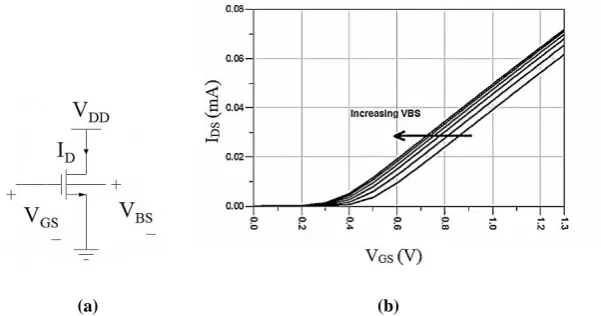
result of reducing of by moderating the through forward body biasing is shown in Fig. 5.
Decreasing of has been validated by simulation result, as expected. In the standard 0.13 μm CMOS process, the value of for a typical BSIM3 NMOS
transistor model is about 0.43 V. As it can be seen from Fig. 5 (b), by applying a positive the magnitude of the can be reduced. In this design the value of for
output MOS device reduces from 0.43-V to 0.23-V as a result of employing of forward body biasing method. The
optimum value of forward body bias voltage for simulation is about 1 V.
This means that, a lower gate voltage is now demanded which able to turn the MOS on. Therefore, a lower drain voltage can be utilized for MOS device that operates in strong inversion region. This effect is employed in output MOS device of the proposed gain-cell to reduce the drain voltage of it. This voltage is the same voltage which directly uses in calculating DC power dissipation of DAs.The total DC power dissipation of the DA is as follows:
(15)
Where represents the drain current through one stage’s output. N refers to the number of DA’s stages. is the bias voltage of DA’s drain lineandthe drain
voltage of the output MOS that is reduced by utilizing of forward body biasing to achieve lower DC power consumption. In this design, the value of for
simulation is about 0.87 V.
(a) (b)
Figure 5: a) MOS transistor as a four terminals device, and b) The modification of by moderating the bulk-source
voltage through forward body biasing
Appling the MOS body-effect in conjunction with cascaded topology that operates at low voltage and low power conditions enhance the gain, considerably while the power consumption keeps as low as possible over the entire interest band.
2- 2- THE HIGH FREQUENCY
TRANSCONDUCTANCE ANALYSIS OF THE PROPOSED GAIN CELL
As mentioned earlier, the power gain of the CMOS-DA depends on the totaltransconductance of its gain-cell. Therefore, the total high frequency small-signal transconductance of the proposed gain-cell by
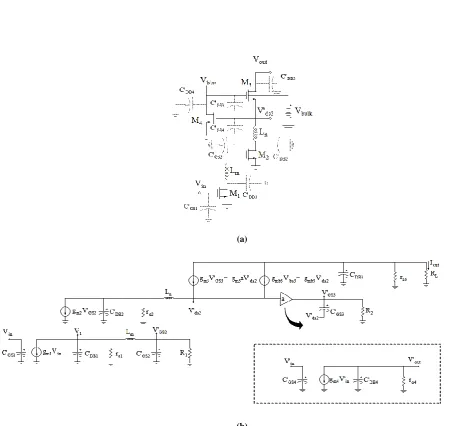
taking into account parasitic capacitances must be carried on for calculating the power gain of DA. The next sub-section is provided this significant. Fig. 6 (a) and (b) display the circuit schematic and the high frequency
small-signal equivalent circuit of the proposed gain-cell, which are utilized to calculate the corresponding
Calculating of is necessary because
according to DA’s power gain formula with assuming lossless TLs that is provided in (16), it is only unknown factor to calculate the DA’s power gain [13].
| |
| | (16)
Where represents the gain-cell’s
transconductance of the DAs which shape based on new gain-cells, is the TL’s characteristic impedance ( ), and N refers to the number of DA’s stages [13]. (i = 1, 2, 3, 4) that are shown by dashed
gate-to-source and drain-to-bulk capacitances of the MOS devices in the proposed gain-cell. In this analysis, suppose that parasiticgate-to-drain capacitance from
each NMOS device combines with its and by employing the Miller effect to shape and .
Also, and (i = 1, 2, 3, 4) are the
transconductances and the output resistances of the NMOS transistors, respectively. Note that, (i = 1, 2) and (i = m, n) refer to the resistors and inductors that are utilized in each gain-cell. As discussed earlier, the
(i = 1, 2) are belong the biasing circuit which not shown in Fig. 2 for simplicity.
Typically, (i = 1, 2, 3, 4) are relatively large hence,
they can be disregarded. The total high frequency small signal transconductance of the new gain-cell can be derived as follows:
(17)
(a)
(b)
Figure 6: a)The circuit schematic, and b) The high frequency small-signal equivalent circuit of the proposed gain-cell
The gate voltage of to ground is equal to
multiplied by small signal voltage gain of
devicenamed (– ). Note that, device realized the negative feedback loop. In Fig. 6 (b), device is shown by a block with gain of – also, its small-signal equivalent circuit placed in a dashed box for simplicity of
high frequency analysis. Thus, the gate-to-source voltage of can be given as follows:
(18)
With a KCL at the output node of Fig. 6 (b) it can be achieved that:
Vol. 45, No. 1, spring 2013 43
As a result:
(20)
By writing a KVL in the path of and it can be given that:
(21)
From KCL at the , and nodes we have:
(22)
( )
(23)
As a consequence, the can be rewritten as
(24):
( )
(24)
Where shows the small signal voltage gain of device. The factor is calculated according to (25), from its small-signal equivalent circuit that it demonstrated in the dashed box in Fig. 6 (b):
(25)
Note that, there are two zeroes in the expression
of that associated with peaking inductive
coupled cascaded concept (see in Fig. 6 (a) and 6 (b)). Therefore, these zeroes can be utilized to increase the bandwidth of the amplifier by canceling the effect of dominate poles. Moreover as discussed earlier, the expression of in relation, validates increasing the power gain of the proposed CMOS-DA by utilizing of forward body biasing in output MOS device.
2- 3-VELOCITY MATCHING OF THE
PROPOSED CMOS-DA
The phase velocity of a signal traveling upon a TL can be written as (26) [13]:
√
√ √ (26)
Combining (26) with the expression of the lossless TL’s characteristic impedance, which is given according to (27) [13]:
√ √ √ (27)
Allows one to achieve expressions for the phase velocities upon both the gate, and drain lines as follows [13]:
(28)
(29)
Observing (28), (29) show that the larger series inductance of the gate line introduces additional phase delay, thus making it necessary to increase the delay incurred in the drain line by an equal amount. In practice case, it can be implemented by increasing the length of the drain line , sufficiently to satisfy the below relationship:
(30)
Where , represent the equivalent series inductors of the gate and drain lines, and , are the length of segment lines at gate and drain, respectively.
2- 4- BROADBAND INPUT IMPEDANCE OF THE PROPOSED CMOS-DA
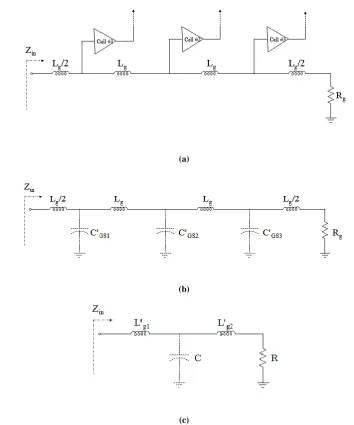
The circuit schematic of a typical three-stages DAand its input equivalent circuitshown in Fig. 7 (a) and 7 (b). They are utilized to describe the input impedance matching. Note that, circuit biasing and drain TL are removed for simplicity. As discussed earlier, for simplicity of high frequency analysis suppose that parasiticgate-to-drain capacitance from each NMOS device combines with its and by employing the
Miller effect, to shape and . Following this
(a)
(b)
(c)
Vol. 45, No. 1, spring 2013 45
⁄ (31)
⁄
⁄ (32)
(
) (33)
(34)
Similar definitions apply to the equations , and which yielded following relations:
⁄
⁄ (35)
⁄ (36)
(
) (37)
Impedance matching can be described by extracting an expression for the input impedance of the equivalent circuit model shown in Fig. 7 (c). According to Fig. 7 (c), the input impedance is given as follows:
( )
(38)
Rearranging and separating into real and imaginary parts give:
{ }
( )( ) ( )
( )
(39)
For input impedance matching, the real part value of
should be equal to the source impedance is to set
50 Ω. Also, in the proposed design both the gate and drain-termination resistors are chosen to match the 50 Ω source/load resistors to avoid unwanted reflection from the gate and drain TLs. This method of obtaining broadband impedance matching is a direct benefit of the intrinsic broadband nature of the pseudo TLs.
3- SIMULATION RESULTS AND DISCUSSIONS
Simulation of the proposed CMOS-DA’s performance in 0.13 μm CMOS process is conducted using BSIM3 transistor models via Agilent Advanced Design System (ADS) simulation tool. The next sub-sections illustrate the original simulation results, additionally MC simulation results to take into account the non-ideal properties associated with various input parameters of the proposed CMOS-DA.
3- 1- ORIGINAL SIMULATION RESULTS
Figs. 8 ~ 12 show the simulated frequency responses of the proposed CMOS-DA. As it can be seen from these
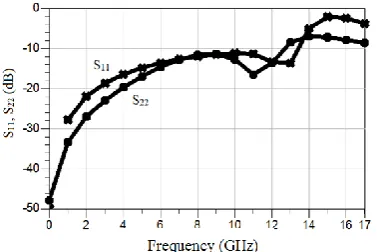
figures, the power gain is about 26.5 dB with a gain flatness of ± 0.4 dB (Fig. 8 (a)). The DA exhibits a 3-dB bandwidth of 13 GHz. The reverse isolation of the proposed DA is less than - 40 dB over the amplifier’s corresponding bandwidth (Fig. 8 (b)). Also, the simulated input and output return losses both are better than - 11 dB over the entire frequency band (Fig. 9).
The valuable measures of the stability called rollett stability factor (or K-factor) and the stability measure. If K-factor to be greater than one and the stability measure ( ) to be greater than zero and less than one imply that the amplifier is unconditionally stable [21]. Fig. 10 shows the simulated characteristics of k and against frequency of the CMOS-DA. As it can be seen, the CMOS-DA is unconditionally stable for frequencies from DC up to 13 GHz.
Linearity in CMOS-DA is typically evaluated in terms of input third intercept point (IIP3) which is required to be maximized. Two-tone testing is carried out with 1-MHz spacing for third-order inter-modulation distortion shown in Fig. 11 (a), the IIP3 simulated result is – 10 dBm at 6 GHz. Also, simulated input referred 1-dB compression point at 6 GHz is illustrated in Fig. 11 (b) that achieves the value of -20 dBm. Finally, Fig. 12 illustrates the simulated eye-diagram of this design. The most important eye-diagram parameters are summarized in Table 1.
Until now, distinctive DA design techniques are demonstrated that each of them enhances one of the DA design parameters. As a consequence, a figure-of-merit (FOM) is defined to evaluate the most important parameters in DAs designing, containing power dissipation, noise, gain and bandwidth [6, 22]:
[ ⁄ ] [ ] [ ]
[ ] [ ] (40)
Where [1] illustrates the average power gain in
(a)
(b)
Figure 8: Simulated results of a) power gain (S21), and b)
reverse isolation (S12)
Figure 9: Simulated results of input (S11) and output (S22)
impedance matching
Figure 10: Simulated result of stability factor (k) and
stability measure ( )
(a)
(b)
Figure 11: a) Simulated fundamental and IM3 output power
against input power characteristics at 6 GHzb) Simulated
Vol. 45, No. 1, spring 2013 47
Figure12: Simulated eye diagram of the proposed CMOS-DA
Table 1
Simulated Eye Parameters Eye height 0.909
Eye width 4.566E-10 Eye Jitter (PP) 4.998E-11 Eye opening factor 0.975
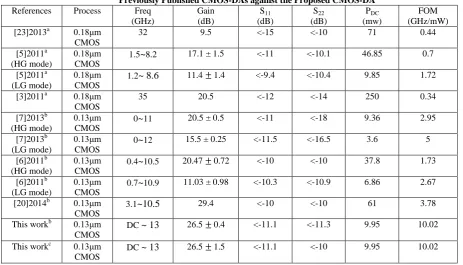
Table 2 compares the performance of the presented CMOS-DA with other broadband CMOS-DAs. The presented DA has a high gain and low power dissipation performance, at the same time.
Table 2
Previously Published CMOS-DAs against the Proposed CMOS-DA References Process Freq
(GHz) Gain (dB) S11 (dB) S22 (dB) PDC (mw) FOM (GHz/mW) [23]2013a 0.18μm
CMOS
32 9.5 <-15 <-10 71 0.44
[5]2011a (HG mode)
0.18μm CMOS
1.5~8.2 17.1 ± 1.5 <-11 <-10.1 46.85 0.7
[5]2011a (LG mode)
0.18μm CMOS
1.2~ 8.6 11.4 ± 1.4 <-9.4 <-10.4 9.85 1.72
[3]2011a 0.18μm CMOS
35 20.5 <-12 <-14 250 0.34
[7]2013b (HG mode)
0.13μm CMOS
0~11 20.5 ± 0.5 <-11 <-18 9.36 2.95
[7]2013b (LG mode)
0.13μm CMOS
0~12 15.5 ± 0.25 <-11.5 <-16.5 3.6 5
[6]2011b (HG mode)
0.13μm CMOS
0.4~10.5 20.47 ± 0.72 <-10 <-10 37.8 1.73
[6]2011b (LG mode)
0.13μm CMOS
0.7~10.9 11.03 ± 0.98 <-10.3 <-10.9 6.86 2.67
[20]2014b 0.13μm CMOS
3.1~10.5 29.4 <-10 <-10 61 3.78
This workb 0.13μm CMOS
DC ~ 13 26.5 ± 0.4 <-11.1 <-11.3 9.95 10.02
This workc 0.13μm CMOS
DC ~ 13 26.5 ± 1.5 <-11.1 <-10 9.95 10.02
a: Based on the measurement results b: Based on the simulation results c: Based on the MC simulation results
To author’s knowledge, this circuit reports one of the good FOM among the reported DAs covering ultra-wide-band (UWB) ranges of frequencies (3.1 to 10.6 GHz) in 0.18 μm and 0.13 μm CMOS processes. The high value of the FOM implicates to this fact that the new design exhibits a good combination of gain, bandwidth, NF, and power consumption. Thanks to the operation from DC up to 13 GHz in conjunction with the high gain and low power consumption characterizes, this CMOS-DA design can be used in various ultra-broad band applications.
B- MC Simulation Results
The first step of the actual modeling of the proposed design is to consider the non-ideal properties which are unavoidable in practice. They have been known as, possible fluctuations in MOS parameters such as ,
effective gate length , thickness of the gate oxide ,
and the drain-source region parasitic resistance [24]
and also, the variations of supply voltage and the tolerance of passive components like inductors and resistors.
components, the MC simulation is appropriate option. Whereas, in MC simulation a tolerance range is considered for each of inputs. In the other words, MC simulation relies on a repetitive process of inputs value random sampling from their specified tolerance range, simulating of the design finally, getting a set of output parameters to obtain an estimation of the accuracy performance of the proposed design under various conditions [25]. A set of random inputs with normal (Gaussian) distribution in the range of their possible values are generated by ADS simulation tool, note that the Gaussian distribution models the worst case of possible situation. Then, the proposed design is simulated by running multiple trial runs, (e.g., 1000). Ultimately, a set of output parameters are yielded. Now, it is possible to determine a number of non-ideal properties which may appear in real implementation of the proposed CMOS-DA. In this design, the tolerance of the passive component including inductors, and resistors take into account. The fluctuations in MOS parameters belong to 0.13 μm CMOS technology are given according to Table 3.
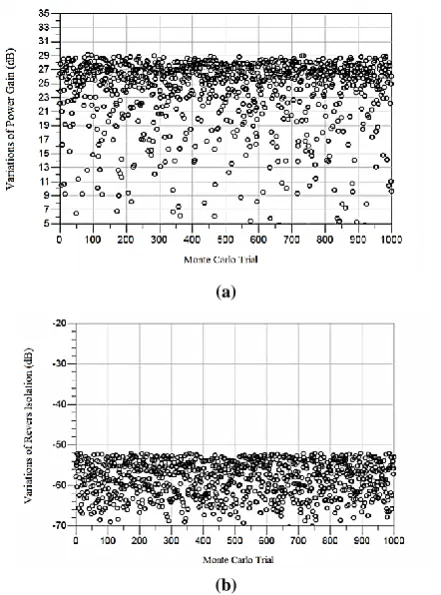
Figs. 13 ~ 15 illustrate the effects of input’s uncertainty on performance of the proposed CMODA including S-parameters, and stability factor responses. As it can be seen from these figures, within 1000 MC trail runs the revers isolation (Fig. 14 (b)), input and output impedances matching (Fig. 15 (a), (b)), and stability factor (Fig. 16) responses demonstrate the better results than original simulation. Also, the density of results around of 26.5 dB as shown in Fig. 14 (a) validates the accuracy of the power gain response, while only a few numbers of the results will fail, which they can be tolerated.
In this way, MC simulation predicts an estimate of the good accuracy performance of the proposed design under various conditions, in view of the fact that the MC and original simulation results show a good agreement. Table 3 Parameter Values and ±3σ Variations of MOS transistor [24].
Table 3
Parameter Values and ±3σ Variations of MOS transistor
[24]
Technology 0.13 µm
Parameters nmos pmos
0.09 ±
15%
0.09 ± 15%
33 ±
4%
33 ± 4%
0.33 ±
15.5%
- 0.33 ± 15.5% ⁄ 200 ±
10%
400 ± 10%
1.3 ± 10%
(a)
(b)
Figure 13:Scatter plot of 1000 Monte Carlo runs for
investigating a) Power Gain and b) Reverse Isolation Performances
(a)
(b)
Figure 14:Scatter plot of 1000 Monte Carlo runs for
Vol. 45, No. 1, spring 2013 49
Figure 15: Scatter plot of 1000 Monte Carlo runs for investigating Stability-Factor Performances
4- CONCLUSION
In this study, we have demonstrated a high-performance CMOS-DA construction using a new cascaded gain-cell which comprises an inductively series-peaking CS stage and an RGC configuration. The new gain-cell architecture enhances the gain considerably while the power dissipation keeps as low as possible, over the amplifier’s corresponding bandwidth. The main idea behind of RGC is more increasing the output impedance without adding further cascode devices. This effect basically arises from the modification of the output impedance due to the negative feedback. As well, it has been illustrated that exploiting the advantages of the bulk terminal of output MOS transistor in RGC cell of the proposed gain-cell, aims with more increasing the gain and reducing the power consumption of the proposed CMOS-DA. In that the operation from DC up to 13 GHz, this CMOS-DA design can be used in various ultra-broad band applications including UWB frequencies and even higher or lower frequencies than UWB. To the best of author’s knowledge, this design is one of the good reported high-gain and low-power dissipation performances. Also, it has the lowest power consumption ever reported with an average of larger than 20 dB for
a high gain CMOS-DA in the literature.
5- REFERENCES
[1] A. Ghadiri and K. Moez, “A new loss-reduced distributed amplifier structure”, in Circuits and Systems, 2009. ISCAS 2009. IEEE International Symposium on, pp. 2029- 2032, 2009.
[2] A. Arbabian and A. M. Niknejad, “Design of a CMOS Tapered Cascaded Multistage Distributed Amplifier”, Microwave Theory and Techniques, IEEE Transactions on, vol. 57, pp. 938- 947, 2009.
[3] P. Chen, J.-C. Kao, P.-C. Huang, and H. Wang, “A novel distributed amplifier with high gain, low noise and high output power in 0.18-µm CMOS technology”, in Microwave Symposium
Digest (MTT), 2011 IEEE MTT-S International, pp. 1- 4, 2011.
[4] G. Xin and N. Cam, “Low-power-consumption and high-gain CMOS distributed amplifiers using cascade of inductively coupled common-source gain cells for UWB systems”, Microwave Theory and Techniques, IEEE Transactions on, vol. 54, pp. 3278- 3283, 2006.
[5] J.-F. Chang and Y.-S. Lin, “A High-Performance Distributed Amplifier Using
Multiple Noise Suppression
Techniques”,Microwave and Wireless Components Letters, IEEE, vol. 21, pp. 495- 497, 2011.
[6] L. Yo-Sheng, C. Jin-Fa, and L. Shey-Shi, “Analysis and Design of CMOS Distributed Amplifier Using Inductively Peaking Cascaded Gain Cell for UWB Systems”, Microwave Theory and Techniques, IEEE Transactions on, vol. 59, pp. 2513- 2524, 2011.
[7] A. H. Farzamiyan and A. Hakimi, “Low-power CMOS distributed amplifier using new cascade gain cell for high and low gain modes”, Analog Integrated Circuits and Signal Processing, vol. 74, pp. 453- 460, 2013.
[8] J.-C. Chien, T.-Y. Chen, and L.-H. Lu, “A 9.5-dB 50-GHz Matrix Distributed Amplifier in 0.18-/spl mu/m CMOS”, in VLSI Circuits, 2006. Digest of Technical Papers. 2006 Symposium on, pp. 146- 147, 2006.
[9] J.-C. Chien and L.-H. Lu, “40-Gb/s high-gain distributed amplifiers with cascaded gain stages in 0.18-μm CMOS”, Solid-State Circuits, IEEE Journal of, vol. 42, pp. 2715- 2725, 2007.
[10] A. Arbabian and A. M. Niknejad, “A broadband distributed amplifier with internal feedback providing 660GHz GBW in 90nm CMOS”, in Solid-State Circuits Conference. ISSCC 2008. Digest of Technical Papers. IEEE International, 2008, pp. 196- 606, 2008.
[11] D. Hua, Z. Shun'an, C. Yueyang, and Z. Qian, “A 25-GHz 9-dB distributed amplifier in CMOS technology”, in Electric Information and Control Engineering (ICEICE), 2011 International Conference on, pp. 12- 15, 2011.
[12] T. H. Lee, The design of CMOS radio-frequency integrated circuits: Cambridge university press, 2004.
[13] D. M. Pozar, “Microwave engineering, 3rd”, Danvers, MA: Wiley, 2005.
Microwave Theory and Techniques, IEEE Transactions on, vol. 57, pp. 2862- 2871, 2009.
[15] P. Heydari, “Design and Analysis of a Performance-Optimized CMOS UWB Distributed LNA”, Solid-State Circuits, IEEE Journal of, vol. 42, pp. 1892- 1905, 2007.
[16] B. Razavi, Design of analog CMOS integrated circuits: Tata McGraw-Hill Education, 2002.
[17] B. Razavi, Fundamentals of microelectronics vol. 1: Wiley Hoboken, 2008.
[18] K. Moez and M. Elmasry, “A New Loss Compensation Technique for CMOS Distributed Amplifiers”, Circuits and Systems II: Express Briefs, IEEE Transactions on, vol. 56, pp. 185- 189, 2009.
[19] D. A. Neamen, “Semiconductor physics and devices”, 1992, 1994.
[20] M. Zakerhaghighi and A. Hakimi, “A Novel Topology of Variable Gain Distributed Amplifier in 0.13 μm CMOS Technology for UWB Applications”, Electronic Components and Materials, vol. 44, pp. 75- 83, 2014.
[21] J.-F. Chang and Y.-S. Lin, “DC∼ 10.5 GHz complimentary metal oxide semiconductor distributed amplifier with RC gate terminal network for ultra-wideband pulse radio systems”, IET microwaves, antennas & propagation, vol. 6, pp. 127- 134, 2012.
[22] D. Barras, F. Ellinger, H. Jackel, and W. Hirt, “A low supply voltage SiGe LNA for ultra-wideband frontends”, Microwave and Wireless Components Letters, IEEE, vol. 14, pp. 469- 471, 2004.
[23] H. Chih-Yin, S. Tzu-Yu, and S. S. H. Hsu, “CMOS Distributed Amplifiers Using Gate–Drain Transformer Feedback Technique”, Microwave Theory and Techniques, IEEE Transactions on, vol. 61, pp. 2901- 2910, 2013.
[24] V. Venkatraman and W. Burleson, “Impact of process variations on multi-level signaling for on-chip interconnects”, in VLSI Design, 2005. 18th International Conference on, pp. 362- 367, 2005.