Please cite this article as: D. Moazenzadeh, H. Hamidi, Analysis and Development of Technology Acceptance Model in Mobile Bank Field, International Journal of Engineering (IJE), IJE TRANSACTIONS C: Aspects Vol. 31, No. 9, (September 2018) 1521-1528
International Journal of Engineering
J o u r n a l H o m e p a g e : w w w . i j e . i rAnalysis and Development of Technology Acceptance Model in Mobile Bank Field
D. Moazenzadeha, H. Hamidi*b
a Department of Information Technology Engineering, South Tehran Branch, Islamic Azad University, Tehran, Iran. b Department of Industrial Engineering, Information Technology Group, K. N. Toosi University of Technology, Tehran, Iran.
P A P E R I N F O
Paper history: Received 31 January 2018
Received in revised form 12 February 2018 Accepted 9 March 2018
Keywords:
Adoption of Mobile Bank Mobile Bank
Development of Technology Acceptance Model
Banking Fuzzy Topsis
A B S T R A C T
Internet bank has limitations such as access to the internet network and personal computer (PC). In addition to provideeasily bank services to customers at any time, The provision of mobile phone services with the title of Mobile Bank was introduced to eliminate these restrictions and limitations. Due to importance of technology adoption by users, in this research, the technology acceptance model was developed by taking into account the variables of the original model, by adding new variables such as risk perception, cost perception, trust, resistance, compatibility while examining the proposed models. This research has analyzed the statistical population using the questionnaire. Finally, by analyzing obtained results, with regression analysis observed that individual's age has not much effect on the technology adoption according to results, and also individuals do not have much resistance to adopt the technology in this period, which leads to adopt more new technologies. Individuals are also willing to pay for the services and technology used while benefiting from its advantages. The cost has not affected the attitude of individuals and is not an impediment and barrier to technology adoption, and ultimately, individuals have adopted the risk of use of technology. This issue does not damage their trust in new technology.
doi: 10.5829/ije.2018.31.09c.07
1. INTRODUCTION1
Internet bank provides access to bank services for customers at any time. The major limitation of this model is to access the computer and the Internet that has eliminated and resolved this limitation by providing another model of electronic services with the title of mobile bank, which provides the services at any time and place only through a mobile device. Mobile bank is one of the important innovations of technology for institutions and the transfer of bank customers to electronic channels for banks and financial institutions. It is very important due to the possibility of reducing operating costs and enhance accurate presentation of services to customers [1-5]. Mobile Bank allows customers to control account information, pay bills, etc. by using a mobile phone or portable digital device [1, 6, 7].
Several studies have obtained and used this technology in order to explore the factors that affecting
*Corresponding Author Email: [email protected] (H. Hamidi)
the decision of customers to adopt and use the advancement of the mobile bank. Affecting factors, the adoption of this technology by users who use the mobile bank in Iran was examined in this research. In continuation of this paper, the proposed models are introduced and then the methodology of the research includes discussion and last part refers to the conclusion and suggestions.
2. LITERATURE SURVEY
initial trust in the mobile bank and its intention to use it. A few researchers integrated two TTF and UTAUT with the aim of improving the mobile bank acceptance model [14, 15]. A brief introduction to several models for reviewing mobile bank technology is presented in the following sections.
2. 1. Task-Technology Fit (TTF) This model shows that users adopted a new technology if there are enough users to handle their daily affairs. Hence, adoption a new technology depends heavily on its performance in improving the performing of users' daily affairs [12-16].
2. 2. Unified Theory of Acceptance and Usage of Technology (UTAUT) This model was introduced as a development of technology acceptance model (TAM) [9, 17]. This model has attracted the attention of researchers and was used in various research to examine the behavior way and adoption of techniques [6, 15].
2. 3. Initial Trust Model The initial trust is an individual's willingness to risk in performing a work without previous experience or credible information [18, 19]. Initial trust plays an important role in adopting the technology by a user who has no previous experience [18, 20]. McKnight et al. [21] categorized factors that affect initial trust as follows: entity/ individual/ environment [22, 23]. Environmental factors are organizational structured guarantees related to increased trust, such as services guarantee and social effects [24, 25].
The initial trust in e-commerce related to the Internet shopping area [26-28]. Mobile bank services have been widely studied [29]. Five models were dominated among the various presented models [30], untila reasecher presented the UTAUT. These models include the IDT [31], theory of reasoned action (TRA) [32], theory of planned behavior (TPB) [33], TAM [9], theory of perceived risk (TPR) [34].
TRA defines the relationship between beliefs, attitudes, norms, intentions and behaviors of individuals [32]. The TPB model is a development of the TRA model, which is the result of a limitation in behaviors that individuals have little control over them [33].
2. 4. Technology Acceptance Model The technology acceptance model is a simple and practical model and theory [35]. This is adaptation that has been taken from TRA and the field of psychology toward information systems [36]. It seems that TRA is widely adopted among research of information systems [37] previous research on consumers' behavior (consumers) and information systems has also highlighted the importance of risk perception as a barrier to technology acceptance [7, 38].
A summary of conducted studies in this area has been presented in Table 1.
TABLE 1. Review some studies
The factors examined in the
proposed model Title Ref.
The moderating variables that influence the constructs are now age, gender, and experience, dropping voluntariness from the previous UTAUT. The model also adds a direct relationship between facilitating conditions and behavioral intention, and habit is also hypothesized to directly affect both behavioral intention and use behavior. In addition to these changes, the effect of behavioral intention on use is also moderated by experience.
Understanding mobile banking: The
unified theory of acceptance and use of technology combined
with cultural moderators
Goncalo and Tiago [7]
perceived usefulness, perceived ease of use, and personal innovativeness were adopted from literature, attitude and subjective norm from literature, perception of risk from Huang, Rau, Salvendy, literature, perceived compatibility and intention to use from literature, resistance and awareness from literature.
A study of mobile banking loyalty in
Iran
Mohammadi [38]
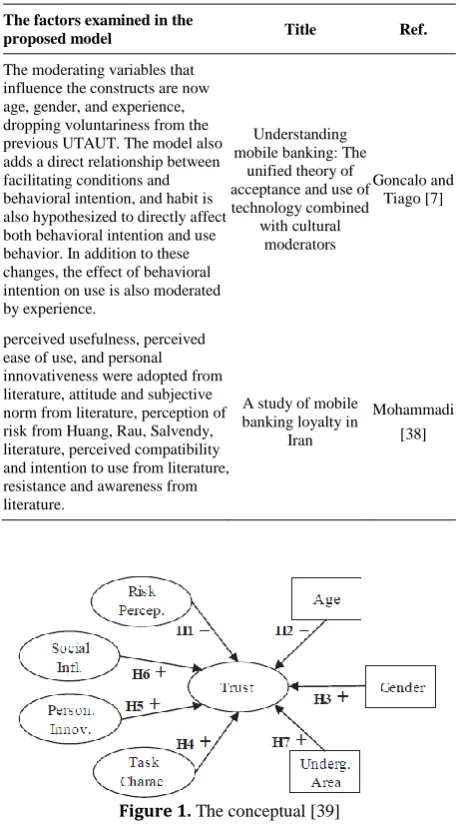
Figure 1. The conceptual [39]
In the following, we introduce 2 samples of the tested models.
Sample of testing model 1: Trust in mobile bank and factors affecting trust, including age, gender, individual innovation, risk perception and social influence have been reported by Rodrigo and Malaquias [40]. The following results obtained by analyzing the data collected through a questionnaire that people in Brazil. The results showed that risk perception and age have a negative effect on trust than the mobile bank. Social influence, individual innovation, and gender (male) have a positive effect on trust than the mobile bank. The proposed model for this research is shown in Figure 1 [39].
pressures, etc were reviewed. The proposed conceptual framework is based on social psychology theory, extended TAM, and innovation diffusion and technology adoption frameworks. They obtained following results by analyzing the data from 776 online questionnaires that its respondents were selected by snowball method:
Adaptability, usefulness, utility, ease of use, credibility, and trust have an important and positive effects in separating individuals with greater enthusiasm in using mobile bank services.
Self-efficacy is the factor separating customers by their willingness and tendency to adopt mobile bank. Their proposed model is illustrated in Figure 2.
2. 5. Variables Reviewed and Examined in This Research Considering the growing use of mobile devices for performing the daily affairs, mobile bank services are also being developed, so the focus and review on effective factors in acceptance this technology can increase its acceptance by individuals. In this research, the effect of factors on the adoption of the mobile bank has been examined with the development of technology acceptance model.
Usefulness: According to definition by Davis [9], usefulness is actually the rate of raising the performance of individuals at the time of using technology [13, 14]. Hypothesis H1: Usefulness has an effect on the adoption of mobile bank services.
Hypothesis H1a: Usefulness has an effect on the easy to use in relation to adopting mobile bank.
Hypothesis H1b: Usefulness has an effect on the individual's attitude in relation to adopting mobile bank. Easy to Use: Ease of use is actually the rate of individual's willingness to use technology, and they expect to spend the least effort at the time of working [41-43].
Hypothesis H2: Easy to use has an effect on the adoption of mobile banking services.
Hypothesis H2a: Easy to use has an effect on the utility in relation to adopting mobile bank.
H2b Hypothesis: Easy to use has an effect on the individual's attitude in relation to adopting mobile bank. Attitude: Attitude explains the consumer's behavioral intentions and is an important structure in understanding and perception decision-making from a marketing perspective [44, 45].
Hypothesis H3: The attitude of individuals affects the adoption of mobile bank services.
Cost: One of the barriers to adopting new technologies is often the cost of acquiring and using them.
H4 Hypothesis: Cost perception has an effect on the adoption of the mobile bank services.
Hypothesis H4a: Cost perception has an effect on the individual's attitudes in relation to adopting mobile bank. Risk Perception: There is a great risk in using mobile bank services than fixed devices because of remote
communication that they are established. Viruses and hackers, etc., may also exist on mobile terminals [46, 47, 48].
Hypothesis H5: Risk perception has an effect on the adopting mobile bank services.
Hypothesis H5a: Risk perception has an effect on the trust in relation to adopting mobile bank.
Trust: According to the definition by Mui, et al.[48] trust is in fact, an expectation on the other side for performing something that is formed based on the behavior of individuals in the past [49-53].
Hypothesis H6: Trust has an effect on the adoption of mobile bank services.
Hypothesis H6a: Trust has an effect on the individual's attitudes in relation to the adoption of mobile bank. Resistance: Resistance is, in fact, a persistence against the acceptance of the new technology and use of it, which can be expressed directly or indirectly.
Hypothesis H7: Resistance of individuals has an effect on the utility in relation to the adoption of the mobile bank.
H7a Hypothesis: Resistance of individuals has an effect on the easy to use in relation to the adoption of the mobile bank.
Comptability: In this theory, compatibility has been defined as the degree of alignment of banking services along with lifestyle and customer needs [14, 53]. Hypothesis H8: Compatibility has an effect on the easy to use in relation to adopting mobile bank.
The conceptual model of the research has been considered as shown in Figure 3 using the conducted studies and the expressed hypotheses, which has been further analyzed in the following sections.
3.RESEARCHMETHODOLOGY
The statistical population of the research includes all customers of 3 banks in 3 hours, which their number is equal to 732 people. The minimum size of the needed sample determined by Cochran's formulas: that sample population for this research has reached to 253 individuals.
3. 1. Demographic Features The demographic features of the examined sample have been specified in Table 2 according to the data of collecting the questionnaires:
A. Gender: 161 people means 64% were female and 92 people means 36% of respondents were male. B. Age: 139 people have less than 30 years have
allocated 55% sample size to this group. 63 respondents aged 30-39 and were about 25% of the sample size. Persons aged 40 to 50 years old include 29 people, 22 people have over 50 years of age or older.
C. Academic Degree: 32 individuals have the diploma degree have allocated 13% of the sample size to this group.
Figure 3. Conceptual model of research
91 respondents have a bachelor's degree and form 36% of the sample size. Individuals with a master's degree in education include 111 individuals and have the most frequency. Individuals with a PhD degree are 19 and form 7% of the sample size.
The data collecting tool for research is a questionnaire that was designed and set by researcher after examining questionnaires of similar research and obtaining viewpoints of bank experts and academic researchers. In this regard, the questions of the research questionnaire were extracted from standard questionnaires.
In the recent questionnaire, the alpha value is 0.86, which is greater than 0.7, so the questionnaire is stable. In this research, descriptive statistical techniques have been used to examine demographic features of the community. The normality data test was performed using Kolmogorov-Smirnov test and a greater significant value of error level (0.05) has been obtained based on Kolmogorov-Smirnov test results, in all cases. Therefore, the distribution of data is normal. Regression test has been used to examine the status of the relationship between dimensions and variables of research from respondents' perspective.
4.RESERCHFINDINGS
It can be said with citation to each of these statistical findings of the results of single sample t-test based on the average of respondent's views in this research with 95% confidence: Adoption of banking services, utility, easy to use, cost perception, attitude, risk perception, trust, resistance, adaptability.
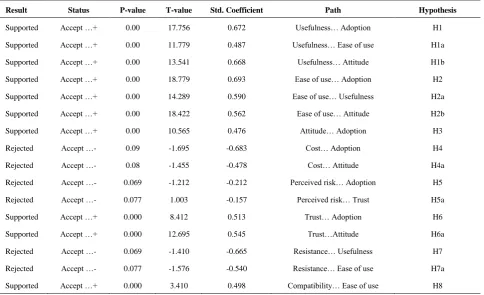
Regression analysis has been used to predict the value of a variable from the values of other variables that the results of the regression analysis on the data collected in this research are in accordance with Table 3 and the description of its results is expressed in following.
TABLE 2. Sample demographic information
Sample populations
Percentage (%)
Gender Female 161 64
Male 92 36
Age
Less than 30 years old 139 55
30 -39 years old 63 25
40-50 years old 29 11.5
More than 50 years
old 22 8.6
Education level
Diploma 32 13
Bachelor 91 36
Master 111 44
It has been specified according to the results of the regression test that the hypothesis H1 has been confirmed, which is in line with the results of the Hanafizadeh [14], and Haluk Koksal [17] and Mohammadi [38]. It has been specified according to the results of the regression test that the H1a hypothesis is confirmed. Also, it has been specified according to the results of the regression test that the H1b hypothesis is confirmed, which is in line with the results of the research of Mohammadi [38]. According to the results of the regression test that the H2 hypothesis is confirmed, which is in line with the results of the research of Hanafizadeh [14] and Haluk Koksal [17] and Hong-Li [43], Govender and Sihlali [52].
It has been specified according to the results of the regression test that the H2a hypothesis and H2b hypothesis are confirmed, which are in line with the results of the research of Mohammadi [38]. Also, it has been specified according to the results of the regression test that the H3 hypothesis is confirmed, which is in line with the results of the research of Mohammadi [38], Govender and Sihlali [52].
It has been specified according to the results of the regression test that the H4 hypothesis is confirmed, which is in line with the results of the research of Haluk Koksal [17] and Hanafizadeh [14] and Tran and Corner [41]. Also, it has been specified according to the results of the regression test that the H4a hypothesis and H5
hypothesis were confirmed, which are in line with the results of research of Hanafizadeh [14].
It has been specified according to the results of the regression test that the H5a hypothesis is confirmed, which is in line with the results of research of Rodrigo and Malaquias [40].
It has been specified according to the results of the regression test that the H6 hypothesis is confirmed, which is in line with the results of research of Hanafizadeh [14] and Tran and Corner [41]. Also, it has been specified according to the results of the regression test that the H6a hypothesis is confirmed, which is in line with the results of research of Govender and Sihlali [52]. It has been specified according to the results of the regression test that the H7 hypothesis, H7a hypothesis and H8 hypothesis were confirmed, which are in line with the results of research of Mohammadi [38].
5.CONCLOSIONANDSUGGESTION
This technology has progressed a lot due to the short duration of using mobile bank services in the field of commerce and banking.Mobile bank, as a new model of electronic service provision, has had a great deal of value added to both customers and banks, which has been caused to increase adoption by individuals, which is an important factor for the success of a new technology.
TABLE 3. Regression analysis results
Result Status P-value T-value Std. Coefficient Path Hypothesis
Supported Accept …+ 0.00 17.756 0.672 Usefulness… Adoption H1
Supported Accept …+ 0.00 11.779 0.487 Usefulness… Ease of use H1a
Supported Accept …+ 0.00 13.541 0.668 Usefulness… Attitude H1b
Supported Accept …+ 0.00 18.779 0.693 Ease of use… Adoption H2
Supported Accept …+ 0.00 14.289 0.590 Ease of use… Usefulness H2a
Supported Accept …+ 0.00 18.422 0.562 Ease of use… Attitude H2b
Supported Accept …+ 0.00 10.565 0.476 Attitude… Adoption H3
Rejected Accept …- 0.09 -1.695 -0.683 Cost… Adoption H4
Rejected Accept …- 0.08 -1.455 -0.478 Cost… Attitude H4a
Rejected Accept …- 0.069 -1.212 -0.212 Perceived risk… Adoption H5
Rejected Accept …- 0.077 1.003 -0.157 Perceived risk… Trust H5a
Supported Accept …+ 0.000 8.412 0.513 Trust… Adoption H6
Supported Accept …+ 0.000 12.695 0.545 Trust…Attitude H6a
Rejected Accept …- 0.069 -1.410 -0.665 Resistance… Usefulness H7
Rejected Accept …- 0.077 -1.576 -0.540 Resistance… Ease of use H7a
It has been specified based on the obtained results of Table 3 that more and more individuals are using banking services every day, and the age factor has not had much effect on this field and no specific resistance to adoption and use of it was observed given the easy access and usefulness and utility of using these services for both the customer and the banks. As well as individuals, are willing to pay and accept the risks associated with it against taking advantage of its services and have not lost their confidence in this new technology.
This research has also had some limitations. First of all, this research only has examined papers were obtained by query in the fields of "Mobile Bank", "Banking", "Development of Technology Acceptance Model", "Technology Acceptance Factors". Research papers whose contents were the same but have not had these keywords were not extracted. Secondly, not all available online databases have been used in this query. The presence of other journal sources that has not been mentioned here could provide a more comprehensive and conceptual presentation on the subject. Lastly, sources other than English and Persian have not been considered in this research, while in this area, certainly, works that can be examined have been conducted in other languages.
It has been concluded by conducting this research that the utility and ease of use are among important and influential cases in the adoption of mobile bank technology, as well as age, has a negative effect on this subject, so banks should try to be able to implement and present applications so that, older people can easily use it to increase the level of customer satisfaction. It is also possible to reduce the resistance of individuals in adopting this technology by appropriate training. It is also possible to increase the trust of individuals in this technology by creating a high-level possibility of security, in which case the attitude of individuals will change positively to this technology, and this matter will lead to the adoption of this technology by more individuals. Researchers can examine the effect of customer satisfaction factors and advertising factors on the attitude of individuals and trust in the relation to adopting the mobile bank in future research.
6. REFERENCES
1. Lin, H.-F., “An empirical investigation of mobile banking adoption: The effect of innovation attributes and knowledge-based trust”,
International Journal of Information Management, Vol. 31,
No. 3, (2011), 252–260.
2. Lin, H.-F., “Determining the relative importance of mobile banking quality factors”, Computer Standards & Interfaces, Vol. 35, No. 2, (2013), 195–204.
3. Laukkanen, T., “Internet vs mobile banking: comparing customer value perceptions”, Business Process Management Journal,
Vol. 13, No. 6, (2007), 788–797.
4. Calisir, F., and Gumussoy, C.A., “Internet banking versus other banking channels: Young consumers’ view”, International
Journal of Information Management, Vol. 28, No. 3, (2008),
215–221.
5. Gerrard, P., and Barton Cunningham, J., “The diffusion of Internet banking among Singapore consumers”, International Journal of
Bank Marketing, Vol. 21, No. 1, (2003), 16–28.
6. Oliveira, T., Faria, M., Thomas, M.A., and Popovič, A., “Extending the understanding of mobile banking adoption: When UTAUT meets TTF and ITM”, International Journal of Information
Management, Vol. 34, No. 5, (2014), 689–703.
7. Baptista, G., and Oliveira, T., “Understanding mobile banking: The unified theory of acceptance and use of technology combined with cultural moderators”, Computers in Human Behavior, Vol. 50, No. 50, (2015), 418–430.
8. Hamidi, H., and Daraei, A., “Analysis of Pre-processing and Post-processing Methods and Using Data Mining to Diagnose Heart Diseases”, International Journal of Engineering - Transactions
A: Basics, Vol. 29, No. 7, (2016), 921–930.
9. Davis, F.D., “Perceived Usefulness, Perceived Ease of Use, and User Acceptance of Information Technology”, MIS Quarterly, Vol. 13, No. 3, (1989), 319–340.
10. Johnson, R.D., Li, Y., and Dulebohn, J.H., “Unsuccessful Performance and Future Computer Self-Efficacy Estimations”,
Journal of Organizational and End User Computing, Vol. 28,
No. 1, (2016), 1–14.
11. Venkatesh, V., Morris, M.G., Davis, G.B., and Davis, F.D., “User Acceptance of Information Technology: Toward a Unified View”, MIS Quarterly, Vol. 27, No. 3, (2003), 425–478. 12. Goodhue, D.L., and Thompson, R.L., “Task-Technology Fit and
Individual Performance”, MIS Quarterly, Vol. 19, No. 2, (1995), 213–236.
13. Im, I., Kim, Y., and Han, H.-J., “The effects of perceived risk and technology type on users’ acceptance of technologies”,
Information & Management, Vol. 45, No. 1, (2008), 1–9.
14. Hanafizadeh, P., Behboudi, M., Abedini Koshksaray, A., and Jalilvand Shirkhani Tabar, M., “Mobile-banking adoption by Iranian bank clients”, Telematics and Informatics, Vol. 31, No. 1, (2014), 62–78.
15. Davis, F.D., Bagozzi, R.P., and Warshaw, P.R., “User Acceptance of Computer Technology: A Comparison of Two Theoretical Models”, Management Science, Vol. 35, No. 8, (1989), 982– 1003.
16. Purwanegara, M., Apriningsih, A., and Andika, F., “Snapshot on Indonesia Regulation in Mobile Internet Banking Users Attitudes”, Procedia-Social and Behavioral Sciences, Vol. 115, (2014), 147–155.
17. Koksal, M.H., “The intentions of Lebanese consumers to adopt mobile banking”, International Journal of Bank Marketing, Vol. 34, No. 3, (2016), 327–346.
18. Hong, W., Thong, J.Y.L., Chasalow, L.C., and Dhillon, G., “User Acceptance of Agile Information Systems: A Model and Empirical Test”, Journal of Management Information Systems, Vol. 28, No. 1, (2011), 235–272.
19. Kim, K.K., and Prabhakar, B., “Initial trust and the adoption of B2C e-commerce”, ACM SIGMIS Database, Vol. 35, No. 2, (2004), 50–64.
20. Liu, Y., Tan, C.-H., and Sutanto, J., “Selective Attention to Commercial Information Displays in Globally Available Mobile Application”, Journal of Global Information Management, Vol. 24, No. 2, (2016), 18–38.
E-Commerce Customer Relationships: An Interdisciplinary Conceptual Typology”, International Journal of Electronic
Commerce, Vol. 6, No. 2, (2001), 35–59.
22. Shadloo, B., Motevalian, A., Rahimi-Movaghar, V., et al., “Psychiatric Disorders Are Associated with an Increased Risk of Injuries: Data from the Iranian Mental Health Survey (IranMHS).”, Iranian Journal of Public Health, Vol. 45, No. 5, (2016), 623–35.
23. Wu, J., Ding, F., Xu, M., Mo, Z., and Jin, A., “Investigating the Determinants of Decision-Making on Adoption of Public Cloud Computing in E-government”, Journal of Global Information
Management, Vol. 24, No. 3, (2016), 71–89.
24. Moradi, H., and Hamidi, S., Analysis of Consideration of Security Parameters by Vendors on Trust and Customer Satisfaction in E-Commerce, Idea Group Pub, (1993).
25. Lee, M.K.O., and Turban, E., “A Trust Model for Consumer Internet Shopping”, International Journal of Electronic
Commerce, Vol. 6, No. 1, (2001), 75–91.
26. Lowry, P.B., Vance, A., Moody, G., Beckman, B., and Read, A., “Explaining and Predicting the Impact of Branding Alliances and Web Site Quality on Initial Consumer Trust of E-Commerce Web Sites”, Journal of Management Information Systems, Vol. 24, No. 4, (2008), 199–224.
27. Sandro Bimonte, Lucile Sautot, L.J. and B.F., “Multidimensional Model Design using Data Mining: A Rapid Prototyping Methodology”, International Journal of Data Warehousing and
Mining (IJDWM), Vol. 13, No. 1, (2017), 1–35.
28. Mallat, N., “Exploring consumer adoption of mobile payments – A qualitative study”, The Journal of Strategic Information
Systems, Vol. 16, No. 4, (2007), 413–432.
29. Hamidi, H., and Mousavi, R., “Analysis and Evaluation of a Framework for Sampling Database in Recommenders”, Journal
of Global Information Management, Vol. 26, No. 1, (2018), 41–
57.
30. Hu, L., Zhu, Y., Chen, M., et al., “Development and Validation of a Disease Severity Scoring Model for Pediatric Sepsis.”, Iranian
Journal of Public Health, Vol. 45, No. 7, (2016), 875–84.
31. Alshaheen, H., and Rizk, H.T., “Improving the energy efficiency for the WBSN bottleneck zone based on random linear network coding”, IET Wireless Sensor Systems, Vol. 8, No. 1, (2017), 17– 25.
32. Ajzen, I., “The theory of planned behavior”, Organizational
Behavior and Human Decision Processes, Vol. 50, No. 2,
(1991), 179–211.
33. Karimzadeh-Farshbafan, M., and Ashtiani, F., “Semi-myopic algorithm for resource allocation in wireless body area networks”,
IET Wireless Sensor Systems, Vol. 8, No. 1, (2018), 26–35.
34. Min, Q., Ji, S., and Qu, G., “Mobile commerce user acceptance study in China: A revised UTAUT model”, Tsinghua Science
and Technology, Vol. 13, No. 3, (2008), 257–264.
35. Hanafizadeh, P., Keating, B.W., and Khedmatgozar, H.R., “A systematic review of Internet banking adoption”, Telematics and
Informatics, Vol. 31, No. 3, (2014), 492–510.
36. Luarn, P., and Lin, H.-H., “Toward an understanding of the behavioral intention to use mobile banking”, Computers in
Human Behavior, Vol. 21, No. 6, (2005), 873–891.
37. Luo, X., Li, H., Zhang, J., and Shim, J.P., “Examining multi-dimensional trust and multi-faceted risk in initial acceptance of emerging technologies: An empirical study of mobile banking services”, Decision Support Systems, Vol. 49, No. 2, (2010), 222–234.
38. Mohammadi, H., “A study of mobile banking loyalty in Iran”,
Computers in Human Behavior, Vol. 44, (2015), 35–47.
39. Hamidi, H., and Hashemzadeh, E., “An Approach to Improve Generation of Association Rules in Order to Be Used in Recommenders”, International Journal of Data Warehousing
and Mining, Vol. 13, No. 4, (2017), 1–18.
40. Malaquias, R.F., and Hwang, Y., “An empirical study on trust in mobile banking: A developing country perspective”, Computers
in Human Behavior, Vol. 54, (2016), 453–461.
41. Tran, H.T.T., and Corner, J., “The impact of communication channels on mobile banking adoption”, International Journal of
Bank Marketing, Vol. 34, No. 1, (2016), 78–109.
42. Yu, C.-S., “Customer Adoption of Mobile Banking: An Integration of TAM with Trust and Social Influnce”, International Journal
of Cyber Society and Education, Vol. 7, No. 1, (2014), 1–28.
43. Song, H.L., “Customer Adoption of Mobile Banking: An Integration of TAM with Trust and Social Influnce”, Applied
Mechanics and Materials, Vol. 701–702, (2015), 1323–1327.
44. Abd, R., Aziz, E., and Hussien, M.I., ATM, Internet Banking and Mobile Banking Services in a Digital Environment: The Egyptian Banking Industry, (2014).
45. Mustafa, R., “Business model innovation: Pervasiveness of mobile banking ecosystem and activity system – an illustrative case of Telenor Easypaisa”, Journal of Strategy and Management, Vol. 8, No. 4, (2015), 342–367.
46. Hamidi, H., Vafaei, A., and Monadjemi, A.H., “Algorithm based fault tolerant and check pointing for high performance computing systems”, Journal of Applied Sciences, Vol. 9, No. 22, (2009), 3947–3956.
47. Moser, F., “Mobile BankingA fashionable concept or an institutionalized channel in future retail banking”, International
Journal of Bank Marketing, Vol. 33, No. 2, (2015), 162–177.
48. Mui, L., Mohtashemi, M., and Halberstadt, A., “A computational model of trust and reputation”, Proceedings of the 35th Annual Hawaii International Conference on System Sciences, IEEE Comput. Soc (2002), 2431–2439.
49. Zhang, L., Zhu, J., and Liu, Q., “A meta-analysis of mobile commerce adoption and the moderating effect of culture”,
Computers in Human Behavior, Vol. 28, No. 5, (2012), 1902–
1911.
50. Hamidi, H., and Jahanshahifard, M., “The Role of the Internet of Things in the Improvement and Expansion of Business”, Journal
of Organizational and End User Computing (JOEUC), Vol. 30,
No. 3, (2018), 24–44.
51. Lee, H., Harindranath, G., Oh, S., and Kim, D.-J., “Provision of mobile banking services from an actor–network perspective: Implications for convergence and standardization”,
Technological Forecasting and Social Change, Vol. 90, (2015),
551–561.
52. Govender, I., and Sihlali, W., “A Study of Mobile Banking Adoption among University Students Using an Extended TAM”,
Mediterranean Journal of Social Sciences, Vol. 5, No. 7, (2010),
451–459.
Analysis and Development of Technology Acceptance Model in Mobile Bank Field
D. Moazenzadeha, H. Hamidib
a Department of Information Technology Engineering, South Tehran Branch, Islamic Azad University, Tehran, Iran b Department of Industrial Engineering, Information Technology Group, K. N.Toosi University of Technology, Tehran, Iran
P A P E R I N F O
Paper history: Received 31 January 2018
Received in revised form 12 February 2018 Accepted 9 March 2018
Keywords:
Adoption of Mobile Bank Mobile Bank
Development of Technology Acceptance Model
Banking Fuzzy Topsis
هدیکچ
یرادکناب ،ناکم و نامز ره رد یرادکناب تامدخ زا هدافتسا تیدودحم ندرب نیب زا یارب هارمه
هئارا هک دش زاین یرتشم ار
اهنت اب کی نفلت هارمه مأت نی م ی دنک . رد نیا هلاقم اب هفاضا ندرک یاهریغتم یدیدج زا کسیر کرد هلمج و
هنیزه کرد ،
دامتعا ، و تمواقم ،یراگزاس یدمآراکدوخ ،
یعامتجا ذوفن ،
راک یگژیو و یروآون ذپ لدم
ی شر هعسوت یروانف هداد
اب و هدش
زجت یرامآ هعماج همانشسرپ رازبا زا هدافتسا ی
ه و لحت ی ل هرود نیا رد دارفا هک داد ناشن جیاتن .تسا هدش یارب یدایز تمواقم
؛دنرادن یروانف ذاختا ره شریذپ ثعاب هک
یروانف رتشیب هچ شرگن یروانف زا هدافتسا هنیزه نینچمه .دوب دهاوخ نیون یاه
تسین یروانف شریذپ یارب یعنام و هدادن رارق ریثأت تحت ار دارفا
.
![Figure 2. The conceptual model [17]](https://thumb-us.123doks.com/thumbv2/123dok_us/25809.2002871/3.595.318.535.468.735/figure-the-conceptual-model.webp)